Overview
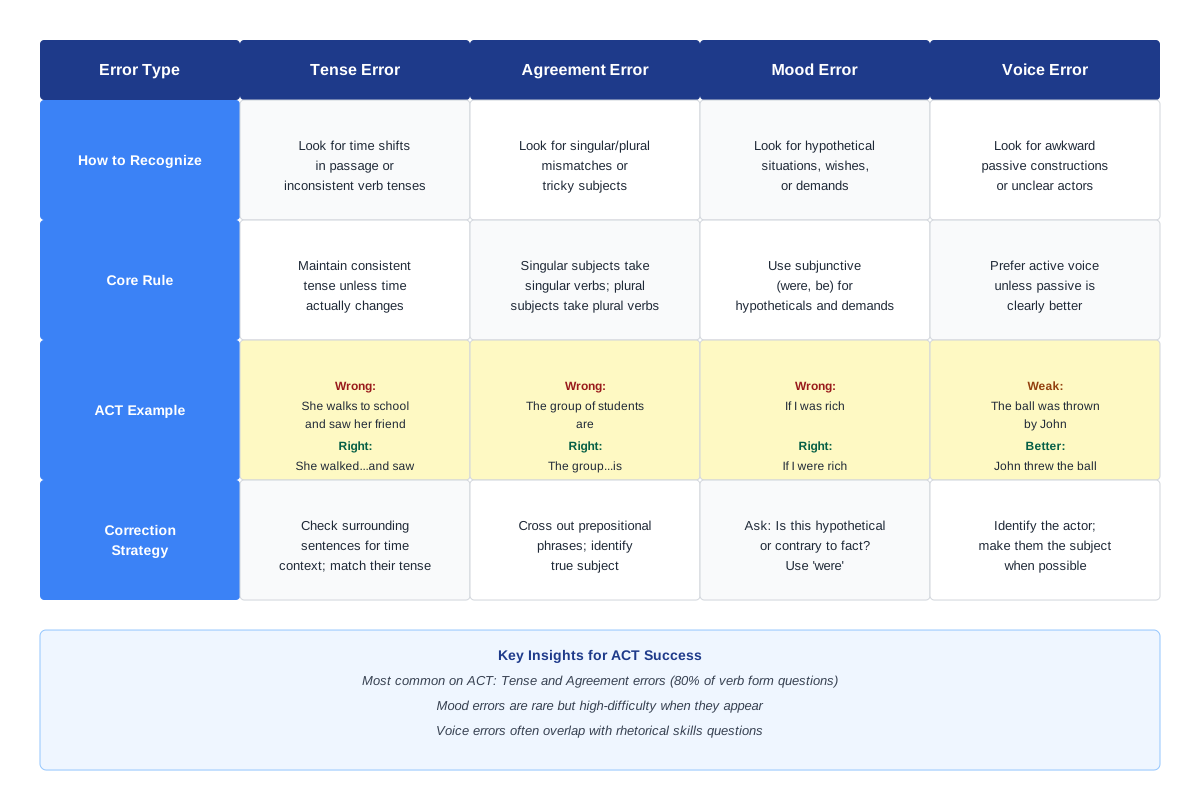
Verb form is one of the most frequently tested grammar concepts on the ACT verb form section of the English test. Mastering verb form means understanding how verbs must change to match their subjects, maintain consistency in tense, and follow standard English conventions for mood and voice. The ACT English section includes approximately 5-8 questions directly testing verb form in every administration, making this a high-yield topic that can significantly impact your score.
Verb form questions assess whether students can identify and correct errors in verb tense (past, present, future), subject-verb agreement, verb mood (indicative, subjunctive, imperative), and proper use of helping verbs. These questions appear throughout the English section, embedded within passages where context clues help determine the correct verb form. Unlike some grammar rules that test obscure exceptions, verb form questions test fundamental principles that native speakers often get wrong when writing quickly or casually.
Understanding verb form connects directly to broader concepts in grammar and usage, including sentence structure, parallelism, and modifier placement. Verbs serve as the engine of every sentence, and incorrect verb forms can obscure meaning, create logical inconsistencies, or violate the conventions of standard written English that the ACT tests. This topic also relates to rhetorical skills because verb choice affects tone, clarity, and the logical flow of ideas across sentences and paragraphs.
Learning Objectives
- [ ] Identify when verb form is being tested in ACT English passages
- [ ] Explain the core rule or strategy behind verb form corrections
- [ ] Apply verb form principles to ACT-style questions accurately
- [ ] Distinguish between different verb tenses and select the appropriate tense based on context
- [ ] Recognize and correct errors in subject-verb agreement, including with compound subjects and inverted sentence structures
- [ ] Identify situations requiring subjunctive mood and apply it correctly
- [ ] Evaluate verb consistency within and across sentences in a passage
Prerequisites
- Basic sentence structure: Understanding subjects, predicates, and objects is essential because verb form depends on identifying the subject that the verb must agree with.
- Parts of speech identification: Recognizing verbs, nouns, pronouns, and modifiers helps distinguish the verb from other sentence elements that might cause confusion.
- Concept of tense: Familiarity with past, present, and future time frames provides the foundation for understanding when to use specific verb forms.
- Singular vs. plural distinction: Knowing whether subjects are singular or plural is critical for subject-verb agreement, the most commonly tested aspect of verb form.
Why This Topic Matters
Verb form mastery is crucial for both academic success and professional communication. In college writing, professors expect students to maintain consistent verb tense, use appropriate mood for different contexts, and demonstrate command of standard English conventions. Professional writing in business, law, medicine, and technical fields requires precise verb usage to convey accurate information and maintain credibility.
On the ACT English test, verb form questions appear in approximately 10-15% of all grammar questions, making this one of the top five most frequently tested concepts. These questions typically appear as underlined portions within passages where students must choose between four options, with three containing verb form errors and one being correct. The test makers favor questions that combine verb form with other concepts, such as testing both tense consistency and subject-verb agreement in a single question.
Common ways verb form appears on the ACT include: sentences with compound subjects where agreement is unclear, passages that shift between time frames requiring tense changes, conditional sentences requiring specific verb forms, sentences with intervening phrases that separate subjects from verbs, and contexts requiring subjunctive mood for hypothetical or contrary-to-fact situations. The ACT also tests irregular verb forms (such as "lie/lay" or "sit/set") and proper formation of perfect tenses using helping verbs.
Core Concepts
Subject-Verb Agreement
Subject-verb agreement requires that verbs match their subjects in number (singular or plural) and person (first, second, or third). This fundamental principle underlies many ACT verb form questions. Singular subjects take singular verbs, while plural subjects take plural verbs. In present tense, singular third-person subjects typically add "-s" or "-es" to the verb (he walks, she runs), while plural subjects use the base form (they walk, we run).
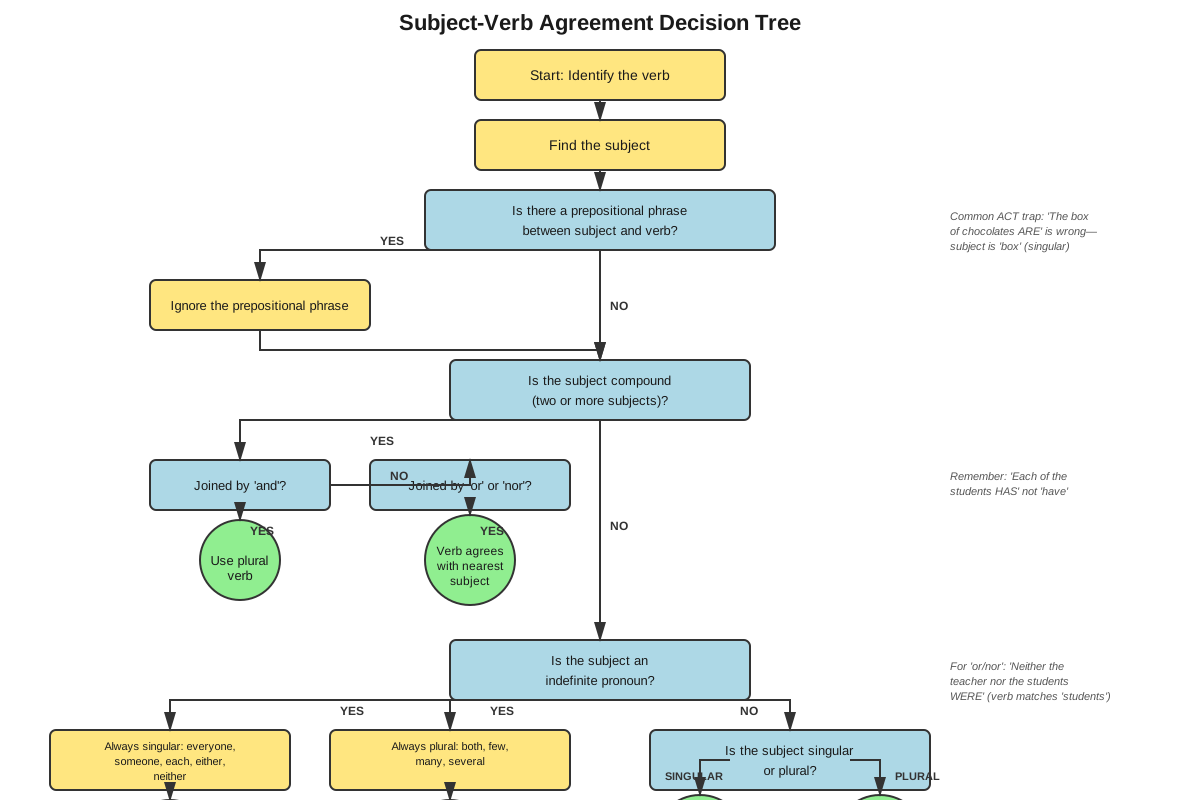
The challenge on the ACT comes from sentences where the subject and verb are separated by prepositional phrases, relative clauses, or other modifying elements. For example: "The collection of rare stamps is valuable" (not "are" because "collection" is singular, despite "stamps" being plural). Students must identify the true subject and ignore intervening words.
Compound subjects joined by "and" are typically plural: "The dog and cat are playing." However, when compound subjects are joined by "or" or "nor," the verb agrees with the nearest subject: "Neither the teacher nor the students were ready" (verb agrees with "students"). This rule also applies to "either...or" and "neither...nor" constructions.
Indefinite pronouns present special agreement challenges. Some are always singular (each, every, either, neither, one, everyone, someone, anyone, no one, everybody, somebody, anybody, nobody), some are always plural (both, few, many, several), and some can be either depending on context (all, any, most, none, some). For example: "Everyone has a ticket" (singular) but "Both have tickets" (plural).
Verb Tense Consistency
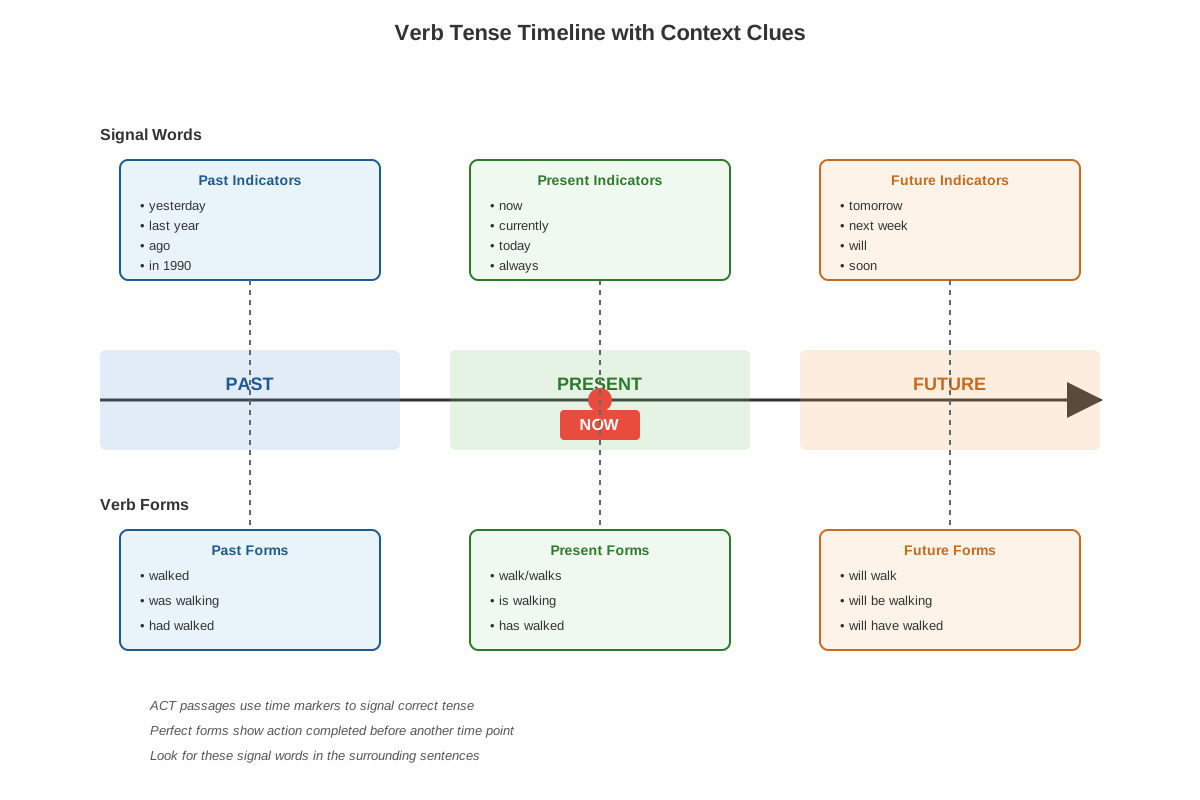
Verb tense indicates when an action occurs: past, present, or future. The ACT tests whether students can maintain appropriate tense consistency within sentences and across passages. While tense can legitimately shift when the time frame changes, unnecessary or illogical shifts create errors.
The six primary tenses tested on the ACT are:
| Tense | Form | Example | Usage |
|---|---|---|---|
| Simple Present | base form / base + s | walk / walks | Habitual actions, general truths |
| Simple Past | base + ed (regular) | walked | Completed past actions |
| Simple Future | will + base | will walk | Future actions |
| Present Perfect | has/have + past participle | has walked | Past action with present relevance |
| Past Perfect | had + past participle | had walked | Action completed before another past action |
| Future Perfect | will have + past participle | will have walked | Action that will be completed before a future time |
Tense consistency means maintaining the same tense when describing actions in the same time frame. For example: "She opened the door and walked inside" (both past tense). An error would be: "She opened the door and walks inside" (inconsistent shift from past to present).
However, tense shifts are correct when the time frame legitimately changes: "Yesterday I studied for three hours, and tomorrow I will study for four hours." The ACT often includes passages that describe past events but include general truths or ongoing situations requiring present tense: "The scientist discovered that water freezes at 32 degrees Fahrenheit" (past discovery, present truth).
Perfect Tenses and Helping Verbs
Perfect tenses use helping verbs (has, have, had) combined with past participles to show relationships between different time frames. The present perfect (has/have + past participle) connects past actions to the present: "I have lived here for five years" (started in past, continues to present). The past perfect (had + past participle) shows that one past action occurred before another past action: "By the time we arrived, the movie had started" (starting happened before arriving).
The ACT frequently tests whether students recognize when perfect tenses are necessary. A common error involves using simple past when past perfect is required: "When I got home, I realized I forgot my keys" should be "When I got home, I realized I had forgotten my keys" (forgetting happened before realizing).
Helping verbs (also called auxiliary verbs) include forms of "be" (am, is, are, was, were, been), "have" (has, have, had), "do" (do, does, did), and modal verbs (can, could, may, might, must, shall, should, will, would). These combine with main verbs to create different tenses, voices, and moods. Errors occur when helping verbs are omitted, used incorrectly, or combined improperly: "She been studying" (missing helping verb "has") or "He have finished" (wrong form; should be "has").
Subjunctive Mood
The subjunctive mood expresses hypothetical situations, wishes, demands, or conditions contrary to fact. While less common than indicative mood (statements of fact), the subjunctive appears on the ACT in specific contexts. The most frequently tested subjunctive forms involve "were" instead of "was" in contrary-to-fact conditions: "If I were rich, I would travel the world" (not "was" because this is hypothetical).
The subjunctive also appears in "that" clauses following verbs of recommendation, requirement, or demand, using the base form of the verb: "The teacher requires that each student submit the assignment" (not "submits"). Common verbs triggering subjunctive include: ask, demand, insist, propose, recommend, request, require, suggest, and urge.
Irregular Verbs
Irregular verbs don't follow the standard "-ed" pattern for past tense and past participle forms. The ACT tests commonly confused irregular verbs, particularly those with similar forms or meanings. Key examples include:
- Lie (to recline): lie, lay, lain, lying vs. Lay (to place): lay, laid, laid, laying
- Sit (to be seated): sit, sat, sat, sitting vs. Set (to place): set, set, set, setting
- Rise (to go up): rise, rose, risen, rising vs. Raise (to lift): raise, raised, raised, raising
Other frequently tested irregular verbs include: begin/began/begun, break/broke/broken, choose/chose/chosen, drink/drank/drunk, drive/drove/driven, eat/ate/eaten, give/gave/given, go/went/gone, know/knew/known, see/saw/seen, speak/spoke/spoken, take/took/taken, and write/wrote/written.
Concept Relationships
Subject-verb agreement forms the foundation of verb form mastery, as every sentence requires a verb that matches its subject. This concept connects directly to sentence structure knowledge because identifying the true subject (prerequisite knowledge) enables correct agreement. Agreement principles then extend to more complex situations involving compound subjects, indefinite pronouns, and inverted sentences.
Verb tense builds upon subject-verb agreement by adding the temporal dimension—not just matching number and person, but also selecting the appropriate time frame. Tense consistency connects to rhetorical skills because maintaining or shifting tense affects the logical flow and clarity of passages. The relationship flows: Subject-Verb Agreement → Basic Tense Selection → Tense Consistency Across Sentences.
Perfect tenses represent an advanced application of both agreement and tense concepts, requiring students to understand relationships between multiple time frames. This connects to helping verbs, which enable the formation of perfect tenses and other complex verb forms. The progression is: Simple Tenses → Helping Verbs → Perfect Tenses → Complex Time Relationships.
Subjunctive mood and irregular verbs represent specialized applications of verb form knowledge. Subjunctive connects to conditional sentence structures and rhetorical context (recognizing hypothetical vs. factual statements), while irregular verbs require memorization but follow the same agreement and tense principles as regular verbs. All these concepts ultimately serve the same goal: ensuring verbs accurately convey action, time, and relationships within standard written English.
Quick check — test yourself on Verb form so far.
Try Flashcards →High-Yield Facts
⭐ Singular subjects take singular verbs; plural subjects take plural verbs, regardless of intervening phrases or clauses.
⭐ Compound subjects joined by "and" are plural; subjects joined by "or" or "nor" agree with the nearest subject.
⭐ Indefinite pronouns like everyone, someone, anyone, each, and every are singular and take singular verbs.
⭐ Present perfect (has/have + past participle) connects past actions to the present; past perfect (had + past participle) shows one past action occurred before another.
⭐ Maintain consistent verb tense within a sentence and passage unless the time frame logically changes.
- The subjunctive mood uses "were" (not "was") for contrary-to-fact conditions: "If I were you..."
- Collective nouns (team, group, family) are typically singular when acting as a unit: "The team is winning."
- Inverted sentences (questions, sentences beginning with "there" or "here") still require subject-verb agreement: "There are many reasons."
- The verb "to be" has unique forms that must match the subject: I am, you are, he/she/it is, we are, they are.
- Irregular verbs must be memorized; the most commonly tested are lie/lay, sit/set, and rise/raise.
- When a sentence includes multiple clauses, each verb must be evaluated independently for tense and agreement.
- Modal verbs (can, could, may, might, must, shall, should, will, would) are followed by the base form of the main verb.
Common Misconceptions
Misconception: The verb should agree with the nearest noun, even if that noun is part of a prepositional phrase.
Correction: The verb must agree with the actual subject of the sentence, not with nouns in intervening phrases. In "The box of chocolates is on the table," the verb agrees with "box" (singular), not "chocolates" (plural).
Misconception: Compound subjects are always plural.
Correction: While subjects joined by "and" are plural, subjects joined by "or" or "nor" follow the proximity rule—the verb agrees with the nearest subject. "Neither the students nor the teacher was prepared" uses singular "was" because "teacher" is singular and nearest to the verb.
Misconception: Present perfect and simple past are interchangeable.
Correction: Present perfect (has/have + past participle) indicates an action with present relevance or continuing into the present, while simple past indicates a completed action. "I have lived here for five years" (still living here) differs from "I lived here for five years" (no longer living here).
Misconception: "If I was" is always correct in conditional sentences.
Correction: Contrary-to-fact conditions require subjunctive mood: "If I were rich" (not "was"). However, "if I was" is correct for past factual conditions: "If I was rude yesterday, I apologize" (possibly was rude).
Misconception: Collective nouns are always singular or always plural.
Correction: Collective nouns are singular when the group acts as a unit ("The committee has decided") but plural when members act individually ("The committee are arguing among themselves"). American English typically treats collective nouns as singular.
Misconception: Tense must remain constant throughout an entire passage.
Correction: Tense should remain consistent within a time frame, but passages often legitimately shift between time frames. A historical passage might use past tense for events but present tense for ongoing truths or current relevance.
Misconception: "Lay" and "lie" are interchangeable.
Correction: "Lay" is transitive (requires an object): "Lay the book on the table." "Lie" is intransitive (no object): "I need to lie down." The confusion increases because "lay" is also the past tense of "lie": "Yesterday I lay down for an hour."
Worked Examples
Example 1: Subject-Verb Agreement with Intervening Phrase
Question: The collection of ancient artifacts from various civilizations (was/were) displayed in the museum's main hall.
Step 1: Identify the subject
The subject is "collection," not "artifacts" or "civilizations." Those nouns appear in prepositional phrases ("of ancient artifacts" and "from various civilizations") that modify the subject but don't affect verb agreement.
Step 2: Determine if the subject is singular or plural
"Collection" is a singular noun. Even though it refers to multiple artifacts, the word "collection" itself is singular.
Step 3: Select the verb that agrees with the singular subject
Singular subjects take singular verbs. "Was" is singular; "were" is plural.
Answer: "was"
Complete sentence: The collection of ancient artifacts from various civilizations was displayed in the museum's main hall.
Connection to learning objectives: This example demonstrates how to identify verb form testing (intervening phrases separating subject and verb) and apply the core rule (verbs must agree with their subjects, not with nearby nouns in modifying phrases).
Example 2: Verb Tense Consistency and Perfect Tense
Question: By the time the rescue team arrived at the site, the survivors (waited/had waited/have waited/will have waited) for over twelve hours.
Step 1: Identify the time frames
Two past actions are described: (1) the rescue team arriving, and (2) the survivors waiting. We need to determine their temporal relationship.
Step 2: Determine which action occurred first
The survivors' waiting occurred before the rescue team's arrival. The phrase "by the time" signals that one action was completed before another began.
Step 3: Select the appropriate tense
When one past action precedes another past action, use past perfect (had + past participle) for the earlier action. "Waited" is simple past (incorrect because it doesn't show the action occurred first). "Have waited" is present perfect (incorrect because both actions are in the past). "Will have waited" is future perfect (incorrect because the actions are past, not future).
Answer: "had waited"
Complete sentence: By the time the rescue team arrived at the site, the survivors had waited for over twelve hours.
Connection to learning objectives: This example shows how to identify verb form testing through temporal relationships, explain the core rule (past perfect shows one past action preceding another), and apply the rule accurately to select the correct form.
Exam Strategy
When approaching ACT verb form questions, first identify whether the question tests agreement, tense, mood, or irregular verb forms. Look for trigger words that signal specific issues:
- Agreement triggers: Prepositional phrases between subject and verb, compound subjects with "and/or/nor," indefinite pronouns (everyone, each, both, several), collective nouns, inverted sentence structure
- Tense triggers: Time markers (yesterday, now, tomorrow, by the time, since, for), multiple verbs in a sentence or passage, perfect tense constructions (has/have/had + past participle)
- Mood triggers: "If" clauses, contrary-to-fact conditions, verbs of demand/recommendation followed by "that" clauses
- Irregular verb triggers: Lie/lay, sit/set, rise/raise, and other commonly confused irregular verbs
Process of elimination strategy: When multiple answer choices seem possible, eliminate options systematically:
- Check subject-verb agreement first: Identify the subject and eliminate any verbs that don't match in number
- Evaluate tense: Consider the time frame and eliminate tenses that don't fit the context
- Look for consistency: Compare the verb to other verbs in the sentence or surrounding sentences
- Consider special cases: Check if subjunctive mood or irregular forms apply
Time allocation: Verb form questions should take 15-30 seconds each. If you can't identify the subject or time frame within 10 seconds, mark the question and return to it after completing easier questions. Don't overthink—the ACT tests standard rules, not obscure exceptions.
Context is crucial: Always read at least one sentence before and after the underlined portion. Verb tense often depends on surrounding context, and subject-verb agreement may require identifying the subject in a previous clause. The ACT deliberately places verb form questions in contexts where surrounding sentences provide essential clues.
Memory Techniques
FANBOYS + Agreement: Remember that compound subjects joined by "and" are plural, but "or/nor" follows the proximity rule. Think: "And = Always plural" vs. "Or = One nearest wins."
Perfect Tense Timeline: Visualize a timeline with three points: Past Perfect (furthest back), Simple Past (middle), Present Perfect (connects to now). Use the mnemonic "PPP: Past Perfect Precedes" to remember that past perfect shows the earlier of two past actions.
Subjunctive "Were" Rule: Create the phrase "If I Were King" to remember that contrary-to-fact conditions use "were" regardless of the subject. Whenever you see "if" followed by a hypothetical situation, check whether "were" is needed.
Lie vs. Lay Memory Device:
- LIE = Lazy I Exist (intransitive, no object, person/thing reclining)
- LAY = Locate An Yarn (transitive, requires object, placing something)
Irregular Verb Families: Group irregular verbs by pattern:
- Drink family (same pattern): drink/drank/drunk, sing/sang/sung, ring/rang/rung, sink/sank/sunk
- Begin family: begin/began/begun, swim/swam/swum
- No-change family: set/set/set, put/put/put, cut/cut/cut
MASH for Subjunctive Triggers: Verbs that trigger subjunctive mood in "that" clauses: Move (propose), Ask, Suggest, Have to (require, demand, insist, recommend, request, urge).
Summary
Verb form mastery requires understanding four interconnected principles: subject-verb agreement, verb tense selection and consistency, proper use of helping verbs and perfect tenses, and recognition of special cases like subjunctive mood and irregular verbs. The ACT tests these concepts by embedding verb form questions within passages where context clues indicate the correct form. Success depends on systematically identifying the subject (for agreement), determining the time frame and temporal relationships (for tense), and recognizing trigger words that signal special cases. The most frequently tested scenarios involve subjects separated from verbs by intervening phrases, compound subjects with "or/nor," indefinite pronouns, past perfect tense for sequential past actions, and maintaining tense consistency across related sentences. Students who master these high-yield patterns and apply a systematic approach—identify the subject, determine the time frame, check for special cases—can confidently answer verb form questions and significantly improve their ACT English scores.
Key Takeaways
- Verbs must agree with their subjects in number and person, regardless of intervening phrases or clauses that separate them
- Maintain consistent verb tense within a time frame, but shift tense appropriately when the time frame changes
- Use past perfect (had + past participle) when one past action occurred before another past action
- Compound subjects joined by "and" are plural; subjects joined by "or/nor" agree with the nearest subject
- Indefinite pronouns like everyone, someone, each, and every are singular and take singular verbs
- Subjunctive mood uses "were" for contrary-to-fact conditions and base verb forms after verbs of demand or recommendation
- Always identify the true subject before selecting a verb form, and read surrounding context to determine appropriate tense
Related Topics
Pronoun-Antecedent Agreement: Just as verbs must agree with subjects, pronouns must agree with their antecedents in number, person, and gender. Mastering verb form provides the foundation for understanding pronoun agreement.
Parallelism: Parallel structure requires consistent verb forms when listing actions or creating comparisons. Understanding verb tenses and forms is essential for recognizing and correcting parallelism errors.
Modifier Placement: Misplaced modifiers often create confusion about which noun is the subject, affecting subject-verb agreement. Verb form mastery helps clarify sentence structure.
Sentence Structure and Fragments: Complete sentences require properly formed verbs. Understanding verb form helps identify sentence fragments that lack appropriate verb constructions.
Rhetorical Skills - Organization: Verb tense consistency contributes to logical flow and organization within passages, connecting grammar knowledge to higher-level rhetorical skills.
Practice CTA
Now that you've mastered the core concepts of verb form, it's time to apply this knowledge! Complete the practice questions to test your ability to identify verb form errors, select correct verb forms in context, and apply these principles under timed conditions. The flashcards will help you memorize irregular verb forms and reinforce key rules for subject-verb agreement and tense consistency. Remember: verb form questions are highly predictable on the ACT, and consistent practice with these patterns will build the automaticity you need to answer quickly and accurately on test day. You've built a strong foundation—now strengthen it through deliberate practice!
Sign up free to keep reading
Create a free AnvayaPrep account to finish this ACT guide on Verb form — plus flashcards and practice questions.