Overview
Modifier placement is one of the most frequently tested grammar concepts on the ACT English section, appearing in approximately 10-15% of all grammar questions. A modifier is any word, phrase, or clause that describes, clarifies, or gives more information about another word in the sentence. The fundamental principle is simple yet powerful: modifiers must be placed as close as possible to the words they modify to ensure clarity and avoid confusion. When modifiers are misplaced or dangling, sentences become ambiguous, illogical, or unintentionally humorous.
The ACT tests modifier placement because it directly measures a student's ability to construct clear, logical sentences—a skill essential for academic and professional writing. Questions on this topic require students to identify when a modifier is incorrectly positioned and to recognize the correct placement that creates a logical relationship between the modifier and what it modifies. These questions often appear as underlined portions within passages, where students must choose the revision that places modifiers correctly, or as questions asking where a sentence should be placed within a paragraph.
Understanding ACT modifier placement connects to broader grammar concepts including sentence structure, subject-verb relationships, and logical flow. Mastering this topic strengthens overall sentence construction skills and improves the ability to identify and correct ambiguous writing—competencies that extend beyond the ACT to college-level composition and professional communication.
Learning Objectives
- [ ] Identify when Modifier placement is being tested
- [ ] Explain the core rule or strategy behind Modifier placement
- [ ] Apply Modifier placement to ACT-style questions accurately
- [ ] Distinguish between misplaced modifiers, dangling modifiers, and correctly placed modifiers
- [ ] Recognize common modifier placement patterns that appear on the ACT
- [ ] Evaluate multiple sentence revisions to determine which correctly positions modifiers
- [ ] Construct sentences with complex modifiers in appropriate positions
Prerequisites
- Basic sentence structure: Understanding subjects, verbs, and objects is essential because modifiers must logically connect to these sentence elements
- Parts of speech identification: Recognizing adjectives, adverbs, phrases, and clauses helps identify what functions as a modifier and what it should modify
- Phrase and clause recognition: Distinguishing between different types of phrases (prepositional, participial, infinitive) enables proper modifier identification
- Logical reasoning skills: Determining what a modifier logically describes requires understanding the intended meaning of sentences
Why This Topic Matters
In real-world writing, misplaced modifiers create confusion, ambiguity, and sometimes unintended humor. Professional and academic writing demands precision, and proper modifier placement ensures that readers understand exactly what the writer intends to communicate. Whether drafting a business proposal, writing a research paper, or composing an email, the ability to position modifiers correctly distinguishes clear communication from muddled prose.
On the ACT English section, modifier placement questions appear with remarkable consistency, typically comprising 3-5 questions per test. These questions appear in two primary formats: (1) identifying and correcting misplaced or dangling modifiers within sentences, and (2) determining the optimal placement of entire sentences within paragraphs to ensure modifiers logically connect to their intended subjects. The ACT particularly favors testing introductory modifying phrases, which frequently appear at the beginning of sentences and must modify the subject that immediately follows.
Common manifestations in ACT passages include sentences beginning with participial phrases (verb forms ending in -ing or -ed), prepositional phrases indicating time or location, and infinitive phrases expressing purpose. The test writers deliberately create sentences where the modifier could theoretically modify multiple elements, requiring students to identify which placement creates the most logical meaning. Questions may also involve limiting modifiers like "only," "nearly," "almost," and "just," which change meaning dramatically based on their position in the sentence.
Core Concepts
The Proximity Principle
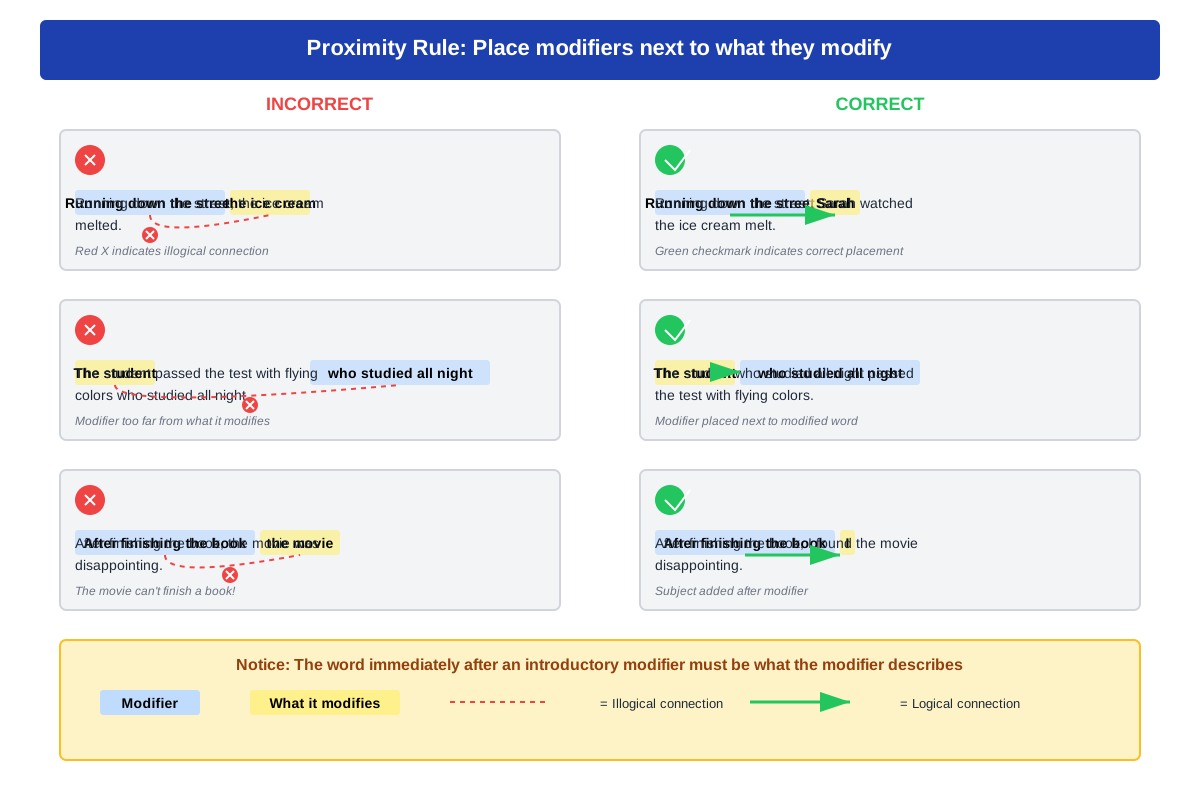
The fundamental rule governing modifier placement states that modifiers must be positioned as close as possible to the words they modify. This proximity ensures clarity and prevents ambiguity. When a modifier is separated from its intended target, readers may incorrectly associate the modifier with a different word, creating confusion or illogical meaning.
Consider this example: "Running quickly down the street, the bus was barely caught by Maria." The introductory phrase "Running quickly down the street" appears to modify "the bus" because it immediately precedes that noun. However, buses don't run down streets—people do. The modifier should be placed to clearly modify "Maria": "Running quickly down the street, Maria barely caught the bus."
Dangling Modifiers
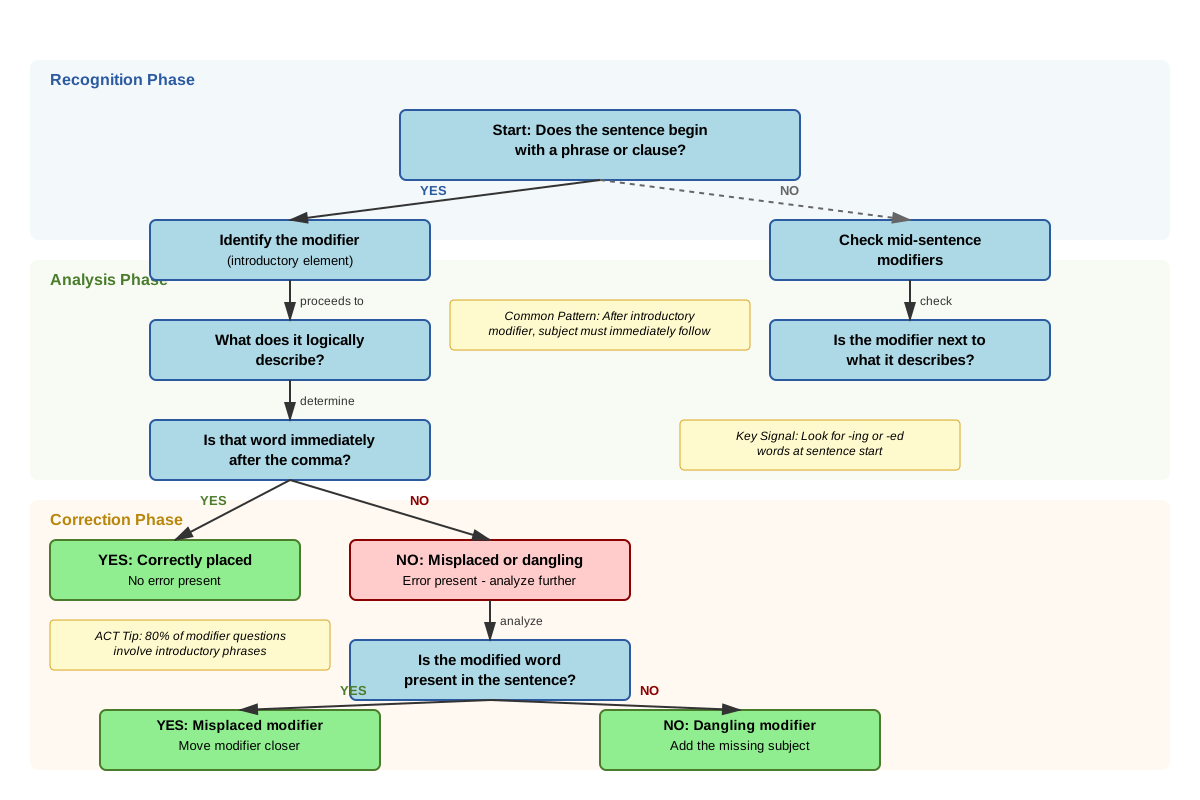
A dangling modifier occurs when the word that the modifier is supposed to describe is missing from the sentence entirely or when the modifier doesn't logically connect to any word in the sentence. These errors are particularly common with introductory phrases.
Structure of dangling modifiers:
- The sentence begins with a modifying phrase
- The subject that should follow the comma is missing or incorrect
- The modifier "dangles" without a logical connection
Example: "After studying for three hours, the test seemed much easier." Who studied for three hours? The test didn't study—a person did, but that person isn't mentioned in the sentence. Correction: "After studying for three hours, I found the test much easier" or "After I studied for three hours, the test seemed much easier."
Misplaced Modifiers
A misplaced modifier occurs when the modifier is positioned too far from the word it modifies or is placed next to the wrong word, creating ambiguity or illogical meaning. Unlike dangling modifiers, the word being modified does exist in the sentence—it's just in the wrong position relative to the modifier.
Types of misplaced modifiers:
| Type | Description | Example | Correction |
|---|---|---|---|
| Misplaced adjective phrase | Descriptive phrase separated from noun | "The student received an award with the highest GPA." | "The student with the highest GPA received an award." |
| Misplaced adverb phrase | Phrase describing action in wrong position | "She nearly drove her car for six hours." | "She drove her car for nearly six hours." |
| Squinting modifier | Modifier between two elements, unclear which it modifies | "Students who study frequently get better grades." | "Students who frequently study get better grades." or "Frequently, students who study get better grades." |
Limiting Modifiers
Limiting modifiers are words that restrict or limit the meaning of what they modify. These include "only," "just," "nearly," "almost," "merely," "simply," and "even." The placement of these modifiers dramatically changes sentence meaning, making them high-yield test content.
Example demonstrating meaning changes:
- "Only Sarah called her mother yesterday." (No one else called her mother)
- "Sarah only called her mother yesterday." (She called but didn't visit)
- "Sarah called only her mother yesterday." (She didn't call anyone else)
- "Sarah called her mother only yesterday." (It happened just yesterday, not earlier)
Introductory Modifying Phrases
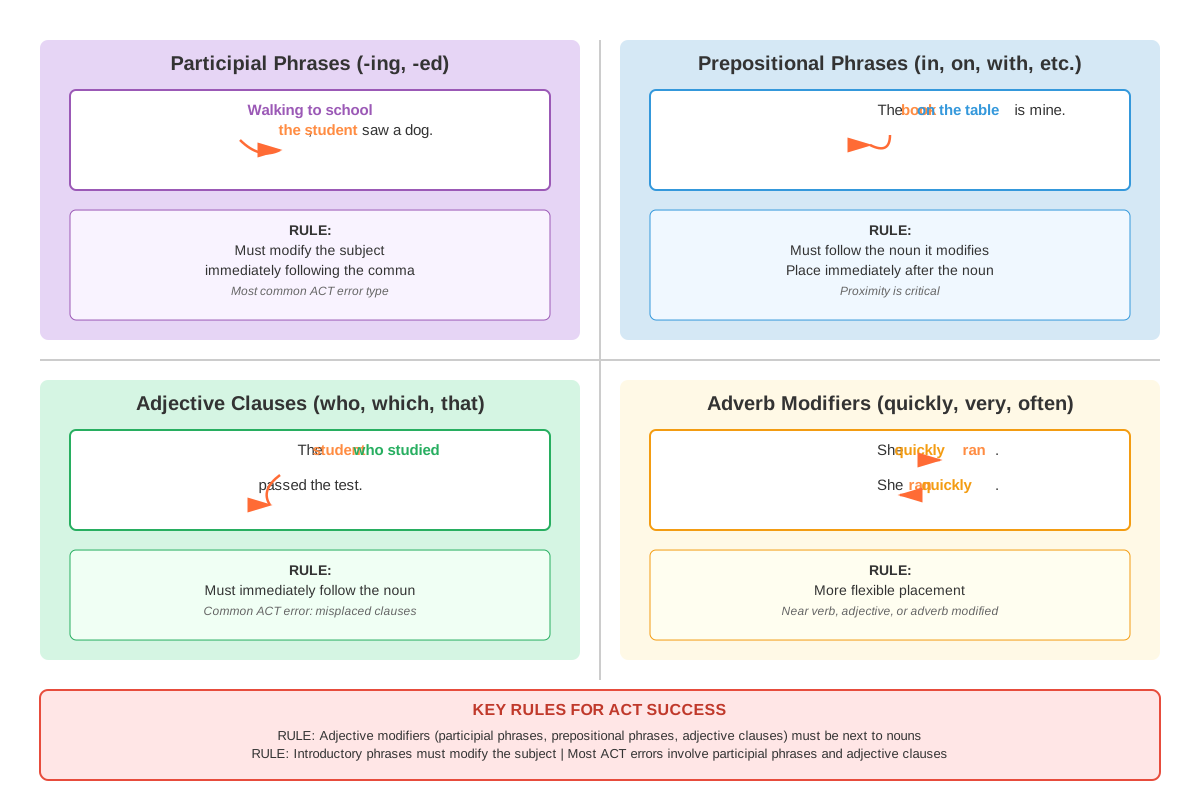
The ACT heavily tests introductory modifying phrases—phrases that begin sentences and modify the subject that immediately follows the comma. These phrases can be participial, prepositional, or infinitive phrases.
Critical rule: Whatever noun or pronoun comes immediately after the comma must be what the introductory phrase logically modifies.
Examples:
- Participial phrase: "Walking through the museum, the paintings captivated me." (Incorrect—paintings weren't walking) → "Walking through the museum, I was captivated by the paintings."
- Prepositional phrase: "At the age of five, my family moved to Texas." (Incorrect—the family wasn't five years old) → "At the age of five, I moved to Texas with my family."
- Infinitive phrase: "To win the championship, practice was essential for the team." (Incorrect—practice doesn't win championships) → "To win the championship, the team needed essential practice."
Relative Clause Placement
Relative clauses (clauses beginning with who, which, that, whom, whose) must be placed immediately after the noun they modify. Separating a relative clause from its antecedent creates confusion about what the clause describes.
Incorrect: "The book was fascinating that I borrowed from the library."
Correct: "The book that I borrowed from the library was fascinating."
Essential vs. Non-Essential Modifiers
Understanding whether a modifier is essential (restrictive) or non-essential (non-restrictive) affects both punctuation and placement:
- Essential modifiers provide information necessary to identify what is being modified; they are not set off by commas
- Non-essential modifiers provide additional information but aren't necessary for identification; they are set off by commas
Example: "Students who study regularly perform better." (Essential—only those students who study regularly)
Example: "My sister, who lives in Boston, is visiting." (Non-essential—additional information about the only sister)
Concept Relationships
The concepts within modifier placement form an interconnected system where understanding one element strengthens comprehension of others. The proximity principle serves as the foundation, establishing that modifiers must be near what they modify. This principle directly leads to identifying dangling modifiers (when the modified word is absent) and misplaced modifiers (when the modified word exists but is too far away).
Introductory modifying phrases represent a specific application of the proximity principle, requiring that the subject immediately following the comma be what the phrase modifies. This concept connects to participial phrases from prerequisite knowledge, as many introductory modifiers use participles.
Limiting modifiers demonstrate how the proximity principle operates at the word level rather than the phrase level, showing that even single-word modifiers must be precisely positioned. This concept reinforces that modifier placement isn't just about avoiding obvious errors but about achieving precise meaning.
The distinction between essential and non-essential modifiers connects to punctuation rules (commas with non-essential elements) and affects how modifiers integrate into sentence structure. This relationship shows how modifier placement intersects with other grammar concepts tested on the ACT.
Relationship map:
Proximity Principle → Dangling Modifiers (word missing) + Misplaced Modifiers (word present but distant) → Introductory Modifying Phrases (specific application) → Limiting Modifiers (word-level precision) → Relative Clause Placement (specific modifier type) → Essential vs. Non-Essential distinction (affects punctuation and meaning)
Quick check — test yourself on Modifier placement so far.
Try Flashcards →High-Yield Facts
⭐ Modifiers must be placed as close as possible to the words they modify to ensure clarity and logical meaning
⭐ Introductory modifying phrases must modify the subject that immediately follows the comma
⭐ Dangling modifiers occur when the word being modified is missing from the sentence entirely
⭐ Limiting modifiers like "only," "just," and "nearly" change sentence meaning based on their exact position
⭐ Misplaced modifiers create ambiguity by being positioned too far from the word they modify
- Participial phrases at the beginning of sentences are the most commonly tested modifier type on the ACT
- The word immediately following an introductory modifying phrase and comma must be capable of performing the action described in the phrase
- Relative clauses (who, which, that) must immediately follow the noun they modify
- Squinting modifiers are positioned between two elements and could logically modify either one
- Prepositional phrases should be placed near the words they modify to avoid confusion
- Adverbs can often be moved within sentences, but their position affects emphasis and sometimes meaning
- The ACT frequently tests whether students can identify which revision correctly places a modifier
- Modifier errors often create unintentionally humorous meanings, which can help identify them
- Essential modifiers are not set off by commas; non-essential modifiers require commas
- When evaluating answer choices, ask "What is being modified?" and "Does the placement make logical sense?"
Common Misconceptions
Misconception: Any word or phrase at the beginning of a sentence can modify anything in the sentence.
Correction: Introductory modifying phrases specifically modify the subject that immediately follows the comma. The subject must be capable of performing the action or possessing the quality described in the phrase.
Misconception: As long as the modified word appears somewhere in the sentence, the modifier is correctly placed.
Correction: The modifier must be positioned close to the word it modifies. Having the word present but distant still creates a misplaced modifier error that obscures meaning.
Misconception: "Only" and similar limiting modifiers can be placed anywhere in a sentence without changing meaning.
Correction: Limiting modifiers dramatically change sentence meaning based on their exact position. "Only Sarah called" means something entirely different from "Sarah only called" or "Sarah called only yesterday."
Misconception: Dangling modifiers are acceptable if the reader can figure out what was meant.
Correction: On the ACT, sentences must be grammatically correct and unambiguous. Even if the intended meaning is clear from context, dangling modifiers are always incorrect and must be revised.
Misconception: Long, complex sentences naturally have modifier placement issues, so they're acceptable in formal writing.
Correction: Sentence complexity doesn't excuse modifier errors. Complex sentences require even more careful attention to modifier placement to maintain clarity. The ACT expects precise modifier placement regardless of sentence length.
Misconception: If a modifier is set off by commas, it can be placed anywhere in the sentence.
Correction: Non-essential modifiers still must be positioned near what they modify. Commas indicate that the information is additional, not that the modifier can be randomly placed.
Worked Examples
Example 1: Identifying and Correcting a Dangling Modifier
Original sentence: "While walking through the park, the fountain caught my attention."
Step 1: Identify the modifier
The introductory phrase "While walking through the park" is a participial phrase that modifies something in the sentence.
Step 2: Determine what should be modified
The phrase describes someone walking. We need to ask: Who was walking through the park?
Step 3: Identify what currently follows the comma
"The fountain" immediately follows the comma, which means the sentence structure suggests the fountain was walking through the park—an illogical meaning.
Step 4: Recognize the error type
This is a dangling modifier because the person who was walking isn't properly positioned as the subject after the comma.
Step 5: Correct the error
We need to place the person doing the walking immediately after the comma:
- Correction 1: "While walking through the park, I noticed the fountain."
- Correction 2: "While I was walking through the park, the fountain caught my attention."
Connection to learning objectives: This example demonstrates how to identify when modifier placement is being tested (introductory phrase followed by illogical subject) and apply the core rule (modifier must be near what it modifies).
Example 2: ACT-Style Question with Limiting Modifier
Passage excerpt: "The research team nearly discovered three new species during their expedition to the rainforest."
Question: Which of the following alternatives to the underlined portion would be LEAST acceptable?
A. discovered nearly three
B. discovered three nearly new
C. nearly discovered three new
D. discovered almost three
Step 1: Understand what the original sentence means
"Nearly discovered three new species" suggests they almost discovered them but didn't quite—they came close but failed.
Step 2: Evaluate each answer choice
Choice A: "discovered nearly three" means they discovered approximately three species (maybe 2.5 or so)—this changes the meaning but is grammatically acceptable.
Choice B: "discovered three nearly new" suggests the species were almost new but not quite—this is illogical and changes the meaning dramatically. Species are either new (newly discovered) or not.
Choice C: This is identical to the original, so it's acceptable.
Choice D: "discovered almost three" is similar to Choice A, meaning approximately three—grammatically acceptable.
Step 3: Identify the LEAST acceptable choice
Choice B is the least acceptable because "nearly new species" creates an illogical meaning. Species cannot be "nearly new"—they are either newly discovered or previously known.
Answer: B
Connection to learning objectives: This example shows how limiting modifiers change meaning based on position and demonstrates the application of modifier placement rules to ACT-style questions where students must evaluate multiple revisions.
Exam Strategy
When approaching modifier placement questions on the ACT, implement a systematic process that quickly identifies errors and selects correct answers.
Trigger words and phrases to watch for:
- Sentences beginning with -ing words (participial phrases): "Running," "Walking," "Hoping," "Having studied"
- Sentences beginning with -ed words: "Exhausted," "Determined," "Located"
- Sentences beginning with prepositional phrases: "At the age of," "During the summer," "In the morning"
- Sentences beginning with infinitive phrases: "To win," "To understand," "To achieve"
- The words "only," "just," "nearly," "almost," "merely," "simply," "even"
- Relative pronouns: "who," "which," "that," "whom," "whose"
Step-by-step approach:
- Identify the modifier: Locate any introductory phrase, descriptive clause, or limiting word
- Ask "What is being modified?": Determine what the modifier logically describes
- Check proximity: Verify that the modifier is positioned immediately next to what it modifies
- Test for logic: Read the sentence literally to see if the current structure creates an illogical or humorous meaning
- Evaluate all answer choices: Don't stop at the first option that seems correct; compare all choices
Process-of-elimination tips:
Eliminate any answer choice where the word immediately following an introductory phrase and comma cannot logically perform the action described in the phrase
Eliminate choices that place limiting modifiers in positions that create illogical meanings
Eliminate choices that separate relative clauses from their antecedents
Time allocation advice:
Modifier placement questions should take 20-30 seconds each. If you can quickly identify the modifier and what it should modify, these questions become straightforward. Don't overthink—trust the proximity principle and logical meaning. If a sentence sounds awkward or creates a humorous image when read literally, it likely contains a modifier error.
Red flag patterns:
- Any sentence where an introductory phrase is followed by an inanimate object or abstract concept
- Sentences where "only" or "just" appears far from what it should limit
- Long sentences with multiple phrases where modifiers are separated from their targets
- Passive voice constructions that obscure who performed the action described in a modifier
Memory Techniques
Mnemonic for checking introductory modifiers: "COMMA = Can Our Modifier Modify Anything?"
When you see an introductory phrase followed by a comma, ask whether the modifier can logically modify what comes next.
The "Who's Doing What?" technique:
For participial phrases, always ask "Who's doing the action?" The answer must immediately follow the comma.
- "Running down the street" → Who's running? That person/thing must come next.
- "Exhausted from the journey" → Who's exhausted? That person/thing must come next.
The "Only" movement visualization:
Imagine the word "only" as a spotlight that illuminates whatever word comes immediately after it. Move the spotlight to see how meaning changes:
- "Only [spotlight] Sarah called" = Sarah alone, no one else
- "Sarah only [spotlight] called" = called but nothing else
- "Sarah called only [spotlight] her mother" = her mother alone, no one else
The "Dangling Detector" question:
For any introductory phrase, immediately ask: "Is the doer of this action the subject of the sentence?" If no, you've found a dangling modifier.
Acronym for modifier placement rules: PLACE
- Proximity: Keep modifiers close to what they modify
- Logic: Ensure the modification makes logical sense
- Action: The subject must be able to perform the action in participial phrases
- Clarity: Placement should eliminate all ambiguity
- Exactness: Limiting modifiers require precise positioning
Summary
Modifier placement represents a critical grammar skill tested extensively on the ACT English section, requiring students to ensure that descriptive words, phrases, and clauses are positioned as close as possible to what they modify. The fundamental principle—proximity creates clarity—governs all modifier placement rules. Dangling modifiers occur when the modified word is missing entirely from the sentence, while misplaced modifiers exist when the word is present but positioned too far from the modifier. Introductory modifying phrases, particularly participial phrases beginning with -ing or -ed words, must modify the subject that immediately follows the comma. Limiting modifiers like "only," "just," and "nearly" dramatically change sentence meaning based on their exact position. Success on ACT modifier placement questions requires identifying what is being modified, checking whether the modifier is positioned next to that element, and testing whether the sentence creates logical meaning. By systematically applying the proximity principle and asking "What is being modified?" students can quickly identify errors and select correct revisions.
Key Takeaways
- Modifiers must be placed immediately next to the words they modify to ensure clarity and prevent ambiguity
- Introductory modifying phrases must modify the subject that comes immediately after the comma
- Dangling modifiers lack the word they're supposed to modify; misplaced modifiers have the word but in the wrong position
- Limiting modifiers ("only," "just," "nearly") change meaning dramatically based on their exact placement
- Always ask "What is being modified?" and "Does this placement make logical sense?" when evaluating sentences
- Participial phrases at sentence beginnings are the most frequently tested modifier type on the ACT
- Reading sentences literally helps identify modifier errors that create illogical or humorous meanings
Related Topics
Parallelism: Mastering modifier placement enhances the ability to construct parallel structures, as both topics require attention to how sentence elements relate to each other grammatically and logically.
Sentence Structure and Fragments: Understanding modifier placement deepens knowledge of how phrases and clauses function within complete sentences, helping distinguish between fragments and complete thoughts.
Comma Usage: Many modifier placement rules intersect with comma rules, particularly regarding introductory elements and non-essential modifiers, making these topics mutually reinforcing.
Pronoun-Antecedent Agreement: Like modifiers that must clearly connect to what they modify, pronouns must clearly connect to their antecedents, requiring similar analytical skills.
Wordiness and Redundancy: Proper modifier placement contributes to concise writing by ensuring that descriptive elements are positioned efficiently without requiring additional clarifying words.
Practice CTA
Now that you've mastered the core concepts of modifier placement, it's time to solidify your understanding through active practice. Attempt the practice questions to apply these rules to ACT-style scenarios, and use the flashcards to reinforce high-yield facts and common error patterns. Remember: modifier placement questions are highly predictable once you recognize the patterns. With focused practice, these questions become opportunities to quickly earn points and boost your English score. Every correctly placed modifier brings you closer to your target score!
Sign up free to keep reading
Create a free AnvayaPrep account to finish this ACT guide on Modifier placement — plus flashcards and practice questions.