Overview
The best introduction question type is one of the most frequently tested rhetorical skills on the ACT English section. These questions ask students to select the most effective opening sentence or paragraph for a passage, essay, or section. Unlike grammar-focused questions, best introduction questions assess a student's ability to understand the purpose, tone, and scope of an entire passage and determine which introductory statement best establishes the context for what follows.
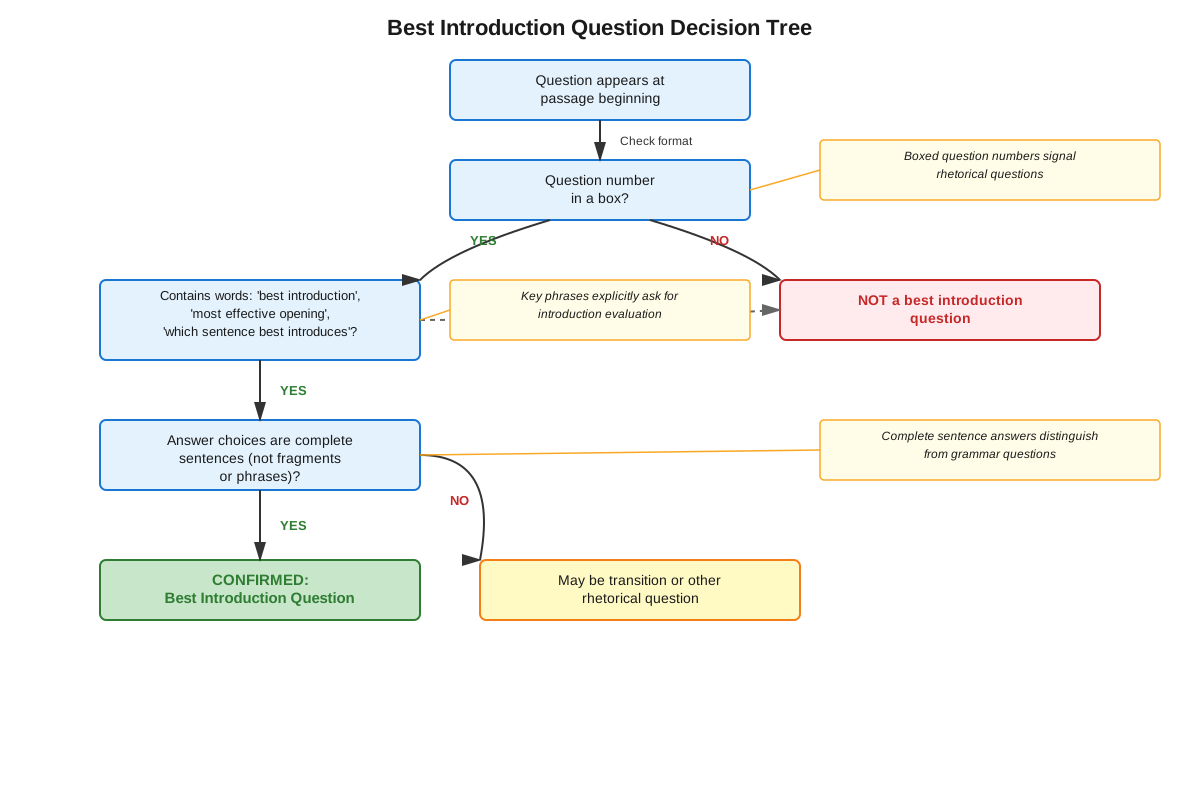
Mastering ACT best introduction questions requires developing a holistic reading approach that goes beyond surface-level comprehension. Students must quickly identify the passage's main idea, recognize its intended audience and purpose, and evaluate how well each answer choice sets up the discussion that follows. These questions typically appear at the beginning of a passage and are marked with a question number in a box, signaling that they test rhetorical effectiveness rather than grammatical correctness.
This topic connects directly to other rhetorical skills tested on the ACT, including main idea identification, purpose and audience awareness, transitions, and organizational structure. Strong performance on best introduction questions demonstrates advanced reading comprehension and the ability to evaluate writing effectiveness—skills that extend beyond the exam into college-level writing and critical analysis. Understanding how to approach these questions strategically can significantly boost overall English section scores, as they represent high-value questions that reward careful, methodical thinking.
Learning Objectives
- [ ] Identify when Best introduction is being tested
- [ ] Explain the core rule or strategy behind Best introduction
- [ ] Apply Best introduction to ACT-style questions accurately
- [ ] Evaluate multiple introduction options by analyzing their relationship to passage content
- [ ] Distinguish between introductions that are too broad, too narrow, or off-topic
- [ ] Recognize common wrong answer patterns in best introduction questions
- [ ] Synthesize passage main ideas quickly to select the most appropriate introduction
Prerequisites
- Reading comprehension skills: Understanding main ideas and supporting details is essential for determining which introduction best matches the passage content
- Paragraph structure knowledge: Recognizing how topic sentences and supporting sentences work together helps evaluate introduction effectiveness
- Basic rhetorical awareness: Understanding concepts like purpose, audience, and tone provides the foundation for assessing rhetorical appropriateness
- Passage skimming techniques: The ability to quickly grasp overall passage content enables efficient evaluation of introduction options
Why This Topic Matters
Best introduction questions appear consistently on every ACT English section, typically 2-3 times per test. These questions carry the same point value as grammar questions but often require more comprehensive reading and critical thinking. Students who master this question type gain a significant advantage because these questions reward strategic thinking rather than memorization of rules.
In real-world contexts, the ability to craft and evaluate effective introductions is crucial for academic writing, professional communication, and persuasive discourse. College essays, research papers, business proposals, and grant applications all depend on strong introductions that engage readers and establish clear expectations. The skills developed through ACT best introduction practice—quickly identifying main ideas, assessing relevance, and evaluating rhetorical effectiveness—transfer directly to college-level writing courses and professional environments.
On the ACT, best introduction questions typically appear in one of three formats: selecting the best opening sentence for an entire passage, choosing the most effective introduction for a specific paragraph within a passage, or determining whether a proposed introduction accomplishes a stated goal. These questions often include answer choices that are grammatically correct but rhetorically weak, testing whether students can distinguish between technically acceptable writing and truly effective communication. The most common placement is at the very beginning of a passage, though they can also appear before body paragraphs when the passage discusses multiple distinct topics.
Core Concepts
Understanding Best Introduction Questions
Best introduction questions ask students to evaluate which opening statement most effectively establishes the context, purpose, and scope of the writing that follows. These questions differ fundamentally from grammar questions because all answer choices may be grammatically correct—the task is to identify which option best serves the rhetorical purpose of introducing the passage content.
The ACT signals these questions through specific formatting: they typically appear in a box with a question number and ask directly about which choice "best introduces" the passage or paragraph. The question stem often includes phrases like "Which of the following would provide the most effective introduction?" or "Which choice best introduces the topic of this paragraph?"
The Three-Part Evaluation Framework
Effective introduction evaluation requires assessing three critical dimensions:
Relevance: The introduction must directly relate to the passage's actual content. An introduction about environmental conservation would be inappropriate for a passage about Renaissance art, regardless of how well-written it might be. Students must read enough of the passage to understand its true focus before selecting an introduction.
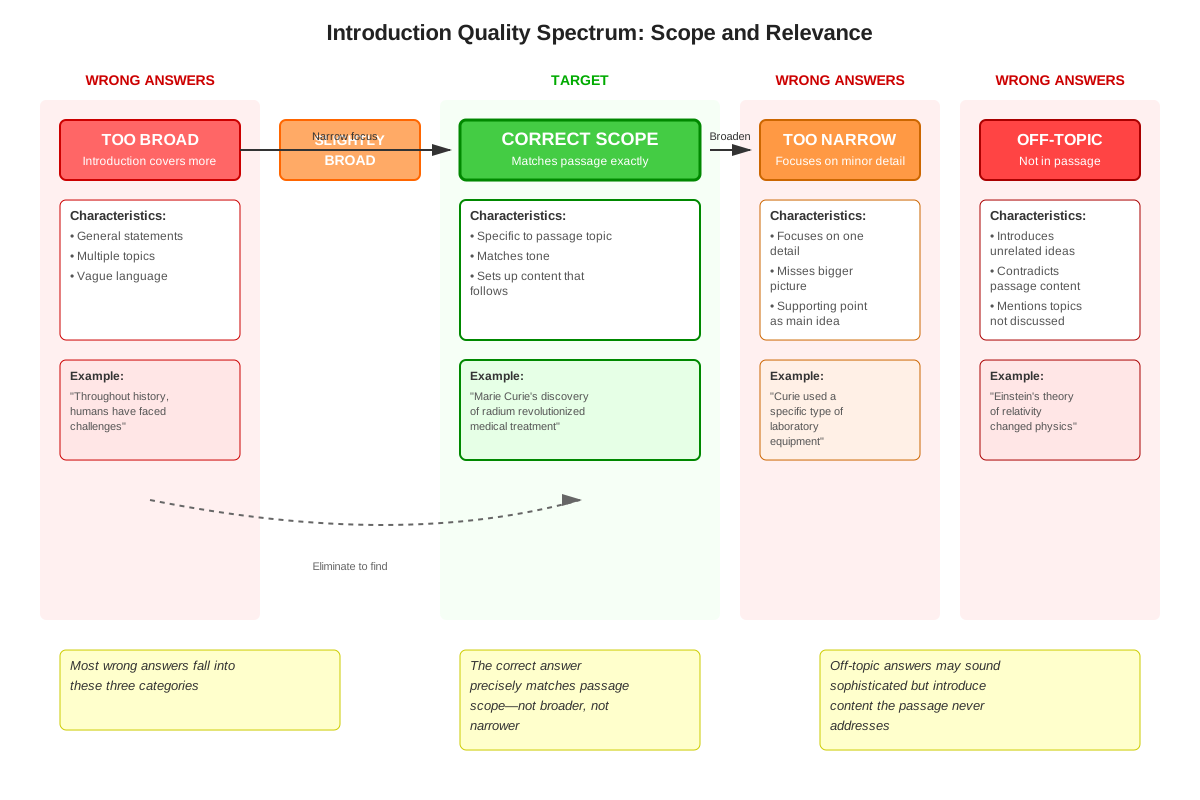
Scope: The introduction should match the passage's breadth and specificity. If a passage discusses one specific artist's technique, an introduction about "the history of Western art" would be too broad. Conversely, if a passage surveys multiple scientific discoveries, an introduction focusing solely on one experiment would be too narrow.
Tone and Purpose: The introduction must align with the passage's overall tone (formal, informal, academic, personal) and purpose (to inform, persuade, entertain, describe). A lighthearted, humorous introduction would clash with a serious, academic passage about medical research.
Reading Strategy for Best Introduction Questions
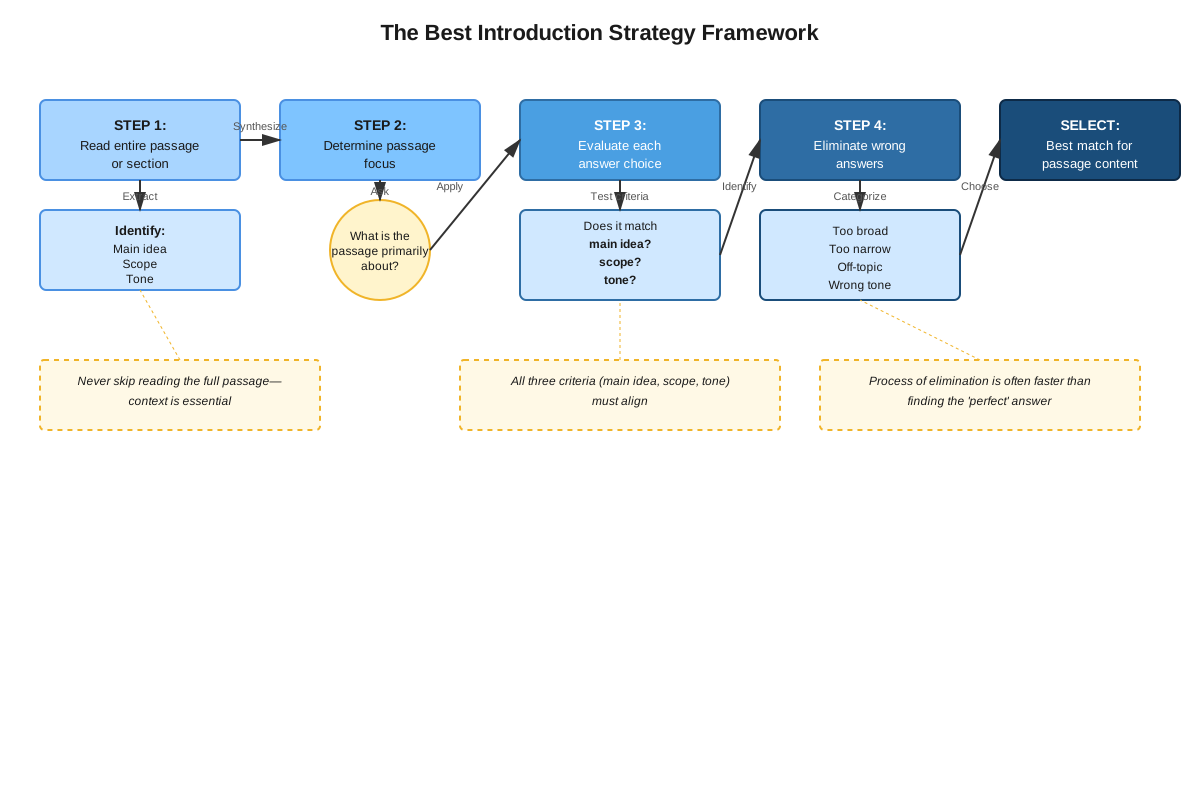
When encountering a best introduction question, follow this systematic approach:
- Recognize the question type by identifying the boxed question asking about introduction effectiveness
- Read the entire passage or paragraph before evaluating answer choices (attempting to answer without reading leads to errors)
- Identify the passage's main idea, purpose, and scope by noting key topics, examples, and the overall focus
- Eliminate clearly wrong answers that are off-topic, too broad, too narrow, or tonally inappropriate
- Compare remaining choices by evaluating which best establishes expectations that the passage fulfills
Common Answer Choice Patterns
Understanding typical wrong answer patterns helps eliminate options efficiently:
| Answer Type | Characteristics | Why It's Wrong |
|---|---|---|
| Off-topic | Discusses content not addressed in passage | Fails relevance test |
| Too broad | Makes sweeping claims beyond passage scope | Creates false expectations |
| Too narrow | Focuses on minor detail rather than main idea | Misrepresents passage focus |
| Tone mismatch | Uses inappropriate level of formality or emotion | Clashes with passage style |
| Misleading | Suggests content or argument not present | Violates reader expectations |
| Vague | Provides no specific information about topic | Fails to establish context |
The "Expectation Test"
The most effective strategy for evaluating introductions is the expectation test: after reading an introduction, what would a reader expect the passage to discuss? The correct answer creates expectations that the passage actually fulfills. If an introduction promises a discussion of three causes but the passage only discusses effects, that introduction fails the expectation test.
Specific vs. General Balance
Effective introductions strike a balance between being specific enough to establish clear focus and general enough to encompass the full passage scope. Consider these examples:
- Too general: "Many things have changed throughout history." (Could introduce anything)
- Too specific: "In 1847, Maria Mitchell discovered a comet using a two-inch telescope." (Only works if passage focuses exclusively on this event)
- Balanced: "Nineteenth-century women astronomers overcame significant barriers to make lasting contributions to science." (Specific enough to establish focus, broad enough to cover multiple examples)
Introduction Purpose Recognition
Some questions explicitly state what the introduction should accomplish: "Which choice best introduces the passage while emphasizing the author's personal connection to the topic?" These questions require evaluating not just relevance and scope but also whether the introduction achieves the specified rhetorical goal. Read the question stem carefully to identify any additional criteria beyond basic effectiveness.
Concept Relationships
Best introduction questions integrate multiple reading and rhetorical skills into a single assessment. The foundation begins with reading comprehension—students must accurately understand passage content before evaluating introduction options. This comprehension feeds into main idea identification, which determines what the introduction should address.
Scope analysis connects directly to organizational structure understanding: recognizing whether a passage follows a chronological, compare-contrast, cause-effect, or problem-solution structure helps predict what an effective introduction should establish. For example, a passage using problem-solution structure benefits from an introduction that establishes the problem's significance.
The relationship flows as follows:
Reading Comprehension → Main Idea Identification → Scope Analysis → Purpose Recognition → Introduction Evaluation
Additionally, best introduction skills connect to transition questions (both assess logical flow and connection between ideas) and conclusion questions (introductions and conclusions should mirror each other in scope and focus). Mastery of best introduction questions also supports adding or deleting sentences questions, as both require evaluating whether specific content fits the passage's purpose and scope.
Understanding audience and purpose (prerequisite rhetorical concepts) directly enables effective introduction evaluation, as introductions must be tailored to the intended audience and support the author's purpose. This creates a bidirectional relationship: practicing best introduction questions reinforces audience and purpose awareness, which in turn improves introduction evaluation skills.
High-Yield Facts
⭐ Best introduction questions always require reading the full passage or paragraph before selecting an answer—attempting to answer based solely on the introduction options leads to errors.
⭐ The correct introduction must match the passage's actual scope—if the passage discusses three examples, the introduction should reference multiple examples, not just one.
⭐ All answer choices may be grammatically correct—these questions test rhetorical effectiveness, not grammar rules.
⭐ The introduction should create expectations that the passage fulfills—if an introduction promises to discuss causes, the passage must actually discuss causes.
⭐ Tone consistency is essential—a formal, academic passage requires a formal introduction, while a personal narrative needs a more conversational opening.
- Wrong answers often discuss topics that appear nowhere in the passage, making them easy to eliminate once you've read the content.
- Introductions that are too broad make claims beyond what the passage can support (e.g., "Throughout all of human history" for a passage about one decade).
- Introductions that are too narrow focus on a minor detail rather than the passage's main focus (e.g., introducing a passage about an artist's career by mentioning only one painting).
- The most effective introductions often include specific details that establish credibility while remaining broad enough to encompass the full discussion.
- When questions specify additional criteria ("while emphasizing the author's personal connection"), the correct answer must meet both the basic introduction requirements AND the specified additional goal.
- Vague, generic introductions that could apply to dozens of different passages are almost never correct on the ACT.
- The correct introduction typically appears in the middle range of specificity—not the most general option, not the most specific, but balanced between the two.
Quick check — test yourself on Best introduction so far.
Try Flashcards →Common Misconceptions
Misconception: The longest or most detailed answer choice is usually correct.
Correction: Length does not determine effectiveness. The correct introduction must match the passage's scope and purpose, which sometimes requires brevity. A concise, focused introduction often outperforms a lengthy but unfocused one.
Misconception: You can answer best introduction questions by reading only the answer choices and the first paragraph.
Correction: Effective evaluation requires reading the entire passage (or the full paragraph if the question asks about a body paragraph introduction). The passage's full scope and development often aren't apparent from just the opening section.
Misconception: The introduction that sounds most impressive or uses the most sophisticated vocabulary is best.
Correction: Effectiveness depends on appropriateness, not impressiveness. An introduction must match the passage's tone and purpose. A highly formal, academic introduction would be inappropriate for a casual, personal narrative.
Misconception: If an answer choice mentions something discussed anywhere in the passage, it's a good introduction.
Correction: Mere mention isn't sufficient—the introduction must reflect the passage's main focus and overall scope. A detail that appears in one sentence doesn't warrant introduction-level emphasis unless it's central to the passage's purpose.
Misconception: The correct answer will always be completely different from the other choices.
Correction: Correct answers often share elements with wrong answers but include crucial differences in scope, specificity, or emphasis. Careful comparison is necessary to identify the subtle distinctions that make one option superior.
Misconception: Best introduction questions are subjective and don't have definitively correct answers.
Correction: While these questions assess rhetorical effectiveness rather than grammar rules, they have objectively correct answers based on how well each option matches the passage's content, scope, purpose, and tone. The ACT's correct answers can be defended through specific textual evidence.
Worked Examples
Example 1: Evaluating Introduction Scope
Question: Which of the following provides the best introduction to the passage?
Answer Choices:
- A) Throughout human history, people have sought to understand the natural world.
- B) Marine biology encompasses the study of all ocean-dwelling organisms.
- C) Dr. Sylvia Earle's groundbreaking deep-sea research has revolutionized our understanding of ocean ecosystems.
- D) Scientists use various methods to study underwater environments.
Passage Summary: The passage discusses Dr. Sylvia Earle's career, focusing on three specific deep-sea expeditions she led in the 1970s and 1980s and their impact on marine conservation policy.
Analysis:
Choice A is too broad. While technically true, this statement could introduce passages about astronomy, geology, botany, or countless other topics. It fails to establish any specific focus on marine biology or Dr. Earle. Eliminate.
Choice B is too broad for this specific passage. While the passage does relate to marine biology, it focuses specifically on one scientist's work, not the entire field. This introduction would better suit a passage surveying the discipline generally. Eliminate.
Choice C matches the passage scope precisely. It identifies the specific subject (Dr. Sylvia Earle), indicates the type of work (deep-sea research), and suggests significance (revolutionized understanding), all of which align with the passage's actual content about her expeditions and their impact. Strong candidate.
Choice D is too vague and doesn't mention Dr. Earle at all. While the passage might reference research methods, this introduction fails to establish the passage's actual focus on one scientist's specific contributions. Eliminate.
Correct Answer: C
This introduction passes the expectation test: after reading it, a reader would expect to learn about Dr. Earle's deep-sea research and its significance—exactly what the passage delivers. It balances specificity (naming the scientist and type of research) with appropriate scope (not limiting to just one expedition).
Example 2: Matching Tone and Purpose
Question: Which choice best introduces the passage while establishing the author's personal perspective?
Answer Choices:
- A) The Grand Canyon, formed over millions of years by the Colorado River, attracts approximately six million visitors annually.
- B) Geological formations provide scientists with valuable data about Earth's history.
- C) Standing at the canyon's edge for the first time, I understood why my grandmother had insisted I make this journey.
- D) Tourism has significantly impacted the economy of northern Arizona.
Passage Summary: The passage is a personal narrative describing the author's visit to the Grand Canyon, reflecting on family memories and the emotional significance of the landscape.
Analysis:
Choice A provides factual, encyclopedic information appropriate for an informational article but completely lacks personal perspective. The tone is objective and detached, mismatching the personal narrative style. Eliminate.
Choice B takes a scientific approach that doesn't align with a personal narrative. While not incorrect information, it suggests the passage will discuss geological research rather than personal experience. Eliminate.
Choice C immediately establishes personal perspective through first-person narration ("I"), introduces the setting (Grand Canyon), and suggests emotional significance through family connection. The tone is reflective and personal, matching a narrative style. Strong candidate.
Choice D focuses on economic impacts, suggesting an analytical or argumentative passage rather than a personal narrative. It contains no personal perspective. Eliminate.
Correct Answer: C
This question explicitly requires the introduction to "establish the author's personal perspective," making the first-person narrative approach essential. Choice C is the only option that uses personal voice and suggests the emotional, reflective content that follows. It creates appropriate expectations for a personal narrative while introducing the setting and hinting at the family significance that the passage explores.
Exam Strategy
When approaching best introduction questions on the ACT, implement this systematic process:
Step 1: Identify the Question Type
Look for the boxed question number and phrases like "best introduces" or "most effective introduction." Recognize immediately that this tests rhetorical effectiveness, not grammar.
Step 2: Read Before Answering
Resist the temptation to evaluate answer choices before reading. Invest 60-90 seconds reading the entire passage (or full paragraph if the question addresses a body paragraph). This upfront investment prevents costly errors and actually saves time by enabling confident elimination.
Step 3: Summarize Main Idea and Scope
After reading, mentally articulate: "This passage is mainly about [X] and covers [Y scope]." For example: "This passage is mainly about urban beekeeping and covers its environmental benefits, challenges, and growing popularity." This summary becomes your evaluation standard.
Step 4: Check for Additional Criteria
Reread the question stem to identify any specified requirements beyond basic effectiveness (e.g., "while emphasizing controversy" or "establishing the author's expertise"). The correct answer must meet ALL stated criteria.
Step 5: Eliminate Systematically
Work through answer choices, eliminating those that:
- Discuss topics not addressed in the passage (off-topic)
- Make claims broader than the passage supports (too broad)
- Focus on minor details rather than main ideas (too narrow)
- Use inappropriate tone or formality level (tone mismatch)
Step 6: Apply the Expectation Test
For remaining choices, ask: "If I read only this introduction, what would I expect the passage to discuss?" The correct answer creates expectations that the passage fulfills.
Exam Tip: When stuck between two choices, identify the passage's primary focus (the topic that receives the most attention or appears in the most paragraphs). The correct introduction will emphasize this primary focus rather than secondary details.
Trigger Phrases to Watch For:
- "Best introduces" or "most effective introduction"
- "While emphasizing" or "while establishing" (indicates additional criteria)
- "Provide the most appropriate introduction"
- "Most clearly introduce the topic"
Time Management:
Allocate approximately 60-90 seconds for reading plus 30-45 seconds for evaluation, totaling about 2 minutes per best introduction question. This is slightly longer than grammar questions but justified by the reading requirement. Don't rush—these questions reward careful analysis.
Process of Elimination Power:
Best introduction questions typically include at least one or two obviously wrong answers (completely off-topic or absurdly broad). Eliminate these immediately to improve odds. The real decision usually comes down to two reasonable options that differ in scope or emphasis—this is where passage knowledge determines success.
Memory Techniques
RISE Mnemonic for evaluating introductions:
- Relevance: Does it relate to passage content?
- Introductory purpose: Does it establish context for what follows?
- Scope: Does it match passage breadth (not too broad/narrow)?
- Expectations: Does it create expectations the passage fulfills?
The "Movie Trailer" Analogy: Think of the introduction as a movie trailer—it should accurately represent what follows without giving everything away. A trailer for a romantic comedy shouldn't look like a horror film, and it shouldn't promise plot elements that don't appear in the movie. This analogy helps remember that introductions must match content and tone while establishing appropriate expectations.
Scope Spectrum Visualization: Picture a spectrum from "extremely broad" to "extremely narrow." The correct introduction typically falls in the middle zone—specific enough to establish clear focus but broad enough to encompass all passage content. Visualize sliding answer choices along this spectrum to identify the balanced option.
The Three Bears Test: Like Goldilocks seeking the "just right" porridge, evaluate introductions as "too broad," "too narrow," or "just right" in scope. This simple framework makes scope evaluation more intuitive and memorable.
MATCH Acronym for tone evaluation:
- Mood: Does the emotional tone fit?
- Audience: Is the formality level appropriate?
- Topic: Is the subject matter aligned?
- Content: Does it reflect what's actually discussed?
- How: Does the style match the passage approach?
Summary
Best introduction questions assess the ability to evaluate rhetorical effectiveness by selecting opening statements that appropriately establish context, scope, and expectations for passages or paragraphs. Success requires reading the full passage before evaluating options, identifying the main idea and scope, and systematically eliminating choices that are off-topic, too broad, too narrow, or tonally inappropriate. The correct answer creates expectations that the passage fulfills, matches the passage's actual scope and purpose, and uses a tone consistent with the overall writing style. These questions appear 2-3 times per ACT English section and reward strategic, methodical thinking over quick guessing. Mastery depends on understanding that all answer choices may be grammatically correct—the task is identifying which option best serves the rhetorical purpose of introducing the content that follows. The expectation test provides the most reliable evaluation method: the correct introduction should make a reader expect exactly what the passage delivers.
Key Takeaways
- Always read the entire passage or paragraph before evaluating introduction options—attempting to answer without reading leads to predictable errors
- The correct introduction must match the passage's scope: not too broad (making claims beyond what the passage supports) and not too narrow (focusing on minor details)
- All answer choices may be grammatically correct; these questions test rhetorical effectiveness, not grammar rules
- Apply the expectation test: the correct introduction creates expectations that the passage actually fulfills
- Eliminate systematically by checking for off-topic content, scope mismatches, and tone inconsistencies
- When questions specify additional criteria ("while emphasizing" or "establishing"), the correct answer must meet both basic introduction requirements and the specified goal
- Best introduction questions reward careful, methodical analysis and typically require 2 minutes including reading time
Related Topics
Main Idea and Purpose Questions: Understanding how to identify a passage's central focus and author's purpose directly supports best introduction evaluation, as effective introductions must align with these elements.
Transition and Organization Questions: These questions assess logical flow between sentences and paragraphs, skills that complement introduction evaluation by developing awareness of how writing elements connect.
Conclusion Questions: Selecting effective conclusions requires similar skills to introduction evaluation—both assess whether opening or closing statements appropriately match passage scope and content.
Adding and Deleting Sentences: These questions test whether specific content fits the passage's purpose and focus, developing the same relevance-evaluation skills needed for introduction questions.
Writer's Purpose and Effect: Advanced rhetorical questions that assess why authors make specific choices build on the audience and purpose awareness essential for introduction evaluation.
Practice CTA
Now that you understand the strategies and concepts behind best introduction questions, it's time to apply this knowledge through practice. Work through the practice questions to reinforce your ability to identify passage scope, evaluate introduction effectiveness, and eliminate wrong answers systematically. Each practice question provides an opportunity to implement the RISE framework and expectation test in realistic ACT contexts. Remember: these questions reward careful reading and methodical analysis, so take your time and trust the process. The flashcards will help you internalize key concepts and common wrong answer patterns, building the automatic recognition skills that lead to confident, accurate performance on test day. You've got this!
Sign up free to keep reading
Create a free AnvayaPrep account to finish this ACT guide on Best introduction — plus flashcards and practice questions.