Overview
The main idea is the central concept, argument, or purpose that unifies an entire passage or a specific paragraph. On the ACT Reading test, identifying the main idea represents one of the most frequently tested skills, appearing in approximately 20-25% of all questions. Understanding main ideas goes beyond simply recognizing what a passage discusses—it requires distinguishing between the author's primary purpose and the supporting details that illustrate or develop that purpose. Students who master main idea questions gain a significant advantage because these questions often appear early in each passage's question set and provide a framework for understanding more specific detail questions that follow.
The ACT main idea questions assess whether students can synthesize information across multiple paragraphs, distinguish between primary arguments and secondary examples, and recognize the author's overarching intent. These questions typically ask students to identify what the passage is "primarily about," what the author's "main purpose" is, or which statement "best summarizes" the entire passage. Unlike detail questions that focus on specific facts or examples, main idea questions require a holistic understanding of how individual components work together to support a unified message.
Main idea comprehension serves as the foundation for virtually all other reading skills tested on the ACT. Once students identify the main idea, they can more effectively evaluate supporting details, understand the author's tone and perspective, analyze structural choices, and make inferences about implicit meanings. This skill connects directly to understanding paragraph function, recognizing organizational patterns, and distinguishing between major and minor points—all critical competencies for achieving a high score on the ACT Reading section.
Learning Objectives
- [ ] Identify when Main idea is being tested in ACT Reading questions
- [ ] Explain the core rule or strategy behind Main idea identification
- [ ] Apply Main idea strategies to ACT-style questions accurately
- [ ] Distinguish between the main idea and supporting details within passages
- [ ] Recognize common incorrect answer patterns in main idea questions
- [ ] Synthesize information from multiple paragraphs to determine overarching themes
- [ ] Evaluate answer choices for scope accuracy (too broad or too narrow)
Prerequisites
- Basic reading comprehension: The ability to understand literal meanings in written text is essential because main idea identification builds upon understanding what individual sentences and paragraphs communicate.
- Vocabulary knowledge: Familiarity with common academic vocabulary enables students to understand nuanced differences between answer choices and recognize when options misrepresent the passage's focus.
- Paragraph structure awareness: Understanding that paragraphs typically contain topic sentences and supporting details helps students locate and synthesize main ideas more efficiently.
Why This Topic Matters
Main idea questions appear with remarkable consistency across all four ACT Reading passages—Prose Fiction/Literary Narrative, Social Science, Humanities, and Natural Science. Research on ACT question distribution indicates that 2-3 questions per passage directly test main idea comprehension, accounting for roughly 8-12 questions on the entire 40-question Reading test. This frequency makes main idea identification one of the highest-yield skills students can develop for score improvement.
Beyond standardized testing, the ability to identify main ideas represents a fundamental academic and professional skill. College coursework requires students to synthesize lengthy textbook chapters, research articles, and primary sources to extract central arguments. In professional contexts, executives must distill lengthy reports into key takeaways, while researchers must identify the core contributions of published studies. The ACT Reading section specifically tests this skill because it predicts success in college-level reading assignments.
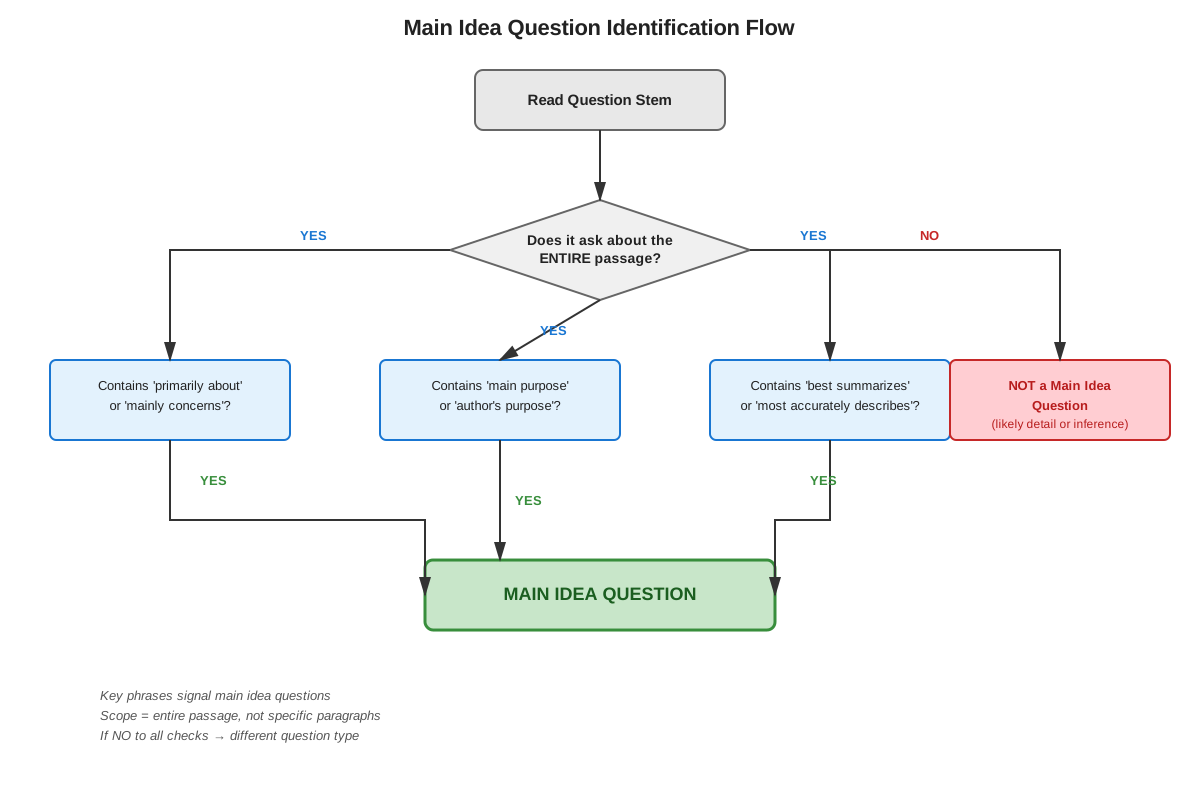
Main idea questions typically appear in several distinct formats on the ACT. The most common phrasing includes: "The main purpose of the passage is to...", "Which of the following best describes what the passage is about?", "The passage can best be described as...", and "The author's primary concern in this passage is...". These questions may target the entire passage or focus on specific paragraphs, requiring students to adjust their scope accordingly. Understanding these question formats helps students quickly recognize when main idea skills are being assessed and deploy appropriate strategies.
Core Concepts
Defining Main Idea vs. Supporting Details
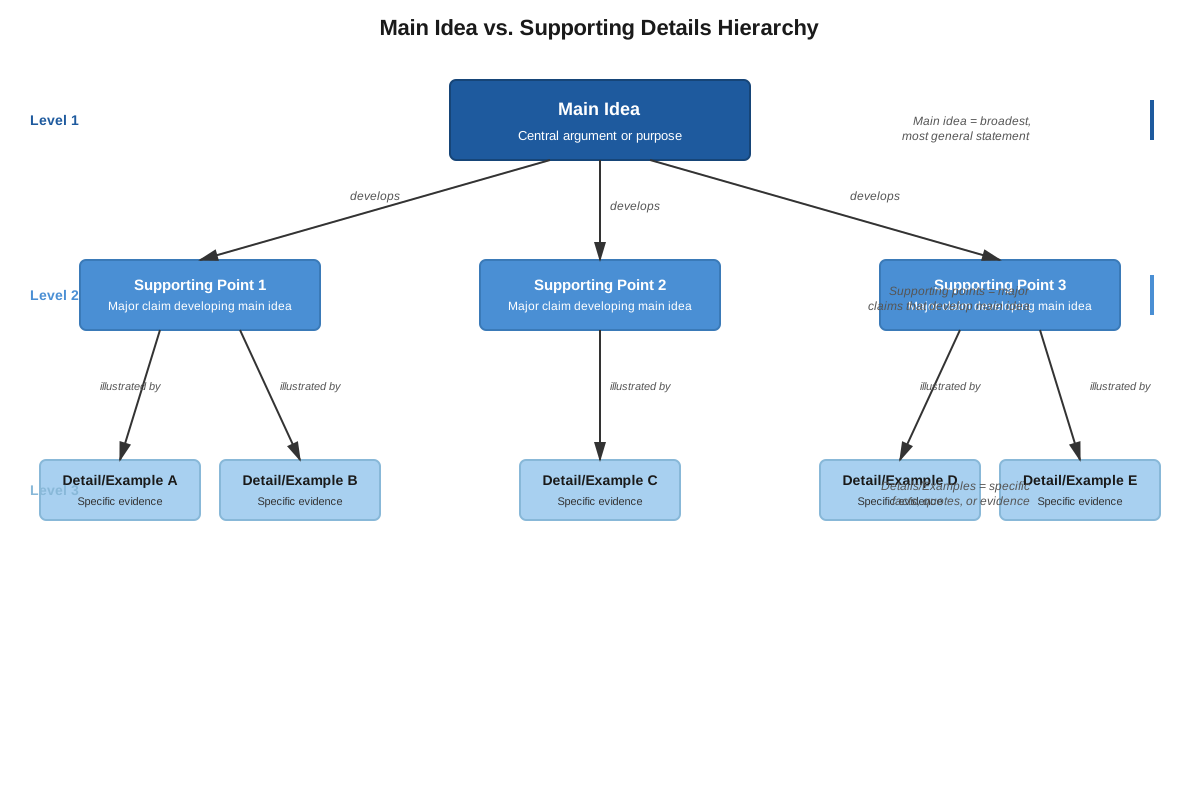
The main idea represents the central point, argument, or purpose that the author wants readers to understand or accept. It answers the question: "What is this passage fundamentally about, and why did the author write it?" In contrast, supporting details are the specific facts, examples, anecdotes, statistics, or descriptions that illustrate, prove, or develop the main idea. A crucial distinction is that supporting details could be removed without destroying the passage's core purpose, while removing the main idea would eliminate the passage's coherence.
Consider this relationship: if a passage's main idea is "Urban gardens provide multiple benefits to city communities," supporting details might include specific examples like "The Chicago community garden program increased neighborhood vegetable consumption by 40%" or "Participants reported feeling more connected to neighbors." These details support and illustrate the main idea but are not themselves the central point.
Scope and Main Ideas
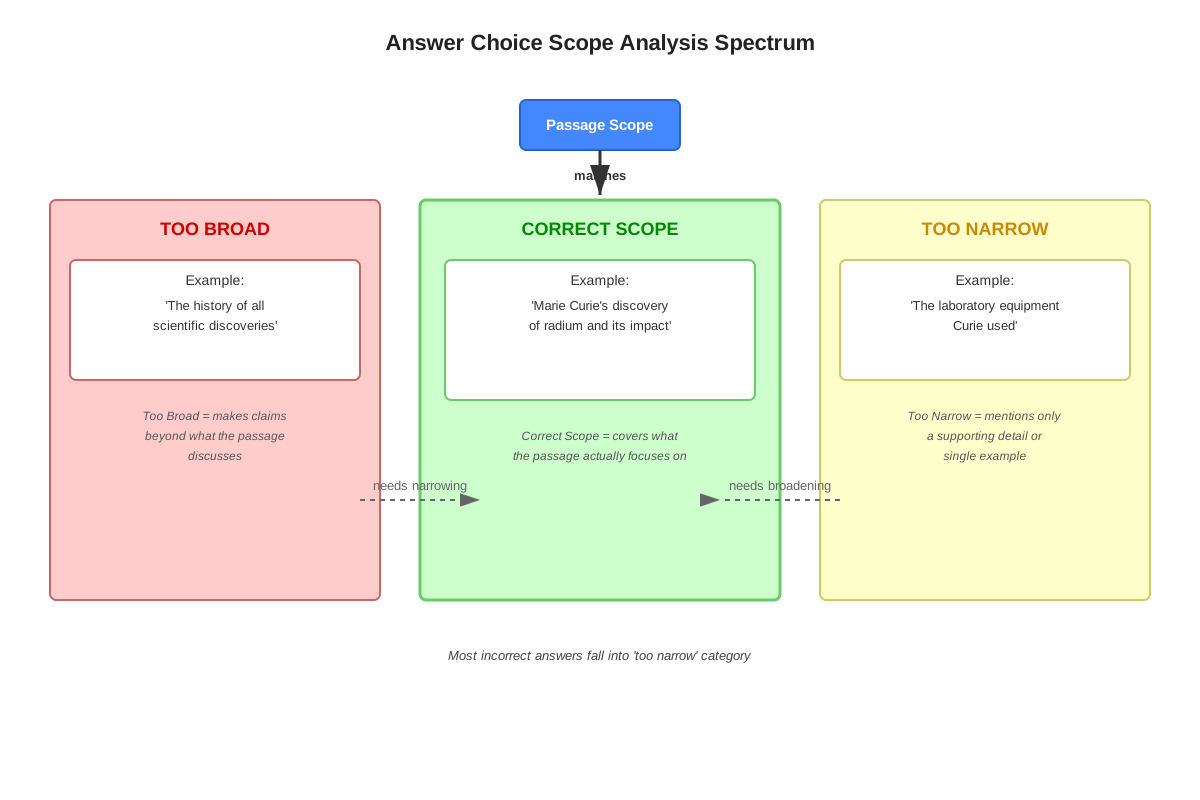
Understanding scope is critical for ACT main idea questions. The scope refers to how broad or narrow the main idea is—whether it encompasses the entire passage, a single paragraph, or something in between. ACT answer choices frequently include options that are too broad (covering more than the passage actually discusses) or too narrow (focusing on just one supporting detail or example).
| Scope Issue | Characteristics | Example |
|---|---|---|
| Too Broad | Includes topics not discussed; overgeneralizes | "The history of all agricultural practices" when passage only discusses urban gardens |
| Appropriate Scope | Matches the passage's actual coverage and focus | "The benefits of urban community gardens" |
| Too Narrow | Focuses on one example or detail rather than the whole | "The Chicago garden program's vegetable statistics" |
Explicit vs. Implicit Main Ideas
Some passages state their main idea explicitly, often in the introduction or conclusion, using clear thesis statements. However, many ACT passages—particularly literary narratives—present implicit main ideas that readers must infer by synthesizing information across paragraphs. For implicit main ideas, students must ask: "What connects all these details? What larger point do these examples collectively support?"
In explicit cases, students might find sentences like: "This essay examines three ways that renewable energy can transform rural economies." In implicit cases, a literary narrative might describe a character's various experiences without stating directly that "This passage explores how childhood experiences shape adult identity"—yet that implicit main idea unifies all the described events.
Main Idea Question Stems
Recognizing question stems helps students immediately activate appropriate strategies. Common ACT main idea question formats include:
- "The main idea of the passage is..."
- "The passage is primarily concerned with..."
- "Which of the following best describes the passage as a whole?"
- "The author's primary purpose in writing this passage is to..."
- "The passage can best be characterized as..."
- "The main focus of the [specific paragraph] is..."
Each format requires the same fundamental skill—identifying the central point—but may emphasize slightly different aspects (purpose vs. content, whole passage vs. paragraph).
The Topic Sentence Strategy
In well-structured expository passages, the first and last paragraphs often contain or strongly suggest the main idea. Similarly, individual paragraphs frequently begin with topic sentences that state their main point. The topic sentence strategy involves:
- Reading the first paragraph carefully to identify potential thesis statements
- Checking the conclusion for summary statements that restate the main idea
- Skimming the first sentence of body paragraphs to understand how they contribute to the overall argument
- Synthesizing these elements to determine what unifies the entire passage
This strategy works particularly well for Social Science, Humanities, and Natural Science passages, which typically follow academic writing conventions.
The Synthesis Approach for Literary Passages
Literary narratives and Prose Fiction passages rarely state their main ideas explicitly. Instead, students must use a synthesis approach:
- Identify what happens in the passage (plot events or descriptions)
- Determine what these events reveal about characters, relationships, or themes
- Ask: "Why did the author choose to show me these specific moments?"
- Formulate the main idea as the underlying point or theme these events illustrate
For example, a passage might describe a teenager's awkward interactions at a new school. The main idea isn't "A teenager goes to a new school" (too literal) but rather "The passage explores the challenges of finding one's identity in unfamiliar social environments."
Concept Relationships
Main idea identification serves as the foundation that connects to virtually every other ACT Reading skill. The relationship flows hierarchically: Main Idea → Paragraph Function → Supporting Details → Specific Facts. Once students identify the main idea, they can better understand why specific paragraphs exist (to introduce, support, contrast, or conclude the main idea) and how individual details contribute to the larger argument.
Main idea comprehension also connects directly to author's purpose and tone. The main idea reveals what the author wants to communicate, while purpose describes why (to persuade, inform, entertain, or analyze). Tone—the author's attitude toward the subject—often becomes clearer once students understand the main idea. For instance, if the main idea is "Despite challenges, community activism can create meaningful change," the tone is likely optimistic or encouraging.
The relationship between main ideas and inference questions is particularly important. Many inference questions ask students to extend or apply the main idea to new situations. Understanding the main idea provides the framework for making valid inferences that align with the passage's overall message rather than contradicting it.
Textual relationship map: Reading Comprehension → Main Idea Identification → Understanding Paragraph Function → Distinguishing Supporting Details → Answering Specific Detail Questions → Making Valid Inferences → Analyzing Author's Craft and Purpose
High-Yield Facts
⭐ Main idea questions account for approximately 20-25% of ACT Reading questions, making them one of the most frequently tested skills.
⭐ The main idea is what the passage is primarily about, while supporting details are the examples, facts, and descriptions that develop or illustrate that central point.
⭐ Incorrect answer choices for main idea questions are typically too broad (covering more than the passage discusses) or too narrow (focusing on one detail or example).
⭐ The first and last paragraphs of expository passages often contain explicit statements or strong clues about the main idea.
⭐ Literary narrative passages rarely state their main ideas explicitly; students must synthesize events and descriptions to infer the underlying theme or point.
- Main idea questions use predictable language patterns including "primarily concerned with," "main purpose," "best describes," and "passage as a whole."
- A valid main idea must be supported by most or all paragraphs in the passage, not just one section.
- Topic sentences (usually the first sentence of paragraphs) help reveal how each paragraph contributes to the overall main idea.
- The main idea should be specific enough to distinguish the passage from other passages on similar topics but broad enough to encompass the entire passage.
- Eliminating answer choices that contradict any part of the passage is an effective strategy for main idea questions.
- Main ideas in Natural Science passages often describe a phenomenon, explain a process, or present research findings and their significance.
- Social Science and Humanities passages frequently have main ideas that analyze cultural, historical, or social phenomena or present arguments about these topics.
Quick check — test yourself on Main idea so far.
Try Flashcards →Common Misconceptions
Misconception: The main idea is always stated explicitly in the first paragraph.
Correction: While expository passages often introduce their main idea early, literary narratives typically require readers to infer the main idea by synthesizing details throughout the passage. Additionally, some expository passages build toward their main point, stating it most clearly in the conclusion.
Misconception: The most interesting or memorable detail in the passage is the main idea.
Correction: ACT test writers deliberately include vivid, memorable details as supporting examples. These attention-grabbing elements often appear in incorrect answer choices that are too narrow. The main idea is the broader point these details support, not the details themselves.
Misconception: If an answer choice contains information from the passage, it must be correct for a main idea question.
Correction: All answer choices for main idea questions typically contain accurate information from the passage. The key is determining which option captures the central, unifying point rather than a supporting detail or tangential topic.
Misconception: Main idea questions are asking for a summary of everything that happens in the passage.
Correction: Main idea questions ask for the central point or purpose, not a comprehensive summary. A passage might describe five different examples, but the main idea is the overarching concept these examples illustrate, not a list of all five examples.
Misconception: The longest or most complex answer choice is usually correct for main idea questions.
Correction: Answer length and complexity don't correlate with correctness. In fact, overly complex answer choices often include too many specific details, making them too narrow. The correct answer should be clear and encompassing without being overly detailed.
Misconception: The main idea and the topic are the same thing.
Correction: The topic is what the passage discusses (e.g., "renewable energy"), while the main idea is the specific point or argument the passage makes about that topic (e.g., "renewable energy technologies have become economically competitive with fossil fuels"). The main idea includes both the topic and what the author says about it.
Worked Examples
Example 1: Natural Science Passage
Passage excerpt: "For decades, scientists believed that the deep ocean floor was a barren, lifeless environment. The absence of sunlight, extreme pressure, and near-freezing temperatures seemed incompatible with life. However, the 1977 discovery of hydrothermal vents changed this understanding completely. These underwater geysers, which release superheated, mineral-rich water from beneath the Earth's crust, support thriving ecosystems. Tube worms, giant clams, and unique species of shrimp cluster around the vents, sustained not by photosynthesis but by chemosynthesis—a process in which bacteria convert chemicals from the vents into energy. This discovery revolutionized marine biology and expanded our understanding of where life can exist. Subsequent research has revealed dozens of vent communities across the ocean floor, each hosting species found nowhere else on Earth. These findings have implications beyond marine science, informing the search for life on other planets where similar extreme environments might exist."
Question: The main purpose of the passage is to:
A) Explain the chemical process of chemosynthesis in deep-sea bacteria
B) Describe the discovery of hydrothermal vents and their significance for understanding life
C) Argue that scientists should focus more research funding on deep-sea exploration
D) Compare photosynthesis and chemosynthesis as energy-production mechanisms
Analysis:
Step 1: Identify what the passage discusses. The passage mentions hydrothermal vents, the ecosystems around them, chemosynthesis, and the broader implications of these discoveries.
Step 2: Determine the scope. The passage covers the discovery, the ecosystems, and the significance—not just one narrow aspect.
Step 3: Evaluate each answer:
- Choice A is too narrow. Chemosynthesis is mentioned as one supporting detail explaining how vent ecosystems function, but it's not the main focus.
- Choice B captures both the discovery and its broader significance ("revolutionized marine biology," "implications beyond marine science"), matching the passage's scope.
- Choice C introduces an argument about funding that never appears in the passage—this is outside the scope.
- Choice D is too narrow and inaccurate. The passage mentions both processes but doesn't compare them in detail; this is a supporting detail, not the main purpose.
Answer: B
Connection to learning objectives: This example demonstrates how to identify main idea questions (the phrase "main purpose"), distinguish between main ideas and supporting details (chemosynthesis is a detail supporting the larger point about the discovery's significance), and evaluate scope (eliminating options that are too narrow or too broad).
Example 2: Literary Narrative Passage
Passage excerpt: "Maria stood at the edge of the empty lot where her grandmother's house had stood for sixty years. The demolition crew had finished yesterday, leaving only bare earth and scattered bricks. She remembered summer evenings on the porch, her grandmother's stories about immigrating from Mexico, the smell of tamales filling the small kitchen. Now a sign announced 'Future Site of Riverside Luxury Condominiums.' Her neighbors had already moved—some to cheaper apartments across town, others to different cities entirely. The bodega where she'd bought candy as a child was boarded up. Even the community center where her mother had taught ESL classes was scheduled for demolition next month. Maria picked up a brick, still warm from the afternoon sun, and slipped it into her bag. It wasn't much, but it was something to hold onto as the neighborhood she'd known her entire life disappeared around her."
Question: The passage is primarily concerned with:
A) Maria's memories of her grandmother's cooking and storytelling
B) The process of urban development and condominium construction
C) The emotional impact of neighborhood change and displacement
D) The history of immigration in Maria's community
Analysis:
Step 1: Since this is a literary narrative, look for the implicit main idea by asking: "What do all these details collectively reveal or explore?"
Step 2: Identify the key elements: Maria observing demolished house, memories of the past, signs of neighborhood change, her emotional response (taking a brick as a keepsake).
Step 3: Synthesize: The passage uses specific details about Maria's grandmother and the neighborhood to explore a larger theme about loss and change.
Step 4: Evaluate answers:
- Choice A is too narrow. The grandmother's cooking and stories are supporting details that illustrate what Maria is losing, not the main point.
- Choice B focuses on the wrong aspect. Urban development is the catalyst for the story but not what the passage explores; the passage focuses on Maria's experience, not the development process itself.
- Choice C captures the implicit main idea. All the details—the demolished house, memories, disappearing businesses, Maria's emotional response—collectively explore how neighborhood change affects residents emotionally.
- Choice D is too narrow and somewhat off-topic. Immigration is mentioned as part of the grandmother's background but isn't the passage's focus.
Answer: C
Connection to learning objectives: This example shows how to identify implicit main ideas in literary passages by synthesizing details, recognize that memorable details (grandmother's stories) are often supporting elements rather than the main idea, and evaluate scope in narrative contexts.
Exam Strategy
Approaching Main Idea Questions Systematically
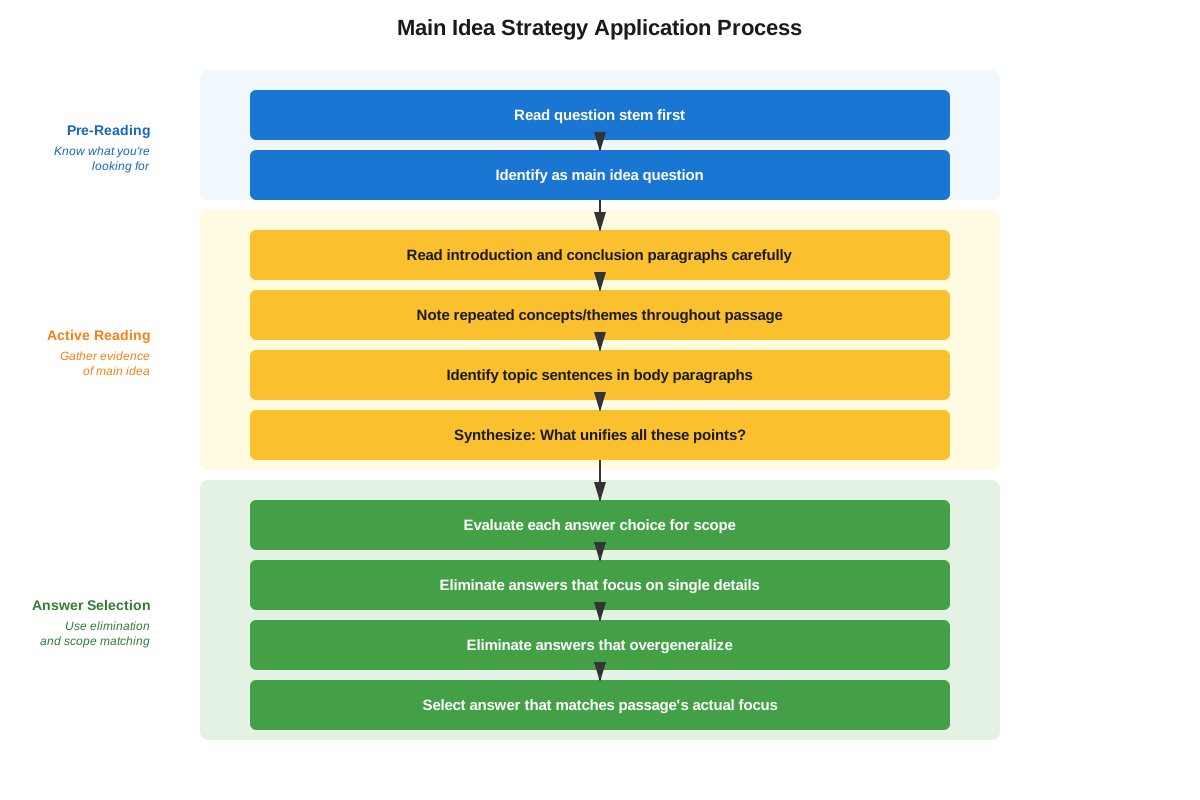
When encountering a main idea question on the ACT, follow this strategic process:
- Read the question stem carefully to determine whether it asks about the entire passage or a specific paragraph
- Before looking at answer choices, formulate your own one-sentence summary of the main idea
- Eliminate answers that are too narrow (focus on one detail or example)
- Eliminate answers that are too broad (include topics not discussed in the passage)
- Eliminate answers that contradict any part of the passage
- Choose the answer that best matches your pre-formulated summary and encompasses the passage's scope
Trigger Words and Phrases
Recognize these question stems that signal main idea questions:
- "primarily concerned with"
- "main purpose"
- "best describes the passage as a whole"
- "passage can best be characterized as"
- "author's primary intent"
- "central idea"
- "overall focus"
Exam Tip: If you see "primarily," "main," "overall," or "as a whole" in a question stem, you're almost certainly dealing with a main idea question. Activate your synthesis and scope-checking strategies immediately.
Process of Elimination Specific to Main Ideas
Eliminate answers that:
- Mention topics or ideas not discussed anywhere in the passage
- Focus exclusively on information from only one paragraph (unless the question specifically asks about that paragraph)
- Use extreme language ("always," "never," "only") unless the passage itself uses such language
- Describe the passage's tone or structure rather than its content (unless specifically asked)
- Accurately describe a supporting detail but miss the larger point
Keep answers that:
- Could serve as an umbrella covering most or all paragraphs
- Match the passage's scope and specificity level
- Align with your pre-formulated summary
- Capture both what the passage discusses and what it says about that topic
Time Allocation
Main idea questions should typically take 30-45 seconds once you've read the passage. Since these questions require holistic understanding rather than locating specific details, they're often more efficient to answer than detail questions. Many students benefit from answering main idea questions first (when they appear) because doing so reinforces their understanding of the passage's structure, making subsequent detail questions easier.
Strategic Insight: If you're struggling with a main idea question, skip it temporarily and answer several detail questions first. Working with specific parts of the passage often clarifies the overall main idea, allowing you to return and answer the main idea question more confidently.
Memory Techniques
The SCOPE Acronym
Use SCOPE to evaluate main idea answer choices:
- Synthesizes most/all paragraphs
- Captures the central point, not details
- Omits nothing important from the passage
- Precise enough to distinguish this passage from others
- Eliminates contradictions with passage content
The "Umbrella Test" Visualization
Visualize the main idea as an umbrella that covers all the supporting details beneath it. If an answer choice is too narrow, it's like a small umbrella that only covers one or two details. If it's too broad, it's like an enormous umbrella that extends far beyond what the passage actually discusses. The correct answer is the umbrella that's exactly the right size—covering all the passage's content without extending beyond it.
The "Dinner Party Summary" Technique
Imagine explaining the passage to someone at a dinner party who asks, "What was it about?" You wouldn't list every detail or example—you'd give a concise summary of the main point. This mental exercise helps students distinguish between main ideas (what you'd say at the dinner party) and supporting details (what you'd only mention if asked for more information).
First and Last Paragraph Mnemonic: "FLAP"
First paragraph often introduces the main idea
Last paragraph often reinforces or restates it
Analyze both for thesis statements
Paragraphs in between provide supporting details
Summary
Main idea identification represents one of the most critical and frequently tested skills on the ACT Reading section, appearing in approximately 20-25% of questions across all passage types. The main idea is the central point, argument, or purpose that unifies a passage, distinguishing it from supporting details, which are the specific examples, facts, and descriptions that develop that central point. Success with main idea questions requires understanding scope—recognizing when answer choices are too broad (covering more than the passage discusses) or too narrow (focusing on one detail rather than the whole). While expository passages in Natural Science, Social Science, and Humanities often state their main ideas explicitly, particularly in opening or closing paragraphs, literary narratives typically require readers to synthesize details and infer implicit main ideas. Effective strategies include formulating your own summary before examining answer choices, using the first and last paragraphs as guides in expository texts, and applying the umbrella test to ensure answer choices cover all major content without extending beyond the passage's actual scope. Mastering main idea identification not only improves performance on these direct questions but also provides the framework for understanding paragraph function, evaluating supporting details, and making valid inferences throughout the ACT Reading test.
Key Takeaways
- The main idea is the central point or purpose that unifies the entire passage, while supporting details are specific examples that illustrate that point
- Main idea questions appear in 20-25% of ACT Reading questions, making them one of the highest-yield skills to master
- Incorrect answers are typically too narrow (one detail) or too broad (beyond passage scope); use scope evaluation as your primary elimination strategy
- Expository passages often state main ideas explicitly in opening or closing paragraphs; literary narratives require synthesizing details to infer implicit main ideas
- Formulate your own one-sentence summary before examining answer choices to avoid being misled by attractive but incorrect options
- The correct main idea answer should function as an umbrella covering most or all paragraphs without extending beyond what the passage actually discusses
- Recognizing question stems with "primarily," "main purpose," or "as a whole" immediately signals the need for main idea strategies rather than detail-location techniques
Related Topics
Supporting Details and Evidence: After mastering main idea identification, students should study how to locate and interpret specific supporting details that develop the main idea. This skill builds directly on main idea comprehension because understanding the central point helps students recognize which details are most significant.
Paragraph Function: Understanding why specific paragraphs exist within a passage (to introduce, support, contrast, or conclude the main idea) represents the next logical progression. This topic examines how individual paragraphs contribute to developing the overall main idea.
Author's Purpose and Tone: Once students can identify what a passage is about (main idea), they can more effectively analyze why the author wrote it (purpose) and the author's attitude toward the subject (tone). These skills work together to provide comprehensive passage understanding.
Inference Questions: Main idea mastery enables students to make valid inferences that align with the passage's central message. Many inference questions essentially ask students to extend or apply the main idea to new situations or unstated implications.
Practice CTA
Now that you've mastered the strategies for identifying main ideas on the ACT Reading test, it's time to put these skills into action! Complete the practice questions to reinforce your understanding of scope evaluation, distinguishing main ideas from supporting details, and recognizing implicit main ideas in literary passages. Use the flashcards to memorize key question stems and elimination strategies. Remember: main idea questions are among the most frequently tested and highest-yield skills on the ACT Reading section—every minute you invest in practice directly translates to points on test day. You've built the foundation; now strengthen it through deliberate practice!
Sign up free to keep reading
Create a free AnvayaPrep account to finish this ACT guide on Main idea — plus flashcards and practice questions.