Overview
Formal style is a critical component of the ACT English test that evaluates a student's ability to recognize and maintain appropriate tone, diction, and register in academic and professional writing contexts. On the ACT, questions testing formal style require students to identify language choices that align with the conventions of standard written English while avoiding colloquialisms, slang, contractions, and overly casual expressions. These questions assess whether students can distinguish between language appropriate for a text message to a friend versus language suitable for an academic essay, research paper, or professional communication.
Understanding ACT formal style is essential because approximately 15-20% of the Rhetorical Skills questions on the ACT English section directly or indirectly test style appropriateness. These questions often appear in passages covering academic subjects like science, history, or literature, where maintaining a consistent formal tone is paramount. Students who master formal style gain a significant advantage because these questions follow predictable patterns: the correct answer almost always favors more sophisticated, precise, and objective language over casual, vague, or subjective alternatives.
Formal style connects intimately with other ACT English concepts, particularly word choice, tone consistency, and audience awareness. While grammar and punctuation questions test mechanical correctness, formal style questions evaluate rhetorical effectiveness and appropriateness. Mastering this topic requires developing an ear for register shifts—the ability to detect when language suddenly becomes too casual, too wordy, or inappropriately emotional for the passage's overall tone. This skill extends beyond the ACT, forming the foundation for successful college writing and professional communication throughout one's academic and career trajectory.
Learning Objectives
- [ ] Identify when formal style is being tested in ACT English passages
- [ ] Explain the core rule or strategy behind formal style and its application
- [ ] Apply formal style principles to ACT-style questions accurately
- [ ] Distinguish between formal and informal language registers in various contexts
- [ ] Recognize specific markers of informal language (slang, contractions, colloquialisms)
- [ ] Evaluate answer choices for consistency with passage tone and academic register
- [ ] Predict correct answers by eliminating options with inappropriate informality
Prerequisites
- Basic grammar and sentence structure: Understanding sentence components helps distinguish between grammatically correct options that differ only in formality level
- Vocabulary knowledge: Recognizing synonyms with different connotation levels enables identification of more formal alternatives
- Reading comprehension: Grasping passage tone and purpose is essential for determining appropriate style choices
- Understanding of audience and purpose: Recognizing who the intended reader is and why the passage was written guides style decisions
Why This Topic Matters
Formal style proficiency extends far beyond standardized testing into real-world applications. College essays, research papers, professional emails, business proposals, and graduate school applications all require command of formal register. Employers consistently rank written communication skills among the most valued competencies, and the ability to adjust language formality to context distinguishes effective communicators from those who struggle professionally.
On the ACT English test, formal style questions appear with high frequency—typically 3-5 questions per test, though style considerations influence many additional questions indirectly. These questions usually present four answer choices that are grammatically correct but vary in formality level, precision, or tone appropriateness. The test makers deliberately include tempting wrong answers that use casual language students might employ in everyday speech but that violates academic writing conventions.
Common manifestations of formal style questions include passages about scientific discoveries, historical events, biographical sketches of notable figures, or explanations of complex processes. The ACT frequently tests whether students can maintain consistent formality when describing technical subjects, avoid inappropriate humor or casual asides in serious contexts, and select precise academic vocabulary over vague colloquial expressions. Recognizing these patterns enables students to approach style questions with confidence and systematic strategy.
Core Concepts
Defining Formal Style
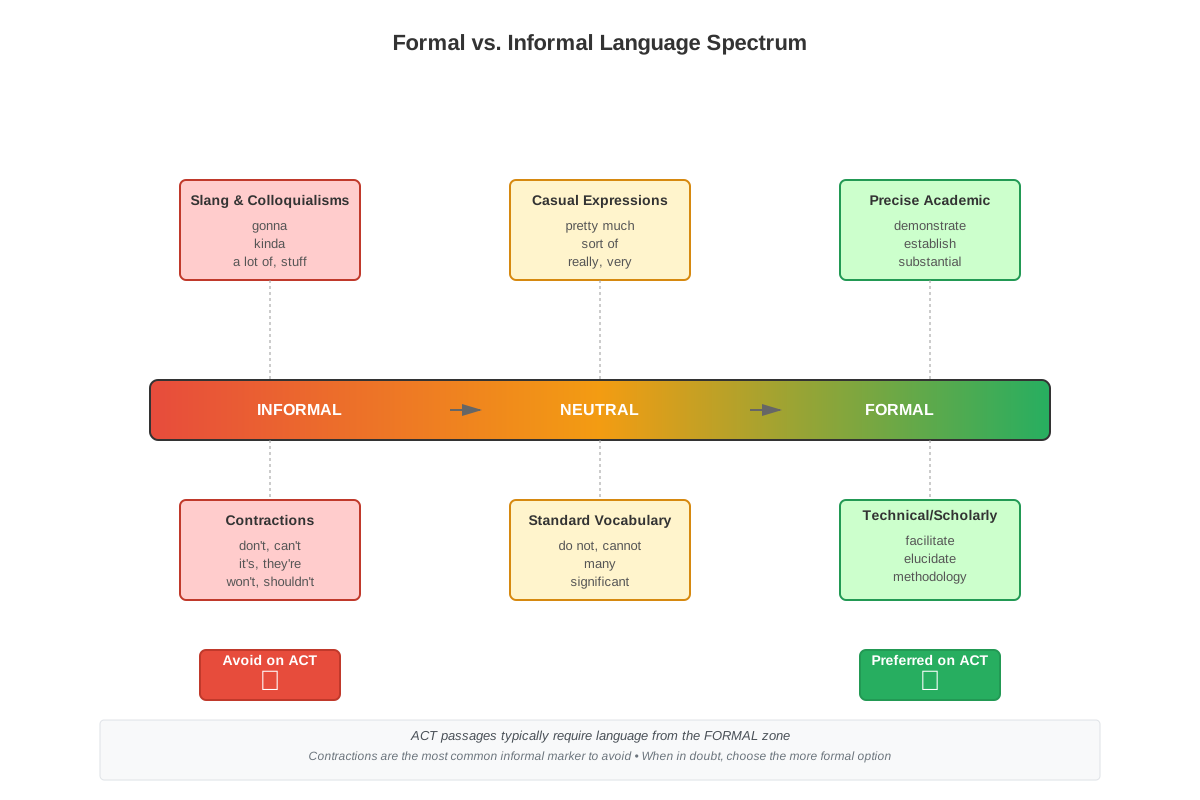
Formal style refers to the language register appropriate for academic, professional, and official communication contexts. This register is characterized by complete sentences, standard grammar, sophisticated vocabulary, objective tone, and absence of casual elements. Formal writing avoids contractions (can't, won't, shouldn't), slang (cool, awesome, freaked out), colloquialisms (a lot, kind of, sort of), and overly personal or emotional language. Instead, formal style employs precise terminology, maintains emotional distance, uses third-person perspective when appropriate, and demonstrates careful attention to word choice.
The ACT tests formal style by presenting passages written in academic register and asking students to select revisions that maintain or improve that formality level. Understanding formal style requires recognizing that language exists on a spectrum from highly formal (legal documents, scientific journals) to highly informal (text messages, casual conversation), with most ACT passages falling in the "standard academic" range—formal but not stilted, clear but not simplistic.
Markers of Informal Language
Several specific features signal inappropriate informality on the ACT:
Contractions: Words like "don't," "can't," "won't," "it's," and "they're" are universally considered too casual for formal academic writing. The ACT consistently marks answers containing contractions as incorrect when testing formal style. Always expand contractions to their full forms: "do not," "cannot," "will not," "it is," "they are."
Slang and colloquialisms: Expressions like "kids" (instead of "children"), "a lot" (instead of "many" or "numerous"), "get" (when "obtain" or "receive" is more precise), "pretty" (meaning "quite" or "rather"), and "really" (as an intensifier) signal informality. Regional expressions, trendy phrases, and words that would seem dated in a decade all fall into this category.
Vague language: Formal writing demands precision. Words like "things," "stuff," "nice," "good," "bad," and "interesting" are too vague for academic contexts. The ACT rewards specific, descriptive alternatives.
Casual intensifiers: Words like "very," "really," "so," "totally," and "absolutely" often signal informal emphasis. Formal writing achieves emphasis through word choice and sentence structure rather than intensifiers.
Markers of Formal Language
Conversely, several features characterize appropriately formal language:
Precise vocabulary: Formal writing employs specific, often Latinate vocabulary. Instead of "show," formal writing might use "demonstrate," "illustrate," or "reveal." Instead of "make," it might use "create," "produce," or "generate."
Complete constructions: Formal style avoids sentence fragments, elliptical constructions, and incomplete comparisons. Every sentence expresses a complete thought with explicit subjects and predicates.
Objective tone: Formal writing minimizes personal opinion markers ("I think," "I believe," "in my opinion") and emotional language. It presents information and arguments through evidence and logical reasoning rather than subjective reaction.
Standard idioms: Formal writing uses established expressions correctly and avoids trendy or regional variations.
The Formality Spectrum
Understanding that formality exists on a continuum helps students make nuanced judgments:
| Too Informal | Appropriately Formal | Too Formal/Stilted |
|---|---|---|
| "The scientist was totally amazed" | "The scientist was astonished" | "The scientist experienced profound stupefaction" |
| "Kids nowadays don't get enough exercise" | "Children today receive insufficient physical activity" | "Contemporary juveniles fail to obtain adequate corporeal exertion" |
| "The experiment didn't work out" | "The experiment failed to produce expected results" | "The experimental endeavor proved unsuccessful in yielding anticipated outcomes" |
The ACT rarely tests the "too formal" extreme, focusing instead on distinguishing appropriate formality from inappropriate informality. However, occasionally an answer choice will be unnecessarily wordy or pretentious, and students should recognize that effective formal writing is clear and direct, not pompous.
Context Clues for Formality Level
Determining appropriate formality requires reading the entire passage to establish its tone and register. Key indicators include:
Subject matter: Scientific, historical, and technical passages demand higher formality than personal narratives or descriptive essays (though even these maintain standard academic register on the ACT).
Existing vocabulary: If the passage uses sophisticated terminology and complex sentence structures, maintain that level in revisions.
Author's relationship to subject: Objective, informational passages require more formality than reflective personal essays, though both avoid slang and contractions.
Publication context: Passages excerpted from academic journals, textbooks, or formal publications maintain consistent academic register throughout.
Common Formal Style Question Types
The ACT presents formal style questions in several predictable formats:
- Direct style questions: "Which choice best maintains the formal style established in the passage?"
- Word choice questions: Four synonyms or near-synonyms with varying formality levels
- Phrase replacement questions: Longer expressions that differ in tone and precision
- Deletion questions: Whether to keep or delete casual asides or informal commentary
- Transition questions: Selecting connective words or phrases appropriate to formal register
Concept Relationships
Formal style connects directly to several other ACT English concepts, forming an interconnected web of rhetorical skills. Word choice and formal style overlap significantly—selecting precise, sophisticated vocabulary inherently supports formal register, while vague or casual word choices undermine it. The relationship flows bidirectionally: understanding formal style improves word choice decisions, and expanding vocabulary enables more formal expression.
Tone consistency depends on maintaining appropriate formality throughout a passage. A passage that begins with academic language but suddenly shifts to casual expressions violates tone consistency. Thus, formal style → supports → tone consistency → enhances → overall passage coherence.
Audience awareness determines appropriate formality level. Understanding that ACT passages target educated general readers → requires → formal but accessible language → manifests as → standard academic register. This relationship explains why ACT passages avoid both extreme informality and unnecessarily technical jargon.
Concision and formal style sometimes create tension. While formal writing avoids casual language, it should not become wordy or pretentious. The relationship: formal style + concision → produces → clear, sophisticated prose. Students must balance these principles, recognizing that the most formal option is not always correct if it introduces unnecessary wordiness.
Grammar and mechanics provide the foundation upon which formal style builds. Grammatically correct sentences → enable → appropriate style choices → result in → effective formal communication. However, grammatical correctness alone does not guarantee appropriate formality—all four answer choices may be grammatically correct while differing in register.
Quick check — test yourself on Formal style so far.
Try Flashcards →High-Yield Facts
⭐ Contractions are never appropriate in formal ACT passages—always expand them to full forms.
⭐ The most casual answer choice is almost always wrong when formal style is being tested.
⭐ Slang, colloquialisms, and regional expressions violate formal style regardless of grammatical correctness.
⭐ Precise, specific vocabulary is preferred over vague, general terms in formal writing contexts.
⭐ Formal style questions often present four grammatically correct options that differ only in tone and register.
- Formal writing avoids personal pronouns (I, you, we) in objective, informational passages.
- Intensifiers like "very," "really," and "so" signal inappropriate informality in academic contexts.
- The phrase "a lot" should be replaced with "many," "numerous," or "frequently" in formal writing.
- Formal style maintains emotional distance and objectivity rather than expressing personal reactions.
- Academic vocabulary often derives from Latin or Greek roots, while casual language uses Anglo-Saxon origins.
- Formal writing uses "children" rather than "kids," "obtain" rather than "get," and "demonstrate" rather than "show."
- Sentence fragments and incomplete constructions violate formal style conventions.
- Formal passages maintain consistent register throughout—sudden shifts to casual language signal errors.
- The ACT rewards clear, direct formal writing over unnecessarily complex or pretentious language.
- Reading the entire passage before answering style questions helps establish the appropriate formality level.
Common Misconceptions
Misconception: Formal writing should use the longest, most complex words available. → Correction: Formal writing prioritizes clarity and precision over complexity. While formal vocabulary is often more sophisticated than casual alternatives, unnecessarily obscure or pretentious language is incorrect. Choose the clearest, most precise option that maintains appropriate formality.
Misconception: All contractions are acceptable if they appear in the original passage. → Correction: The ACT tests whether students can identify and correct informal elements, including contractions. If a question offers an expanded form as an alternative, it is almost always the correct answer in formal contexts, regardless of what appears elsewhere in the passage.
Misconception: First-person pronouns (I, we) are never acceptable in formal writing. → Correction: While objective, informational passages avoid first-person perspective, personal narratives and reflective essays appropriately use first-person pronouns. The key is consistency with passage type and purpose, not absolute prohibition.
Misconception: Formal style means using passive voice instead of active voice. → Correction: Formal writing can employ either active or passive voice depending on emphasis and clarity needs. The ACT generally prefers active voice for its directness and clarity, even in formal contexts.
Misconception: If an answer sounds "smart" or "fancy," it must be more formal. → Correction: Pretentious, unnecessarily complex language violates effective formal style. The ACT rewards clear, precise, appropriately sophisticated language, not pompous or convoluted expressions.
Misconception: Formal style only matters in science and history passages. → Correction: All ACT English passages maintain standard academic register, regardless of subject matter. Even personal narratives avoid slang, contractions, and colloquialisms, though they may be slightly less formal than technical passages.
Misconception: "Get" and "got" are always wrong in formal writing. → Correction: While "get" often signals informality when more precise alternatives exist ("obtain," "receive," "acquire"), it is acceptable in certain idiomatic expressions and when no clearer alternative exists. Context determines appropriateness.
Worked Examples
Example 1: Identifying Informal Language
Passage excerpt: "The archaeologists were really excited when they discovered the ancient artifacts. The find was totally unexpected and pretty significant for understanding the civilization."
Question: Which of the following alternatives to the underlined portion would be LEAST acceptable?
A. genuinely thrilled
B. authentically enthusiastic
C. truly delighted
D. legitimately stoked
Solution:
Step 1: Identify what the question asks. "LEAST acceptable" means we're looking for the option that is most inappropriate or informal.
Step 2: Analyze the passage tone. This passage discusses archaeological discovery in an informational context, requiring formal academic register.
Step 3: Evaluate each option:
- Option A: "genuinely thrilled" - "Thrilled" is somewhat informal but acceptable; "genuinely" is appropriately formal
- Option B: "authentically enthusiastic" - Both words maintain formal register; "enthusiastic" is standard academic vocabulary
- Option C: "truly delighted" - "Delighted" is acceptable in formal contexts; "truly" is appropriately formal
- Option D: "legitimately stoked" - "Stoked" is slang meaning excited; completely inappropriate for formal academic writing
Step 4: Select the answer. Option D is LEAST acceptable because "stoked" is slang that violates formal style conventions.
Answer: D
Connection to learning objectives: This example demonstrates identifying when formal style is tested (recognizing the question type) and applying formal style principles (eliminating slang) to select the correct answer.
Example 2: Maintaining Consistent Formality
Passage excerpt: "The research team conducted extensive experiments to determine the effects of temperature on plant growth. Their findings indicated that moderate temperatures facilitated optimal development, whereas extreme temperatures [45] inhibited growth processes."
Question 45:
F. NO CHANGE
G. really messed up how plants grew
H. totally prevented plants from getting bigger
J. basically stopped the plants from developing right
Solution:
Step 1: Read the entire sentence and surrounding context. The passage maintains formal scientific register with words like "conducted," "extensive," "determine," "facilitated," and "optimal."
Step 2: Analyze the original phrase. "Inhibited growth processes" uses precise scientific vocabulary appropriate to the formal context.
Step 3: Evaluate alternatives:
- Option F (NO CHANGE): "inhibited growth processes" - Formal, precise, scientifically appropriate
- Option G: "really messed up how plants grew" - Multiple violations: "really" (intensifier), "messed up" (slang), "how plants grew" (casual phrasing)
- Option H: "totally prevented plants from getting bigger" - "Totally" (intensifier), "getting bigger" (casual phrasing instead of "developing" or "growing")
- Option J: "basically stopped the plants from developing right" - "Basically" (hedge word), "right" (casual adverb instead of "properly" or "correctly")
Step 4: Apply formal style principles. Options G, H, and J all contain multiple markers of informality that clash with the passage's established academic tone.
Step 5: Select the answer. NO CHANGE maintains appropriate formality.
Answer: F
Connection to learning objectives: This example illustrates explaining the core strategy (maintaining consistency with established passage tone) and applying formal style principles to eliminate multiple inappropriate alternatives.
Exam Strategy
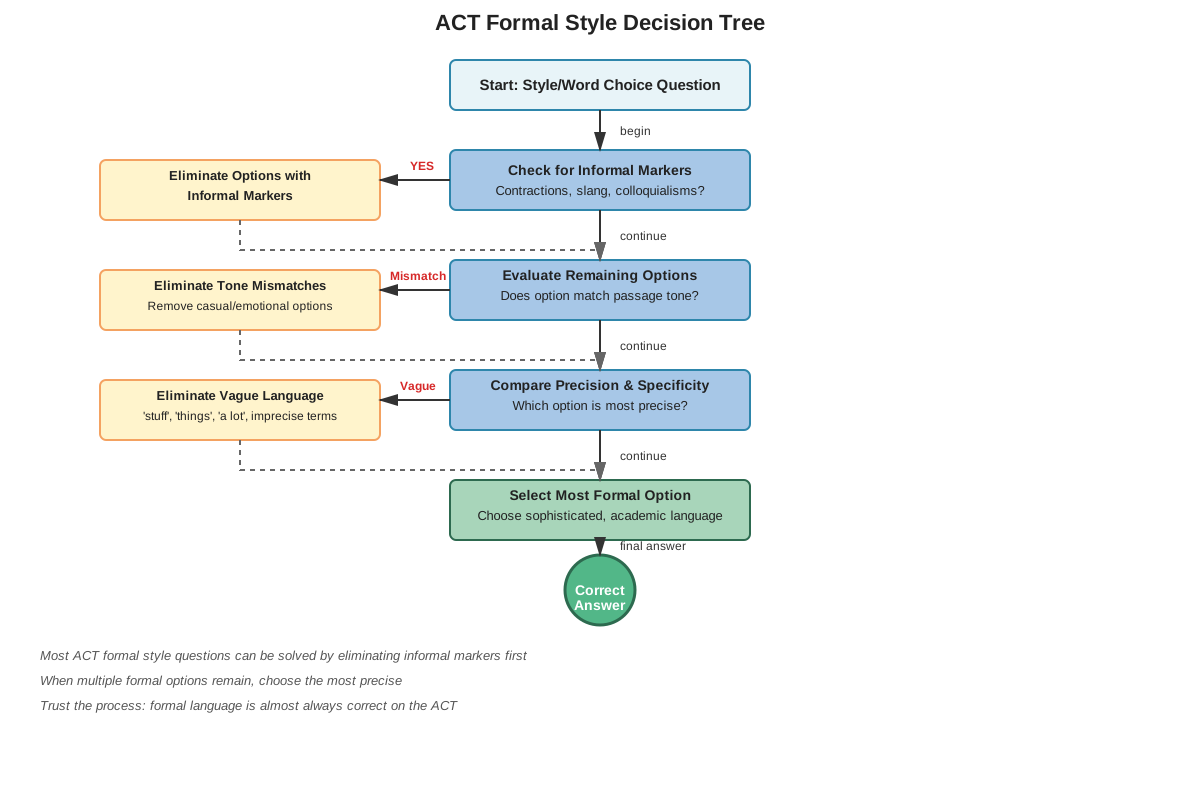
When approaching formal style questions on the ACT, employ this systematic strategy:
Step 1: Read for context. Before answering any style question, read at least the full paragraph (preferably more) to establish the passage's tone, subject matter, and formality level. This context is essential for making appropriate style judgments.
Step 2: Identify trigger words. Questions containing phrases like "maintain the formal style," "best fits the tone," "most appropriate," or "LEAST acceptable" signal style testing. Recognize these immediately and shift your evaluation criteria from pure grammar to register appropriateness.
Step 3: Scan for obvious informality markers. Quickly eliminate answer choices containing contractions, slang, colloquialisms, or casual intensifiers. These are almost never correct in formal contexts.
Step 4: Compare remaining options for precision. Among formally appropriate choices, select the most precise and specific option. Vague language ("things," "stuff," "nice") is less formal than precise alternatives.
Step 5: Read your choice in context. Before finalizing your answer, mentally insert it into the passage and confirm it maintains consistent tone with surrounding sentences.
Trigger words and phrases to watch for:
- "Maintain the style" → Focus on consistency with passage tone
- "LEAST acceptable" → Find the most informal or inappropriate option
- "Best accomplishes" → Consider both formality and rhetorical effectiveness
- "Most appropriate" → Evaluate register, precision, and clarity together
Process of elimination tips:
- Eliminate contractions first—they're rarely correct
- Eliminate slang and colloquialisms second
- Between two formal options, choose the more precise one
- When in doubt, select the option that sounds like it belongs in a textbook
Time allocation: Formal style questions should take 20-30 seconds once you've read the passage context. Don't overthink—trust your ear for register shifts and apply the systematic elimination strategy.
Memory Techniques
FORMAL acronym for identifying inappropriate informality:
- Fragments and incomplete sentences
- Overly casual vocabulary (slang, colloquialisms)
- Really, very, so, totally (casual intensifiers)
- Misplaced personal tone (inappropriate "I think" or emotional language)
- Abbreviations and contractions
- Language that's vague (stuff, things, nice, good)
The "Textbook Test": When uncertain about formality, ask yourself, "Would this appear in a textbook?" If the answer is no, the language is probably too informal for the ACT.
The "Expansion Rule": Whenever you see a contraction, mentally expand it. The expanded form is almost always correct in formal contexts: can't → cannot, won't → will not, it's → it is.
Visualization strategy: Picture yourself writing a college research paper or presenting to a professor. Would you use this language? If not, it's too informal.
The "Casual Conversation Test": If you would say something exactly this way to a friend in casual conversation, it's probably too informal for the ACT. Formal writing differs from speech patterns.
Summary
Formal style on the ACT English test evaluates students' ability to recognize and maintain appropriate academic register in written communication. Success requires identifying markers of informality—contractions, slang, colloquialisms, vague language, and casual intensifiers—and selecting alternatives that employ precise vocabulary, complete constructions, and objective tone. The ACT consistently presents formal style questions by offering four grammatically correct options that differ in register, with the correct answer maintaining consistency with the passage's established academic tone. Students must read passages carefully to determine appropriate formality level, then systematically eliminate options containing informal elements. Mastering formal style requires developing an ear for register shifts and understanding that effective formal writing balances sophistication with clarity, avoiding both casual language and unnecessarily pretentious expressions. This skill extends beyond standardized testing into college writing and professional communication, making it among the most practically valuable competencies the ACT assesses.
Key Takeaways
- Formal style questions test register appropriateness, not just grammatical correctness—all options may be grammatically correct
- Contractions, slang, and colloquialisms are virtually never acceptable in ACT formal writing contexts
- Read the full passage context before answering style questions to establish appropriate formality level
- Precise, specific vocabulary is preferred over vague, general terms in formal academic writing
- The most casual answer choice is almost always wrong when formal style is being tested
- Effective formal writing balances sophistication with clarity—avoid both informality and pretentious complexity
- Systematic elimination of informal markers (contractions, slang, intensifiers) efficiently identifies correct answers
Related Topics
Tone and Voice: Understanding how authors create and maintain consistent tone throughout passages builds directly on formal style mastery. Tone encompasses formality but also includes attitude, mood, and perspective.
Word Choice and Diction: Expanding vocabulary and understanding connotation differences enables more sophisticated formal style decisions. Precise diction is essential for formal register.
Concision and Wordiness: Balancing formal style with concise expression prevents unnecessarily complex or pretentious writing. Effective formal writing is both sophisticated and efficient.
Audience and Purpose: Recognizing intended readers and writing goals helps determine appropriate formality level. Different contexts demand different registers.
Transitions and Flow: Formal passages require sophisticated transitional expressions that maintain academic register while connecting ideas logically.
Practice CTA
Now that you've mastered the principles of formal style, it's time to apply this knowledge! Complete the practice questions to test your ability to identify informal language, maintain consistent register, and select appropriately formal alternatives. The flashcards will reinforce key concepts and help you internalize the markers of formal and informal language. Remember: formal style questions follow predictable patterns, and with practice, you'll develop the instinct to spot informal language instantly. Each practice question you complete strengthens your command of this high-yield topic and moves you closer to your target ACT score. You've got this!
Sign up free to keep reading
Create a free AnvayaPrep account to finish this ACT guide on Formal style — plus flashcards and practice questions.