Overview
Maintaining focus is one of the most frequently tested rhetorical skills on the ACT English section, appearing in approximately 15-20% of all rhetorical skills questions. This concept tests a student's ability to determine whether sentences, phrases, or entire paragraphs belong in a passage based on the passage's established purpose, tone, and subject matter. Unlike grammar questions that focus on mechanical correctness, maintaining focus questions assess reading comprehension and organizational skills simultaneously.
The ACT English test evaluates whether students can identify when content strays from the main idea, introduces irrelevant details, or disrupts the logical flow of an argument. These questions often appear as "yes/yes/no/no" format questions, where students must first decide whether to add, delete, or keep specific content, then select the reasoning that best explains their decision. Mastering ACT maintaining focus questions requires understanding not just what the passage says, but what it's trying to accomplish and who its intended audience is.
This topic connects directly to other rhetorical skills including organization, transitions, and purpose. While organization questions deal with the sequence of ideas, maintaining focus questions determine which ideas should be present at all. Strong performance on focus questions demonstrates critical reading skills that extend beyond the ACT into college-level writing and analytical thinking. Students who excel at these questions can quickly identify a passage's thesis, recognize supporting versus tangential information, and evaluate whether additional content would strengthen or weaken the author's argument.
Learning Objectives
- [ ] Identify when Maintaining focus is being tested in ACT English questions
- [ ] Explain the core rule or strategy behind Maintaining focus
- [ ] Apply Maintaining focus to ACT-style questions accurately
- [ ] Distinguish between relevant and irrelevant information based on passage context
- [ ] Evaluate whether proposed additions or deletions strengthen passage coherence
- [ ] Analyze the relationship between specific details and the passage's overall purpose
- [ ] Recognize common distractors in maintaining focus answer choices
Prerequisites
- Basic paragraph structure: Understanding topic sentences, supporting details, and concluding sentences helps identify when content doesn't support the main idea
- Reading comprehension skills: The ability to identify main ideas and supporting details is essential for determining what belongs in a passage
- Understanding of rhetorical purpose: Recognizing whether a passage aims to inform, persuade, entertain, or describe helps evaluate content relevance
- Familiarity with ACT question formats: Knowing how "yes/yes/no/no" questions work prevents confusion during timed testing conditions
Why This Topic Matters
In real-world writing, maintaining focus separates effective communication from rambling, unfocused prose. Professional writers, journalists, and academics must constantly evaluate whether each sentence advances their argument or distracts from it. College professors expect students to write essays that stay on topic, and workplace communication demands clarity and relevance. The skills tested in maintaining focus questions directly translate to editing one's own writing and evaluating the quality of information sources.
On the ACT English section, maintaining focus questions appear with high frequency—typically 6-8 questions per test out of 75 total English questions. These questions carry the same weight as grammar questions, making them crucial for achieving a competitive score. Students aiming for scores above 30 must answer these questions consistently and efficiently, as they often appear in clusters within longer passages.
Maintaining focus questions commonly appear in several formats: questions asking whether to add a sentence at a specific point, questions about whether to delete existing content, questions about whether a passage accomplishes a stated goal, and questions about the most relevant concluding sentence. The passages themselves span various genres including personal narratives, scientific explanations, historical accounts, and persuasive essays. Each genre requires slightly different evaluation criteria—a personal anecdote might be relevant in a narrative but distracting in a scientific explanation.
Core Concepts
The Central Principle of Focus
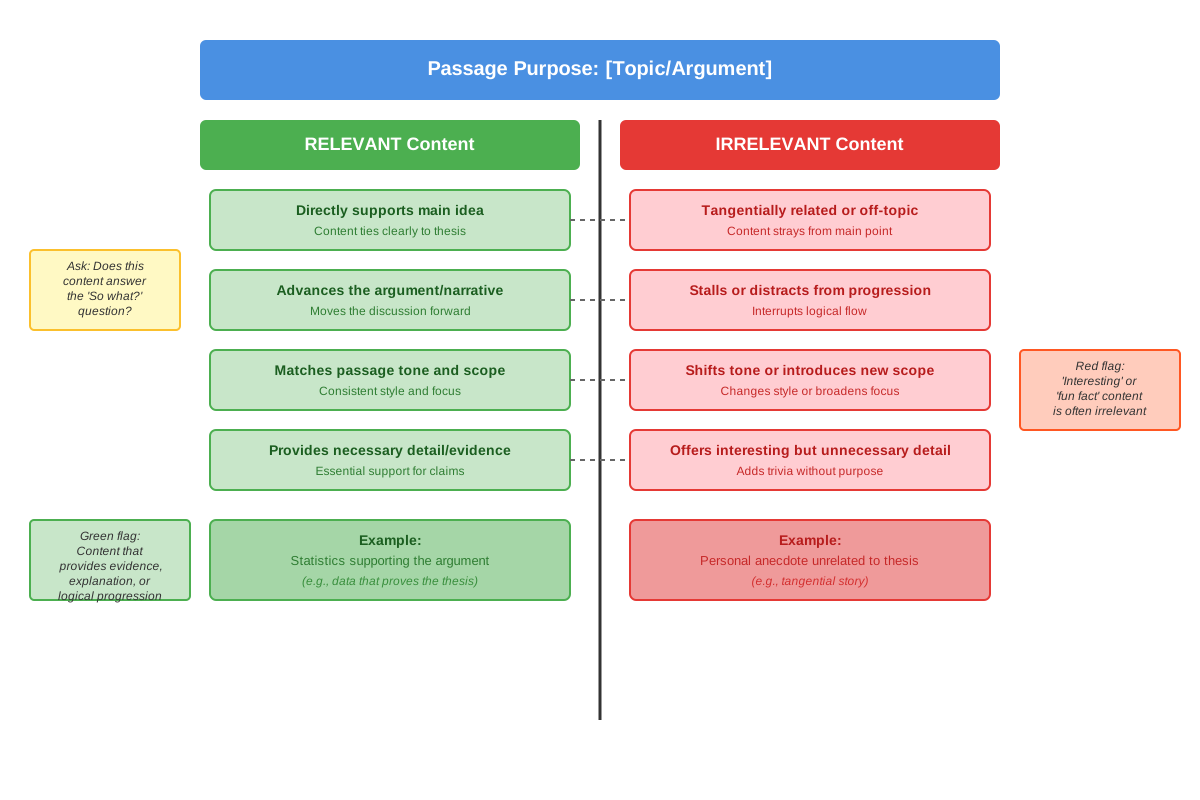
The fundamental rule of maintaining focus is that every sentence in a passage must directly support or develop the passage's main idea, purpose, or thesis. Content that seems interesting, factually accurate, or well-written should still be eliminated if it doesn't advance the specific argument or narrative the passage is constructing. This principle requires students to think like editors rather than readers, constantly asking: "Does this sentence help the passage accomplish its goal?"
The ACT tests this principle by presenting content that is often tangentially related to the topic but not directly relevant to the passage's specific angle. For example, a passage about Marie Curie's discovery of radium might mention that she was the first woman to win a Nobel Prize. While this fact relates to Marie Curie, it might be irrelevant if the passage focuses specifically on her scientific methodology rather than her achievements or historical significance.
Identifying the Passage's Purpose
Before evaluating whether specific content maintains focus, students must identify the passage's primary purpose. This purpose typically falls into one of these categories:
| Purpose Type | Characteristics | Example Focus |
|---|---|---|
| Narrative | Tells a story with chronological events | Personal experience, historical event |
| Descriptive | Creates vivid imagery of a place, person, or thing | Sensory details, spatial organization |
| Expository | Explains or informs about a topic | Process explanation, factual information |
| Persuasive | Argues for a position or viewpoint | Evidence, logical reasoning, counterarguments |
Each purpose type has different criteria for relevance. In a narrative about learning to swim, technical details about pool chemistry would likely be irrelevant. In an expository essay about pool maintenance, those same details would be essential. The ACT frequently tests whether students can distinguish between generally related information and specifically relevant information.
The "Yes/Yes/No/No" Question Format
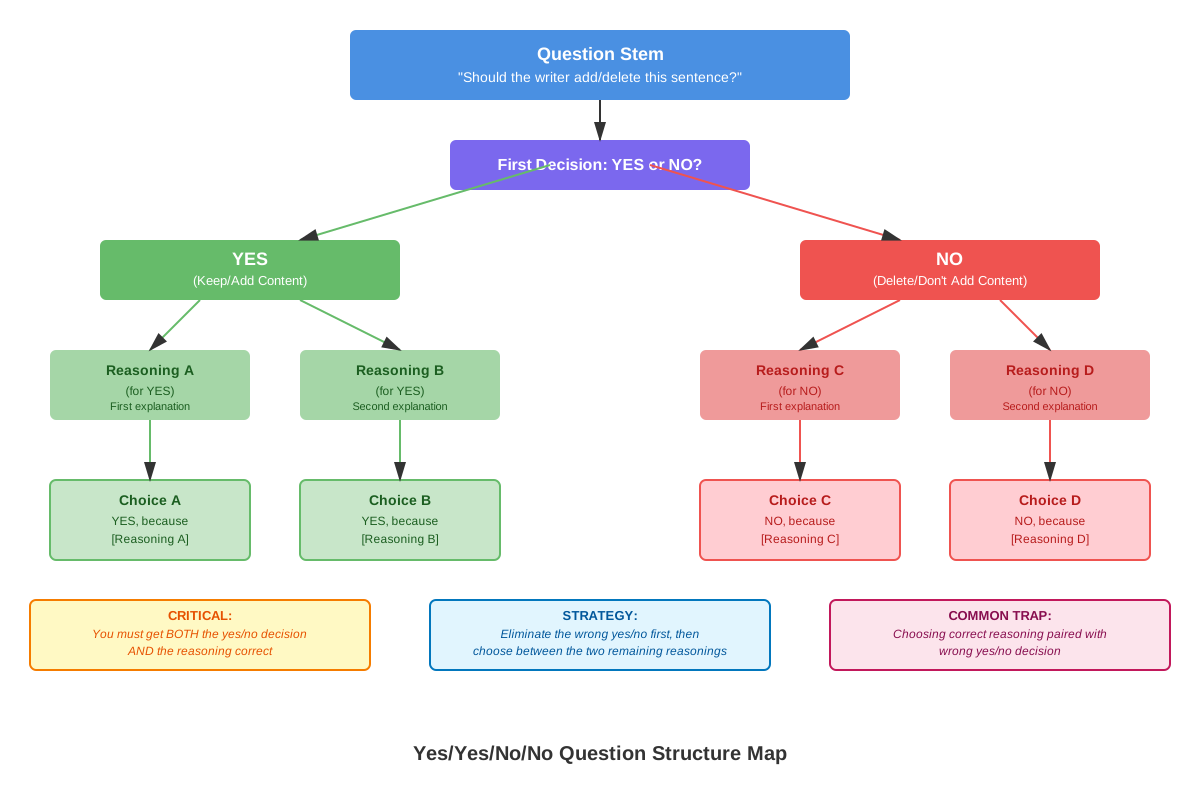
Most maintaining focus questions follow a distinctive format with four answer choices divided into two "yes" options and two "no" options. The structure looks like this:
- Should the writer make this addition/deletion?
- Two choices say "Yes" with different reasons
- Two choices say "No" with different reasons
This format requires a two-step decision process. First, determine whether the content should be added, deleted, or kept based on relevance. Second, select the reasoning that accurately explains why. Many students make the mistake of choosing an answer with correct reasoning but the wrong yes/no decision, or vice versa.
Evaluating Additions
When the ACT asks whether to add a sentence, students must consider three factors:
- Relevance: Does the new sentence relate directly to the paragraph's main idea?
- Redundancy: Does the sentence repeat information already stated?
- Flow: Does the sentence fit logically at the proposed location?
A sentence can be factually accurate and interesting but still be a poor addition if it introduces a new subtopic, contradicts the passage's tone, or disrupts the logical progression of ideas. The correct "no" answer will typically explain that the addition is irrelevant, redundant, or disruptive.
Evaluating Deletions
Deletion questions ask whether existing content should be removed. The content should be kept if it:
- Provides essential information for understanding the main idea
- Offers specific examples that support a general claim
- Creates necessary transitions between ideas
- Establishes important context for subsequent information
Content should be deleted if it:
- Strays from the passage's specific focus
- Repeats information without adding new insight
- Introduces tangential topics
- Contradicts the passage's established tone or purpose
Goal-Based Questions
Some maintaining focus questions ask whether the passage as a whole accomplishes a stated goal. These questions typically appear at the end of a passage and read: "Suppose the writer's goal was to [specific purpose]. Would this essay accomplish that goal?"
To answer these questions, students must:
- Identify the stated goal's key requirements
- Review the passage's actual content and emphasis
- Determine whether the passage addresses the goal's specific focus
- Select the answer that accurately describes the match or mismatch
The incorrect answers often describe what the passage does accomplish rather than addressing whether it accomplishes the stated goal.
Scope and Specificity
A critical aspect of maintaining focus involves matching the scope of details to the passage's level of specificity. A passage with a broad scope (e.g., "the history of aviation") can include various subtopics, while a narrow scope (e.g., "the Wright brothers' first flight at Kitty Hawk") requires all details to relate directly to that specific event.
The ACT often tests this by offering details that are too broad for a specific passage or too specific for a general passage. For example, in a passage about general smartphone technology, a detailed paragraph about one company's manufacturing process would likely be too specific and off-focus.
Concept Relationships
Maintaining focus serves as the foundation for several other rhetorical skills tested on the ACT. The relationship flows as follows:
Passage Purpose → Maintaining Focus → Organization → Transitions
First, the passage establishes a purpose (inform, persuade, narrate, or describe). Maintaining focus ensures that only relevant content appears in the passage. Organization determines the sequence of that relevant content. Finally, transitions connect the organized, relevant ideas smoothly.
Maintaining focus also connects to audience awareness. Content that maintains focus for one audience might be irrelevant for another. A passage written for experts might appropriately include technical jargon, while the same terms would be off-focus in a passage for general readers. The ACT tests this by asking students to consider whether additions match the passage's established level of technicality and assumed reader knowledge.
The relationship to tone and style is equally important. Content can be topically relevant but stylistically inappropriate. A humorous anecdote might be off-focus in a serious academic passage, even if it relates to the topic. Conversely, dense technical language might be off-focus in a light, personal narrative.
Understanding these relationships helps students recognize that maintaining focus questions aren't isolated—they require synthesizing multiple aspects of the passage including purpose, audience, tone, and organizational structure.
High-Yield Facts
⭐ Every sentence in a passage must directly support the passage's specific purpose, not just relate to the general topic
⭐ In "yes/yes/no/no" questions, first decide yes or no, then select the reasoning that accurately explains your decision
⭐ Content can be factually accurate and interesting but still be irrelevant to a passage's specific focus
⭐ Goal-based questions ask whether the passage accomplishes a stated goal, not whether the passage is well-written
⭐ Details that are too broad or too specific for the passage's established scope should be eliminated
- Maintaining focus questions typically appear 6-8 times per ACT English test
- The most common wrong answers describe what the passage does accomplish rather than addressing the specific question asked
- Redundant information should be deleted even if it's relevant to the topic
- Personal anecdotes are only appropriate in passages with a narrative or personal tone
- Technical details should match the passage's established level of complexity
- Transitional phrases like "for example" or "in addition" don't automatically make content relevant
- The correct answer to a deletion question often explains that the content "strays from the passage's focus" or "introduces irrelevant information"
- Content that appears in the middle of a passage is more likely to be tested for focus than opening or closing sentences
- Maintaining focus questions often appear after longer passages (400+ words) where scope is harder to track
- The ACT rarely asks about deleting topic sentences or thesis statements—these almost always should be kept
Quick check — test yourself on Maintaining focus so far.
Try Flashcards →Common Misconceptions
Misconception: If a sentence is factually accurate and relates to the general topic, it should be included in the passage.
Correction: Factual accuracy and topical relation are necessary but not sufficient for inclusion. The sentence must specifically advance the passage's particular angle or argument. A passage about climate change solutions doesn't need facts about climate change causes, even though both relate to climate change.
Misconception: Longer, more detailed answers are always better in maintaining focus questions.
Correction: The correct answer is the one that accurately describes the relationship between the content and the passage's purpose, regardless of length. Sometimes the correct answer is concise: "No, because it strays from the passage's focus on X."
Misconception: If a sentence provides interesting information, it improves the passage.
Correction: Interest value doesn't determine relevance. A fascinating fact about a tangential topic weakens rather than strengthens a focused passage. Readers appreciate tight, coherent writing more than scattered interesting facts.
Misconception: The first sentence of a paragraph always states the main idea, so additions should relate to that sentence.
Correction: While topic sentences often appear first, students must consider the entire passage's purpose, not just the immediate paragraph. A sentence might fit the paragraph but still be off-focus for the overall passage.
Misconception: If the question asks about adding a sentence "at this point," the sentence must fit perfectly at that exact location.
Correction: The question is really asking whether the sentence belongs in the passage at all. If the content is irrelevant to the passage's purpose, it shouldn't be added anywhere, regardless of how well it might fit at the proposed location.
Misconception: Deleting content always makes a passage worse because it removes information.
Correction: Effective writing often requires cutting content that doesn't serve the purpose. Professional editors regularly delete well-written sentences that don't maintain focus. Less can be more when every remaining sentence is relevant.
Misconception: Goal-based questions ask whether the passage is good or well-written.
Correction: These questions ask whether the passage accomplishes a specific stated goal. A passage can be excellent but still not accomplish a particular goal if it focuses on a different aspect of the topic.
Worked Examples
Example 1: Addition Question
Passage Context: The passage describes the process of how honeybees communicate the location of food sources to other bees in the hive through a "waggle dance."
Question: At this point, the writer is considering adding the following sentence:
"Honeybees also play a crucial role in pollinating crops, contributing billions of dollars to agricultural economies worldwide."
Should the writer make this addition here?
Answer Choices:
- A) Yes, because it provides important context about why honeybees matter.
- B) Yes, because it explains why understanding bee communication is valuable.
- C) No, because it introduces information that is irrelevant to the paragraph's focus on bee communication methods.
- D) No, because it contradicts information presented earlier in the passage.
Step-by-Step Solution:
- Identify the passage's specific purpose: The passage explains how honeybees communicate through the waggle dance, not why honeybees are important or what they do for agriculture.
- Evaluate the proposed addition: The sentence provides factually accurate information about honeybees' economic importance. However, this information doesn't explain or develop the communication process.
- Determine yes or no: The addition should NOT be made because it shifts focus from communication methods to economic importance.
- Evaluate the reasoning:
- Choice A is incorrect because while the information might provide general context about bees, it doesn't support the specific focus on communication
- Choice B is incorrect because the sentence doesn't explain anything about communication
- Choice C correctly identifies that the information is irrelevant to the paragraph's specific focus
- Choice D is incorrect because there's no contradiction—the issue is relevance, not accuracy
Correct Answer: C
Key Takeaway: This question demonstrates that topically related information (both sentences are about honeybees) can still be irrelevant to a passage's specific focus (communication methods vs. economic importance).
Example 2: Goal-Based Question
Passage Context: The passage describes the author's experience visiting the Grand Canyon for the first time, focusing on the visual spectacle and emotional impact of seeing the canyon at sunset. The passage includes vivid descriptions of colors, the sense of scale, and the author's feelings of awe.
Question: Suppose the writer's primary purpose had been to explain the geological processes that formed the Grand Canyon. Would this essay accomplish that purpose?
Answer Choices:
- A) Yes, because it describes the Grand Canyon in detail.
- B) Yes, because it conveys the canyon's impressive scale and depth.
- C) No, because it focuses on the author's personal experience and visual impressions rather than geological formation.
- D) No, because it doesn't mention how long the canyon took to form.
Step-by-Step Solution:
- Identify what the stated goal requires: An essay explaining geological processes would need to discuss erosion, rock layers, the Colorado River's role, timeframes, and scientific concepts.
- Identify what the passage actually does: The passage provides a personal narrative with sensory descriptions and emotional reactions.
- Determine the match: The passage does NOT accomplish the stated goal because it focuses on personal experience rather than geological science.
- Evaluate the reasoning:
- Choice A is incorrect because describing the canyon's appearance doesn't explain its formation
- Choice B is incorrect because conveying scale and depth doesn't explain geological processes
- Choice C correctly identifies the mismatch between the personal/descriptive focus and the scientific/explanatory goal
- Choice D is too specific—the problem isn't just one missing detail but the entire approach
Correct Answer: C
Key Takeaway: Goal-based questions require comparing what the passage does accomplish with what the stated goal requires. The passage can be well-written and accomplish a different goal while still failing to meet the stated purpose.
Exam Strategy
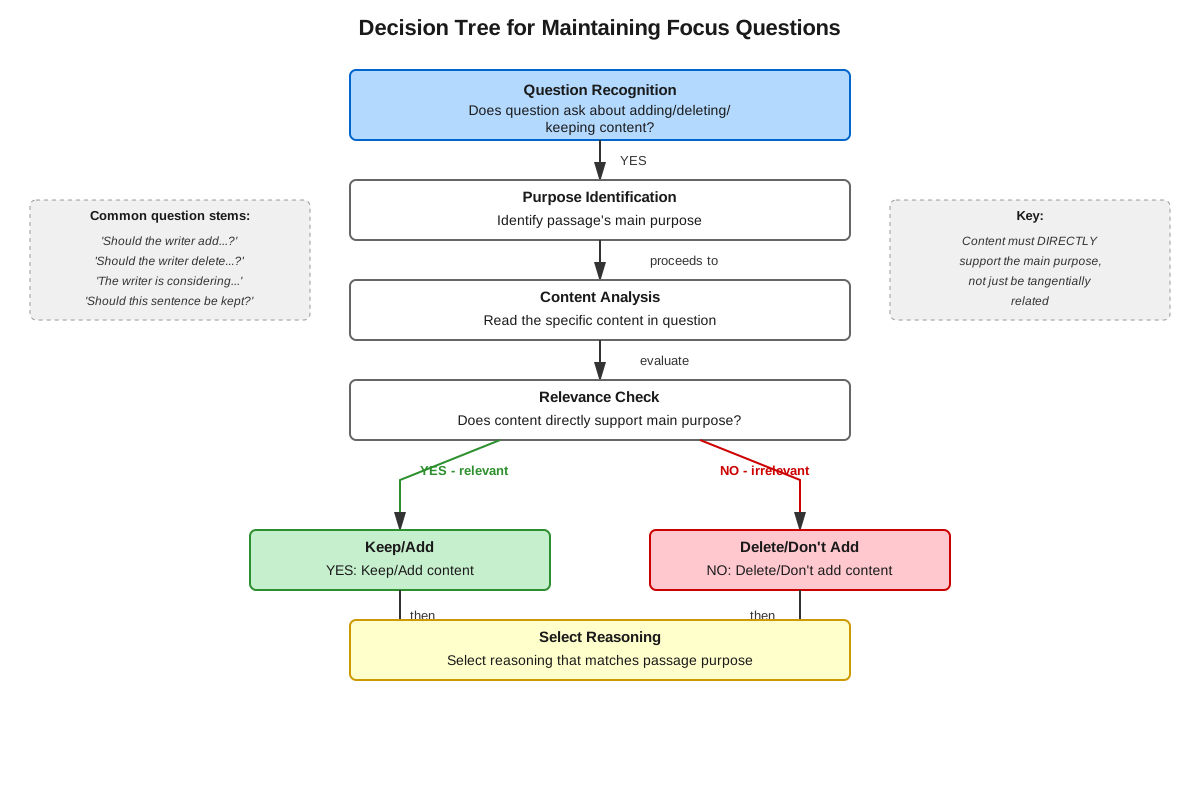
When approaching maintaining focus questions on the ACT, follow this systematic process:
Step 1: Identify the Question Type
Quickly determine whether the question asks about:
- Adding content ("considering adding")
- Deleting content ("considering deleting")
- Overall goal accomplishment ("suppose the writer's goal")
- Most relevant option (choosing between alternatives)
Step 2: Locate and Understand the Passage's Purpose
Before evaluating specific content, identify:
- The passage's main topic and specific angle
- The intended audience and tone
- Whether the passage is narrative, descriptive, expository, or persuasive
Exam Tip: The passage's opening paragraph usually establishes its purpose and scope. Quickly review it before answering focus questions.
Step 3: Apply the Relevance Test
Ask three questions about the content in question:
- Does it directly support the passage's specific purpose?
- Does it provide new, non-redundant information?
- Does it match the passage's established tone and scope?
If the answer to any question is "no," the content likely doesn't maintain focus.
Step 4: Use Process of Elimination
For "yes/yes/no/no" questions:
- First eliminate the two choices (yes or no) that don't match your decision
- Then evaluate the remaining two reasoning statements
- Choose the reasoning that accurately describes the relationship between the content and the passage
Trigger Words and Phrases
Watch for these phrases in questions—they signal maintaining focus:
- "relevant to the passage"
- "accomplish the goal"
- "strays from the focus"
- "at this point"
- "primary purpose"
- "main idea"
Watch for these phrases in wrong answers:
- "provides interesting information" (interesting ≠ relevant)
- "relates to the topic" (general relation ≠ specific relevance)
- "adds detail" (more detail isn't always better)
Time Management
Maintaining focus questions typically require 30-45 seconds each:
- 10 seconds: Identify question type and locate relevant passage section
- 15 seconds: Evaluate content against passage purpose
- 10 seconds: Eliminate wrong answers
- 5 seconds: Confirm and bubble answer
If a question requires re-reading large portions of the passage, mark it and return after completing faster questions. However, most focus questions can be answered by understanding the passage's main purpose without re-reading extensively.
Common Trap Answers
The ACT frequently includes these types of wrong answers:
- Answers that describe what the passage does accomplish rather than addressing the stated goal
- Answers that confuse "related to the topic" with "relevant to the purpose"
- Answers with correct reasoning but wrong yes/no decisions
- Answers that focus on writing quality rather than relevance
Memory Techniques
The FOCUS Acronym
Use FOCUS to remember the evaluation criteria:
- Fits the purpose: Does the content support the passage's specific goal?
- On topic specifically: Is it relevant to the particular angle, not just the general subject?
- Consistent with tone: Does it match the passage's established style and audience?
- Unique information: Does it add something new rather than repeating?
- Scope appropriate: Is the level of detail right for the passage's breadth?
The "Laser vs. Flashlight" Visualization
Imagine the passage's purpose as a laser beam pointing at a specific target. Relevant content follows the laser's path directly to the target. Irrelevant content is like a flashlight beam that spreads out, illuminating interesting things nearby but missing the specific target. When evaluating content, ask: "Is this laser-focused or flashlight-scattered?"
The "Dinner Party" Analogy
Think of a passage like a dinner party conversation. If everyone is discussing a specific movie, someone who starts talking about their vacation (even if interesting) has lost focus. If someone repeats a point already made, they're being redundant. If someone uses overly technical film theory terms when everyone else is speaking casually, they've mismatched the tone. This analogy helps remember that relevance depends on the specific conversation (purpose), not just the general topic (movies/entertainment).
The Two-Question Method
For any maintaining focus question, ask:
- What is the passage trying to do? (Inform about X, persuade about Y, narrate Z)
- Does this content help do that? (Yes = keep/add; No = delete/don't add)
This simple two-question framework cuts through complexity and focuses on the essential evaluation.
Summary
Maintaining focus is a critical rhetorical skill that tests whether students can identify relevant versus irrelevant content based on a passage's specific purpose, tone, and scope. The fundamental principle is that every sentence must directly support the passage's particular goal, not just relate to its general topic. The ACT tests this skill through addition questions, deletion questions, and goal-based questions, most commonly using the "yes/yes/no/no" format that requires both a decision and accurate reasoning. Success requires identifying the passage's specific purpose, evaluating content against that purpose using the relevance test, and recognizing that factually accurate, interesting information can still be off-focus if it doesn't advance the passage's particular argument or narrative. Students must distinguish between content that relates to the general topic and content that specifically supports the passage's angle, match details to the appropriate scope, and select answers that accurately describe why content should or shouldn't be included rather than simply describing what the content says.
Key Takeaways
- Maintaining focus requires that every sentence directly support the passage's specific purpose, not just relate to the general topic
- The "yes/yes/no/no" question format requires two decisions: whether to add/delete/keep content, then which reasoning accurately explains that decision
- Passage purpose (narrative, descriptive, expository, persuasive) determines what types of content are relevant
- Content can be factually accurate, well-written, and interesting but still be irrelevant if it doesn't advance the passage's specific focus
- Goal-based questions ask whether the passage accomplishes a stated purpose, not whether it's well-written or addresses the general topic
- Wrong answers often describe what the passage does accomplish rather than addressing whether it accomplishes the specific stated goal
- Effective evaluation requires identifying the passage's scope and ensuring details match that level of specificity—neither too broad nor too narrow
Related Topics
Organization and Transitions: After mastering maintaining focus (determining what content belongs), students should study organization (determining the sequence of relevant content) and transitions (connecting ideas smoothly). These skills build on focus by assuming all content is relevant and addressing how to arrange it effectively.
Purpose and Audience: Understanding rhetorical purpose and audience awareness deepens focus skills by explaining why certain content is relevant for specific readers and goals. This topic explores how the same information might be relevant or irrelevant depending on who will read the passage.
Concision and Redundancy: While maintaining focus addresses whether content belongs at all, concision addresses whether relevant content is expressed efficiently. These complementary skills together create tight, effective writing.
Main Idea and Supporting Details: This reading comprehension skill provides the foundation for maintaining focus by teaching students to identify hierarchical relationships between ideas—essential for determining what supports versus distracts from a passage's purpose.
Practice CTA
Now that you understand the principles of maintaining focus, it's time to apply these strategies to real ACT-style questions. The practice questions and flashcards will help you recognize focus questions quickly, evaluate content systematically, and avoid common traps. Remember that maintaining focus questions reward careful readers who think about purpose, not just topic. Each practice question you complete strengthens your ability to identify relevant versus irrelevant content—a skill that will serve you not just on test day, but in all your academic writing. Start practicing now to build the confidence and speed you need to excel on these high-frequency, high-value questions!
Sign up free to keep reading
Create a free AnvayaPrep account to finish this ACT guide on Maintaining focus — plus flashcards and practice questions.