Overview
Paragraph organization is one of the most frequently tested rhetorical skills on the ACT English section, appearing in approximately 10-15% of all questions. These questions assess a student's ability to recognize logical flow, coherence, and structural integrity within and between paragraphs. Unlike grammar-focused questions that test mechanical correctness, paragraph organization questions evaluate higher-order thinking skills related to how ideas should be arranged for maximum clarity and effectiveness.
The ACT tests paragraph organization through several question types: determining the best placement for a sentence within a paragraph, deciding whether to add or delete sentences based on relevance, identifying the most logical sequence of sentences, and occasionally determining the best order for entire paragraphs within a passage. Mastering ACT paragraph organization requires understanding both micro-level sentence relationships and macro-level passage structure. Students must recognize transition words, identify topic sentences, track pronoun references, follow chronological or logical progressions, and maintain thematic unity.
This topic connects directly to other rhetorical skills including transitions, relevance, and purpose. Strong paragraph organization skills also enhance performance on reading comprehension tasks, as the same logical thinking applies to understanding passage structure. Students who excel at paragraph organization questions demonstrate sophisticated reading comprehension and can mentally map the architecture of written arguments—skills valuable far beyond standardized testing.
Learning Objectives
- [ ] Identify when Paragraph organization is being tested
- [ ] Explain the core rule or strategy behind Paragraph organization
- [ ] Apply Paragraph organization to ACT-style questions accurately
- [ ] Analyze sentence relationships using transition words and logical connectors
- [ ] Evaluate whether sentences maintain paragraph unity and relevance
- [ ] Determine optimal sentence placement by tracking pronoun references and contextual clues
- [ ] Distinguish between chronological, logical, and thematic organizational patterns
Prerequisites
- Basic sentence structure understanding: Recognizing subjects, verbs, and objects helps identify what each sentence discusses and how sentences relate to one another
- Transition word familiarity: Knowledge of words like "however," "therefore," "additionally," and "for example" is essential for tracking logical flow
- Pronoun reference comprehension: Understanding how pronouns refer to previously mentioned nouns helps determine correct sentence order
- Topic sentence recognition: Identifying main ideas versus supporting details enables evaluation of paragraph unity
Why This Topic Matters
Paragraph organization questions appear consistently on every ACT English test, typically comprising 6-8 questions per exam. These questions carry the same weight as grammar questions, making them crucial for achieving competitive scores. Students who master paragraph organization often see score improvements of 2-4 points in the English section, as these questions reward careful reading and logical thinking rather than memorization of obscure grammar rules.
In real-world applications, paragraph organization skills translate directly to effective writing in academic essays, professional communications, and persuasive arguments. The ability to structure ideas logically determines whether writing achieves its intended purpose—whether convincing a scholarship committee, communicating research findings, or crafting compelling narratives. Employers consistently rank clear written communication among the most valued professional skills.
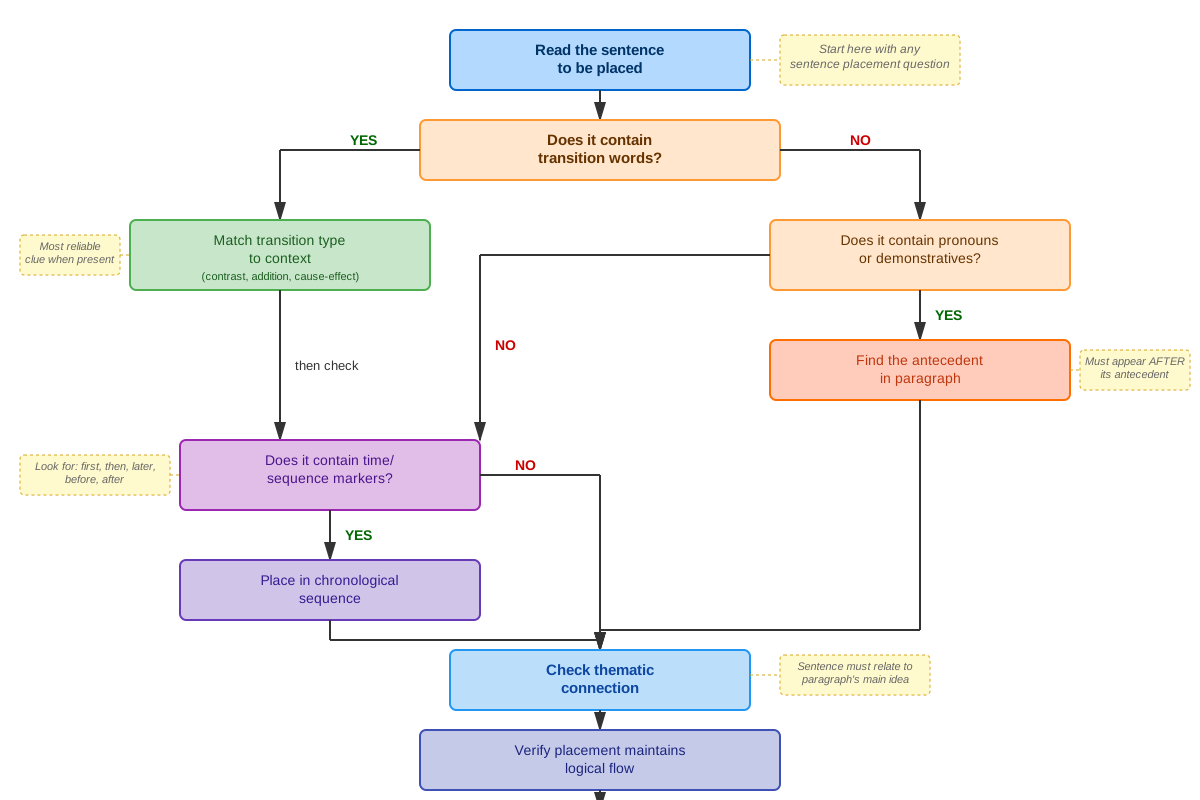
On the ACT, paragraph organization questions typically appear in several formats: numbered sentence placement questions asking "Where should sentence X be placed?", questions about adding or deleting sentences for relevance, questions about the most logical sequence of sentences (often with Roman numeral options), and occasionally questions about reordering entire paragraphs. These questions usually appear 1-2 times per passage, with higher frequency in longer passages containing 4-5 paragraphs.
Core Concepts
Logical Flow and Coherence
Logical flow refers to the smooth progression of ideas from one sentence to the next, where each sentence builds upon or relates clearly to surrounding sentences. Coherent paragraphs follow predictable patterns: general to specific, cause to effect, chronological sequence, or problem to solution. When evaluating sentence placement, students must identify which arrangement creates the most natural progression of thought.
Consider how ideas connect: Does sentence B provide an example of the concept introduced in sentence A? Does sentence C present a contrasting viewpoint that requires sentence B's context? Strong paragraph organization ensures readers never feel confused about why a particular sentence appears in a specific location. The ACT rewards students who can mentally "hear" whether a sequence sounds logical when read aloud.
Transition Words and Logical Connectors
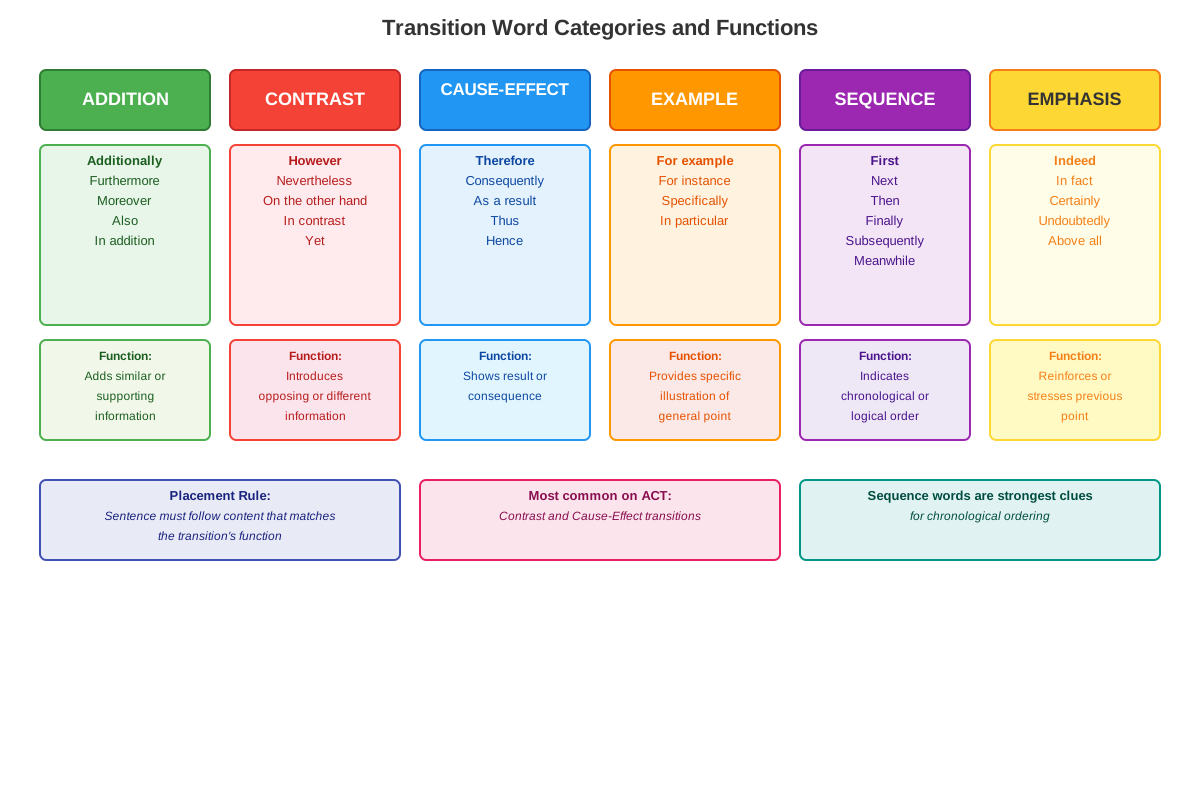
Transition words serve as signposts indicating relationships between ideas. These fall into several categories:
| Transition Type | Examples | Function |
|---|---|---|
| Addition | furthermore, moreover, additionally, also | Introduces supporting information |
| Contrast | however, nevertheless, conversely, yet | Signals opposing or different ideas |
| Cause/Effect | therefore, consequently, thus, as a result | Shows logical outcomes |
| Example | for instance, specifically, namely, such as | Provides illustration |
| Time | meanwhile, subsequently, previously, finally | Indicates chronological relationships |
| Emphasis | indeed, certainly, undoubtedly, in fact | Strengthens a point |
When a sentence begins with "However," it must follow a sentence presenting an idea it contrasts with. When a sentence starts with "For example," it must follow a general statement it illustrates. Recognizing these patterns allows students to eliminate incorrect placement options quickly.
Pronoun Reference and Contextual Clues
Pronoun references provide critical clues for sentence placement. When a sentence contains pronouns like "this," "these," "it," "they," or "such," students must identify the antecedent—the noun the pronoun refers to. A sentence cannot logically precede the introduction of its pronoun's antecedent.
Similarly, contextual clues include specific references to previously mentioned concepts, continuation of examples, or elaboration on earlier points. If a sentence mentions "this technique" or "these findings," earlier sentences must have introduced a technique or findings. If a sentence discusses "the second reason," a previous sentence must have presented a first reason.
Topic Sentences and Supporting Details
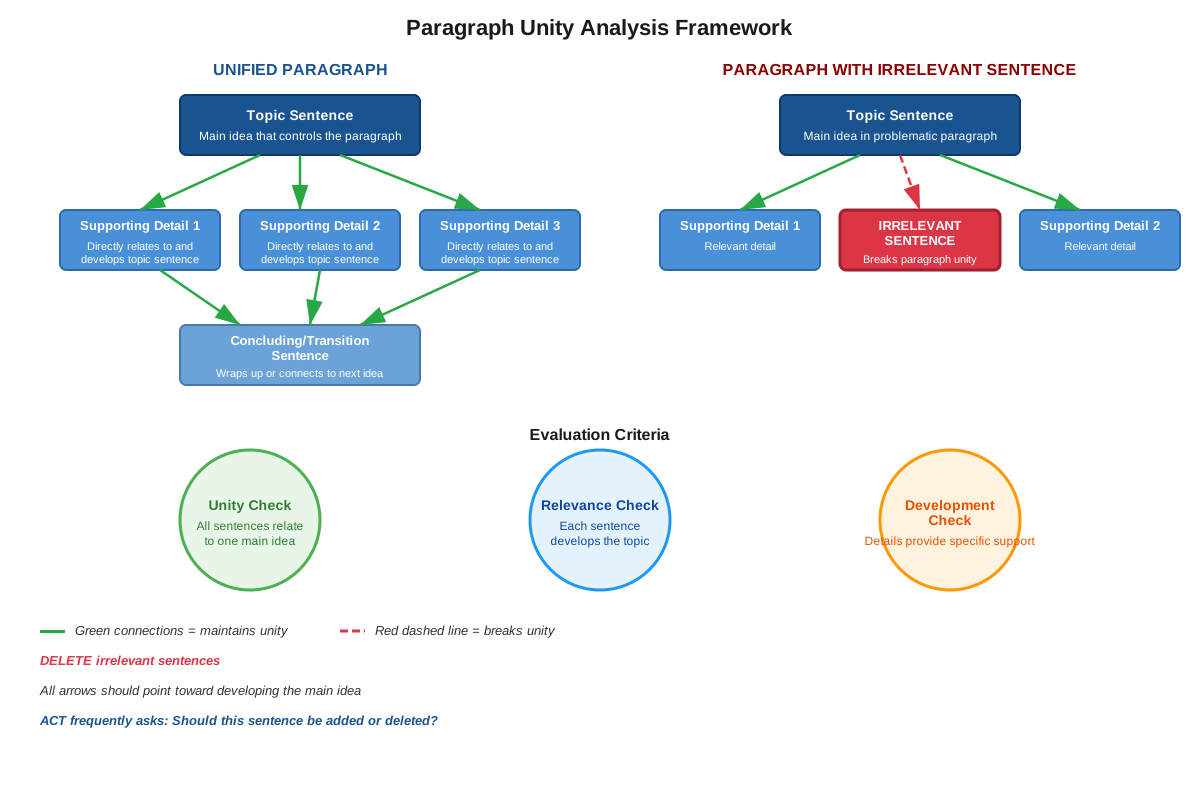
Topic sentences state the main idea of a paragraph, typically appearing at the beginning but occasionally at the end for emphasis. Supporting details provide evidence, examples, explanations, or elaboration of the topic sentence. Effective paragraph organization ensures all supporting sentences relate directly to the topic sentence, maintaining paragraph unity.
When evaluating whether to add or delete a sentence, students must determine whether it supports the paragraph's main idea. A sentence might be factually accurate and well-written but still merit deletion if it introduces tangential information that disrupts unity. The ACT frequently tests this distinction between interesting information and relevant information.
Chronological and Logical Sequencing
Chronological organization arranges events or steps in time order, using temporal markers like "first," "then," "after," "before," and "finally." This pattern appears frequently in narrative passages and process descriptions. Students must recognize when time-based ordering is essential versus when other organizational patterns apply.
Logical sequencing follows patterns like cause-to-effect, problem-to-solution, or general-to-specific. In argumentative passages, this might mean presenting a claim before evidence, or establishing context before introducing a controversy. Scientific passages often move from observation to hypothesis to conclusion. Recognizing these conventional patterns helps students predict optimal sentence order.
Paragraph Transitions and Inter-Paragraph Relationships
While most questions focus on sentence placement within paragraphs, some questions address relationships between paragraphs. The first sentence of a new paragraph often references the previous paragraph's content while introducing a new aspect of the topic. Strong paragraph transitions maintain coherence across the entire passage, ensuring readers understand how each paragraph contributes to the overall purpose.
Concept Relationships
The core concepts of paragraph organization form an interconnected system. Logical flow serves as the overarching principle, with all other concepts supporting it. Transition words explicitly signal the logical relationships that create flow, while pronoun references and contextual clues provide implicit connections between sentences.
Topic sentences establish the framework within which supporting details must fit, with both concepts working together to maintain paragraph unity. The specific type of organization—chronological versus logical sequencing—determines which arrangement of supporting details best serves the topic sentence.
This relationship map illustrates the hierarchy:
Logical Flow (primary goal) → achieved through → Transition Words + Pronoun References + Contextual Clues (connection mechanisms) → organized by → Chronological or Logical Sequencing (organizational patterns) → structured around → Topic Sentences + Supporting Details (content hierarchy) → resulting in → Paragraph Unity (outcome)
These concepts connect to prerequisite knowledge of sentence structure (identifying what each sentence discusses), transition word familiarity (recognizing logical relationships), and pronoun reference comprehension (tracking connections). They also relate to other rhetorical skills topics: transitions (which focuses specifically on connector words), relevance (which addresses whether information belongs), and purpose (which considers the passage's overall goal).
High-Yield Facts
⭐ Paragraph organization questions typically ask about sentence placement, sentence order, or whether to add/delete sentences
⭐ Transition words at the beginning of a sentence indicate its relationship to the previous sentence
⭐ Pronouns and demonstrative adjectives ("this," "these," "such") must have clear antecedents in preceding sentences
⭐ Topic sentences usually appear at the beginning of paragraphs and state the main idea
⭐ All sentences in a paragraph should relate directly to the paragraph's main idea (unity principle)
- Chronological organization uses time markers like "first," "then," "after," "subsequently," and "finally"
- Sentences providing examples must follow sentences making general claims
- Sentences beginning with "However" or "Nevertheless" must follow sentences they contrast with
- Specific details and evidence should follow the claims they support
- The most logical placement often creates the smoothest reading experience when read aloud
⭐ Questions asking "Where should sentence X be placed?" require checking each option by reading the paragraph with the sentence in that position
- Sentences introducing new topics typically begin paragraphs rather than appearing mid-paragraph
- Concluding sentences often summarize, provide implications, or transition to the next paragraph
- Cause-and-effect relationships require causes to precede effects
- Questions about adding sentences often include wrong answers that are factually true but irrelevant to the paragraph's focus
Quick check — test yourself on Paragraph organization so far.
Try Flashcards →Common Misconceptions
Misconception: Longer or more complex sentences should always come later in paragraphs → Correction: Sentence placement depends on logical relationships, not sentence length or complexity. A complex topic sentence can appropriately begin a paragraph, while a simple concluding sentence can end it.
Misconception: Transition words alone determine correct sentence order → Correction: While transition words provide important clues, students must also consider pronoun references, contextual clues, and overall logical flow. A sentence with "Additionally" might fit grammatically in multiple positions but logically in only one.
Misconception: Sentences should be added if they contain interesting or true information → Correction: Sentences should only be added if they directly support the paragraph's main idea and enhance unity. Tangential information, however interesting, disrupts coherence and should be excluded.
Misconception: Chronological order always means earliest-to-latest → Correction: Some passages use reverse chronological order or flashback structures. Students must identify the intended temporal pattern rather than assuming a default sequence.
Misconception: The first sentence of a paragraph is always the topic sentence → Correction: While topic sentences frequently appear first, they can also appear at the end of a paragraph for emphasis, or occasionally in the middle. Students should identify the sentence stating the main idea regardless of position.
Misconception: All sentences in a paragraph must use transition words → Correction: Not every sentence requires an explicit transition word. When logical relationships are clear from context, transition words may be unnecessary or even redundant.
Worked Examples
Example 1: Sentence Placement
Passage excerpt with numbered sentences:
[1] The monarch butterfly's annual migration covers thousands of miles. [2] Scientists have discovered that monarchs use a combination of sun position and internal circadian rhythms to navigate. [3] This remarkable journey takes the butterflies from Canada to Mexico. [4] The navigational mechanism allows them to maintain a consistent southward direction despite changing sun angles throughout the day.
Question: To make this paragraph most logical, sentence 3 should be placed:
A. where it is now
B. before sentence 1
C. after sentence 1
D. after sentence 4
Solution Process:
First, identify what each sentence discusses:
- Sentence 1: Introduces the migration and its distance
- Sentence 2: Explains the navigation mechanism
- Sentence 3: Provides specific geographic details about the journey
- Sentence 4: Elaborates on how the navigation mechanism works
Next, examine logical relationships:
- Sentence 3 contains "This remarkable journey," with "this" referring to the migration mentioned in sentence 1
- Sentence 3 provides specific details (Canada to Mexico) that elaborate on the general concept (thousands of miles) in sentence 1
- Sentences 2 and 4 form a connected pair about navigation mechanisms
Optimal order: Sentence 1 (introduces migration) → Sentence 3 (provides specific geographic details) → Sentence 2 (explains navigation) → Sentence 4 (elaborates on navigation)
Answer: C (after sentence 1)
The pronoun "this" in sentence 3 requires sentence 1 as its antecedent. Placing sentence 3 after sentence 1 creates a logical progression from general distance information to specific geographic details, then transitions to the explanation of how monarchs accomplish this feat.
Example 2: Adding or Deleting Sentences
Passage excerpt:
The development of CRISPR gene-editing technology has revolutionized biological research. Scientists can now modify DNA sequences with unprecedented precision, enabling studies that were impossible just a decade ago. [Question about adding sentence here] This precision has accelerated research in genetic diseases, agriculture, and evolutionary biology.
Proposed sentence to add: "The Nobel Prize in Chemistry has been awarded to scientists in various fields since 1901."
Question: Should the writer add the proposed sentence at this point?
A. Yes, because it provides relevant historical context about scientific achievements
B. Yes, because it emphasizes the importance of the research discussed
C. No, because it shifts focus away from CRISPR technology to general Nobel Prize history
D. No, because it contradicts information presented earlier in the passage
Solution Process:
Identify the paragraph's main idea: The impact of CRISPR technology on biological research
Evaluate the proposed sentence's relevance:
- The sentence discusses Nobel Prize history generally
- It does not mention CRISPR, gene editing, or biological research specifically
- While CRISPR researchers did win a Nobel Prize, this sentence doesn't make that connection
- The sentence would interrupt the flow from CRISPR's precision to its research applications
Apply the unity principle: Does this sentence support the main idea? No—it introduces tangential information about Nobel Prize history that doesn't advance the discussion of CRISPR's impact.
Answer: C
Although the sentence is factually accurate and Nobel Prizes relate broadly to scientific achievement, it disrupts paragraph unity by shifting focus from CRISPR's specific applications to general prize history. The paragraph maintains better coherence without this digression.
Exam Strategy
When approaching ACT paragraph organization questions, follow this systematic process:
Step 1: Identify the question type (sentence placement, sentence order, add/delete decision)
Step 2: Read the entire paragraph or relevant section before attempting to answer. Context is essential for evaluating logical relationships.
Step 3: Look for explicit clues:
- Transition words indicating relationships (however, therefore, for example)
- Pronouns requiring antecedents (this, these, it, they, such)
- Specific references to previously mentioned concepts
- Time markers indicating chronological sequence (first, then, after, finally)
Step 4: For placement questions, test each option by mentally reading the paragraph with the sentence in that position. The correct answer will create smooth, logical flow.
Step 5: For add/delete questions, apply the relevance test: Does the sentence directly support the paragraph's main idea? If not, it should be deleted regardless of how interesting or well-written it is.
Exam Tip: When stuck between two options, read the paragraph aloud (mentally) with each option. The correct answer will sound more natural and logical.
Trigger phrases to watch for:
- "To make this paragraph most logical..." signals a sentence placement question
- "Should the writer add/delete..." signals a relevance question
- "The best placement for sentence X..." signals a sentence order question
- "Which sequence of sentences..." signals a full paragraph reordering question
Time allocation: Spend 30-45 seconds on paragraph organization questions. These require more reading than grammar questions but shouldn't consume excessive time. If a question requires reading an entire paragraph, that investment pays off as you'll better understand context for subsequent questions.
Process of elimination tips:
- Eliminate options that place sentences with pronouns before their antecedents
- Eliminate options that separate cause-effect pairs or example-claim pairs
- Eliminate options that disrupt chronological sequences in narrative passages
- For add/delete questions, eliminate "yes" options if the sentence is irrelevant, regardless of other reasoning provided
Memory Techniques
TOPIC mnemonic for evaluating paragraph organization:
- Transitions: Check transition words for logical relationships
- Order: Verify chronological or logical sequence
- Pronouns: Ensure pronouns have clear antecedents
- Idea unity: Confirm all sentences support the main idea
- Context: Look for specific references requiring prior information
The "Flow Test": Imagine reading the paragraph aloud to someone. If you would naturally pause, backtrack, or feel confused, the organization is likely flawed. The correct answer creates smooth, uninterrupted flow.
Visualization strategy: Picture each sentence as a building block. Topic sentences form the foundation, supporting details stack logically on top, and concluding sentences cap the structure. A misplaced sentence is like a block that doesn't fit—it disrupts the stable structure.
The "This/These" rule: Whenever you see "this" or "these" at the beginning of a sentence, draw a mental arrow backward to what it refers to. That reference must appear in a preceding sentence.
Chronological anchor technique: For passages describing events or processes, identify time markers and create a mental timeline. Sentences must follow this timeline unless the passage explicitly uses flashback or reverse chronology.
Summary
Paragraph organization questions assess the ability to recognize logical flow, coherence, and structural integrity in written passages. Success requires identifying transition words that signal relationships between ideas, tracking pronoun references to ensure antecedents precede pronouns, recognizing topic sentences and supporting details, and maintaining paragraph unity by ensuring all sentences relate to the main idea. The ACT tests these skills through sentence placement questions, sentence order questions, and add/delete questions that evaluate relevance. Effective strategies include reading entire paragraphs for context, testing each placement option mentally, applying the relevance test for add/delete questions, and using transition words and contextual clues to determine logical relationships. Students must distinguish between chronological organization (using time markers) and logical organization (following patterns like cause-effect or general-to-specific). Mastering paragraph organization requires both micro-level analysis of sentence relationships and macro-level understanding of how paragraphs contribute to overall passage structure, skills that improve both ACT scores and real-world writing effectiveness.
Key Takeaways
- Paragraph organization questions appear 6-8 times per ACT English test and assess logical flow, coherence, and structural relationships
- Transition words, pronoun references, and contextual clues provide essential signals for determining correct sentence placement
- All sentences in a paragraph must support the main idea (unity principle); relevant information advances the topic while tangential information disrupts coherence
- Chronological organization uses time markers and follows temporal sequence, while logical organization follows patterns like cause-effect or general-to-specific
- The most effective strategy involves reading entire paragraphs for context, testing placement options mentally, and choosing the arrangement that creates the smoothest, most logical flow
- Pronouns and demonstrative adjectives must have clear antecedents in preceding sentences, making this a reliable elimination criterion
- Add/delete questions require evaluating relevance to the paragraph's main idea, not just whether information is interesting or factually accurate
Related Topics
Transitions and Logical Connectors: Focuses specifically on choosing appropriate transition words and phrases to link ideas, building directly on the transition word concepts introduced in paragraph organization
Relevance and Purpose: Examines whether sentences and paragraphs serve the passage's overall purpose, extending the unity principle from paragraph-level to passage-level analysis
Main Idea and Supporting Details: Develops skills in identifying thesis statements and evaluating how evidence supports claims, complementing the topic sentence and supporting detail concepts
Sentence Structure and Variety: Addresses how different sentence types and structures contribute to effective writing, providing tools for evaluating whether sentence arrangement enhances readability
Reading Comprehension Strategies: Applies similar logical thinking skills to understanding passage structure in the ACT Reading section, demonstrating how paragraph organization skills transfer across sections
Practice CTA
Now that you understand the principles of paragraph organization, it's time to apply these strategies to ACT-style questions. The practice questions and flashcards will reinforce your ability to identify transition words, track pronoun references, evaluate paragraph unity, and determine optimal sentence placement. Each practice question you complete strengthens your pattern recognition and builds the confidence needed to approach these questions efficiently on test day. Remember: paragraph organization questions reward careful reading and logical thinking—skills you're developing with every practice attempt. Start practicing now to transform these concepts into automatic, test-day-ready skills!
Sign up free to keep reading
Create a free AnvayaPrep account to finish this ACT guide on Paragraph organization — plus flashcards and practice questions.