Overview
Precision in ACT English refers to the ability to select the most accurate, specific, and contextually appropriate word or phrase to convey meaning. This concept tests whether students can distinguish between words that may seem similar but carry different connotations, levels of specificity, or contextual appropriateness. On the ACT, ACT precision questions require students to evaluate word choice based on clarity, exactness, and how well the selected term fits the passage's tone, purpose, and meaning.
Precision questions appear frequently throughout the ACT English section, often disguised as simple word choice questions. These questions assess whether students understand subtle differences between synonyms, can identify redundancy, and recognize when a word is too vague, too specific, or simply incorrect for the context. Unlike grammar questions that have clear right-or-wrong answers based on rules, precision questions demand careful reading of the surrounding context and an understanding of nuanced word meanings.
This topic connects directly to other rhetorical skills on the ACT, including style, tone, and concision. While concision focuses on eliminating unnecessary words, precision ensures that the words retained are exactly right for the context. Similarly, while style questions address overall writing quality, precision zeroes in on individual word choices. Mastering precision is essential because these questions constitute a significant portion of the rhetorical skills subscore and directly impact overall English section performance.
Learning Objectives
- [ ] Identify when Precision is being tested in ACT English questions
- [ ] Explain the core rule or strategy behind Precision word choice
- [ ] Apply Precision principles to ACT-style questions accurately
- [ ] Distinguish between synonyms based on connotation and contextual appropriateness
- [ ] Recognize when word choices are too vague, too specific, or redundant
- [ ] Evaluate word choices based on passage tone, purpose, and audience
- [ ] Eliminate incorrect answer choices by identifying contextual mismatches
Prerequisites
- Basic vocabulary knowledge: Understanding common words and their definitions is essential for distinguishing between similar terms and recognizing appropriate word choices.
- Reading comprehension skills: Students must be able to understand passage context, tone, and purpose to select words that fit appropriately.
- Understanding of connotation vs. denotation: Recognizing that words have both literal meanings and emotional associations helps in selecting contextually appropriate terms.
- Familiarity with ACT English question format: Knowing how questions are structured allows students to quickly identify what is being tested.
Why This Topic Matters
Precision in word choice is fundamental to effective communication in academic, professional, and personal contexts. The ability to select exactly the right word ensures clarity, prevents misunderstanding, and demonstrates sophisticated thinking. In college writing, imprecise language can obscure arguments and weaken academic papers. In professional settings, precise communication prevents costly errors and builds credibility.
On the ACT English section, precision questions appear in approximately 10-15% of all questions, making them one of the most frequently tested rhetorical skills. These questions typically appear as underlined words or phrases with four answer choices that may seem similar but differ in specificity, connotation, or contextual fit. The ACT tests precision through several question types: synonym selection, specificity evaluation, tone matching, and redundancy identification.
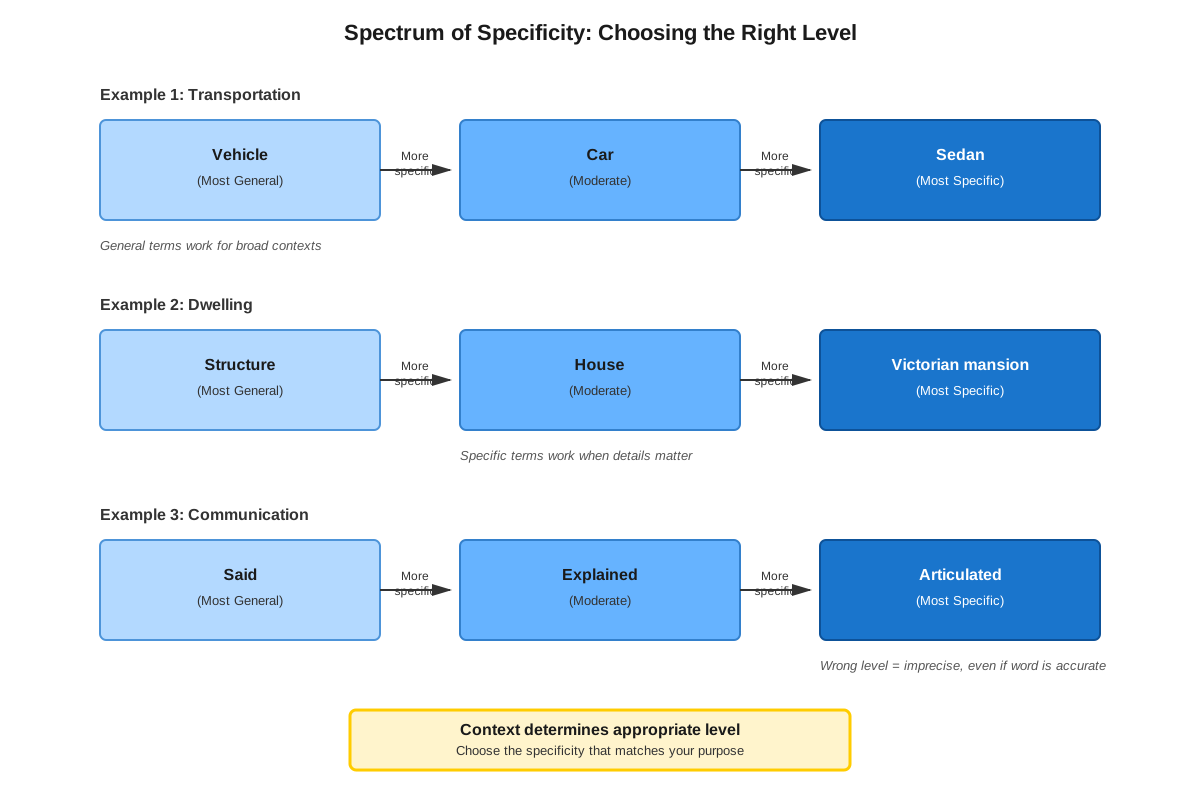
Common ways precision appears in ACT passages include: selecting between words with similar meanings but different connotations (e.g., "old" vs. "ancient" vs. "vintage"), choosing the appropriate level of specificity (e.g., "vehicle" vs. "car" vs. "sedan"), matching word choice to passage tone (formal vs. informal), and eliminating redundant or imprecise modifiers. Students who master precision gain a significant advantage because these questions reward careful reading and vocabulary knowledge rather than memorization of grammar rules.
Core Concepts
Understanding Precision in Context
Precision means selecting words that convey exactly the intended meaning with appropriate specificity and clarity. Unlike grammar questions that test mechanical correctness, precision questions evaluate whether a word accurately fits the context, tone, and purpose of the passage. The correct answer is not just grammatically correct—it must be the most accurate and appropriate choice for the specific situation.
Context is paramount in precision questions. A word that works perfectly in one passage may be completely inappropriate in another. Students must read the surrounding sentences carefully to understand what the passage is trying to communicate, who the intended audience is, and what tone the author is establishing. The ACT rewards students who can think beyond simple definitions and consider how words function within larger contexts.
Levels of Specificity
Words exist on a spectrum from general to specific. Consider this hierarchy: living thing → animal → mammal → dog → golden retriever. Each level provides more precise information. On the ACT, selecting the appropriate level of specificity is crucial.
| Too General | Appropriately Specific | Too Specific |
|---|---|---|
| "thing" | "device" | "iPhone 14 Pro Max" |
| "went" | "traveled" | "perambulated" |
| "good" | "beneficial" | "salutary" |
| "place" | "laboratory" | "the third-floor biochemistry lab" |
The correct answer typically provides enough detail to be clear without being unnecessarily specific. If a passage discusses scientific research generally, "laboratory" is more appropriate than "the third-floor biochemistry lab." However, if the passage focuses on a specific location, the more detailed term might be correct.
Connotation and Tone Matching
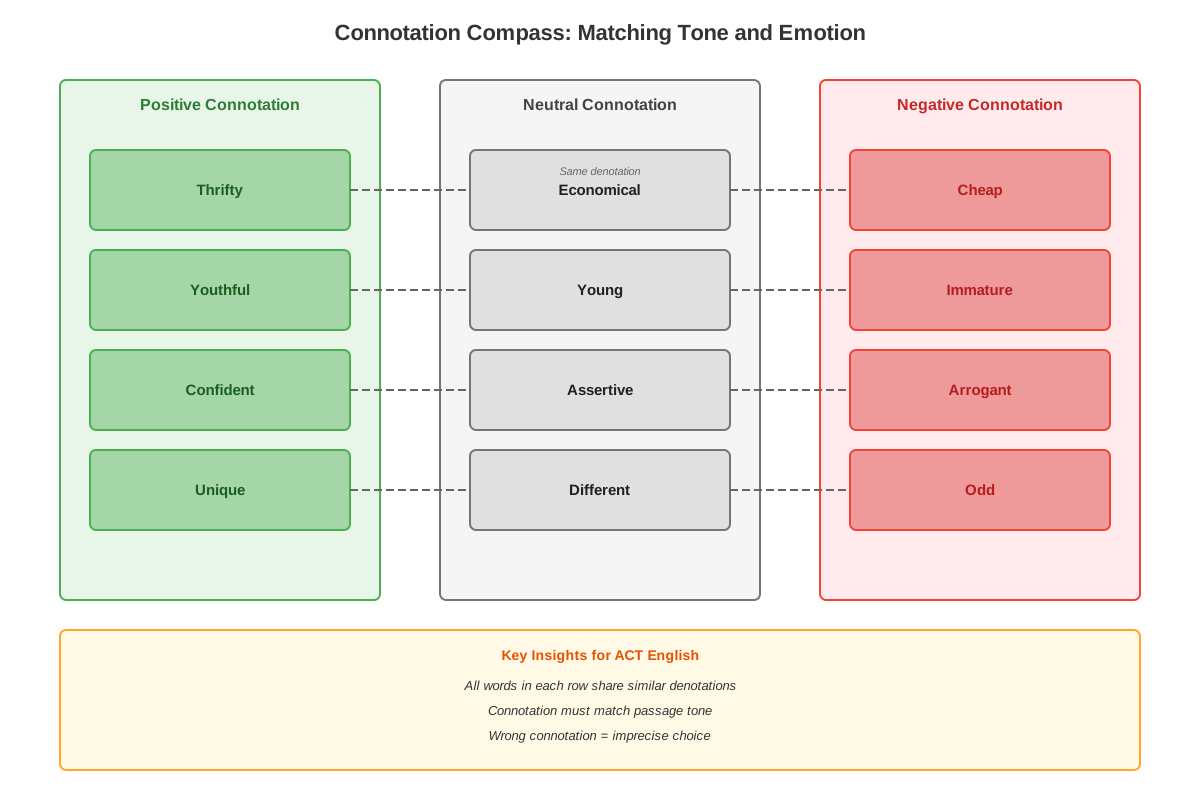
Words carry both denotation (literal meaning) and connotation (emotional associations). The ACT frequently tests whether students can distinguish between words with similar denotations but different connotations.
Consider these synonyms for "thin": slender, skinny, gaunt, svelte, emaciated. All denote a lack of body mass, but their connotations differ dramatically:
- Slender and svelte: positive, elegant
- Skinny: neutral to slightly negative, informal
- Gaunt: negative, suggesting illness or hardship
- Emaciated: strongly negative, suggesting severe malnutrition
The correct choice depends on the passage's tone and what the author wants to convey. A passage praising a dancer's physique would use "slender" or "svelte," while a passage about famine would use "gaunt" or "emaciated."
Redundancy and Imprecision
Precision also involves eliminating redundant or unnecessarily vague language. Redundancy occurs when words repeat information already conveyed. Common redundant phrases include:
- "past history" (history is always past)
- "advance planning" (planning is always in advance)
- "end result" (results come at the end)
- "completely unanimous" (unanimous means complete agreement)
Imprecision occurs when words are too vague to convey clear meaning. Words like "thing," "stuff," "very," "really," and "nice" often signal imprecision. The ACT rewards replacing vague terms with specific, descriptive alternatives.
Contextual Appropriateness
Beyond meaning and tone, words must fit the passage's register (level of formality) and purpose. Academic passages require formal vocabulary, while personal narratives may use conversational language. Scientific passages demand technical precision, while creative passages might prioritize vivid imagery.
Consider the word "kids" versus "children." Both refer to young people, but "kids" is informal and conversational, while "children" is more formal. In a scientific study about child development, "children" is appropriate. In a personal essay about summer camp, "kids" might fit better.
Idiomatic Precision
Some precision questions test knowledge of idioms and standard expressions. English contains many fixed phrases where only certain word combinations are correct:
- "different from" (not "different than" in formal writing)
- "comply with" (not "comply to")
- "capable of" (not "capable to")
These questions require familiarity with standard English usage and the ability to recognize when a phrase sounds wrong, even if the individual words are correct.
Concept Relationships
Precision connects to multiple aspects of ACT English testing. At its foundation, precision builds on vocabulary knowledge and reading comprehension—students must understand word meanings and passage context to make appropriate choices. Precision directly supports concision because eliminating redundancy requires recognizing when words repeat information. Both skills work together to create clear, efficient writing.
Precision also relates closely to style and tone questions. While style questions ask about overall writing quality and tone questions focus on the passage's attitude, precision questions zoom in on individual word choices that contribute to style and establish tone. A single imprecise word can undermine an entire passage's effectiveness.
The relationship map flows as follows: Reading Comprehension → enables → Context Understanding → informs → Precision in Word Choice → contributes to → Appropriate Tone → supports → Effective Style → results in → Clear Communication. Additionally, Vocabulary Knowledge → enhances → Precision in Word Choice, while Understanding Connotation → refines → Precision in Word Choice.
Precision also connects to grammar and usage because some precision questions involve selecting the correct word from commonly confused pairs (affect/effect, accept/except). However, true precision questions go beyond simple word confusion to test nuanced understanding of meaning and context.
Quick check — test yourself on Precision so far.
Try Flashcards →High-Yield Facts
⭐ Precision questions require reading the full sentence and surrounding context, not just the underlined portion.
⭐ The correct answer is the most specific, accurate, and contextually appropriate choice—not necessarily the most sophisticated vocabulary word.
⭐ Words with similar denotations often have different connotations that make only one appropriate for the passage's tone.
⭐ Redundant phrases repeat information already conveyed and should be eliminated or replaced with more precise language.
⭐ Vague words like "thing," "stuff," "very," and "really" are usually incorrect on precision questions.
- Formal passages require formal vocabulary; informal passages may use conversational language appropriately.
- The most obscure or sophisticated vocabulary word is often a trap answer—precision means appropriateness, not complexity.
- If two answer choices seem equally correct, examine connotation and specificity more carefully.
- Precision questions often test commonly confused words (affect/effect, imply/infer, fewer/less).
- The correct answer should maintain consistency with the passage's established vocabulary level and style.
- Idiomatic expressions have fixed word combinations; changing one word makes the phrase incorrect.
- Context clues in surrounding sentences often indicate which word choice is most appropriate.
Common Misconceptions
Misconception: The most sophisticated or impressive vocabulary word is always correct. → Correction: Precision means selecting the most appropriate word for the context, which is often a simple, clear term rather than an obscure one. Using "utilize" instead of "use" doesn't improve precision—it may actually introduce unnecessary complexity.
Misconception: Synonyms are interchangeable in all contexts. → Correction: While synonyms share similar meanings, they differ in connotation, formality, and specificity. "Cheap" and "inexpensive" both mean low-cost, but "cheap" has negative connotations (poor quality) while "inexpensive" is neutral or positive.
Misconception: Precision questions are just vocabulary tests. → Correction: While vocabulary knowledge helps, precision questions primarily test contextual understanding. A student might know all four answer choices but still need to read carefully to determine which fits the passage's tone, purpose, and meaning.
Misconception: Longer, more detailed answers are more precise. → Correction: Precision often involves concision. Adding unnecessary words or excessive detail reduces precision by obscuring the main point. "The large, enormous, gigantic building" is less precise than "the enormous building."
Misconception: If a word is grammatically correct, it's the right answer. → Correction: Precision questions test appropriateness, not just correctness. All four answer choices may be grammatically correct, but only one fits the context perfectly. Grammar is necessary but not sufficient for precision.
Misconception: Informal language is always wrong on the ACT. → Correction: The appropriateness of informal language depends on the passage's style and purpose. Personal narratives and creative passages may use informal language effectively, while academic passages require formal vocabulary.
Worked Examples
Example 1: Connotation and Tone
Passage Context: "The chef's innovative approach to traditional recipes has made her restaurant one of the most [underlined: popular] dining establishments in the city."
Answer Choices:
A. popular
B. famous
C. notorious
D. well-known
Step 1: Analyze the context
The passage discusses a chef's positive innovation and restaurant success. The tone is positive and complimentary.
Step 2: Evaluate each choice's connotation
- "Popular" (A): neutral to positive, suggests many people like it
- "Famous" (B): neutral, suggests wide recognition
- "Notorious" (C): negative, suggests fame for bad reasons
- "Well-known" (D): neutral, suggests recognition without judgment
Step 3: Consider specificity and appropriateness
"Notorious" is immediately wrong due to negative connotation. "Famous" and "well-known" are too neutral—they don't convey that people actually enjoy the restaurant, just that they know about it. "Popular" best captures both the restaurant's success and the positive reception of the chef's work.
Correct Answer: A (popular)
This question tests understanding that while all choices relate to being known, only "popular" carries the positive connotation appropriate for this context and specifically indicates that people favor the restaurant.
Example 2: Specificity and Redundancy
Passage Context: "The archaeologists carefully [underlined: examined and studied] the ancient artifacts discovered at the excavation site."
Answer Choices:
A. examined and studied
B. examined
C. looked at and examined
D. studied and investigated thoroughly
Step 1: Identify redundancy
"Examined" and "studied" are essentially synonymous in this context—both mean to look at something carefully to understand it. Using both is redundant.
Step 2: Evaluate alternatives
- Choice A: redundant (examined and studied mean the same thing)
- Choice B: precise and concise
- Choice C: redundant and less precise ("looked at" is vague)
- Choice D: redundant and wordy ("thoroughly" is implied by "studied and investigated")
Step 3: Apply the precision principle
The most precise answer eliminates redundancy while maintaining meaning. "Examined" alone conveys the careful, professional study that archaeologists conduct.
Correct Answer: B (examined)
This question demonstrates that precision often involves eliminating redundancy. The single word "examined" is more precise than multiple synonyms because it conveys the meaning clearly without unnecessary repetition.
Exam Strategy
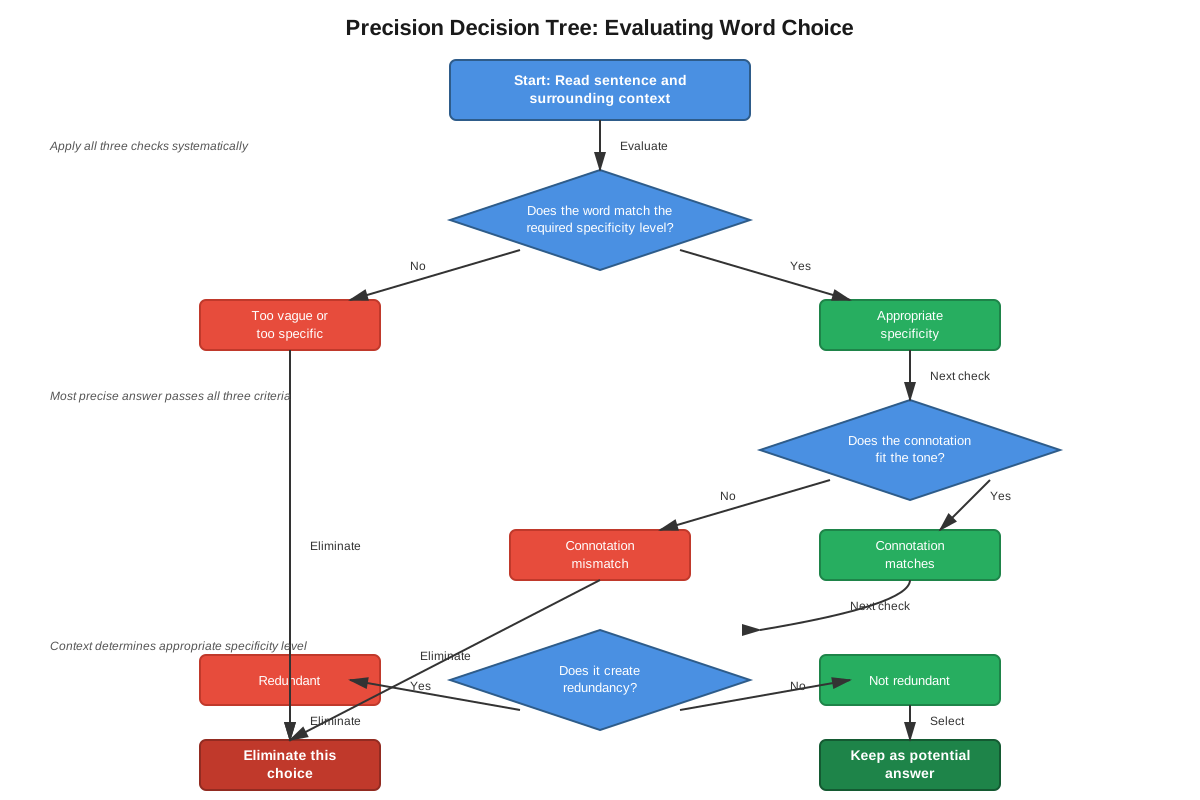
When approaching precision questions on the ACT, follow this systematic process:
1. Read the full sentence and surrounding context before looking at answer choices. Understanding what the passage is trying to communicate is essential for selecting the appropriate word.
2. Identify what's being tested: Is the question about specificity, connotation, redundancy, or contextual appropriateness? This helps narrow your focus.
3. Watch for trigger words and phrases in the question stem:
- "Most specific" signals a specificity question
- "Best maintains the tone" indicates a connotation question
- "Most clearly expresses" suggests precision and clarity
- "Most appropriate" requires contextual evaluation
4. Eliminate obviously wrong answers first:
- Words with inappropriate connotations for the passage's tone
- Redundant phrases that repeat information
- Overly vague or overly specific terms
- Words that don't fit the passage's formality level
5. Compare remaining choices carefully: When down to two answers, examine subtle differences in connotation, specificity, and contextual fit. Often, one will be slightly more precise or appropriate.
6. Trust your ear: If a word sounds wrong in context, it probably is. Read the sentence aloud mentally with each answer choice.
7. Time allocation: Precision questions should take 20-30 seconds each. If you're spending more than 45 seconds, make your best choice and move on. These questions reward quick, confident decision-making based on context.
Exam Tip: When stuck between two answers, choose the simpler, more direct option. The ACT rarely rewards unnecessarily complex vocabulary over clear, appropriate word choice.
Memory Techniques
PRECISE Acronym for evaluating word choices:
- Purpose: Does the word fit the passage's purpose?
- Redundancy: Does it repeat information already stated?
- Emotional tone: Does the connotation match the passage's tone?
- Context: Does it fit the surrounding sentences?
- Idiom: Is it part of a standard expression?
- Specificity: Is it appropriately specific or general?
- Elegance: Is it the simplest, clearest choice?
The Goldilocks Principle: Like Goldilocks seeking the "just right" porridge, precision requires finding the word that's not too general, not too specific, not too formal, not too casual—but just right for the context.
Connotation Visualization: Picture a spectrum from negative to positive. Place synonyms along this spectrum to visualize their emotional associations. For example: emaciated (very negative) → gaunt (negative) → thin (neutral) → slender (positive) → svelte (very positive).
The Redundancy Red Flag: Train yourself to hear alarm bells when you see paired synonyms. Phrases like "each and every," "hopes and desires," or "first and foremost" should trigger immediate scrutiny.
Context Circle Technique: Mentally draw a circle around the underlined word and the 2-3 sentences surrounding it. This visual reminder helps you read enough context without getting lost in the entire passage.
Summary
Precision in ACT English tests the ability to select the most accurate, specific, and contextually appropriate word or phrase. Unlike grammar questions with rule-based answers, precision questions require careful reading of context to evaluate word choices based on connotation, specificity, tone, and appropriateness. The correct answer is not necessarily the most sophisticated vocabulary word but rather the one that best fits the passage's purpose, audience, and style. Students must distinguish between synonyms with different connotations, recognize redundancy, identify appropriate levels of specificity, and match word choices to passage tone. Mastering precision requires strong vocabulary knowledge, careful reading comprehension, and the ability to think critically about subtle differences in meaning. These questions appear frequently on the ACT and significantly impact rhetorical skills subscores, making precision a high-yield topic for focused study and practice.
Key Takeaways
- Precision questions test contextual appropriateness, not just vocabulary knowledge—always read surrounding sentences before selecting an answer
- Words with similar denotations often have different connotations that make only one appropriate for the passage's tone and purpose
- The correct answer is typically the most specific, clear, and direct choice that fits the context, not the most impressive or complex vocabulary word
- Redundancy reduces precision—eliminate answer choices that repeat information already conveyed in the sentence
- Context determines appropriateness: formal passages require formal vocabulary, while informal passages may use conversational language effectively
- When evaluating answer choices, consider the PRECISE criteria: Purpose, Redundancy, Emotional tone, Context, Idiom, Specificity, and Elegance
- Trust your ear and read sentences aloud mentally with each answer choice to identify words that sound wrong in context
Related Topics
Concision: While precision focuses on selecting the right words, concision addresses eliminating unnecessary words. Together, these skills create clear, efficient writing. Mastering precision provides the foundation for understanding concision because you must first know which words are appropriate before determining which are necessary.
Style and Tone: Precision contributes directly to establishing and maintaining appropriate style and tone throughout a passage. Understanding precision helps students recognize how individual word choices create overall stylistic effects.
Word Choice and Diction: This broader category encompasses precision but also includes figurative language, imagery, and rhetorical devices. Precision skills transfer directly to more advanced diction analysis.
Grammar and Usage: Some precision questions overlap with grammar, particularly regarding commonly confused words (affect/effect, fewer/less). Strong precision skills complement grammar knowledge for comprehensive ACT English mastery.
Reading Comprehension: The ability to understand context, identify main ideas, and recognize tone—all essential for precision—directly supports reading comprehension skills tested in the ACT Reading section.
Practice CTA
Now that you've mastered the core concepts of precision, it's time to put your knowledge into action! Attempt the practice questions to reinforce your understanding and build confidence with ACT-style precision questions. Use the flashcards to memorize key distinctions between commonly confused words and internalize the PRECISE evaluation criteria. Remember, precision improves with practice—each question you work through strengthens your ability to quickly identify contextually appropriate word choices. You've built a strong foundation; now apply these strategies to achieve your target score!
Sign up free to keep reading
Create a free AnvayaPrep account to finish this ACT guide on Precision — plus flashcards and practice questions.