Overview
Revision for clarity is one of the most frequently tested rhetorical skills on the ACT English section. This topic assesses a student's ability to recognize and correct unclear, ambiguous, or confusing writing by selecting the most precise and straightforward expression of an idea. Unlike grammar questions that focus on mechanical correctness, clarity questions evaluate whether a sentence or passage communicates its intended meaning effectively to readers.
On the ACT, approximately 15-20% of English questions test rhetorical skills related to clarity, making this a high-yield topic for score improvement. These questions typically present a sentence or phrase that is grammatically correct but unclear, wordy, or ambiguous, then ask students to choose the revision that best expresses the idea. Success on these questions requires understanding that good writing prioritizes directness, specificity, and logical flow over elaborate or unnecessarily complex constructions.
ACT revision for clarity connects closely to other rhetorical skills including concision, word choice, and organization. While concision focuses on eliminating redundancy, clarity emphasizes making meaning unmistakable. Both skills work together to create effective communication. Understanding clarity also supports success with transition questions, sentence placement, and paragraph organization, as clear writing naturally flows more logically from one idea to the next.
Learning Objectives
- [ ] Identify when Revision for clarity is being tested on the ACT English section
- [ ] Explain the core rule or strategy behind Revision for clarity
- [ ] Apply Revision for clarity to ACT-style questions accurately
- [ ] Distinguish between grammatically correct but unclear writing and clear, effective writing
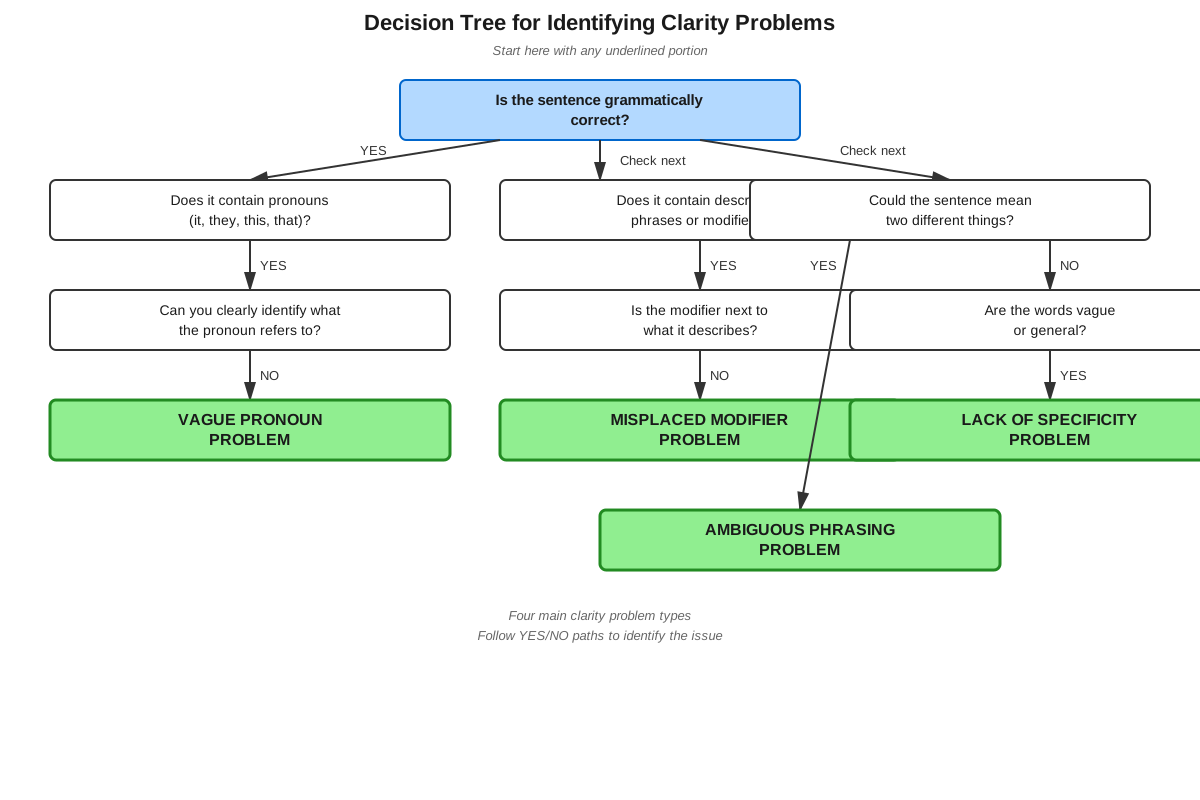
- [ ] Recognize common clarity problems including vague pronouns, misplaced modifiers, and ambiguous phrasing
- [ ] Evaluate multiple answer choices to select the option that most clearly expresses an idea
- [ ] Analyze context to determine which revision best fits the passage's meaning and tone
Prerequisites
- Basic sentence structure: Understanding subjects, verbs, and objects helps identify what a sentence is trying to communicate and whether that communication is clear
- Pronoun-antecedent relationships: Recognizing what pronouns refer to is essential for identifying vague or ambiguous pronoun usage
- Modifier placement: Knowing how modifiers relate to the words they describe enables recognition of confusing or misplaced descriptive phrases
- Reading comprehension: Understanding passage context and author's intent is necessary to evaluate which revision best clarifies meaning
Why This Topic Matters
In real-world communication, clarity determines whether writing achieves its purpose. Unclear writing in professional emails, academic papers, or technical documentation can lead to misunderstandings, errors, and wasted time. The ability to revise for clarity is a fundamental skill for college writing, where professors expect students to express complex ideas precisely and unambiguously.
On the ACT English section, clarity questions appear in approximately 8-12 questions per test, making them one of the most common question types. These questions typically appear as underlined portions within passages, with the question stem asking "Which choice most clearly expresses the idea?" or "Which choice provides the most specific and relevant information?" Unlike grammar questions with definitive right answers based on rules, clarity questions require judgment about effectiveness and precision.
Clarity questions commonly appear in several formats: selecting the most specific word or phrase, eliminating ambiguous pronoun references, correcting misplaced modifiers that create confusion, choosing between vague and precise descriptions, and determining which sentence structure most logically presents information. These questions often include answer choices that are all grammatically correct, requiring students to evaluate effectiveness rather than correctness alone.
Core Concepts
What Makes Writing Clear
Clear writing communicates its intended meaning immediately and unambiguously to readers. Three fundamental principles define clarity: specificity (using precise rather than vague language), directness (presenting ideas in straightforward rather than convoluted ways), and logical structure (organizing information so relationships between ideas are obvious).
Specificity means choosing words that convey exact meanings rather than general or ambiguous ones. For example, "The scientist examined the specimen" is clearer than "The person looked at the thing" because it provides precise information about who did what to what. On the ACT, questions testing specificity often present a vague word or phrase and ask students to select a more precise alternative that fits the context.
Directness involves expressing ideas in the most straightforward manner possible without unnecessary complexity. While sophisticated vocabulary and varied sentence structures enhance writing, they should never obscure meaning. A sentence like "It was the decision of the committee to postpone the meeting" is less direct than "The committee decided to postpone the meeting." The second version places the actor (committee) and action (decided) in clear subject-verb relationship.
Vague Pronoun References
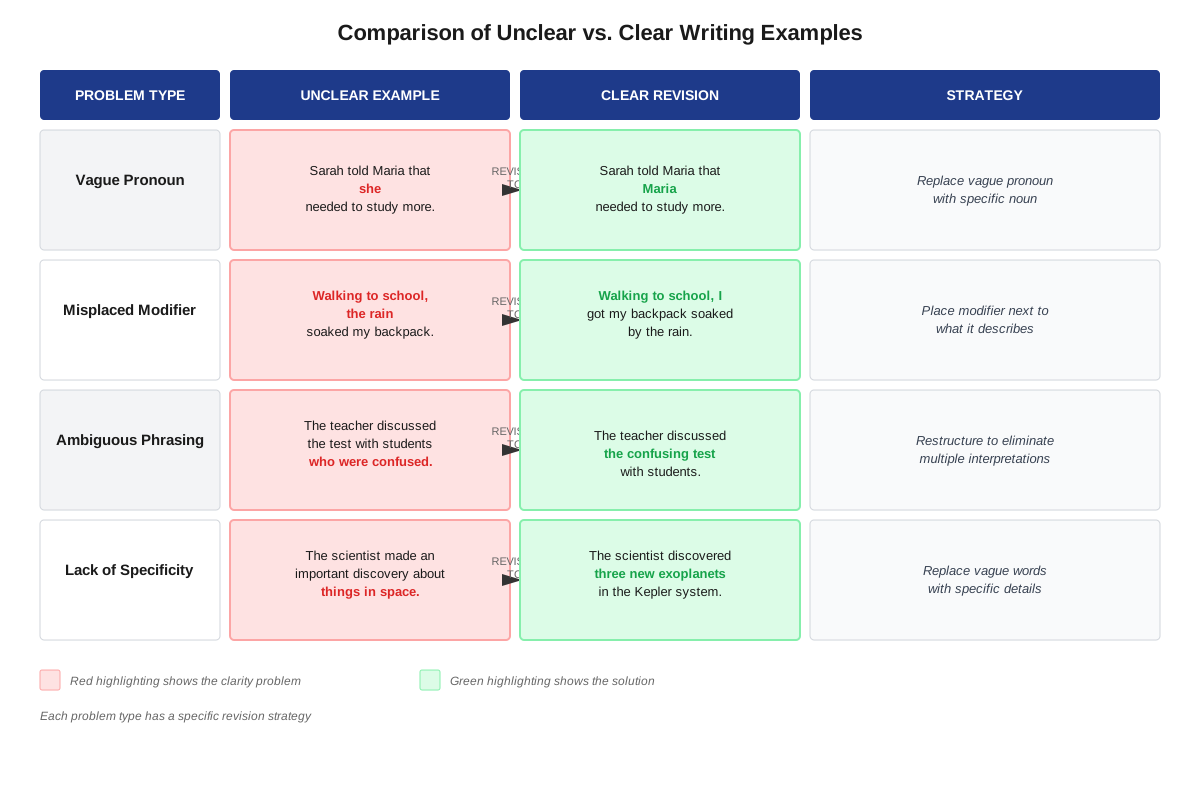
Vague pronoun references occur when a pronoun could refer to multiple antecedents or when the antecedent is unclear or missing entirely. This is one of the most common clarity problems on the ACT. Consider: "Sarah told Maria that she needed to revise her essay." The pronouns "she" and "her" could refer to either Sarah or Maria, creating ambiguity about who needs to revise whose essay.
To fix vague pronoun references, replace the pronoun with a specific noun or restructure the sentence to eliminate ambiguity. The example above could be revised to: "Sarah told Maria to revise her essay" or "Sarah told Maria, 'You need to revise your essay.'" Both revisions make the meaning unmistakable.
The ACT frequently tests pronouns like "it," "this," "that," "they," and "which" when they lack clear antecedents. Watch especially for "this" or "that" at the beginning of a sentence referring vaguely to an entire previous idea rather than a specific noun.
Misplaced and Dangling Modifiers
Misplaced modifiers are descriptive words or phrases positioned so they appear to modify the wrong element in a sentence, creating confusion or unintended meanings. "Walking down the street, the trees looked beautiful" suggests the trees were walking, when the writer meant a person walking saw beautiful trees. The modifier "walking down the street" should be placed next to the person doing the walking.
Dangling modifiers occur when the word being modified doesn't appear in the sentence at all. "After studying all night, the test was easy" leaves unclear who studied all night—the test certainly didn't. Correction requires adding the missing subject: "After studying all night, I found the test easy."
On the ACT, modifier questions test clarity by presenting sentences where the modifier's placement creates ambiguity or illogical meaning. The correct answer repositions the modifier or restructures the sentence so the relationship between modifier and modified element is clear.
Ambiguous Sentence Structure
Ambiguous sentence structure creates confusion about relationships between ideas or about which words modify which other words. Consider: "The professor told students who missed class frequently fail." Does this mean the professor told students something, or that students who miss class frequently fail? Punctuation and structure clarify: "The professor told students that those who miss class frequently fail" or "The professor told students, 'Students who miss class frequently fail.'"
Parallel structure contributes to clarity by presenting similar ideas in similar grammatical forms. "The job requires writing reports, to attend meetings, and presentation skills" mixes gerunds, infinitives, and nouns confusingly. Revision to parallel form clarifies: "The job requires writing reports, attending meetings, and presenting findings."
Wordiness vs. Clarity
While wordiness and lack of clarity often overlap, they are distinct issues. Wordiness involves using more words than necessary; lack of clarity involves using words that don't precisely convey meaning. "Due to the fact that" is wordy (better: "because") but not necessarily unclear. However, "The thing that happened was unexpected" is both wordy and unclear because "thing" and "happened" are vague.
The ACT tests the distinction by including answer choices that are concise but unclear alongside choices that are both clear and concise. The best answer prioritizes clarity first, then concision. If a slightly longer option is significantly clearer, it's the better choice.
Context-Dependent Clarity
Context determines what counts as clear writing. A technical term that's perfectly clear to specialists might confuse general readers. On the ACT, always consider the passage's audience and purpose when evaluating clarity. If a passage discusses a scientific topic for a general audience, replacing jargon with accessible language improves clarity. If the passage addresses specialists, technical terms may be appropriately clear.
The surrounding sentences provide crucial context for determining which revision is clearest. A pronoun that seems vague in isolation might be perfectly clear given the previous sentence. Always read at least one sentence before and after the underlined portion before selecting an answer.
Concept Relationships
The core concepts of revision for clarity form an interconnected system where each element supports the others. Specificity serves as the foundation—using precise language prevents vague pronoun references and reduces ambiguous sentence structures. When writers choose specific nouns over general ones, pronouns become clearer because their antecedents are more distinct.
Directness builds on specificity by organizing precise language into straightforward structures. Direct sentence construction naturally positions modifiers correctly because it places actors and actions in logical subject-verb relationships. This connection means that fixing a misplaced modifier often involves making the sentence more direct: "The trees looked beautiful to me as I walked down the street" is both more direct and correctly positions the modifier.
Logical structure emerges from combining specificity and directness with attention to how ideas relate. Ambiguous sentence structures often result from trying to pack too many ideas into one sentence without clear signals about their relationships. Breaking complex sentences into simpler ones or adding transitional phrases improves both structure and clarity.
The relationship between wordiness and clarity is complementary rather than identical. Eliminating wordiness often improves clarity by removing distracting unnecessary words, but concision alone doesn't guarantee clarity. The optimal revision is both concise and clear, but when forced to choose, clarity takes precedence.
Context-dependent clarity acts as the governing principle that determines how all other concepts apply in specific situations. What counts as specific, direct, or logically structured depends on the passage's purpose, audience, and surrounding content. This relationship means students must always evaluate answer choices within context rather than applying rigid rules.
High-Yield Facts
- ⭐ Clarity questions ask "Which choice most clearly expresses the idea?" or similar phrasing, signaling that all options may be grammatically correct
- ⭐ Vague pronouns (it, this, that, they, which) without clear antecedents are the most common clarity problem on the ACT
- ⭐ The clearest answer choice uses specific nouns rather than general terms or pronouns when meaning could be ambiguous
- ⭐ Modifiers should be placed immediately next to the words they modify to avoid confusion
- ⭐ When a sentence could mean two different things, the ACT considers it unclear regardless of grammatical correctness
- Direct subject-verb-object construction is typically clearer than passive voice or complex clause structures
- "This" or "that" at the beginning of a sentence often signals a vague reference problem
- Parallel structure (presenting similar ideas in similar grammatical forms) enhances clarity
- The correct answer to clarity questions must fit the passage's context and maintain consistent tone
- Reading one sentence before and after the underlined portion is essential for evaluating clarity
- Clarity questions often include one answer that's concise but vague and another that's slightly longer but much clearer—choose clarity
- Technical terms are clear only if the passage's audience would understand them
- Ambiguous comparisons ("more than them") need clarification about what's being compared
- Pronouns should agree in number with their antecedents, but even grammatically correct pronouns can be unclear if multiple antecedents are possible
Quick check — test yourself on Revision for clarity so far.
Try Flashcards →Common Misconceptions
Misconception: The shortest answer is always the clearest. → Correction: While concision generally improves clarity, the shortest option may be too vague or omit necessary information. The clearest answer provides enough detail to make meaning unmistakable, even if it's slightly longer than other options.
Misconception: If a pronoun is grammatically correct (agrees in number and case), it's clear. → Correction: Grammatical correctness doesn't guarantee clarity. A pronoun can agree perfectly with its antecedent but still be unclear if multiple possible antecedents exist or if the reference requires readers to look back several sentences.
Misconception: Complex vocabulary and sentence structures make writing clearer by sounding more sophisticated. → Correction: Complexity often obscures meaning. Clear writing uses the simplest language and structure that accurately conveys the intended idea. Sophistication should enhance, not replace, clarity.
Misconception: Clarity questions have subjective answers based on personal preference. → Correction: While clarity involves judgment, ACT questions have definitively correct answers based on objective criteria: specificity, directness, logical structure, and fit with context. The correct answer is demonstrably clearer than alternatives.
Misconception: Context doesn't matter for clarity—a clear sentence is clear in any situation. → Correction: Context is essential for clarity. A revision that's clear in one passage might be confusing in another. Always evaluate answer choices based on the surrounding sentences, the passage's purpose, and the intended audience.
Misconception: Passive voice is always unclear and should be avoided. → Correction: While active voice is generally more direct, passive voice is sometimes clearer, especially when the action's recipient is more important than the actor or when the actor is unknown. Choose the voice that most clearly expresses the idea in context.
Worked Examples
Example 1: Vague Pronoun Reference
Passage Context: "The museum curator and the artist discussed the new exhibition. She was concerned about the lighting in the gallery."
Question: Which choice most clearly expresses who was concerned about the lighting?
Answer Choices:
- A) NO CHANGE
- B) The curator was concerned
- C) She, the curator, was concerned
- D) Being concerned
Analysis:
Step 1: Identify the clarity problem. The pronoun "she" could refer to either the curator or the artist, creating ambiguity about who was concerned.
Step 2: Evaluate each answer choice for clarity.
- Choice A maintains the vague pronoun, leaving the meaning unclear
- Choice B replaces the pronoun with a specific noun, making it unmistakably clear that the curator was concerned
- Choice C attempts to clarify by adding an appositive, but the structure is awkward and still begins with the vague pronoun
- Choice D creates a dangling modifier and doesn't specify who was concerned
Step 3: Select the clearest option. Choice B directly states "The curator was concerned," eliminating all ambiguity. This revision uses a specific noun instead of a pronoun, following the principle that specificity enhances clarity.
Correct Answer: B
Connection to Learning Objectives: This example demonstrates identifying when clarity is being tested (vague pronoun), explaining the core strategy (replace vague pronouns with specific nouns), and applying the strategy to select the clearest answer.
Example 2: Misplaced Modifier and Ambiguous Structure
Passage Context: "After working on the project for months, the deadline was finally extended by the committee."
Question: Which choice most clearly and logically expresses the idea?
Answer Choices:
- A) NO CHANGE
- B) the committee finally extended the deadline
- C) the extension of the deadline was finally done by the committee
- D) finally, the deadline's extension was done
Analysis:
Step 1: Identify the clarity problem. The opening modifier "After working on the project for months" appears to modify "the deadline," creating the illogical suggestion that the deadline worked on the project. This is a dangling modifier. Additionally, the passive voice ("was extended") makes the sentence less direct.
Step 2: Evaluate each answer choice.
- Choice A maintains the dangling modifier and passive construction
- Choice B corrects the modifier problem by making "the committee" the subject, which can logically work on a project. It also uses active voice ("extended") for directness
- Choice C still has the dangling modifier problem and uses awkward passive construction
- Choice D maintains the dangling modifier and creates an unnecessarily complex noun phrase
Step 3: Consider context and logic. The sentence should indicate that someone (the committee) worked on the project and then extended the deadline. Choice B makes this relationship clear by placing the committee as the subject who performs both actions (implied working, explicit extending).
Step 4: Apply clarity principles. Choice B is most specific (names the committee as actor), most direct (active voice, clear subject-verb), and most logically structured (modifier can logically apply to the subject).
Correct Answer: B
Connection to Learning Objectives: This example shows how to identify multiple clarity issues (dangling modifier, passive voice), explain the strategy (make the logical actor the subject, use active voice), and apply these principles to select the answer that most clearly expresses the idea.
Exam Strategy
Recognizing Clarity Questions
Clarity questions typically include specific trigger phrases in the question stem: "Which choice most clearly expresses the idea?", "Which choice provides the most specific information?", "Which choice is clearest and most logical?", or "Which choice best maintains the sentence's focus?" When you see these phrases, shift from grammar-checking mode to clarity-evaluation mode.
Unlike grammar questions where you can often spot errors immediately, clarity questions require reading context. Always read at least one full sentence before and one after the underlined portion. This context reveals what the sentence is trying to communicate and whether the current version succeeds.
Systematic Approach
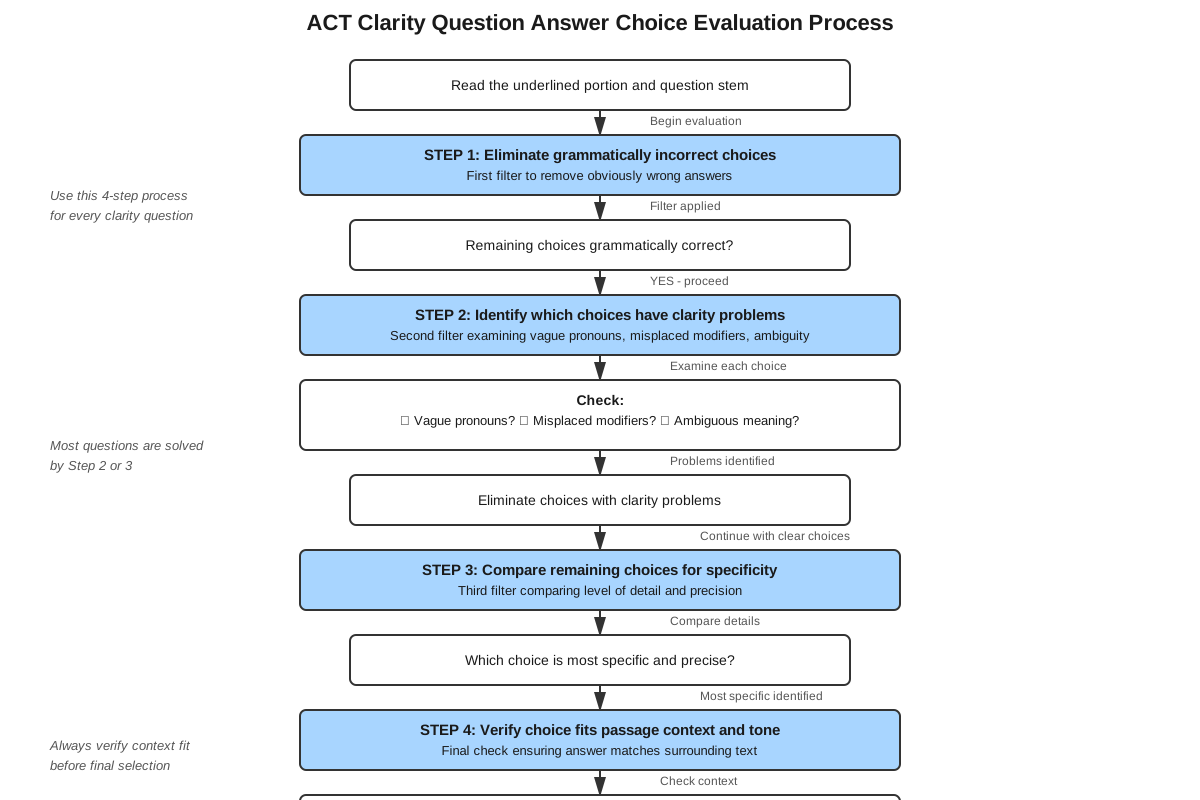
Use this four-step process for every clarity question:
- Read for meaning: Understand what the sentence is trying to say within the passage context
- Identify the clarity problem: Determine whether the issue involves vague pronouns, misplaced modifiers, ambiguous structure, or lack of specificity
- Eliminate clearly wrong answers: Remove options that are grammatically incorrect, change the intended meaning, or are obviously less clear
- Compare remaining choices: Select the option that most directly, specifically, and logically expresses the idea
Process of Elimination Tips
When multiple answers seem acceptable, use these specific elimination criteria:
- Eliminate any choice with a pronoun that could refer to multiple antecedents
- Eliminate choices where modifiers don't clearly connect to what they modify
- Eliminate options that use vague words ("thing," "stuff," "aspect") when specific alternatives exist
- Eliminate answers that require readers to reread or puzzle out the meaning
- Keep the choice that would be clearest to someone reading the passage for the first time
Time Management
Clarity questions often take longer than grammar questions because they require contextual reading and judgment. Budget approximately 45-60 seconds per clarity question, including time to read surrounding context. If you're stuck between two answers, trust the more specific and direct option—the ACT consistently favors these qualities.
Don't overthink clarity questions. The correct answer should feel noticeably clearer than alternatives. If you find yourself constructing elaborate justifications for why an answer might work, it's probably wrong. Clear writing doesn't require explanation; it communicates immediately.
Common Trap Answers
The ACT includes predictable wrong answers on clarity questions:
- The concise but vague option: Short but uses pronouns or general terms that don't clearly convey meaning
- The grammatically perfect but ambiguous option: Follows all grammar rules but could mean multiple things
- The overly complex option: Uses sophisticated vocabulary or structure that obscures rather than clarifies meaning
- The technically accurate but contextually inappropriate option: Clear in isolation but doesn't fit the passage's tone or purpose
Memory Techniques
The CLEAR Acronym
Use CLEAR to remember the five key principles of clarity:
- Context: Always read surrounding sentences
- Logical structure: Ideas should flow in sensible order
- Eliminate vagueness: Replace pronouns and general terms with specific nouns
- Adjacent placement: Put modifiers next to what they modify
- Readable directness: Use straightforward subject-verb-object construction
The Pronoun Test
When evaluating pronoun clarity, use this mental test: "Can I point to exactly one noun that this pronoun replaces?" If you hesitate or can point to multiple possibilities, the pronoun is vague. Visualize physically pointing at the antecedent—if your finger wavers between options, choose the answer that replaces the pronoun with a specific noun.
The "First-Time Reader" Visualization
Imagine someone reading the passage for the first time with no background knowledge. Would they immediately understand the sentence, or would they need to pause and figure it out? Clear writing works for first-time readers. Visualize yourself as this reader to evaluate which answer choice communicates most effectively.
The Modifier Proximity Rule
Remember: "Modifiers marry their matches." A modifier should be immediately adjacent to (married to) the word it modifies. Visualize drawing an arrow from the modifier to what it describes—the shorter the arrow, the clearer the sentence.
Summary
Revision for clarity is a high-yield ACT English topic that tests whether students can identify and correct unclear, ambiguous, or confusing writing. Unlike grammar questions that focus on mechanical correctness, clarity questions evaluate effectiveness of communication through specificity, directness, and logical structure. The most common clarity problems include vague pronoun references (pronouns that could refer to multiple antecedents), misplaced or dangling modifiers (descriptive phrases positioned so they modify the wrong element or nothing at all), and ambiguous sentence structures (constructions that could mean multiple things). Success on clarity questions requires reading context to understand intended meaning, identifying which specific clarity problem exists, and selecting the answer choice that most precisely and straightforwardly expresses the idea. The correct answer prioritizes clear communication over brevity or sophistication, using specific nouns instead of vague pronouns, placing modifiers adjacent to what they modify, and organizing ideas in logical, direct structures that readers can understand immediately without rereading or puzzling out meaning.
Key Takeaways
- Clarity questions ask "Which choice most clearly expresses the idea?" and require evaluating effectiveness rather than just grammatical correctness
- Vague pronouns without clear antecedents are the most frequently tested clarity problem—replace them with specific nouns
- Modifiers must be placed immediately next to the words they modify to avoid confusion or illogical meanings
- Always read surrounding context (at least one sentence before and after) to evaluate which revision is clearest
- The clearest answer uses specific language, direct structure, and logical organization—even if it's slightly longer than alternatives
- When multiple answers are grammatically correct, choose the one that communicates meaning most immediately and unambiguously
- Context determines clarity—consider the passage's audience, purpose, and tone when evaluating answer choices
Related Topics
Concision and Redundancy: While clarity focuses on making meaning unmistakable, concision emphasizes eliminating unnecessary words. Mastering clarity provides the foundation for concision because you must first ensure meaning is clear before removing any words. Together, these skills create writing that is both precise and efficient.
Word Choice and Tone: Selecting the most appropriate word involves both clarity (choosing words that precisely convey meaning) and tone (choosing words that fit the passage's style). Understanding clarity helps with word choice questions because the clearest word is often the most appropriate one.
Transitions and Logical Flow: Clear writing naturally flows more logically from one idea to the next. The skills developed in revision for clarity—especially understanding how ideas relate and structuring sentences logically—directly support success with transition questions and paragraph organization.
Sentence Structure and Style: Many clarity problems stem from overly complex or poorly structured sentences. Mastering clarity deepens understanding of how sentence structure affects meaning, preparing students for advanced questions about style, emphasis, and rhetorical effect.
Practice CTA
Now that you understand the principles of revision for clarity, it's time to apply these skills to ACT-style questions. The practice questions and flashcards will help you recognize clarity problems quickly, evaluate answer choices systematically, and build confidence in selecting the clearest revision. Remember that clarity questions reward careful reading and thoughtful analysis—skills that improve with focused practice. Each question you work through strengthens your ability to communicate effectively, a skill that will serve you well beyond the ACT. Start practicing now to transform your understanding into exam success!
Sign up free to keep reading
Create a free AnvayaPrep account to finish this ACT guide on Revision for clarity — plus flashcards and practice questions.