Overview
Sentence placement is one of the most frequently tested rhetorical skills on the ACT English section, appearing in approximately 2-4 questions per test. These questions assess a student's ability to determine the most logical position for a sentence within a paragraph or passage, requiring careful analysis of context, transitions, and logical flow. Unlike grammar-focused questions that test mechanical correctness, sentence placement questions evaluate reading comprehension, organizational logic, and the ability to recognize how ideas connect within written discourse.
Mastering ACT sentence placement questions is essential because they directly test critical thinking and organizational skills that extend beyond the exam itself. These questions require students to understand not just individual sentences, but how information builds coherently throughout a paragraph. Students must identify transitional cues, chronological sequences, cause-and-effect relationships, and thematic connections that determine where a sentence belongs. The ability to recognize proper sentence placement demonstrates sophisticated reading comprehension and an understanding of effective writing structure.
Within the broader context of ACT English Rhetorical Skills, sentence placement connects intimately with other organizational and stylistic concepts. It relates to paragraph transitions, topic sentences, supporting details, and overall passage organization. Students who excel at sentence placement typically also perform well on questions about adding or deleting sentences, determining paragraph order, and identifying main ideas. This topic serves as a bridge between micro-level sentence structure and macro-level passage organization, making it a cornerstone skill for achieving a high English subscore.
Learning Objectives
- [ ] Identify when sentence placement is being tested on the ACT
- [ ] Explain the core rule or strategy behind sentence placement
- [ ] Apply sentence placement strategies to ACT-style questions accurately
- [ ] Analyze transitional words and phrases that signal logical sentence order
- [ ] Evaluate multiple placement options by testing each position systematically
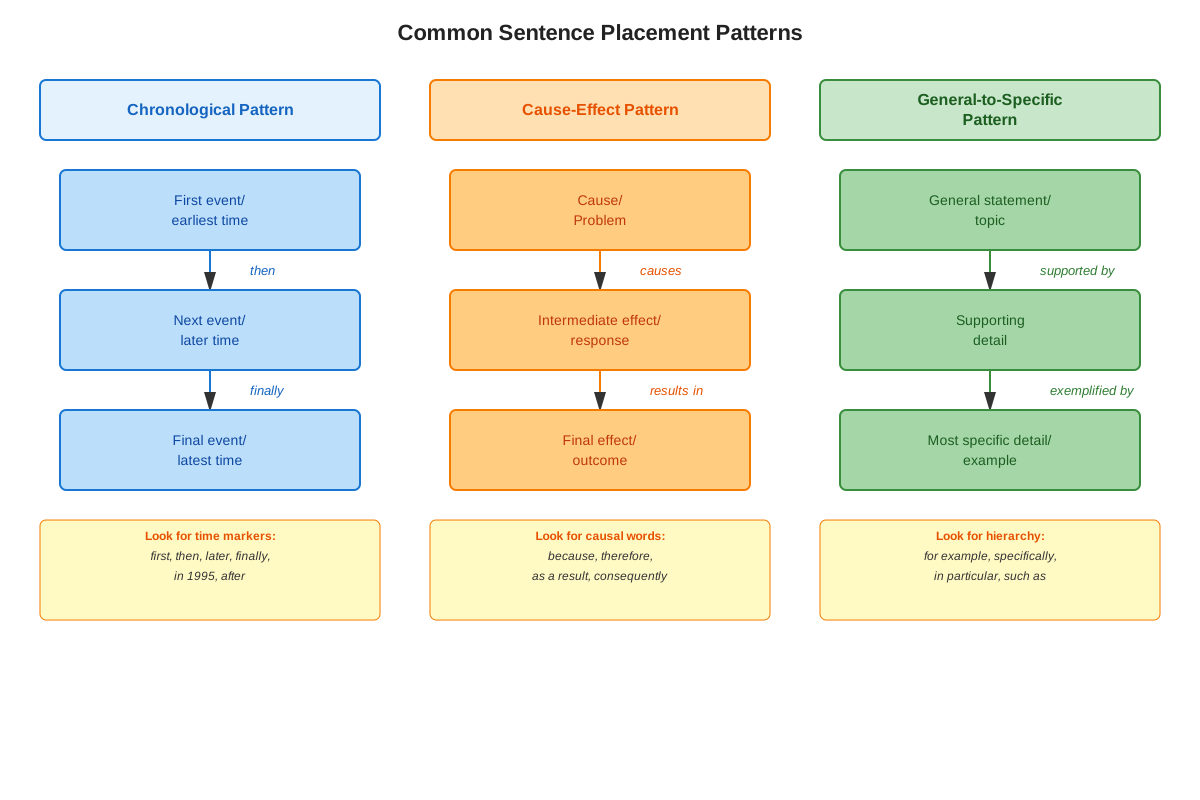
- [ ] Recognize common sentence placement patterns (chronological, cause-effect, general-to-specific)
- [ ] Distinguish between sentences that introduce, support, or conclude ideas within paragraphs
Prerequisites
- Basic paragraph structure: Understanding topic sentences, supporting details, and concluding sentences is essential because sentence placement questions require recognizing where different types of sentences belong within paragraph organization.
- Transitional words and phrases: Familiarity with words like "however," "therefore," "for example," and "additionally" is necessary because these signal relationships between ideas and provide crucial clues for determining correct placement.
- Pronoun reference: Knowledge of how pronouns refer to antecedents helps because a sentence containing "this," "these," or "it" must be placed after the noun it references.
- Reading comprehension: The ability to understand main ideas and supporting details is fundamental because sentence placement requires grasping the overall meaning and logical progression of a paragraph.
Why This Topic Matters
Sentence placement questions appear with remarkable consistency on every ACT English test, typically comprising 3-5% of all English questions. This translates to 2-4 questions per exam, making it a high-yield topic that can significantly impact overall scores. These questions are particularly valuable because they tend to be more straightforward than some grammar questions once students learn the systematic approach to solving them, offering reliable points for well-prepared test-takers.
In real-world applications, the skills tested by sentence placement questions are fundamental to effective written communication. Professional writing, academic essays, business correspondence, and technical documentation all require the ability to organize information logically. Writers must constantly decide where to position information for maximum clarity and impact. The ability to recognize proper sentence placement reflects sophisticated understanding of how readers process information and how ideas build upon one another to create coherent arguments or narratives.
On the ACT, sentence placement questions typically appear in a distinctive format: a numbered sentence appears in brackets within a paragraph, followed by a question asking where the sentence would most logically be placed. The answer choices usually include "where it is now" plus three alternative positions (often marked as "after Sentence 1," "after Sentence 2," etc.). These questions may also appear as "The writer wants to add the following sentence to the paragraph. Where should it be placed?" Less commonly, students might encounter questions asking whether a sentence should be moved without providing the sentence in brackets. Recognizing these formats immediately helps students activate the appropriate problem-solving strategies.
Core Concepts
Understanding Sentence Placement Questions
Sentence placement questions test the ability to determine where a sentence belongs within a paragraph based on logical flow, chronological order, and thematic coherence. These questions assess organizational skills rather than grammatical correctness, requiring students to read and comprehend entire paragraphs rather than focusing on isolated sentences. The fundamental principle underlying all sentence placement questions is that sentences must appear in an order that makes logical sense to readers, with each sentence building naturally on what came before and setting up what comes after.
The ACT tests sentence placement because effective writing requires careful attention to information sequencing. A sentence introducing a new concept must precede sentences that elaborate on that concept. A sentence containing a pronoun must follow the sentence that establishes its antecedent. A sentence describing a result must come after the sentence explaining the cause. These logical relationships form the foundation of coherent writing and are precisely what sentence placement questions evaluate.
Key Strategies for Determining Correct Placement
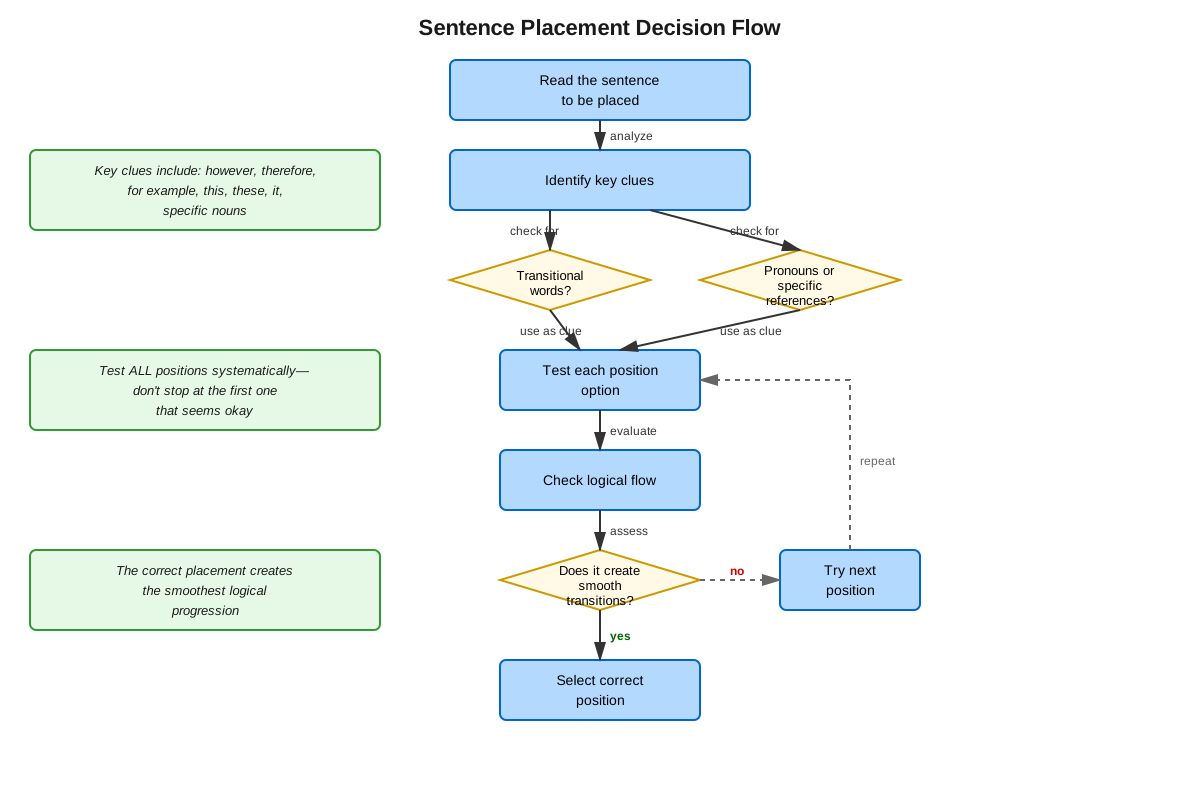
The most reliable approach to sentence placement questions involves a systematic, step-by-step process:
- Read the entire paragraph first without the bracketed sentence to understand the existing flow and main idea
- Identify the content and purpose of the sentence to be placed (Does it introduce? Support? Conclude? Provide an example?)
- Look for transitional clues within the sentence (words like "however," "for instance," "this," "therefore")
- Identify specific references that require context (pronouns, demonstratives, specific nouns that must be introduced first)
- Test each possible position by reading the paragraph with the sentence in that location
- Verify smooth transitions before and after the sentence in the chosen position
Transitional Words and Logical Connectors
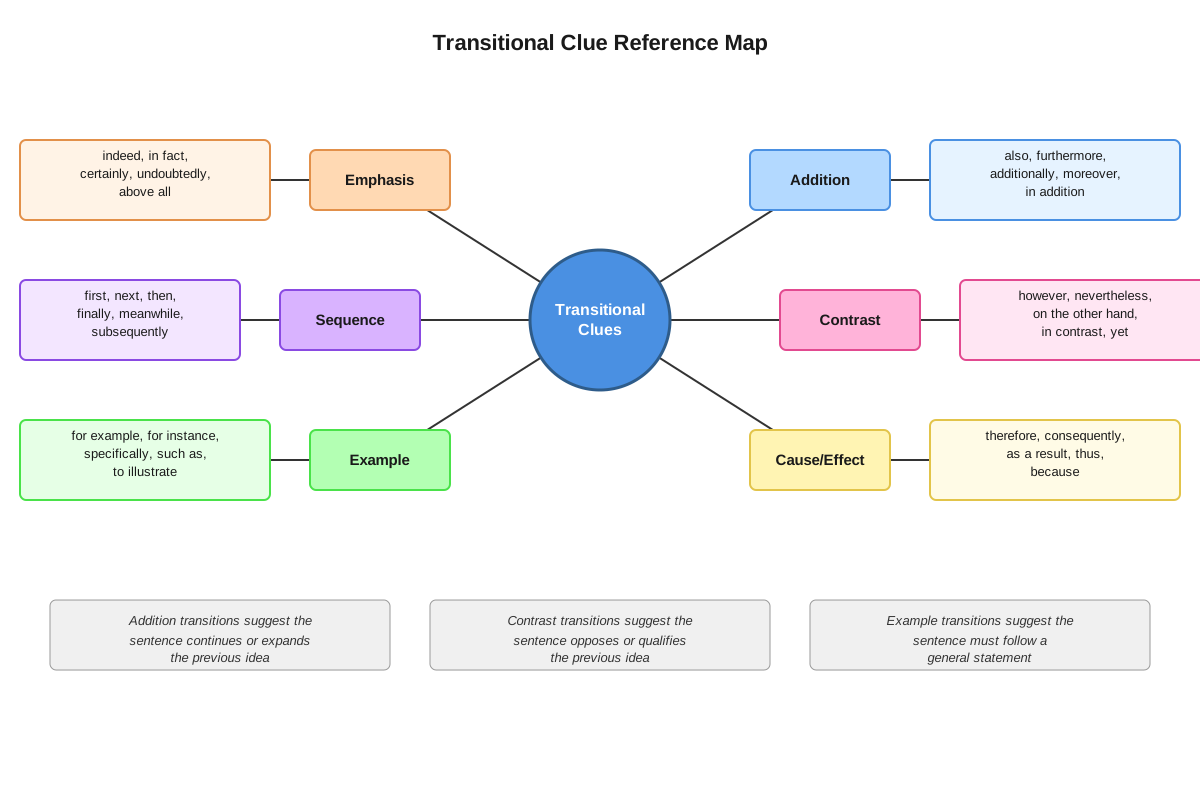
Transitional words within a sentence provide critical clues about where it belongs. These words establish relationships between ideas and signal the sentence's function within the paragraph:
| Transition Type | Examples | Placement Implication |
|---|---|---|
| Contrast | however, nevertheless, on the other hand, yet | Must follow a statement it contrasts with |
| Addition | furthermore, moreover, additionally, also | Continues or expands previous point |
| Example | for instance, for example, specifically | Must follow a general statement it illustrates |
| Result | therefore, thus, consequently, as a result | Must follow the cause or reason |
| Sequence | first, next, then, finally | Indicates chronological or procedural order |
| Emphasis | indeed, in fact, certainly | Reinforces or intensifies previous statement |
Pronoun and Demonstrative References
Sentences containing pronouns or demonstrative adjectives (this, that, these, those) must be placed after the nouns they reference. This is one of the most reliable clues for sentence placement:
- A sentence beginning with "This discovery" must follow a sentence describing the discovery
- A sentence containing "these methods" must come after methods are mentioned
- A sentence with "he" or "she" must follow identification of the person
- A sentence with "it" must follow the singular noun it references
Chronological and Sequential Ordering
Many paragraphs present information in chronological order, describing events as they occurred in time. When a sentence contains time markers (dates, "before," "after," "during," "later," "initially"), it must be placed in the appropriate chronological position. Similarly, procedural or process descriptions require sentences to appear in the order steps are performed.
Cause-and-Effect Relationships
Sentences describing causes must precede sentences describing effects. When a sentence begins with "As a result," "Consequently," or "Therefore," it must follow the sentence explaining the cause. Conversely, sentences containing "because," "since," or "due to" might introduce causes that explain effects mentioned previously.
General-to-Specific and Specific-to-General Patterns
Effective paragraphs often move from general statements to specific details, or occasionally from specific examples to general conclusions. A sentence providing a specific example must follow the general statement it illustrates. A sentence making a broad claim typically precedes sentences offering supporting evidence or details.
Topic Sentences and Concluding Sentences
Topic sentences, which introduce the main idea of a paragraph, belong at or near the beginning. Concluding sentences, which summarize or provide closure, belong at the end. A sentence that synthesizes information or provides a final thought should not appear in the middle of a paragraph where development is still occurring.
Concept Relationships
The concepts within sentence placement form an interconnected system where multiple clues often work together to indicate correct positioning. Transitional words signal logical relationships, which combine with pronoun references to narrow placement options. For example, a sentence beginning with "However, this approach" must both contrast with a previous statement (due to "however") and follow a sentence mentioning an approach (due to "this approach"). The relationship flows: Transitional clues → identify logical relationship → pronoun references → confirm specific position → chronological markers → verify final placement.
Sentence placement connects directly to prerequisite knowledge of paragraph structure. Understanding that paragraphs typically begin with topic sentences helps students recognize that introductory sentences belong early, while supporting details follow. This relationship extends: Topic sentence identification → paragraph structure understanding → sentence placement decisions → overall passage organization.
The connection between sentence placement and other rhetorical skills is particularly strong. Questions about adding or deleting sentences require similar analysis of logical flow and relevance. Paragraph ordering questions apply sentence placement principles at a larger scale. The skill progression moves: Sentence-level placement → paragraph-level organization → passage-level structure, with each level building on the same fundamental principles of logical sequencing and coherent development.
High-Yield Facts
⭐ Sentence placement questions typically appear 2-4 times per ACT English test, making them a high-frequency question type.
⭐ Transitional words at the beginning of a sentence provide the strongest clues about where it belongs in relation to surrounding sentences.
⭐ A sentence containing pronouns or demonstrative adjectives (this, that, these, those) must be placed after the noun they reference.
⭐ The correct placement creates smooth, logical transitions both before and after the sentence—test both connections.
⭐ Chronological markers (dates, time words) require sentences to appear in temporal order within the paragraph.
- Sentences providing specific examples must follow general statements they illustrate.
- Cause-and-effect relationships require causes to precede effects unless the sentence structure explicitly reverses this order.
- Topic sentences introducing new ideas typically belong at or near the beginning of paragraphs.
- Concluding or summarizing sentences belong at the end of paragraphs, not in the middle of development.
- Reading the entire paragraph before attempting placement prevents errors caused by insufficient context.
- The answer choice "where it is now" is correct approximately 25% of the time—don't assume the sentence must be moved.
- Sentences beginning with "For example" or "For instance" must follow the general statement they exemplify.
Quick check — test yourself on Sentence placement so far.
Try Flashcards →Common Misconceptions
Misconception: The sentence should always be moved from its current position. → Correction: "Where it is now" is a legitimate answer choice that's correct about one-quarter of the time. Always evaluate whether the current position makes logical sense before assuming the sentence needs to move.
Misconception: Sentence placement is primarily about grammar and punctuation. → Correction: Sentence placement questions test organizational logic and reading comprehension, not grammatical correctness. The sentence itself is grammatically correct; the question is about where it belongs based on meaning and flow.
Misconception: The shortest or simplest answer is usually correct. → Correction: Unlike some grammar questions where conciseness matters, sentence placement has nothing to do with brevity. The correct answer is determined solely by logical positioning within the paragraph's flow of ideas.
Misconception: You can determine correct placement by reading only the sentence in question and the sentence immediately before and after. → Correction: Effective sentence placement requires understanding the entire paragraph's structure, main idea, and development. Reading only adjacent sentences often provides insufficient context for accurate placement decisions.
Misconception: Transitional words always indicate the same placement regardless of context. → Correction: While transitional words provide important clues, their implications depend on the specific content of surrounding sentences. "However" indicates contrast, but you must identify what specific idea is being contrasted to determine correct placement.
Misconception: If a sentence mentions a topic discussed in the paragraph, it can go anywhere that topic appears. → Correction: Sentences must fit into the specific logical progression of ideas. Even if a topic is mentioned multiple times, the sentence belongs in only one position based on its specific content, function, and relationship to surrounding sentences.
Worked Examples
Example 1: Pronoun Reference and Logical Flow
Paragraph with bracketed sentence:
[1] Marie Curie made groundbreaking discoveries in radioactivity during the early 20th century. [2] She became the first woman to win a Nobel Prize and remains the only person to win Nobel Prizes in two different sciences. [3] [Her research laid the foundation for modern cancer treatment through radiation therapy.] [4] Born in Poland, Curie moved to Paris to pursue her education when opportunities for women in science were severely limited in her homeland.
Question: For the sake of logic and coherence, Sentence 3 should be placed:
A. where it is now
B. after Sentence 1
C. after Sentence 4
D. at the beginning of the paragraph (before Sentence 1)
Solution Process:
Step 1: Read the paragraph without Sentence 3 to understand the existing flow. The paragraph currently moves from Curie's discoveries (Sentence 1) to her Nobel Prizes (Sentence 2) to her background (Sentence 4). This creates an awkward jump from achievements to biography.
Step 2: Analyze Sentence 3's content and function. It describes the impact of "her research," providing a consequence or application of her work. The pronoun "her" requires prior identification of Curie.
Step 3: Examine transitional relationships. Sentence 3 extends the discussion of Curie's scientific achievements rather than introducing biographical information.
Step 4: Test each position:
- Before Sentence 1: "Her research" would have no antecedent—eliminated
- After Sentence 1: This creates a logical flow: discoveries → impact of discoveries → recognition (Nobel Prizes) → background. The transition works smoothly.
- Where it is now (after Sentence 2): This separates achievements from biography awkwardly but is grammatically possible
- After Sentence 4: This would place impact of research after biographical information, disrupting the achievement-focused opening
Step 5: Verify transitions. After Sentence 1, the flow becomes: "discoveries in radioactivity" → "Her research [in radioactivity] laid the foundation for modern cancer treatment" → "She became the first woman to win a Nobel Prize." This creates a logical progression from discovery to impact to recognition.
Answer: B (after Sentence 1)
The sentence belongs after Sentence 1 because it extends the discussion of Curie's scientific work before moving to her awards and biography. The pronoun "her" clearly references Curie from Sentence 1, and the content about research impact logically follows the mention of her discoveries.
Example 2: Chronological Ordering and Cause-Effect
Paragraph with bracketed sentence:
[1] The ancient city of Pompeii thrived as a wealthy Roman resort town in 79 CE. [2] Mount Vesuvius erupted violently, burying the city under volcanic ash and pumice. [3] [Archaeologists began systematic excavations in 1748, uncovering remarkably preserved buildings, artifacts, and even the forms of victims.] [4] The ash preserved the city in extraordinary detail, creating a snapshot of Roman life. [5] Today, Pompeii provides invaluable insights into daily life during the Roman Empire.
Question: To make this paragraph most logical, Sentence 3 should be placed:
A. where it is now
B. after Sentence 4
C. after Sentence 5
D. before Sentence 1
Solution Process:
Step 1: Identify the paragraph's chronological structure. It describes events from 79 CE (Sentences 1-2), the preservation effect (Sentence 4), archaeological discovery (Sentence 3), and modern significance (Sentence 5).
Step 2: Analyze Sentence 3's temporal marker. "Began systematic excavations in 1748" indicates this occurred much later than the eruption, and "uncovering" describes what archaeologists found.
Step 3: Examine logical relationships. Sentence 3 describes the discovery of what Sentence 4 explains was preserved. The cause-effect relationship is: eruption → preservation → later discovery → modern significance.
Step 4: Test positions:
- Before Sentence 1: Discussing 1748 excavations before establishing what happened in 79 CE is illogical—eliminated
- Where it is now (after Sentence 2): This jumps from eruption directly to 1748 without explaining what was preserved—creates a gap
- After Sentence 4: This creates proper chronology: eruption → preservation effect → discovery of preserved materials → modern significance
- After Sentence 5: This would place the discovery after discussing modern significance, disrupting chronological flow
Step 5: Verify the logical flow with Sentence 3 after Sentence 4: "The ash preserved the city in extraordinary detail" → "Archaeologists began systematic excavations in 1748, uncovering remarkably preserved buildings." The word "preserved" connects both sentences, and the chronology flows naturally from preservation to discovery.
Answer: B (after Sentence 4)
Sentence 3 belongs after Sentence 4 because it maintains chronological order (eruption → preservation → discovery → modern significance) and creates a logical cause-effect sequence where the preservation described in Sentence 4 explains what archaeologists uncovered in Sentence 3.
Exam Strategy
When approaching sentence placement questions on the ACT, begin by identifying the question format. Look for numbered sentences in brackets within paragraphs or questions explicitly asking where a sentence should be placed. This recognition triggers the specific strategy needed for organizational questions rather than grammar questions.
Trigger phrases to watch for:
- "For the sake of logic and coherence, Sentence X should be placed..."
- "The best placement for the underlined portion would be..."
- "Where should the writer place this sentence?"
- "To make this paragraph most logical..."
Step-by-step approach:
- Read the entire paragraph first (15-20 seconds): Never attempt to place a sentence without understanding the paragraph's complete structure and main idea. This initial reading provides essential context.
- Identify the sentence's function (5 seconds): Determine whether the sentence introduces a topic, provides an example, offers a contrasting view, describes a result, or concludes an idea.
- Look for explicit clues (10 seconds): Circle transitional words, pronouns, demonstratives, time markers, and specific references that require context.
- Eliminate impossible positions (10 seconds): Use pronoun references and chronological markers to eliminate positions that would create logical impossibilities.
- Test remaining options (20-30 seconds): Mentally read the paragraph with the sentence in each remaining position, checking transitions before and after.
- Verify your choice (5-10 seconds): Confirm that your selected position creates smooth transitions and logical flow.
Time management: Allocate 60-75 seconds per sentence placement question. These questions require more reading than typical grammar questions but should not consume excessive time. If you're struggling after testing each position once, select your best answer and move forward rather than re-reading multiple times.
Process of elimination tips:
- Eliminate any position where a pronoun would lack an antecedent
- Eliminate positions that violate chronological order when time markers are present
- Eliminate positions where "for example" would precede the general statement it illustrates
- Eliminate positions where "however" or "nevertheless" would have nothing to contrast with
- Remember that "where it is now" is wrong about 75% of the time but right 25% of the time—don't automatically eliminate it
Memory Techniques
PLACE mnemonic for sentence placement strategy:
- Pronoun references must follow antecedents
- Logical flow requires smooth transitions
- Analyze the entire paragraph first
- Chronological and sequential order matters
- Examine transitional words for relationship clues
The "Connector Check" visualization: Imagine each sentence as a puzzle piece with specific shapes on its edges. The sentence you're placing has particular "connectors" (pronouns, transitions, references) that must match the "connectors" of surrounding sentences. Visualize testing whether the piece fits in each possible position by checking if the connectors align.
Transitional word categories acronym - CARES:
- Contrast: however, nevertheless, yet
- Addition: furthermore, moreover, also
- Result: therefore, thus, consequently
- Example: for instance, for example
- Sequence: first, next, then, finally
The "Before and After" rule: A correctly placed sentence must make sense with what comes BEFORE it AND what comes AFTER it. If either transition feels awkward, the placement is wrong. Visualize checking both directions like looking both ways before crossing a street.
Chronology visualization: For paragraphs with time elements, create a mental timeline. Place events on the timeline as you read, then position the sentence being placed at its appropriate point on that timeline.
Summary
Sentence placement questions on the ACT English test assess the ability to determine where a sentence belongs within a paragraph based on logical flow, transitional relationships, and coherent organization. These questions appear 2-4 times per test and require systematic analysis rather than grammatical knowledge. The key to mastering sentence placement lies in reading entire paragraphs for context, identifying transitional clues and pronoun references within the sentence to be placed, and testing each possible position by evaluating transitions before and after. Students must recognize that sentences containing pronouns or demonstratives must follow their antecedents, that chronological markers require temporal ordering, that examples must follow general statements, and that cause-effect relationships dictate specific sequencing. Success requires understanding that "where it is now" is sometimes correct, that transitional words provide crucial relationship signals, and that smooth logical flow in both directions confirms correct placement. By applying a methodical approach that considers the sentence's function, explicit textual clues, and the paragraph's overall structure, students can consistently identify correct placement and secure these high-yield points on the ACT.
Key Takeaways
- Sentence placement questions test organizational logic and reading comprehension, not grammar, appearing 2-4 times per ACT English test
- Always read the entire paragraph before attempting to place a sentence—context is essential for determining logical positioning
- Pronouns and demonstrative adjectives (this, that, these, those) must be placed after the nouns they reference, providing reliable placement clues
- Transitional words signal specific relationships (contrast, addition, example, result, sequence) that indicate where sentences belong relative to surrounding content
- Test each possible position systematically by checking whether transitions work smoothly both before and after the sentence in that location
- Chronological markers and cause-effect relationships require specific ordering that cannot be violated without creating logical errors
- "Where it is now" is correct approximately 25% of the time—evaluate the current position fairly rather than assuming the sentence must move
Related Topics
Adding and Deleting Sentences: This closely related skill requires determining whether sentences should be included in or removed from passages based on relevance and purpose. Mastering sentence placement provides the foundation for these decisions because both require understanding paragraph structure and logical flow.
Paragraph Ordering: This advanced organizational skill applies sentence placement principles at a larger scale, requiring students to determine the most logical sequence for entire paragraphs within a passage. Success with sentence placement builds the analytical skills needed for paragraph ordering.
Transitions and Logical Relationships: Understanding how transitional words and phrases connect ideas is fundamental to both sentence placement and broader writing effectiveness. Deepening knowledge of transitions enhances placement accuracy and overall rhetorical skills performance.
Main Idea and Purpose Questions: These reading comprehension questions require identifying central themes and authorial intent, skills that directly support sentence placement by helping students understand where different types of information belong within organized writing.
Practice CTA
Now that you've mastered the strategies for sentence placement questions, it's time to apply these skills to authentic ACT-style practice questions. The concepts you've learned—analyzing transitional clues, checking pronoun references, testing each position systematically, and verifying logical flow—will become automatic through deliberate practice. Challenge yourself with the practice questions and flashcards to reinforce these high-yield strategies. Remember, sentence placement questions offer reliable points once you've internalized the systematic approach. Each practice question you complete strengthens your ability to quickly identify correct placement and builds the confidence you need to excel on test day. You've got this!
Sign up free to keep reading
Create a free AnvayaPrep account to finish this ACT guide on Sentence placement — plus flashcards and practice questions.