Overview
Style consistency is a critical rhetorical skill tested on the ACT English section that evaluates a student's ability to recognize and maintain uniform tone, diction, and register throughout a passage. When writers shift unexpectedly between formal and informal language, technical and conversational vocabulary, or objective and subjective perspectives, they create jarring inconsistencies that undermine the effectiveness of their communication. The ACT frequently tests whether students can identify these stylistic disruptions and select revisions that align with the established voice of a passage.
Understanding ACT style consistency requires developing sensitivity to the subtle cues that define a passage's overall character. A scientific article discussing climate research demands precise, formal language with technical terminology, while a personal narrative about a family vacation calls for more relaxed, conversational phrasing. The ACT presents passages with deliberate stylistic mismatches and asks students to identify which word, phrase, or sentence disrupts the established tone. These questions assess not just grammatical correctness but rhetorical appropriateness—the ability to match language choices to context, audience, and purpose.
Style consistency connects intimately with other rhetorical skills including word choice, audience awareness, and purpose. While grammar questions have definitive right and wrong answers based on mechanical rules, style questions require judgment about what sounds appropriate within a specific context. Mastering this topic strengthens overall writing quality and prepares students for the nuanced decision-making that characterizes effective communication in academic and professional settings.
Learning Objectives
- [ ] Identify when style consistency is being tested on ACT English questions
- [ ] Explain the core rule or strategy behind maintaining style consistency
- [ ] Apply style consistency principles to ACT-style questions accurately
- [ ] Distinguish between formal, informal, and technical registers in written passages
- [ ] Evaluate multiple answer choices to determine which best matches established tone
- [ ] Recognize common patterns of stylistic disruption in ACT passages
- [ ] Justify style-based decisions using textual evidence from surrounding context
Prerequisites
- Basic vocabulary knowledge: Understanding word connotations and formality levels enables recognition of stylistic shifts
- Reading comprehension skills: Grasping the overall purpose and tone of a passage provides the foundation for identifying inconsistencies
- Familiarity with different writing genres: Recognizing whether a passage is narrative, expository, persuasive, or technical helps establish appropriate style expectations
- Understanding of audience and purpose: Knowing how writers adjust language for different readers and goals underlies all style decisions
Why This Topic Matters
Style consistency appears frequently on the ACT English section, typically accounting for 3-5 questions per test. These questions often prove challenging because they lack the clear-cut correctness of grammar questions—students must develop judgment about appropriateness rather than simply applying rules. Strong performance on style questions can significantly boost English subscores, particularly the Rhetorical Skills subscore that colleges increasingly value.
Beyond test performance, style consistency represents an essential real-world writing skill. Professional emails, academic papers, business proposals, and creative writing all require maintaining appropriate tone throughout. A job application letter that shifts from professional language to slang undermines credibility. A research paper that suddenly adopts conversational phrasing appears unprofessional. Developing sensitivity to stylistic appropriateness prepares students for the writing demands of college and career.
On the ACT, style consistency questions typically appear as underlined portions where students must choose between the original phrasing and three alternatives. The question stem often includes phrases like "Which choice best maintains the style of the passage?" or "Given that all choices are grammatically correct, which provides the most appropriate tone?" These questions may also appear without explicit prompts, requiring students to recognize that all options are grammatically correct but differ in stylistic appropriateness. Passages testing style consistency span all genres—personal narratives, scientific explanations, historical accounts, and persuasive essays—making this a universally applicable skill.
Core Concepts
Understanding Register and Tone
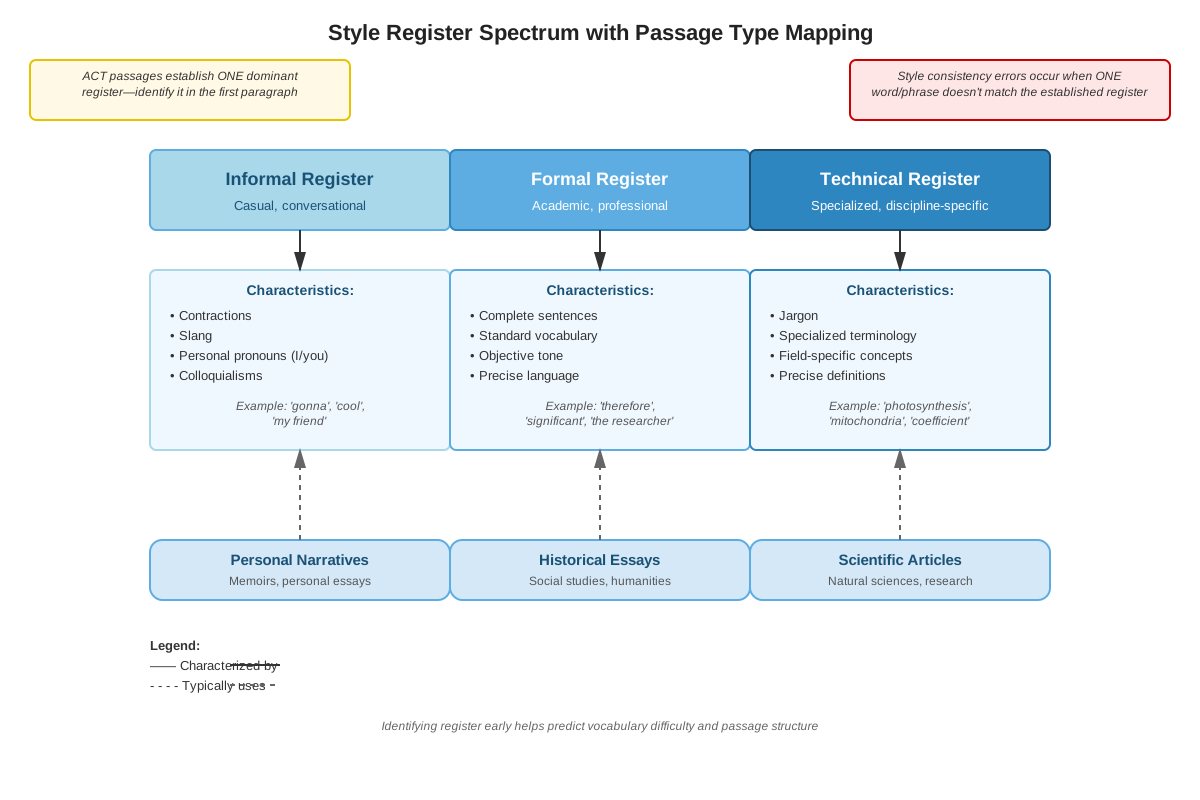
Register refers to the level of formality in language, ranging from highly formal academic or technical writing to casual conversational style. Tone encompasses the writer's attitude toward the subject and audience, which might be serious, humorous, objective, passionate, or skeptical. Together, register and tone create the overall style that should remain consistent throughout a passage.
Formal register employs sophisticated vocabulary, complex sentence structures, and objective phrasing. It avoids contractions, slang, and personal pronouns. Academic papers, scientific reports, and professional correspondence typically use formal register. Informal register includes conversational language, contractions, simpler sentence structures, and sometimes slang or colloquialisms. Personal narratives, blog posts, and casual correspondence often adopt informal register. Semi-formal register occupies the middle ground, maintaining professionalism while allowing some conversational elements—common in magazine articles and general-interest nonfiction.
| Register Level | Characteristics | Example |
|---|---|---|
| Formal | Technical vocabulary, no contractions, objective, complex syntax | "The researchers concluded that the hypothesis warranted further investigation." |
| Semi-formal | Clear vocabulary, occasional contractions, balanced tone | "The team's findings suggest we should look into this more carefully." |
| Informal | Conversational, contractions common, personal, simple syntax | "The scientists figured they'd better check this out some more." |
Identifying Stylistic Disruptions
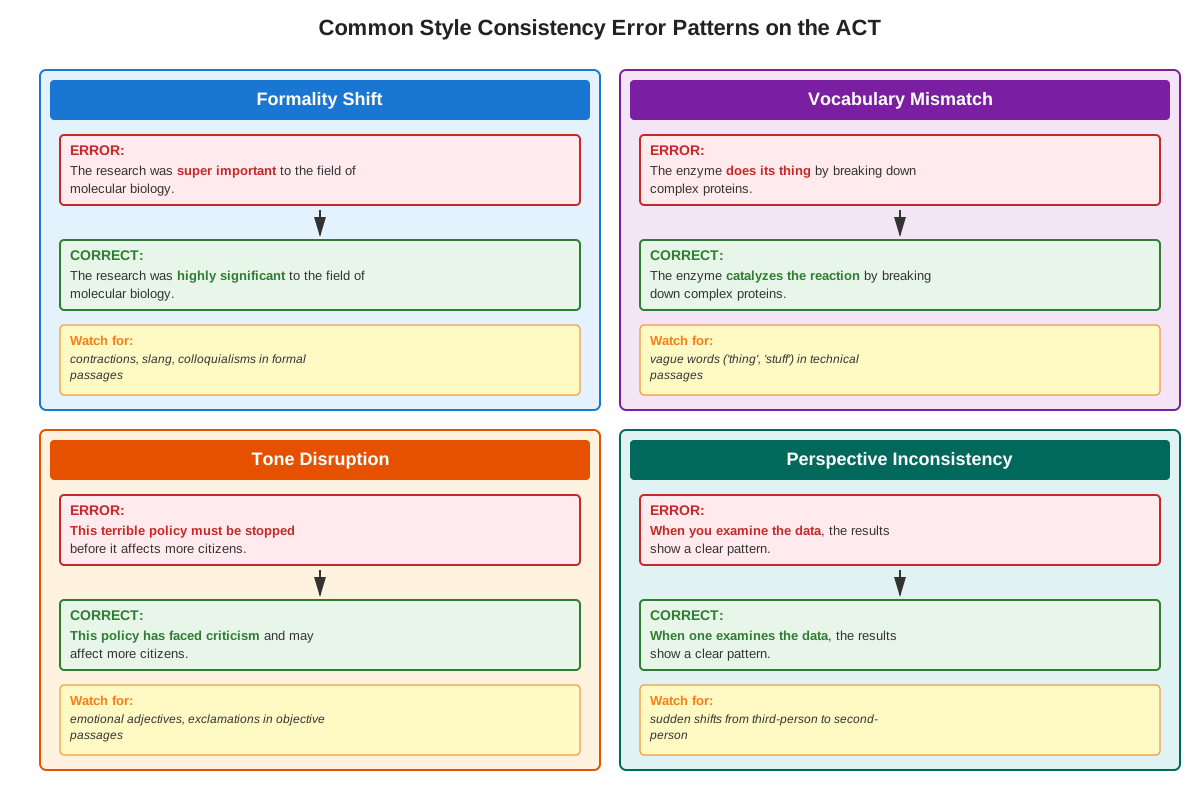
Stylistic disruptions occur when a word, phrase, or sentence clashes with the established tone of a passage. Common disruptions include:
Formality mismatches: Inserting casual language into formal passages or overly stiff phrasing into informal contexts. A scientific passage discussing cellular biology would be disrupted by "The mitochondria are pretty cool organelles that basically make energy for cells." Conversely, a personal narrative about summer camp would sound awkward with "The recreational activities facilitated interpersonal bonding among participants."
Vocabulary level shifts: Using unnecessarily complex words in simple contexts or overly simple words in sophisticated contexts. A passage about economic policy shouldn't suddenly refer to "money stuff" when discussing fiscal instruments. Similarly, a children's story shouldn't describe a character as "exhibiting recalcitrant behavior" instead of "being stubborn."
Objectivity versus subjectivity: Shifting between neutral reporting and personal opinion inappropriately. Historical or scientific passages typically maintain objectivity, so inserting phrases like "I think" or "obviously" disrupts the style. Personal narratives allow subjective perspectives, making overly clinical descriptions feel out of place.
Technical versus general language: Mixing specialized jargon with everyday language inconsistently. A passage explaining photosynthesis to general readers should either define technical terms or avoid them entirely, not alternate between accessible explanations and unexplained scientific terminology.
Analyzing Context Clues
Determining appropriate style requires careful attention to context clues throughout the passage. The opening paragraph typically establishes the dominant style—formal or informal, technical or accessible, objective or personal. Students should note vocabulary choices, sentence complexity, and whether the author uses first-person pronouns or maintains third-person distance.
Surrounding sentences provide immediate context for style questions. If sentences before and after an underlined portion use sophisticated vocabulary and complex structures, the correct answer will match that level. If surrounding text includes contractions and conversational phrasing, informal options become appropriate.
Subject matter also signals appropriate style. Scientific topics, historical analysis, and technical explanations typically demand formal register. Personal experiences, humorous anecdotes, and reflective essays allow informal approaches. However, the actual passage content matters more than general subject expectations—a scientist writing a memoir about research experiences might adopt informal style despite the scientific subject.
Evaluating Answer Choices
When all answer choices are grammatically correct, students must evaluate stylistic appropriateness. This process involves:
- Identifying the established style by reading several sentences before the question
- Categorizing each answer choice by register (formal, informal, semi-formal)
- Eliminating obvious mismatches that clash with the passage tone
- Comparing remaining options for subtle differences in appropriateness
- Selecting the choice that most seamlessly integrates with surrounding text
Consider this example: A formal passage about architectural history includes the underlined phrase. Which maintains style?
A) "The building's design was really awesome and showed great skill."
B) "The edifice exemplified masterful craftsmanship."
C) "The structure demonstrated impressive technical expertise."
D) "The building was put together with serious talent."
Choice A uses "really awesome," which is too informal. Choice D employs "put together" and "serious talent," also too casual. Choice B uses "edifice," which might be overly formal even for an academic passage. Choice C strikes the appropriate balance with "structure," "demonstrated," and "technical expertise"—formal but not pretentious.
Concept Relationships
Style consistency connects directly to word choice (diction), as selecting appropriately formal or informal vocabulary represents the primary mechanism for maintaining consistent style. Every word carries connotations about formality level, and cumulative word choices create overall tone.
The relationship flows: Passage purpose and audience → Appropriate register selection → Consistent vocabulary and syntax choices → Unified style throughout
Style consistency also relates to organization and transitions. Just as ideas should flow logically, stylistic elements should transition smoothly without jarring shifts. A passage might intentionally shift style between sections (such as moving from formal introduction to informal anecdote), but such shifts require clear transitions and purposeful execution.
Understanding rhetorical situation (purpose, audience, context) enables appropriate style selection. A passage written to inform general readers about complex topics requires different style than one addressing specialists. Personal narratives targeting peers allow different choices than formal essays for academic evaluation.
Style consistency supports overall passage effectiveness. Inconsistent style distracts readers, undermines credibility, and weakens communication. Maintaining unified tone allows content to shine without stylistic disruptions drawing attention away from ideas.
High-Yield Facts
- ⭐ Style consistency questions ask students to match the established tone and register of a passage, not just select grammatically correct options
- ⭐ The opening paragraph typically establishes the dominant style that should be maintained throughout
- ⭐ Formal passages avoid contractions, slang, and casual expressions while using sophisticated vocabulary and complex syntax
- ⭐ Informal passages may include contractions, conversational language, and simpler sentence structures
- ⭐ Context clues from surrounding sentences provide the best evidence for determining appropriate style
- Technical passages maintain specialized vocabulary consistently rather than alternating between jargon and everyday language
- Objective passages avoid first-person pronouns and subjective judgments like "obviously" or "clearly"
- Personal narratives allow subjective perspectives and first-person voice
- Semi-formal register represents the middle ground between academic formality and casual conversation
- Style questions often include the phrase "given that all choices are grammatically correct" to signal rhetorical focus
- Vocabulary level should remain consistent—avoid mixing overly simple words with sophisticated terminology
- Humor and colloquialisms are only appropriate when the passage establishes a light, informal tone
- Scientific and historical passages typically require formal, objective style
- The most common error is selecting overly casual language in formal passages
Quick check — test yourself on Style consistency so far.
Try Flashcards →Common Misconceptions
Misconception: Longer, more complex words always represent better style choices.
Correction: Appropriate style matches the passage context. Unnecessarily complex vocabulary in an informal or general-audience passage creates stylistic inconsistency. The goal is appropriateness, not maximum sophistication.
Misconception: All ACT passages require formal, academic style.
Correction: The ACT includes passages across the formality spectrum, from casual personal narratives to technical scientific explanations. Students must adapt to each passage's established style rather than imposing a single standard.
Misconception: Style consistency only involves avoiding slang and contractions.
Correction: Style encompasses vocabulary level, sentence complexity, objectivity versus subjectivity, technical versus general language, and overall tone. Many elements beyond obvious informality contribute to consistent style.
Misconception: If an answer choice is grammatically correct, it's acceptable.
Correction: Style questions specifically test rhetorical appropriateness beyond grammatical correctness. All options may be grammatically sound, but only one matches the passage style.
Misconception: Personal pronouns are always inappropriate in formal writing.
Correction: While objective academic writing typically avoids first-person pronouns, some formal passages (such as personal essays or reflective pieces) appropriately use "I" while maintaining sophisticated vocabulary and complex syntax. Register involves multiple elements, not just pronoun choice.
Misconception: The shortest answer is usually correct for style questions.
Correction: Unlike wordiness questions where conciseness matters, style questions prioritize appropriateness. The correct answer might be longer if it better matches the established tone.
Worked Examples
Example 1: Formal Scientific Passage
Passage Context: A passage discusses recent advances in renewable energy technology, using formal academic language throughout. The surrounding sentences include: "Photovoltaic cells have demonstrated increased efficiency through innovative semiconductor materials. Researchers have systematically investigated various compounds to optimize energy conversion rates."
Question: Which choice best maintains the style established in the passage?
A) Scientists have been checking out different materials to make solar panels work better.
B) The investigation of novel materials has yielded significant improvements in solar technology.
C) People who study this stuff have found some pretty cool ways to boost solar power.
D) Solar panels are getting way more efficient thanks to new materials.
Analysis:
First, identify the established style. The passage uses formal academic register with sophisticated vocabulary ("photovoltaic cells," "systematically investigated," "optimize"), complex sentence structures, and objective tone. No contractions, slang, or casual expressions appear.
Evaluate each choice:
Choice A: "Checking out" is casual phrasal verb; "make solar panels work better" is informal phrasing. This clashes with the formal style. Eliminate.
Choice C: "Stuff" is slang; "pretty cool" is informal; overall tone is conversational. Completely inconsistent with formal passage. Eliminate.
Choice D: "Getting way more efficient" uses casual intensifier "way" and conversational structure. Doesn't match formal register. Eliminate.
Choice B: "Investigation of novel materials" matches "systematically investigated" from context; "yielded significant improvements" uses formal vocabulary; "solar technology" maintains technical precision. This seamlessly integrates with the established style.
Answer: B
This question demonstrates how style consistency requires matching vocabulary level (novel vs. cool), formality (yielded vs. getting), and overall register (technical vs. conversational).
Example 2: Informal Personal Narrative
Passage Context: A student writes about learning to cook with their grandmother. Surrounding text includes: "Every Saturday morning, I'd rush over to Grandma's house, eager to discover what we'd make together. She'd greet me with a warm hug and that knowing smile that meant we were in for something special."
Question: Which choice best maintains the style established in the passage?
A) The culinary instruction I received from my grandmother proved invaluable to my development.
B) My grandmother's pedagogical approach to cooking facilitated significant skill acquisition.
C) Grandma taught me cooking techniques that I still use today.
D) The educational experience enhanced my gastronomic competencies considerably.
Analysis:
The passage establishes informal, personal style through contractions ("I'd"), conversational vocabulary ("rush over," "something special"), first-person perspective, and warm, emotional tone. This is clearly a personal narrative, not an academic essay.
Evaluate each choice:
Choice A: "Culinary instruction," "proved invaluable," "development"—all formal academic language that clashes with the warm, conversational tone. Eliminate.
Choice B: "Pedagogical approach," "facilitated," "skill acquisition"—extremely formal, technical vocabulary completely inconsistent with the personal narrative style. Eliminate.
Choice D: "Educational experience," "gastronomic competencies"—overly formal and pretentious for a personal story about cooking with grandmother. Eliminate.
Choice C: "Grandma" (not "grandmother") matches the informal address used throughout; "taught me" is simple, direct language; "techniques that I still use today" maintains conversational tone while conveying meaning clearly. This fits perfectly with the established style.
Answer: C
This example shows how informal passages require resisting the temptation to "elevate" language inappropriately. The most sophisticated-sounding option is often wrong when the passage establishes casual, personal style.
Exam Strategy
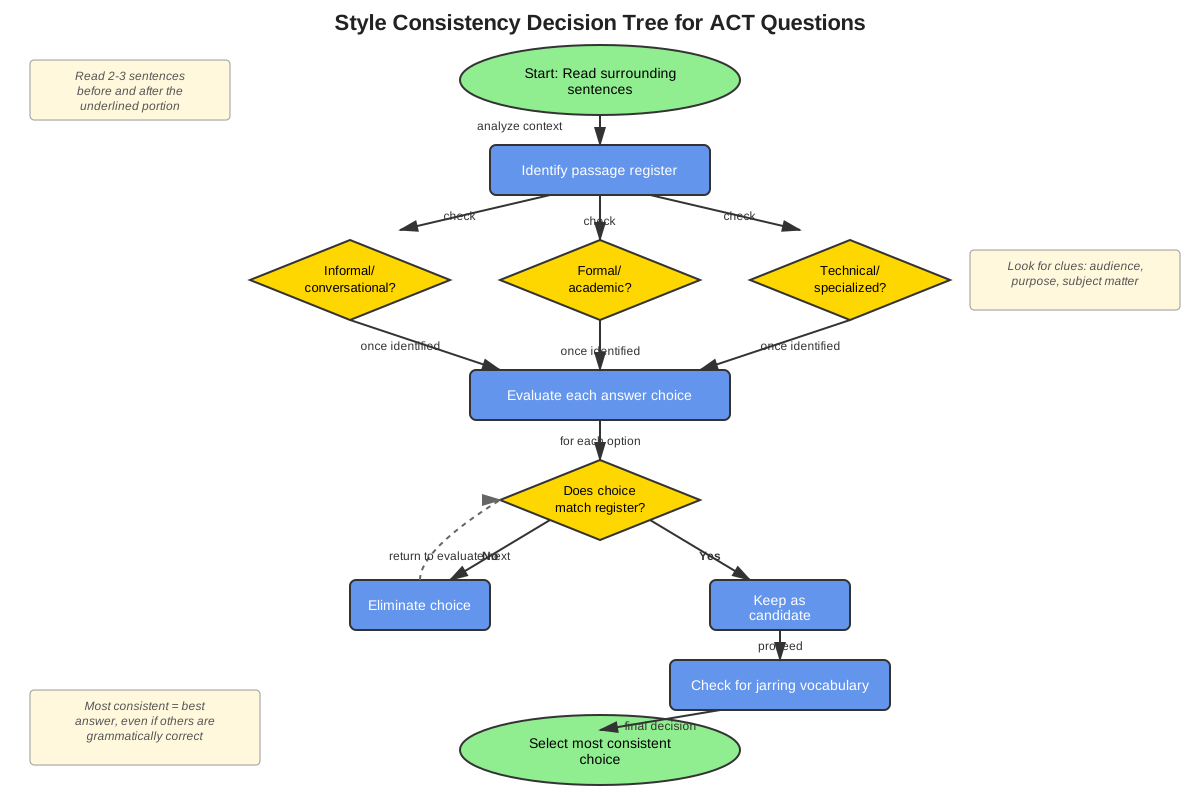
When approaching style consistency questions on the ACT, follow this systematic process:
Step 1: Identify the question type. Look for phrases like "best maintains the style," "most appropriate tone," or "given that all choices are grammatically correct." These signal style consistency questions rather than grammar questions.
Step 2: Read surrounding context. Don't evaluate the underlined portion in isolation. Read at least 2-3 sentences before and after to understand the established style. Note vocabulary level, sentence complexity, use of contractions, and overall tone.
Step 3: Categorize the passage style. Quickly determine: Is this formal, informal, or semi-formal? Is it objective or subjective? Is it technical or general-audience? This categorization guides answer evaluation.
Step 4: Eliminate obvious mismatches. Cross out any choices that clearly clash with the established style—slang in formal passages, pretentious vocabulary in casual narratives, subjective judgments in objective reports.
Step 5: Compare remaining options. Often two choices will seem reasonable. Look for subtle differences in formality level, vocabulary precision, or tone. The correct answer will integrate most seamlessly with surrounding text.
Exam Tip: When stuck between two options, read each one aloud (mentally) in context with surrounding sentences. The correct choice should sound natural and consistent, while the wrong choice will feel slightly jarring or out of place.
Trigger phrases that indicate style consistency questions:
- "Best maintains the style established in the passage"
- "Most appropriate tone"
- "Given that all choices are grammatically correct"
- "Which choice best fits the style of the essay"
- "Most consistent with the passage as a whole"
Time allocation: Style questions require more contextual reading than grammar questions but shouldn't consume excessive time. Spend 30-45 seconds reading context, 15-20 seconds evaluating choices. If genuinely stuck, mark for review and return after completing other questions—fresh perspective often helps.
Process of elimination tips:
- In formal passages, immediately eliminate options with contractions, slang, or casual intensifiers (really, pretty, way)
- In informal passages, eliminate pretentious vocabulary and overly complex syntax
- Eliminate any choice that introduces first-person perspective in objective passages or removes it from personal narratives
- Watch for vocabulary level mismatches—overly simple words in sophisticated passages or unnecessarily complex terms in accessible writing
Memory Techniques
MATCH acronym for evaluating style consistency:
- Mood: Does the choice match the emotional tone (serious, light, neutral)?
- Audience: Is the language appropriate for the intended readers?
- Technical level: Does vocabulary match the passage's technical sophistication?
- Complexity: Does sentence structure align with surrounding syntax?
- Honesty: Does the choice maintain or disrupt the passage's objectivity/subjectivity?
The Formality Spectrum visualization: Picture a line from 0 (extremely casual) to 10 (extremely formal). Place the passage somewhere on this line based on opening paragraphs, then ensure answer choices fall at the same point. Choices more than 2 points away in either direction are likely wrong.
The "Dinner Guest" analogy: Imagine the passage is a dinner party with a specific dress code. Formal passages are black-tie events where casual language shows up in jeans and sneakers—obviously inappropriate. Informal passages are backyard barbecues where overly formal language arrives in a tuxedo—equally out of place. Match the dress code.
Contraction check: In formal passages, contractions are almost always wrong. In informal passages, avoiding contractions often sounds stiff. This simple check eliminates many wrong answers quickly.
Summary
Style consistency represents a crucial rhetorical skill on the ACT English section, testing students' ability to maintain uniform tone, register, and diction throughout a passage. Success requires developing sensitivity to the subtle cues that establish a passage's style—vocabulary level, sentence complexity, formality, objectivity, and technical sophistication. The ACT presents passages across the formality spectrum, from casual personal narratives to formal academic writing, and students must adapt their judgment to each context rather than applying a single standard. Style consistency questions differ from grammar questions because all options may be grammatically correct; students must evaluate rhetorical appropriateness instead. The key strategy involves reading surrounding context carefully to identify established style, then selecting the answer choice that most seamlessly integrates with that style. Common errors include inserting casual language into formal passages, using pretentious vocabulary in informal contexts, and failing to recognize that appropriateness matters more than sophistication. Mastering style consistency requires practice recognizing different registers and developing judgment about what sounds natural within specific contexts—skills that serve students well beyond standardized testing.
Key Takeaways
- Style consistency questions test rhetorical appropriateness, not just grammatical correctness—all options may be grammatically sound
- Always read surrounding context (2-3 sentences before and after) to identify the established style before evaluating answer choices
- Formal passages require sophisticated vocabulary, complex syntax, and objective tone while avoiding contractions and slang
- Informal passages allow conversational language, contractions, and simpler structures—overly formal vocabulary sounds out of place
- The opening paragraph typically establishes the dominant style that should be maintained throughout the passage
- Eliminate answer choices that obviously clash with established style (casual language in formal passages, pretentious vocabulary in personal narratives)
- When stuck between two options, mentally read each in context with surrounding sentences—the correct choice will sound natural and seamless
Related Topics
Word Choice and Diction: Explores how individual word selection affects meaning and tone, providing the foundation for understanding style consistency at the vocabulary level. Mastering style consistency enables more sophisticated analysis of why specific words work better than synonyms in particular contexts.
Audience and Purpose: Examines how writers adjust language for different readers and goals. Understanding style consistency helps students recognize how register shifts to accommodate various rhetorical situations.
Tone and Voice: Investigates the writer's attitude and personality expressed through language choices. Style consistency represents the practical application of maintaining unified tone throughout a piece.
Transitions and Flow: Studies how ideas connect smoothly within and between paragraphs. Just as transitions create logical flow, consistent style creates rhetorical flow that keeps readers engaged without jarring disruptions.
Revision and Editing Strategies: Applies style consistency principles to improving draft writing. Students who master identifying style issues on the ACT can better revise their own writing for consistent tone and register.
Practice CTA
Now that you understand the principles of style consistency, it's time to apply this knowledge! Work through the practice questions to test your ability to identify established style, recognize disruptions, and select appropriate revisions. The flashcards will help reinforce key concepts about register, tone, and stylistic appropriateness. Remember: style consistency questions reward careful attention to context and judgment about what sounds natural within a specific passage. With practice, you'll develop the sensitivity to stylistic nuances that distinguishes strong writers and high-scoring test-takers. You've got this!
Sign up free to keep reading
Create a free AnvayaPrep account to finish this ACT guide on Style consistency — plus flashcards and practice questions.