Overview
Logical sentence flow is one of the most frequently tested concepts on the ACT English section, appearing in approximately 10-15% of all questions. This topic assesses a student's ability to recognize whether sentences within a paragraph are arranged in a coherent, logical order that effectively communicates ideas to readers. Unlike grammar rules that focus on sentence-level correctness, logical sentence flow examines how sentences work together to create meaning across an entire paragraph or passage.
The ACT tests logical sentence flow through questions that ask students to determine the best placement for a sentence within a paragraph, identify whether a sentence should be added or deleted, or evaluate whether sentences are arranged in the most logical sequence. These questions require students to understand not just individual sentence meaning, but also how ideas connect through transitions, chronological order, cause-and-effect relationships, and thematic coherence. Mastering this skill is essential because it directly impacts a student's ability to score in the higher ranges (30+) on the English section.
Understanding ACT logical sentence flow connects directly to broader writing principles including paragraph unity, coherence, and organization. This topic bridges sentence-level grammar skills with passage-level rhetorical skills, making it a critical component of the Production of Writing subscore. Students who excel at logical sentence flow demonstrate sophisticated reading comprehension and an intuitive sense of how effective writing is structured—skills that extend far beyond standardized testing into academic and professional communication.
Learning Objectives
- [ ] Identify when Logical sentence flow is being tested
- [ ] Explain the core rule or strategy behind Logical sentence flow
- [ ] Apply Logical sentence flow to ACT-style questions accurately
- [ ] Analyze transition words and phrases that signal logical relationships between sentences
- [ ] Evaluate whether a sentence belongs in a specific paragraph based on topic unity
- [ ] Determine the optimal placement of a sentence by identifying chronological, spatial, or logical ordering patterns
- [ ] Distinguish between sentences that advance the main idea versus those that introduce tangential information
Prerequisites
- Basic paragraph structure: Understanding topic sentences, supporting details, and concluding sentences is essential because logical flow depends on recognizing how sentences function within paragraph architecture
- Transition word knowledge: Familiarity with coordinating and subordinating conjunctions, conjunctive adverbs, and transitional phrases enables recognition of logical connections between ideas
- Reading comprehension skills: The ability to identify main ideas, supporting details, and authorial purpose is necessary to evaluate whether sentences are logically ordered
- Pronoun reference understanding: Recognizing what pronouns refer to helps determine whether a sentence can logically follow another based on antecedent clarity
Why This Topic Matters
Logical sentence flow represents a fundamental skill in effective communication. In academic writing, professional correspondence, and everyday communication, the ability to organize ideas coherently determines whether a message is understood or causes confusion. Writers who master logical flow create texts that guide readers smoothly from one idea to the next, building arguments systematically and maintaining reader engagement.
On the ACT English section, logical sentence flow questions appear with high frequency—typically 5-7 questions per test. These questions fall under the Production of Writing category and contribute significantly to the Rhetorical Skills subscore. The ACT presents these questions in several formats: sentence placement questions (asking where a sentence should be placed within a paragraph), sentence addition/deletion questions (evaluating whether adding or removing a sentence improves the passage), and paragraph ordering questions (determining the best sequence for sentences or paragraphs).
Common manifestations in ACT passages include: narratives where chronological order must be maintained; expository essays where ideas build from general to specific or from problem to solution; descriptive passages where spatial organization guides the reader's perspective; and argumentative texts where logical reasoning progresses from premises to conclusions. The test frequently places a sentence in an illogical position and asks students to identify the correct placement, or presents a sentence that disrupts paragraph unity and asks whether it should be deleted.
Core Concepts
Understanding Logical Sentence Flow
Logical sentence flow refers to the coherent arrangement of sentences within a paragraph or passage such that ideas progress naturally, connections between thoughts are clear, and the overall message is communicated effectively. This concept encompasses several dimensions: chronological sequencing (events in time order), spatial organization (descriptions following a consistent directional pattern), logical progression (ideas building from simple to complex or from cause to effect), and thematic unity (all sentences relating to a central topic).
The ACT evaluates logical sentence flow by testing whether students can recognize when sentences are out of order, when a sentence doesn't belong in a paragraph, or when a sentence would improve coherence if placed differently. This requires understanding both explicit connections (through transition words and repeated key terms) and implicit connections (through logical relationships and contextual clues).
Types of Logical Organization
Different types of writing employ different organizational patterns, and recognizing these patterns is crucial for answering ACT questions correctly.
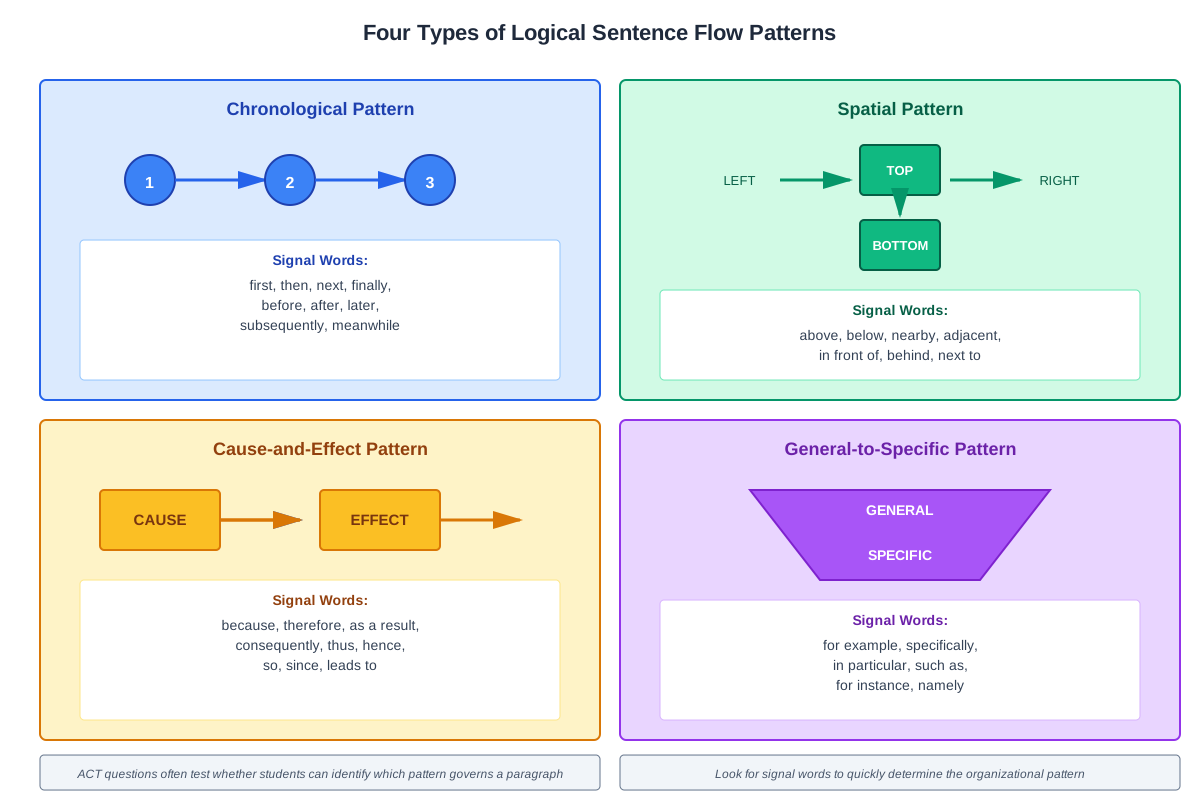
Chronological Order: In narrative passages or process descriptions, sentences follow a time sequence. Signal words include "first," "then," "next," "after," "before," "finally," "meanwhile," and "subsequently." A sentence describing an event that occurred in 1995 cannot logically precede a sentence about events in 1990 unless there's a clear flashback signal.
Spatial Order: Descriptive passages often organize details according to physical location or perspective. Signal words include "above," "below," "nearby," "in the distance," "to the left," "adjacent to," and "surrounding." A description might move from top to bottom, near to far, or left to right, and sentences must maintain this consistent directional pattern.
Order of Importance: Argumentative or persuasive passages may arrange ideas from most to least important (or vice versa). Signal words include "most significantly," "primarily," "additionally," "furthermore," and "finally." The strongest supporting evidence often appears either first (to grab attention) or last (to leave a lasting impression).
Cause and Effect: Explanatory passages frequently organize information to show causal relationships. Signal words include "because," "therefore," "as a result," "consequently," "thus," and "due to." The cause must logically precede the effect unless the writer explicitly signals a reverse presentation.
General to Specific (or Specific to General): Expository writing often begins with a broad statement and narrows to specific details, or presents specific examples before drawing a general conclusion. This pattern helps readers understand the scope and focus of the paragraph.
Transition Words and Coherence Markers
Transition words serve as signposts that indicate the relationship between sentences. Understanding these relationships is essential for determining logical flow.
| Transition Type | Function | Examples |
|---|---|---|
| Addition | Adds similar or supporting information | furthermore, moreover, additionally, also, in addition |
| Contrast | Shows difference or opposition | however, nevertheless, conversely, on the other hand, yet |
| Cause/Effect | Shows causal relationship | therefore, consequently, thus, as a result, because |
| Time | Indicates temporal sequence | first, then, next, finally, meanwhile, subsequently |
| Example | Introduces illustration | for example, for instance, specifically, namely |
| Emphasis | Stresses importance | indeed, in fact, certainly, undoubtedly |
| Conclusion | Signals ending or summary | in conclusion, ultimately, in summary, finally |
Topic Sentences and Unity
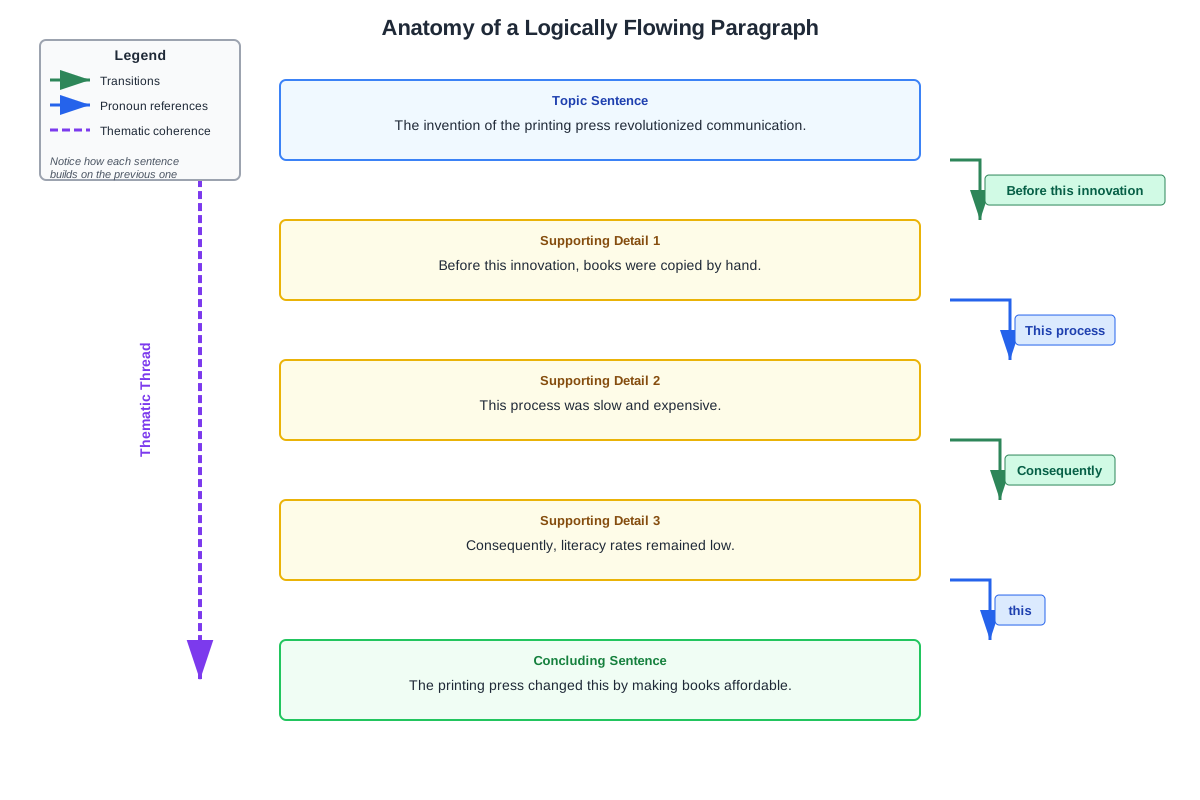
Each paragraph should have a clear main idea, typically expressed in a topic sentence. All other sentences in the paragraph should support, explain, or develop this main idea. A sentence that introduces a completely different topic disrupts paragraph unity and should either be deleted or moved to a more appropriate location.
When evaluating whether a sentence belongs in a paragraph, ask: Does this sentence relate directly to the paragraph's main idea? Does it provide relevant support, explanation, or development? Or does it introduce tangential information that would be better suited elsewhere?
Pronoun and Demonstrative References
Pronouns (he, she, it, they) and demonstrative adjectives (this, that, these, those) create connections between sentences by referring back to previously mentioned nouns. A sentence containing such references cannot logically appear before the sentence that introduces the antecedent. For example, a sentence beginning with "This discovery" must follow a sentence that describes what discovery is being referenced.
Parallel Structure in Sequential Ideas
When a paragraph presents a series of related points, maintaining parallel structure helps readers follow the logical flow. If three sentences each describe a different benefit of a policy, they should follow similar grammatical patterns and appear in a logical sequence (perhaps from most to least significant).
Concept Relationships
The concepts within logical sentence flow are deeply interconnected. Transition words serve as the explicit markers that signal the types of logical organization being employed. For instance, chronological transitions like "then" and "next" indicate temporal sequencing, while contrast transitions like "however" signal a shift in perspective or argument.
Topic sentences and unity form the foundation upon which logical flow is built. Without a clear main idea, determining whether sentences are logically arranged becomes impossible. The topic sentence establishes the paragraph's focus, and all subsequent sentences must maintain thematic unity by relating to this focus. Pronoun and demonstrative references create cohesion by linking sentences together, making the order of sentences dependent on these referential relationships.
The relationship map flows as follows: Topic Sentence → establishes main idea → Supporting Sentences → connected through → Transition Words → following → Organizational Pattern (chronological, spatial, logical, etc.) → maintained through → Pronoun References → all contributing to → Paragraph Unity → resulting in → Logical Sentence Flow.
This topic connects to prerequisite knowledge of basic paragraph structure by building on the understanding of how paragraphs are organized. It extends transition word knowledge by applying these words in context to evaluate sentence relationships. It requires reading comprehension skills to identify main ideas and determine how sentences support those ideas. Finally, it relies on pronoun reference understanding to recognize when sentence order is constrained by referential relationships.
Quick check — test yourself on Logical sentence flow so far.
Try Flashcards →High-Yield Facts
⭐ Chronological order questions require identifying time-sequence signal words and ensuring events are presented in temporal order unless a flashback or flash-forward is explicitly signaled.
⭐ A sentence that introduces a new topic unrelated to the paragraph's main idea should be deleted or moved, as it violates paragraph unity.
⭐ Transition words at the beginning of a sentence provide crucial clues about how that sentence relates to the previous sentence.
⭐ Pronouns and demonstrative adjectives (this, that, these, those) require an antecedent in a previous sentence, constraining sentence placement.
⭐ The topic sentence typically appears at the beginning of a paragraph, and all other sentences should support or develop its main idea.
- Spatial organization questions often appear in descriptive passages and require maintaining a consistent directional pattern (top to bottom, near to far, etc.).
- Cause-and-effect relationships require the cause to be presented before the effect unless the writer explicitly reverses this order for rhetorical effect.
- A sentence containing specific examples should follow a sentence that makes a general claim requiring illustration.
- Contrast transitions (however, nevertheless, on the other hand) signal that the following sentence presents information that differs from or opposes the previous sentence.
- When multiple sentences could grammatically fit in a location, choose the placement that creates the smoothest logical progression and maintains the paragraph's organizational pattern.
- Concluding sentences often contain summary language or final thoughts and should appear at the end of paragraphs.
- Questions asking "Should this sentence be added?" require evaluating both relevance to the main idea and whether the sentence provides new, valuable information.
Common Misconceptions
Misconception: A sentence can be placed anywhere as long as it's grammatically correct. → Correction: Grammatical correctness is necessary but insufficient; sentences must also fit logically within the paragraph's organizational structure and maintain thematic unity with surrounding sentences.
Misconception: Transition words always indicate the correct sentence order. → Correction: While transition words provide important clues, they must be evaluated in context. A sentence beginning with "however" indicates contrast, but multiple sentences might contrast with the previous idea, requiring deeper analysis of content to determine the best placement.
Misconception: The topic sentence must always be the first sentence of a paragraph. → Correction: While topic sentences typically appear first, they can occasionally appear elsewhere (especially in the middle or end) for rhetorical effect. However, on the ACT, topic sentences most commonly do appear first.
Misconception: If a sentence is interesting or well-written, it should be added to the paragraph. → Correction: A sentence should only be added if it's relevant to the paragraph's main idea and contributes meaningfully to the passage's purpose. Interesting but tangential information disrupts unity.
Misconception: Chronological order is the only type of logical organization tested on the ACT. → Correction: The ACT tests multiple organizational patterns including spatial order, order of importance, cause-and-effect, general-to-specific, and problem-solution structures.
Misconception: Sentence placement questions have multiple correct answers. → Correction: While several placements might seem plausible, only one creates the most logical flow by maintaining the paragraph's organizational pattern, preserving pronoun references, and ensuring smooth transitions.
Worked Examples
Example 1: Sentence Placement in a Chronological Narrative
Passage Context: A paragraph describes the development of a new technology.
[1] In 2015, researchers at the university began investigating alternative energy sources. [2] They published their groundbreaking findings in a prestigious journal. [3] By 2018, they had developed a prototype solar panel with unprecedented efficiency. [4] The prototype attracted significant investment from private companies.
Question: Where should the following sentence be placed? "This initial research phase lasted two years and involved extensive laboratory testing."
A. After Sentence 1
B. After Sentence 2
C. After Sentence 3
D. After Sentence 4
Solution Process:
Step 1: Identify the organizational pattern. The paragraph follows chronological order (2015 → 2018), describing the progression of research.
Step 2: Analyze the sentence to be placed. It describes an "initial research phase" lasting "two years," which would span from 2015 to 2017.
Step 3: Examine transition and reference words. "This initial research phase" refers back to research mentioned previously, so it cannot be first. The phrase "initial research phase" suggests it describes the beginning stage.
Step 4: Evaluate each option:
- After Sentence 1: This makes sense chronologically. Sentence 1 mentions research beginning in 2015, and the new sentence describes this initial phase lasting two years (2015-2017).
- After Sentence 2: Sentence 2 mentions publishing findings, which would come after the research phase, not during it.
- After Sentence 3: This is 2018, too late for an "initial" phase.
- After Sentence 4: This discusses investment, which comes after the prototype development.
Answer: A. After Sentence 1
Connection to Learning Objectives: This example demonstrates identifying chronological organization (a type of logical flow), using transition words ("initial") and time references ("two years") to determine placement, and applying logical sentence flow principles to an ACT-style question.
Example 2: Evaluating Paragraph Unity
Passage Context: A paragraph discusses the benefits of urban gardens.
[1] Urban gardens provide numerous benefits to city communities. [2] They create green spaces that improve air quality and reduce urban heat islands. [3] Community members who participate in urban gardening report increased social connections with neighbors. [4] The history of agriculture dates back thousands of years to ancient Mesopotamia. [5] Additionally, urban gardens provide fresh produce to neighborhoods that often lack access to healthy food options.
Question: Which sentence should be deleted because it disrupts the logical flow and unity of the paragraph?
A. Sentence 2
B. Sentence 3
C. Sentence 4
D. Sentence 5
Solution Process:
Step 1: Identify the topic sentence and main idea. Sentence 1 establishes that the paragraph will discuss benefits of urban gardens.
Step 2: Evaluate each sentence's relevance to the main idea:
- Sentence 2: Discusses environmental benefits (air quality, heat reduction) – directly supports main idea
- Sentence 3: Discusses social benefits (community connections) – directly supports main idea
- Sentence 4: Discusses ancient agricultural history – unrelated to urban garden benefits
- Sentence 5: Discusses nutritional benefits (fresh produce access) – directly supports main idea
Step 3: Check for logical connections. Sentences 2, 3, and 5 all provide specific examples of benefits mentioned in Sentence 1. Sentence 4 introduces a completely different topic (ancient history) that doesn't relate to modern urban gardens' benefits.
Step 4: Apply the unity principle. Sentence 4 violates paragraph unity by introducing information that doesn't support or develop the main idea.
Answer: C. Sentence 4
Connection to Learning Objectives: This example demonstrates identifying when logical sentence flow is being tested (through a unity question), explaining the core strategy (all sentences must support the main idea), and applying this principle to determine which sentence disrupts the paragraph's coherence.
Exam Strategy
When approaching logical sentence flow questions on the ACT, follow this systematic process:
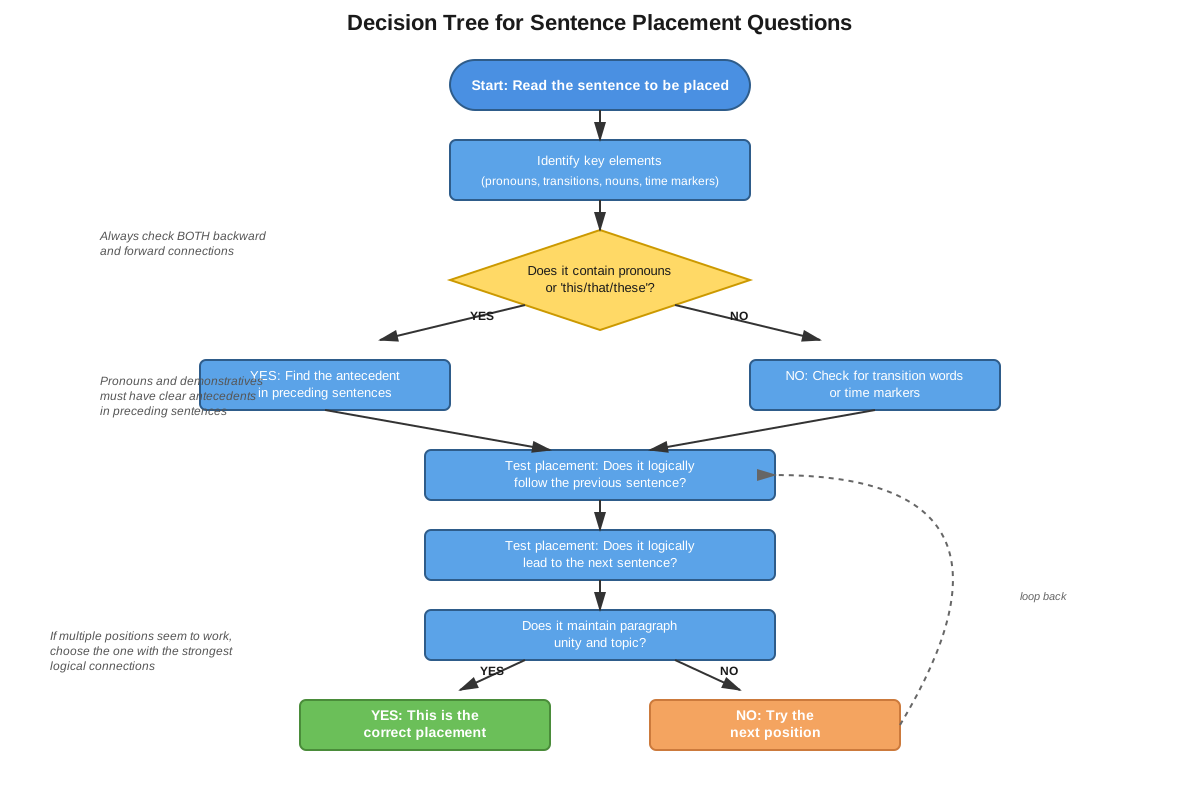
Step 1: Identify the Question Type. Recognize whether the question asks about sentence placement ("Where should this sentence be placed?"), sentence addition ("Should this sentence be added?"), sentence deletion ("Should this sentence be deleted?"), or paragraph ordering.
Step 2: Read the Entire Paragraph. Never attempt to answer based on isolated sentences. Understanding the paragraph's main idea and organizational pattern is essential.
Step 3: Identify the Organizational Pattern. Determine whether the paragraph follows chronological order, spatial order, logical progression, cause-and-effect, or another pattern. This pattern constrains where sentences can logically appear.
Step 4: Look for Explicit Connection Clues. Identify transition words, pronoun references, demonstrative adjectives, and repeated key terms that create links between sentences.
Step 5: Test Each Option. For placement questions, mentally insert the sentence in each proposed location and evaluate whether it creates smooth transitions and maintains the organizational pattern.
Exam Tip: Trigger words to watch for include "Where should this sentence be placed?" (sentence placement), "Should the writer add this sentence?" (addition), "Should the writer delete this sentence?" (deletion), and "For the sake of logic and coherence" (general flow).
Process of Elimination Tips:
- Eliminate placements that would put a pronoun before its antecedent
- Eliminate placements that violate chronological order (unless flashback is signaled)
- Eliminate placements that create illogical transitions (e.g., "however" when no contrast exists)
- Eliminate additions that introduce topics unrelated to the paragraph's main idea
- Eliminate deletions of sentences that provide essential supporting details
Time Allocation: Logical sentence flow questions typically require 30-45 seconds each. If a question requires reading an entire paragraph, allocate up to 60 seconds. Don't rush these questions—they reward careful analysis of relationships between sentences.
Common Question Stems:
- "For the sake of the logic and coherence of this paragraph, Sentence X should be placed..."
- "The writer is considering adding the following sentence... Should the writer make this addition?"
- "The writer is considering deleting the preceding sentence. Should the sentence be kept or deleted?"
- "Which of the following sequences of sentences makes this paragraph most logical?"
Memory Techniques
TOPIC Mnemonic for evaluating sentence placement:
- Transitions: Check transition words for logical connections
- Order: Identify the organizational pattern (chronological, spatial, etc.)
- Pronouns: Ensure pronouns have clear antecedents in previous sentences
- Idea: Verify the sentence supports the paragraph's main idea
- Coherence: Confirm the placement creates smooth flow with surrounding sentences
CASTE Acronym for organizational patterns:
- Chronological (time order)
- Argumentative (claim to evidence)
- Spatial (physical arrangement)
- Topical (general to specific)
- Effect (cause to consequence)
Visualization Strategy: Picture the paragraph as a chain where each sentence is a link. A sentence in the wrong position breaks the chain. When evaluating placement, visualize where the new link fits most naturally to maintain the chain's integrity.
The "Flow Test": Read the paragraph aloud (mentally during the test) with the sentence in each proposed position. The correct placement will "sound right" because it maintains natural progression and doesn't create awkward jumps in logic.
Summary
Logical sentence flow is a high-frequency ACT English topic that tests students' ability to recognize coherent organization within paragraphs and passages. Success requires understanding multiple organizational patterns (chronological, spatial, logical progression, cause-and-effect), recognizing transition words that signal relationships between sentences, maintaining paragraph unity by ensuring all sentences support the main idea, and identifying pronoun and demonstrative references that constrain sentence order. The ACT presents these concepts through sentence placement questions, addition/deletion questions, and paragraph ordering questions. Students must read entire paragraphs to understand context, identify the organizational pattern, look for explicit connection clues like transitions and pronouns, and test each option systematically. Mastering logical sentence flow requires both analytical skills (identifying patterns and relationships) and intuitive understanding of how effective writing guides readers smoothly from one idea to the next.
Key Takeaways
- Logical sentence flow questions test paragraph organization, unity, and coherence—appearing 5-7 times per ACT English section
- Always identify the paragraph's organizational pattern (chronological, spatial, logical, cause-and-effect) before attempting to answer
- Transition words, pronoun references, and demonstrative adjectives provide crucial clues about how sentences connect
- Every sentence in a paragraph must support the main idea; sentences introducing unrelated topics should be deleted
- For placement questions, test each option by considering transitions, pronoun antecedents, and the organizational pattern
- Read the entire paragraph before answering—context is essential for determining logical flow
- The correct answer creates the smoothest progression of ideas while maintaining the paragraph's established pattern
Related Topics
Transition Words and Phrases: A deeper study of coordinating conjunctions, subordinating conjunctions, and conjunctive adverbs builds on logical sentence flow by providing more sophisticated tools for creating connections between ideas. Mastering this topic enables students to not only recognize logical flow but also create it in their own writing.
Paragraph Structure and Development: Understanding how paragraphs are constructed—including topic sentences, supporting details, and concluding sentences—provides the foundation for evaluating logical flow. This topic explores the architecture that makes logical sentence flow possible.
Rhetorical Skills and Author's Purpose: Logical sentence flow connects to broader rhetorical skills including understanding why authors organize information in specific ways. This advanced topic examines how organizational choices serve persuasive, informative, or narrative purposes.
Pronoun-Antecedent Agreement: Since pronoun references constrain sentence order, deeper study of pronoun usage enhances the ability to determine logical placement. This topic explores both agreement rules and referential clarity.
Practice CTA
Now that you've mastered the core concepts of logical sentence flow, it's time to apply this knowledge! Complete the practice questions to test your ability to identify organizational patterns, evaluate sentence placement, and determine paragraph unity. The flashcards will help you memorize key transition words and organizational patterns. Remember: logical sentence flow questions reward careful analysis and systematic thinking. With practice, you'll develop an intuitive sense for how sentences should be arranged, enabling you to answer these high-yield questions quickly and accurately. Your investment in mastering this topic will pay dividends across the entire ACT English section!
Sign up free to keep reading
Create a free AnvayaPrep account to finish this ACT guide on Logical sentence flow — plus flashcards and practice questions.