Overview
Sentence variety is a critical component of effective writing tested extensively on the ACT English section. This concept evaluates a student's ability to recognize when sentences in a passage are monotonous, repetitive, or poorly structured, and to select revisions that create more engaging, sophisticated prose. The ACT doesn't just test whether sentences are grammatically correct—it tests whether they're stylistically effective and varied in structure.
On the ACT, ACT sentence variety questions typically appear 3-5 times per English section, making them high-yield content that directly impacts your score. These questions assess whether you can identify when a passage suffers from repetitive sentence patterns and choose alternatives that introduce structural diversity while maintaining clarity and coherence. The test rewards students who understand that good writing balances simple, compound, complex, and compound-complex sentences to create rhythm and maintain reader engagement.
Sentence variety connects intimately with other ACT English concepts including sentence structure, transitions, and rhetorical skills. While grammar rules tell you what's correct, sentence variety principles guide you toward what's effective. Mastering this topic requires understanding not just individual sentence types but how sentences work together within paragraphs to create flow, emphasis, and readability—skills that distinguish competent writers from exceptional ones.
Learning Objectives
- [ ] Identify when Sentence variety is being tested on the ACT
- [ ] Explain the core rule or strategy behind Sentence variety
- [ ] Apply Sentence variety to ACT-style questions accurately
- [ ] Distinguish between the four main sentence types and their appropriate uses
- [ ] Recognize patterns of monotonous sentence structure in passages
- [ ] Evaluate multiple revision options to determine which best improves sentence variety
- [ ] Combine sentences effectively using coordination, subordination, and modification
Prerequisites
- Basic sentence structure: Understanding subjects, predicates, independent clauses, and dependent clauses is essential because sentence variety involves manipulating these elements to create different sentence types.
- Coordination and subordination: Knowledge of coordinating conjunctions (FANBOYS) and subordinating conjunctions enables the combination and restructuring of sentences for variety.
- Punctuation rules: Proper use of commas, semicolons, and dashes is necessary when creating varied sentence structures without introducing errors.
- Clause identification: Distinguishing independent from dependent clauses allows recognition of simple, compound, complex, and compound-complex sentences.
Why This Topic Matters
Sentence variety represents a sophisticated writing skill that separates adequate communication from compelling prose. In professional writing, academic papers, and creative works, varied sentence structure maintains reader interest, creates emphasis, and demonstrates mastery of language. Writers who rely exclusively on simple sentences sound choppy and immature, while those who overuse complex structures risk confusing readers.
On the ACT English section, sentence variety questions appear in approximately 6-8% of all questions, typically 3-5 questions per test. These questions usually appear in the Rhetorical Skills category under "Style" or "Strategy," though they sometimes overlap with "Sentence Structure and Formation." The ACT presents these questions in several formats: asking whether sentences should be combined, whether a sentence should be revised for variety, or which alternative best improves the flow of a paragraph.
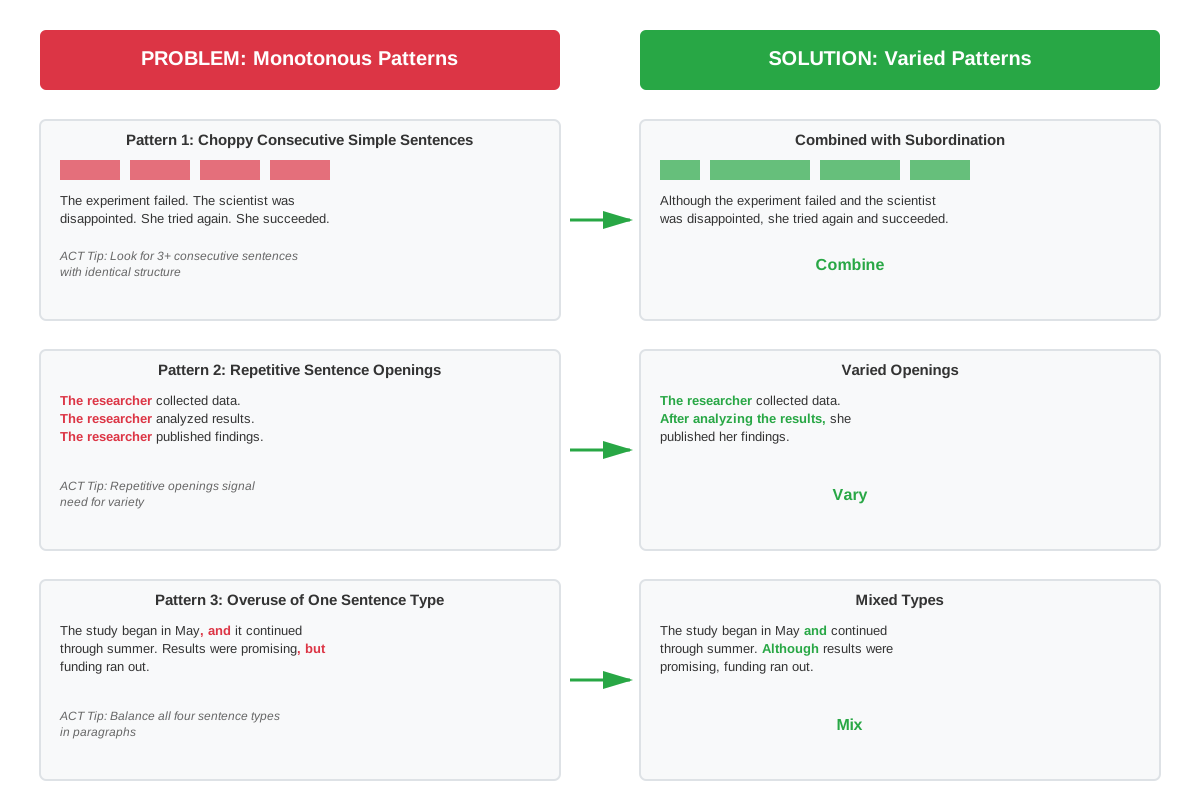
Common manifestations include passages with multiple consecutive short, choppy sentences that need combining; passages with repetitive sentence openings (every sentence starting with "The scientist..." or "He..."); and passages where all sentences follow identical grammatical patterns. The test also presents scenarios where overly complex sentences need simplification for clarity, testing whether students understand that variety means balance, not complexity for its own sake.
Core Concepts
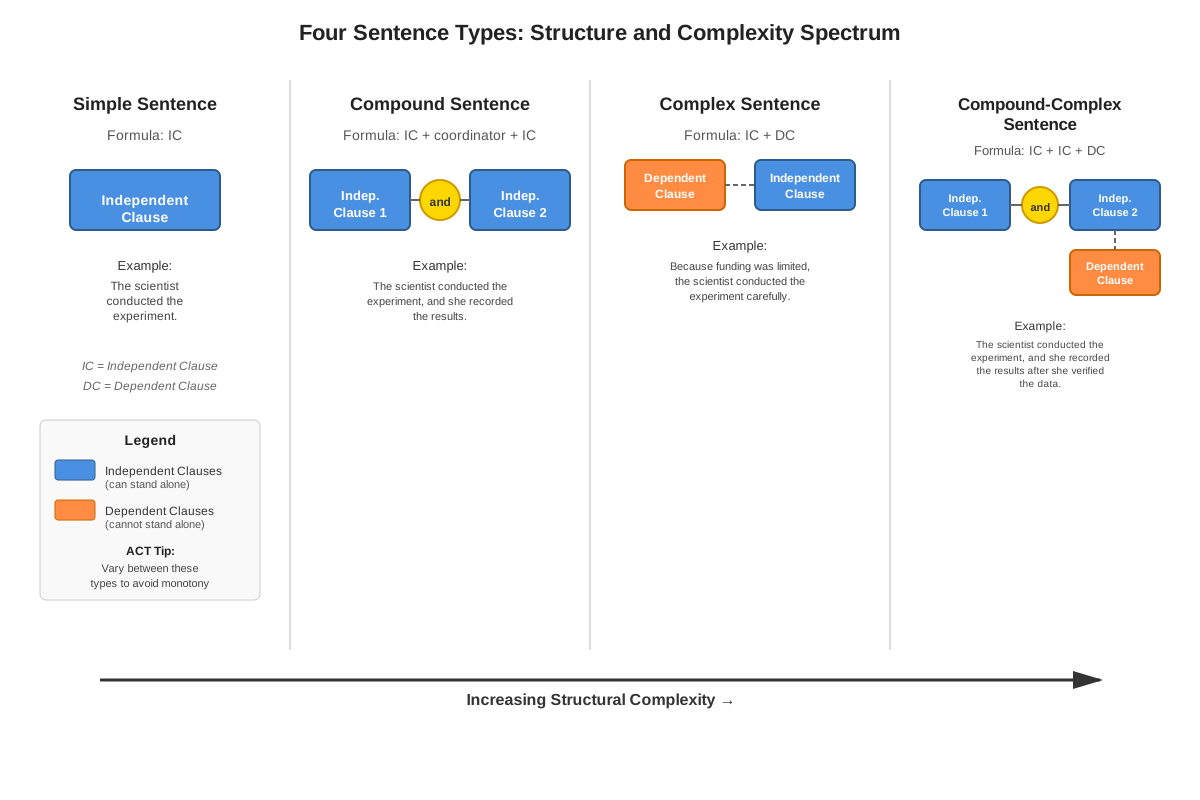
The Four Sentence Types
Understanding the fundamental sentence types forms the foundation of sentence variety. Each type serves distinct rhetorical purposes and creates different rhythms in prose.
Simple sentences contain one independent clause with a subject and predicate. Example: "The researcher conducted the experiment." Simple sentences create emphasis, clarity, and directness. They're powerful for important points but become monotonous when overused.
Compound sentences join two or more independent clauses using coordinating conjunctions (for, and, nor, but, or, yet, so) or semicolons. Example: "The researcher conducted the experiment, and the results surprised everyone." Compound sentences show relationships between equal ideas and create a sense of balance.
Complex sentences contain one independent clause and at least one dependent clause. Example: "Although the researcher was skeptical, she conducted the experiment." Complex sentences establish hierarchical relationships between ideas, showing which information is primary and which is supporting.
Compound-complex sentences combine multiple independent clauses with at least one dependent clause. Example: "Although the researcher was skeptical, she conducted the experiment, and the results surprised everyone." These sentences handle multiple relationships simultaneously and create sophisticated prose when used appropriately.
Sentence Length Variation
Effective writing varies not just sentence structure but also sentence length. Sentence length variation creates rhythm and controls pacing. Short sentences create punch and emphasis. Medium sentences provide information clearly. Longer sentences develop complex ideas and show relationships between multiple concepts.
The ACT frequently tests whether students recognize when passages suffer from uniform sentence length. A paragraph with all 15-20 word sentences feels plodding and mechanical. Strategic placement of a 5-word sentence after several longer ones creates emphasis. Conversely, a well-constructed longer sentence after several short ones can provide necessary elaboration.
| Sentence Length | Word Count | Effect | Best Use |
|---|---|---|---|
| Short | 5-10 words | Emphasis, clarity, impact | Key points, transitions, conclusions |
| Medium | 11-20 words | Standard information delivery | Most content, explanations |
| Long | 21+ words | Complexity, relationships, detail | Elaboration, multiple connected ideas |
Sentence Opening Variation
Sentence opening variation prevents the monotony of repetitive sentence beginnings. Many weak passages start every sentence with the subject: "John went to the store. John bought milk. John returned home." The ACT tests whether students can identify and correct this pattern.
Effective writers vary sentence openings using:
- Adverbial phrases: "In the morning, the team assembled."
- Prepositional phrases: "With great enthusiasm, she began the project."
- Participial phrases: "Running quickly, he caught the bus."
- Dependent clauses: "Because the weather improved, we continued hiking."
- Transitional expressions: "Furthermore, the data supported the hypothesis."
- Inverted structure: "Rarely does such an opportunity arise."
Combining Sentences for Variety
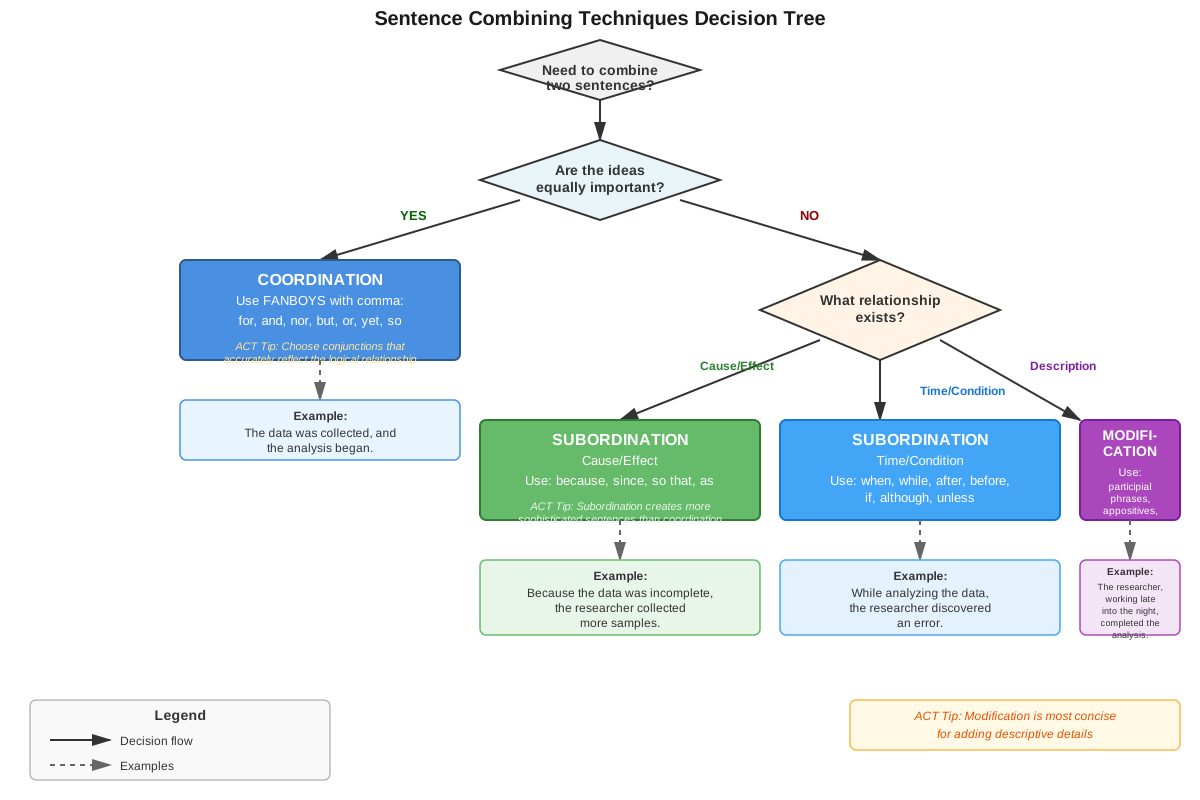
The ACT frequently presents multiple short, choppy sentences and asks which combination is most effective. Sentence combining requires understanding multiple techniques:
Coordination joins equal ideas: "The sun set. The temperature dropped." becomes "The sun set, and the temperature dropped."
Subordination shows hierarchical relationships: "The sun set. The temperature dropped." becomes "When the sun set, the temperature dropped." This version emphasizes the temperature drop as the main point.
Modification incorporates information as modifying phrases: "The sun set. It was brilliant. The temperature dropped." becomes "As the brilliant sun set, the temperature dropped."
The key is choosing the combination that best reflects the logical relationship between ideas and creates the most effective rhythm within the paragraph's context.
Parallel Structure and Variety
While parallel structure requires consistency within lists and comparisons, it works with sentence variety rather than against it. A passage can maintain parallelism within sentences while varying sentence types between sentences. For example:
"The program aims to educate students, to inspire creativity, and to foster collaboration. Through these efforts, participants develop critical skills. When they complete the program, they're prepared for future challenges."
This passage maintains parallel structure in the first sentence's list while varying sentence types across the three sentences (simple, simple, complex).
Context-Appropriate Variety
Effective sentence variety always serves the content and audience. Context-appropriate variety means matching sentence structure to purpose. Technical explanations might use more complex sentences to show relationships between concepts. Narrative passages might use more varied lengths to control pacing. Persuasive writing might employ short sentences for emphasis at key moments.
The ACT tests whether students recognize that variety isn't about making every sentence different—it's about creating patterns that serve the writing's purpose while avoiding monotony.
Concept Relationships
Sentence variety builds directly on foundational grammar concepts. Understanding clause types (independent and dependent) enables recognition of sentence types, which in turn allows strategic variation. Coordination and subordination serve as the primary tools for creating variety through sentence combining.
The relationship flows: Clause identification → Sentence type recognition → Strategic combination → Effective variety
Sentence variety connects forward to broader rhetorical skills. Mastering variety improves transitions because varied sentence openings naturally incorporate transitional elements. It enhances organization because varied structures help signal shifts between ideas. It strengthens style because variety is a hallmark of sophisticated writing.
Within the topic itself, concepts interconnect: Varying sentence types naturally varies sentence length. Combining sentences through subordination creates opportunities for varied openings. Understanding context-appropriate variety guides decisions about which combination technique to use.
The central principle: All sentence variety techniques serve the goal of maintaining reader engagement while clearly communicating ideas. Every decision about structure should balance variety with clarity, sophistication with accessibility.
High-Yield Facts
- ⭐ The ACT tests sentence variety 3-5 times per English section, making it a high-frequency topic
- ⭐ Passages with 3+ consecutive simple sentences of similar length almost always need revision for variety
- ⭐ When combining sentences, subordination is usually more effective than coordination because it shows relationships between ideas
- ⭐ Sentence variety questions often appear with the prompt "Which choice best maintains the style and tone of the passage?"
- ⭐ The correct answer balances variety with clarity—never choose a grammatically correct option that's confusing or awkward
- Simple sentences are most effective for emphasis and should be used strategically, not eliminated entirely
- Varying sentence openings is as important as varying sentence types for creating engaging prose
- Compound-complex sentences should be used sparingly; overuse creates confusion rather than sophistication
- The ACT rewards natural-sounding variety over forced complexity
- Sentence variety questions require reading the surrounding context, not just the sentence in question
- Parallel structure must be maintained even when creating sentence variety
- Short sentences (under 10 words) create the strongest emphasis when placed after longer sentences
- Every sentence type has appropriate uses; variety means strategic deployment, not random mixing
- Monotonous sentence openings (starting every sentence with the subject) is one of the most commonly tested variety issues
- Effective variety serves the content's purpose rather than existing for its own sake
Quick check — test yourself on Sentence variety so far.
Try Flashcards →Common Misconceptions
Misconception: Sentence variety means making every sentence as different as possible from the one before it.
Correction: Effective variety creates patterns and rhythms that serve the content. Some repetition is natural and appropriate; variety prevents monotony without forcing artificial differences.
Misconception: Longer, more complex sentences are always better than shorter, simpler ones.
Correction: Each sentence type serves specific purposes. Simple sentences create emphasis and clarity. The goal is strategic variety, not maximum complexity. A well-placed simple sentence is often more effective than a complex one.
Misconception: Sentence variety questions are purely stylistic and have no clear right answer.
Correction: While these questions involve style, the ACT has clear criteria: the correct answer improves variety while maintaining clarity, fits the passage's tone, and creates logical relationships between ideas. There is always one best answer.
Misconception: When combining sentences, any grammatically correct combination is acceptable.
Correction: Grammar is necessary but insufficient. The correct combination must also reflect the logical relationship between ideas (cause-effect, contrast, sequence, etc.) and fit the paragraph's flow and rhythm.
Misconception: Varying sentence openings means starting sentences with random different words.
Correction: Varied openings should be purposeful and natural. They often incorporate transitional elements, establish time or place, or emphasize particular information. Random variation creates confusion rather than clarity.
Misconception: Sentence variety is only about sentence length.
Correction: Variety encompasses sentence type (simple, compound, complex, compound-complex), length, opening structure, and internal structure. Effective variety addresses multiple dimensions simultaneously.
Misconception: Complex sentences are always better than compound sentences.
Correction: Complex sentences show hierarchical relationships (main idea + supporting detail), while compound sentences show equal relationships. The choice depends on the logical relationship between ideas, not on which type is "better."
Worked Examples
Example 1: Combining Choppy Sentences
Passage Context:
"The archaeologist discovered ancient pottery. The pottery dated to 3000 BCE. She carefully documented her findings. She sent samples to the laboratory."
Question: Which of the following best combines these sentences to improve variety while maintaining clarity?
A) The archaeologist discovered ancient pottery, the pottery dated to 3000 BCE, she carefully documented her findings, and she sent samples to the laboratory.
B) The archaeologist discovered ancient pottery dating to 3000 BCE, carefully documented her findings, and sent samples to the laboratory.
C) The archaeologist discovered ancient pottery. Dating to 3000 BCE, she carefully documented her findings and sent samples to the laboratory.
D) Having discovered ancient pottery, the pottery dated to 3000 BCE, and the archaeologist carefully documented her findings and sent samples to the laboratory.
Analysis:
First, identify the problem: four consecutive short, simple sentences create a choppy, immature rhythm. The passage needs combining for variety.
Evaluate each option:
Option A creates a run-on sentence with comma splices. "The pottery dated to 3000 BCE" is an independent clause incorrectly joined with just a comma. This is grammatically incorrect. Eliminate.
Option C has a misplaced modifier. "Dating to 3000 BCE" appears to modify "she" (the archaeologist) rather than the pottery. This creates confusion. Eliminate.
Option D is wordy and awkward. "Having discovered ancient pottery, the pottery dated..." is redundant and creates a dangling modifier. The structure is unnecessarily complex without adding clarity. Eliminate.
Option B correctly combines all four ideas into one smooth sentence. It uses a participial phrase ("dating to 3000 BCE") to modify pottery, eliminating the need for a separate clause. It creates a compound predicate ("documented... and sent") to show the sequence of actions. The result is grammatically correct, clear, and significantly more sophisticated than the original choppy sentences.
Answer: B
Connection to Learning Objectives: This example demonstrates identifying when variety is tested (multiple short sentences), understanding the strategy (combining through modification and compound predicates), and applying it accurately (choosing the grammatically correct, clear option).
Example 2: Improving Repetitive Openings
Passage Context:
"The research team analyzed the data. The research team identified several patterns. The research team concluded that further investigation was necessary. The research team submitted their findings to the journal."
Question: Which revision best improves sentence variety while maintaining the passage's meaning?
F) NO CHANGE
G) The research team analyzed the data and identified several patterns. Concluding that further investigation was necessary, they submitted their findings to the journal.
H) The research team analyzed the data. Identifying several patterns, the research team concluded that further investigation was necessary. The research team submitted their findings to the journal.
J) Analyzing the data, the research team identified several patterns, concluded that further investigation was necessary, and submitted their findings to the journal.
Analysis:
The problem is clear: every sentence begins with "The research team," creating monotonous repetition. We need varied openings while maintaining clarity.
Option F (NO CHANGE) retains the repetitive structure. This is clearly problematic and unlikely to be correct on a variety question. Eliminate.
Option H still begins two sentences with "The research team" and only varies one opening. This provides minimal improvement. While the participial phrase "Identifying several patterns" adds some variety, the overall passage remains repetitive. Eliminate.
Option J combines everything into one long sentence. While this eliminates repetition, it creates a different problem: the sentence is overloaded with three main actions in a simple list. The logical relationships between these actions (analysis leads to identification, which leads to conclusion, which leads to submission) are lost in the flat structure. This sacrifices clarity for variety. Eliminate.
Option G provides the best balance. It combines the first two related actions (analyzing and identifying) into one sentence with a compound predicate. The second sentence varies the opening with a participial phrase ("Concluding that...") and uses the pronoun "they" instead of repeating "the research team." This creates two well-structured sentences with varied openings, varied lengths, and clear logical relationships. The subordination in "Concluding that further investigation was necessary" appropriately shows this as context for the main action (submitting findings).
Answer: G
Connection to Learning Objectives: This example shows identifying repetitive patterns as a variety issue, understanding that varied openings and strategic combining improve variety, and applying these principles to select the most effective revision.
Exam Strategy
Recognizing Sentence Variety Questions
Sentence variety questions typically include these trigger phrases:
- "Which choice best maintains the style and tone?"
- "Which revision improves the flow of this paragraph?"
- "Which choice most effectively combines these sentences?"
- "Which alternative provides the most effective transition?"
When you see multiple short sentences in a passage or notice repetitive sentence patterns, anticipate a variety question even before reading the question stem.
The Three-Step Approach
- Diagnose the problem: Identify what makes the original passage monotonous (repetitive openings, uniform length, all simple sentences, etc.)
- Evaluate for grammar first: Eliminate any options with grammatical errors (run-ons, fragments, misplaced modifiers, agreement errors). Sentence variety questions still require grammatical correctness.
- Choose the most effective variety: Among grammatically correct options, select the one that best improves variety while maintaining clarity and fitting the passage's tone.
Process of Elimination Tips
Eliminate options that:
- Create grammatical errors (most common: comma splices, misplaced modifiers)
- Are unnecessarily wordy or awkward
- Obscure the logical relationships between ideas
- Combine too many ideas into one confusing sentence
- Change the meaning of the original passage
- Sound overly formal or informal compared to the passage's tone
Time Management
Sentence variety questions often require reading 3-4 sentences of context, making them slightly more time-consuming than pure grammar questions. Budget 45-60 seconds per question. If you're stuck between two options, choose the one that sounds more natural when read aloud mentally.
Context is Critical
Never evaluate sentence variety in isolation. Always read the sentence before and after the question. The correct answer must fit smoothly into the paragraph's flow. An option might create good variety in isolation but disrupt the paragraph's rhythm or logical progression.
Memory Techniques
SCCC Mnemonic for sentence types:
- Simple: Single independent clause
- Compound: Coordinated independent clauses
- Complex: Clause with subordination
- Compound-Complex: Combines both techniques
The "Three Threes" Rule: Watch for three consecutive sentences that share three characteristics (same type, same length, same opening). This pattern almost always signals a variety issue.
VOLES for variety elements to check:
- Varying sentence types
- Openings that differ
- Lengths that change
- Emphasis through structure
- Smooth flow between sentences
Visualization Strategy: Picture sentence variety as a musical rhythm. All quarter notes (same-length sentences) create monotony. A mix of quarter notes, half notes, and eighth notes (varied lengths) creates engaging rhythm. This mental model helps evaluate whether a passage has effective variety.
The "Choppy Test": When reading a passage, if it sounds like a list of facts rather than flowing prose, it needs variety. Imagine reading it aloud to a friend—would it sound natural or robotic?
Summary
Sentence variety is a high-yield ACT English topic that tests your ability to recognize and correct monotonous writing patterns. The core principle is that effective writing balances simple, compound, complex, and compound-complex sentences while varying sentence length and opening structure. The ACT presents passages with repetitive patterns—typically multiple short simple sentences or sentences with identical openings—and asks you to select revisions that improve variety while maintaining grammatical correctness and clarity. Success requires understanding the four sentence types, recognizing when variety is lacking, and applying combination techniques (coordination, subordination, modification) appropriately. The key strategy is eliminating grammatically incorrect options first, then choosing the revision that best improves variety without sacrificing clarity or changing meaning. Remember that variety serves the content: the goal is engaging, natural-sounding prose, not complexity for its own sake. Mastering this topic requires balancing multiple considerations—grammar, logic, flow, and style—making it one of the more sophisticated skills tested on the ACT English section.
Key Takeaways
- Sentence variety questions appear 3-5 times per ACT English section and test whether you can identify and correct monotonous writing patterns
- The four sentence types (simple, compound, complex, compound-complex) each serve distinct purposes; effective variety means strategic deployment of all types
- Multiple consecutive short sentences or repetitive sentence openings are the most common variety issues tested on the ACT
- When combining sentences, choose the option that reflects the logical relationship between ideas (cause-effect, sequence, contrast) while improving variety
- Grammatical correctness is necessary but insufficient—the correct answer must also improve flow, maintain clarity, and fit the passage's tone
- Variety encompasses sentence type, length, opening structure, and internal structure; effective answers address multiple dimensions
- Always read surrounding context; sentence variety questions require understanding how sentences work together within paragraphs
Related Topics
Transitions and Flow: Mastering sentence variety naturally leads to studying transitions, as varied sentence openings often incorporate transitional elements. Understanding how sentences connect within paragraphs builds on variety skills.
Rhetorical Skills - Style: Sentence variety is one component of broader style questions on the ACT. After mastering variety, students should study word choice, tone, and conciseness to complete their style knowledge.
Parallel Structure: While variety requires changing sentence patterns, parallel structure requires maintaining consistency within lists and comparisons. Understanding how these principles work together is essential for advanced ACT performance.
Sentence Structure and Formation: Deeper study of clause types, phrase types, and sentence patterns provides the grammatical foundation for more sophisticated variety techniques.
Practice CTA
Now that you understand the principles of sentence variety, it's time to apply this knowledge! Work through the practice questions to test your ability to identify variety issues and select effective revisions. The flashcards will help you internalize the four sentence types and common variety patterns. Remember: sentence variety questions reward careful reading and attention to context. Take your time, eliminate grammatically incorrect options first, and trust your ear for natural-sounding prose. You've got this!
Sign up free to keep reading
Create a free AnvayaPrep account to finish this ACT guide on Sentence variety — plus flashcards and practice questions.