Overview
Parallel structure is one of the most frequently tested grammar concepts on the ACT English section, appearing in approximately 10-15% of all grammar questions. This fundamental principle requires that elements in a sentence that perform similar functions must be expressed in matching grammatical forms. When writers list items, compare ideas, or connect phrases with coordinating conjunctions, each element must maintain the same grammatical structure—whether that's all nouns, all verbs in the same tense, all infinitives, or all prepositional phrases.
Understanding ACT parallel structure is essential because these questions test both your grammatical knowledge and your ability to recognize patterns in writing. The ACT frequently embeds parallelism errors in longer sentences with multiple clauses, making them easy to miss if you're not actively looking for structural consistency. These questions often appear deceptively simple, but they require careful attention to the grammatical form of each element in a series or comparison.
Parallel structure connects directly to broader concepts of sentence construction, clarity, and effective communication. It relates to coordination (using conjunctions like "and," "or," and "but"), subordination (maintaining consistency in dependent clauses), and overall sentence balance. Mastering parallelism will not only improve your ACT score but also strengthen your ability to identify and correct awkward, unclear writing—a skill that appears throughout the English section in questions about sentence structure, organization, and style.
Learning Objectives
- [ ] Identify when parallel structure is being tested in ACT English questions
- [ ] Explain the core rule or strategy behind parallel structure
- [ ] Apply parallel structure to ACT-style questions accurately
- [ ] Recognize parallel structure violations across different grammatical forms (verbs, nouns, phrases, clauses)
- [ ] Distinguish between correct and incorrect parallelism in lists, comparisons, and correlative conjunctions
- [ ] Evaluate answer choices by systematically checking for structural consistency
- [ ] Construct grammatically parallel sentences using various coordinating patterns
Prerequisites
- Parts of speech identification: Recognizing nouns, verbs, adjectives, adverbs, and phrases is essential because parallel structure requires matching these grammatical forms across sentence elements
- Verb tenses and forms: Understanding infinitives, gerunds, and participles enables identification of verb form consistency in parallel constructions
- Phrase and clause recognition: Distinguishing between prepositional phrases, noun phrases, and dependent clauses helps identify what elements need to be parallel
- Coordinating conjunctions: Familiarity with FANBOYS (for, and, nor, but, or, yet, so) is necessary because these conjunctions typically signal parallel structure requirements
- Basic sentence structure: Understanding subjects, predicates, and modifiers provides the foundation for recognizing when elements perform similar grammatical functions
Why This Topic Matters
Parallel structure questions appear with remarkable consistency on every ACT English test, making this one of the highest-yield grammar topics to master. Test-makers favor parallelism because it assesses multiple skills simultaneously: pattern recognition, grammatical knowledge, and attention to detail. Students who master parallel structure typically see immediate score improvements because these questions follow predictable patterns once you know what to look for.
In real-world writing, parallelism creates clarity, rhythm, and professionalism. Whether crafting a resume, writing a college essay, or composing business communications, parallel structure makes ideas easier to process and more persuasive. Readers naturally expect consistency in lists and comparisons; violations of parallelism create cognitive friction that weakens your message.
On the ACT, parallel structure appears in several distinct question types. Most commonly, you'll encounter lists of three or more items where one element doesn't match the others. The test also frequently presents comparisons using "rather than," "as well as," or "instead of" where the elements on either side must be grammatically identical. Correlative conjunctions ("not only...but also," "either...or," "neither...nor") create another common testing scenario. Finally, the ACT embeds parallelism requirements in questions about verb tense consistency within compound predicates. Approximately 4-6 questions per test directly assess parallel structure, with additional questions where parallelism influences the best answer choice.
Core Concepts
The Fundamental Rule of Parallelism
The core principle of parallel structure states that grammatical elements serving equivalent functions within a sentence must take the same grammatical form. When you connect words, phrases, or clauses with coordinating conjunctions (and, or, but) or present them in a series, each element must match structurally. This matching can occur at multiple levels: individual words (all nouns or all adjectives), phrases (all prepositional phrases or all infinitive phrases), or entire clauses (all independent clauses or all dependent clauses with the same structure).
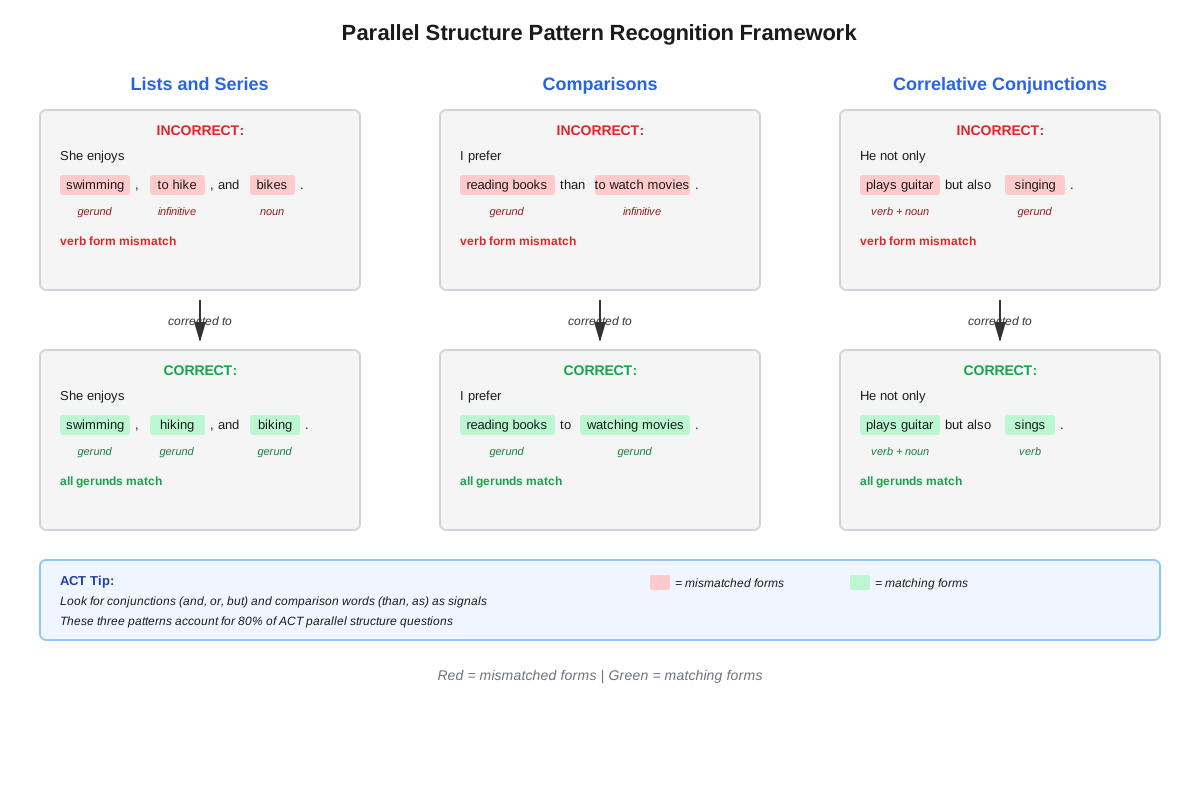
Consider this violation: "Sarah enjoys swimming, to bike, and runs." Each activity uses a different verb form—gerund (swimming), infinitive (to bike), and present tense verb (runs). The parallel version requires consistency: "Sarah enjoys swimming, biking, and running" (all gerunds) or "Sarah likes to swim, to bike, and to run" (all infinitives, though "to" can be omitted after the first instance).
Parallelism in Lists and Series
Lists represent the most common context for parallel structure on the ACT. When three or more items appear in a series, they must maintain identical grammatical forms. The test frequently presents lists where the first two items match but the third breaks the pattern, or where the final item in a longer list violates parallelism.
| Incorrect | Correct | Explanation |
|---|---|---|
| The job requires patience, dedication, and being creative. | The job requires patience, dedication, and creativity. | All three items must be nouns |
| She promised to study harder, attending all classes, and that she would ask questions. | She promised to study harder, to attend all classes, and to ask questions. | All three items must be infinitive phrases |
| The coach is demanding, experienced, and works hard. | The coach is demanding, experienced, and hardworking. | All three items must be adjectives |
Parallelism with Coordinating Conjunctions
When coordinating conjunctions connect two elements, those elements must be grammatically parallel. The conjunction acts as a signal that the structures on either side should mirror each other. This applies whether you're connecting single words, phrases, or entire clauses.
The ACT particularly tests parallelism with compound verbs (two verbs sharing the same subject). For example: "The student studied the material and was taking notes" violates parallelism because "studied" (simple past) doesn't match "was taking" (past progressive). The correction requires matching tenses: "The student studied the material and took notes" or "The student was studying the material and taking notes."
Parallelism with Correlative Conjunctions
Correlative conjunctions work in pairs: "either...or," "neither...nor," "not only...but also," "both...and," "whether...or." These constructions demand strict parallelism—whatever grammatical structure follows the first conjunction must be repeated after the second conjunction.
The key strategy is identifying what comes immediately after each conjunction. If "not only" is followed by a verb, then "but also" must be followed by a verb. If "either" is followed by a prepositional phrase, then "or" must be followed by a prepositional phrase.
Incorrect: "The program not only improved test scores but also student confidence increased."
Correct: "The program not only improved test scores but also increased student confidence."
In the incorrect version, "not only" is followed by a verb phrase ("improved test scores"), but "but also" is followed by a noun and verb ("student confidence increased"). The correct version places a verb phrase after both conjunctions.
Parallelism in Comparisons
Comparison structures using "than," "as," "like," or "rather than" require parallel elements on both sides of the comparison word. The ACT frequently tests this by comparing actions, qualities, or items using non-parallel structures.
Incorrect: "Writing an essay is more challenging than to solve math problems."
Correct: "Writing an essay is more challenging than solving math problems."
Both sides of "than" must use the same form—in this case, gerunds (writing/solving). Similarly, "She prefers reading books rather than to watch television" should be "She prefers reading books rather than watching television."
Parallelism with Prepositions
When multiple prepositional phrases modify the same word, they should maintain parallel structure. This often appears in descriptions of locations, times, or methods.
Incorrect: "The treasure was hidden in the cave, under some rocks, and near where the river bends."
Correct: "The treasure was hidden in the cave, under some rocks, and near the river bend."
Each phrase should begin with a preposition followed by a noun phrase. The phrase "near where the river bends" introduces a dependent clause, breaking the pattern.
Parallelism in Verb Forms
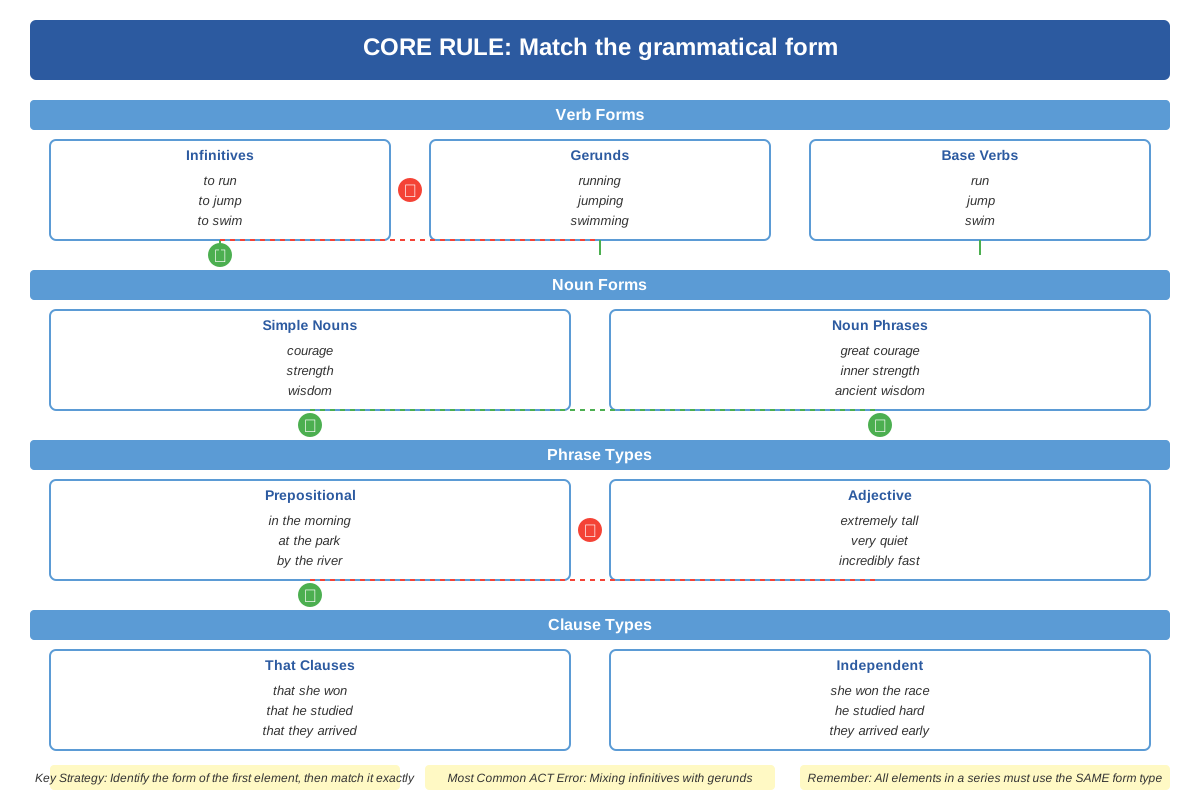
Maintaining consistency in verb forms represents a crucial aspect of parallelism. When listing actions or describing multiple activities, all verbs must use the same form: all infinitives, all gerunds, all participles, or all conjugated verbs in the same tense.
Infinitives: "To succeed requires planning, to practice, and dedication" should be "To succeed requires planning, practicing, and dedicating" (gerunds) or "To succeed, one must plan, practice, and dedicate oneself" (conjugated verbs).
Gerunds: "His hobbies include hiking, to swim, and photography" should be "His hobbies include hiking, swimming, and photography."
Concept Relationships
Parallel structure serves as a unifying principle that connects multiple grammatical concepts. At its foundation, parallelism depends on parts of speech identification → which enables recognition of whether elements match grammatically → which determines whether the sentence maintains structural consistency.
The relationship flows as follows: Coordinating conjunctions → signal the need for parallel structure → which requires matching grammatical forms → which may involve verb tense consistency, phrase structure, or clause construction → all contributing to sentence clarity and effectiveness.
Parallelism also connects to sentence combining and conciseness. When revising sentences for parallel structure, writers often discover opportunities to eliminate redundancy and improve flow. For example, "She likes to swim and she likes to run" can become "She likes to swim and run," maintaining parallelism while reducing wordiness.
The concept extends to pronoun consistency and subject-verb agreement because parallel structures must maintain these agreements across all elements. If you write "Each student must complete their homework and submit their projects," the parallel verbs (complete/submit) must both agree with the singular subject "student."
Understanding parallelism also enhances recognition of faulty coordination and subordination errors. When elements that should be parallel are instead connected through subordination, the sentence becomes unbalanced and unclear.
High-Yield Facts
⭐ Parallel structure requires that elements in a series, list, or comparison use the same grammatical form
⭐ Coordinating conjunctions (and, or, but) signal the need to check for parallelism between connected elements
⭐ Correlative conjunctions (either...or, not only...but also, both...and) require identical grammatical structures after each conjunction in the pair
⭐ In lists of three or more items, all items must maintain the same grammatical form (all nouns, all verbs, all phrases, etc.)
⭐ Comparison words (than, as, like, rather than) require parallel structures on both sides of the comparison
- Infinitives (to + verb) and gerunds (-ing form) cannot be mixed in parallel structures; choose one form and maintain it throughout
- Prepositional phrases in a series should all begin with prepositions and follow the same structural pattern
- Compound verbs sharing the same subject must use the same tense and form
- When checking for parallelism, identify the grammatical form of the first element, then verify that all subsequent elements match exactly
- The ACT often places the parallelism error in the third or final item of a list, after establishing a pattern with the first two items
Quick check — test yourself on Parallel structure so far.
Try Flashcards →Common Misconceptions
Misconception: Parallel structure only applies to lists of three or more items.
Correction: Parallelism is required whenever two or more elements are connected by coordinating conjunctions, appear in comparisons, or are joined by correlative conjunctions. Even two items connected by "and" must be parallel.
Misconception: As long as all items in a list are the same part of speech, the structure is parallel.
Correction: Parallel structure requires more than matching parts of speech; the specific forms must match. For example, "running" (gerund) and "to run" (infinitive) are both verb forms, but they're not parallel. Similarly, "in the morning" and "during the afternoon" are both prepositional phrases, but "at dawn" and "when evening comes" are not parallel because one is a phrase and one is a clause.
Misconception: In correlative conjunctions, the parallel elements begin at the conjunctions themselves.
Correction: The parallel elements are what comes immediately after each conjunction in the pair. "Either she will study or will work" is incorrect because "either" is followed by a subject and verb ("she will study") while "or" is followed by only a verb ("will work"). The correct version is "She will either study or work" (both conjunctions followed by verbs only).
Misconception: Mixing infinitives and gerunds is acceptable if they're both describing actions.
Correction: Infinitives (to swim) and gerunds (swimming) cannot be mixed in parallel structures, even though both describe actions. Choose one form and maintain it consistently throughout the sentence.
Misconception: Parallel structure is just a stylistic preference, not a grammatical rule.
Correction: While parallelism does improve style and readability, it's a grammatical requirement on the ACT. Violations of parallel structure are considered errors, not merely less elegant choices. The test will always have one clearly correct answer that maintains parallelism.
Worked Examples
Example 1: List with Mixed Verb Forms
Question: The committee plans to review the applications, interviewing the candidates, and will make a final decision by Friday.
A) NO CHANGE
B) to review the applications, to interview the candidates, and to make
C) reviewing the applications, interviewing the candidates, and making
D) to review the applications, interview the candidates, and make
Solution Process:
Step 1: Identify that this sentence contains a list of three actions connected by commas and "and."
Step 2: Examine the grammatical form of each element:
- First element: "to review the applications" (infinitive phrase)
- Second element: "interviewing the candidates" (gerund phrase)
- Third element: "will make a final decision" (future tense verb phrase)
Step 3: Recognize that the three elements use different verb forms, violating parallel structure.
Step 4: Evaluate each answer choice:
- Choice A: NO CHANGE—maintains the error with mixed forms
- Choice B: Uses three infinitive phrases ("to review," "to interview," "to make")—this is parallel
- Choice C: Uses three gerund phrases ("reviewing," "interviewing," "making")—this is also parallel
- Choice D: Uses one infinitive followed by two base verbs without "to"—this is parallel because after the first infinitive, "to" can be omitted in a series
Step 5: Determine the best answer. Both B, C, and D are grammatically parallel, but D is the most concise and natural. In a series of infinitives, English allows the "to" to be stated once and understood for subsequent verbs.
Answer: D
Connection to Learning Objectives: This example demonstrates how to identify parallel structure testing (mixed verb forms in a list), explains the core rule (all elements must match), and shows how to apply the concept by systematically evaluating each element's grammatical form.
Example 2: Correlative Conjunctions
Question: The new policy will not only reduce costs but also it will improve efficiency and increase employee satisfaction.
A) NO CHANGE
B) but also improving efficiency
C) but also improve efficiency
D) but it also improves efficiency
Solution Process:
Step 1: Identify the correlative conjunction pair: "not only...but also"
Step 2: Determine what comes immediately after "not only": The phrase "not only" is followed by a verb ("reduce").
Step 3: Determine what should come after "but also": To maintain parallelism, "but also" should be followed by a verb in the same form.
Step 4: Examine the original: "but also it will improve" places a subject and auxiliary verb after "but also," which doesn't match the structure after "not only."
Step 5: Evaluate answer choices:
- Choice A: NO CHANGE—"but also it will improve" doesn't match "not only reduce" (includes subject and auxiliary verb)
- Choice B: "but also improving"—uses a gerund, which doesn't match the base verb "reduce"
- Choice C: "but also improve"—uses a base verb matching "reduce," creating perfect parallelism
- Choice D: "but it also improves"—changes the correlative conjunction structure and doesn't maintain parallelism
Step 6: Note that the sentence lists three parallel outcomes: "reduce costs," "improve efficiency," and "increase employee satisfaction." Choice C maintains parallelism across all three verbs.
Answer: C
Connection to Learning Objectives: This example shows how to identify correlative conjunction parallelism, explains the rule that structures after each conjunction must match, and demonstrates the application strategy of examining what immediately follows each conjunction.
Exam Strategy
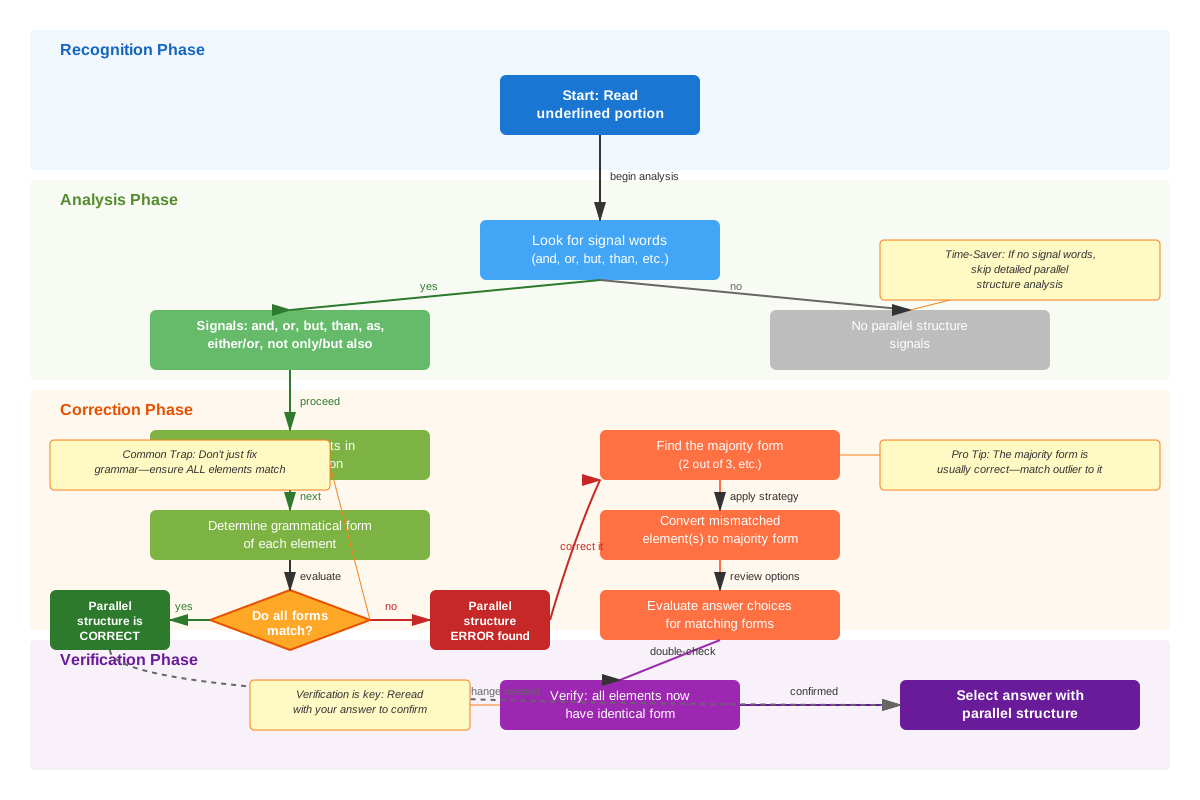
When approaching ACT parallel structure questions, develop a systematic process that quickly identifies potential errors and evaluates answer choices efficiently.
Trigger Words and Phrases: Train yourself to immediately check for parallelism when you see:
- Coordinating conjunctions (and, or, but) connecting two or more elements
- Correlative conjunctions (either...or, neither...nor, not only...but also, both...and, whether...or)
- Comparison words (than, as, like, rather than, instead of)
- Lists with commas separating three or more items
- Series of verbs sharing the same subject
The Three-Step Approach:
- Identify the parallel elements: Circle or mentally note each element that should be parallel. In a list, mark each item. With conjunctions, mark what comes before and after the conjunction.
- Determine the grammatical form of the first element: Is it a noun, verb, infinitive, gerund, prepositional phrase, or clause? This first element sets the pattern that all others must follow.
- Check each subsequent element: Does it exactly match the grammatical form of the first element? If any element differs, you've found the error.
Process of Elimination Tips:
- Eliminate any answer choice that mixes infinitives and gerunds
- Eliminate choices where correlative conjunctions are followed by different grammatical structures
- Eliminate choices that break an established pattern in a list
- When multiple choices seem parallel, choose the most concise option that maintains clarity
Time Allocation: Parallel structure questions should take 20-30 seconds once you've mastered the concept. If you find yourself spending more than 45 seconds, you may be overthinking. Trust the pattern-matching approach: identify the first element's form, then scan for matches.
Common Trap: The ACT often makes the first two items in a list parallel, then breaks the pattern with the third item. Don't assume that because the first two match, the entire sentence is correct. Always check every element.
Exam Tip: Read the sentence aloud (mentally) with emphasis on the parallel elements. Your ear will often catch structural inconsistencies that your eye might miss, especially with verb forms and phrase structures.
Memory Techniques
The MATCH Acronym for checking parallelism:
- Mark all elements that should be parallel
- Analyze the first element's grammatical form
- Test each subsequent element against the first
- Confirm all elements use identical structures
- Highlight the answer that maintains consistency
The "Same Family" Visualization: Think of parallel elements as family members who must wear matching outfits. If the first element wears an infinitive "outfit" (to + verb), all siblings must wear infinitive outfits. If one shows up in a gerund "outfit" (-ing form), the family photo (sentence) looks wrong.
The Conjunction Signal: Create a mental alert system where coordinating and correlative conjunctions trigger an automatic parallelism check. Visualize these conjunctions as bridges that can only connect identical structures—you can't bridge a noun to a verb or an infinitive to a gerund.
The "Copy-Paste" Test: When checking parallelism, imagine you could copy the first element and paste it in place of each subsequent element. If the sentence structure still makes sense (even if the meaning changes), the elements are parallel. For example, in "She likes swimming, biking, and running," you could replace "biking" with "swimming" and the structure remains valid: "She likes swimming, swimming, and running."
Rhyme for Correlative Conjunctions: "After 'not only' and after 'but also,' the grammar must be the same, you know!"
Summary
Parallel structure is a fundamental grammatical principle requiring that elements serving equivalent functions within a sentence maintain identical grammatical forms. This concept appears in 10-15% of ACT English questions, making it one of the highest-yield topics to master. Parallelism applies to lists, comparisons, coordinating conjunctions, and correlative conjunctions. The key to success is systematically identifying parallel elements, determining the grammatical form of the first element, and verifying that all subsequent elements match exactly. Common testing scenarios include lists where the final item breaks the pattern, correlative conjunctions where structures after each conjunction don't match, and comparisons using "than" or "as" where the compared elements differ in form. Mastering parallel structure requires recognizing trigger words (coordinating and correlative conjunctions, comparison words), understanding various grammatical forms (infinitives, gerunds, phrases, clauses), and applying a consistent checking process to every potential parallelism situation.
Key Takeaways
- Parallel structure requires identical grammatical forms for all elements in a series, comparison, or conjunction-connected pair
- Coordinating conjunctions (and, or, but) and correlative conjunctions (either...or, not only...but also) are primary signals to check for parallelism
- The first element in a parallel structure sets the pattern that all subsequent elements must follow
- Infinitives and gerunds cannot be mixed in parallel structures; choose one verb form and maintain it consistently
- Correlative conjunctions require that whatever grammatical structure follows the first conjunction must be repeated after the second conjunction
- Lists of three or more items must maintain the same grammatical form throughout, with the ACT often placing the error in the final item
- Systematic checking—identifying parallel elements, analyzing the first element's form, and testing each subsequent element—ensures accurate identification of parallelism errors
Related Topics
Subject-Verb Agreement: Parallel structures must maintain proper agreement between subjects and verbs across all parallel elements, particularly in compound predicates where multiple verbs share a single subject.
Verb Tense Consistency: While parallel structure focuses on grammatical form, maintaining consistent verb tenses within parallel elements ensures clarity and correctness, especially in narrative or descriptive passages.
Sentence Structure and Variety: Understanding parallelism enables more sophisticated sentence construction, allowing writers to create balanced, rhythmic sentences that effectively coordinate multiple ideas.
Coordination and Subordination: Parallel structure is essential for proper coordination of equal elements, while understanding when to use subordination instead of coordination helps avoid false parallelism.
Conciseness and Redundancy: Mastering parallelism often reveals opportunities to eliminate wordiness, as parallel structures naturally promote efficient expression of related ideas.
Practice CTA
Now that you understand the principles of parallel structure, it's time to reinforce your learning through active practice. Complete the practice questions to test your ability to identify parallelism errors in ACT-style passages and apply the systematic checking process you've learned. Use the flashcards to memorize trigger words and common parallelism patterns. Remember, parallel structure is one of the most predictable and high-yield topics on the ACT—consistent practice will translate directly into points on test day. Each question you practice strengthens your pattern-recognition skills and builds the automaticity you need to spot these errors quickly and confidently!
Sign up free to keep reading
Create a free AnvayaPrep account to finish this ACT guide on Parallel structure — plus flashcards and practice questions.