Overview
Evaluating functions is a foundational algebraic skill that appears frequently on the ACT Math test, typically showing up in 2-4 questions per exam. This topic involves substituting specific values into a function and simplifying the result to find an output. While the concept itself is straightforward, the ACT tests this skill in increasingly sophisticated ways—embedding it within word problems, combining it with other algebraic operations, or using complex function notation that can trip up unprepared students. Mastering function evaluation is not merely about mechanical substitution; it requires careful attention to order of operations, proper handling of negative numbers and fractions, and the ability to work with various function notations including f(x), g(t), and composite functions.
The importance of this topic extends far beyond isolated function problems. ACT evaluating functions serves as a gateway skill that connects to numerous other mathematical concepts tested on the exam. Students who struggle with evaluating functions will find themselves at a disadvantage when tackling questions involving function composition, inverse functions, transformations of graphs, and even some trigonometry problems. The ACT frequently embeds function evaluation within more complex scenarios, such as determining whether a point lies on a function's graph, finding unknown coefficients, or working with piecewise-defined functions.
Understanding function evaluation also strengthens broader mathematical reasoning skills essential for ACT success. It reinforces the critical distinction between independent and dependent variables, builds fluency with algebraic manipulation, and develops the careful step-by-step thinking that prevents careless errors under time pressure. Since the ACT Math section allows only 60 minutes for 60 questions, efficiency in evaluating functions—knowing when to simplify before substituting versus after, recognizing patterns that allow mental calculation, and avoiding common sign errors—can save precious seconds that accumulate across the entire test.
Learning Objectives
- [ ] Identify when Evaluating functions is being tested in ACT questions
- [ ] Explain the core rule or strategy behind Evaluating functions
- [ ] Apply Evaluating functions to ACT-style questions accurately
- [ ] Evaluate functions with negative numbers, fractions, and algebraic expressions as inputs
- [ ] Work with multiple function notations including f(x), g(t), h(n), and others
- [ ] Solve problems involving function evaluation within real-world contexts and word problems
- [ ] Recognize and avoid common errors in order of operations during function evaluation
Prerequisites
- Basic algebraic manipulation: Essential for simplifying expressions after substitution; students must combine like terms and apply distributive property correctly
- Order of operations (PEMDAS): Critical for evaluating functions correctly, as substitution often creates expressions requiring careful sequencing of operations
- Working with negative numbers: Necessary because function inputs frequently include negative values, and sign errors are the most common mistake in evaluation
- Understanding of function notation: Students must recognize that f(x) represents a function named f with input x, not multiplication
- Exponent rules: Required when evaluating functions containing powers, especially when substituting negative numbers that must be squared or cubed
Why This Topic Matters
Function evaluation represents one of the most practical mathematical skills students encounter. In real-world applications, functions model relationships between quantities—from calculating compound interest (where time is the input) to determining medication dosages based on patient weight, to computing the trajectory of a projectile based on elapsed time. Engineers use function evaluation constantly when testing how systems respond to different inputs, while data scientists evaluate statistical functions to make predictions. The ability to substitute values and compute outputs is fundamental to using mathematics as a tool for solving actual problems rather than merely manipulating abstract symbols.
On the ACT specifically, function evaluation appears with remarkable consistency. Statistical analysis of recent ACT exams reveals that approximately 3-7% of all Math questions directly test function evaluation, with an additional 5-10% incorporating it as a necessary step within more complex problems. This translates to roughly 2-4 standalone questions plus several more where evaluation is embedded. The ACT tests this concept through multiple question formats: straightforward "find f(3)" problems worth quick points, word problems where students must first identify the function and then evaluate it, questions asking students to find input values that produce specific outputs, and problems involving piecewise functions where students must first determine which piece applies before evaluating.
Common ACT question patterns include: evaluating polynomial functions at specific values; working with rational functions (fractions) where careful simplification is required; evaluating functions at algebraic expressions like f(2x) or g(a+1); determining function values from graphs or tables; and solving equations of the form f(x) = k for some constant k. The test writers deliberately include answer choices that represent common errors—such as the result of forgetting to square a negative sign or applying operations in the wrong order—making it essential that students not only know how to evaluate functions but can do so with precision under time pressure.
Core Concepts
Function Notation and Basic Evaluation
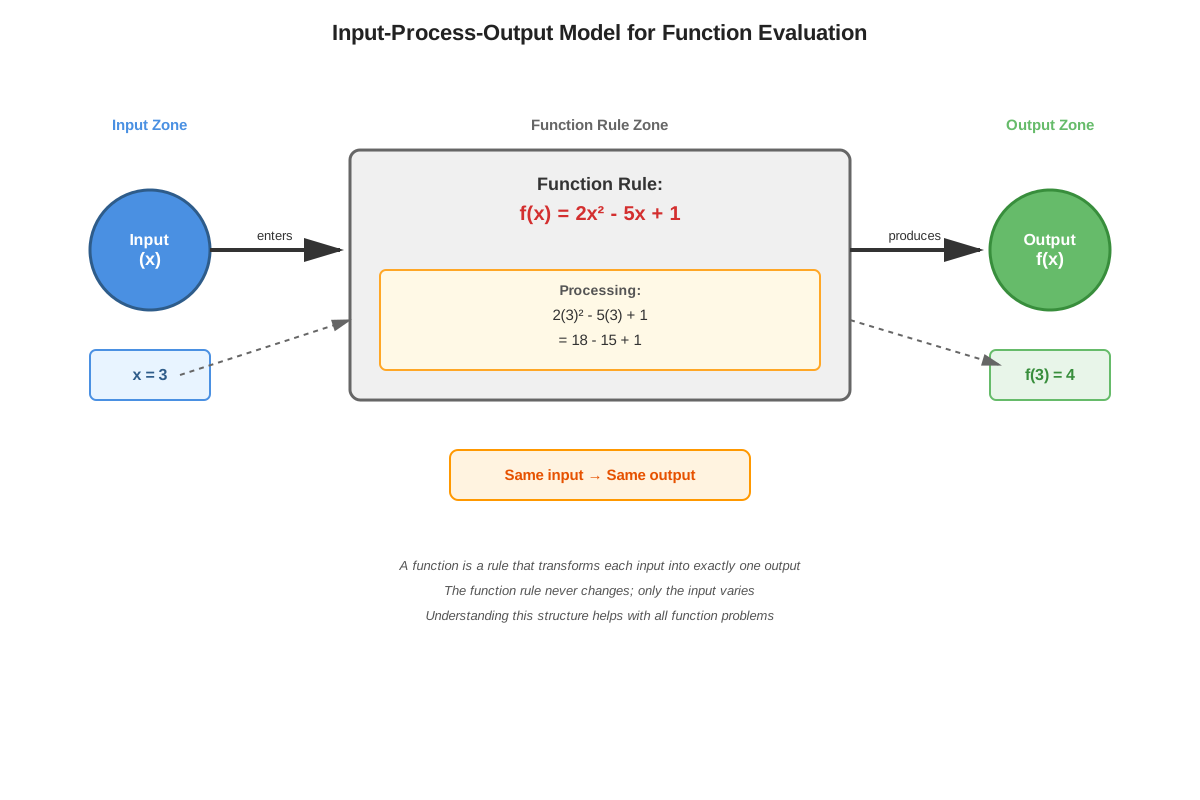
A function is a mathematical relationship that assigns exactly one output to each input. Function notation uses the form f(x), read as "f of x," where f is the function name, x is the input variable (also called the independent variable or argument), and the entire expression f(x) represents the output (dependent variable). The notation f(x) = 2x + 5 means "the function f takes an input x and produces an output equal to 2x + 5."
Evaluating functions means finding the output when a specific input value is substituted for the variable. To evaluate f(3) when f(x) = 2x + 5:
- Replace every occurrence of x with 3
- Simplify using order of operations
- f(3) = 2(3) + 5 = 6 + 5 = 11
The parentheses in function notation indicate substitution, not multiplication. When evaluating f(a) for some value a, every instance of the input variable must be replaced with a, including multiple occurrences within the same expression.
Evaluating with Different Input Types
Numerical Inputs
When the input is a number, direct substitution applies. However, special care is required for:
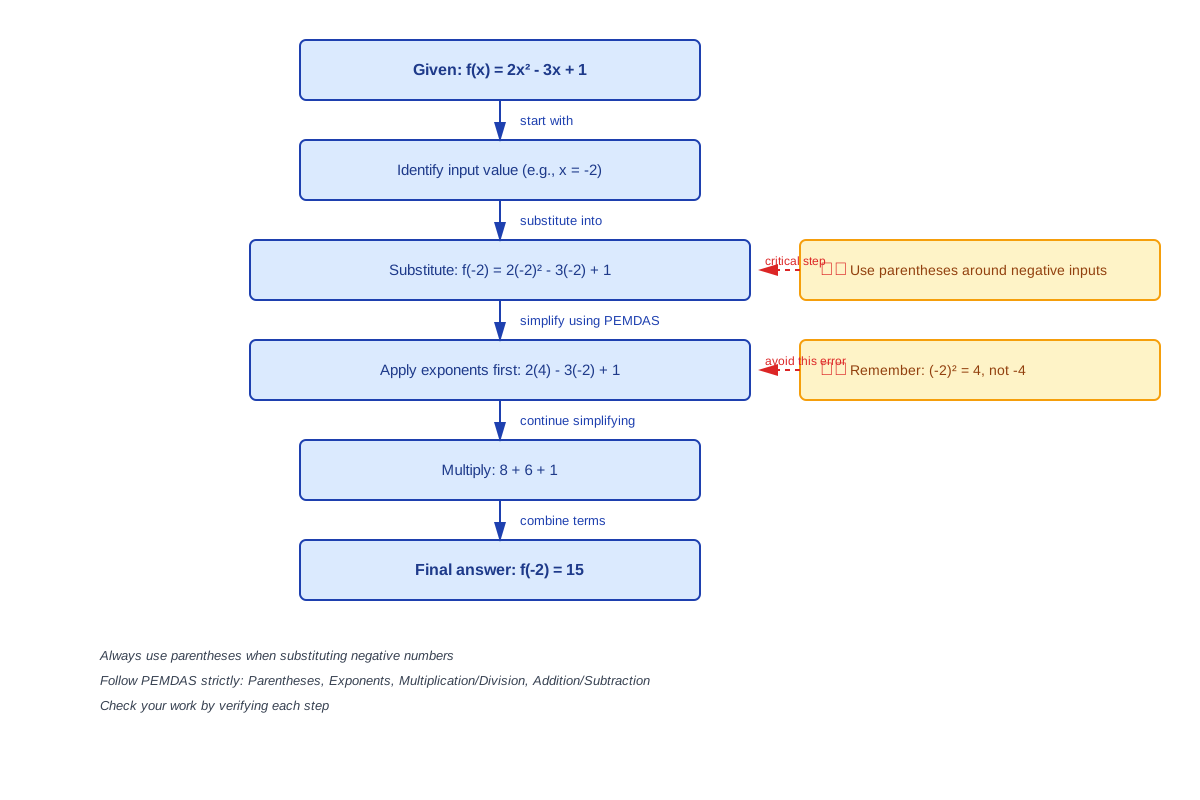
Negative numbers: Always use parentheses when substituting negative values to avoid sign errors.
- If f(x) = x² - 3x + 1, then f(-2) = (-2)² - 3(-2) + 1 = 4 + 6 + 1 = 11
- Common error: -2² = -4 (incorrect) versus (-2)² = 4 (correct)
Fractions: Maintain proper fraction arithmetic throughout the evaluation.
- If g(x) = 4x - 2, then g(1/2) = 4(1/2) - 2 = 2 - 2 = 0
Zero: Often appears in ACT questions because it simplifies many expressions and tests understanding of function behavior.
- If h(x) = x³ - 5x, then h(0) = 0³ - 5(0) = 0
Algebraic Inputs
Functions can be evaluated at algebraic expressions rather than just numbers. When the input is an expression like 2a, x+1, or n-3, substitute the entire expression for every occurrence of the variable:
If f(x) = x² + 2x, then:
- f(2a) = (2a)² + 2(2a) = 4a² + 4a
- f(x+1) = (x+1)² + 2(x+1) = x² + 2x + 1 + 2x + 2 = x² + 4x + 3
This type of evaluation frequently appears in ACT questions testing both function evaluation and algebraic manipulation skills simultaneously.
Multiple Function Notations
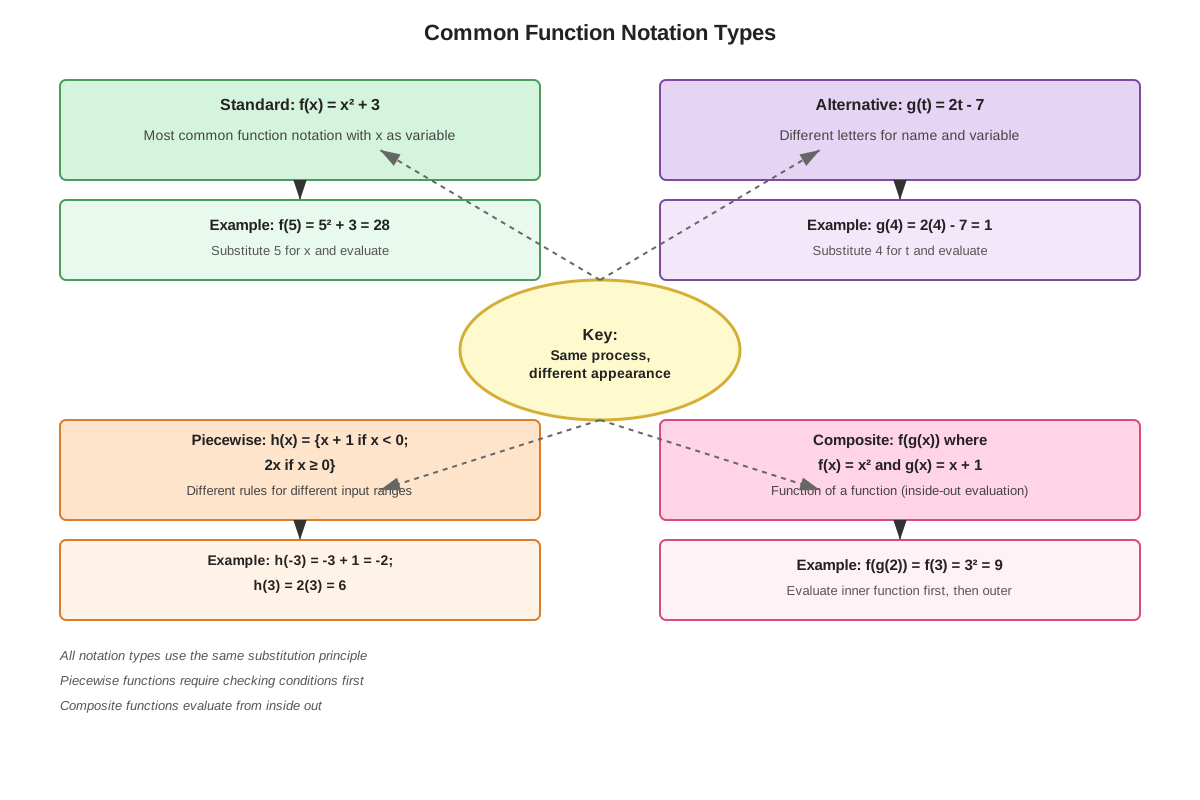
The ACT uses various letters and variables for functions to test whether students understand the concept rather than just memorizing f(x) patterns:
| Notation | Meaning | Example |
|---|---|---|
| f(x) | Function f with input x | f(x) = 3x - 1 |
| g(t) | Function g with input t | g(t) = t² + 4 |
| h(n) | Function h with input n | h(n) = 2ⁿ |
| C(r) | Function C with input r | C(r) = πr² (area function) |
| P(x) | Function P with input x | P(x) = x³ - 2x² + x - 5 (polynomial) |
The letter used for the function name and the input variable are arbitrary labels. What matters is the relationship between input and output. Students must be equally comfortable evaluating g(5) as f(5), and recognize that the variable name (x, t, n, etc.) is simply a placeholder.
Piecewise Functions
A piecewise function uses different formulas for different input ranges. The ACT frequently tests whether students can identify which piece of the function applies before evaluating:
f(x) = { 2x + 1,  if x < 0
       { x²,      if x ≥ 0
To evaluate f(-3): Since -3 < 0, use the first piece: f(-3) = 2(-3) + 1 = -6 + 1 = -5
To evaluate f(4): Since 4 ≥ 0, use the second piece: f(4) = 4² = 16
The critical step is determining which condition the input satisfies before performing any calculation. ACT answer choices often include results from evaluating the wrong piece.
Function Evaluation from Graphs and Tables
Not all functions are given as algebraic formulas. The ACT tests function evaluation using:
Graphs: To find f(a) from a graph, locate a on the x-axis, move vertically to the function curve, then read the y-coordinate.
Tables: Function values are listed explicitly. If a table shows that when x = 3, f(x) = 7, then f(3) = 7 by direct reading.
These representations test whether students understand that a function is fundamentally about input-output relationships, regardless of how that relationship is expressed.
Solving for Input Values
Some ACT questions reverse the evaluation process: given an output, find the input. If f(x) = 2x - 5 and f(x) = 11, find x:
- Set up the equation: 2x - 5 = 11
- Solve for x: 2x = 16, so x = 8
- Verify: f(8) = 2(8) - 5 = 16 - 5 = 11 ✓
This type of problem combines function evaluation with equation-solving skills and appears regularly on the ACT.
Concept Relationships
Function evaluation serves as the foundation for a hierarchy of related concepts. At the most basic level, understanding function notation enables basic evaluation with numerical inputs, which then extends to evaluation with algebraic inputs. This progression builds toward more sophisticated applications.
The relationship map flows as follows:
Function Notation → Basic Numerical Evaluation → Evaluation with Negative Numbers/Fractions → Algebraic Expression Evaluation → Function Composition (evaluating f(g(x)))
Simultaneously, function evaluation connects horizontally to other topics:
Function Evaluation ↔ Graphing Functions (evaluation finds specific points on graphs)
Function Evaluation ↔ Solving Equations (finding inputs that produce specific outputs)
Function Evaluation ↔ Domain and Range (evaluation reveals which outputs are possible)
The prerequisite knowledge of order of operations and algebraic manipulation directly supports every type of function evaluation. Without fluency in PEMDAS, students will make errors even when they correctly substitute values. Similarly, working with negative numbers is not merely a prerequisite but an integrated skill that appears in nearly every evaluation problem involving negative inputs.
Function evaluation also enables progression to advanced topics tested on the ACT: composite functions require evaluating one function and using that result as input to another; inverse functions reverse the evaluation process; function transformations involve evaluating shifted or scaled versions of functions. Students who master evaluation can approach these topics with confidence, while those with shaky evaluation skills struggle with every subsequent concept.
High-Yield Facts
⭐ Function notation f(x) means substitute x with the given value, not multiply f times x
⭐ When substituting negative numbers, always use parentheses: f(-3) requires replacing x with (-3) throughout
⭐ The most common error in function evaluation is sign mistakes with negative inputs, especially when squaring
⭐ For piecewise functions, determine which piece applies before evaluating—check the condition first
⭐ When evaluating f(algebraic expression), substitute the entire expression for every occurrence of the variable
- Function names (f, g, h, etc.) and variable names (x, t, n, etc.) are arbitrary labels—focus on the relationship
- To find an input that produces a specific output, set f(x) equal to that output and solve the resulting equation
- Evaluating at x = 0 often simplifies expressions significantly and is a common ACT test value
- When a function contains multiple instances of the variable, each must be replaced during evaluation
- Function evaluation from a graph requires reading the y-coordinate at the specified x-value
- The order of operations (PEMDAS) must be followed precisely after substitution—exponents before multiplication
- Rational functions (fractions) may simplify before or after substitution; choose the approach that minimizes calculation
- Composite function evaluation works from the inside out: to find f(g(3)), first evaluate g(3), then use that result in f
Quick check — test yourself on Evaluating functions so far.
Try Flashcards →Common Misconceptions
Misconception: The notation f(x) means f multiplied by x.
Correction: Function notation f(x) indicates that f is a function with input x. The parentheses denote substitution, not multiplication. If f(x) = 2x + 1, then f(3) means "substitute 3 for x," giving 2(3) + 1 = 7, not f · 3.
Misconception: When evaluating f(-2) in f(x) = x², the answer is -4.
Correction: The expression (-2)² equals positive 4, not -4. The negative sign is inside the parentheses and gets squared along with the 2. The error -2² = -4 occurs when the negative is not properly included in the squaring operation. Always use parentheses when substituting negative values.
Misconception: For piecewise functions, you can use any piece to evaluate the function.
Correction: Each piece of a piecewise function applies only to specific input values defined by the conditions. You must first check which condition your input satisfies, then use only that corresponding piece. Using the wrong piece produces an incorrect answer that often appears as a distractor in ACT answer choices.
Misconception: When evaluating f(2x), you can just multiply the function by 2.
Correction: Evaluating f(2x) means substituting the expression "2x" for every occurrence of the variable in the function definition. If f(x) = x² + 3, then f(2x) = (2x)² + 3 = 4x² + 3, not 2(x² + 3). The substitution must be performed before any simplification.
Misconception: If f(3) = 7, then x = 3 and f = 7.
Correction: Function notation represents a relationship, not separate variables. The statement f(3) = 7 means "when the input to function f is 3, the output is 7." The letter f is the function name, not a variable with a value. You cannot "solve for f" in this context.
Misconception: The variable letter in a function definition matters for evaluation.
Correction: Whether a function is written as f(x) = 2x + 1, f(t) = 2t + 1, or f(n) = 2n + 1, the function is identical. The variable is simply a placeholder. To evaluate f(5), substitute 5 for whatever variable appears in the definition, regardless of its letter.
Misconception: You must simplify the function before substituting values.
Correction: While sometimes helpful, simplification before substitution is not required and can sometimes make evaluation harder. The standard approach is to substitute first, then simplify. However, strategic simplification (like factoring) can occasionally make calculation easier—flexibility is key.
Worked Examples
Example 1: Multi-Step Evaluation with Negative Input
Problem: If f(x) = 2x² - 3x + 5, find f(-4).
Solution:
Step 1: Identify what needs to be substituted. We need to replace every x in the function with -4.
Step 2: Write the function with -4 substituted, using parentheses around the negative number:
f(-4) = 2(-4)² - 3(-4) + 5
Step 3: Evaluate the exponent first (order of operations):
(-4)² = 16
So: f(-4) = 2(16) - 3(-4) + 5
Step 4: Perform multiplication:
2(16) = 32
-3(-4) = 12
So: f(-4) = 32 + 12 + 5
Step 5: Add from left to right:
32 + 12 = 44
44 + 5 = 49
Answer: f(-4) = 49
Connection to Learning Objectives: This problem demonstrates the core strategy of function evaluation (substitution followed by simplification) and highlights the critical importance of proper handling of negative numbers. The ACT frequently includes answer choices like -49 or 9 (common errors from sign mistakes) to catch students who don't use parentheses when substituting negative values.
Example 2: Algebraic Input Evaluation
Problem: If g(x) = x² - 2x + 1, find g(a + 3) in simplified form.
Solution:
Step 1: Recognize that we're substituting an algebraic expression (a + 3) for x. Every x must be replaced with (a + 3).
Step 2: Substitute (a + 3) for each occurrence of x:
g(a + 3) = (a + 3)² - 2(a + 3) + 1
Step 3: Expand (a + 3)² using (A + B)² = A² + 2AB + B²:
(a + 3)² = a² + 6a + 9
Step 4: Distribute -2 through (a + 3):
-2(a + 3) = -2a - 6
Step 5: Combine all terms:
g(a + 3) = a² + 6a + 9 - 2a - 6 + 1
Step 6: Combine like terms:
- a² term: a²
- a terms: 6a - 2a = 4a
- Constant terms: 9 - 6 + 1 = 4
Answer: g(a + 3) = a² + 4a + 4
Alternative observation: The simplified result a² + 4a + 4 factors as (a + 2)², which makes sense because the original function g(x) = x² - 2x + 1 factors as (x - 1)², so g(a + 3) = (a + 3 - 1)² = (a + 2)².
Connection to Learning Objectives: This example demonstrates evaluation with algebraic inputs, a higher-level skill that combines function evaluation with polynomial expansion and algebraic simplification. ACT questions of this type test whether students can maintain accuracy through multiple steps of algebra while keeping track of the substitution process.
Example 3: Piecewise Function Evaluation
Problem:
h(x) = { x² + 1,     if x ≤ 2
       { 3x - 4,     if x > 2
Find h(2) and h(5).
Solution for h(2):
Step 1: Determine which piece applies. Check the conditions:
- Is 2 ≤ 2? Yes, this is true.
- Therefore, use the first piece: h(x) = x² + 1
Step 2: Evaluate using the first piece:
h(2) = (2)² + 1 = 4 + 1 = 5
Answer: h(2) = 5
Solution for h(5):
Step 1: Determine which piece applies. Check the conditions:
- Is 5 ≤ 2? No, this is false.
- Is 5 > 2? Yes, this is true.
- Therefore, use the second piece: h(x) = 3x - 4
Step 2: Evaluate using the second piece:
h(5) = 3(5) - 4 = 15 - 4 = 11
Answer: h(5) = 11
Common ACT Trap: Answer choices would likely include 26 (from incorrectly using x² + 1 for h(5): 5² + 1 = 26) and 2 (from incorrectly using 3x - 4 for h(2): 3(2) - 4 = 2). These wrong answers catch students who don't carefully check which piece applies.
Connection to Learning Objectives: This example addresses the identification of when function evaluation is being tested (recognizing piecewise notation) and demonstrates the strategy of checking conditions before evaluating. Piecewise functions appear regularly on the ACT and require careful reading to avoid using the wrong formula.
Exam Strategy
When approaching ACT evaluating functions questions, begin by identifying the question type. Look for function notation like f(x), g(t), or h(n) as the primary trigger. Questions may ask directly "What is f(3)?" or embed evaluation within word problems: "If the cost function is C(n) = 15n + 50, what is the cost for 8 items?"
Trigger words and phrases that signal function evaluation:
- "Find f(a)" or "Evaluate g(x) when..."
- "What is the value of..."
- "If f(x) = [expression], then f([number]) = ?"
- "For the function defined by..."
- "What is the output when the input is..."
Step-by-step approach:
- Identify the function definition: Locate the formula or rule that defines the function
- Identify the input value: Determine what value or expression you're substituting
- Use parentheses: Write the substitution with parentheses around the input, especially for negative numbers
- Apply order of operations: Evaluate exponents first, then multiplication/division, then addition/subtraction
- Simplify completely: Continue until you reach a single numerical answer
- Check answer choices: If your answer doesn't match, review your signs and order of operations
Process of elimination tips:
- Eliminate answers that have the wrong sign (positive vs. negative)
- For piecewise functions, eliminate answers that come from the wrong piece
- Check if an answer choice equals the input value—this is rarely correct and usually represents the error of not evaluating
- When evaluating with negative inputs, eliminate answers that ignore the negative sign
- For algebraic inputs, eliminate answers that are just numbers (the answer should contain variables)
Time allocation: Standard function evaluation questions should take 30-45 seconds. If you're spending more than a minute, you may be overcomplicating the problem. Consider:
- Whether you can evaluate mentally for simple functions
- If you're using the correct piece for piecewise functions
- Whether you've made a sign error that's causing your answer not to match
When stuck: If you can't find your answer among the choices, the most likely errors are:
- Sign error with negative numbers (especially squaring negatives)
- Order of operations mistake
- Using the wrong piece of a piecewise function
- Forgetting to substitute all occurrences of the variable
Quickly re-check these four areas before moving on.
Memory Techniques
SPIN - The four-step process for function evaluation:
- Substitute the input value for the variable
- Parenthesize negative numbers and expressions
- Implement order of operations (PEMDAS)
- Numerical answer (simplify completely)
"Every X Must Go" - Remember that when evaluating f(a), every single occurrence of x in the function must be replaced with a. Students often forget to substitute all instances, especially in expressions like f(x) = x² - 3x + 2 where x appears three times.
Negative Number Parentheses Rule: Visualize a protective bubble around negative numbers. Whenever you substitute a negative value, imagine placing it in a protective bubble (parentheses) that keeps the negative sign attached during all operations. This prevents the most common evaluation error.
Piecewise Function Checklist: Use the acronym CLIP:
- Check the condition first
- Locate which piece applies
- Ignore all other pieces
- Proceed with evaluation
Function vs. Multiplication: Remember "Function notation Forbids multiplication thinking." The parentheses in f(x) mean something completely different from multiplication parentheses. When you see f(3), think "f accepts 3" not "f times 3."
Algebraic Input Visualization: When evaluating f(2x) or g(a+1), visualize the algebraic expression as a single package that replaces the variable. Imagine putting the entire expression in a box, then placing that box wherever the variable appears. This prevents the error of only partially substituting the expression.
Summary
Evaluating functions is a high-yield ACT Math topic that tests the fundamental skill of substituting values into algebraic expressions and simplifying the results. The core process involves three essential steps: identifying what to substitute, performing the substitution with careful attention to parentheses (especially for negative numbers and algebraic expressions), and simplifying using proper order of operations. The ACT tests this concept through various formats including direct evaluation with numerical inputs, evaluation with algebraic expressions, piecewise functions requiring conditional logic, and reverse problems where students must find inputs that produce specific outputs. Success requires mastery of prerequisite skills like order of operations and working with negative numbers, combined with careful attention to detail to avoid the most common errors: sign mistakes when squaring negative numbers, using the wrong piece of piecewise functions, and failing to substitute all occurrences of the variable. Students who develop systematic habits—always using parentheses for substitution, checking conditions before evaluating piecewise functions, and methodically applying PEMDAS—can consistently earn points on these questions while building the foundation for more advanced function concepts.
Key Takeaways
- Function evaluation means substituting a specific value for the variable and simplifying—this is the fundamental definition that applies to all evaluation problems
- Always use parentheses when substituting negative numbers or algebraic expressions to prevent sign errors and maintain proper order of operations
- The most common ACT error is sign mistakes with negative inputs, especially when squaring: remember that (-3)² = 9, not -9
- For piecewise functions, check which condition applies before evaluating—using the wrong piece is a deliberate trap in ACT answer choices
- Function notation f(x) indicates substitution, not multiplication—the parentheses tell you to replace x with the given value
- When evaluating f(algebraic expression), substitute the entire expression for every occurrence of the variable, then simplify using algebraic rules
- Function evaluation appears in 2-4 direct questions per ACT plus several embedded applications—mastering this skill provides both quick points and enables success on related topics
Related Topics
Function Composition: Building on basic evaluation, composition involves evaluating one function and using that result as input to another function, written as f(g(x)). Mastering evaluation makes composition straightforward since it's just evaluation performed twice in sequence.
Inverse Functions: Finding and working with inverse functions requires understanding the relationship between inputs and outputs established through evaluation. If you can evaluate f(x) to find outputs, you can work backward with f⁻¹(x) to find inputs.
Domain and Range: Determining which inputs are valid (domain) and which outputs are possible (range) relies on the ability to evaluate functions at various values and observe the results. Function evaluation provides the concrete examples that illustrate domain and range concepts.
Graphing Functions: Every point on a function's graph represents an evaluation: the point (a, b) means f(a) = b. Understanding evaluation helps interpret graphs and vice versa, creating a powerful connection between algebraic and visual representations.
Function Transformations: Evaluating transformed functions like f(x-2) + 3 requires combining evaluation skills with understanding of shifts and stretches. The evaluation process remains the same, but the input or output is modified according to transformation rules.
Practice CTA
Now that you've mastered the concepts and strategies for evaluating functions, it's time to put your knowledge into action! Work through the practice questions to reinforce these skills and build the speed and accuracy you need for ACT success. Each practice problem is designed to mirror actual ACT question types and difficulty levels. As you practice, focus on implementing the systematic approach outlined in this guide: use parentheses for all substitutions, check your signs carefully, and apply order of operations methodically. The flashcards will help you memorize key facts and common patterns, while the practice questions will develop your problem-solving fluency. Remember, function evaluation is a high-yield topic that appears multiple times on every ACT—investing time in practice now will pay dividends on test day. You've got this!
Sign up free to keep reading
Create a free AnvayaPrep account to finish this ACT guide on Evaluating functions — plus flashcards and practice questions.