Overview
The range is one of the most fundamental measures of variability in statistics, representing the spread between the highest and lowest values in a data set. On the ACT Math test, range questions appear regularly in the Statistics and Probability content area, making this a high-yield topic that students must master for exam success. Understanding range is essential not only for direct calculation questions but also for interpreting data displays, analyzing real-world scenarios, and solving multi-step problems that involve data analysis.
The concept of range serves as a gateway to understanding more complex statistical measures of spread, such as interquartile range, variance, and standard deviation. While range is the simplest measure of variability, it provides crucial information about data distribution and is frequently tested because it requires students to demonstrate both computational accuracy and conceptual understanding. The ACT often embeds range calculations within word problems, data tables, graphs, and scenarios that require careful reading and interpretation.
Mastering range connects directly to broader mathematical reasoning skills tested on the ACT, including number sense, algebraic thinking, and data interpretation. Questions involving range frequently appear alongside other statistical concepts like mean, median, and mode, requiring students to distinguish between different measures and apply the appropriate calculation. The ability to quickly identify when range is being tested and execute the calculation accurately can secure valuable points on test day, particularly since these questions typically appear in the middle difficulty range where strategic point-earning is most efficient.
Learning Objectives
- [ ] Identify when Range is being tested in ACT questions
- [ ] Explain the core rule or strategy behind Range calculations
- [ ] Apply Range to ACT-style questions accurately
- [ ] Calculate range from various data representations including lists, tables, and graphs
- [ ] Determine how changes to a data set affect the range
- [ ] Distinguish between range and other measures of spread in multi-concept questions
- [ ] Solve multi-step problems that incorporate range with other statistical measures
Prerequisites
- Basic arithmetic operations (addition, subtraction): Range calculation requires finding the difference between two values, making subtraction fluency essential
- Understanding of data sets and numerical ordering: Students must be able to identify maximum and minimum values from organized or unorganized data
- Reading and interpreting tables and graphs: ACT range questions frequently present data in visual formats requiring extraction of relevant values
- Concept of variables and algebraic expressions: Some range problems involve unknown values that must be determined through algebraic reasoning
Why This Topic Matters
In real-world applications, range provides immediate insight into data variability across countless fields. Meteorologists use range to describe temperature fluctuations, financial analysts examine price ranges to assess market volatility, quality control engineers monitor manufacturing ranges to ensure consistency, and educators analyze test score ranges to understand class performance distribution. The simplicity of range makes it an accessible first step in understanding how data spreads, which is fundamental to making informed decisions based on quantitative information.
On the ACT Math test, range appears in approximately 2-4 questions per exam, representing roughly 3-7% of the 60 total math questions. This frequency, combined with the medium difficulty level, makes range a high-value topic for score improvement. Questions testing range typically appear in positions 20-45 of the math section, placing them in the middle-to-upper difficulty range where strategic preparation yields the greatest return on investment.
ACT range questions commonly appear in several formats: direct calculation from a list of numbers, determination of range from data tables or graphs, word problems requiring identification of maximum and minimum values, and complex scenarios where students must determine an unknown value given the range and other data points. The test makers frequently combine range with other statistical concepts, requiring students to calculate multiple measures or determine which measure is most appropriate for a given situation. Additionally, range questions often appear in real-world contexts involving sports statistics, weather data, test scores, prices, or measurements, requiring students to extract relevant information from contextual descriptions.
Core Concepts
Definition and Formula
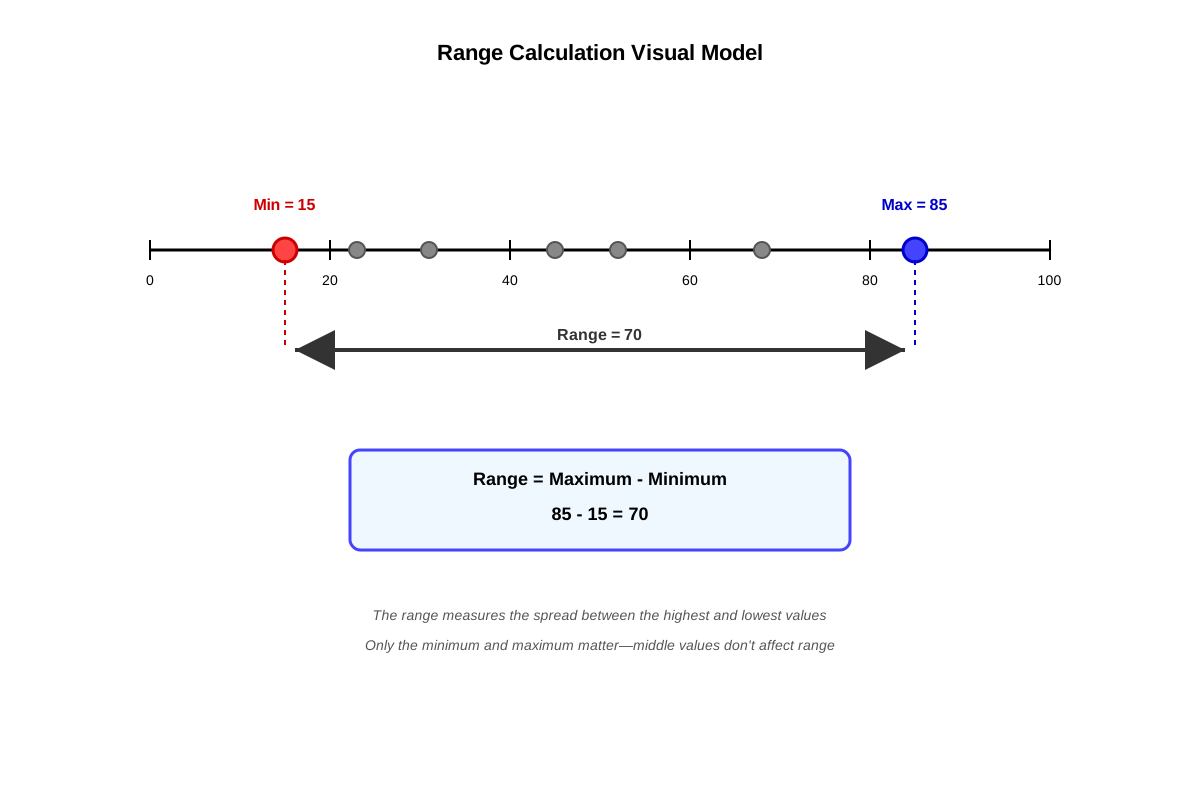
The range of a data set is defined as the difference between the maximum (largest) value and the minimum (smallest) value in that set. This single number quantifies the total spread or dispersion of the data from its lowest to highest point. The formula is elegantly simple:
Range = Maximum Value - Minimum ValueIt is crucial to note that range is always expressed as a single positive number (or zero if all values are identical), never as an interval or pair of numbers. When someone says "the range is 15," they mean the spread is 15 units, not that values range from some number to another.
Calculating Range from Different Data Representations
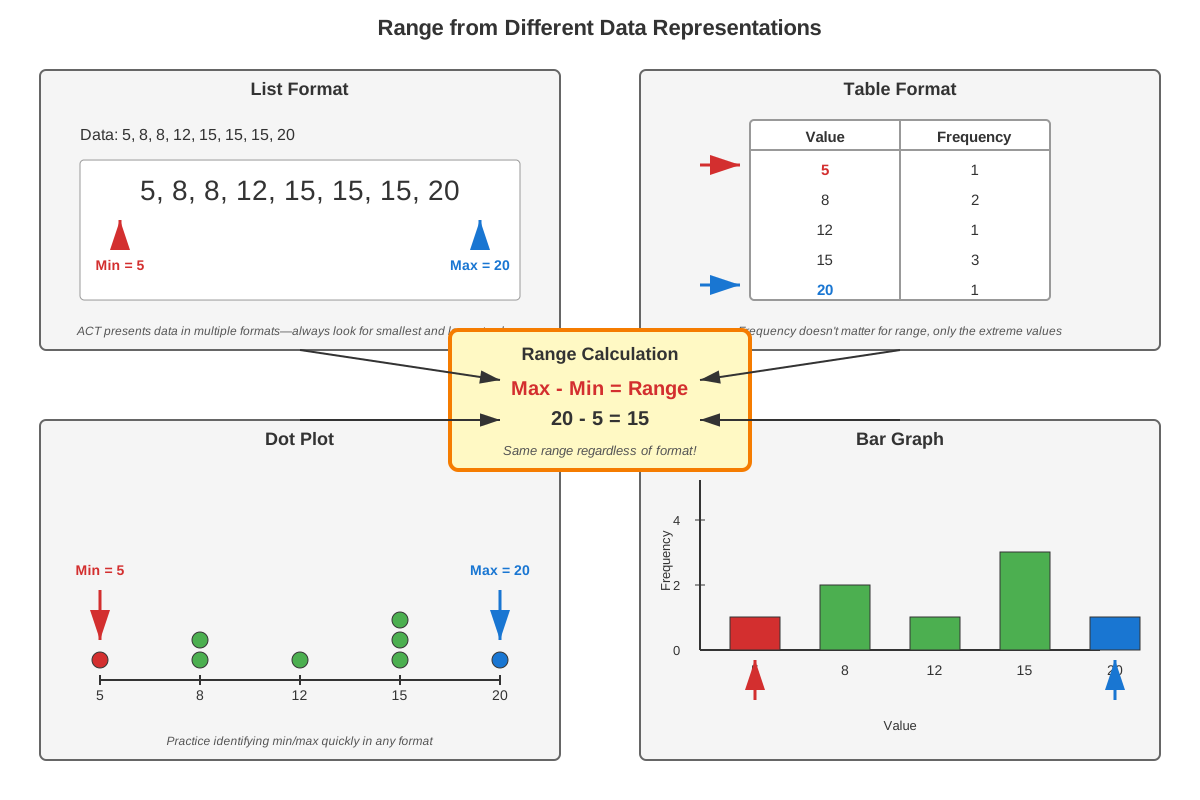
From an unordered list: When given a set of numbers not arranged in order, the first step is to identify the largest and smallest values by scanning through the data. For example, given the set {23, 17, 45, 12, 38, 29}, the maximum is 45 and the minimum is 12, so the range = 45 - 12 = 33.
From an ordered list: When data is already sorted (either ascending or descending), the maximum and minimum are simply the first and last values. For the ordered set {5, 8, 12, 15, 19, 23}, the range = 23 - 5 = 18.
From a frequency table: When data is presented with frequencies, identify the highest and lowest values that actually appear in the data set (frequency > 0), regardless of how many times they occur. The frequency counts do not affect the range calculation itself.
| Value | Frequency |
|---|---|
| 10 | 3 |
| 15 | 5 |
| 20 | 2 |
| 25 | 4 |
In this table, range = 25 - 10 = 15, regardless of the frequency values.
From graphs: Bar graphs, histograms, line plots, and scatter plots require visual identification of the highest and lowest data points. Pay careful attention to axis scales and labels to extract accurate values.
Properties and Characteristics of Range
The range possesses several important mathematical properties that frequently appear in ACT questions:
- Non-negative: Range is always greater than or equal to zero; it cannot be negative
- Zero range: A range of zero indicates all values in the data set are identical
- Sensitivity to outliers: Range is heavily influenced by extreme values; a single outlier can dramatically increase the range
- Unit preservation: Range is expressed in the same units as the original data
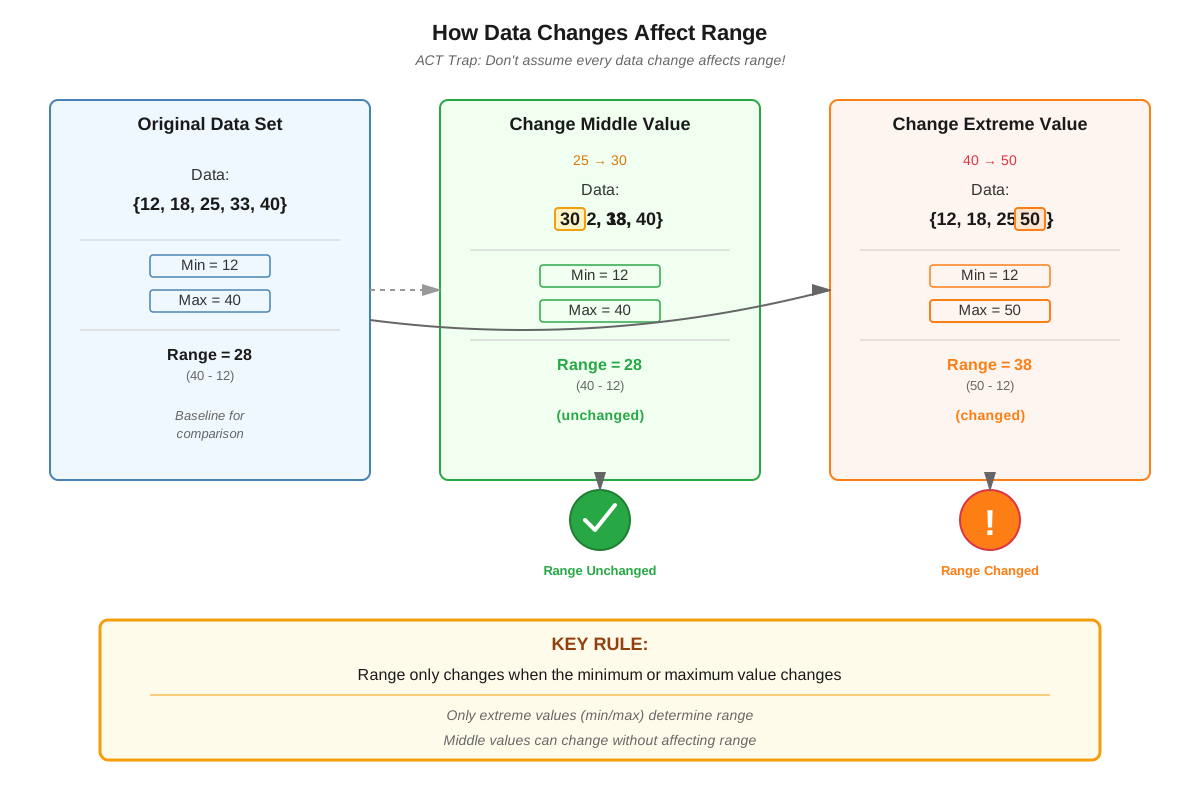
- Independence from middle values: Only the extreme values matter; all middle values could change without affecting the range
- Not affected by data set size: A set of 5 numbers and a set of 500 numbers could have identical ranges
Effect of Data Transformations on Range
Understanding how operations on data affect range is a high-yield ACT concept:
Adding or subtracting a constant: Adding the same value to every data point does NOT change the range. If every value increases by 5, both the maximum and minimum increase by 5, so their difference remains constant.
Multiplying or dividing by a constant: Multiplying every value by a constant multiplies the range by that same constant (assuming positive multiplication). If the original range is 20 and every value is multiplied by 3, the new range is 60.
Adding or removing middle values: Adding data points that fall between the existing minimum and maximum does not change the range. Only adding values that become new extremes affects the range.
Removing extreme values: Removing the current maximum or minimum will change the range, creating a new, smaller range based on the remaining extreme values.
Range in Context of Other Measures
While range measures spread, it differs fundamentally from measures of central tendency:
| Measure | What It Shows | Affected by Outliers |
|---|---|---|
| Range | Total spread | Extremely sensitive |
| Mean | Average value | Moderately sensitive |
| Median | Middle value | Not sensitive |
| Mode | Most frequent | Not sensitive |
The ACT frequently tests whether students can distinguish between these measures and select the appropriate one for a given situation. Range answers questions about variability and spread, while mean, median, and mode answer questions about typical or central values.
Concept Relationships
The concept of range serves as the foundation for understanding statistical variability, connecting directly to more sophisticated measures of spread. Range → leads to → Interquartile Range (IQR), which measures the spread of the middle 50% of data and is less sensitive to outliers. Both range and IQR quantify spread but focus on different portions of the data distribution.
Range connects to data visualization concepts, as the range determines the necessary scale for graphs and charts. When creating a number line, histogram, or box plot, the range informs the axis boundaries needed to display all data points. This relationship appears in ACT questions that ask students to interpret or create appropriate visual representations.
The relationship between range and outliers is particularly important for the ACT. An outlier is a data point that lies far from other values, and since range depends only on extreme values, a single outlier can dominate the range calculation. This connects to questions about which statistical measure is most appropriate for describing a data set: when outliers are present, range may be misleading, while median and IQR provide more robust measures.
Range also relates to algebraic problem-solving when questions present scenarios with unknown values. For example, "If the range of five test scores is 18 and the four known scores are 72, 78, 85, and 88, what are the possible values for the fifth score?" This requires understanding that the unknown score could be either a new minimum (88 - 18 = 70) or a new maximum (72 + 18 = 90), connecting range to inequality reasoning.
Finally, range connects to real-world modeling and data analysis, as it provides quick insight into data variability. Questions often present scenarios where students must calculate range to make decisions, compare data sets, or draw conclusions about consistency and reliability.
High-Yield Facts
⭐ The range equals the maximum value minus the minimum value, always expressed as a single non-negative number
⭐ Range is the simplest measure of spread but is extremely sensitive to outliers and extreme values
⭐ Adding or subtracting the same constant to all data values does NOT change the range
⭐ Multiplying all data values by a constant multiplies the range by that same constant
⭐ Only the two extreme values (highest and lowest) determine the range; all middle values are irrelevant
- A range of zero indicates all values in the data set are identical
- Range is expressed in the same units as the original data (dollars, points, degrees, etc.)
- Adding data points between the existing minimum and maximum does not change the range
- Removing the current maximum or minimum will always decrease the range (or keep it the same if duplicates exist)
- Range can be calculated from any data representation: lists, tables, graphs, or word problems
- The size of the data set (number of values) does not directly affect the range
- When comparing two data sets, the one with the larger range has greater variability in its extreme values
- Range is always less than or equal to the difference between any two values in the data set multiplied by the number of gaps between them
Quick check — test yourself on Range so far.
Try Flashcards →Common Misconceptions
Misconception: Range is the set of all values from minimum to maximum → Correction: Range is a single number representing the difference between maximum and minimum, not an interval or list of values. If someone asks for the range and you answer "12 to 45," you're describing the span, not the range. The correct answer would be "33" (45 - 12).
Misconception: Range is calculated as maximum plus minimum → Correction: Range is always maximum minus minimum. Adding these values would give a meaningless number unrelated to spread. This error often occurs under time pressure when students confuse range with other calculations like finding the midpoint (which does involve addition).
Misconception: Frequency values in a frequency table affect the range calculation → Correction: Range depends only on which values appear in the data set, not how many times they appear. Whether a value occurs once or 100 times, it contributes the same way to range. Only the presence of the value matters, not its frequency.
Misconception: Adding any new data point to a set always changes the range → Correction: Range only changes if the new value becomes a new maximum or new minimum. Adding values between the existing extremes leaves the range unchanged. For example, adding 15 to the set {10, 20} doesn't change the range of 10.
Misconception: A larger data set automatically has a larger range → Correction: The number of data points is independent of the range. A set of 3 numbers could have a range of 100, while a set of 1,000 numbers could have a range of 5. Range measures spread, not quantity.
Misconception: Range and standard deviation measure the same thing → Correction: While both measure variability, range only considers extreme values while standard deviation considers how all values deviate from the mean. Standard deviation is more sophisticated and less sensitive to outliers, making it more robust for many applications.
Misconception: Multiplying all values by -1 keeps the range the same → Correction: While the absolute value of the range remains the same, you must recalculate which value is now the maximum and which is the minimum after the sign change. The range value itself remains the same magnitude, but the calculation requires identifying the new extremes.
Worked Examples
Example 1: Multi-Step Range Problem with Unknown Value
Problem: A student has taken four quizzes with scores of 78, 85, 92, and 88. If the range of all five quiz scores (including one more quiz) is 20, what are all possible scores for the fifth quiz?
Solution:
Step 1: Identify the current maximum and minimum from the four known scores.
- Current maximum = 92
- Current minimum = 78
- Current range = 92 - 78 = 14
Step 2: Recognize that the fifth score must change the range from 14 to 20, meaning it must be a new extreme value (either a new maximum or new minimum).
Step 3: Consider Case 1 - The fifth score is a new maximum.
- If the new maximum creates a range of 20, and the minimum remains 78:
- New maximum - 78 = 20
- New maximum = 98
- Check: This score (98) is indeed higher than the current maximum (92) ✓
Step 4: Consider Case 2 - The fifth score is a new minimum.
- If the new minimum creates a range of 20, and the maximum remains 92:
- 92 - New minimum = 20
- New minimum = 72
- Check: This score (72) is indeed lower than the current minimum (78) ✓
Step 5: Verify no other possibilities exist.
- Any score between 72 and 98 that isn't 72 or 98 would not create a range of 20
- Scores between 78 and 92 wouldn't change the range at all
- Scores between 72 and 78 or between 92 and 98 would create ranges between 14 and 20, but not exactly 20
Answer: The fifth quiz score must be either 72 or 98.
Connection to Learning Objectives: This problem requires identifying that range is being tested (Objective 1), applying the core formula in a multi-step context (Objective 3), and determining how changes to a data set affect range (Objective 5).
Example 2: Range with Data Transformation
Problem: The daily high temperatures (in °F) for one week were: 68, 72, 75, 71, 69, 73, 70. A weather station in Canada wants to convert these temperatures to Celsius using the formula C = (5/9)(F - 32). What is the range of temperatures in Celsius? (Round to the nearest tenth.)
Solution:
Step 1: Find the range in Fahrenheit first.
- Maximum temperature = 75°F
- Minimum temperature = 68°F
- Range in Fahrenheit = 75 - 68 = 7°F
Step 2: Recognize the transformation property. When converting using C = (5/9)(F - 32), we're subtracting 32 from all values (which doesn't change range) and then multiplying by 5/9 (which multiplies the range by 5/9).
Step 3: Apply the transformation to the range.
- Range in Celsius = (5/9) × 7
- Range in Celsius = 35/9
- Range in Celsius ≈ 3.9°C
Step 4: Verify by converting the actual extreme values (optional but recommended for checking).
- Maximum in Celsius: (5/9)(75 - 32) = (5/9)(43) ≈ 23.9°C
- Minimum in Celsius: (5/9)(68 - 32) = (5/9)(36) = 20.0°C
- Range = 23.9 - 20.0 = 3.9°C ✓
Answer: The range in Celsius is 3.9°C.
Connection to Learning Objectives: This problem demonstrates applying range to ACT-style questions (Objective 3), understanding how transformations affect range (Objective 5), and working with real-world contexts that appear on the exam.
Exam Strategy
When approaching ACT range questions, begin by identifying trigger words and phrases that signal range is being tested. Look for terms like "spread," "difference between highest and lowest," "variability," "from minimum to maximum," or direct use of the word "range." These questions often appear in word problems describing real-world scenarios, so extract the relevant numerical data before attempting calculations.
Process-of-elimination strategy: If answer choices are given, quickly eliminate options that are impossible. Range cannot be negative, so eliminate any negative answers immediately. If you can identify the maximum and minimum values, any answer choice larger than the maximum value itself is impossible. For questions asking about range after transformations, eliminate choices that don't follow transformation rules (e.g., if adding 5 to all values, the range should stay the same, so eliminate different values).
Time allocation: Range questions typically require 30-60 seconds to solve, making them efficient point-earning opportunities. Don't spend excessive time on these questions—if you understand the concept, execution should be quick. If a range question seems to require more than 90 seconds, you may be overcomplicating it; step back and reconsider the approach.
Common question variations to watch for:
- Direct calculation: Simply find max - min from given data
- Unknown value problems: Given the range and some values, find possible values for unknowns
- Comparison questions: Which data set has the larger range?
- Transformation questions: How does the range change when data is transformed?
- Graph interpretation: Extract max and min from visual representations
- Multi-concept questions: Calculate range along with mean, median, or other measures
Red flags and careful reading: Pay attention to whether the question asks for range or asks you to identify the maximum and minimum separately. Some questions may ask "what is the difference between the highest and lowest values" without using the word "range"—this is still a range question. Be careful with units and ensure your answer matches the requested format.
Strategic guessing: If you must guess on a range question, eliminate extreme answer choices. The range is typically a moderate value relative to the data set—not tiny (unless all values are very close) and not enormous (unless there are clear outliers). Use reasonableness to guide elimination.
Memory Techniques
Mnemonic for Range Formula: "Max Minus Min" - The three M's remind you that range is Maximum Minus Minimum. Visualize three mountain peaks (M shapes) where you measure from the highest peak to the lowest valley.
Visualization Strategy: Picture a number line with all data points marked. The range is the physical distance you'd measure with a ruler from the leftmost (minimum) to rightmost (maximum) point. This visual reinforces that range is about spread and distance.
Acronym for Range Properties: NOSE
- Non-negative (always ≥ 0)
- Outlier sensitive (extreme values dominate)
- Subtraction formula (max - min)
- Extremes only (middle values don't matter)
Transformation Memory Aid: "Add/Subtract = Same, Multiply/Divide = Change" - When you add or subtract the same number to all values, the range stays the same. When you multiply or divide all values, the range changes by that factor.
Conceptual Anchor: Think of range as the "wingspan" of your data—it measures how far the data stretches from one extreme to the other, just like a bird's wingspan measures from wingtip to wingtip.
Summary
Range is the fundamental measure of data spread, calculated as the difference between the maximum and minimum values in a data set. This single number quantifies total variability and appears regularly on the ACT Math test in various contexts including direct calculations, word problems, data transformations, and multi-step scenarios. The formula (Range = Maximum - Minimum) is straightforward, but successful application requires careful identification of extreme values from different data representations, understanding of how transformations affect range, and ability to distinguish range from other statistical measures. Range is extremely sensitive to outliers since only the two extreme values matter, making it less robust than other spread measures but also simpler to calculate. Key properties include non-negativity, unit preservation, and independence from middle values and data set size. ACT questions frequently test whether students can apply range in real-world contexts, determine unknown values given range constraints, and understand how adding, subtracting, multiplying, or dividing data values affects the range. Mastery requires both computational accuracy and conceptual understanding of what range represents and when it provides meaningful information about data variability.
Key Takeaways
- Range equals maximum value minus minimum value, always expressed as a single non-negative number
- Only the two extreme values determine range; all middle values and frequencies are irrelevant to the calculation
- Adding or subtracting a constant to all data values does not change the range, but multiplying or dividing by a constant changes the range by that same factor
- Range is extremely sensitive to outliers and may not represent typical data spread when extreme values are present
- ACT range questions appear in multiple formats including direct calculations, transformations, unknown value problems, and real-world applications
- Quick identification of maximum and minimum values from any data representation (lists, tables, graphs) is essential for efficient problem-solving
- Understanding the difference between range (a measure of spread) and measures of central tendency (mean, median, mode) is crucial for multi-concept questions
Related Topics
Interquartile Range (IQR): Building on range concepts, IQR measures the spread of the middle 50% of data by finding the difference between the third and first quartiles. This measure is more robust to outliers than range and frequently appears alongside range on the ACT.
Box Plots and Five-Number Summary: These visual representations display minimum, first quartile, median, third quartile, and maximum—directly incorporating range as the span from minimum to maximum. Understanding range is prerequisite to interpreting box plots.
Standard Deviation and Variance: These more sophisticated measures of spread consider all data values, not just extremes. Mastering range provides the conceptual foundation for understanding why more complex spread measures are sometimes necessary.
Mean Absolute Deviation: This measure averages the distances of all data points from the mean, providing another perspective on spread that connects to range concepts while being less sensitive to outliers.
Data Analysis and Interpretation: Range is one tool in a comprehensive data analysis toolkit. Mastering range enables progression to more complex statistical reasoning required for ACT Science passages and advanced Math questions.
Practice CTA
Now that you've mastered the concept of range, it's time to solidify your understanding through active practice! Attempt the practice questions to test your ability to identify range problems, apply the formula accurately, and handle the various question formats that appear on the ACT. Work through the flashcards to reinforce key facts and properties until they become automatic. Remember, range questions are high-yield opportunities to earn quick points on test day—consistent practice now will translate directly to score improvement. Challenge yourself with increasingly complex scenarios, and don't just focus on getting the right answer; make sure you understand why each step is necessary. You've got this!
Sign up free to keep reading
Create a free AnvayaPrep account to finish this ACT guide on Range — plus flashcards and practice questions.