Overview
Exponential equations are mathematical expressions in which variables appear in exponents, and solving them requires understanding the properties of exponential functions and logarithms. On the ACT Math test, these equations appear regularly and test a student's ability to manipulate expressions where the unknown quantity is in the power rather than the base. Mastery of exponential equations is crucial because they appear in approximately 2-3 questions per ACT Math section, making them a high-yield topic that can significantly impact overall scores.
The ACT tests exponential equations in various contexts, from straightforward algebraic manipulation to real-world applications involving growth and decay. Students must recognize when an equation involves exponential relationships and apply appropriate solution strategies, including setting equal bases, using logarithms, or recognizing special patterns. These problems often combine multiple algebraic skills, making them excellent discriminators between average and high-scoring students.
Understanding exponential equations connects directly to broader mathematical concepts including functions, logarithms, and algebraic manipulation. This topic serves as a bridge between basic algebra and more advanced mathematical modeling, appearing not only in pure mathematics questions but also in word problems involving compound interest, population growth, radioactive decay, and other real-world phenomena that the ACT frequently incorporates into its questions.
Learning Objectives
- [ ] Identify when exponential equations are being tested in ACT problems
- [ ] Explain the core rule or strategy behind solving exponential equations
- [ ] Apply exponential equation techniques to ACT-style questions accurately
- [ ] Convert exponential equations to common bases to facilitate solving
- [ ] Recognize when to apply logarithms to solve exponential equations
- [ ] Solve real-world application problems involving exponential growth and decay
- [ ] Distinguish between exponential equations and exponential expressions
Prerequisites
- Basic exponent rules: Understanding properties like x^a · x^b = x^(a+b) and (x^a)^b = x^(ab) is essential for manipulating exponential equations
- Algebraic equation solving: The ability to isolate variables and perform inverse operations provides the foundation for exponential equation techniques
- Understanding of functions: Recognizing that exponential expressions represent functions helps in visualizing solutions and understanding behavior
- Integer operations: Facility with positive and negative integers is necessary when working with exponents and their properties
- Fraction and decimal manipulation: Many exponential equations involve fractional or decimal bases and exponents
Why This Topic Matters
ACT exponential equations appear with remarkable consistency on every administration of the test, typically comprising 3-5% of all Math questions. These problems test mathematical reasoning at a level that distinguishes students aiming for scores above 28 from those scoring lower. The ACT specifically favors exponential equation problems because they efficiently assess multiple skills simultaneously: pattern recognition, algebraic manipulation, and logical reasoning.
In real-world contexts, exponential relationships govern countless phenomena including population dynamics, financial investments, radioactive decay, bacterial growth, and technological advancement (Moore's Law). Understanding exponential equations enables students to model and predict outcomes in fields ranging from biology and chemistry to economics and computer science. The compound interest formula, for instance, is fundamentally an exponential equation that determines retirement savings, loan payments, and investment returns.
On the ACT, exponential equations commonly appear as:
- Pure algebraic problems requiring students to solve for an unknown exponent
- Word problems involving growth or decay scenarios
- Questions asking students to identify equivalent exponential expressions
- Problems requiring conversion between exponential and logarithmic forms
- Multi-step problems where exponential equation solving is one component
Core Concepts
Definition and Structure of Exponential Equations
An exponential equation is any equation in which the variable appears in an exponent position. The general form is b^x = c, where b is the base (a positive number not equal to 1), x is the unknown exponent, and c is a constant. Unlike polynomial equations where variables are in the base, exponential equations place the unknown in the power, fundamentally changing the solution approach.
The key characteristic distinguishing exponential equations from other equation types is this placement of the variable. For example, x² = 16 is a polynomial equation (variable in base), while 2^x = 16 is an exponential equation (variable in exponent). This distinction is critical for the ACT because it determines which solution strategy to employ.
The Equal Base Method
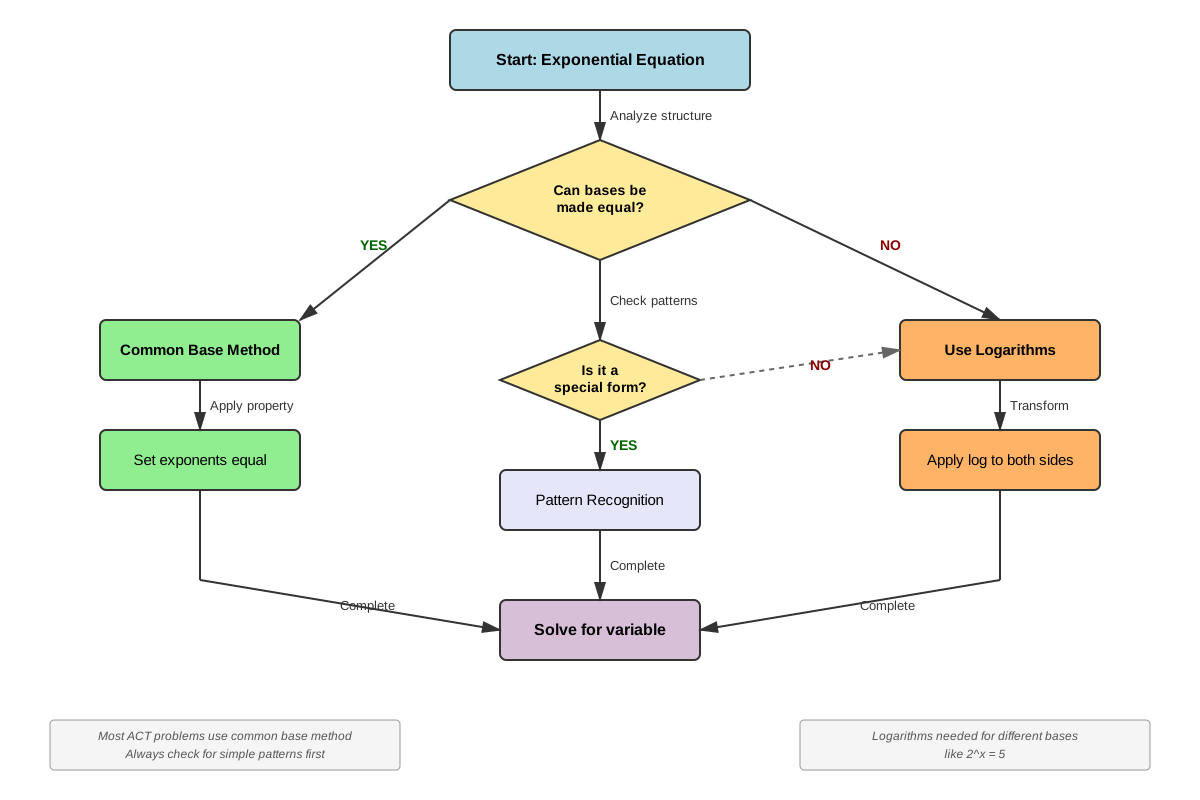
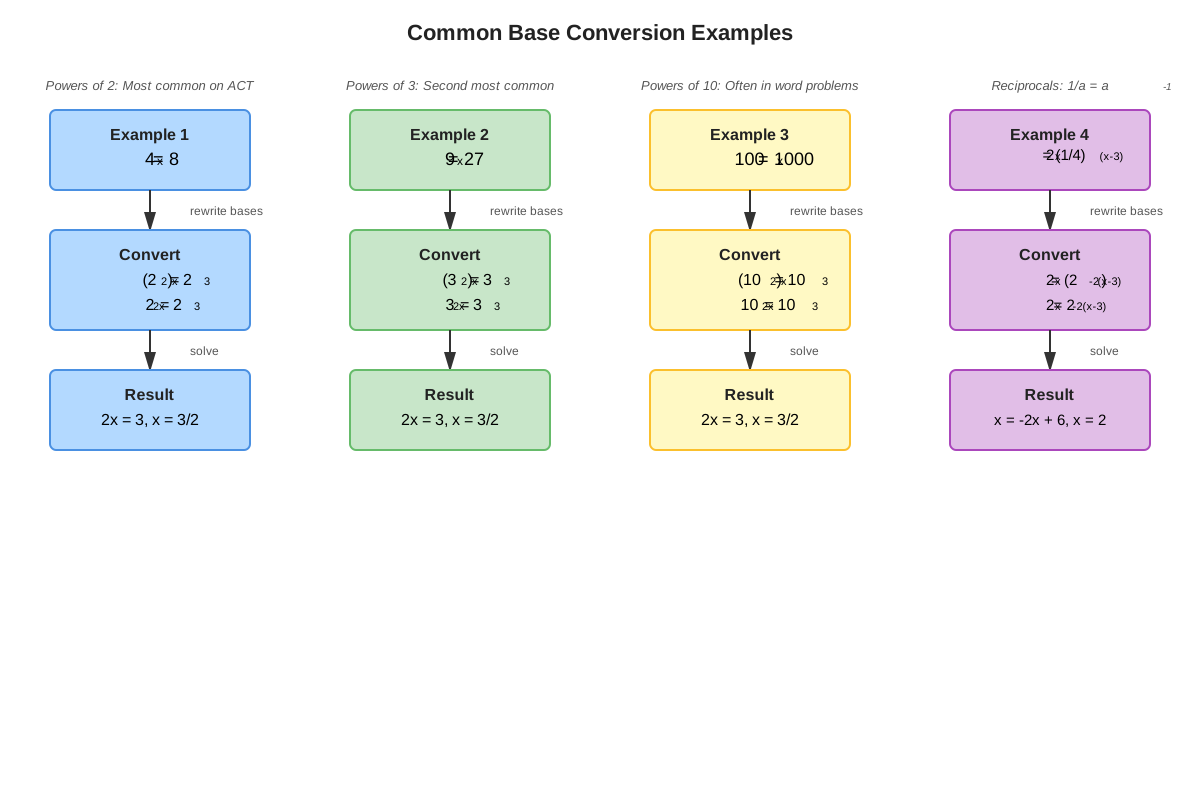
The most fundamental strategy for solving exponential equations involves expressing both sides of the equation with the same base. When both sides share a common base, the exponents must be equal. This principle stems from the fact that exponential functions are one-to-one: if b^x = b^y, then x = y (provided b > 0 and b ≠ 1).
Steps for the equal base method:
- Examine both sides of the equation to identify if they can be expressed with a common base
- Rewrite each side using the common base and exponent properties
- Set the exponents equal to each other
- Solve the resulting algebraic equation
- Verify the solution in the original equation
For example, to solve 4^x = 32:
- Recognize that both 4 and 32 are powers of 2
- Rewrite: (2²)^x = 2^5
- Simplify: 2^(2x) = 2^5
- Set exponents equal: 2x = 5
- Solve: x = 5/2
Common Bases to Recognize
| Number | Prime Factorization | Powers to Memorize |
|---|---|---|
| 2 | 2 | 2, 4, 8, 16, 32, 64, 128, 256, 512, 1024 |
| 3 | 3 | 3, 9, 27, 81, 243, 729 |
| 4 | 2² | 4, 16, 64, 256 |
| 5 | 5 | 5, 25, 125, 625 |
| 8 | 2³ | 8, 64, 512 |
| 9 | 3² | 9, 81, 729 |
Exponential Equations with Matching Bases
When an equation already presents both sides with the same base, the solution becomes straightforward. For instance, 5^(2x-1) = 5^7 immediately yields 2x - 1 = 7, so x = 4. The ACT frequently includes these problems as confidence builders or as components of more complex multi-step problems.
Using Logarithms for Exponential Equations
When the equal base method is impractical or impossible, logarithms provide an alternative solution strategy. Taking the logarithm of both sides allows the exponent to be "brought down" using the power rule of logarithms: log(b^x) = x·log(b).
For an equation like 3^x = 50:
- Take the logarithm of both sides: log(3^x) = log(50)
- Apply the power rule: x·log(3) = log(50)
- Solve for x: x = log(50)/log(3)
While the ACT rarely requires students to calculate logarithm values, understanding this relationship helps with conceptual questions and ensures students recognize when logarithms are the appropriate tool.
Exponential Growth and Decay Models
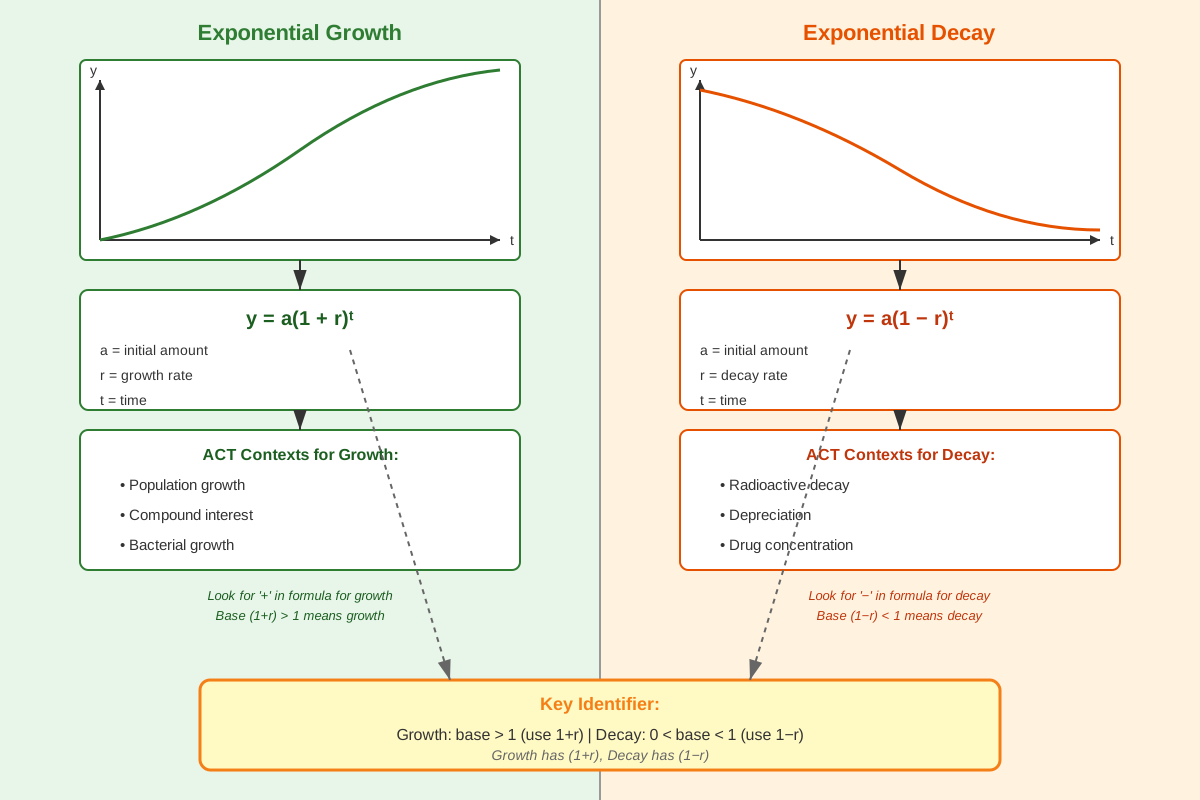
The ACT frequently tests exponential equations through real-world applications. The standard forms are:
Growth: A(t) = A₀(1 + r)^t or A(t) = A₀·e^(kt) where k > 0
Decay: A(t) = A₀(1 - r)^t or A(t) = A₀·e^(-kt) where k > 0
In these formulas:
- A(t) represents the amount at time t
- A₀ represents the initial amount
- r represents the growth/decay rate (as a decimal)
- t represents time
- e represents Euler's number (approximately 2.718)
Solving Exponential Equations with Coefficients
Some exponential equations include coefficients multiplying the exponential term, such as 3·2^x = 96. The solution strategy involves:
- Isolate the exponential expression by dividing both sides by the coefficient
- Apply the equal base method or logarithms as appropriate
- Solve for the variable
For 3·2^x = 96:
- Divide both sides by 3: 2^x = 32
- Recognize 32 = 2^5: 2^x = 2^5
- Therefore: x = 5
Exponential Equations with Variables in Multiple Positions
Advanced ACT problems may present variables in both the base and exponent, or in multiple exponential terms. For equations like 2^x + 2^x = 32, recognize that 2^x + 2^x = 2·2^x, allowing factoring before solving. This becomes 2·2^x = 32, so 2^x = 16, yielding x = 4.
Concept Relationships
The core concepts within exponential equations build upon each other in a logical progression. The equal base method serves as the foundation, requiring recognition of common bases and application of exponent rules. This method connects directly to prerequisite exponent properties, particularly the power rule and product rule. When the equal base method proves insufficient, the logarithm method provides an alternative pathway, creating a bridge between exponential and logarithmic functions.
Exponential growth and decay models represent applications of the fundamental exponential equation structure, connecting abstract algebraic manipulation to concrete real-world scenarios. These models incorporate the equal base method when solving for time or rate variables, demonstrating how pure mathematical techniques apply to practical problems.
The relationship map flows as follows:
Exponent Properties → Equal Base Recognition → Equal Base Method → Simple Exponential Equations
Exponent Properties → Logarithm Properties → Logarithm Method → Complex Exponential Equations
Simple Exponential Equations → Growth/Decay Models → Real-World Applications
All paths converge at problem-solving strategies, where students must identify which method applies to a given ACT question. This decision-making process—recognizing problem type and selecting appropriate technique—represents the highest level of mastery and most directly predicts ACT success.
High-Yield Facts
⭐ If b^x = b^y, then x = y (provided b > 0 and b ≠ 1) — this is the fundamental principle enabling the equal base method
⭐ Common bases to memorize: Powers of 2 (up to 2^10 = 1024), powers of 3 (up to 3^6 = 729), and powers of 5 (up to 5^4 = 625)
⭐ To solve b^x = c when bases cannot be matched, use logarithms: x = log(c)/log(b)
⭐ Exponential growth formula: A(t) = A₀(1 + r)^t, where r is the growth rate as a decimal
⭐ Exponential decay formula: A(t) = A₀(1 - r)^t, where r is the decay rate as a decimal
- When solving 2^(2x) = 2^8, recognize that 2x = 8, so x = 4 (not x = 8)
- The equation a·b^x = c requires first isolating b^x by dividing both sides by a
- Negative exponents indicate reciprocals: b^(-x) = 1/b^x
- Zero exponents always equal 1: b^0 = 1 (for any b ≠ 0)
- Fractional exponents represent roots: b^(1/n) = ⁿ√b
- When both sides of an exponential equation equal the same value, consider whether multiple solutions exist
- The base of an exponential expression must be positive and not equal to 1 for standard exponential behavior
- Compound interest problems use the formula A = P(1 + r/n)^(nt), a specialized exponential equation
Quick check — test yourself on Exponential equations so far.
Try Flashcards →Common Misconceptions
Misconception: When solving 2^x = 8, students divide both sides by 2 to get x = 4.
Correction: Division doesn't work with exponential equations. Instead, recognize that 8 = 2^3, so 2^x = 2^3 means x = 3. The variable is in the exponent, not the base, requiring different operations.
Misconception: The equation 3^x = 27 has the same solution as x^3 = 27.
Correction: These are fundamentally different equations. 3^x = 27 means 3^x = 3^3, so x = 3. However, x^3 = 27 means x = ³√27 = 3. While they happen to have the same answer here, the solution methods differ, and this coincidence doesn't hold generally.
Misconception: To solve 2^x = 5, students assume x must be between 2 and 3 and guess x = 2.5.
Correction: While x is indeed between 2 and 3 (since 2^2 = 4 and 2^3 = 8), the exact value is x = log(5)/log(2) ≈ 2.32. The ACT may ask for an approximate value or test conceptual understanding rather than requiring calculation.
Misconception: In the equation 2^(x+1) = 16, students solve x + 1 = 16, getting x = 15.
Correction: First express 16 as a power of 2: 16 = 2^4. Then 2^(x+1) = 2^4 means x + 1 = 4, so x = 3. The exponent (x+1) equals the exponent (4), not the value on the right side (16).
Misconception: Exponential equations always have exactly one solution.
Correction: While most exponential equations have one solution, some have none (like 2^x = -4, since exponential functions with positive bases never produce negative outputs) and some contexts may have multiple solutions when considering different domains.
Misconception: The expressions 2^x and x^2 are equivalent or interchangeable.
Correction: These represent fundamentally different relationships. In 2^x, the variable is in the exponent (exponential function), while in x^2, the variable is in the base (polynomial function). They grow at different rates and require different solution techniques.
Worked Examples
Example 1: Equal Base Method with Algebraic Manipulation
Problem: Solve for x: 4^(x-1) = 8^(x+2)
Solution:
Step 1: Identify a common base. Both 4 and 8 are powers of 2.
- 4 = 2^2
- 8 = 2^3
Step 2: Rewrite the equation using base 2.
- (2^2)^(x-1) = (2^3)^(x+2)
Step 3: Apply the power rule: (a^m)^n = a^(mn)
- 2^(2(x-1)) = 2^(3(x+2))
- 2^(2x-2) = 2^(3x+6)
Step 4: Since the bases are equal, set the exponents equal.
- 2x - 2 = 3x + 6
Step 5: Solve the linear equation.
- 2x - 3x = 6 + 2
- -x = 8
- x = -8
Step 6: Verify by substituting back into the original equation.
- Left side: 4^(-8-1) = 4^(-9) = 1/4^9
- Right side: 8^(-8+2) = 8^(-6) = 1/8^6 = 1/(2^3)^6 = 1/2^18 = 1/(2^2)^9 = 1/4^9 ✓
Connection to Learning Objectives: This problem demonstrates identifying exponential equations (both sides have variables in exponents), applying the core strategy (equal base method), and accurately solving an ACT-style problem requiring multiple algebraic steps.
Example 2: Real-World Application with Growth Model
Problem: A population of bacteria doubles every 3 hours. If there are initially 500 bacteria, how many hours will it take for the population to reach 32,000?
Solution:
Step 1: Identify the exponential growth model. Since the population doubles, the growth factor is 2.
- Formula: A(t) = A₀ · 2^(t/d)
- Where A₀ = initial amount, t = time elapsed, d = doubling period
Step 2: Set up the equation with known values.
- 32,000 = 500 · 2^(t/3)
Step 3: Isolate the exponential expression.
- 32,000/500 = 2^(t/3)
- 64 = 2^(t/3)
Step 4: Express 64 as a power of 2.
- 64 = 2^6
Step 5: Apply the equal base method.
- 2^(t/3) = 2^6
- t/3 = 6
Step 6: Solve for t.
- t = 18 hours
Step 7: Verify the answer makes sense.
- After 3 hours: 500 × 2 = 1,000
- After 6 hours: 1,000 × 2 = 2,000
- After 9 hours: 2,000 × 2 = 4,000
- After 12 hours: 4,000 × 2 = 8,000
- After 15 hours: 8,000 × 2 = 16,000
- After 18 hours: 16,000 × 2 = 32,000 ✓
Connection to Learning Objectives: This example shows how to identify exponential equations in word problem contexts, apply the growth model formula, and use the equal base method to solve real-world ACT-style applications.
Exam Strategy
When approaching exponential equation problems on the ACT, begin by identifying the problem type. Look for trigger words and phrases such as "doubles," "triples," "grows exponentially," "decays," "half-life," or any mention of compound interest. These signal exponential relationships. Also watch for equations where variables appear in exponent positions—this visual cue immediately indicates an exponential equation.
Step-by-step approach for ACT exponential equation problems:
- Read carefully to determine what the question asks for (solving for x, finding time, calculating final amount, etc.)
- Identify the structure: Is this a pure algebraic equation or a word problem requiring a model?
- Check for common bases: Can both sides be expressed with the same base? This is the fastest solution method.
- Isolate exponential terms: If coefficients are present, divide them out first
- Apply the equal base method when possible, or recognize when logarithms would be needed (though calculation is rarely required)
- Solve the resulting equation using standard algebraic techniques
- Check answer reasonableness: Does the solution make sense in context?
Process of elimination tips:
- Eliminate answers that would make the exponential expression negative when the base is positive (exponential functions with positive bases never produce negative outputs)
- For growth problems, eliminate answers suggesting decrease; for decay problems, eliminate answers suggesting increase
- When solving for an exponent, eliminate answers that are obviously too large or small by testing powers mentally
- If the problem involves doubling and asks "how many doublings," count the doublings and eliminate answers that don't match
Time allocation: Most exponential equation problems should take 45-75 seconds. If a problem requires more than 90 seconds, consider whether you've missed a simpler approach or should mark it for review and move on. The equal base method, when applicable, should lead to solutions in under 60 seconds.
ACT Tip: The test writers often include answer choices that result from common errors. If you get an answer very quickly, double-check your work—it might be a trap answer designed to catch a specific mistake.
Memory Techniques
BEST - Remember the four main solution strategies:
- Bases equal (equal base method)
- Exponent properties (simplify first)
- Separate the exponential term (isolate it)
- Test answer choices (when stuck, plug in)
Powers of 2 Finger Method: Use your fingers to remember powers of 2. Starting with your thumb as 2^0 = 1, each finger represents the next power: index finger = 2^1 = 2, middle = 2^2 = 4, ring = 2^3 = 8, pinky = 2^4 = 16. Then start over with your other hand for 2^5 = 32, continuing the pattern.
"Same Base, Same Place": When bases are equal, exponents must be equal. This rhyme helps remember the fundamental principle of the equal base method.
Growth vs. Decay Visual: Picture growth as a plant growing upward (1 + r, adding to 1) and decay as leaves falling downward (1 - r, subtracting from 1). The +/- sign in the formula matches the direction of change.
"Divide Before You Derive": When coefficients multiply exponential terms, always divide them out first before attempting to solve the exponential equation. This rhyme reminds you of the correct order of operations.
Summary
Exponential equations represent a high-yield ACT Math topic where variables appear in exponent positions, requiring specialized solution strategies distinct from polynomial equations. The primary solution method involves expressing both sides of the equation with a common base, then setting exponents equal—a technique that works efficiently for most ACT problems. Students must memorize common powers (especially powers of 2, 3, and 5) to quickly recognize when the equal base method applies. When common bases cannot be identified, logarithms provide an alternative approach, though the ACT rarely requires actual logarithm calculations. Real-world applications involving exponential growth (A = A₀(1+r)^t) and decay (A = A₀(1-r)^t) appear frequently, testing both equation-solving skills and conceptual understanding. Success requires recognizing problem types, selecting appropriate strategies, and avoiding common errors like confusing exponential equations with polynomial equations or misapplying operations that work for linear equations but not exponential ones.
Key Takeaways
- Exponential equations place variables in exponent positions, fundamentally changing solution approaches compared to polynomial equations
- The equal base method (if b^x = b^y, then x = y) is the fastest and most common solution strategy for ACT problems
- Memorize powers of 2 through 2^10, powers of 3 through 3^6, and powers of 5 through 5^4 for quick base recognition
- Growth models use A = A₀(1+r)^t while decay models use A = A₀(1-r)^t, with the +/- sign indicating direction of change
- Always isolate exponential terms by dividing out coefficients before attempting to solve
- Exponential functions with positive bases never produce negative outputs—use this to eliminate impossible answer choices
- When bases cannot be matched, recognize that logarithms would be needed, though ACT problems rarely require actual calculation
Related Topics
Logarithmic Equations: The inverse relationship to exponential equations, where solving log equations often requires converting to exponential form. Mastering exponential equations provides the foundation for understanding logarithms.
Exponential Functions and Graphs: Understanding how exponential equations relate to the graphs of exponential functions helps visualize solutions and understand behavior like asymptotes and growth rates.
Sequences and Series: Geometric sequences are discrete versions of exponential functions, and understanding exponential equations helps solve problems involving geometric growth.
Compound Interest and Financial Mathematics: Specialized applications of exponential equations that appear regularly on the ACT, requiring understanding of the formula A = P(1 + r/n)^(nt).
Rational Exponents and Radicals: Exponential equations sometimes involve fractional exponents, connecting to radical expressions and requiring facility with both notations.
Practice CTA
Now that you've mastered the core concepts, strategies, and common pitfalls of exponential equations, it's time to solidify your understanding through practice. Work through the practice questions to apply these techniques to actual ACT-style problems, and use the flashcards to reinforce key facts and formulas. Remember, exponential equations appear on every ACT Math test—your investment in mastering this topic will directly translate to points on test day. Approach each practice problem systematically, identify which strategy applies, and build the confidence that comes from repeated successful application. You've got this!
Sign up free to keep reading
Create a free AnvayaPrep account to finish this ACT guide on Exponential equations — plus flashcards and practice questions.