Overview
Exponents are one of the most frequently tested concepts in the ACT Math section, appearing in approximately 10-15% of all questions across various difficulty levels. Understanding exponents is not merely about memorizing rules—it requires developing fluency with how numbers behave when multiplied by themselves repeatedly and recognizing the patterns that emerge from these operations. The ACT tests exponents both directly through computational problems and indirectly through algebraic manipulation, scientific notation, exponential growth and decay, and polynomial operations.
Mastery of exponents is foundational to success on the ACT because these concepts interconnect with nearly every other mathematical domain tested on the exam. Exponents appear in questions involving polynomial factoring, rational expressions, radical simplification, logarithms, and even geometric formulas for area and volume. Students who can quickly recognize exponent patterns and apply the appropriate rules gain significant time advantages on test day, allowing them to tackle more complex problems with confidence.
The relationship between exponents and other mathematical concepts creates a web of interconnected knowledge. Exponents bridge arithmetic and algebra, connect to roots and radicals (which are fractional exponents), and provide the foundation for understanding exponential functions and scientific notation. Questions involving ACT exponents often combine multiple mathematical skills in a single problem, requiring students to recognize which exponent rule applies while simultaneously managing algebraic expressions, fractions, or negative numbers. This integration makes exponents a high-yield study topic that delivers returns across multiple question types.
Learning Objectives
- [ ] Identify when Exponents is being tested in ACT Math questions
- [ ] Explain the core rule or strategy behind Exponents operations
- [ ] Apply Exponents to ACT-style questions accurately
- [ ] Simplify complex expressions involving multiple exponent rules simultaneously
- [ ] Convert between exponential and radical notation fluently
- [ ] Recognize and correct common exponent errors under time pressure
- [ ] Evaluate expressions with negative and fractional exponents without a calculator
Prerequisites
- Basic multiplication and division: Exponents represent repeated multiplication, so fluency with multiplication facts and division operations is essential for understanding exponential relationships
- Order of operations (PEMDAS): Exponents occupy a specific position in the order of operations, and students must know when to evaluate exponential expressions relative to other operations
- Integer operations: Working with negative bases and negative exponents requires solid understanding of how negative numbers behave under multiplication
- Fraction operations: Fractional exponents and division of exponential expressions often produce fractional results that must be simplified
- Basic algebraic manipulation: Most ACT exponent questions involve variables, requiring comfort with algebraic notation and expression simplification
Why This Topic Matters
Exponents appear throughout mathematics, science, and real-world applications, making them indispensable for academic and practical problem-solving. In finance, compound interest calculations rely on exponential expressions to determine investment growth over time. In science, exponential notation expresses extremely large numbers (like astronomical distances) and extremely small numbers (like atomic measurements) efficiently. Population growth models, radioactive decay calculations, and computer science algorithms all depend on exponential relationships.
On the ACT Math section, exponent questions appear with remarkable consistency. Students can expect 3-5 direct exponent questions per test, plus an additional 4-6 questions where exponent rules are embedded within larger algebraic or geometric problems. These questions span difficulty levels from straightforward simplification (testing basic rules) to complex multi-step problems requiring strategic application of multiple exponent properties. The ACT particularly favors questions that combine exponent rules with other algebraic concepts, such as factoring polynomials with exponential terms or simplifying rational expressions containing exponents.
Common question formats include: simplifying expressions with multiple exponent operations, solving equations where the variable appears in an exponent, converting between exponential and radical form, working with scientific notation, and identifying equivalent expressions. The ACT also tests exponents indirectly through polynomial operations, where understanding how exponents behave during multiplication and division is crucial for correct factoring and simplification. Questions may present exponents in abstract algebraic form or embed them within word problems involving growth, decay, or geometric scaling.
Core Concepts
Definition and Basic Notation
An exponent (also called a power) indicates how many times a number (the base) is multiplied by itself. In the expression b^n, b represents the base and n represents the exponent. The expression b^n is read as "b to the nth power" or "b raised to the power of n." For example, 5^3 means 5 × 5 × 5 = 125. The exponent tells us the number of times the base appears as a factor in the multiplication.
Understanding this fundamental definition prevents many common errors. The exponent applies only to what it is directly attached to—in the expression -3^2, the exponent applies only to 3, not to the negative sign, yielding -(3 × 3) = -9. However, (-3)^2 means (-3) × (-3) = 9, where the parentheses indicate the exponent applies to the entire negative number.
Product Rule for Exponents
When multiplying expressions with the same base, add the exponents: b^m × b^n = b^(m+n). This rule emerges logically from the definition of exponents. Consider x^3 × x^4 = (x × x × x) × (x × x × x × x) = x^7. The base appears as a factor 3 times in the first expression and 4 times in the second, totaling 7 times.
This rule applies only when the bases are identical. The expression x^3 × y^4 cannot be simplified using the product rule because the bases differ. However, expressions like (2x)^3 × (2x)^2 can be simplified to (2x)^5 because the entire quantity 2x serves as the common base.
Quotient Rule for Exponents
When dividing expressions with the same base, subtract the exponents: b^m ÷ b^n = b^(m-n). This rule also follows from the definition. Consider x^5 ÷ x^2 = (x × x × x × x × x) ÷ (x × x). Canceling two factors of x from numerator and denominator leaves three factors of x, giving x^3 = x^(5-2).
The quotient rule explains why any non-zero number raised to the zero power equals 1. Using the rule: x^3 ÷ x^3 = x^(3-3) = x^0. Since any number divided by itself equals 1, we conclude x^0 = 1. This holds for all non-zero values.
Power Rule for Exponents
When raising a power to another power, multiply the exponents: (b^m)^n = b^(m×n). For example, (x^2)^3 means x^2 × x^2 × x^2 = x^(2+2+2) = x^6 = x^(2×3). This rule is frequently tested on the ACT, especially in problems requiring simplification of nested exponential expressions.
The power rule extends to products and quotients within parentheses: (ab)^n = a^n × b^n and (a/b)^n = a^n / b^n. These extensions allow simplification of complex expressions like (3x^2y)^3 = 3^3 × x^(2×3) × y^3 = 27x^6y^3.
Negative Exponents
A negative exponent indicates reciprocal: b^(-n) = 1/b^n (where b ≠ 0). This definition maintains consistency with the quotient rule. Consider x^2 ÷ x^5 = x^(2-5) = x^(-3). Expanding the division: (x × x) ÷ (x × x × x × x × x) = 1/(x × x × x) = 1/x^3, confirming x^(-3) = 1/x^3.
Negative exponents never make the result negative—they create fractions. The expression 2^(-3) equals 1/8, not -8. To move an exponential term between numerator and denominator, change the sign of the exponent: x^(-2)/y^(-3) = y^3/x^2.
Fractional Exponents
Fractional exponents represent roots: b^(1/n) = ⁿ√b (the nth root of b). More generally, b^(m/n) = ⁿ√(b^m) = (ⁿ√b)^m. For example, 8^(2/3) can be evaluated as either ³√(8^2) = ³√64 = 4 or as (³√8)^2 = 2^2 = 4. The second approach often yields easier calculations when the root simplifies to a whole number.
This notation unifies exponents and radicals under a single system, allowing all exponent rules to apply to radical expressions. The expression √x can be written as x^(1/2), and ³√(x^2) becomes x^(2/3), enabling simplification using standard exponent rules.
Zero and One as Exponents
Any non-zero number raised to the first power equals itself: b^1 = b. This follows from the definition—a number appearing once as a factor is simply that number. Any non-zero number raised to the zero power equals one: b^0 = 1 (where b ≠ 0). This maintains consistency with the quotient rule, as demonstrated earlier.
The expression 0^0 is undefined in most mathematical contexts, though some conventions assign it a value of 1. The ACT avoids this ambiguity by not testing 0^0 directly.
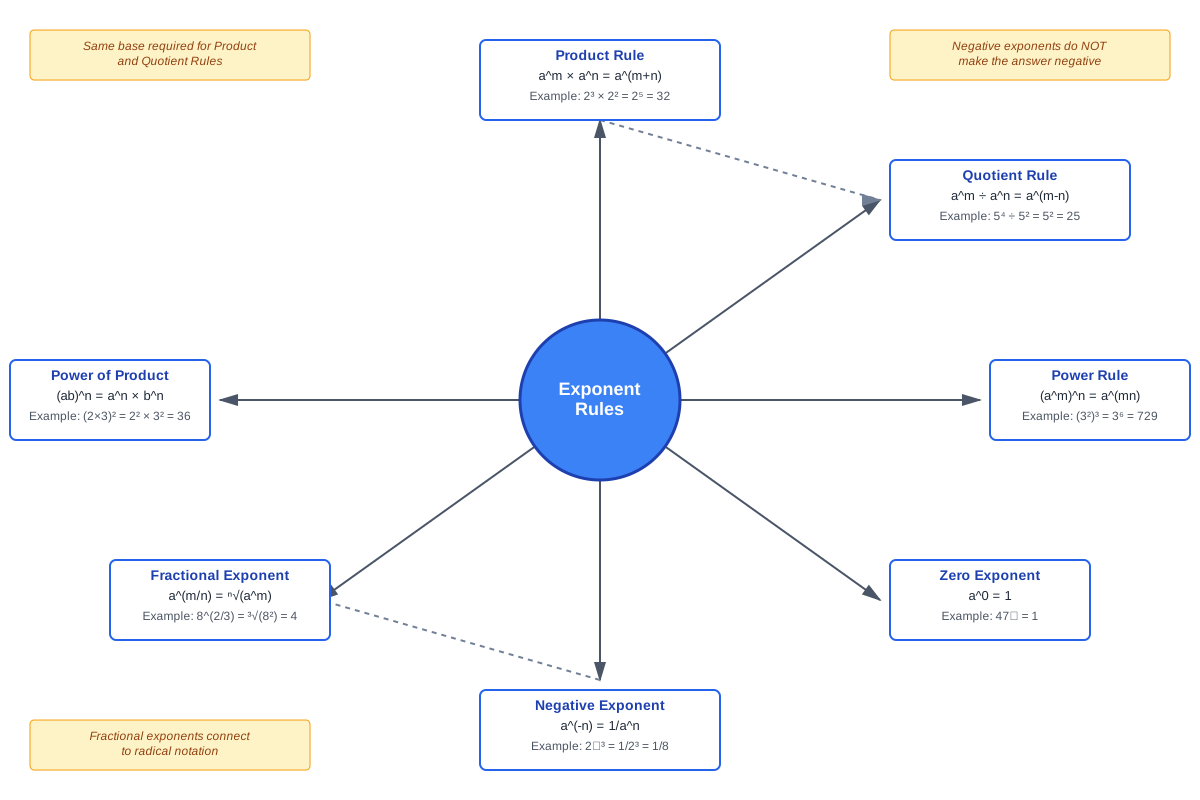
Exponent Rules Summary Table
| Rule Name | Formula | Example |
|---|---|---|
| Product Rule | b^m × b^n = b^(m+n) | x^3 × x^5 = x^8 |
| Quotient Rule | b^m ÷ b^n = b^(m-n) | y^7 ÷ y^2 = y^5 |
| Power Rule | (b^m)^n = b^(m×n) | (z^2)^4 = z^8 |
| Power of Product | (ab)^n = a^n × b^n | (2x)^3 = 8x^3 |
| Power of Quotient | (a/b)^n = a^n / b^n | (x/3)^2 = x^2/9 |
| Negative Exponent | b^(-n) = 1/b^n | 5^(-2) = 1/25 |
| Fractional Exponent | b^(m/n) = ⁿ√(b^m) | 27^(2/3) = 9 |
| Zero Exponent | b^0 = 1 | 47^0 = 1 |
Concept Relationships
The exponent rules form an interconnected system where each rule logically derives from the fundamental definition of exponents as repeated multiplication. The product rule (adding exponents) and quotient rule (subtracting exponents) are inverse operations, just as multiplication and division are inverses. The power rule (multiplying exponents) extends the product rule to situations where the same base is multiplied repeatedly.
Negative exponents connect to the quotient rule—when subtracting a larger exponent from a smaller one, the result is negative, indicating the expression belongs in the denominator. Fractional exponents bridge exponents and radicals, unifying two seemingly different notations under one system. This connection allows students to convert difficult radical expressions into exponential form, apply exponent rules, then convert back if needed.
The relationship map flows as follows: Basic Definition (repeated multiplication) → Product Rule (combining repeated multiplications) → Quotient Rule (removing repeated multiplications) → Zero Exponent (special case of quotient rule) → Negative Exponents (extending quotient rule beyond zero). Simultaneously: Basic Definition → Power Rule (repeated application of product rule) → Power of Product/Quotient (distributing power rule across operations). Finally: Fractional Exponents connect back to Basic Definition through roots, which are inverse operations to exponents.
These concepts connect to prerequisite knowledge of multiplication (the foundation of exponents), fractions (needed for fractional exponents and division), and negative numbers (essential for negative exponents and negative bases). They extend forward to polynomial operations (where exponent rules govern multiplication and division of terms), radical simplification (using fractional exponent notation), exponential functions (where variables appear in exponents), and logarithms (the inverse operation to exponentiation).
Quick check — test yourself on Exponents so far.
Try Flashcards →High-Yield Facts
⭐ When multiplying like bases, add exponents: x^a × x^b = x^(a+b)
⭐ When dividing like bases, subtract exponents: x^a ÷ x^b = x^(a-b)
⭐ When raising a power to a power, multiply exponents: (x^a)^b = x^(ab)
⭐ Any non-zero number to the zero power equals 1: x^0 = 1 (x ≠ 0)
⭐ Negative exponents create reciprocals: x^(-a) = 1/x^a
- Fractional exponents represent roots: x^(1/n) = ⁿ√x and x^(m/n) = ⁿ√(x^m)
- When raising a product to a power, distribute the exponent: (xy)^a = x^a × y^a
- When raising a quotient to a power, distribute the exponent: (x/y)^a = x^a / y^a
- The exponent applies only to what it's directly attached to: -x^2 ≠ (-x)^2
- Exponent rules only work with identical bases; x^2 × y^3 cannot be simplified further
- Adding or subtracting exponential expressions requires identical bases AND identical exponents: 3x^2 + 5x^2 = 8x^2, but x^2 + x^3 cannot be combined
- In scientific notation, the exponent on 10 indicates decimal place movement: 3.5 × 10^4 = 35,000
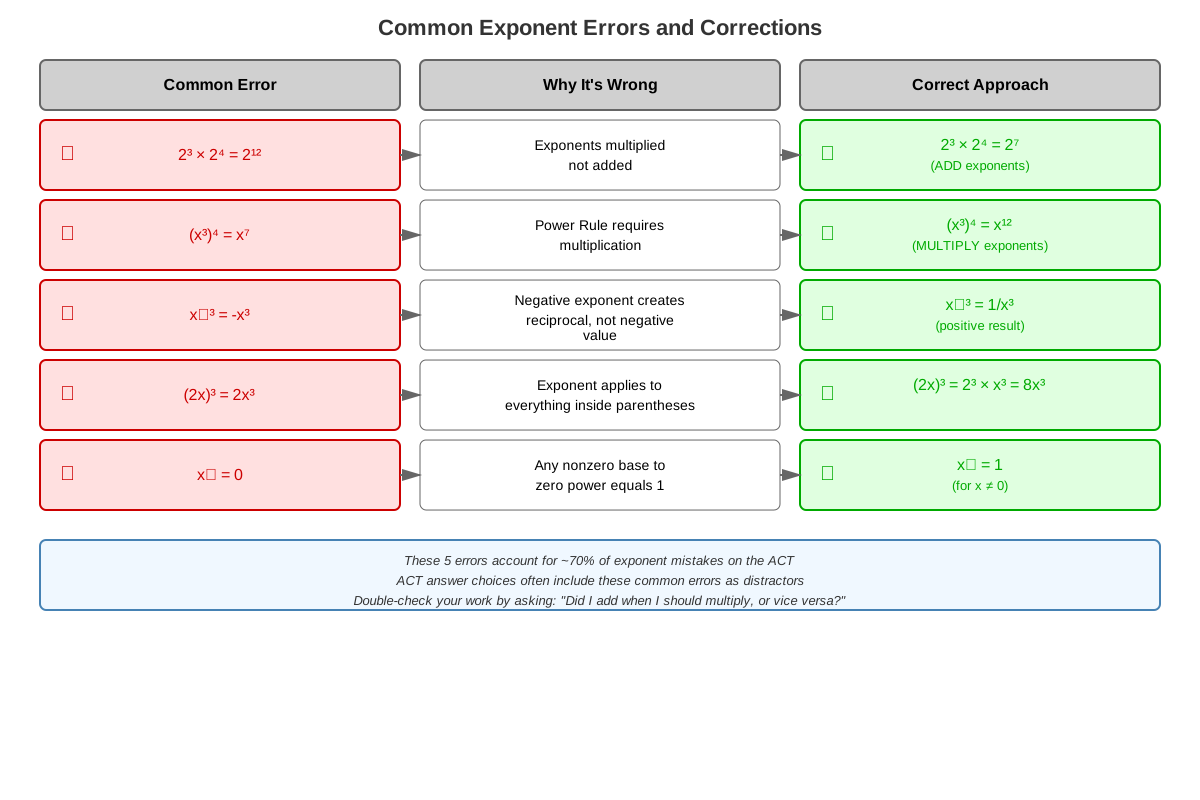
Common Misconceptions
Misconception: When multiplying exponential expressions, multiply the exponents (x^2 × x^3 = x^6).
Correction: When multiplying like bases, add the exponents: x^2 × x^3 = x^5. Multiplying exponents occurs only when raising a power to a power: (x^2)^3 = x^6.
Misconception: A negative exponent makes the entire result negative (2^(-3) = -8).
Correction: Negative exponents create reciprocals, not negative numbers. 2^(-3) = 1/2^3 = 1/8, which is positive. The negative sign affects position (numerator vs. denominator), not sign (positive vs. negative).
Misconception: The exponent applies to everything in front of it (-3^2 = 9).
Correction: Without parentheses, the exponent applies only to what it's directly attached to. -3^2 = -(3^2) = -9, while (-3)^2 = 9. Parentheses determine what the exponent affects.
Misconception: Zero to any power equals zero, including 0^0 = 0.
Correction: While 0^n = 0 for positive n, the expression 0^0 is undefined (or defined as 1 in some contexts). More importantly, any non-zero number to the zero power equals 1, not zero: 5^0 = 1.
Misconception: Exponent rules work when adding or subtracting (x^2 + x^3 = x^5).
Correction: Exponent rules apply only to multiplication and division operations. Addition and subtraction of exponential terms require identical bases AND identical exponents to combine: x^2 + x^2 = 2x^2, but x^2 + x^3 cannot be simplified using exponent rules.
Misconception: Fractional exponents create fractions (8^(1/2) = 8/2 = 4).
Correction: Fractional exponents represent roots, not division. 8^(1/2) = √8 ≈ 2.83, not 4. The numerator becomes the power, and the denominator becomes the root: 8^(2/3) = ³√(8^2) = ³√64 = 4.
Misconception: You can distribute exponents over addition inside parentheses: (x + y)^2 = x^2 + y^2.
Correction: Exponents distribute only over multiplication and division, not addition or subtraction. (x + y)^2 = (x + y)(x + y) = x^2 + 2xy + y^2, which requires FOIL or the binomial expansion formula.
Worked Examples
Example 1: Multi-Step Simplification
Problem: Simplify the expression (2x^3y^(-2))^3 × (x^(-1)y^4)^2 and write the answer with positive exponents only.
Solution:
Step 1: Apply the power rule to each parenthetical expression separately.
- For (2x^3y^(-2))^3: Distribute the exponent 3 to each factor
- 2^3 = 8
- (x^3)^3 = x^(3×3) = x^9
- (y^(-2))^3 = y^(-2×3) = y^(-6)
- Result: 8x^9y^(-6)
Step 2: Apply the power rule to (x^(-1)y^4)^2:
- (x^(-1))^2 = x^(-1×2) = x^(-2)
- (y^4)^2 = y^(4×2) = y^8
- Result: x^(-2)y^8
Step 3: Multiply the results from Steps 1 and 2:
- 8x^9y^(-6) × x^(-2)y^8
- Combine like bases using the product rule:
- Coefficient: 8
- x terms: x^9 × x^(-2) = x^(9+(-2)) = x^7
- y terms: y^(-6) × y^8 = y^(-6+8) = y^2
Step 4: Write with positive exponents:
- 8x^7y^2 (all exponents are already positive)
Answer: 8x^7y^2
Connection to Learning Objectives: This problem demonstrates identifying when multiple exponent rules are tested simultaneously (power rule, product rule, negative exponents), explaining the strategy of working inside parentheses first then combining terms, and applying rules accurately through multiple steps.
Example 2: Equation Solving with Exponents
Problem: If 3^(2x+1) = 27^(x-1), find the value of x.
Solution:
Step 1: Express both sides using the same base.
- Notice that 27 = 3^3
- Rewrite the equation: 3^(2x+1) = (3^3)^(x-1)
Step 2: Apply the power rule to the right side.
- (3^3)^(x-1) = 3^(3(x-1)) = 3^(3x-3)
- Equation becomes: 3^(2x+1) = 3^(3x-3)
Step 3: Since the bases are equal, the exponents must be equal.
- 2x + 1 = 3x - 3
Step 4: Solve for x.
- 2x + 1 = 3x - 3
- 1 + 3 = 3x - 2x
- 4 = x
Step 5: Verify the solution.
- Left side: 3^(2(4)+1) = 3^9
- Right side: 27^(4-1) = 27^3 = (3^3)^3 = 3^9 ✓
Answer: x = 4
Connection to Learning Objectives: This problem shows how to identify when exponents are tested in equation form, explains the core strategy of converting to a common base, and demonstrates accurate application to reach a solution. It also illustrates the importance of recognizing that 27 is a power of 3, a pattern-recognition skill crucial for ACT success.
Exam Strategy
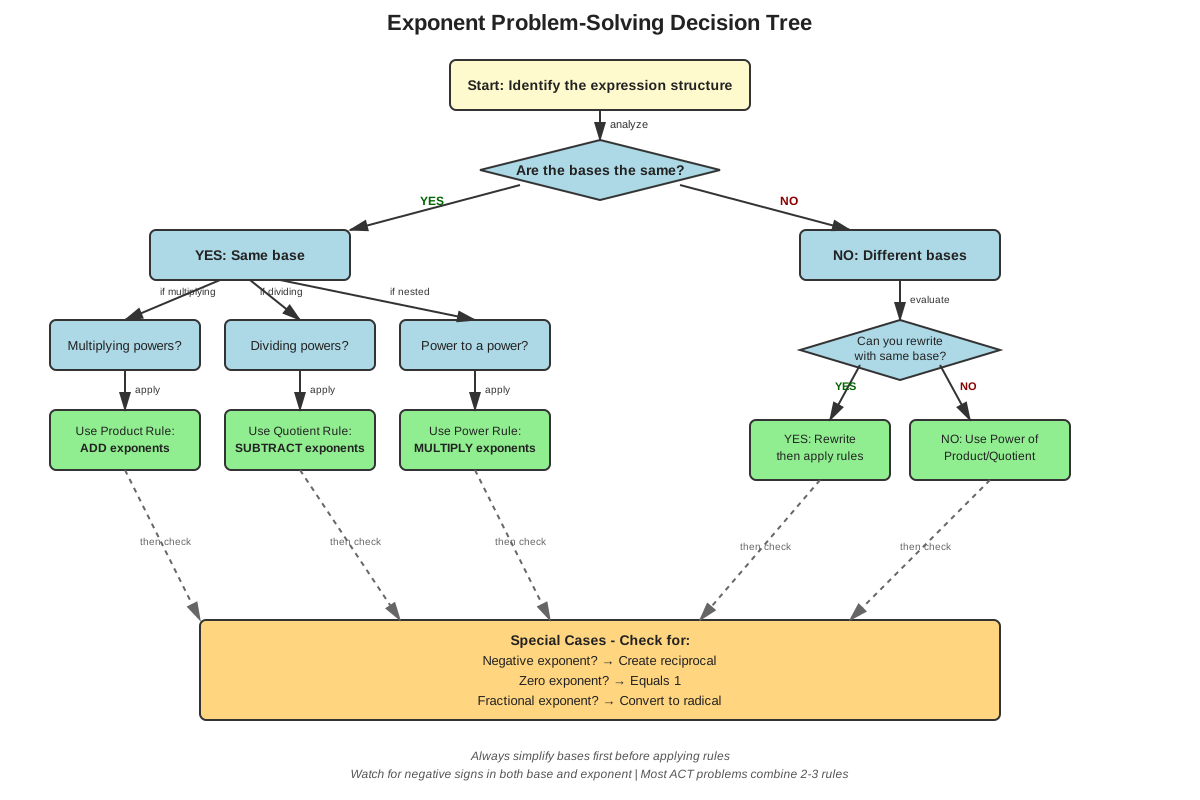
When approaching ACT exponents questions, begin by identifying which exponent rules apply. Look for common bases that can be combined or converted—the ACT frequently uses bases like 2, 3, 4, 8, 9, 16, 25, 27, and 125 because these are perfect powers that can be rewritten. If you see 8 and 2, recognize that 8 = 2^3. If you see 27 and 3, know that 27 = 3^3.
Trigger words and phrases that signal exponent questions include: "simplify," "express with positive exponents," "which expression is equivalent to," "if x^a = b, then x equals," and problems involving scientific notation. Questions asking you to "evaluate" or "calculate" with large or small numbers often expect you to use exponent rules rather than compute directly.
Process-of-elimination strategies: When answer choices contain exponential expressions, check the signs of exponents first—eliminate any answers with incorrect positive/negative exponents. Next, verify the base—if the question involves x and y, eliminate answers containing z or other variables. Then check the numerical coefficients—if the original expression has a coefficient of 8, answers with coefficients of 2 or 4 are likely incorrect unless division occurred. Finally, verify exponent values by testing with simple numbers (like x = 2) if time permits.
Time allocation: Simple exponent simplification questions should take 30-45 seconds. Multi-step problems combining several exponent rules may require 60-90 seconds. Equation-solving problems with exponents typically need 90-120 seconds. If a problem requires more than two minutes, mark it for review and move on—you may see the solution path more clearly on a second pass.
Common ACT patterns: Watch for problems that combine exponent rules with factoring (factor out the greatest common factor with the lowest exponent), rational expressions (simplify numerator and denominator separately, then divide), and radical expressions (convert to fractional exponents, simplify, then convert back). The ACT loves testing whether students can recognize that (x^2)^3 ≠ x^5 and that x^2 + x^3 cannot be simplified to x^5.
Memory Techniques
MADSPM for the six main exponent rules:
- Multiply bases → Add exponents (Product Rule)
- Divide bases → Subtract exponents (Quotient Rule)
- Power to power → Multiply exponents (Power Rule)
"Negative means flip": Visualize negative exponents as flipping the fraction—x^(-2) flips to 1/x^2, and 1/x^(-3) flips to x^3. The negative sign is a position indicator, not a value indicator.
"Fraction means root": The denominator of a fractional exponent tells you which root to take. x^(1/2) = √x (square root), x^(1/3) = ³√x (cube root), x^(1/4) = ⁴√x (fourth root). The numerator tells you the power: x^(2/3) means "cube root of x squared" or "square the cube root of x."
"Zero makes one": Any base (except zero) raised to the zero power equals one. Visualize this as the exponent "zeroing out" all the base's factors, leaving just 1. Think: "Zero effort gives one result."
"Same base, same rules": Exponent rules only work when bases match. Before applying any rule, check that bases are identical. If they're not, look for ways to rewrite them (like converting 8 to 2^3).
Visualization for power rule: Picture (x^2)^3 as three boxes, each containing x^2. When you open all the boxes, you have x^2 + x^2 + x^2 in terms of exponent addition, which equals x^6. This reinforces that you multiply the exponents.
Summary
Exponents represent repeated multiplication and follow systematic rules that govern how exponential expressions combine, divide, and transform. The core exponent rules—product rule (add exponents when multiplying like bases), quotient rule (subtract exponents when dividing like bases), and power rule (multiply exponents when raising powers to powers)—form the foundation for simplifying complex expressions. Negative exponents create reciprocals rather than negative values, while fractional exponents represent roots, unifying exponential and radical notation. Zero as an exponent always yields 1 for non-zero bases. Success with ACT exponent questions requires recognizing which rules apply, converting expressions to common bases when possible, and carefully tracking signs and operations. Students must distinguish between operations that allow exponent rule application (multiplication and division) and those that don't (addition and subtraction of unlike terms). Mastery involves both computational accuracy and strategic pattern recognition, particularly identifying perfect powers and equivalent expressions.
Key Takeaways
- When multiplying like bases, add exponents; when dividing like bases, subtract exponents; when raising a power to a power, multiply exponents
- Negative exponents indicate reciprocals (move between numerator and denominator), not negative values
- Fractional exponents represent roots: the denominator indicates which root, the numerator indicates the power
- Any non-zero number raised to the zero power equals 1, and any number raised to the first power equals itself
- Exponent rules apply only to multiplication and division operations, not to addition or subtraction
- Always convert to common bases when possible—recognize that 4 = 2^2, 8 = 2^3, 9 = 3^2, 27 = 3^3, etc.
- Parentheses determine what the exponent affects: -x^2 ≠ (-x)^2
Related Topics
Polynomial Operations: Exponent rules govern how polynomial terms multiply and divide. Mastering exponents enables efficient factoring, expansion, and simplification of polynomial expressions, which appear frequently on the ACT.
Radical Expressions: Radicals are fractional exponents in disguise. Converting between radical and exponential notation allows application of exponent rules to simplify complex radical expressions.
Exponential Functions: Understanding exponent behavior prepares students for exponential growth and decay problems, where variables appear in exponents and solutions require logarithms or strategic substitution.
Scientific Notation: This notation system uses powers of 10 to express very large or very small numbers efficiently. Exponent rules enable calculations with scientific notation without converting to standard form.
Logarithms: Logarithms are the inverse operation to exponentiation. Strong exponent foundations make logarithmic concepts more intuitive and accessible.
Practice CTA
Now that you've mastered the core concepts and strategies for exponents, it's time to solidify your understanding through active practice. Attempt the practice questions to test your ability to identify exponent patterns, apply rules accurately, and solve problems efficiently under test-like conditions. Use the flashcards to drill the essential rules and facts until they become automatic—speed and accuracy with exponent rules will save you valuable time on test day and boost your confidence across multiple question types. Remember, exponents appear throughout the ACT Math section, so every minute spent mastering this topic pays dividends across numerous problems. You've got this!
Sign up free to keep reading
Create a free AnvayaPrep account to finish this ACT guide on Exponents — plus flashcards and practice questions.