Overview
The quadratic formula stands as one of the most powerful and frequently tested algebraic tools on the ACT Math section. This formula provides a systematic method for finding the solutions (also called roots or zeros) of any quadratic equation, regardless of whether the equation can be easily factored. While factoring remains a valuable skill for simpler problems, the quadratic formula serves as the universal solution method that works in every situation, making it an indispensable tool for test-takers aiming for high scores.
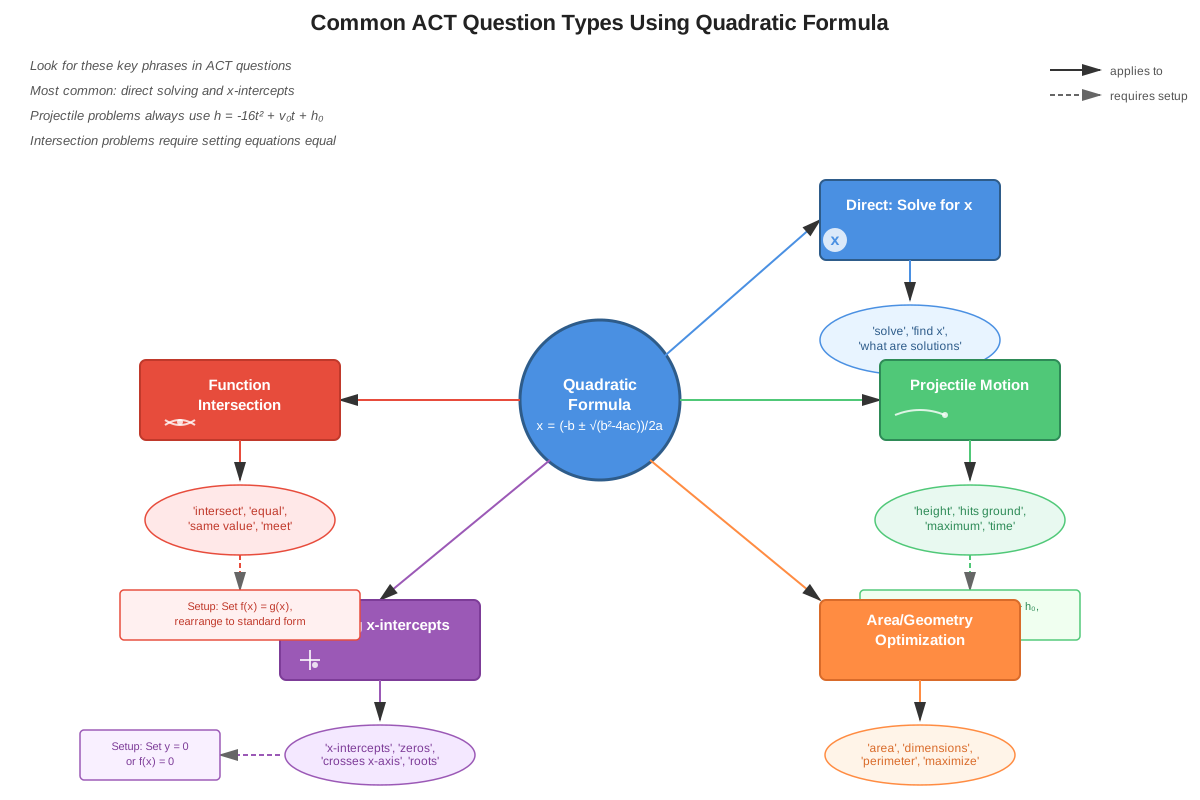
On the ACT, quadratic equations appear in multiple contexts: solving for unknown variables, finding x-intercepts of parabolas, determining where two functions intersect, and analyzing real-world scenarios involving projectile motion or area optimization. The ACT quadratic formula questions typically appear 2-4 times per test, often embedded within more complex problems that require multiple steps. Understanding when and how to apply this formula efficiently can save valuable time and ensure accuracy on problems that might otherwise seem intractable.
The quadratic formula connects deeply to broader mathematical concepts including parabolas, the discriminant, complex numbers, and the relationship between algebraic and graphical representations of functions. Mastery of this topic builds upon foundational algebra skills while opening pathways to more advanced concepts in coordinate geometry and functions. Students who can quickly recognize quadratic formula opportunities and execute the calculation accurately gain a significant competitive advantage on test day.
Learning Objectives
- [ ] Identify when Quadratic formula is being tested
- [ ] Explain the core rule or strategy behind Quadratic formula
- [ ] Apply Quadratic formula to ACT-style questions accurately
- [ ] Determine the number and nature of solutions using the discriminant
- [ ] Convert word problems into quadratic equations suitable for the formula
- [ ] Simplify radical expressions that result from applying the quadratic formula
- [ ] Recognize when alternative methods (factoring, completing the square) might be more efficient
Prerequisites
- Standard form of quadratic equations (ax² + bx + c = 0): Essential for identifying the coefficients a, b, and c that plug directly into the formula
- Order of operations (PEMDAS): Required for correctly evaluating the formula's multiple operations in the proper sequence
- Simplifying radical expressions: Necessary for reducing answers to simplest form, as most ACT answers require simplified radicals
- Basic arithmetic with negative numbers: Critical since the formula involves subtracting b and working with negative values under the square root
- Understanding of solutions/roots/zeros: These interchangeable terms all refer to x-values that make the equation equal zero
Why This Topic Matters
The quadratic formula represents a fundamental problem-solving tool that extends far beyond the ACT. In physics, it models projectile motion, allowing engineers to calculate trajectory paths and landing points. Economists use quadratic functions to optimize profit and minimize cost. Architects apply these principles when designing parabolic arches and structures. The formula's universality makes it one of the most practical mathematical tools students will encounter.
On the ACT Math section, quadratic formula questions appear with high frequency—typically 2-4 questions per 60-question test, representing approximately 3-7% of the exam. These questions often carry medium to high difficulty ratings and frequently appear in the latter half of the test. The ACT tests this concept through direct "solve for x" problems, word problems requiring equation setup, questions about parabola properties, and multi-step problems where finding roots is one component of a larger solution.
Common ACT question formats include: finding where a projectile hits the ground (setting height equation equal to zero), determining x-intercepts of parabolas, solving equations that don't factor nicely, finding intersection points of curves, and analyzing the discriminant to determine the number of real solutions. The formula also appears in coordinate geometry questions about parabolas and in function problems requiring root analysis.
Core Concepts
The Quadratic Formula Structure
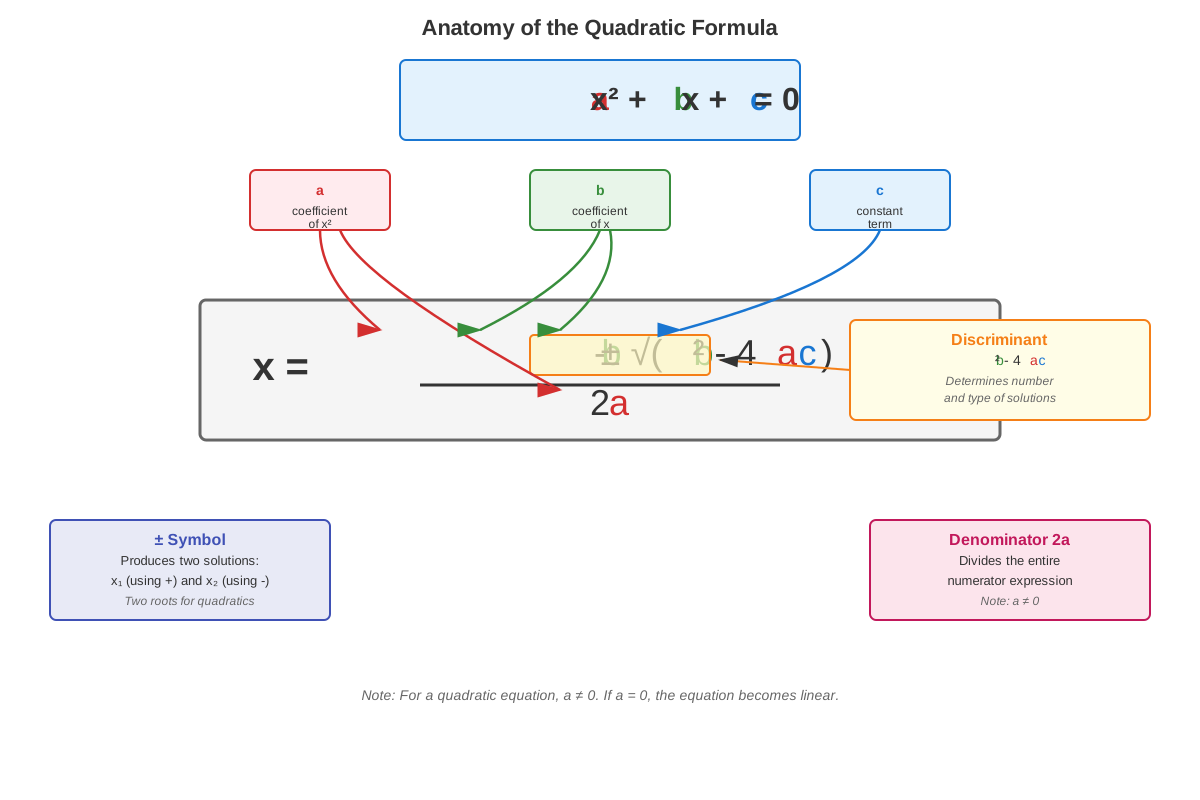
The quadratic formula states that for any quadratic equation in standard form ax² + bx + c = 0 (where a ≠ 0), the solutions are:
x = (-b ± √(b² - 4ac)) / (2a)This formula contains three distinct coefficients that must be identified correctly:
- a: the coefficient of the x² term (must be non-zero)
- b: the coefficient of the x term (can be zero, positive, or negative)
- c: the constant term (can be zero, positive, or negative)
The ± symbol indicates that most quadratic equations have two solutions: one using addition and one using subtraction. These two solutions correspond to the two points where a parabola crosses the x-axis.
Converting Equations to Standard Form
Before applying the quadratic formula, equations must be arranged in standard form with all terms on one side and zero on the other. This process requires careful attention to signs:
- Move all terms to one side of the equation
- Arrange in descending order of exponents: x² term, then x term, then constant
- Ensure the equation equals zero
- Identify a, b, and c (including their signs)
For example, 3x² = 5x - 2 must be rewritten as 3x² - 5x + 2 = 0, giving a = 3, b = -5, and c = 2. Notice that b is negative because the 5x term was moved across the equals sign.
The Discriminant
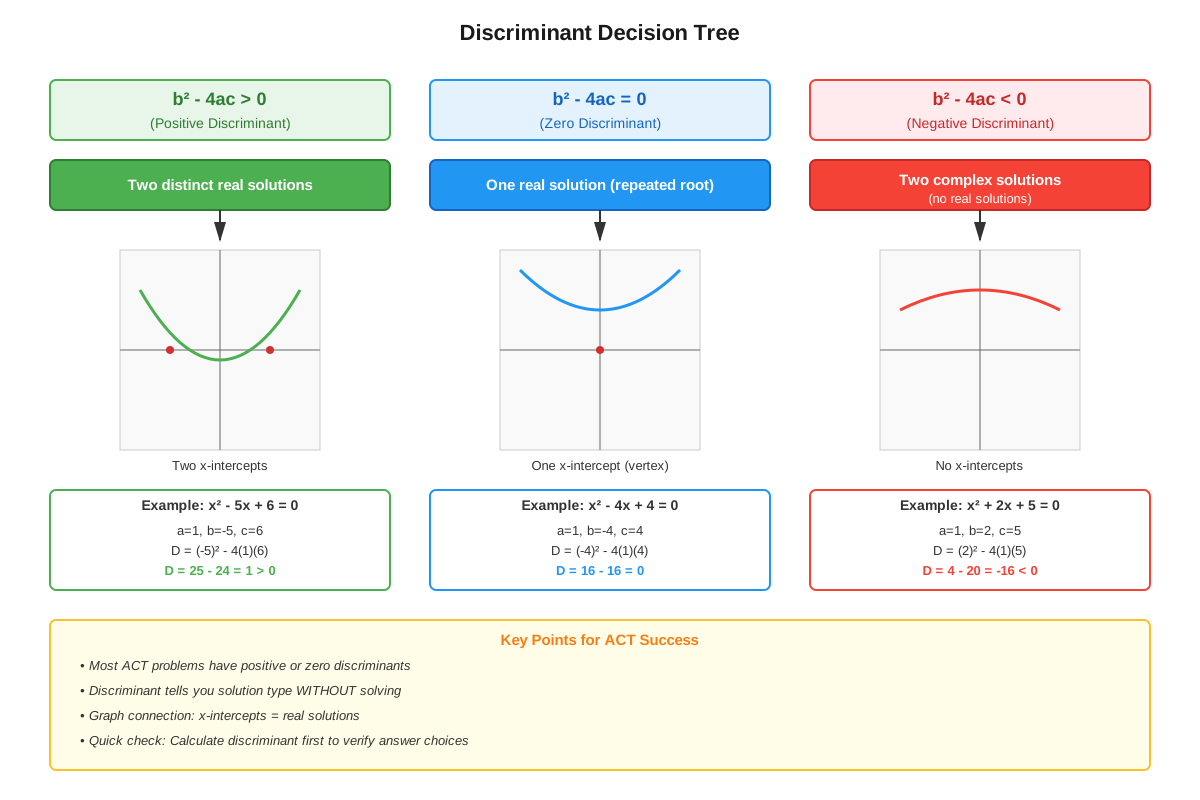
The expression under the square root, b² - 4ac, is called the discriminant and provides crucial information about the nature of solutions:
| Discriminant Value | Number of Real Solutions | Graph Interpretation |
|---|---|---|
| Positive (> 0) | Two distinct real solutions | Parabola crosses x-axis twice |
| Zero (= 0) | One real solution (repeated root) | Parabola touches x-axis at vertex |
| Negative (< 0) | No real solutions (two complex) | Parabola doesn't touch x-axis |
The discriminant allows students to answer questions about the number of solutions without fully solving the equation, saving valuable time on the ACT.
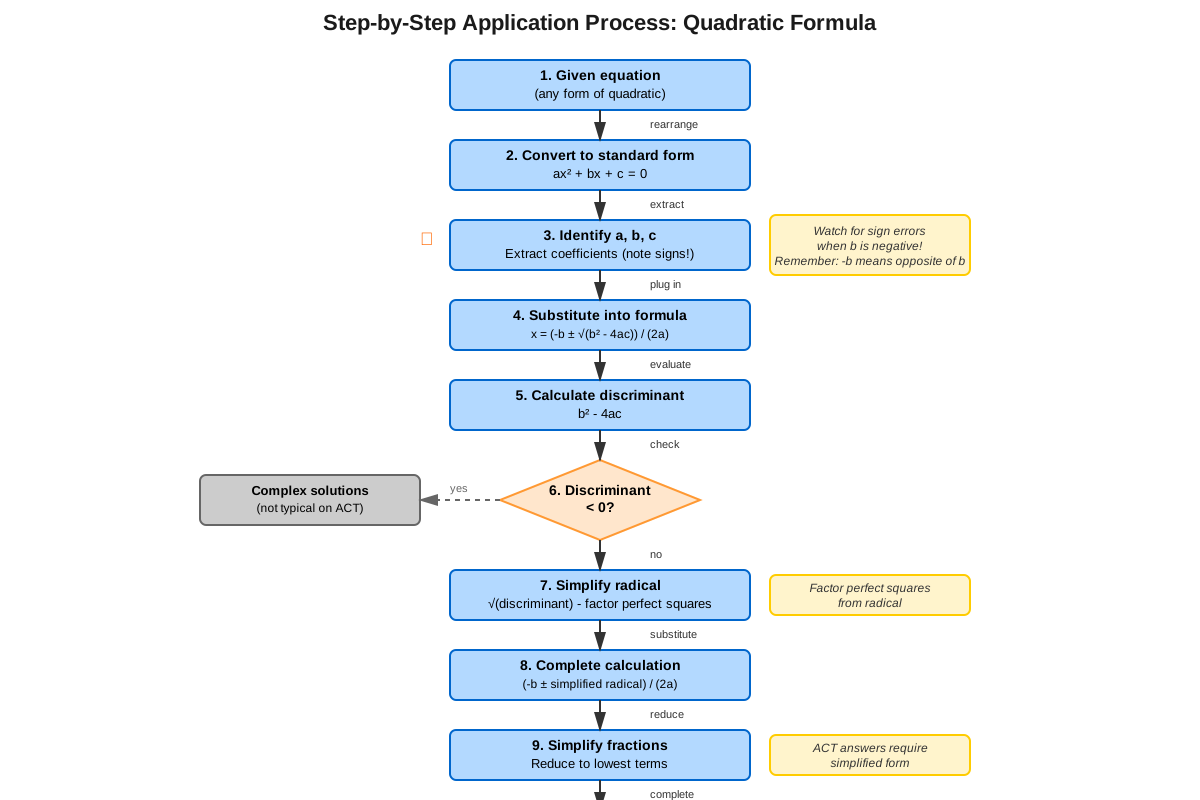
Step-by-Step Application Process
- Identify coefficients: Write down a, b, and c with their correct signs
- Calculate the discriminant: Compute b² - 4ac first to check if real solutions exist
- Evaluate the numerator: Calculate -b ± √(b² - 4ac), creating two separate values
- Divide by 2a: Apply the denominator to both numerator values
- Simplify: Reduce radicals and fractions to simplest form
Simplifying Radical Results
ACT answers typically require simplified radical form. When the discriminant is not a perfect square:
- Factor out perfect squares from under the radical
- Simplify the fraction by finding common factors in numerator and denominator
- Express answers as simplified radicals rather than decimals
For example, if the formula yields (6 ± √12)/4, simplify √12 to 2√3, giving (6 ± 2√3)/4, which reduces to (3 ± √3)/2.
Special Cases and Shortcuts
When b = 0, the equation becomes ax² + c = 0, which can be solved more quickly by isolating x²: x² = -c/a, then x = ±√(-c/a).
When c = 0, the equation becomes ax² + bx = 0, which factors as x(ax + b) = 0, giving solutions x = 0 and x = -b/a without needing the formula.
When a = 1, the formula simplifies slightly, making mental calculation easier.
Concept Relationships
The quadratic formula serves as the central hub connecting multiple algebraic and geometric concepts. It derives from completing the square, which is the algebraic manipulation technique used to prove the formula. Understanding this derivation (though not required for the ACT) reinforces why the formula works universally.
The formula directly connects to factoring: when a quadratic factors nicely, the solutions found by factoring match those from the formula. The formula essentially provides the factored form in reverse—if the solutions are x = p and x = q, the factored form is (x - p)(x - q) = 0.
Graphically, the quadratic formula finds x-intercepts of parabolas, linking algebra to coordinate geometry. The discriminant portion connects to the vertex and axis of symmetry of parabolas: the axis of symmetry always lies at x = -b/(2a), which is the average of the two roots.
The relationship map flows as follows:
Standard Form Equation → Identify a, b, c → Calculate Discriminant → Determine Number of Solutions → Apply Full Formula → Simplify Results → Interpret Solutions (algebraically or graphically)
This topic also connects forward to polynomial functions (quadratics are second-degree polynomials), rational equations (which sometimes reduce to quadratics), and systems of equations (where finding intersections may require solving quadratics).
Quick check — test yourself on Quadratic formula so far.
Try Flashcards →High-Yield Facts
⭐ The quadratic formula is x = (-b ± √(b² - 4ac)) / (2a) for equations in the form ax² + bx + c = 0
⭐ The discriminant b² - 4ac determines the number of real solutions: positive gives two, zero gives one, negative gives none
⭐ Both solutions must be checked in the original equation when solving word problems, as one may be extraneous
⭐ The sum of the two roots equals -b/a, and the product of the two roots equals c/a (Vieta's formulas)
⭐ The axis of symmetry of the parabola is x = -b/(2a), which is the midpoint between the two roots
- When the discriminant is a perfect square, the quadratic factors over the integers
- The quadratic formula works for all quadratic equations, even when other methods fail
- Sign errors with b are the most common mistake—pay careful attention to negative coefficients
- Simplifying radicals in the final answer is almost always required on the ACT
- If a quadratic equation has rational solutions, factoring is usually faster than the formula
- The vertex form and standard form of a quadratic contain the same information in different arrangements
- Complex (imaginary) solutions always come in conjugate pairs: a + bi and a - bi
Common Misconceptions
Misconception: The formula is x = (-b ± √(b² - 4ac)) / 2a, with only b divided by 2a
Correction: The entire numerator (-b ± √(b² - 4ac)) must be divided by 2a. Use parentheses: x = [(-b) ± √(b² - 4ac)] / (2a)
Misconception: When b is negative in the original equation, use its value directly in -b
Correction: If the equation is x² - 5x + 6 = 0, then b = -5, and -b = -(-5) = +5. The negative sign in the formula changes the sign of b.
Misconception: A negative discriminant means there are no solutions at all
Correction: A negative discriminant means no real solutions, but there are two complex (imaginary) solutions. On the ACT, this typically means "no real solutions" is the answer.
Misconception: Both solutions from the ± must always be valid in word problems
Correction: Always check both solutions in the context of the problem. Negative time, negative length, or other contextually impossible values should be rejected.
Misconception: The quadratic formula only works when the equation cannot be factored
Correction: The formula works for all quadratic equations, including those that factor. However, factoring is often faster when it's easily recognizable.
Misconception: Simplifying radicals is optional if the answer looks correct
Correction: ACT answer choices are always in simplest form. An unsimplified answer like (4 ± √8)/2 won't match the correct choice (2 ± √2)/1.
Worked Examples
Example 1: Direct Application with Simplification
Problem: Solve 2x² + 7x - 4 = 0
Solution:
Step 1: Identify coefficients
- a = 2, b = 7, c = -4
Step 2: Calculate the discriminant
- b² - 4ac = (7)² - 4(2)(-4)
- = 49 - (-32)
- = 49 + 32 = 81
Step 3: Apply the quadratic formula
- x = (-b ± √(b² - 4ac)) / (2a)
- x = (-7 ± √81) / (2·2)
- x = (-7 ± 9) / 4
Step 4: Find both solutions
- x = (-7 + 9) / 4 = 2/4 = 1/2
- x = (-7 - 9) / 4 = -16/4 = -4
Answer: x = 1/2 or x = -4
This example demonstrates proper coefficient identification, discriminant calculation, and simplification. The positive discriminant (81) indicated two real solutions, which we found. This problem connects to Learning Objective 3 (applying the formula accurately).
Example 2: Word Problem Application
Problem: A ball is thrown upward from a height of 5 feet with an initial velocity of 40 feet per second. Its height h (in feet) after t seconds is given by h = -16t² + 40t + 5. When does the ball hit the ground?
Solution:
Step 1: Set up the equation
- The ball hits the ground when h = 0
- 0 = -16t² + 40t + 5
- Rearranging: -16t² + 40t + 5 = 0
Step 2: Identify coefficients
- a = -16, b = 40, c = 5
Step 3: Calculate the discriminant
- b² - 4ac = (40)² - 4(-16)(5)
- = 1600 - (-320)
- = 1600 + 320 = 1920
Step 4: Apply the formula
- t = (-40 ± √1920) / (2·(-16))
- t = (-40 ± √1920) / (-32)
Step 5: Simplify the radical
- √1920 = √(64 × 30) = 8√30
- t = (-40 ± 8√30) / (-32)
- t = (-40 + 8√30) / (-32) or t = (-40 - 8√30) / (-32)
Step 6: Simplify fractions
- t = (40 - 8√30) / 32 = (5 - √30) / 4 or t = (40 + 8√30) / 32 = (5 + √30) / 4
Step 7: Evaluate and check context
- (5 - √30) / 4 ≈ (5 - 5.48) / 4 ≈ -0.12 (negative time—reject)
- (5 + √30) / 4 ≈ (5 + 5.48) / 4 ≈ 2.62 seconds (valid)
Answer: The ball hits the ground after approximately (5 + √30)/4 seconds, or about 2.62 seconds.
This example illustrates Learning Objectives 1 and 5 (identifying when the formula is needed and converting word problems to equations). It also demonstrates the importance of checking solutions in context.
Exam Strategy
When approaching ACT quadratic formula questions, first scan the equation to determine if factoring is immediately obvious. If the equation is x² + 5x + 6 = 0, factoring to (x + 2)(x + 3) = 0 takes seconds. Reserve the quadratic formula for equations with large coefficients, non-integer solutions, or when factoring isn't immediately apparent.
Trigger words and phrases that signal quadratic formula problems include:
- "Find the x-intercepts"
- "When does [object] hit the ground"
- "Solve for x"
- "Find all real solutions"
- "At what times does..."
- "Where does the graph cross the x-axis"
Exam Tip: If answer choices contain radicals or complex expressions, the quadratic formula is likely required. If answers are simple integers, try factoring first.
For process of elimination, calculate the discriminant first. If it's negative and answer choices include "no real solutions" or "no solution," select that immediately without completing the formula. If the discriminant is a perfect square and answers are integers, you can verify by factoring or by checking which answer choices, when substituted back, satisfy the equation.
Time allocation: Budget 60-90 seconds for straightforward quadratic formula problems. If a problem requires more than 2 minutes, mark it and return later. Practice the formula enough that coefficient identification and calculation become automatic.
Common time-savers:
- Write a, b, c values clearly before starting
- Calculate b² - 4ac separately and check if it's a perfect square
- Use your calculator efficiently for arithmetic but show work for algebra
- Recognize when only one solution makes contextual sense in word problems
Memory Techniques
Primary Mnemonic: "Negative Boy, Be Square: 4get About Crying, 2gether Always"
This encodes: -b ± √(b² - 4ac) / 2a
Visual Memory Aid: Picture the formula as a fraction with three distinct parts:
- Top left: negative b (a minus sign before b)
- Top right: plus-or-minus square root (the ± and radical)
- Bottom: two times a (denominator)
Discriminant Mnemonic: "Positive = Pair, Zero = Zing (one), Negative = None"
- Positive discriminant → Pair of solutions
- Zero discriminant → Zing (one solution)
- Negative discriminant → None (no real solutions)
Coefficient Identification: Use the acronym ABC = Always Before Constant
- A comes before x²
- B comes before x
- C is the constant (no x)
Sign Check Reminder: "Negative B Needs Negation" — remember that -b in the formula means you change b's sign.
Summary
The quadratic formula provides a universal method for solving any quadratic equation in the form ax² + bx + c = 0, yielding solutions x = (-b ± √(b² - 4ac)) / (2a). This formula appears frequently on the ACT Math section, typically 2-4 times per test, and requires careful coefficient identification, accurate arithmetic, and proper simplification of radical expressions. The discriminant (b² - 4ac) reveals the number of real solutions before full calculation: positive gives two solutions, zero gives one, and negative indicates no real solutions. Success with this topic demands recognizing when the formula is needed versus when factoring is faster, converting word problems into standard form equations, and checking solutions for contextual validity. Mastery of the quadratic formula connects algebraic manipulation to graphical interpretation of parabolas and serves as a foundation for more advanced polynomial and function concepts.
Key Takeaways
- The quadratic formula x = (-b ± √(b² - 4ac)) / (2a) solves any quadratic equation in standard form ax² + bx + c = 0
- Always convert equations to standard form first, ensuring all terms are on one side with zero on the other
- The discriminant b² - 4ac determines solution count: positive (two), zero (one), or negative (none real)
- Sign errors with coefficient b are the most common mistake—pay special attention when b is negative
- Simplify all radical expressions and fractions to match ACT answer format
- Check both solutions in word problems for contextual validity; reject impossible values like negative time
- Calculate the discriminant first to save time and guide your solution strategy
Related Topics
Factoring Quadratic Expressions: The alternative method for solving quadratics when equations factor nicely over integers; mastering both factoring and the formula allows strategic choice of the faster method for each problem.
Completing the Square: The algebraic technique from which the quadratic formula is derived; useful for converting to vertex form and understanding parabola transformations.
Graphing Parabolas: Visual representation of quadratic functions where the formula's solutions represent x-intercepts; connects algebraic and geometric thinking.
Complex Numbers: When the discriminant is negative, solutions involve imaginary numbers; understanding this extension prepares students for advanced algebra.
Polynomial Functions: Quadratics are second-degree polynomials; the formula introduces root-finding concepts that extend to higher-degree polynomials.
Systems of Equations: Finding intersection points of a line and parabola often requires solving a quadratic equation using the formula.
Practice CTA
Now that you've mastered the quadratic formula's theory and application, it's time to cement your understanding through practice. Attempt the practice questions to test your ability to identify coefficients, calculate discriminants, and solve complete problems under timed conditions. Use the flashcards to drill the formula itself and key discriminant interpretations until recall becomes automatic. Remember: the difference between knowing the formula and scoring points is consistent, accurate application under test pressure. Your investment in practice now will pay dividends in confidence and speed on test day. You've got this!
Sign up free to keep reading
Create a free AnvayaPrep account to finish this ACT guide on Quadratic formula — plus flashcards and practice questions.