Overview
Systems of equations represent one of the most frequently tested algebraic concepts on the ACT Math section, appearing in approximately 2-4 questions per exam. A system of equations consists of two or more equations with two or more variables that must be solved simultaneously to find values that satisfy all equations at once. Mastering this topic is essential because it forms the foundation for understanding how multiple constraints interact mathematically—a skill that extends far beyond algebra into geometry, functions, and real-world problem modeling.
On the ACT, ACT systems of equations questions typically involve two linear equations with two variables, though occasionally you'll encounter systems with three variables or systems that include one quadratic equation. These problems test your ability to recognize when multiple pieces of information must be combined, select the most efficient solution method, and execute calculations accurately under time pressure. The ACT rewards students who can quickly identify which solving technique—substitution, elimination, or graphing—will lead to the answer most efficiently.
Understanding systems of equations connects directly to broader mathematical reasoning skills tested throughout the ACT Math section. This topic builds upon your knowledge of linear equations, coordinate geometry, and algebraic manipulation while serving as a gateway to more complex concepts like matrices, inequalities, and optimization problems. The ability to work with systems also enhances your capacity to translate word problems into mathematical language, a skill that appears across multiple ACT question types.
Learning Objectives
- [ ] Identify when Systems of equations is being tested
- [ ] Explain the core rule or strategy behind Systems of equations
- [ ] Apply Systems of equations to ACT-style questions accurately
- [ ] Determine the most efficient solution method (substitution, elimination, or graphing) based on the form of given equations
- [ ] Recognize special cases including systems with no solution, infinitely many solutions, or unique solutions
- [ ] Translate word problems involving multiple constraints into systems of equations and solve them within 90 seconds
Prerequisites
- Linear equations in one variable: Understanding how to isolate variables and solve basic equations is fundamental to manipulating equations within a system
- Coordinate plane and graphing: Recognizing that equations represent lines and that solutions represent intersection points provides geometric intuition for systems
- Algebraic manipulation: Skills in distributing, combining like terms, and factoring enable the equation transformations required for both substitution and elimination methods
- Slope-intercept and standard form: Familiarity with different equation formats helps identify the most efficient solution approach quickly
Why This Topic Matters
Systems of equations model countless real-world scenarios where multiple conditions must be satisfied simultaneously. From calculating break-even points in business (where cost equals revenue) to determining optimal mixtures in chemistry, from analyzing supply and demand in economics to planning routes with multiple constraints, systems of equations provide the mathematical framework for solving complex problems with multiple variables. Understanding this topic develops logical reasoning and the ability to manage multiple pieces of information—skills valuable far beyond mathematics.
On the ACT Math section, systems of equations questions appear with high frequency, typically comprising 3-7% of all math questions. This translates to 2-4 questions per exam, making it a high-yield topic that significantly impacts your score. These questions appear most commonly in the middle difficulty range (questions 20-40 out of 60), though more complex systems occasionally appear in the final third of the test. The ACT tests systems through direct algebraic problems, word problems requiring translation, and occasionally through coordinate geometry questions asking about intersection points.
Common question formats include: finding the value of x or y in a given system; determining the sum or difference of variables (x + y or x - y); identifying which ordered pair satisfies both equations; solving word problems about mixtures, rates, or costs; and analyzing systems graphically. The ACT particularly favors questions where one equation is already solved for a variable, making substitution efficient, or where coefficients align perfectly for elimination.
Core Concepts
Definition and Solution Types
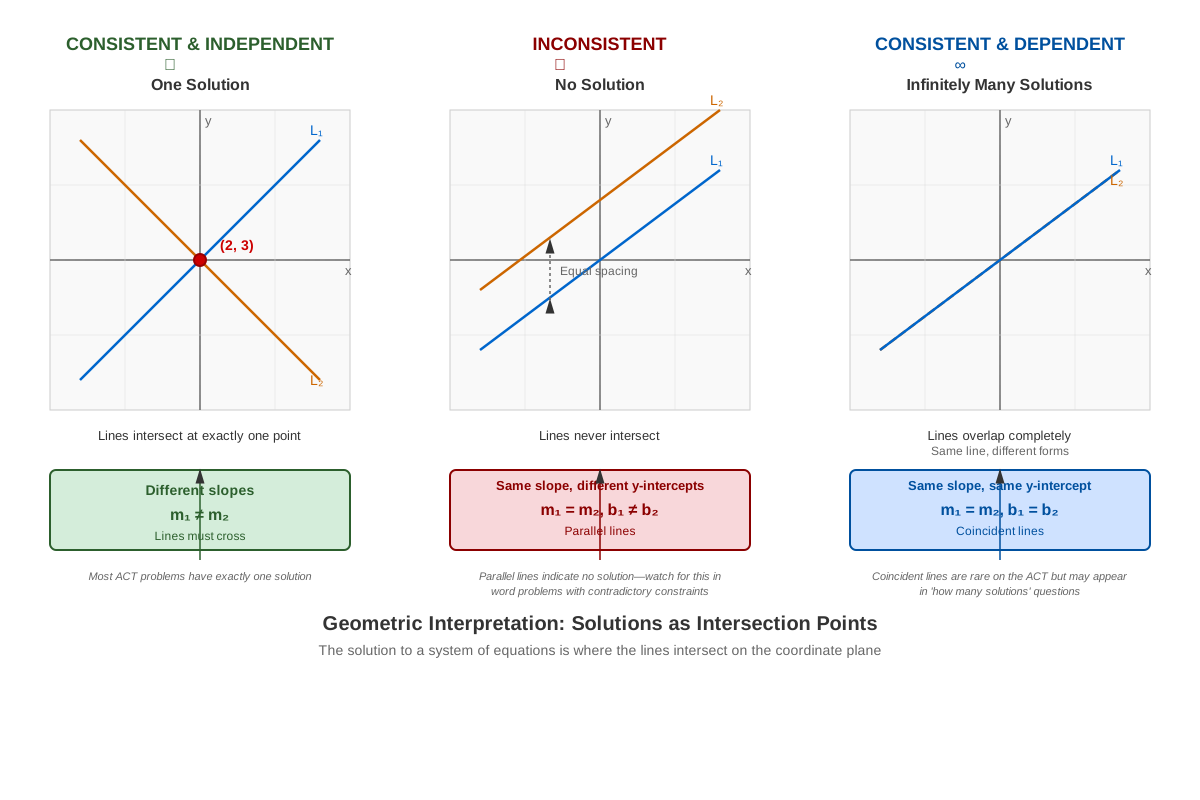
A system of equations consists of two or more equations containing two or more variables, where the goal is to find values for all variables that simultaneously satisfy every equation in the system. For two linear equations with two variables, three possible outcomes exist:
- One unique solution: The lines intersect at exactly one point; the system is consistent and independent
- No solution: The lines are parallel and never intersect; the system is inconsistent
- Infinitely many solutions: The lines are identical (coincident); the system is consistent and dependent
On the ACT, the vast majority of systems have one unique solution, though recognizing the special cases can save valuable time when they appear.
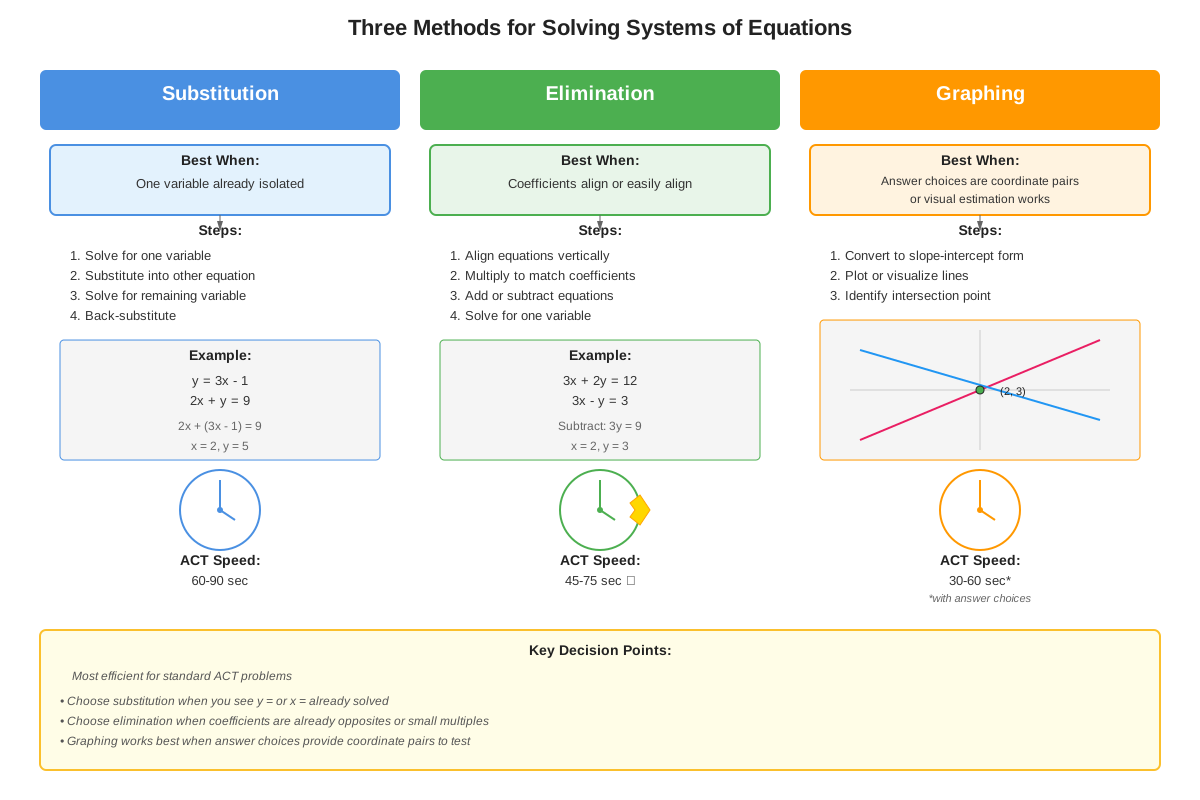
The Substitution Method
The substitution method works by solving one equation for one variable, then substituting that expression into the other equation. This method is most efficient when:
- One equation is already solved for a variable (e.g., y = 3x + 2)
- One variable has a coefficient of 1 or -1, making it easy to isolate
Step-by-step process:
- Solve one equation for one variable (choose the easiest to isolate)
- Substitute this expression into the other equation
- Solve the resulting single-variable equation
- Substitute the found value back into either original equation to find the other variable
- Check your solution in both original equations (if time permits)
The Elimination Method
The elimination method (also called the addition method or linear combination method) involves adding or subtracting equations to eliminate one variable. This method is most efficient when:
- Coefficients of one variable are already opposites or equal
- Coefficients can be made opposites or equal through simple multiplication
- Both equations are in standard form (Ax + By = C)
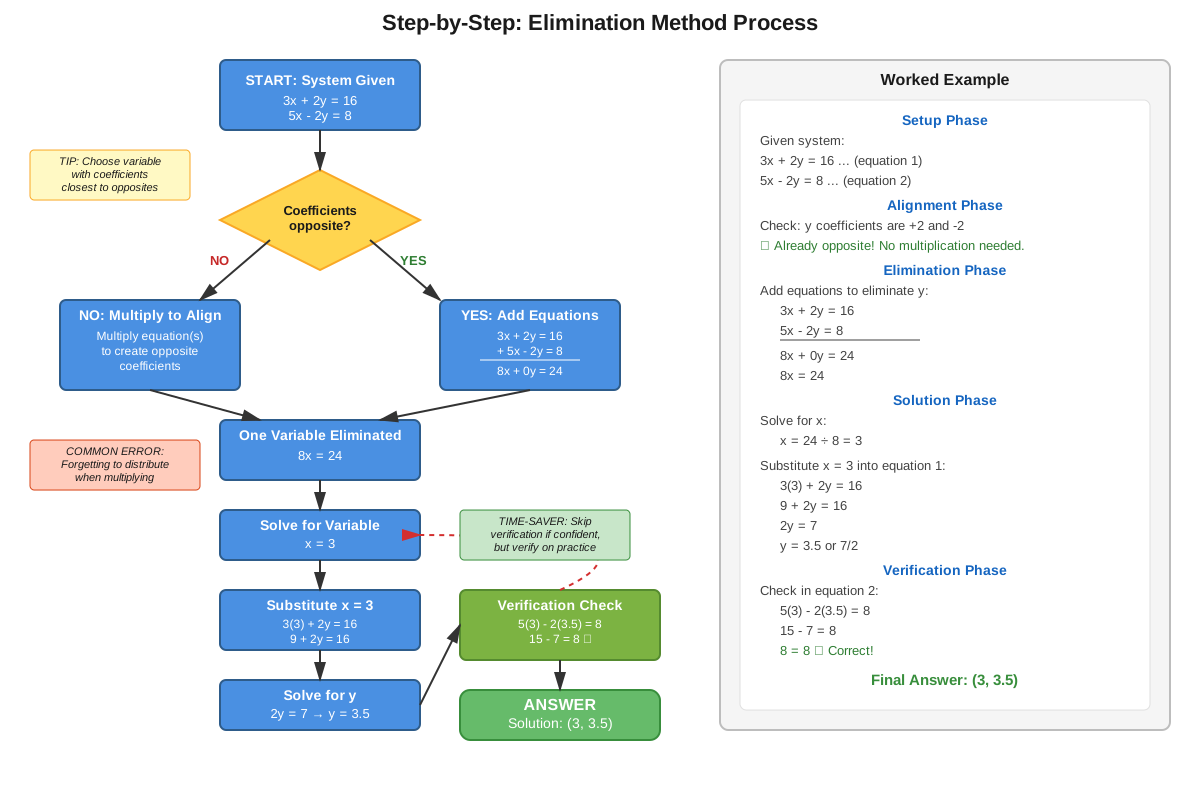
Step-by-step process:
- Arrange both equations in standard form with variables aligned vertically
- Multiply one or both equations by constants to make coefficients of one variable opposites
- Add the equations to eliminate that variable
- Solve the resulting single-variable equation
- Substitute back to find the other variable
The Graphing Method
The graphing method involves plotting both equations on the coordinate plane and identifying their intersection point. While rarely the most efficient method for ACT questions requiring exact answers, graphing provides valuable conceptual understanding and can be useful for:
- Multiple-choice questions where you can estimate the intersection point
- Questions explicitly asking about graphical relationships
- Verifying answers when time permits
The intersection point's coordinates (x, y) represent the solution to the system.
Comparison of Methods
| Method | Best When | Advantages | Disadvantages |
|---|---|---|---|
| Substitution | One variable is isolated or has coefficient ±1 | Straightforward; fewer steps | Can create complex fractions |
| Elimination | Coefficients align well; standard form | Clean arithmetic; avoids fractions | Requires strategic multiplication |
| Graphing | Visual verification needed; estimation acceptable | Conceptual clarity | Time-consuming; imprecise |
Systems with Three Variables
Occasionally, the ACT presents systems with three equations and three variables. The solution approach extends the two-variable methods:
- Use elimination to reduce the system from three equations to two equations with two variables
- Solve the resulting two-variable system
- Substitute back to find the third variable
These questions are less common but typically appear in the higher-difficulty range of the test.
Special Cases Recognition
Parallel lines (no solution): When using elimination, if all variables cancel and you're left with a false statement (e.g., 0 = 5), the system has no solution. When using substitution, you'll reach the same contradiction.
Coincident lines (infinitely many solutions): When all variables cancel and you're left with a true statement (e.g., 0 = 0 or 3 = 3), the equations represent the same line, yielding infinitely many solutions.
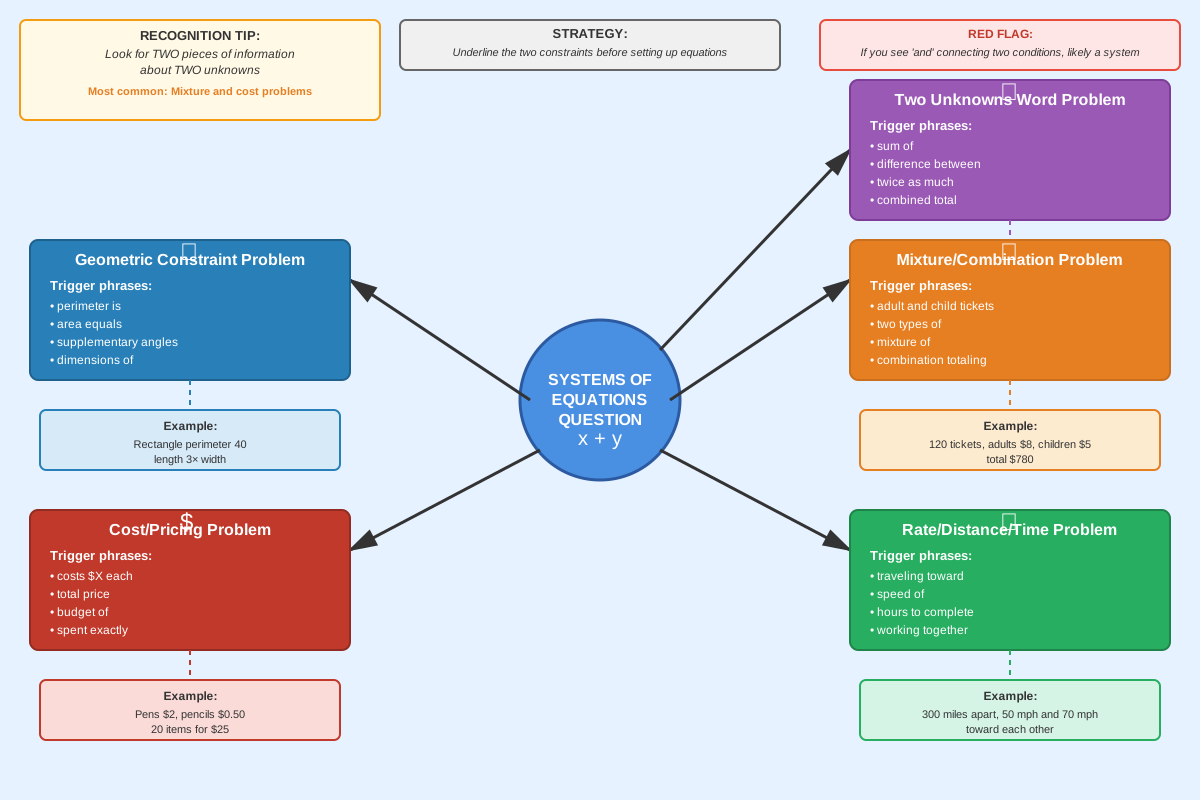
Word Problem Translation
Many ACT systems of equations questions present real-world scenarios requiring translation into mathematical language. Key strategies include:
- Identify the two unknown quantities and assign variables
- Find two different relationships or constraints in the problem
- Translate each relationship into an equation
- Solve the resulting system
Common word problem types include mixture problems, age problems, rate/distance/time problems, and cost/quantity problems.
Concept Relationships
The core concepts within systems of equations are deeply interconnected. The definition and solution types establish the theoretical foundation, explaining what solutions mean geometrically (intersection points) and algebraically (values satisfying all equations). This understanding directly informs the choice of solution method—substitution, elimination, or graphing—each of which represents a different algorithmic approach to finding the same intersection point.
Substitution and elimination are complementary techniques: substitution transforms a two-variable system into a one-variable equation by expressing one variable in terms of another, while elimination achieves the same goal by combining equations to cancel a variable. Both methods ultimately reduce complexity by decreasing the number of variables, demonstrating the principle: multiple equations → strategic manipulation → single-variable equation → solution → back-substitution.
Special cases (no solution or infinitely many solutions) emerge naturally from both methods when the geometric reality (parallel or coincident lines) manifests algebraically as contradictions or identities. Recognizing these cases prevents wasted time attempting to solve unsolvable systems.
Word problem translation sits at the application level, requiring students to first convert verbal information into the mathematical structure of a system, then apply the solution methods. This progression—real-world scenario → mathematical model (system) → solution method → numerical answer → interpretation—represents the complete problem-solving cycle.
The topic connects to prerequisite knowledge of linear equations (each equation in the system is typically linear) and coordinate geometry (solutions represent intersection points). It also enables progression to more advanced topics like linear inequalities systems, matrices, and linear programming.
Quick check — test yourself on Systems of equations so far.
Try Flashcards →High-Yield Facts
⭐ Most ACT systems of equations involve exactly two linear equations with two variables, and the vast majority have one unique solution
⭐ When one equation is already solved for a variable (y = ...), substitution is almost always the fastest method
⭐ When coefficients of one variable are equal or opposite, elimination is typically more efficient than substitution
⭐ The solution to a system is the ordered pair (x, y) that makes both equations true simultaneously
⭐ If variables cancel and you get a false statement (like 0 = 7), the system has no solution; if you get a true statement (like 5 = 5), there are infinitely many solutions
- The ACT frequently asks for x + y, x - y, or 2x + 3y rather than individual variable values, so consider whether you can find these directly without solving for each variable separately
- When using elimination, you can multiply an entire equation by any non-zero constant without changing its solutions
- Substitution typically creates more complex expressions but requires fewer strategic decisions than elimination
- Systems word problems on the ACT almost always involve two unknowns and two distinct pieces of information
- Checking your solution by substituting back into both original equations catches arithmetic errors but requires extra time—use strategically
- If answer choices are far apart numerically, estimation through graphing or testing values can be faster than algebraic solution
Common Misconceptions
Misconception: When using elimination, you must always make the coefficients of x opposites.
Correction: You can choose to eliminate either variable—select whichever requires simpler multiplication. Sometimes eliminating y is much easier than eliminating x.
Misconception: The solution to a system is just a single number.
Correction: For a two-variable system, the solution is an ordered pair (x, y) containing values for both variables. Some ACT questions ask for individual variables, while others ask for expressions like x + y.
Misconception: If you get different x-values when substituting back into the two original equations, you should average them.
Correction: If substitution yields different values, you made an arithmetic error. The correct solution must satisfy both equations exactly—there's no averaging in systems of equations.
Misconception: Graphing is never useful on the ACT because it's too slow and imprecise.
Correction: While full graphing is rarely optimal, quickly sketching the general position of lines can help eliminate impossible answer choices or verify that your algebraic solution is reasonable.
Misconception: When multiplying an equation by a constant for elimination, you only multiply the terms with variables, not the constant term.
Correction: You must multiply every term in the equation, including the constant on the right side, to maintain equality. For example, multiplying 2x + y = 5 by 3 gives 6x + 3y = 15, not 6x + 3y = 5.
Misconception: Systems with three equations and three variables are impossible to solve on the ACT within time constraints.
Correction: While less common, three-variable systems follow the same principles—use elimination twice to reduce to a two-variable system, then solve normally. The ACT designs these to have relatively clean arithmetic.
Misconception: If the problem asks for x + y, you must first find x and y separately, then add them.
Correction: Sometimes you can find x + y directly by adding the two equations strategically, saving time and reducing error opportunities.
Worked Examples
Example 1: Substitution Method with Word Problem
Problem: At a school fundraiser, adult tickets cost $8 and student tickets cost $5. The school sold 150 tickets total and collected $930. How many adult tickets were sold?
Solution:
Step 1: Define variables and identify constraints.
- Let a = number of adult tickets
- Let s = number of student tickets
- Constraint 1 (total tickets): a + s = 150
- Constraint 2 (total revenue): 8a + 5s = 930
Step 2: Choose the substitution method because the first equation makes it easy to isolate a variable.
From equation 1: s = 150 - a
Step 3: Substitute into equation 2.
8a + 5(150 - a) = 930
8a + 750 - 5a = 930
3a + 750 = 930
3a = 180
a = 60
Step 4: Verify (optional but recommended for word problems).
If a = 60, then s = 150 - 60 = 90
Check revenue: 8(60) + 5(90) = 480 + 450 = 930 ✓
Answer: 60 adult tickets were sold.
Connection to learning objectives: This example demonstrates identifying when systems are being tested (multiple constraints in a word problem), explaining the strategy (substitution when one equation easily isolates a variable), and applying the method accurately to an ACT-style question.
Example 2: Elimination Method with Strategic Approach
Problem: Solve the system:
3x + 4y = 18
5x - 2y = 4Solution:
Step 1: Analyze coefficients to choose elimination strategy.
The y-coefficients are 4 and -2. Multiplying the second equation by 2 will make them 4 and -4 (opposites).
Step 2: Multiply the second equation by 2.
3x + 4y = 18  (equation 1, unchanged)
10x - 4y = 8  (equation 2, multiplied by 2)
Step 3: Add the equations to eliminate y.
3x + 4y = 18
10x - 4y = 8
_______________
13x + 0y = 26
Therefore: 13x = 26, so x = 2
Step 4: Substitute x = 2 into either original equation to find y.
Using equation 1: 3(2) + 4y = 18
6 + 4y = 18
4y = 12
y = 3
Step 5: Express the solution as an ordered pair.
Solution: (2, 3)
Verification:
- Equation 1: 3(2) + 4(3) = 6 + 12 = 18 ✓
- Equation 2: 5(2) - 2(3) = 10 - 6 = 4 ✓
Connection to learning objectives: This example shows how to determine the most efficient method based on equation structure, execute the elimination strategy accurately, and verify the solution—all essential skills for ACT success.
Exam Strategy
Recognition triggers: Watch for these phrases that signal systems of equations:
- "Two equations," "system of equations," "simultaneously"
- Word problems with two unknowns and two distinct pieces of information
- Questions about intersection points of two lines
- Problems stating "if [equation 1] and [equation 2], then..."
Approach sequence:
- Identify the system structure (2-3 seconds): Count variables and equations; note the form of each equation
- Choose your method (2-3 seconds): Is one variable already isolated? Are coefficients aligned for easy elimination?
- Execute efficiently (30-45 seconds): Follow your chosen method systematically
- Check reasonableness (5 seconds): Does your answer make sense in context? Is it among the answer choices?
Process of elimination tips:
- If the problem asks for x + y or x - y, eliminate answer choices by testing whether they could result from reasonable x and y values
- For word problems, eliminate answers that violate constraints (negative quantities when only positive makes sense, non-integer answers for counting problems)
- If you recognize a special case (parallel or coincident lines), immediately eliminate answers suggesting a unique solution
Time allocation: Budget 60-90 seconds per systems question. If you exceed 90 seconds, mark your best guess and move on—you can return if time permits. Simple substitution problems should take 45-60 seconds, while complex word problems may require the full 90 seconds.
Calculator usage: The ACT permits calculators, but for most systems questions, mental math and paper-and-pencil algebra are faster than entering complex expressions. Use your calculator for final arithmetic verification rather than as your primary solving tool.
Common trap answers: The ACT often includes answer choices representing:
- The value of the wrong variable (if asking for x, they'll include the y-value)
- The negative of the correct answer
- The result of a common arithmetic error
- Values that satisfy only one equation, not both
Memory Techniques
SEGA Method Selection:
- Substitution when Solved (one variable already isolated)
- Elimination when Equal or opposite coefficients
- Graphing for Geometric/visual questions
- Any method works, but choose the fastest
DICE for Elimination:
- Decide which variable to eliminate
- Identify what to multiply each equation by
- Combine (add or subtract) the equations
- Evaluate and substitute back
Substitution Steps Mnemonic - "SASSY":
- Select the easier equation
- Arrange to isolate one variable
- Substitute into the other equation
- Solve for the remaining variable
- Yield the second variable by substituting back
Special Cases Memory:
- "Zero equals ZERO = infinite solutions" (true statement)
- "Zero equals NUMBER = no solution" (false statement)
Visualization: Picture two lines on a graph. Most ACT problems show lines crossing once (one solution). Parallel lines never meet (no solution). Identical lines overlap everywhere (infinite solutions). This mental image helps verify whether your algebraic answer makes geometric sense.
Summary
Systems of equations represent a high-yield ACT Math topic requiring students to find values that simultaneously satisfy multiple equations. The three primary solution methods—substitution, elimination, and graphing—each offer advantages depending on equation structure. Substitution works best when a variable is already isolated or easily isolated, while elimination excels when coefficients align favorably. Most ACT systems involve two linear equations with two variables and have exactly one solution, though recognizing special cases (no solution or infinitely many solutions) prevents wasted time. Success requires quickly identifying that a system is being tested, selecting the most efficient solution method, executing calculations accurately, and interpreting results correctly. Word problems demand additional translation skills, converting verbal constraints into mathematical equations before solving. Mastering systems of equations not only secures 2-4 questions per ACT but also builds algebraic reasoning skills essential for higher-level mathematics.
Key Takeaways
- Systems of equations appear 2-4 times per ACT Math section, making them a high-priority topic for score improvement
- Choose substitution when one variable is already isolated; choose elimination when coefficients of one variable are equal or opposite
- The solution to a two-variable system is an ordered pair (x, y) that satisfies both equations simultaneously
- Special cases: if variables cancel leaving a false statement, there's no solution; if they leave a true statement, there are infinitely many solutions
- Word problems require translating two distinct pieces of information into two equations before solving
- Always verify that your answer makes sense in context and matches what the question asks for (individual variable vs. expression)
- Budget 60-90 seconds per systems question and move on if you're stuck—these questions reward efficiency over perfection
Related Topics
Linear Inequalities Systems: After mastering equations, systems of inequalities extend the concept to regions rather than points, requiring graphing skills and understanding of shaded regions. This topic appears occasionally on the ACT and builds directly on systems of equations knowledge.
Matrices and Matrix Operations: Matrices provide an alternative method for solving systems, particularly those with three or more variables. While not heavily tested on the ACT, understanding the connection between systems and matrices deepens algebraic insight.
Quadratic-Linear Systems: Some ACT questions present a system containing one linear and one quadratic equation, requiring substitution and quadratic formula application. Mastering linear systems provides the foundation for these more complex problems.
Functions and Relations: Understanding systems helps clarify when two functions have the same output (intersection points), connecting algebraic and functional thinking—a relationship tested in higher-difficulty ACT questions.
Practice CTA
Now that you've mastered the core concepts, strategies, and common pitfalls of systems of equations, it's time to cement your understanding through active practice. Attempt the practice questions designed specifically for this topic, focusing on applying the method selection strategies you've learned. Use the flashcards to reinforce high-yield facts and special cases until they become automatic. Remember: the difference between knowing how to solve systems and quickly solving them under test conditions comes from deliberate practice. Each problem you work through builds the pattern recognition and computational fluency that will save you valuable seconds on test day. You've got this!
Sign up free to keep reading
Create a free AnvayaPrep account to finish this ACT guide on Systems of equations — plus flashcards and practice questions.