Overview
Linear inequalities are mathematical statements that compare two expressions using inequality symbols (<, >, ≤, ≥) rather than an equals sign. On the ACT Math test, linear inequalities represent a critical bridge between basic algebraic manipulation and more complex problem-solving scenarios. These problems require students to understand not just how to solve for a variable, but how to interpret solution sets, graph regions on number lines or coordinate planes, and recognize when inequality relationships exist in word problems.
The ACT consistently tests linear inequalities across multiple question formats, making this topic essential for achieving competitive scores. Students encounter these problems both as straightforward algebraic exercises and embedded within real-world contexts involving constraints, budgets, measurements, and optimization scenarios. Understanding ACT linear inequalities requires mastery of solution techniques, proper handling of inequality symbols during algebraic operations, and the ability to translate between algebraic, graphical, and verbal representations.
Linear inequalities connect foundational algebra skills with coordinate geometry, systems of equations, and even function analysis. The principles learned here extend to absolute value inequalities, quadratic inequalities, and linear programming—topics that appear in more advanced mathematics. For the ACT specifically, linear inequality questions often test multiple skills simultaneously, combining algebraic manipulation with number sense, graphing abilities, and logical reasoning about solution sets.
Learning Objectives
- [ ] Identify when Linear inequalities is being tested in ACT questions
- [ ] Explain the core rule or strategy behind Linear inequalities, particularly the multiplication/division by negative numbers rule
- [ ] Apply Linear inequalities to ACT-style questions accurately and efficiently
- [ ] Graph solution sets of linear inequalities on both number lines and coordinate planes
- [ ] Translate word problems into appropriate linear inequality expressions
- [ ] Solve compound inequalities and interpret their solution sets
- [ ] Recognize and avoid common errors when manipulating inequality symbols
Prerequisites
- Basic algebraic manipulation: Ability to combine like terms, distribute, and isolate variables—essential for solving inequalities using the same techniques as equations
- Understanding of inequality symbols: Knowledge of what <, >, ≤, and ≥ mean—necessary to interpret problems and write solutions correctly
- Number line concepts: Familiarity with plotting points and intervals on a number line—required for graphing solution sets
- Coordinate plane basics: Understanding of x and y axes, plotting points, and graphing lines—needed for two-variable inequality problems
- Properties of real numbers: Knowledge of positive, negative, and zero values—critical for understanding when inequality direction changes
Why This Topic Matters
Linear inequalities model countless real-world situations where exact equality doesn't apply but constraints do exist. Budget planning (spending must be less than or equal to income), manufacturing specifications (dimensions must fall within tolerance ranges), speed limits (velocity must not exceed a threshold), and resource allocation all rely on inequality relationships. Understanding these mathematical models empowers students to analyze practical scenarios quantitatively and make informed decisions based on constraints.
On the ACT Math test, linear inequality questions appear with high frequency—typically 2-4 questions per exam, representing approximately 3-7% of the 60-question test. These problems appear in various formats: pure algebraic manipulation questions, word problems requiring translation from verbal descriptions, graphing questions on number lines or coordinate planes, and questions involving systems of inequalities. The ACT particularly favors questions that combine multiple skills, such as solving an inequality derived from a word problem and then identifying the correct graphical representation.
Common ACT question types include: solving single-variable inequalities with multiple steps, identifying which values satisfy a given inequality, graphing linear inequalities in two variables (including shading the correct region), solving compound inequalities (using "and" or "or"), and translating real-world constraints into mathematical inequalities. The test also frequently presents answer choices that include common errors, such as solutions that would be correct if the inequality symbol had been reversed incorrectly.
Core Concepts
Understanding Inequality Symbols and Their Meanings
The four primary inequality symbols each convey specific mathematical relationships:
- < (less than): The left expression has a smaller value than the right expression
- > (greater than): The left expression has a larger value than the right expression
- ≤ (less than or equal to): The left expression is smaller than or equal to the right expression
- ≥ (greater than or equal to): The left expression is larger than or equal to the right expression
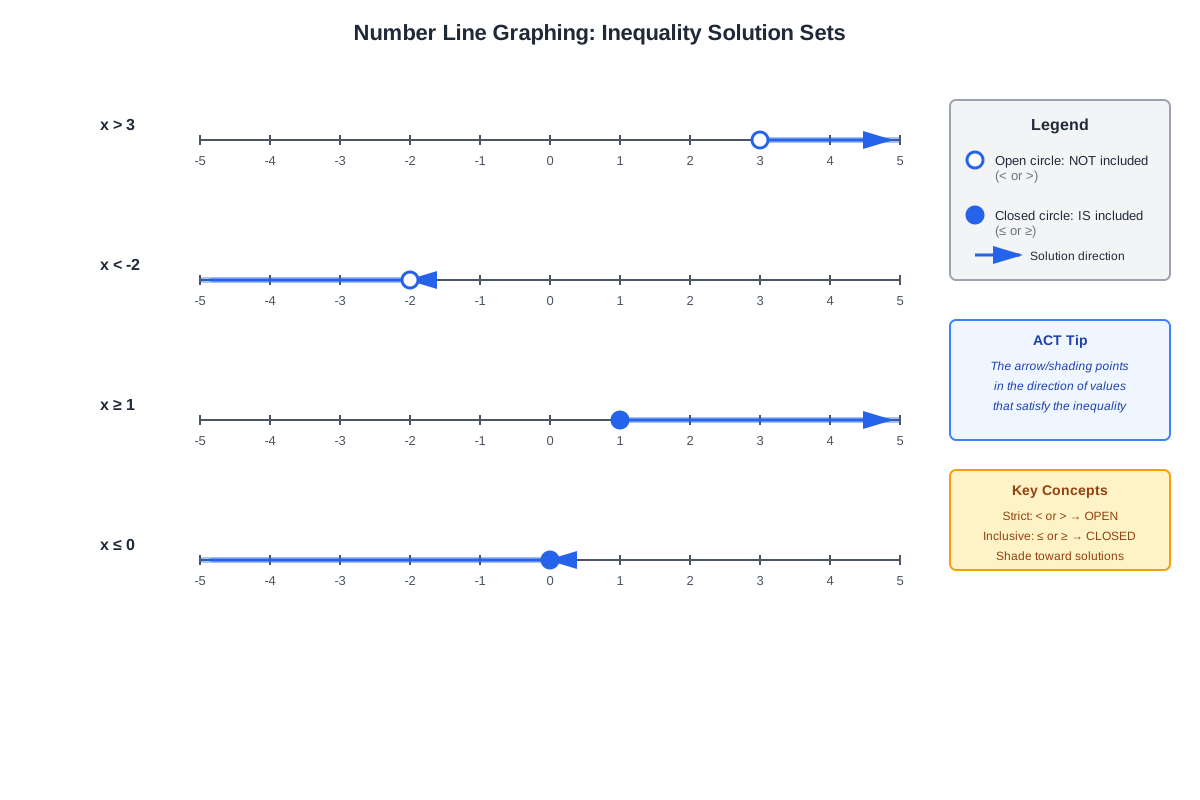
The distinction between strict inequalities (<, >) and non-strict inequalities (≤, ≥) becomes crucial when graphing solutions. Strict inequalities use open circles or dashed lines to indicate the boundary value is not included, while non-strict inequalities use closed circles or solid lines to show the boundary is included in the solution set.
Solving Single-Variable Linear Inequalities
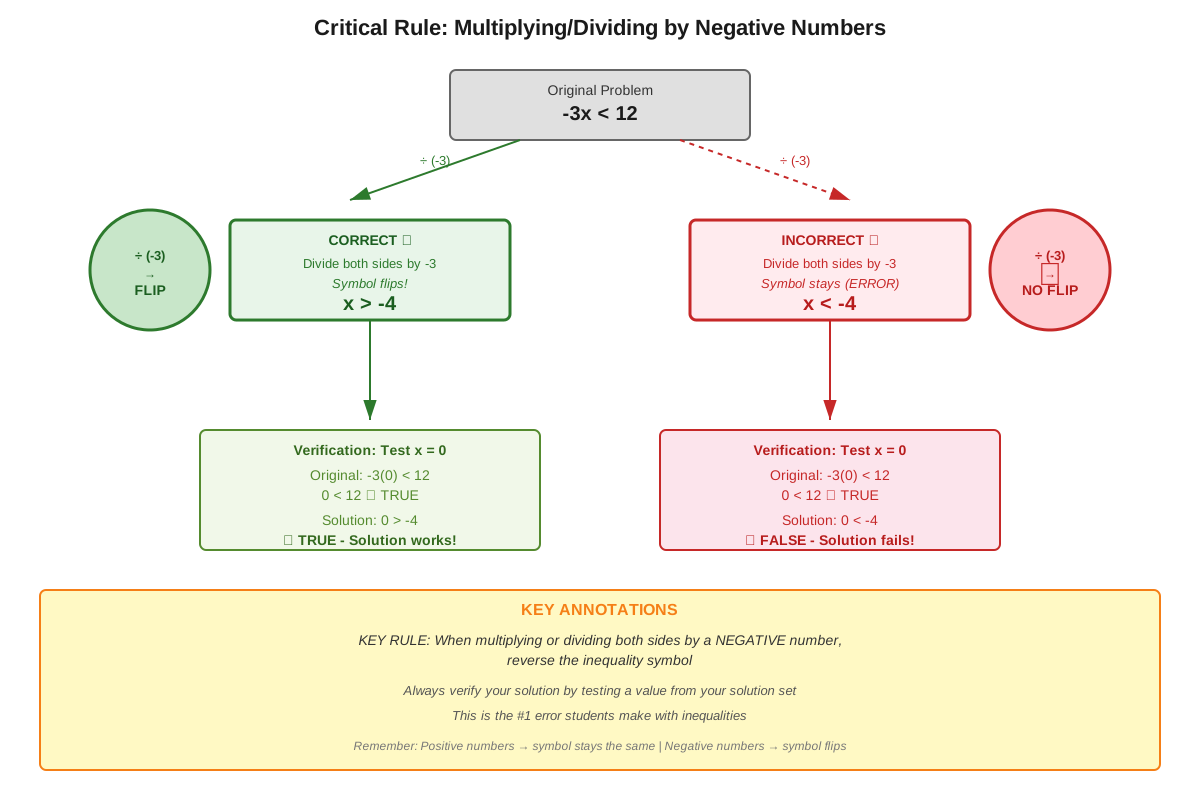
Solving linear inequalities follows nearly identical procedures to solving linear equations, with one critical exception: multiplying or dividing both sides by a negative number reverses the inequality symbol. This rule represents the most frequently tested concept on ACT linear inequality questions.
The standard solving process follows these steps:
- Simplify both sides of the inequality (combine like terms, distribute)
- Use addition or subtraction to collect variable terms on one side and constants on the other
- Use multiplication or division to isolate the variable
- If multiplying or dividing by a negative number, reverse the inequality symbol
- Express the solution in appropriate form (inequality notation, interval notation, or graphically)
Example: Solve 3 - 2x ≥ 11
3 - 2x ≥ 11
-2x ≥ 8          (subtract 3 from both sides)
x ≤ -4           (divide both sides by -2, REVERSE the symbol)
The Critical Rule: Multiplying/Dividing by Negative Numbers
When both sides of an inequality are multiplied or divided by a negative number, the inequality symbol must be reversed to maintain a true statement. This occurs because multiplication by a negative number reflects values across zero on the number line, reversing their relative positions.
Conceptual understanding: If 3 < 5, then multiplying both sides by -1 gives -3 and -5. Since -3 is actually greater than -5 (it's closer to zero, further right on the number line), the relationship becomes -3 > -5. The inequality direction reversed.
This rule applies only to multiplication or division by negative numbers. Adding or subtracting negative numbers does not require reversing the symbol.
Graphing Solutions on a Number Line
Solution sets for single-variable inequalities are represented on number lines using specific conventions:
| Inequality Type | Boundary Point | Shading Direction |
|---|---|---|
| x < a | Open circle at a | Shade left (toward smaller values) |
| x > a | Open circle at a | Shade right (toward larger values) |
| x ≤ a | Closed circle at a | Shade left |
| x ≥ a | Closed circle at a | Shade right |
The shaded region represents all values that satisfy the inequality. For example, x ≥ -2 would show a closed circle at -2 with shading extending rightward to indicate all numbers greater than or equal to -2 are solutions.
Compound Inequalities
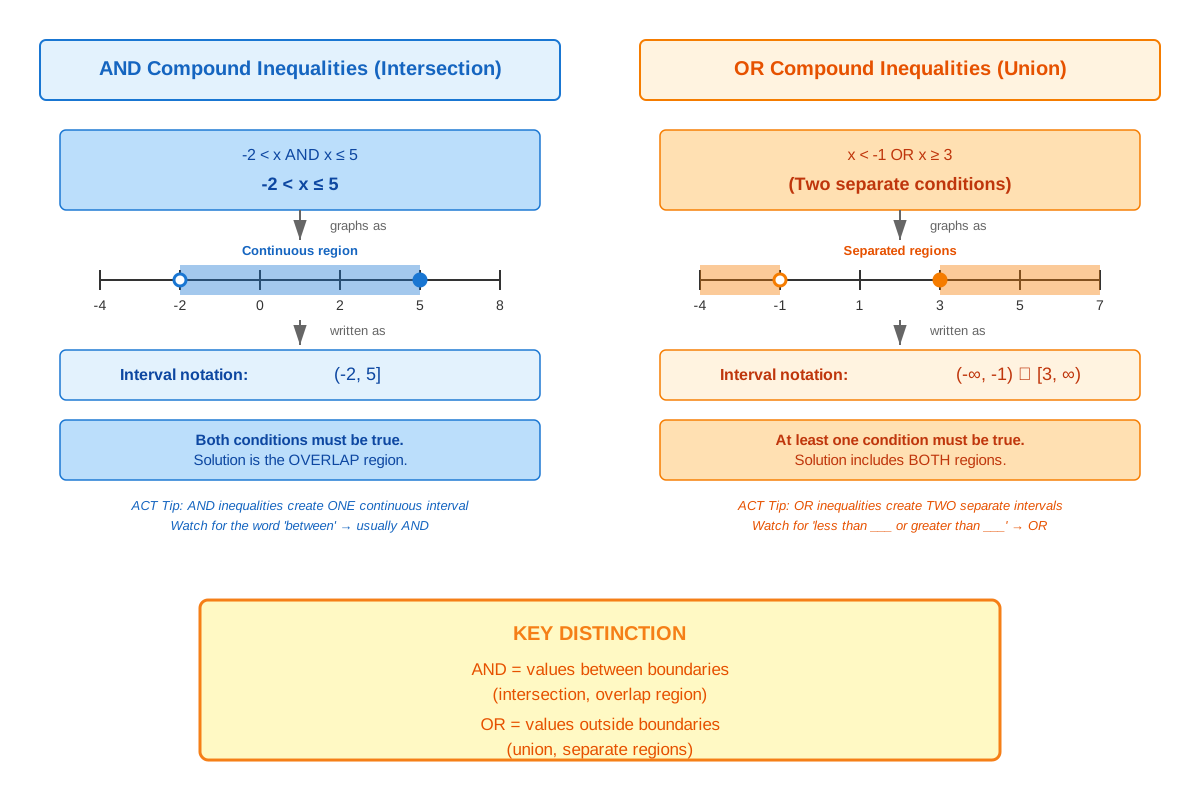
Compound inequalities involve two inequality statements connected by "and" or "or":
"And" compound inequalities (conjunction): Both conditions must be satisfied simultaneously. Written as a < x < b or as two separate inequalities connected by "and." The solution is the intersection of both individual solution sets.
Example: -3 < x ≤ 5 means x is greater than -3 AND less than or equal to 5. On a number line, this appears as a region between -3 (open circle) and 5 (closed circle).
"Or" compound inequalities (disjunction): At least one condition must be satisfied. Written as two separate inequalities connected by "or." The solution is the union of both individual solution sets.
Example: x < -2 or x ≥ 4 means x satisfies either condition. On a number line, this shows two separate shaded regions.
Two-Variable Linear Inequalities and Graphing
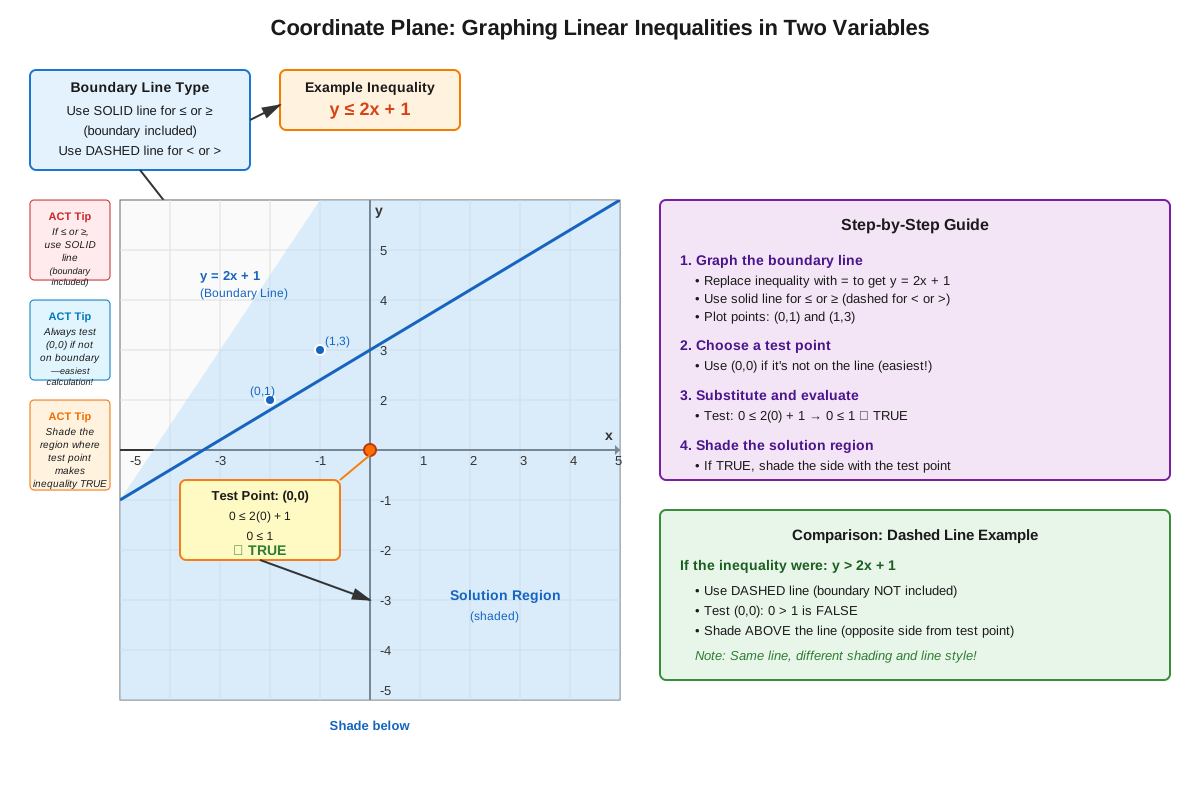
Linear inequalities in two variables (typically x and y) have solution sets that are regions of the coordinate plane rather than single points or line segments. The inequality y > 2x - 3 represents all points above the line y = 2x - 3.
Graphing procedure:
- Graph the boundary line by treating the inequality as an equation (y = 2x - 3)
- Determine line style: dashed for strict inequalities (<, >), solid for non-strict (≤, ≥)
- Choose a test point not on the line (often the origin (0,0) if the line doesn't pass through it)
- Substitute the test point into the original inequality
- If the inequality is true, shade the region containing the test point; if false, shade the opposite region
The inequality symbol determines which side of the boundary line to shade:
- y > mx + b or y ≥ mx + b: Shade above the line
- y < mx + b or y ≤ mx + b: Shade below the line
Translating Word Problems into Inequalities
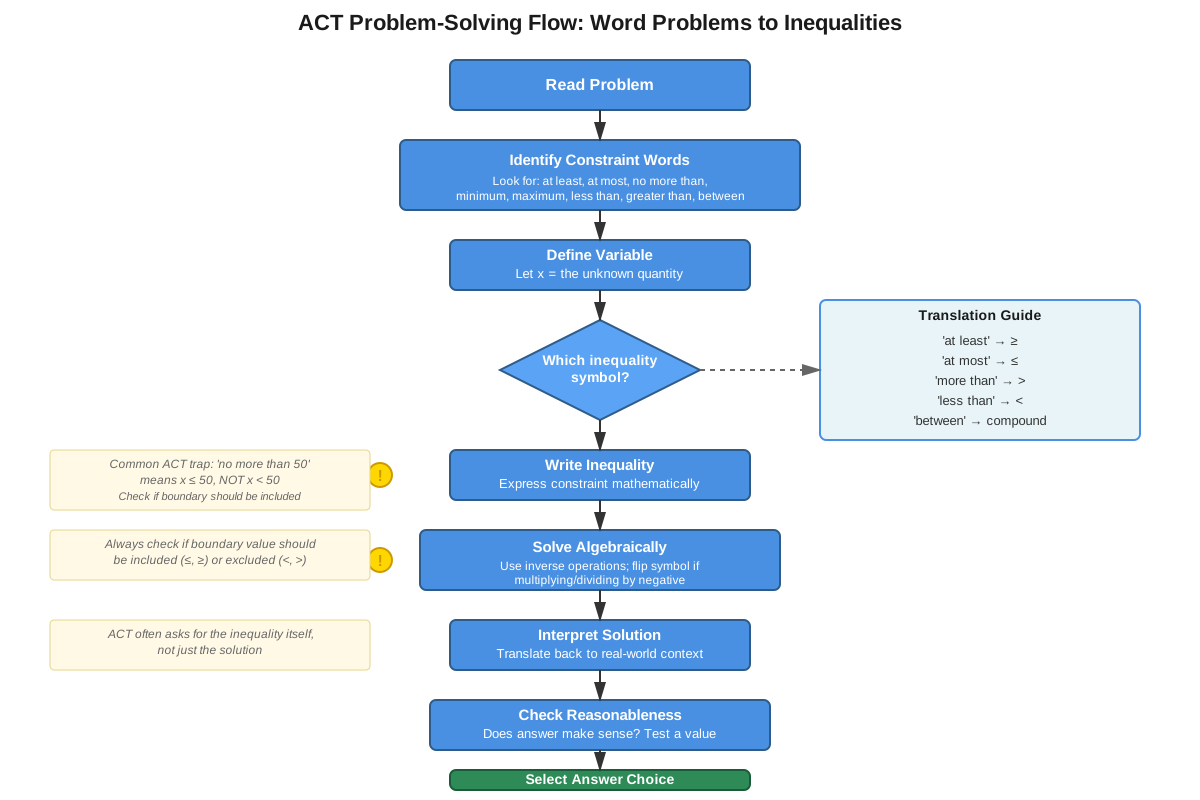
ACT questions frequently present inequality relationships within real-world contexts. Key trigger phrases indicate inequality relationships:
- "at least" → ≥
- "no more than" → ≤
- "exceeds" → >
- "less than" → <
- "maximum" → ≤
- "minimum" → ≥
- "up to" → ≤
- "more than" → >
Successful translation requires identifying the variable, understanding what quantity it represents, and recognizing the constraint being described. For example: "Sarah needs at least $500 for her trip" translates to m ≥ 500, where m represents the money Sarah needs.
Concept Relationships
The concepts within linear inequalities build upon each other in a logical progression. Understanding inequality symbols forms the foundation → which enables solving single-variable inequalities → which requires mastery of the negative multiplication/division rule → leading to graphing solutions on number lines → extending to compound inequalities (which combine multiple single-variable inequalities) → and finally generalizing to two-variable inequalities graphed on coordinate planes.
Linear inequalities connect directly to prerequisite knowledge of basic algebraic manipulation (the same techniques solve both equations and inequalities) and number line concepts (which provide the visual representation of solution sets). The topic also relates forward to systems of inequalities (multiple two-variable inequalities graphed simultaneously), absolute value inequalities (which split into compound inequalities), and quadratic inequalities (which require similar graphing and solution set analysis).
The relationship between algebraic and graphical representations is bidirectional: students must be able to solve an inequality algebraically and then graph it, or interpret a graph and write the corresponding inequality. This dual representation appears frequently on the ACT, testing whether students truly understand the concept or merely follow procedures mechanically.
High-Yield Facts
⭐ When multiplying or dividing both sides of an inequality by a negative number, the inequality symbol must be reversed.
⭐ For graphing on a number line: use open circles for < and >, closed circles for ≤ and ≥.
⭐ "And" compound inequalities require both conditions to be true; "or" compound inequalities require at least one condition to be true.
⭐ When graphing y > mx + b or y ≥ mx + b on a coordinate plane, shade above the line; for y < mx + b or y ≤ mx + b, shade below.
⭐ The phrase "at least" translates to ≥, while "no more than" translates to ≤.
- Adding or subtracting any number (positive or negative) to both sides of an inequality does not change the direction of the inequality symbol.
- A compound inequality like -3 < x < 5 is equivalent to the "and" statement: x > -3 AND x < 5.
- When graphing two-variable inequalities, use a dashed line for strict inequalities (<, >) and a solid line for non-strict inequalities (≤, ≥).
- The solution set to a linear inequality in one variable is typically an infinite set of numbers (a ray on the number line).
- To test which region to shade when graphing a two-variable inequality, substitute a test point (often the origin) into the original inequality.
- Multiplying or dividing by a positive number preserves the inequality direction, just as with equations.
- The intersection of two solution sets (for "and" compound inequalities) is always smaller than or equal to either individual set; the union (for "or" compound inequalities) is always larger than or equal to either individual set.
Quick check — test yourself on Linear inequalities so far.
Try Flashcards →Common Misconceptions
Misconception: When solving -x > 5, students divide by -1 but forget to reverse the inequality, getting x > -5.
Correction: Dividing both sides by -1 requires reversing the symbol: -x > 5 becomes x < -5. Always reverse the inequality when multiplying or dividing by a negative number.
Misconception: Students believe that adding a negative number to both sides requires reversing the inequality symbol.
Correction: Only multiplication or division by negative numbers requires reversing the symbol. Adding or subtracting any number (positive or negative) does not change the inequality direction. For example, x + 3 < 7 becomes x < 4 by subtracting 3 from both sides—no reversal needed.
Misconception: When graphing x ≤ 3, students use an open circle at 3 instead of a closed circle.
Correction: The symbol ≤ means "less than or equal to," so 3 is included in the solution set and requires a closed circle. Open circles are used only for strict inequalities (< or >).
Misconception: Students interpret "at least 10" as x < 10 instead of x ≥ 10.
Correction: "At least" means the minimum acceptable value, so the quantity must be greater than or equal to that value. "At least 10" means 10 or more, which translates to x ≥ 10.
Misconception: When graphing y < 2x + 1, students shade above the line instead of below.
Correction: For inequalities in the form y < (expression), shade below the boundary line because y-values in that region are less than the corresponding values on the line. A helpful check is to test the origin or another point to verify which region satisfies the inequality.
Misconception: Students believe that x > 3 and x < 7 written together means there's no solution because "x can't be both greater than 3 and less than 7."
Correction: This is an "and" compound inequality with solution set 3 < x < 7, representing all numbers between 3 and 7. The solution is the intersection—values that satisfy both conditions simultaneously. For example, x = 5 is greater than 3 AND less than 7.
Worked Examples
Example 1: Multi-Step Inequality with Negative Coefficient
Problem: Solve the inequality 5 - 3x ≤ 17 and graph the solution on a number line.
Solution:
Step 1: Isolate the term containing x by subtracting 5 from both sides.
5 - 3x ≤ 17
-3x ≤ 12
Step 2: Divide both sides by -3 to solve for x. Critical step: Since we're dividing by a negative number, we must reverse the inequality symbol from ≤ to ≥.
x ≥ -4Step 3: Graph the solution on a number line. Since the inequality is ≥ (non-strict), use a closed circle at -4. Since x is greater than or equal to -4, shade to the right (toward larger values).
Graph description: A number line with a closed circle at -4 and shading extending rightward through all values greater than -4.
Connection to learning objectives: This problem demonstrates the core rule of reversing inequality symbols when dividing by negative numbers and shows how to translate algebraic solutions into graphical representations.
Example 2: Word Problem with Compound Inequality
Problem: A rental car company charges a flat fee of $25 plus $0.15 per mile driven. Maria has a budget of at least $40 but no more than $70 for the rental. Write and solve a compound inequality to find the possible number of miles Maria can drive.
Solution:
Step 1: Define the variable. Let m = number of miles driven.
Step 2: Write the cost expression. Total cost = 25 + 0.15m
Step 3: Translate the budget constraint. "At least $40" means ≥ 40, and "no more than $70" means ≤ 70. This creates a compound inequality:
40 ≤ 25 + 0.15m ≤ 70Step 4: Solve the compound inequality by performing the same operations on all three parts.
Subtract 25 from all parts:
40 - 25 ≤ 0.15m ≤ 70 - 25
15 ≤ 0.15m ≤ 45
Divide all parts by 0.15 (positive number, so no reversal):
15/0.15 ≤ m ≤ 45/0.15
100 ≤ m ≤ 300Answer: Maria can drive between 100 and 300 miles, inclusive.
Connection to learning objectives: This problem requires translating a word problem into an inequality (identifying "at least" and "no more than" as inequality triggers), solving a compound inequality, and interpreting the solution in context.
Example 3: Two-Variable Inequality Graphing
Problem: Graph the inequality 2x + y > 4 on a coordinate plane.
Solution:
Step 1: Graph the boundary line by treating the inequality as an equation: 2x + y = 4, or y = -2x + 4.
This line has a y-intercept of 4 and a slope of -2. Plot the y-intercept (0, 4) and use the slope to find another point: from (0, 4), move down 2 and right 1 to reach (1, 2).
Step 2: Determine the line style. Since the inequality is strict (>), use a dashed line to indicate points on the line are not included in the solution set.
Step 3: Choose a test point. The origin (0, 0) is convenient and doesn't lie on the line.
Step 4: Test the point in the original inequality:
2(0) + 0 > 4
0 > 4  (FALSE)
Step 5: Since the test point makes the inequality false, shade the region that does NOT contain the origin—the region above and to the right of the line.
Alternative method: Rewrite the inequality in slope-intercept form:
2x + y > 4
y > -2x + 4
Since y is greater than the expression, shade above the line.
Connection to learning objectives: This demonstrates graphing two-variable linear inequalities, using test points to determine shading, and recognizing that strict inequalities require dashed boundary lines.
Exam Strategy
When approaching ACT linear inequalities questions, begin by identifying the question type: pure algebraic manipulation, word problem translation, or graphing. Each type requires a slightly different approach, but all demand careful attention to inequality symbols.
Trigger words and phrases to watch for:
- "At least," "minimum," "no less than" → ≥
- "At most," "maximum," "no more than" → ≤
- "More than," "exceeds," "greater than" → >
- "Less than," "fewer than," "below" → <
- "Between" → compound inequality with "and"
- "Either...or" → compound inequality with "or"
Process-of-elimination strategies:
- Check the inequality direction: If you solved an inequality and got x > 3, immediately eliminate any answer choices showing x < 3 or x ≤ 3.
- Test boundary values: For multiple-choice questions, substitute the boundary value into the original inequality. If the original inequality is strict (< or >), the boundary value should NOT satisfy it; if non-strict (≤ or ≥), it should satisfy it.
- Verify negative multiplication/division: If your solution process involved dividing by a negative number, double-check that you reversed the symbol. Many incorrect answer choices represent the solution without the reversal.
- Match graph to algebra: When answer choices show graphs, eliminate any with incorrect circle types (open vs. closed) or shading direction before checking the boundary value.
- Test a value in the solution region: Pick a simple number that should be in your solution set and verify it satisfies the original inequality. This catches algebraic errors.
Time allocation advice: Most linear inequality questions should take 30-60 seconds. If you're spending more than 90 seconds, you may be overcomplicating the problem. Simple one-step or two-step inequalities should be solved in under 30 seconds. Word problems requiring translation may take up to 90 seconds. If stuck, mark the question and return to it—don't let one inequality question consume 2-3 minutes.
ACT Tip: The test makers frequently include answer choices that represent common errors, particularly the solution without reversing the inequality symbol. Always double-check your work when dividing or multiplying by negative numbers.
Memory Techniques
Mnemonic for inequality reversal: "Negative Flips" (Negative multiplication/division Flips the inequality symbol)
Mnemonic for "at least" vs. "at most":
- "At Least" = Larger or equal (≥)
- "At Most" = Minimum or equal (≤) — wait, this doesn't work perfectly, so instead:
- "At Most" = Maximum, can't go higher (≤)
Visual memory for graphing: Picture the inequality symbol as an arrow pointing toward the shading direction:
- x > 3: The symbol > points right, shade right
- x < 3: The symbol < points left, shade left
Acronym for graphing two-variable inequalities: BTTS
- Boundary line (graph it)
- Type of line (dashed or solid)
- Test point (substitute to check)
- Shade (the correct region)
Memory aid for compound inequalities:
- "AND means All conditions, Narrower Domain" (intersection, smaller solution set)
- "OR means One condition, Range expands" (union, larger solution set)
Visualization for why negatives flip: Imagine a number line with 3 and 5 marked. 3 < 5 (3 is left of 5). Now imagine flipping the number line upside down and rotating it 180°—the positions reverse, so -3 is now right of -5, making -3 > -5.
Summary
Linear inequalities represent mathematical relationships where one expression is greater than, less than, greater than or equal to, or less than or equal to another expression. Solving these inequalities follows the same algebraic procedures as solving equations, with one critical exception: multiplying or dividing both sides by a negative number requires reversing the inequality symbol. This reversal rule is the most frequently tested concept on ACT linear inequality questions and the source of most student errors. Solution sets are represented graphically using number lines (for single-variable inequalities) or coordinate planes (for two-variable inequalities), with specific conventions for open versus closed circles and shading directions. Compound inequalities combine two conditions with "and" (requiring both to be true, producing an intersection) or "or" (requiring at least one to be true, producing a union). Word problems require translating verbal phrases like "at least," "no more than," and "exceeds" into appropriate inequality symbols. Mastery of linear inequalities requires fluency in algebraic manipulation, careful attention to inequality symbols throughout the solution process, and the ability to move between algebraic, graphical, and verbal representations of the same mathematical relationship.
Key Takeaways
- The inequality symbol reverses when multiplying or dividing both sides by a negative number—this is the most critical rule and most commonly tested concept
- Strict inequalities (<, >) use open circles and dashed lines; non-strict inequalities (≤, ≥) use closed circles and solid lines
- "And" compound inequalities create intersections (narrower solution sets); "or" compound inequalities create unions (broader solution sets)
- Common translation phrases: "at least" → ≥, "no more than" → ≤, "exceeds" → >, "less than" → <
- When graphing two-variable inequalities, shade above the line for y > or y ≥, below the line for y < or y ≤
- Adding or subtracting any number (positive or negative) never requires reversing the inequality symbol
- Always verify solutions by testing a value from your solution set in the original inequality
Related Topics
Systems of Linear Inequalities: Building on single linear inequalities, systems involve graphing multiple inequalities on the same coordinate plane and identifying the overlapping solution region. Mastering single linear inequalities is essential before tackling systems.
Absolute Value Inequalities: These inequalities involve absolute value expressions and split into compound inequalities. Understanding how to solve and graph compound inequalities provides the foundation for absolute value inequality problems.
Quadratic Inequalities: These extend inequality concepts to quadratic expressions, requiring analysis of parabolas and solution intervals. The graphing and solution set interpretation skills from linear inequalities transfer directly.
Linear Programming: This optimization technique uses systems of linear inequalities to model constraints and find maximum or minimum values. It represents a practical application of linear inequality concepts in business and economics contexts.
Piecewise Functions: These functions are defined differently on different intervals, often using inequalities to specify the domains. Understanding inequality notation is necessary for interpreting and working with piecewise functions.
Practice CTA
Now that you've mastered the core concepts of linear inequalities, it's time to solidify your understanding through practice! Work through the practice questions to apply these strategies to ACT-style problems, and use the flashcards to reinforce key facts and rules. Remember, the difference between knowing the material and scoring well comes down to practice—especially with that critical inequality reversal rule. Each practice problem you solve builds the pattern recognition and confidence you need to tackle these questions quickly and accurately on test day. You've got this!
Sign up free to keep reading
Create a free AnvayaPrep account to finish this ACT guide on Linear inequalities — plus flashcards and practice questions.