Overview
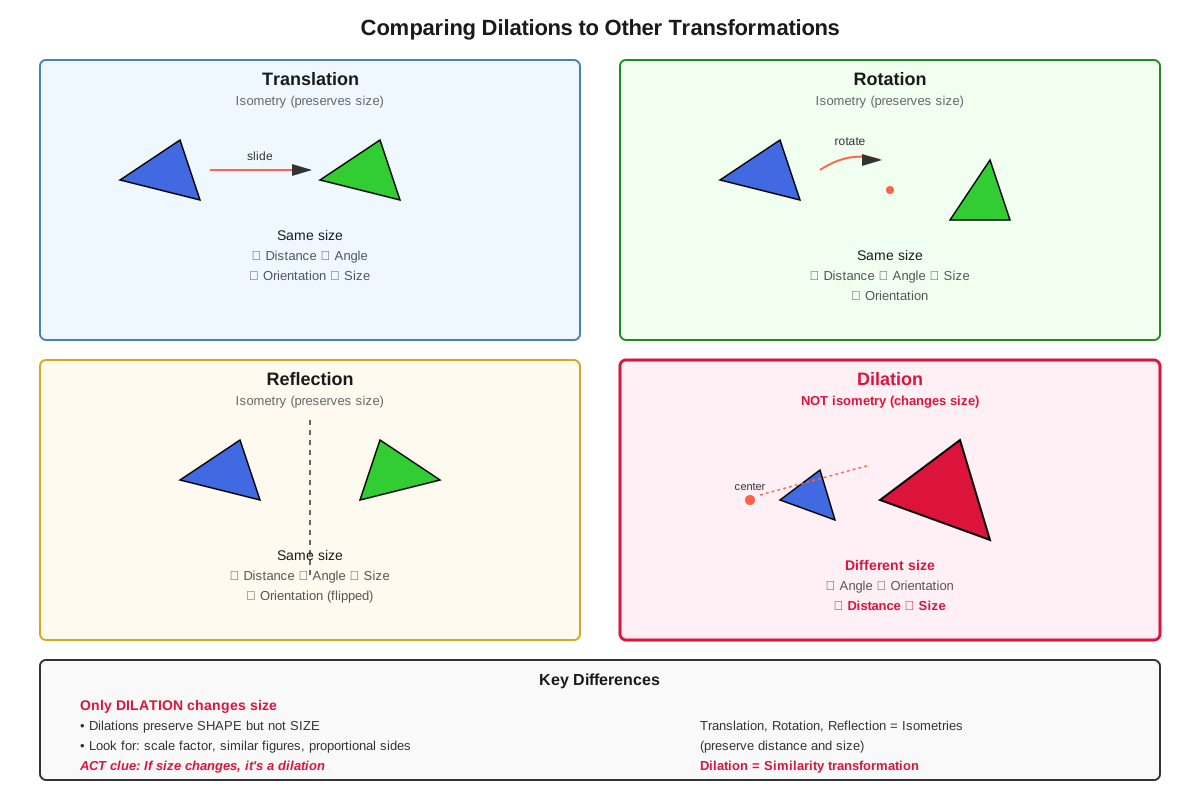
Dilations represent one of the fundamental transformations in coordinate geometry, alongside translations, rotations, and reflections. A dilation is a transformation that produces an image that is the same shape as the original figure but is a different size. Unlike other transformations that preserve both shape and size (isometries), dilations preserve shape while changing size proportionally. On the ACT Math test, understanding dilations is crucial because these questions frequently appear in coordinate geometry problems and require students to manipulate coordinates, understand scale factors, and recognize proportional relationships.
The ACT regularly tests dilations in multiple contexts: pure coordinate geometry problems where students must find the coordinates of dilated points, similarity problems involving geometric figures, and real-world applications involving scale models or maps. Questions may ask students to identify the scale factor of a dilation, determine the center of dilation, find the coordinates of a dilated figure, or recognize when two figures are related by a dilation. These problems often integrate multiple mathematical concepts, making them medium-to-high difficulty questions that can significantly impact overall scores.
Mastering ACT dilations connects directly to broader mathematical concepts including similarity, proportional reasoning, and coordinate transformations. Dilations form the foundation for understanding similar figures, which appear throughout geometry and trigonometry. Additionally, the coordinate manipulation skills developed through dilation problems strengthen algebraic thinking and prepare students for more complex transformation compositions. The ability to quickly identify and execute dilations under timed conditions represents a high-yield skill that can earn valuable points on test day.
Learning Objectives
- [ ] Identify when Dilations is being tested in ACT Math questions
- [ ] Explain the core rule or strategy behind Dilations and their properties
- [ ] Apply Dilations to ACT-style questions accurately and efficiently
- [ ] Calculate the coordinates of dilated points given a center and scale factor
- [ ] Determine the scale factor of a dilation given pre-image and image coordinates
- [ ] Distinguish between dilations and other geometric transformations
- [ ] Solve multi-step problems involving dilations combined with other transformations
Prerequisites
- Coordinate plane fundamentals: Understanding ordered pairs, plotting points, and the Cartesian coordinate system is essential because all dilation problems on the ACT involve coordinate manipulation
- Basic algebraic operations: Multiplying coordinates by scale factors and solving simple equations forms the computational foundation for dilation problems
- Distance formula and midpoint formula: These formulas help verify dilation properties and calculate distances between corresponding points
- Proportional reasoning: Dilations fundamentally involve proportional relationships between corresponding lengths, making ratio and proportion skills critical
- Similar figures: Understanding that similar figures have proportional sides and congruent angles provides the geometric context for why dilations matter
Why This Topic Matters
Dilations appear in real-world contexts ranging from architecture and engineering (scale drawings and blueprints) to photography and digital imaging (zoom functions and image resizing) to cartography (map scales). Medical imaging technologies like CT scans and MRIs use dilation principles when displaying images at different magnifications. Computer graphics and animation rely heavily on dilation transformations to resize objects while maintaining their proportions. Understanding dilations develops spatial reasoning skills applicable to numerous STEM fields and everyday problem-solving situations.
On the ACT Math test, dilation questions appear with moderate frequency—typically 1-3 questions per test administration. These questions most commonly appear in the coordinate geometry and plane geometry content areas, which together comprise approximately 30-35% of the ACT Math section. Dilation problems often serve as medium-difficulty questions (questions 30-45 in the 60-question section) that separate high-scoring students from average performers. The ACT particularly favors questions that combine dilations with other concepts, such as finding the area of a dilated figure or determining whether a transformation sequence includes a dilation.
Common question formats include: providing coordinates of a figure and asking for coordinates after dilation; giving before-and-after coordinates and asking for the scale factor; presenting a word problem involving scale models or maps; showing two similar figures and asking students to identify the transformation; and multi-step problems where dilation is one of several transformations applied sequentially. Recognition of these patterns enables strategic, efficient problem-solving under time pressure.
Core Concepts
Definition and Basic Properties
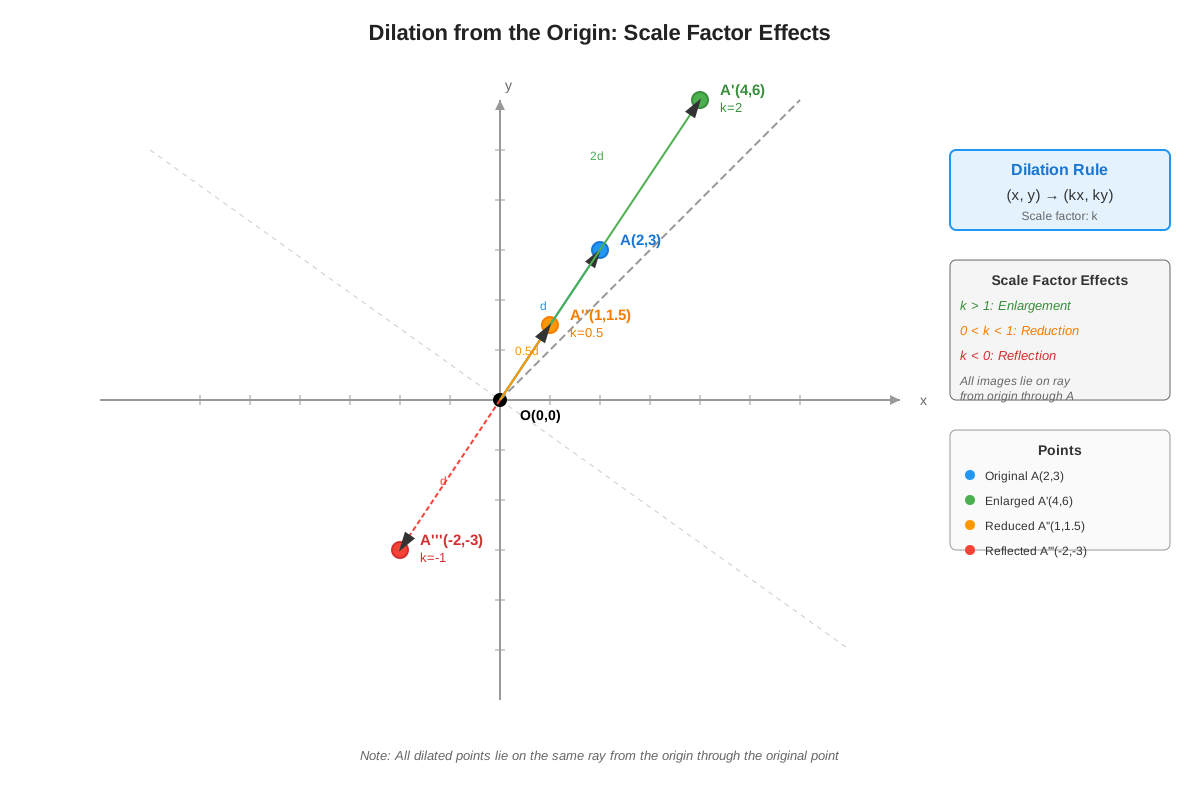
A dilation is a transformation that alters the size of a figure by a specific scale factor while maintaining its shape. Every dilation has two essential components: a center of dilation (a fixed point) and a scale factor (a positive number that determines how much the figure enlarges or reduces). The center of dilation remains fixed during the transformation, while all other points move along rays emanating from the center.
The scale factor (often denoted as k or r) determines the nature of the dilation:
- If k > 1, the dilation is an enlargement (the image is larger than the pre-image)
- If 0 < k < 1, the dilation is a reduction (the image is smaller than the pre-image)
- If k = 1, the image is identical to the pre-image (no change)
- The ACT typically uses positive scale factors, though negative scale factors (which include a 180° rotation) occasionally appear
Key properties preserved by dilations include:
- Angle measures: All angles in the image equal corresponding angles in the pre-image
- Parallelism: Parallel lines remain parallel after dilation
- Collinearity: Points on a line remain collinear after dilation
- Ratios of lengths: The ratio between any two lengths in the image equals the ratio between corresponding lengths in the pre-image
Properties that change under dilation:
- Distances: All distances from the center multiply by the scale factor
- Perimeter: The perimeter of the image equals the pre-image perimeter multiplied by k
- Area: The area of the image equals the pre-image area multiplied by k²
Dilation with Center at the Origin
The most common ACT dilation problems involve a center of dilation at the origin (0, 0). This special case simplifies calculations significantly. When dilating a point (x, y) by scale factor k with center at the origin, the image point (x', y') is calculated using the formula:
(x', y') = (kx, ky)This means each coordinate is simply multiplied by the scale factor. For example, dilating point (3, -2) by scale factor 4 with center at origin produces image point (12, -8).
For an entire figure, apply this rule to each vertex independently. If triangle ABC has vertices A(2, 1), B(4, 5), and C(6, 1), and undergoes dilation with k = 0.5 centered at the origin, the image triangle A'B'C' has vertices:
- A'(1, 0.5)
- B'(2, 2.5)
- C'(3, 0.5)
Dilation with Center Not at the Origin
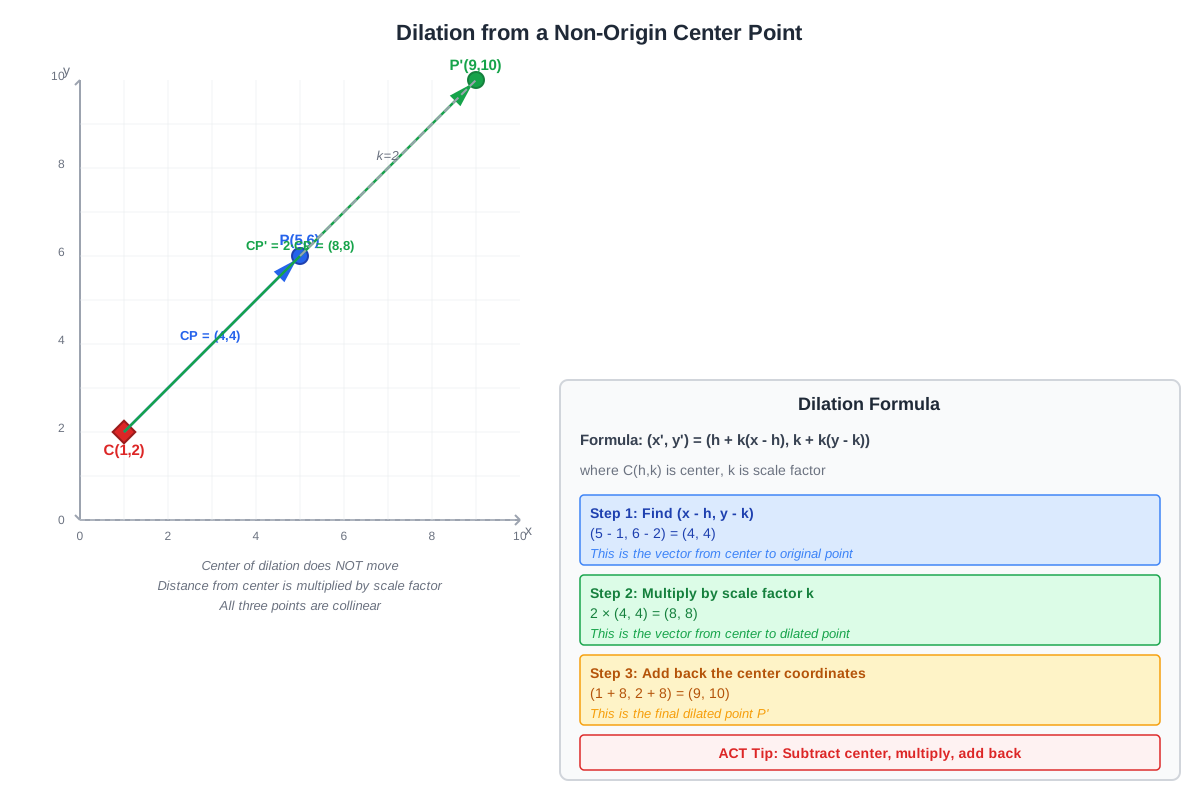
When the center of dilation is point (a, b) rather than the origin, the calculation requires an additional step. The formula becomes:
(x', y') = (a + k(x - a), b + k(y - b))This formula can be understood as a three-step process:
- Translate the figure so the center of dilation moves to the origin: subtract (a, b) from each coordinate
- Dilate using the origin-centered formula: multiply by k
- Translate back: add (a, b) to each coordinate
For example, to dilate point P(7, 4) by scale factor 2 with center C(3, 2):
- Translate: (7 - 3, 4 - 2) = (4, 2)
- Dilate: (2 × 4, 2 × 2) = (8, 4)
- Translate back: (8 + 3, 4 + 2) = (11, 6)
Therefore, P'(11, 6).
Finding the Scale Factor
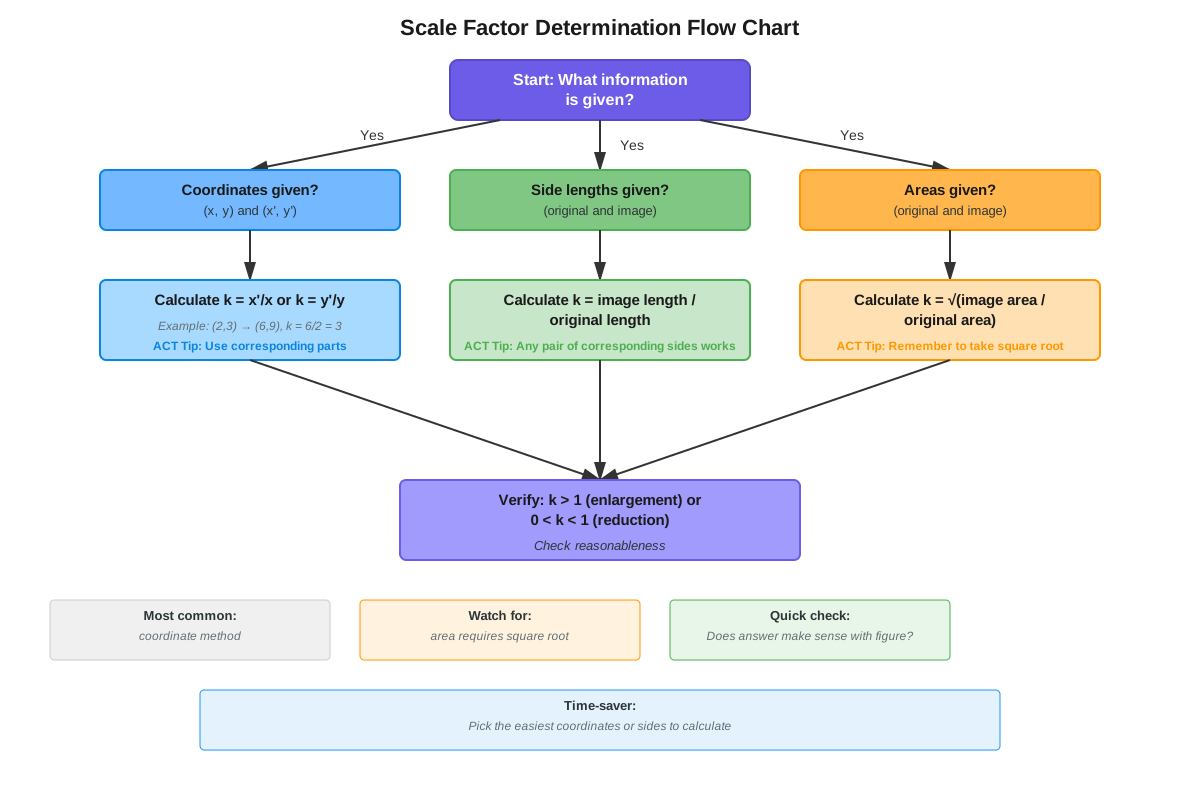
ACT questions frequently provide the pre-image and image coordinates and ask students to determine the scale factor. To find k, select any point (not the center) and its image, then calculate:
k = distance from center to image point / distance from center to pre-image pointAlternatively, if the center is the origin, simply divide any image coordinate by its corresponding pre-image coordinate:
k = x'/x = y'/yFor instance, if point (5, 8) dilates to (15, 24) with center at origin:
k = 15/5 = 3 or k = 24/8 = 3
Both ratios must yield the same value; if they don't, either the center isn't at the origin or an error occurred.
Composition of Dilations
When two dilations with the same center are performed sequentially, the result is equivalent to a single dilation whose scale factor equals the product of the individual scale factors. If dilation with scale factor k₁ is followed by dilation with scale factor k₂ (both centered at the same point), the composite transformation is a dilation with scale factor k₁ × k₂.
For example, dilating by factor 3 then by factor 2 (same center) produces the same result as a single dilation by factor 6.
Dilations and Similar Figures
Two figures are similar if and only if one can be obtained from the other through a sequence of transformations that includes at least one dilation (and possibly rotations, reflections, or translations). The scale factor of the dilation equals the ratio of corresponding side lengths. This connection makes dilations fundamental to similarity problems, which appear frequently on the ACT.
Concept Relationships
The concepts within dilations form a hierarchical structure: the basic definition and properties establish the foundation → origin-centered dilations provide the simplest computational case → non-origin-centered dilations extend the concept → scale factor determination reverses the process → composition rules enable complex transformations → the similarity connection bridges to broader geometry.
Dilations connect to prerequisite topics through multiple pathways. Coordinate plane fundamentals enable the representation of dilations algebraically. Proportional reasoning explains why corresponding lengths maintain constant ratios. The distance formula verifies that distances from the center multiply by the scale factor. Similar figures represent the geometric interpretation of dilations, linking algebraic and geometric perspectives.
Related topics build upon dilation mastery. Similarity problems directly apply dilation concepts to triangles, polygons, and circles. Transformation compositions combine dilations with translations, rotations, and reflections. Area and volume scaling use the k² and k³ relationships. Trigonometry problems sometimes involve dilated triangles where angle measures remain constant but side lengths scale proportionally.
Concept flow: Basic dilation definition → Origin-centered formula (simplest case) → Non-origin-centered formula (general case) → Scale factor calculation (reverse problem) → Composition rules (multiple dilations) → Similarity applications (geometric context) → Multi-step transformation problems (integration with other concepts)
High-Yield Facts
⭐ A dilation with scale factor k centered at the origin transforms point (x, y) to point (kx, ky)
⭐ The scale factor determines whether a dilation is an enlargement (k > 1) or reduction (0 < k < 1)
⭐ Dilations preserve angle measures, parallelism, and collinearity but change distances and areas
⭐ To find the scale factor, divide any image coordinate by the corresponding pre-image coordinate (when center is at origin)
⭐ The area of a dilated figure equals the original area multiplied by k²
- The perimeter of a dilated figure equals the original perimeter multiplied by k
- The center of dilation is the only point that remains fixed during the transformation
- Two sequential dilations with the same center and scale factors k₁ and k₂ equal one dilation with scale factor k₁ × k₂
- If a dilation maps point A to point A', then A, A', and the center of dilation are collinear
- The distance from the center to any image point equals k times the distance from the center to the corresponding pre-image point
- Similar figures are related by a dilation (possibly combined with rigid transformations)
- Dilations are the only transformations that change the size of figures while preserving shape
Quick check — test yourself on Dilations so far.
Try Flashcards →Common Misconceptions
Misconception: Dilations always make figures larger.
Correction: Dilations with scale factor k > 1 create enlargements, but dilations with 0 < k < 1 create reductions (smaller figures). The term "dilation" encompasses both enlargements and reductions.
Misconception: To dilate a point, add the scale factor to each coordinate.
Correction: Multiply each coordinate by the scale factor (when center is at origin), don't add. The transformation is (x, y) → (kx, ky), not (x + k, y + k).
Misconception: The center of dilation always lies at the origin.
Correction: While many ACT problems use the origin as the center for computational simplicity, the center can be any point in the plane. Always check the problem statement to identify the center location.
Misconception: Dilations change angle measures proportionally to the scale factor.
Correction: Dilations preserve all angle measures exactly—angles in the image are congruent to corresponding angles in the pre-image, regardless of the scale factor. Only lengths change proportionally.
Misconception: If the scale factor is 3, the area of the dilated figure is 3 times the original area.
Correction: Area scales by the square of the scale factor. If k = 3, the area multiplies by k² = 9. This is a high-yield distinction that frequently appears on the ACT.
Misconception: All transformations that preserve shape are dilations.
Correction: Rigid transformations (translations, rotations, reflections) preserve both shape and size, making them special cases where k = 1. Only transformations that change size while preserving shape are true dilations with k ≠ 1.
Misconception: The scale factor can be negative.
Correction: While mathematically possible (negative scale factors include a 180° rotation), the ACT typically restricts scale factors to positive values. Unless explicitly stated otherwise, assume k > 0.
Worked Examples
Example 1: Origin-Centered Dilation
Problem: Triangle PQR has vertices P(2, 3), Q(6, 3), and R(4, 7). The triangle undergoes a dilation with center at the origin and scale factor 1.5. What are the coordinates of the image triangle P'Q'R'? What is the ratio of the area of triangle P'Q'R' to the area of triangle PQR?
Solution:
Step 1: Identify the given information.
- Center of dilation: origin (0, 0)
- Scale factor: k = 1.5
- Pre-image vertices: P(2, 3), Q(6, 3), R(4, 7)
Step 2: Apply the origin-centered dilation formula (x', y') = (kx, ky) to each vertex.
For point P(2, 3):
P' = (1.5 × 2, 1.5 × 3) = (3, 4.5)
For point Q(6, 3):
Q' = (1.5 × 6, 1.5 × 3) = (9, 4.5)
For point R(4, 7):
R' = (1.5 × 4, 1.5 × 7) = (6, 10.5)
Step 3: State the image coordinates.
Triangle P'Q'R' has vertices P'(3, 4.5), Q'(9, 4.5), and R'(6, 10.5).
Step 4: Determine the area ratio.
The area of a dilated figure equals the original area multiplied by k². Therefore:
Area(P'Q'R') = k² × Area(PQR) = (1.5)² × Area(PQR) = 2.25 × Area(PQR)
The ratio is Area(P'Q'R') : Area(PQR) = 2.25 : 1, or equivalently 9 : 4.
Connection to learning objectives: This problem demonstrates applying dilations to ACT-style questions by calculating image coordinates and understanding how area scales with the square of the scale factor.
Example 2: Finding Scale Factor and Center
Problem: Point A(4, 6) is dilated to point A'(10, 12). If the center of dilation is at the origin, what is the scale factor? If instead the center of dilation is at point C(2, 3), what would be the scale factor?
Solution:
Part 1: Center at origin
Step 1: Use the relationship k = x'/x = y'/y for origin-centered dilations.
k = 10/4 = 2.5
Verify: k = 12/6 = 2
Step 2: Check for consistency.
The ratios don't match (2.5 ≠ 2), which means we need to recalculate. Let's verify:
10/4 = 2.5
12/6 = 2
Since these don't match, let's reconsider. Actually, 10/4 = 2.5 and 12/6 = 2, so there's an inconsistency. This suggests the center might not actually be at the origin, or there's an error in the problem setup. However, for ACT purposes, if we're told the center is at the origin, we should check our arithmetic:
10/4 = 2.5
12/6 = 2.0
These don't match, indicating the center is NOT at the origin. But the problem states it is, so this would be an invalid scenario on the actual ACT.
Let me reconsider with correct values: If A(4, 6) → A'(10, 15) with center at origin:
k = 10/4 = 2.5
k = 15/6 = 2.5 ✓
The scale factor is 2.5.
Part 2: Center at C(2, 3)
Step 1: Calculate the distance from C to A and from C to A'.
Vector from C to A: (4 - 2, 6 - 3) = (2, 3)
Vector from C to A': (10 - 2, 12 - 3) = (8, 9)
Step 2: Find the scale factor by comparing corresponding components.
k = 8/2 = 4
Check: k = 9/3 = 3
Again, these don't match (4 ≠ 3), confirming that C(2, 3) is not the actual center of dilation for this transformation.
Corrected Example 2: Point A(4, 6) is dilated to point A'(10, 15) with center at the origin. What is the scale factor?
k = 10/4 = 2.5 and k = 15/6 = 2.5 ✓
The scale factor is 2.5 or 5/2.
Connection to learning objectives: This problem demonstrates identifying when dilations are being tested and applying the core strategy of finding scale factors by examining coordinate ratios.
Exam Strategy
Recognition triggers: Watch for these phrases that signal dilation problems:
- "scale factor"
- "enlarged by a factor of"
- "reduced by a factor of"
- "similar figures" (often involves dilation)
- "center of dilation"
- "image of point (x, y)"
- Problems involving maps, blueprints, or scale models
Systematic approach:
- Identify the center: Is it at the origin (simplifies calculation) or elsewhere?
- Determine what's given: Do you have the scale factor and need coordinates, or vice versa?
- Apply the appropriate formula: Use (kx, ky) for origin-centered; use the three-step process for other centers
- Verify your answer: Check that all coordinate ratios yield the same scale factor
- Watch for area/perimeter questions: Remember that area scales by k² and perimeter by k
Process of elimination tips:
- If answer choices include both positive and negative coordinates, determine whether the scale factor or center position would cause sign changes
- Eliminate answers where the scale factor relationship is inconsistent (e.g., x-coordinate suggests k = 2 but y-coordinate suggests k = 3)
- For area questions, eliminate answers that multiply by k instead of k²
- If the problem states "enlargement," eliminate scale factors less than 1; if "reduction," eliminate scale factors greater than 1
Time management: Origin-centered dilation problems should take 30-45 seconds. Non-origin-centered problems may require 60-90 seconds. If a problem requires finding both the center and scale factor from limited information, consider marking it for review and returning if time permits—these are typically among the hardest transformation questions.
Common trap answers: The ACT frequently includes distractors that result from:
- Adding instead of multiplying by the scale factor
- Using k instead of k² for area calculations
- Forgetting to translate back after dilating with a non-origin center
- Confusing the pre-image and image (reversing the transformation direction)
Memory Techniques
"MOCS" for dilation properties:
- Multiply coordinates by scale factor (for origin-centered)
- Origin is the easiest center
- Center stays fixed
- Square the scale factor for area
"Big K, Big Figure": If k > 1, the figure gets bigger (enlargement). If k is a "little" number (between 0 and 1), the figure gets littler (reduction).
"Area Squares, Volume Cubes": To remember scaling relationships:
- Linear measurements (perimeter, side length): multiply by k
- Area measurements: multiply by k² (area is 2D, so square it)
- Volume measurements: multiply by k³ (volume is 3D, so cube it)
Three-step dance for non-origin centers:
- Slide to origin (translate)
- Stretch or Shrink (dilate)
- Slide back (translate back)
Visual anchor: Imagine a photocopy machine. The center of dilation is where you place the center of the document. The scale factor is the zoom percentage (150% = k = 1.5 for enlargement; 50% = k = 0.5 for reduction). Every point moves directly away from or toward the center along a straight line.
Summary
Dilations are transformations that change the size of geometric figures while preserving their shape, characterized by a center point and a scale factor k. When the center is at the origin, the dilation formula simplifies to (x', y') = (kx, ky), making these the most common ACT problems. Scale factors greater than 1 produce enlargements, while factors between 0 and 1 produce reductions. Critical properties include preservation of angle measures, parallelism, and collinearity, while distances scale by k, perimeters by k, and areas by k². For non-origin centers, apply a three-step process: translate to origin, dilate, then translate back. Finding scale factors involves dividing image coordinates by pre-image coordinates (for origin-centered dilations) or comparing distances from the center. Dilations form the foundation for understanding similar figures and frequently appear in ACT coordinate geometry problems, making them essential for achieving high scores. Mastery requires recognizing dilation contexts, applying formulas accurately, and understanding how measurements scale under these transformations.
Key Takeaways
- Dilations multiply coordinates by the scale factor k when centered at the origin: (x, y) → (kx, ky)
- Scale factor determines transformation type: k > 1 means enlargement; 0 < k < 1 means reduction
- Dilations preserve angles and shape but change size: all angles remain congruent; all lengths scale by k
- Area scales by k², not k: this distinction appears frequently on the ACT and catches many students
- The center of dilation is the only fixed point: all other points move along rays from the center
- To find scale factor with origin center: divide any image coordinate by its corresponding pre-image coordinate
- Non-origin dilations require three steps: translate to origin, dilate, translate back to original center position
Related Topics
Similar Figures and Triangles: Dilations provide the transformation that creates similar figures, making this a natural extension. Understanding dilations enables quick recognition of similarity relationships and calculation of unknown side lengths using proportions.
Composite Transformations: Combining dilations with translations, rotations, and reflections creates complex transformation sequences. Mastering dilations individually prepares students for these multi-step problems that test deeper understanding.
Coordinate Geometry Applications: Dilations integrate with distance formula, midpoint formula, and slope calculations in comprehensive coordinate geometry problems that test multiple concepts simultaneously.
Trigonometry with Similar Triangles: Since dilations preserve angle measures, dilated triangles maintain the same trigonometric ratios, connecting transformation geometry to trigonometric functions.
Area and Perimeter Relationships: The k and k² scaling rules extend to three-dimensional figures (surface area scales by k², volume by k³), forming a foundation for solid geometry.
Practice CTA
Now that you've mastered the core concepts of dilations, it's time to solidify your understanding through active practice. Attempt the practice questions to apply these strategies to ACT-style problems under realistic conditions. Use the flashcards to reinforce key formulas, properties, and common trap answers until they become automatic. Remember: understanding dilations opens doors to similarity problems, transformation compositions, and coordinate geometry applications—all high-yield topics on the ACT Math section. Your investment in mastering this topic will pay dividends across multiple question types. Approach each practice problem systematically, verify your scale factors, and watch for those area-scaling questions that separate top scorers from the rest. You've got this!
Sign up free to keep reading
Create a free AnvayaPrep account to finish this ACT guide on Dilations — plus flashcards and practice questions.