Overview
Similar triangles represent one of the most frequently tested concepts in the Plane Geometry section of the ACT Math test. These geometric figures share the same shape but differ in size, maintaining identical angle measures while their corresponding sides exist in constant proportion. Understanding similar triangles unlocks the ability to solve complex geometric problems involving indirect measurement, scale factors, and proportional reasoning—skills that appear in approximately 2-4 questions on every ACT Math section.
The power of ACT similar triangles lies in their predictability and the systematic approach they demand. When two triangles are similar, every ratio between corresponding sides remains constant, creating a mathematical relationship that can be exploited to find unknown lengths, areas, and even volumes of related three-dimensional figures. This proportional thinking extends beyond pure geometry into coordinate geometry, trigonometry, and real-world application problems that the ACT frequently incorporates.
Mastering similar triangles creates a foundation for understanding more advanced geometric concepts including trigonometric ratios, geometric means, and coordinate transformations. The topic integrates seamlessly with congruence theorems, the Pythagorean theorem, and area calculations—making it a central pillar of geometric reasoning on the ACT. Students who develop fluency with similarity can often solve problems in seconds that might otherwise require lengthy algebraic manipulation or complex geometric constructions.
Learning Objectives
- [ ] Identify when Similar triangles is being tested in ACT Math questions
- [ ] Explain the core rule or strategy behind Similar triangles and their properties
- [ ] Apply Similar triangles to ACT-style questions accurately and efficiently
- [ ] Determine whether two triangles are similar using AA, SAS, and SSS similarity criteria
- [ ] Calculate unknown side lengths using proportional relationships in similar triangles
- [ ] Solve multi-step problems involving similar triangles embedded in complex figures
- [ ] Apply scale factors to determine area and perimeter relationships between similar triangles
Prerequisites
- Basic triangle properties: Understanding that interior angles sum to 180° is essential for recognizing angle relationships that establish similarity
- Ratio and proportion: The ability to set up and solve proportions forms the computational foundation for all similar triangle problems
- Angle relationships: Knowledge of vertical angles, corresponding angles with parallel lines, and complementary/supplementary angles helps identify equal angles
- Basic algebraic manipulation: Solving equations with variables in numerators and denominators is required for finding unknown side lengths
- Triangle classification: Familiarity with acute, obtuse, right, isosceles, and equilateral triangles aids in recognizing special similarity cases
Why This Topic Matters
Similar triangles appear throughout mathematics, science, and everyday life. Architects use similarity principles to create scale models of buildings. Surveyors employ similar triangles to measure distances across rivers or canyons without direct measurement. Navigation systems, map reading, and even shadow calculations all rely on the proportional relationships inherent in similar figures. Photography and optics depend fundamentally on similar triangles to explain how lenses form images.
On the ACT Math test, similar triangles appear with remarkable consistency. Approximately 6-8% of all Plane Geometry questions directly test similarity concepts, translating to 2-4 questions per exam. These questions typically appear in the medium-to-difficult range (questions 30-50 out of 60), making them crucial for students aiming for scores above 25. The ACT tests similarity through various formats: direct proportion problems, triangles within triangles, triangles formed by parallel lines cutting transversals, coordinate geometry applications, and word problems involving indirect measurement.
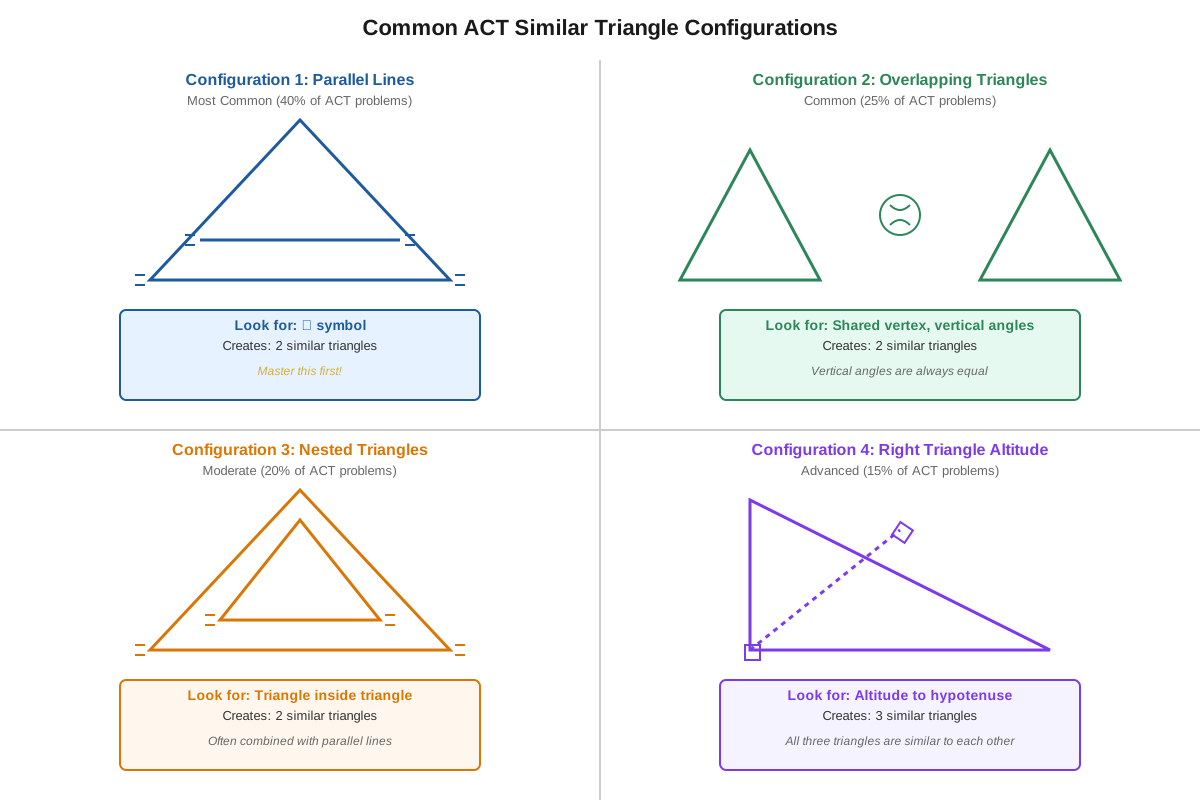
Common ACT presentations include: triangles sharing a common angle with a parallel line creating similar triangles; right triangles with an altitude to the hypotenuse creating three similar triangles; shadow problems requiring proportional reasoning; and coordinate plane problems where students must recognize similar triangles to find distances or slopes. The test writers favor problems that combine similarity with other concepts, such as the Pythagorean theorem, area calculations, or algebraic expressions for side lengths.
Core Concepts
Definition of Similar Triangles
Two triangles are similar if and only if their corresponding angles are congruent (equal in measure) and their corresponding sides are proportional. The symbol for similarity is ~, so if triangle ABC is similar to triangle DEF, we write △ABC ~ △DEF. This notation indicates a specific correspondence: angle A corresponds to angle D, angle B to angle E, and angle C to angle F. Similarly, side AB corresponds to side DE, side BC to side EF, and side AC to side DF.
The scale factor (or ratio of similarity) represents the constant ratio between corresponding sides. If △ABC ~ △DEF with a scale factor of k, then AB/DE = BC/EF = AC/DF = k. This scale factor applies consistently across all corresponding linear measurements in the triangles.
Similarity Criteria
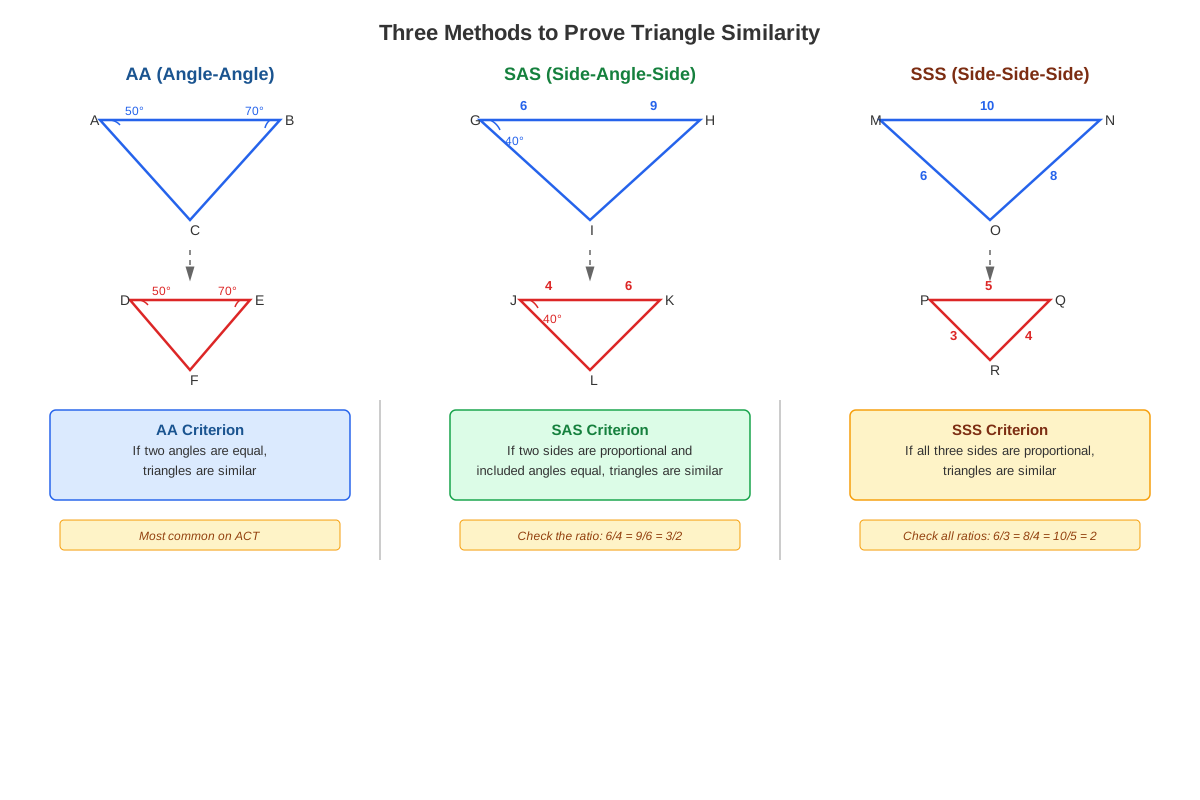
Three primary methods establish triangle similarity, each requiring different information:
Angle-Angle (AA) Similarity: If two angles of one triangle are congruent to two angles of another triangle, the triangles are similar. Since the sum of angles in any triangle equals 180°, knowing two angles automatically determines the third, making AA the most efficient similarity criterion. On the ACT, AA similarity appears most frequently, often through parallel lines creating corresponding angles or through shared angles in overlapping triangles.
Side-Angle-Side (SAS) Similarity: If two sides of one triangle are proportional to two sides of another triangle, and the included angles (the angles between those sides) are congruent, the triangles are similar. This criterion requires both measurement and angle information, making it less common on the ACT but still testable.
Side-Side-Side (SSS) Similarity: If all three sides of one triangle are proportional to the three sides of another triangle, the triangles are similar. This criterion requires only side length information and no angle measures. ACT problems using SSS similarity typically provide all six side lengths or enough information to calculate them.
Proportional Relationships
When triangles are similar, the ratio between any two corresponding sides equals the ratio between any other two corresponding sides. This creates a system of equal ratios that can be expressed as a proportion:
AB/DE = BC/EF = AC/DFTo solve for an unknown side length, identify corresponding sides, set up a proportion using known values, and cross-multiply. For example, if △ABC ~ △DEF, AB = 6, BC = 8, DE = 9, and EF is unknown:
AB/DE = BC/EF
6/9 = 8/EF
6 × EF = 9 × 8
6 × EF = 72
EF = 12
Common Similar Triangle Configurations
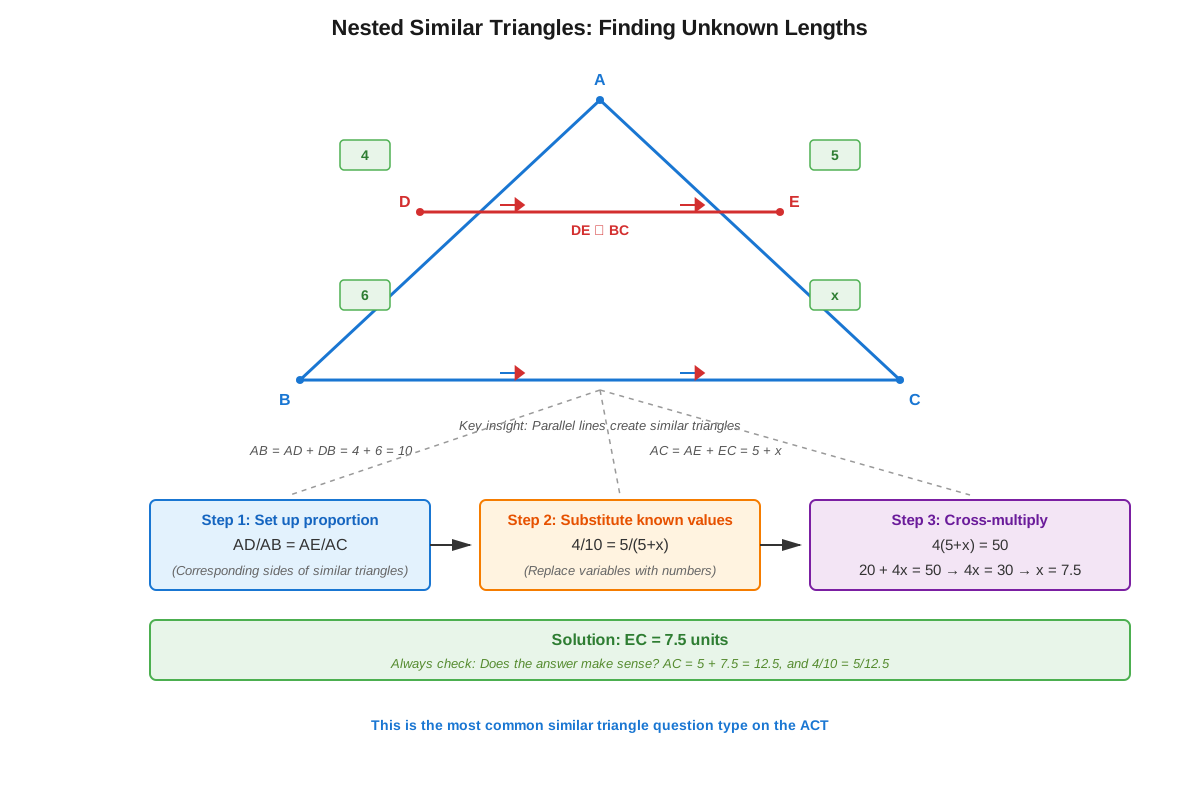
Triangles with Parallel Lines: When a line parallel to one side of a triangle intersects the other two sides, it creates a smaller triangle similar to the original. This configuration appears frequently on the ACT. If line DE is parallel to side BC in triangle ABC, then △ADE ~ △ABC.
Triangles Sharing an Angle: When two triangles share a common angle and have another pair of equal angles (or parallel sides creating equal angles), they are similar. This often occurs in problems with overlapping triangles or triangles that share a vertex.
Right Triangle Altitude Configuration: When an altitude is drawn from the right angle to the hypotenuse of a right triangle, it creates three similar triangles: the two smaller triangles and the original triangle. This configuration generates powerful relationships used in geometric mean problems.
Scale Factor Applications
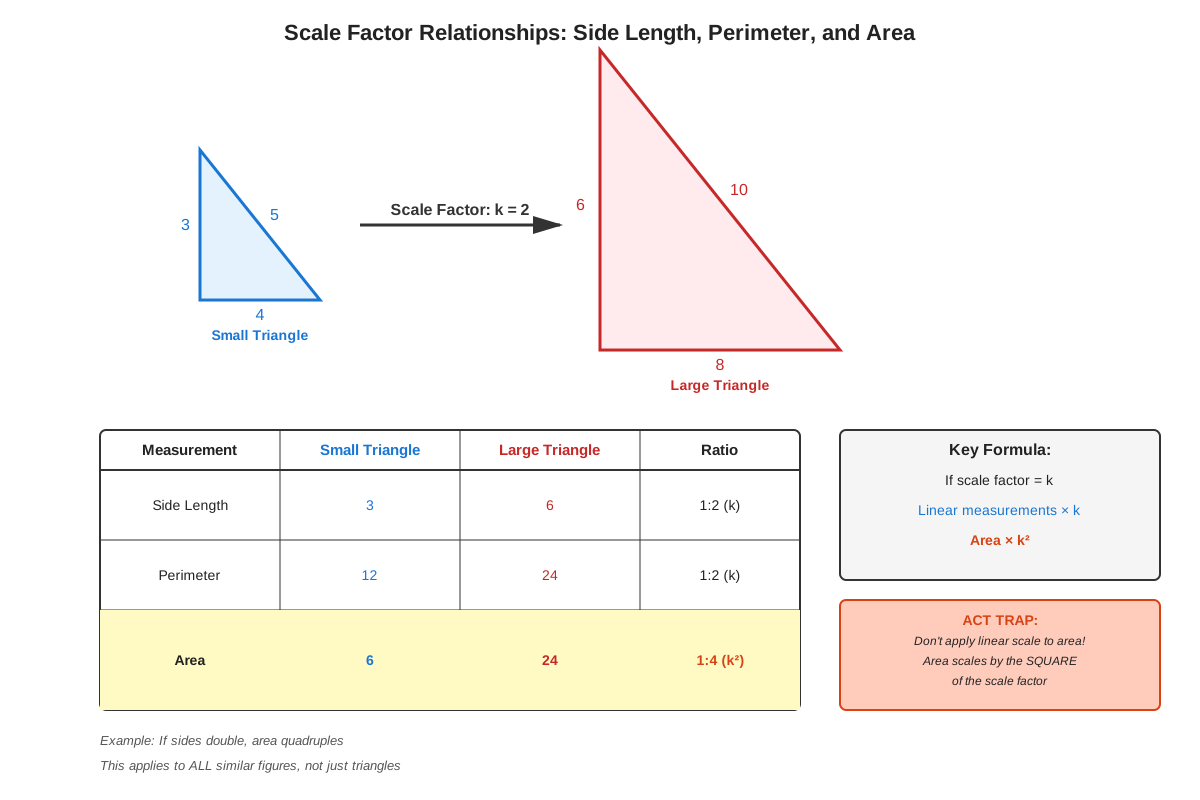
The scale factor affects different measurements differently:
| Measurement Type | Relationship to Scale Factor k |
|---|---|
| Linear (sides, perimeter, height) | Multiplied by k |
| Area | Multiplied by k² |
| Volume (for 3D figures) | Multiplied by k³ |
If two similar triangles have a scale factor of 3:1, the larger triangle has sides three times as long, a perimeter three times as great, but an area nine times as large (3² = 9). This distinction frequently appears in ACT problems asking about area relationships.
Coordinate Geometry and Similar Triangles
Similar triangles appear in coordinate geometry when triangles share proportional dimensions. The ACT may present two triangles on a coordinate plane and ask students to verify similarity by calculating side lengths using the distance formula, then checking if ratios are equal. Alternatively, problems might involve dilations (enlargements or reductions) centered at the origin, where each coordinate is multiplied by the scale factor.
Concept Relationships
The foundation of similar triangles rests on angle congruence, which connects directly to prerequisite knowledge of angle relationships formed by parallel lines and transversals. When parallel lines are cut by a transversal, corresponding angles are equal—this principle leads directly to AA similarity, the most commonly tested criterion.
Proportional reasoning serves as the computational engine for similar triangles. Once similarity is established through angle relationships, proportions allow calculation of unknown sides. This creates a two-step process: first prove similarity (usually through angles), then apply proportions (using sides).
The relationship flows: Angle relationships → Similarity criteria → Proportional sides → Problem solution
Similar triangles connect forward to trigonometry, where sine, cosine, and tangent ratios are actually similarity relationships in right triangles. The concept also extends to area and perimeter calculations, where understanding the quadratic relationship between scale factor and area proves essential. In coordinate geometry, similar triangles underpin slope concepts and distance calculations, as the rise-over-run definition of slope creates similar right triangles along any line.
The Pythagorean theorem frequently combines with similar triangles, particularly in right triangle configurations. Students might need to use similarity to find a side length, then apply the Pythagorean theorem to find another dimension, or vice versa. This integration of concepts represents the ACT's preference for multi-step reasoning problems.
Quick check — test yourself on Similar triangles so far.
Try Flashcards →High-Yield Facts
⭐ If two angles of one triangle are congruent to two angles of another triangle, the triangles are similar (AA Similarity)
⭐ In similar triangles, the ratio of corresponding sides is constant and equal to the scale factor
⭐ When a line parallel to one side of a triangle intersects the other two sides, it creates a similar triangle
⭐ The ratio of areas of similar triangles equals the square of the scale factor (k²)
⭐ The ratio of perimeters of similar triangles equals the scale factor (k)
- All equilateral triangles are similar to each other because all angles equal 60°
- All isosceles right triangles (45-45-90 triangles) are similar to each other
- When an altitude is drawn to the hypotenuse of a right triangle, three similar triangles are formed
- Corresponding sides in similar triangles are sides opposite corresponding angles
- The symbol ~ means "is similar to" while ≅ means "is congruent to"
- Similar triangles have the same shape but not necessarily the same size
- If triangles are congruent, they are also similar (with scale factor 1)
- The order of vertices in similarity statements indicates which angles and sides correspond
- Scale factor can be expressed as a ratio, decimal, or fraction
- In coordinate geometry, dilation by factor k centered at the origin multiplies all coordinates by k
Common Misconceptions
Misconception: Similar triangles must have the same orientation or position.
Correction: Similar triangles can be rotated, reflected, or positioned anywhere. Similarity depends only on angle measures and proportional sides, not on orientation. A triangle can be flipped upside down or turned 90° and still be similar to another triangle.
Misconception: If two triangles have one pair of equal angles, they are similar.
Correction: One pair of equal angles is insufficient to prove similarity. AA similarity requires two pairs of congruent angles. A single equal angle could exist in triangles with completely different shapes.
Misconception: The scale factor is always greater than 1.
Correction: The scale factor can be any positive number. When the scale factor is less than 1, the "similar" triangle is actually smaller than the original. For example, a scale factor of 0.5 means the similar triangle has sides half as long.
Misconception: If the ratio of two sides is equal in two triangles, the triangles are similar.
Correction: Two proportional sides alone do not guarantee similarity. SAS similarity requires two proportional sides AND the included angle to be congruent. Without the angle condition, triangles could have different shapes.
Misconception: The ratio of areas equals the scale factor.
Correction: The ratio of areas equals the square of the scale factor (k²), not k itself. If sides are in ratio 2:1, areas are in ratio 4:1. This is because area is a two-dimensional measurement while side length is one-dimensional.
Misconception: Corresponding sides are sides in the same position in each triangle.
Correction: Corresponding sides are opposite corresponding angles, not necessarily in the same visual position. When triangles are oriented differently, students must match sides by their relationship to equal angles, not by appearance.
Misconception: All right triangles are similar.
Correction: Right triangles are similar only if they share another pair of equal angles (beyond the right angle). Having one 90° angle is insufficient; the other acute angles must also match for similarity.
Worked Examples
Example 1: Parallel Line Configuration
Problem: In triangle ABC, point D lies on side AB and point E lies on side AC such that DE is parallel to BC. If AD = 6, DB = 4, and BC = 15, find the length of DE.
Solution:
Step 1: Identify the similarity relationship.
Since DE || BC, we know that △ADE ~ △ABC by AA similarity. The parallel lines create corresponding angles: ∠ADE ≅ ∠ABC and ∠AED ≅ ∠ACB. Combined with the shared angle ∠A, we have two pairs of congruent angles.
Step 2: Determine the scale factor.
The scale factor is the ratio of corresponding sides from the smaller triangle to the larger triangle.
- AD = 6 and AB = AD + DB = 6 + 4 = 10
- Scale factor = AD/AB = 6/10 = 3/5
Step 3: Set up the proportion.
Since DE corresponds to BC:
DE/BC = AD/AB
DE/15 = 6/10
Step 4: Solve for DE.
DE/15 = 3/5
5 × DE = 3 × 15
5 × DE = 45
DE = 9Answer: DE = 9
Connection to Learning Objectives: This problem demonstrates identifying similar triangles (parallel line configuration), explaining the core strategy (AA similarity through parallel lines), and applying proportional relationships to find unknown sides.
Example 2: Multi-Step Problem with Area
Problem: Triangle PQR has sides PQ = 8, QR = 12, and PR = 10. Triangle STU is similar to triangle PQR with a scale factor of 2.5 (meaning triangle STU is larger). If the area of triangle PQR is 36 square units, what is the area of triangle STU?
Solution:
Step 1: Understand the scale factor relationship.
Triangle STU is similar to triangle PQR with scale factor k = 2.5. This means each side of STU is 2.5 times the corresponding side of PQR.
Step 2: Verify understanding of corresponding sides (optional but helpful).
- ST = 2.5 × PQ = 2.5 × 8 = 20
- TU = 2.5 × QR = 2.5 × 12 = 30
- SU = 2.5 × PR = 2.5 × 10 = 25
Step 3: Apply the area relationship.
The ratio of areas equals the square of the scale factor:
Area(STU)/Area(PQR) = k²
Area(STU)/36 = (2.5)²
Area(STU)/36 = 6.25
Step 4: Solve for the area.
Area(STU) = 36 × 6.25 = 225Answer: The area of triangle STU is 225 square units.
Connection to Learning Objectives: This problem requires understanding how scale factors affect area (quadratic relationship), applying the similarity concept to a multi-step calculation, and distinguishing between linear and area measurements—all critical ACT skills.
Exam Strategy
Trigger Words: Watch for phrases like "parallel to," "corresponding sides," "same shape," "proportional," "scale drawing," "similar figures," and "ratio of sides." These signal similar triangle problems.
Step-by-Step Approach:
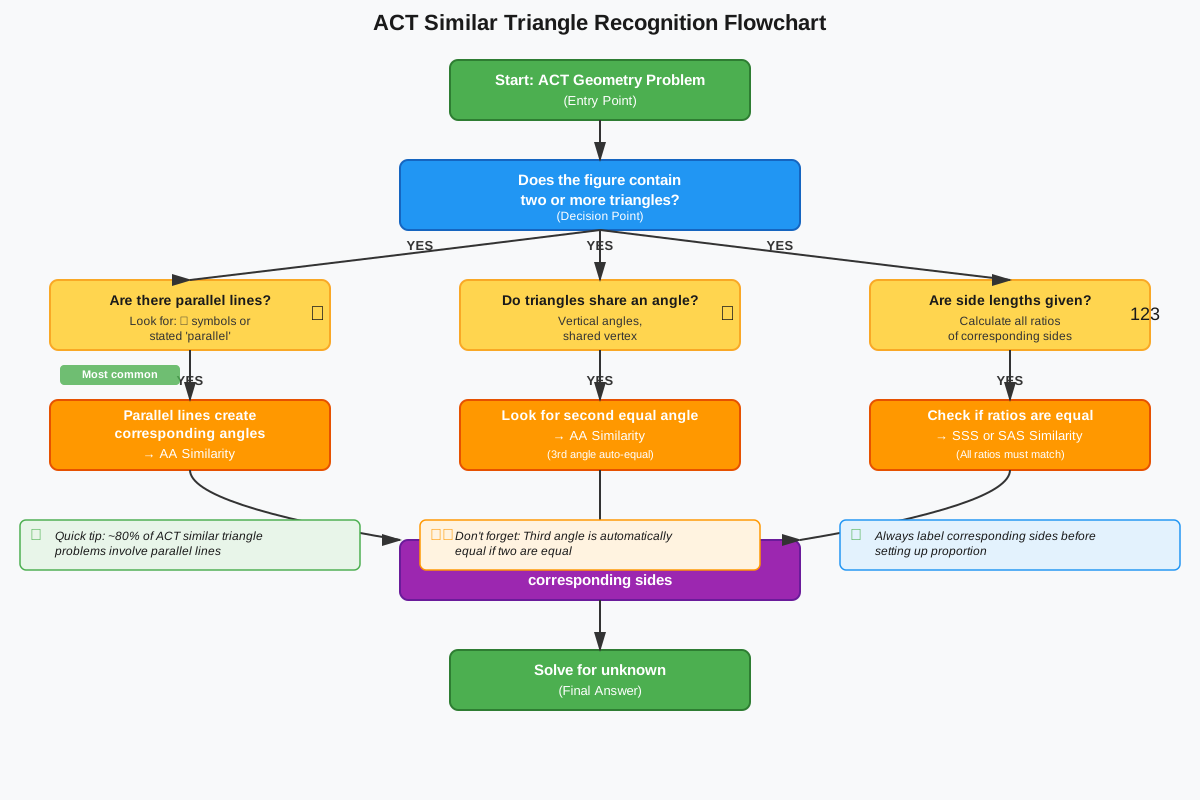
- Identify the triangles: Mark or mentally note which two triangles are being compared. Sometimes they overlap or share sides.
- Establish similarity: Look for angle relationships first (AA is fastest). Check for parallel lines, shared angles, or given angle measures. Only if angles aren't readily available, consider side ratios (SSS or SAS).
- Label corresponding parts: Write down which angles and sides correspond. The order matters: if △ABC ~ △DEF, then A↔D, B↔E, C↔F.
- Set up proportions carefully: Place corresponding sides in the same position in your ratios. Keep "small triangle sides" together and "large triangle sides" together.
- Solve systematically: Cross-multiply and solve. Check that your answer makes logical sense (e.g., if you're finding a side of the larger triangle, it should be larger).
Time Management: Similar triangle problems typically require 45-75 seconds. If you spend more than 90 seconds, you may be overcomplicating the approach. Most ACT similar triangle problems require only one proportion calculation once similarity is established.
Process of Elimination Tips:
- Eliminate answers that violate the proportional relationship (if one side doubles, all must double)
- For area problems, eliminate answers that use k instead of k²
- If the problem involves a scale factor less than 1, eliminate answers larger than the original measurement
- Check extreme cases: if the scale factor is 1, triangles are congruent (identical measurements)
Common Traps:
- Mixing up which triangle is larger (affects whether you multiply or divide)
- Using the scale factor for area instead of its square
- Incorrectly identifying corresponding sides when triangles are oriented differently
- Forgetting to add segments when finding total side lengths
Memory Techniques
AA-SAS-SSS Mnemonic: "All Angles Show Amazing Similarity Surely Soon Someday" - Remember the three similarity criteria in order of usefulness on the ACT.
Scale Factor Memory: "Linear uses Level 1 (k¹), Area uses Amplified 2 (k²), Volume uses Very 3 (k³)" - Remember how scale factor affects different measurements.
Parallel Lines Create Similar Triangles: Visualize a triangle with a line cutting through it parallel to the base. The line creates a "mini-me" triangle at the top—same shape, smaller size. This image helps recall the most common ACT configuration.
Corresponding Parts Acronym - CAST: Corresponding Angles and Sides in Triangles must match up properly. When writing similarity statements, the order of letters shows which parts correspond.
Proportion Setup: "Small over Small equals Big over Big" - When setting up proportions, keep sides from the same triangle together (small triangle sides in one ratio, big triangle sides in another).
Summary
Similar triangles represent a cornerstone of ACT Plane Geometry, appearing in 2-4 questions per test through various configurations including parallel lines, overlapping triangles, and coordinate geometry applications. Two triangles are similar when corresponding angles are congruent and corresponding sides are proportional, established through AA (most common), SAS, or SSS similarity criteria. The constant ratio between corresponding sides—the scale factor—enables calculation of unknown lengths through proportions. Critical to success is recognizing that scale factor k affects linear measurements directly, but areas by k² and volumes by k³. The ACT favors problems combining similarity with other concepts like the Pythagorean theorem, area calculations, and algebraic expressions. Mastery requires three skills: quickly identifying similar triangles through angle relationships, correctly matching corresponding parts, and accurately setting up and solving proportions. Students must distinguish between proving similarity (angle-based) and using similarity (proportion-based), as most ACT problems require both steps in sequence.
Key Takeaways
- AA Similarity is the fastest method: Two pairs of congruent angles prove similarity; watch for parallel lines creating corresponding angles
- Proportions are the computational tool: Once similarity is established, set up ratios of corresponding sides and cross-multiply to solve
- Scale factor affects measurements differently: Linear measurements use k, areas use k², volumes use k³
- Parallel lines create similar triangles: A line parallel to one side of a triangle creates a smaller similar triangle
- Corresponding parts match by angle relationships: Sides opposite equal angles correspond, regardless of triangle orientation
- Order matters in similarity statements: △ABC ~ △DEF means A↔D, B↔E, C↔F; this correspondence guides proportion setup
- Multi-step problems are common: Expect to combine similarity with Pythagorean theorem, area formulas, or algebraic manipulation
Related Topics
Congruent Triangles: While similar triangles have the same shape, congruent triangles have both the same shape and size (scale factor = 1). Understanding congruence criteria (SSS, SAS, ASA, AAS) provides context for similarity criteria.
Right Triangle Trigonometry: Sine, cosine, and tangent ratios are actually similarity relationships in right triangles. Mastering similar triangles provides the conceptual foundation for understanding why trig ratios remain constant for a given angle.
Coordinate Geometry Transformations: Dilations in the coordinate plane create similar figures by multiplying coordinates by a scale factor. This extends similar triangle concepts to the coordinate system.
Geometric Mean: In right triangles with an altitude to the hypotenuse, the altitude is the geometric mean of the two segments it creates. This relationship emerges from the similar triangles formed.
Indirect Measurement: Real-world applications of similar triangles include shadow problems, mirror problems, and surveying—topics that occasionally appear in ACT word problems.
Practice CTA
Now that you've mastered the core concepts of similar triangles, it's time to cement your understanding through practice. Work through the practice questions to apply these strategies to ACT-style problems, testing your ability to identify similarity, set up proportions, and calculate unknown values efficiently. Use the flashcards to reinforce key facts, similarity criteria, and the relationships between scale factors and measurements. Remember: similar triangles appear on every ACT Math test, making this practice time a high-yield investment in your score. Approach each problem systematically—identify, establish, label, proportion, solve—and you'll build the confidence and speed needed for test day success!
Sign up free to keep reading
Create a free AnvayaPrep account to finish this ACT guide on Similar triangles — plus flashcards and practice questions.