Overview
The coordinate plane is one of the most fundamental frameworks in mathematics, and understanding quadrants is essential for success on the ACT Math test. Quadrants divide the coordinate plane into four distinct regions, each with unique characteristics regarding the signs of x and y coordinates. This seemingly simple concept appears in approximately 3-5 questions per ACT Math section, making it a high-yield topic that students must master completely.
On the ACT, quadrants are tested both directly and indirectly. Direct questions might ask students to identify which quadrant contains a specific point or to determine the signs of coordinates in a given quadrant. Indirect questions embed quadrant knowledge within more complex problems involving distance formulas, midpoint calculations, transformations, or graphing functions. The ability to quickly identify quadrant locations and understand the sign conventions for coordinates in each region can save valuable time and prevent careless errors on test day.
Understanding quadrants serves as a gateway to more advanced coordinate geometry concepts. This topic connects directly to graphing linear equations, analyzing function behavior, working with circles and parabolas, and solving systems of equations graphically. The quadrant system provides the organizational structure that makes all coordinate geometry possible, and mastery of this foundational concept enables students to approach complex geometric problems with confidence and accuracy.
Learning Objectives
- [ ] Identify when Quadrants is being tested in ACT Math questions
- [ ] Explain the core rule or strategy behind Quadrants and coordinate sign conventions
- [ ] Apply Quadrants knowledge to ACT-style questions accurately and efficiently
- [ ] Determine the quadrant location of any point given its coordinates
- [ ] Predict coordinate signs when given only a quadrant location
- [ ] Solve multi-step problems that require quadrant analysis combined with other coordinate geometry concepts
- [ ] Recognize when transformations or reflections move points between quadrants
Prerequisites
- Basic coordinate plane structure: Understanding that the coordinate plane consists of a horizontal x-axis and vertical y-axis intersecting at the origin (0,0) is essential because quadrants are defined by these axes.
- Ordered pair notation: Familiarity with representing points as (x, y) is necessary because quadrant identification depends on analyzing both coordinate values.
- Positive and negative number concepts: Recognizing that numbers can be positive, negative, or zero is fundamental because quadrant classification relies entirely on the signs of coordinates.
- Basic graphing skills: The ability to plot points on a coordinate plane helps visualize quadrant locations and reinforces the spatial relationships between regions.
Why This Topic Matters
In real-world applications, the quadrant system appears throughout science, engineering, navigation, and data visualization. GPS coordinates use a similar system to locate positions on Earth's surface. Computer graphics and video game design rely on coordinate systems to position objects in virtual space. Financial analysts use four-quadrant matrices to categorize investments based on risk and return. Architects and engineers use coordinate systems to create precise technical drawings and blueprints.
On the ACT Math test, quadrant questions appear with remarkable consistency. Approximately 8-12% of coordinate geometry questions directly test quadrant knowledge, while another 15-20% require quadrant understanding as part of a larger problem. These questions typically appear in the medium difficulty range (questions 20-40 out of 60), making them accessible to students aiming for scores in the mid-20s and above. The ACT frequently combines quadrant concepts with transformations, distance calculations, and function graphing, creating multi-step problems that test conceptual understanding rather than mere memorization.
Common question formats include: identifying the quadrant containing a point with given coordinates; determining possible coordinate signs for points in a specific quadrant; analyzing how reflections or rotations move points between quadrants; and solving for unknown coordinates when given quadrant information and additional constraints. The ACT also tests quadrants indirectly through questions about function behavior, asking students to identify where a function is positive or negative, which requires understanding which quadrants the graph occupies.
Core Concepts
The Coordinate Plane Structure
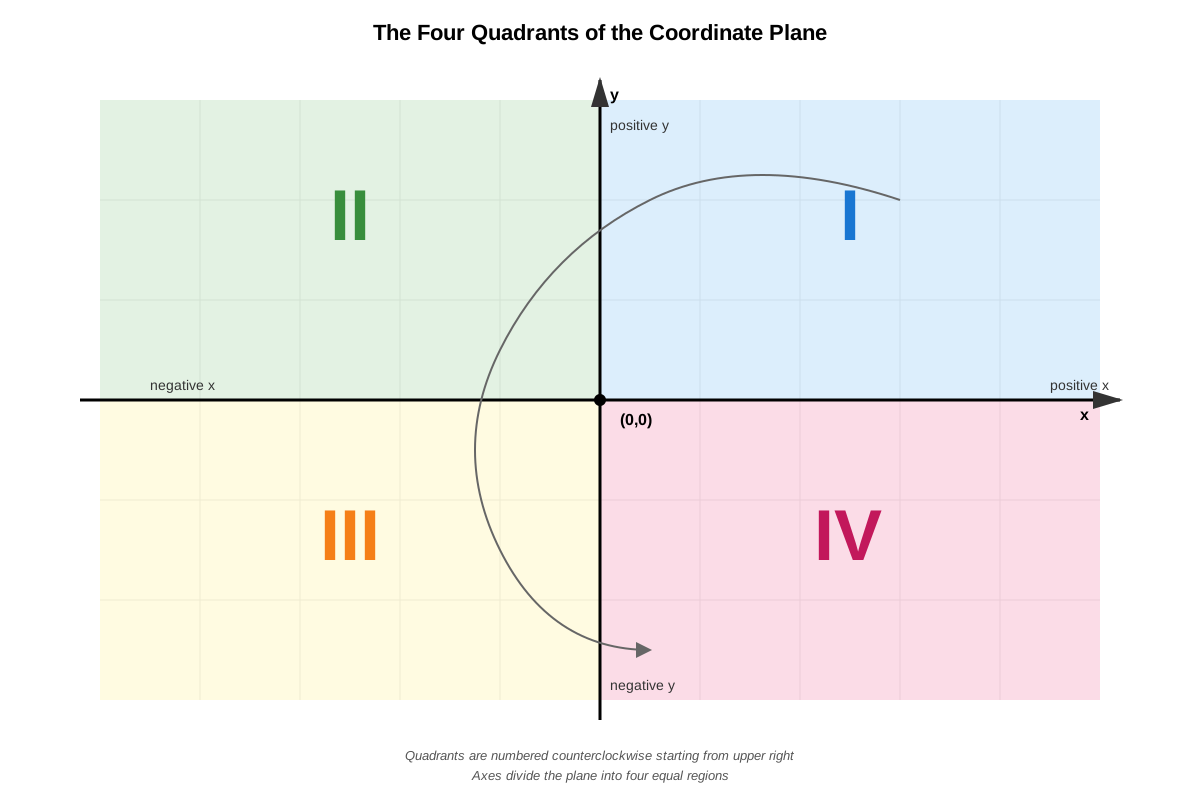
The coordinate plane (also called the Cartesian plane) consists of two perpendicular number lines: the horizontal x-axis and the vertical y-axis. These axes intersect at a point called the origin, which has coordinates (0, 0). The axes divide the plane into four regions called quadrants, which are numbered using Roman numerals I, II, III, and IV in a counterclockwise direction starting from the upper right region.
Every point on the coordinate plane can be represented by an ordered pair (x, y), where x represents the horizontal distance from the origin and y represents the vertical distance from the origin. Positive x-values indicate positions to the right of the y-axis, while negative x-values indicate positions to the left. Similarly, positive y-values indicate positions above the x-axis, while negative y-values indicate positions below.
Quadrant I: The Positive-Positive Region
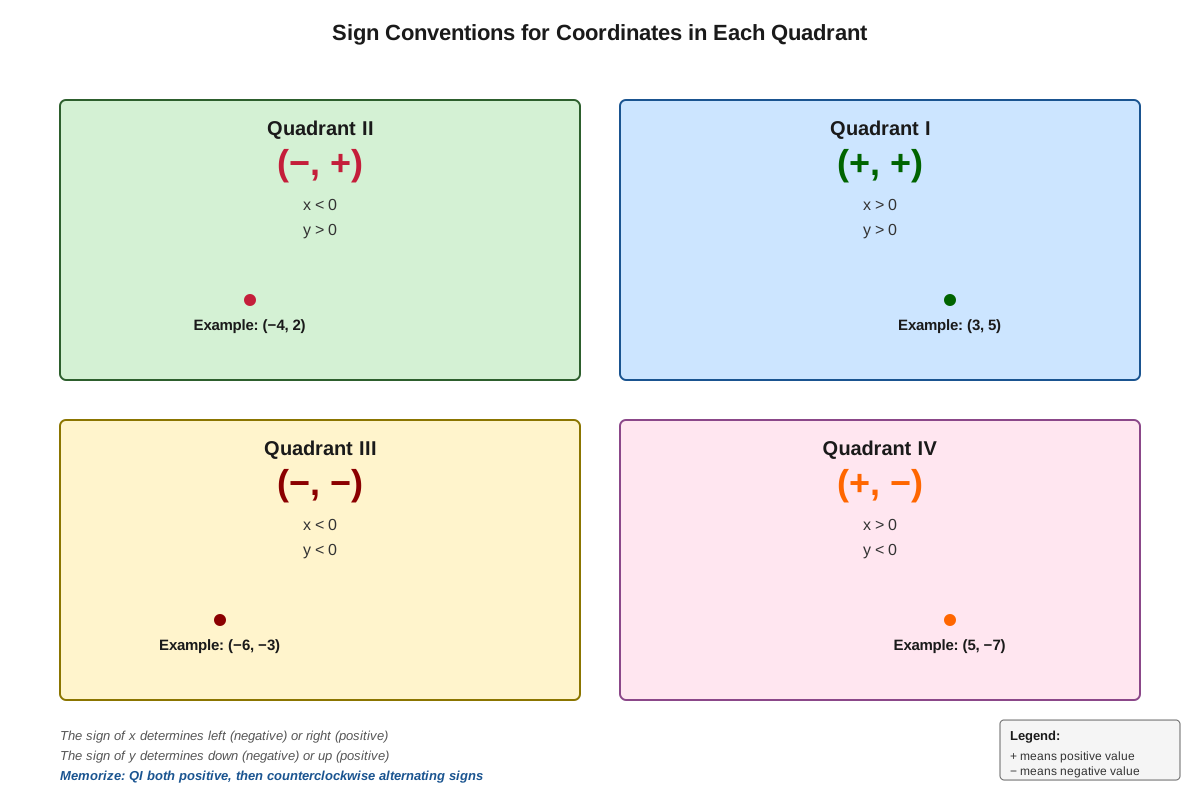
Quadrant I occupies the upper right portion of the coordinate plane. All points in Quadrant I have both positive x-coordinates and positive y-coordinates. This can be expressed as: for any point (x, y) in Quadrant I, x > 0 and y > 0. Examples of Quadrant I points include (3, 5), (1, 1), (7.5, 2.3), and (100, 0.5).
Quadrant I is often the most intuitive region for students because it corresponds to the "natural" counting number system where both dimensions are positive. When graphing real-world data where both variables must be positive (such as time and distance, or price and quantity), the relevant portion of the graph typically lies in Quadrant I.
Quadrant II: The Negative-Positive Region
Quadrant II occupies the upper left portion of the coordinate plane. All points in Quadrant II have negative x-coordinates and positive y-coordinates. This can be expressed as: for any point (x, y) in Quadrant II, x < 0 and y > 0. Examples include (-4, 6), (-1, 2), (-8.5, 3.7), and (-50, 1).
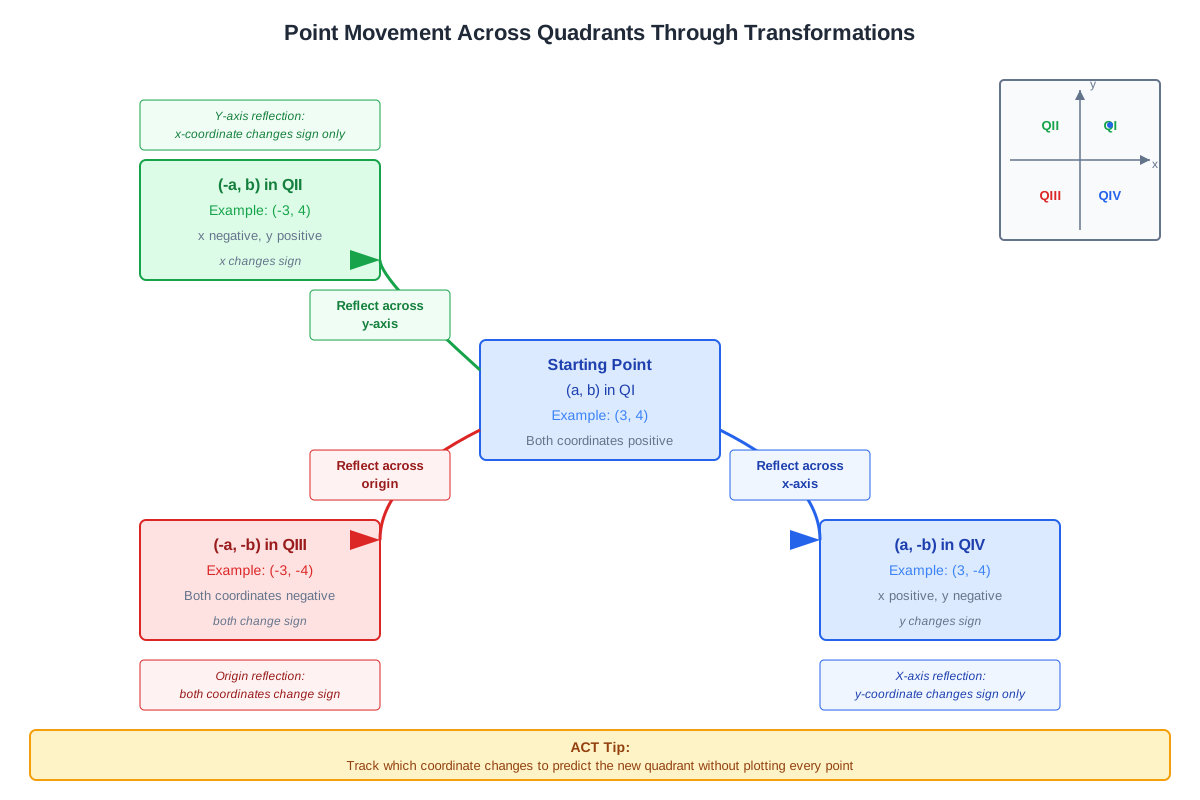
Understanding Quadrant II is crucial for analyzing functions and transformations. When a point is reflected across the y-axis, it moves from Quadrant I to Quadrant II (or vice versa), changing the sign of the x-coordinate while maintaining the y-coordinate.
Quadrant III: The Negative-Negative Region
Quadrant III occupies the lower left portion of the coordinate plane. All points in Quadrant III have both negative x-coordinates and negative y-coordinates. This can be expressed as: for any point (x, y) in Quadrant III, x < 0 and y < 0. Examples include (-2, -5), (-6, -1), (-3.5, -4.2), and (-100, -75).
Quadrant III is directly opposite Quadrant I across the origin. When a point is rotated 180 degrees around the origin, it moves from Quadrant I to Quadrant III, with both coordinates changing signs. This relationship is frequently tested on the ACT through transformation questions.
Quadrant IV: The Positive-Negative Region
Quadrant IV occupies the lower right portion of the coordinate plane. All points in Quadrant IV have positive x-coordinates and negative y-coordinates. This can be expressed as: for any point (x, y) in Quadrant IV, x > 0 and y < 0. Examples include (5, -3), (2, -7), (4.5, -1.8), and (80, -20).
Quadrant IV is particularly important when analyzing functions that have both positive and negative outputs. For instance, when graphing trigonometric functions or polynomial functions, understanding which portions of the graph lie in Quadrant IV helps determine where the function has negative values for positive inputs.
Quadrant Sign Summary Table
| Quadrant | x-coordinate sign | y-coordinate sign | Example Point |
|---|---|---|---|
| I | Positive (+) | Positive (+) | (3, 4) |
| II | Negative (−) | Positive (+) | (−3, 4) |
| III | Negative (−) | Negative (−) | (−3, −4) |
| IV | Positive (+) | Negative (−) | (3, −4) |
Points on Axes: The Special Cases
Points that lie directly on the x-axis or y-axis do not belong to any quadrant. These are special cases that the ACT occasionally tests:
- Points on the x-axis have a y-coordinate of 0, such as (5, 0) or (−3, 0)
- Points on the y-axis have an x-coordinate of 0, such as (0, 7) or (0, −2)
- The origin (0, 0) lies at the intersection of both axes
When an ACT question asks "in which quadrant does point P lie?" and the answer choices include "none" or "on an axis," this is testing whether students recognize that axis points are not in any quadrant.
Quadrant Identification Strategy
To quickly identify which quadrant contains a given point, follow this systematic approach:
- Examine the x-coordinate first: Determine if it's positive (right side) or negative (left side)
- Examine the y-coordinate second: Determine if it's positive (upper half) or negative (lower half)
- Combine the information: Use the sign combination to identify the quadrant
- Check for special cases: If either coordinate is zero, the point lies on an axis, not in a quadrant
This methodical approach prevents errors and works efficiently under time pressure, which is crucial for ACT success.
Concept Relationships
The quadrant system serves as the organizational foundation for all coordinate geometry. Understanding quadrants leads to the ability to graph linear equations, since students must know where lines with different slopes and y-intercepts will pass through the plane. Quadrant knowledge connects directly to transformation geometry, as reflections, rotations, and translations move points between quadrants in predictable ways.
The relationship between quadrants and function analysis is particularly important: knowing which quadrants a function's graph occupies determines where the function is positive or negative. For example, if a parabola's vertex is in Quadrant III and it opens upward, students can deduce that the function will be negative for certain x-values and positive for others based on which quadrants the parabola passes through.
Quadrant concepts build upon the prerequisite understanding of positive and negative numbers, extending this one-dimensional concept into two dimensions. This extension enables more sophisticated geometric analysis, including distance calculations (which require understanding that distances are always positive regardless of which quadrants the points occupy) and midpoint formulas (which require averaging coordinates that may have different signs).
The progression flows as follows: Number line concepts → Coordinate plane structure → Quadrant identification → Point plotting and graphing → Function analysis → Transformation geometry → Advanced coordinate geometry applications
Quick check — test yourself on Quadrants so far.
Try Flashcards →High-Yield Facts
⭐ Quadrant I contains all points where both x and y are positive (x > 0, y > 0)
⭐ Quadrant II contains all points where x is negative and y is positive (x < 0, y > 0)
⭐ Quadrant III contains all points where both x and y are negative (x < 0, y < 0)
⭐ Quadrant IV contains all points where x is positive and y is negative (x > 0, y < 0)
⭐ Quadrants are numbered counterclockwise starting from the upper right: I, II, III, IV
- Points on the x-axis or y-axis do not belong to any quadrant
- The origin (0, 0) is not in any quadrant; it's the intersection point of the axes
- When a point is reflected across the x-axis, it moves to the quadrant with the opposite y-sign
- When a point is reflected across the y-axis, it moves to the quadrant with the opposite x-sign
- When a point is reflected across the origin (180° rotation), both coordinate signs change
- Quadrants I and III are diagonal opposites, as are Quadrants II and IV
- The product xy is positive in Quadrants I and III (both signs match) and negative in Quadrants II and IV (signs differ)
- If a line passes through Quadrants I, II, and III, it must have a negative slope
- If a line passes through Quadrants I, III, and IV, it must have a positive slope
Common Misconceptions
Misconception: Quadrants are numbered clockwise starting from the upper right.
Correction: Quadrants are numbered counterclockwise starting from the upper right. The correct order is I (upper right), II (upper left), III (lower left), IV (lower right). This counterclockwise convention is standard in mathematics and must be memorized.
Misconception: Points on the axes belong to the nearest quadrant.
Correction: Points that lie directly on either axis do not belong to any quadrant. For example, (5, 0) is on the x-axis and (0, −3) is on the y-axis; neither is in a quadrant. Only points with both non-zero coordinates belong to quadrants.
Misconception: The x-coordinate determines whether a point is in the upper or lower half of the plane.
Correction: The y-coordinate determines vertical position (upper or lower), while the x-coordinate determines horizontal position (left or right). Confusing these roles is a common error that leads to incorrect quadrant identification.
Misconception: Quadrant III is in the upper left because "III" comes after "II."
Correction: Quadrant III is in the lower left, not the upper left. Following the counterclockwise numbering from Quadrant I (upper right), we move to Quadrant II (upper left), then Quadrant III (lower left), then Quadrant IV (lower right).
Misconception: If both coordinates are negative, the point must be in Quadrant IV.
Correction: When both coordinates are negative (both x < 0 and y < 0), the point is in Quadrant III, not Quadrant IV. Quadrant IV contains points with positive x-coordinates and negative y-coordinates.
Misconception: Reflecting a point across the x-axis changes its quadrant from I to II.
Correction: Reflecting across the x-axis changes the sign of the y-coordinate only. A point in Quadrant I (positive x, positive y) reflected across the x-axis moves to Quadrant IV (positive x, negative y), not Quadrant II. To move from Quadrant I to Quadrant II, reflect across the y-axis instead.
Worked Examples
Example 1: Direct Quadrant Identification
Problem: Point P has coordinates (−7, 5) and point Q has coordinates (3, −2). In which quadrants do these points lie?
Solution:
Step 1: Analyze point P (−7, 5)
- The x-coordinate is −7, which is negative (x < 0)
- The y-coordinate is 5, which is positive (y > 0)
- A point with negative x and positive y lies in Quadrant II
Step 2: Analyze point Q (3, −2)
- The x-coordinate is 3, which is positive (x > 0)
- The y-coordinate is −2, which is negative (y < 0)
- A point with positive x and negative y lies in Quadrant IV
Answer: Point P is in Quadrant II, and point Q is in Quadrant IV.
Connection to Learning Objectives: This example demonstrates the core strategy of examining coordinate signs to identify quadrants, addressing the objective of applying quadrant knowledge accurately to ACT-style questions.
Example 2: Multi-Step Problem with Transformations
Problem: Point R is located at (4, 6). If point R is reflected across the x-axis to create point S, and then point S is reflected across the y-axis to create point T, in which quadrant does point T lie?
Solution:
Step 1: Identify the starting quadrant for point R
- Point R (4, 6) has positive x and positive y coordinates
- Therefore, R is in Quadrant I
Step 2: Reflect R across the x-axis to find S
- Reflecting across the x-axis changes the sign of the y-coordinate only
- Point S = (4, −6)
- With positive x and negative y, point S is in Quadrant IV
Step 3: Reflect S across the y-axis to find T
- Reflecting across the y-axis changes the sign of the x-coordinate only
- Point T = (−4, −6)
- With negative x and negative y, point T is in Quadrant III
Step 4: Verify the result
- Starting in Quadrant I, reflecting across the x-axis moves to Quadrant IV
- From Quadrant IV, reflecting across the y-axis moves to Quadrant III
- This makes sense because both reflections together change both coordinate signs
Answer: Point T is in Quadrant III.
Connection to Learning Objectives: This example addresses the objective of recognizing when transformations move points between quadrants and demonstrates how quadrant knowledge integrates with other coordinate geometry concepts, which is exactly how the ACT tests this material.
Exam Strategy
When approaching ACT quadrants questions, begin by quickly identifying whether the question is asking for direct quadrant identification or whether quadrant knowledge is embedded in a larger problem. Look for trigger words such as "which quadrant," "positive and negative," "coordinate signs," "reflected across," or "rotated about the origin."
For direct identification questions, use the systematic two-step process: check the x-coordinate sign first, then the y-coordinate sign. This prevents the common error of confusing which coordinate controls which dimension. Write a quick note if needed: "x = left/right, y = up/down."
When quadrant information is given and you need to find possible coordinates, immediately translate the quadrant number into sign requirements. For example, if a question states "point M is in Quadrant II," immediately note that x < 0 and y > 0, then use this constraint to eliminate answer choices that don't match.
For transformation questions involving reflections or rotations, sketch a quick diagram if time permits. Even a rough sketch showing the four quadrants and the point's movement can prevent sign errors. Remember that reflections across the x-axis change only the y-coordinate sign, reflections across the y-axis change only the x-coordinate sign, and reflections across the origin (or 180° rotations) change both signs.
Process of elimination is particularly powerful for quadrant questions. If a question asks which quadrant contains a point and you can determine even one coordinate's sign with certainty, you can immediately eliminate two answer choices. For instance, if you know the x-coordinate must be positive, you can eliminate Quadrants II and III.
Time allocation: Most direct quadrant questions should take 15-30 seconds. If you find yourself spending more than 45 seconds on a quadrant identification question, you may be overcomplicating it. Return to the basic sign analysis: positive or negative for each coordinate, then match to the quadrant.
Watch for trap answers that place points on axes when the question asks for quadrants, or that use clockwise numbering instead of the correct counterclockwise convention. The ACT frequently includes these distractors to catch students who haven't fully mastered the standard conventions.
Memory Techniques
The "All Students Take Calculus" Mnemonic: Starting from Quadrant I and moving counterclockwise, remember:
- All (Quadrant I): All coordinates are positive
- Students (Quadrant II): Only Sine is positive (in trigonometry), meaning y is positive
- Take (Quadrant III): Only Tangent is positive (in trigonometry), meaning both are negative
- Calculus (Quadrant IV): Only Cosine is positive (in trigonometry), meaning x is positive
The "Plus-Minus Pattern" Visualization: Imagine the coordinate plane as a plus sign (+) made by the axes. The upper right quadrant (I) is where you'd put a plus sign (+, +). Moving counterclockwise, change one sign at a time: (−, +) for II, (−, −) for III, (+, −) for IV.
The "Reading Order" Trick: Quadrants I and II are in the "reading position" (top half of the page). Quadrant I is on the right where reading starts in English, Quadrant II is on the left where reading ends. This helps remember that I and II are both above the x-axis.
The "Clock Face" Method: Although quadrants number counterclockwise, you can use clock positions to remember locations: Quadrant I is at 2 o'clock, Quadrant II is at 10 o'clock, Quadrant III is at 8 o'clock, and Quadrant IV is at 4 o'clock.
The "Sign Matching" Rule: In Quadrants I and III, both coordinate signs match (both positive or both negative). In Quadrants II and IV, the signs are opposite (one positive, one negative). This helps quickly identify whether a point with matching or opposite signs belongs to an odd or even-numbered quadrant.
Summary
Quadrants divide the coordinate plane into four distinct regions based on the signs of x and y coordinates. Mastering quadrant identification requires understanding that Quadrant I contains points with both positive coordinates, Quadrant II has negative x and positive y, Quadrant III has both negative coordinates, and Quadrant IV has positive x and negative y. The quadrants are numbered counterclockwise starting from the upper right, and points on the axes belong to no quadrant. This foundational concept appears frequently on the ACT Math test, both in direct identification questions and as a component of more complex coordinate geometry problems. Success requires memorizing the sign conventions for each quadrant, recognizing how transformations move points between quadrants, and applying systematic analysis to determine quadrant locations quickly and accurately. The ability to visualize the coordinate plane and instantly recall which signs correspond to which quadrant is essential for achieving high scores on ACT coordinate geometry questions.
Key Takeaways
- Quadrants are numbered I, II, III, IV in counterclockwise order starting from the upper right
- Each quadrant has a unique combination of coordinate signs: I (+,+), II (−,+), III (−,−), IV (+,−)
- Points on the x-axis or y-axis do not belong to any quadrant
- Reflecting across the x-axis changes only the y-coordinate sign; reflecting across the y-axis changes only the x-coordinate sign
- Quadrant knowledge appears in 8-12% of ACT coordinate geometry questions and is embedded in many others
- Systematic sign analysis (check x first, then y) prevents errors and saves time
- Understanding quadrants is essential for graphing functions, analyzing transformations, and solving advanced coordinate geometry problems
Related Topics
Linear Equations and Graphing: Understanding which quadrants a line passes through helps determine the signs of slope and y-intercept, and enables quick sketching of linear functions. Mastering quadrants makes graphing linear equations more intuitive and efficient.
Distance and Midpoint Formulas: These formulas require working with coordinates from potentially different quadrants, where understanding sign conventions prevents calculation errors. Quadrant knowledge helps verify that computed distances and midpoints make geometric sense.
Transformations and Symmetry: Reflections, rotations, and translations move points between quadrants in predictable patterns. Mastering quadrants enables students to predict transformation results without extensive calculation.
Function Analysis: Determining where functions are positive or negative requires identifying which quadrants the function's graph occupies. This connection makes quadrant knowledge essential for understanding function behavior.
Trigonometry on the Unit Circle: The unit circle divides into quadrants where different trigonometric functions are positive or negative, directly extending the quadrant sign conventions learned in coordinate geometry.
Practice CTA
Now that you've mastered the fundamentals of quadrants and their applications on the ACT, it's time to reinforce your learning through active practice. Complete the practice questions to test your ability to identify quadrants quickly and accurately under test-like conditions. Use the flashcards to drill the sign conventions for each quadrant until they become automatic. Remember, the difference between knowing the concept and scoring points on test day is practice—the more you apply these strategies to ACT-style problems, the more confident and efficient you'll become. You've built a strong foundation; now strengthen it through deliberate practice!
Sign up free to keep reading
Create a free AnvayaPrep account to finish this ACT guide on Quadrants — plus flashcards and practice questions.