Overview
Linear equations form the backbone of algebra and represent one of the most frequently tested concepts on the ACT linear equations section. These equations describe relationships where variables change at constant rates, appearing in approximately 15-20% of all ACT Math questions. Mastering linear equations is not merely about solving for x; it requires understanding how to manipulate equations, interpret their graphical representations, and apply them to real-world scenarios that the ACT loves to test.
On the ACT, linear equations appear in multiple forms: standard form (Ax + By = C), slope-intercept form (y = mx + b), and point-slope form. Questions may ask students to solve for variables, find slopes and intercepts, write equations from word problems, or interpret graphs. The exam frequently embeds linear equations within coordinate geometry, systems of equations, and word problems involving rates, distances, and proportional relationships. Understanding linear equations provides the foundation for more complex algebraic concepts including quadratic equations, inequalities, and functions.
The strategic importance of this topic cannot be overstated. Linear equations serve as building blocks for approximately one-third of the ACT Math section when considering direct questions and those requiring linear equation knowledge as a prerequisite. Students who master linear equations gain confidence tackling word problems, graphing questions, and multi-step algebraic manipulations—all high-frequency question types that separate average scores from top-tier performance.
Learning Objectives
- [ ] Identify when Linear equations is being tested
- [ ] Explain the core rule or strategy behind Linear equations
- [ ] Apply Linear equations to ACT-style questions accurately
- [ ] Convert between different forms of linear equations (standard, slope-intercept, point-slope)
- [ ] Determine slopes and intercepts from equations, graphs, and word problems
- [ ] Write linear equations from given information including two points, a point and slope, or contextual situations
- [ ] Interpret the meaning of slope and y-intercept in real-world contexts
Prerequisites
- Basic algebraic manipulation: Ability to add, subtract, multiply, and divide algebraic expressions; essential for isolating variables and rearranging equations
- Order of operations: Understanding PEMDAS ensures correct simplification when solving multi-step equations
- Coordinate plane fundamentals: Knowledge of x and y axes, plotting points, and understanding quadrants enables graphical interpretation of linear equations
- Fraction and decimal operations: Many linear equations involve fractional slopes and require comfort with rational number arithmetic
- Substitution: The ability to replace variables with numerical values is necessary for checking solutions and evaluating equations at specific points
Why This Topic Matters
Linear equations model countless real-world phenomena where relationships between quantities remain constant. From calculating costs based on unit prices to determining travel times at constant speeds, linear relationships pervade everyday decision-making. In professional contexts, linear equations appear in business projections, scientific measurements, engineering calculations, and economic modeling. Understanding these relationships develops quantitative reasoning skills applicable far beyond the classroom.
On the ACT Math section, linear equations appear in approximately 8-12 questions per test, making them one of the highest-yield topics for score improvement. Questions typically fall into several categories: direct solving (3-4 questions), word problems requiring equation setup (2-3 questions), graphical interpretation (2-3 questions), and slope/intercept identification (1-2 questions). The ACT particularly favors questions that combine linear equations with other concepts, such as finding intersection points of lines or determining equations from contextual information.
Common ACT question formats include: identifying the equation of a line from a graph, writing equations from word problems involving rates or costs, finding where two lines intersect, determining parallel or perpendicular line equations, and interpreting the meaning of slope and intercepts in context. The exam also tests whether students can recognize equivalent forms of the same equation and manipulate equations to match answer choices. Understanding these patterns allows strategic preparation focused on high-probability question types.
Core Concepts
Forms of Linear Equations
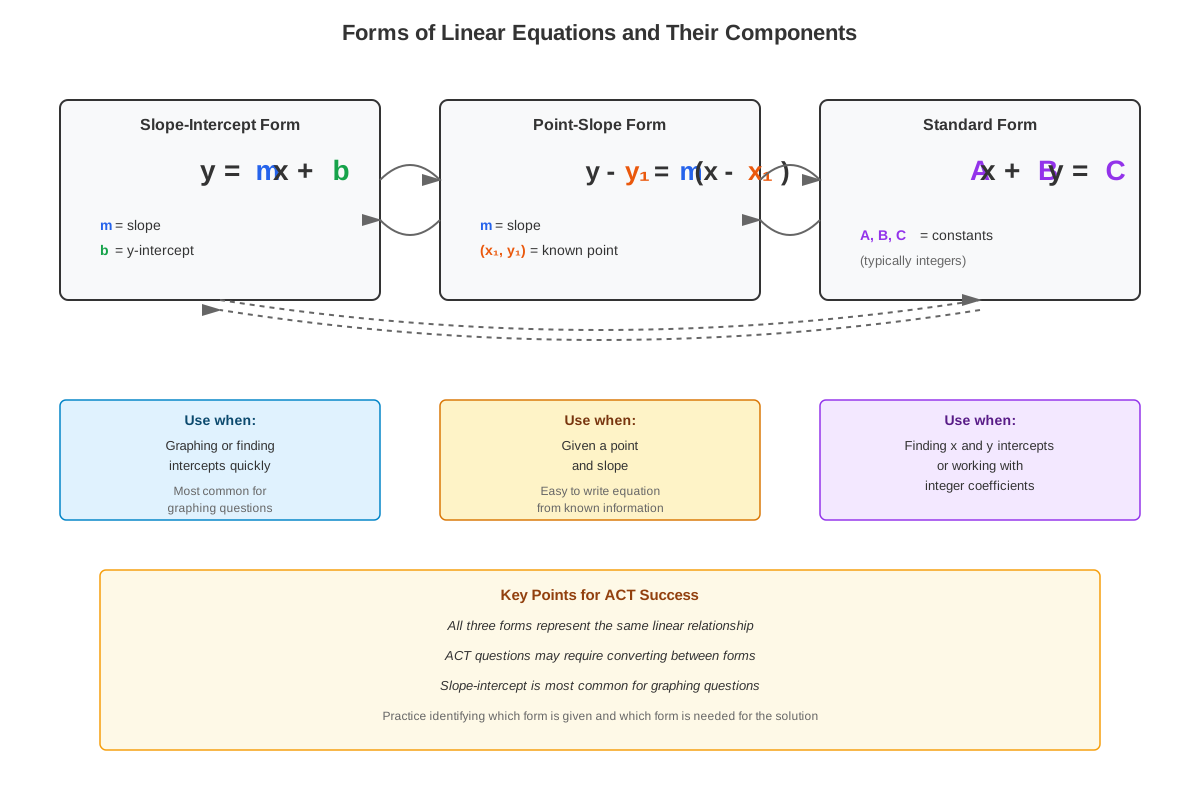
Linear equations can be expressed in three primary forms, each offering distinct advantages depending on the given information and question requirements.
Slope-intercept form (y = mx + b) is the most commonly used form on the ACT, where m represents the slope and b represents the y-intercept. This form immediately reveals the rate of change (slope) and where the line crosses the y-axis (y-intercept). When graphing or interpreting linear relationships, slope-intercept form provides the most direct information. For example, y = 3x + 5 shows a line with slope 3 that crosses the y-axis at point (0, 5).
Standard form (Ax + By = C) presents both variables on the same side of the equation, where A, B, and C are integers and A is typically positive. This form proves useful for finding intercepts quickly: setting x = 0 yields the y-intercept, while setting y = 0 yields the x-intercept. The equation 2x + 3y = 12 can be analyzed by finding that when x = 0, y = 4, and when y = 0, x = 6.
Point-slope form (y - y₁ = m(x - x₁)) uses a known point (x₁, y₁) and the slope m. This form excels when writing equations given a point and slope or when finding equations of lines through two points. If a line passes through (2, 5) with slope 4, the equation becomes y - 5 = 4(x - 2).
Slope: The Rate of Change
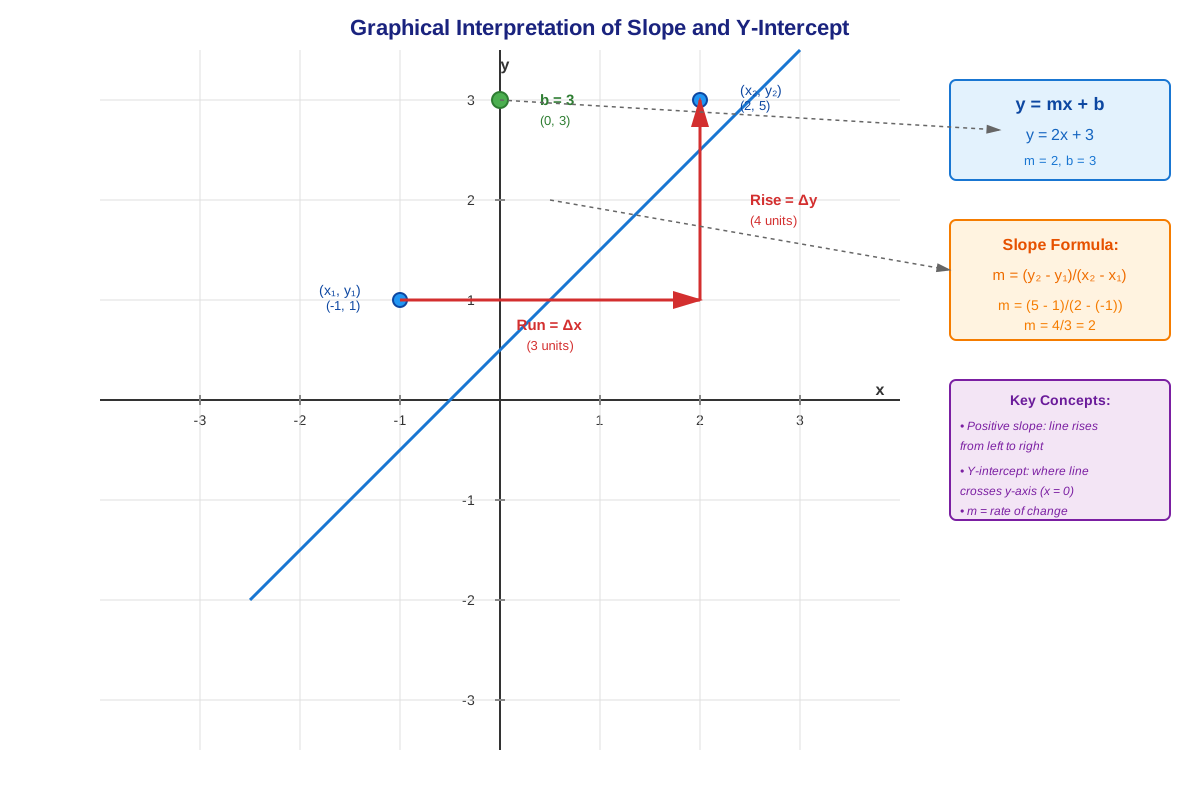
Slope quantifies how steep a line is and represents the rate at which y changes relative to x. Calculated as "rise over run" or (y₂ - y₁)/(x₂ - x₁) for two points, slope indicates both direction and steepness. Positive slopes rise from left to right, negative slopes fall from left to right, zero slopes create horizontal lines, and undefined slopes create vertical lines.
The slope formula requires careful attention to order: the y-coordinates must be subtracted in the same order as the x-coordinates. For points (1, 3) and (4, 9), the slope equals (9 - 3)/(4 - 1) = 6/3 = 2. This means for every 1 unit increase in x, y increases by 2 units.
| Slope Type | Value | Visual | Example |
|---|---|---|---|
| Positive | m > 0 | Rises left to right | y = 2x + 1 |
| Negative | m < 0 | Falls left to right | y = -3x + 4 |
| Zero | m = 0 | Horizontal line | y = 5 |
| Undefined | No value | Vertical line | x = 3 |
Intercepts: Where Lines Cross Axes
The y-intercept represents where a line crosses the y-axis, occurring when x = 0. In slope-intercept form, the y-intercept is immediately visible as the constant term b. In standard form, substitute x = 0 and solve for y. The y-intercept provides a starting value in many real-world contexts, such as initial costs or starting positions.
The x-intercept represents where a line crosses the x-axis, occurring when y = 0. To find it, substitute y = 0 into the equation and solve for x. In word problems, x-intercepts often represent break-even points, times when quantities reach zero, or other meaningful thresholds.
Parallel and Perpendicular Lines
Parallel lines never intersect and have identical slopes. If two lines have equations y = 2x + 3 and y = 2x - 7, they are parallel because both have slope 2. The ACT frequently asks students to identify parallel lines or write equations of lines parallel to given lines.
Perpendicular lines intersect at right angles, and their slopes are negative reciprocals of each other. If one line has slope m, a perpendicular line has slope -1/m. A line with slope 3/4 is perpendicular to any line with slope -4/3. This relationship appears in geometry problems involving perpendicular bisectors and altitude calculations.
Writing Equations from Information
The ACT regularly tests the ability to construct linear equations from various types of information:
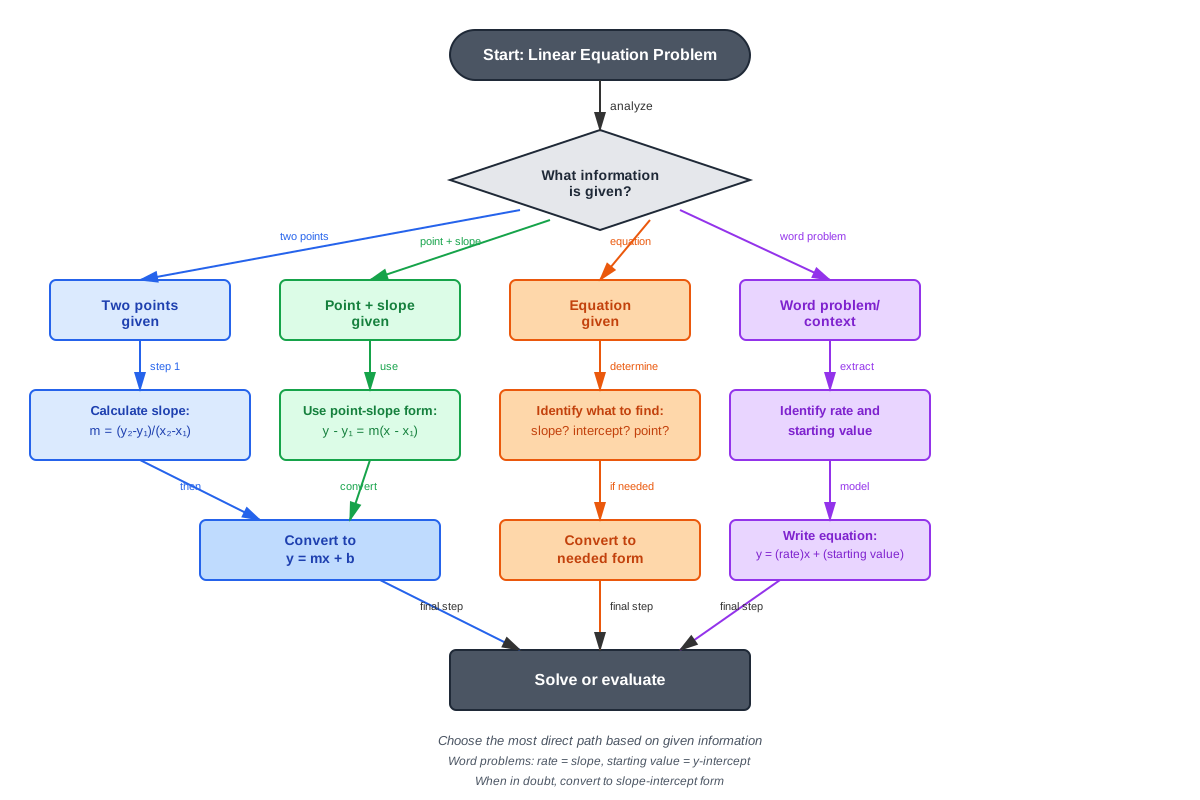
- Given two points: Calculate slope using (y₂ - y₁)/(x₂ - x₁), then use point-slope form with either point, finally converting to the requested form
- Given slope and y-intercept: Directly write in slope-intercept form as y = mx + b
- Given slope and one point: Use point-slope form y - y₁ = m(x - x₁)
- From word problems: Identify the rate of change (slope) and initial value (y-intercept) from context
Solving Linear Equations
Solving linear equations requires systematic isolation of the variable through inverse operations:
- Eliminate fractions by multiplying all terms by the least common denominator
- Distribute to remove parentheses
- Combine like terms on each side
- Move variable terms to one side using addition or subtraction
- Move constant terms to the opposite side
- Divide or multiply to isolate the variable
For example, solving 3(x - 4) + 2 = 5x - 6:
- Distribute: 3x - 12 + 2 = 5x - 6
- Combine like terms: 3x - 10 = 5x - 6
- Subtract 3x: -10 = 2x - 6
- Add 6: -4 = 2x
- Divide by 2: x = -2
Concept Relationships
Linear equations serve as the foundation connecting multiple algebraic concepts. The relationship begins with basic algebraic manipulation → which enables solving linear equations → which leads to understanding slope and rate of change → which connects to graphing linear functions → which extends to systems of linear equations → which applies to linear inequalities.
Within the topic itself, understanding slope is prerequisite to working with slope-intercept form, which in turn enables quick graphing and interpretation of linear relationships. The concept of intercepts connects directly to standard form and provides critical information for graphing and solving real-world problems. The relationship between parallel and perpendicular lines builds upon slope understanding and connects to coordinate geometry.
Linear equations also bridge to other ACT Math topics: they underpin systems of equations (both linear-linear and linear-quadratic), provide the foundation for linear inequalities, connect to functions as the simplest function type, and appear in coordinate geometry when finding equations of lines through points or perpendicular to sides of shapes. Understanding rate of change in linear equations transfers directly to interpreting average rate of change in more complex functions.
Quick check — test yourself on Linear equations so far.
Try Flashcards →High-Yield Facts
⭐ The slope-intercept form y = mx + b immediately reveals slope (m) and y-intercept (b), making it the most efficient form for graphing and interpretation
⭐ Slope is calculated as (y₂ - y₁)/(x₂ - x₁) and represents the rate of change; the order of subtraction must be consistent
⭐ Parallel lines have equal slopes; perpendicular lines have slopes that are negative reciprocals (m₁ × m₂ = -1)
⭐ To find the x-intercept, set y = 0 and solve; to find the y-intercept, set x = 0 and solve
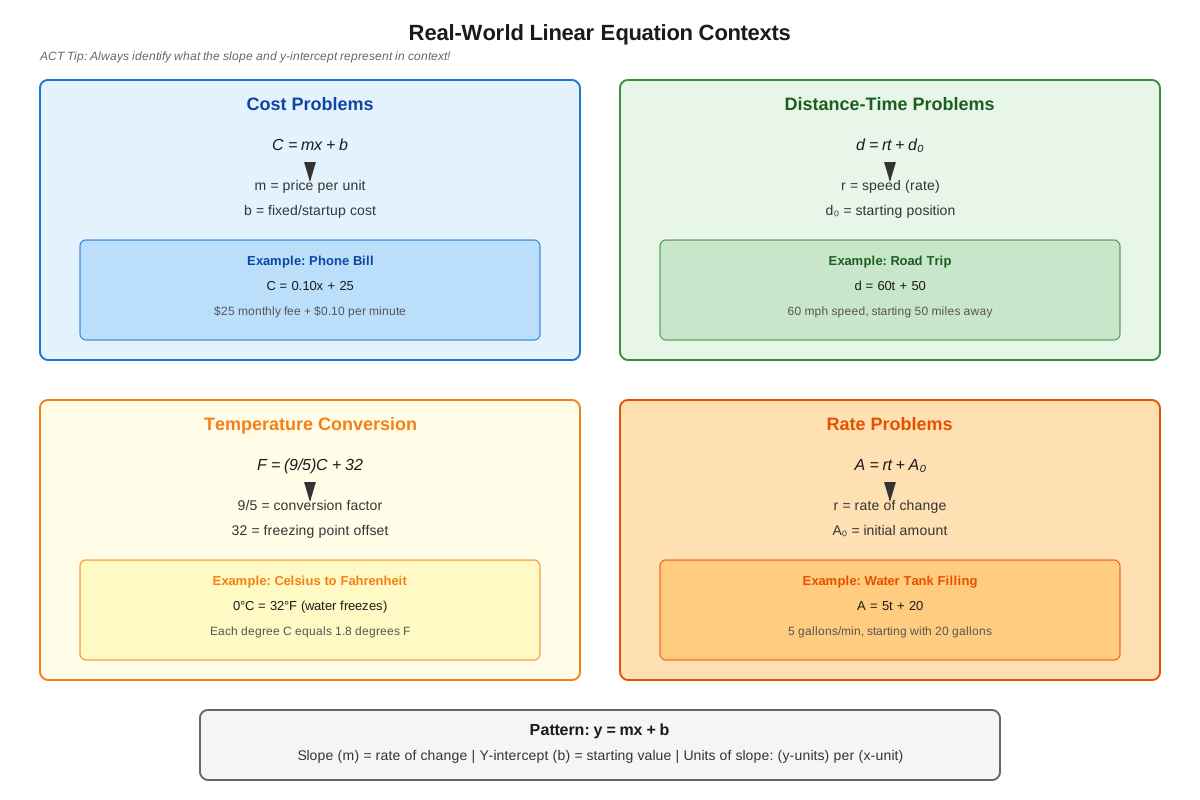
⭐ In word problems, the slope typically represents a rate (cost per item, speed, change per unit time) while the y-intercept represents an initial value or fixed cost
- Horizontal lines have slope 0 and equations of the form y = k; vertical lines have undefined slope and equations of the form x = k
- Converting from standard form (Ax + By = C) to slope-intercept form requires solving for y: y = (-A/B)x + (C/B)
- A positive slope indicates the line rises from left to right; a negative slope indicates the line falls from left to right
- When writing an equation from two points, first calculate slope, then substitute one point and the slope into point-slope form
- The equation of a line parallel to y = mx + b passing through point (x₁, y₁) is y - y₁ = m(x - x₁)
- The equation of a line perpendicular to y = mx + b passing through point (x₁, y₁) is y - y₁ = (-1/m)(x - x₁)
- Linear equations always graph as straight lines; if a graph curves, the relationship is not linear
Common Misconceptions
Misconception: Slope is calculated as (x₂ - x₁)/(y₂ - y₁) → Correction: Slope is "rise over run," which means change in y over change in x: (y₂ - y₁)/(x₂ - x₁). The vertical change (y) goes in the numerator, and the horizontal change (x) goes in the denominator.
Misconception: The y-intercept is the value of y when x = 1 → Correction: The y-intercept is the value of y when x = 0. It represents where the line crosses the y-axis, which always occurs at x = 0. In the equation y = 3x + 7, the y-intercept is 7, not 10.
Misconception: Perpendicular lines have slopes that are opposite signs of each other → Correction: Perpendicular lines have slopes that are negative reciprocals. If one line has slope 2/3, a perpendicular line has slope -3/2 (flip the fraction and change the sign). Simply changing the sign without flipping gives a different line entirely.
Misconception: Standard form Ax + By = C requires A, B, and C to all be positive → Correction: While A should typically be positive and all coefficients should be integers, B and C can be negative. The equation -2x + 3y = -6 should be rewritten as 2x - 3y = 6 to have A positive.
Misconception: In word problems, the independent variable (x) is always time → Correction: The independent variable depends on the context. While time is common, x might represent number of items, distance, quantity purchased, or any input variable. Always read carefully to identify what each variable represents.
Misconception: A line with slope 0 and a line with undefined slope are the same → Correction: A line with slope 0 is horizontal (y = k), while a line with undefined slope is vertical (x = k). These are perpendicular to each other and represent completely different relationships.
Misconception: When converting from point-slope to slope-intercept form, the point used must be the y-intercept → Correction: Any point on the line can be used in point-slope form. After distributing and simplifying, the equation will yield the same slope-intercept form regardless of which point was chosen.
Worked Examples
Example 1: Writing an Equation from Two Points
Problem: Write the equation of the line passing through points (2, 5) and (6, 13) in slope-intercept form.
Solution:
Step 1: Calculate the slope using the slope formula.
m = (y₂ - y₁)/(x₂ - x₁) = (13 - 5)/(6 - 2) = 8/4 = 2Step 2: Use point-slope form with either point. Using (2, 5):
y - y₁ = m(x - x₁)
y - 5 = 2(x - 2)
Step 3: Convert to slope-intercept form by distributing and isolating y:
y - 5 = 2x - 4
y = 2x - 4 + 5
y = 2x + 1
Step 4: Verify by checking that both original points satisfy the equation:
- For (2, 5): 5 = 2(2) + 1 = 5 ✓
- For (6, 13): 13 = 2(6) + 1 = 13 ✓
Answer: y = 2x + 1
This problem demonstrates the complete process of writing a linear equation from two points, addressing Learning Objective 3 (applying linear equations accurately) and Objective 6 (writing equations from given information).
Example 2: Real-World Application with Interpretation
Problem: A phone plan charges a monthly fee of $25 plus $0.10 per text message sent. Write an equation for the total monthly cost C in terms of the number of text messages t. Then determine how many text messages were sent if the monthly bill was $43.
Solution:
Step 1: Identify the components of the linear relationship.
- Fixed cost (y-intercept): $25
- Rate of change (slope): $0.10 per text message
- Independent variable: t (number of texts)
- Dependent variable: C (total cost)
Step 2: Write the equation in slope-intercept form:
C = 0.10t + 25Step 3: Substitute C = 43 and solve for t:
43 = 0.10t + 25
43 - 25 = 0.10t
18 = 0.10t
t = 18/0.10 = 180
Step 4: Interpret the answer in context.
Answer: The equation is C = 0.10t + 25, and 180 text messages were sent.
This example illustrates how linear equations model real-world situations (Learning Objective 7) and demonstrates the interpretation of slope and y-intercept in context. The slope of 0.10 represents the cost per text message, while the y-intercept of 25 represents the fixed monthly fee regardless of usage.
Exam Strategy
When approaching ACT linear equations questions, begin by identifying what form the question requires. If answer choices are in slope-intercept form, convert your work to that form before selecting an answer. If the question provides a graph, extract numerical information (specific points, intercepts) before attempting calculations to avoid estimation errors.
Trigger words and phrases that signal linear equation questions include: "equation of the line," "slope," "y-intercept," "rate of change," "per unit," "constant rate," "directly proportional," "linear relationship," "passes through," and "parallel/perpendicular to." Word problems using phrases like "charges $X plus $Y per" or "starts at X and increases by Y" almost always involve linear equations.
For process of elimination, recognize that:
- If a line rises from left to right, eliminate answer choices with negative slopes
- If a line falls from left to right, eliminate answer choices with positive slopes
- If you know the y-intercept from a graph, eliminate equations with different y-intercepts
- For parallel line questions, eliminate any answer with a different slope
- For perpendicular line questions, eliminate any answer whose slope doesn't multiply with the original to give -1
Time allocation for linear equation questions should average 45-60 seconds for straightforward solving or graphing questions, and 60-90 seconds for word problems requiring equation setup and solving. If a question requires more than 90 seconds, mark it and return later. Questions asking only for slope or intercept identification should take 30-45 seconds maximum.
Exam Tip: When writing equations from word problems, always identify the rate (slope) and initial value (y-intercept) before writing the equation. Circle these values in the problem to avoid mixing them up.
Memory Techniques
Slope Formula Mnemonic: "You Rise Over Run" helps remember that y-values go in the numerator (rise) and x-values go in the denominator (run): (y₂ - y₁)/(x₂ - x₁).
Forms Acronym - SPS: Remember the three forms as Slope-intercept (y = mx + b), Point-slope (y - y₁ = m(x - x₁)), and Standard (Ax + By = C).
Parallel vs. Perpendicular: "Parallel = Perfectly same slopes" and "Perpendicular = Product of slopes is -1" (or negative reciprocals).
Intercept Visualization: Picture the y-intercept as where the line "intercepts" the y-axis (when x = 0), and the x-intercept as where it "intercepts" the x-axis (when y = 0). Visualize crossing the axes.
Slope Direction: Hold your hand flat and tilt it. Tilting up to the right = positive slope; tilting down to the right = negative slope; flat = zero slope; standing straight up = undefined slope.
Word Problem Pattern: Use "RISE" to remember: Rate is slope, Initial value is y-intercept, Set up equation, Evaluate or solve.
Summary
Linear equations represent one of the highest-yield topics on the ACT Math section, appearing in multiple question types across 15-20% of the exam. Mastery requires fluency with three forms—slope-intercept (y = mx + b), point-slope (y - y₁ = m(x - x₁)), and standard (Ax + By = C)—and the ability to convert between them efficiently. The slope represents rate of change and is calculated as rise over run, while intercepts indicate where lines cross the axes. Understanding that parallel lines share identical slopes and perpendicular lines have slopes that are negative reciprocals enables quick solution of geometry-based questions. Success on ACT linear equation questions depends on recognizing question patterns, extracting information from graphs and word problems accurately, and applying systematic solving procedures. Students must practice writing equations from various types of given information, interpreting slope and intercepts in context, and manipulating equations algebraically to match answer choice formats.
Key Takeaways
- Linear equations appear in three primary forms (slope-intercept, point-slope, standard), each optimal for different situations; know when to use each form
- Slope equals (y₂ - y₁)/(x₂ - x₁) and represents rate of change; maintain consistent subtraction order to avoid sign errors
- Parallel lines have equal slopes; perpendicular lines have slopes that are negative reciprocals (their product equals -1)
- In word problems, identify the rate (slope) and initial value (y-intercept) before constructing the equation
- To find intercepts: set x = 0 for y-intercept, set y = 0 for x-intercept
- Systematic equation solving requires inverse operations applied in proper order: eliminate fractions, distribute, combine like terms, isolate variable
- Recognize trigger words like "per unit," "constant rate," and "passes through" that signal linear equation questions on the ACT
Related Topics
Systems of Linear Equations: Building on single linear equations, systems involve finding where two or more lines intersect, requiring substitution or elimination methods. Mastering linear equations provides the foundation for solving systems efficiently.
Linear Inequalities: These extend linear equations by using inequality symbols (<, >, ≤, ≥) instead of equals signs, requiring understanding of solution sets and graphing shaded regions. The algebraic manipulation skills from linear equations transfer directly.
Functions and Function Notation: Linear equations represent the simplest type of function, and understanding them enables progression to more complex function types including quadratic, exponential, and polynomial functions.
Coordinate Geometry: Linear equations frequently appear in coordinate geometry problems involving distances, midpoints, and geometric figures on the coordinate plane. Strong linear equation skills enable efficient solution of these integrated problems.
Quadratic Equations: While more complex, quadratic equations build upon linear equation solving techniques and often require finding where parabolas intersect with lines, making linear equation mastery essential.
Practice CTA
Now that you've mastered the core concepts of linear equations, it's time to solidify your understanding through active practice. Complete the practice questions to test your ability to identify question types, apply solving strategies, and work efficiently under timed conditions. Use the flashcards to reinforce high-yield facts and formulas until they become automatic. Remember, linear equations appear on virtually every ACT Math section—your investment in mastering this topic will pay dividends across multiple questions on test day. Approach each practice problem systematically, and review any mistakes to identify knowledge gaps before moving forward. You've got this!
Sign up free to keep reading
Create a free AnvayaPrep account to finish this ACT guide on Linear equations — plus flashcards and practice questions.