Overview
Transformations on coordinate plane represent one of the most frequently tested concepts in ACT Math, appearing in approximately 3-5 questions per exam. These questions assess a student's ability to visualize and manipulate geometric figures through translations, reflections, rotations, and dilations on the Cartesian coordinate system. Mastery of this topic is essential not only for earning points in the Coordinate Geometry section but also for solving complex problems that integrate multiple mathematical concepts.
The ACT tests transformations through direct questions about coordinate changes, questions requiring identification of transformed figures, and multi-step problems where transformations serve as intermediate steps toward finding areas, distances, or other properties. Understanding how coordinates change under various transformations allows students to solve problems efficiently without relying solely on graphing, which can be time-consuming during the exam. This topic bridges algebraic thinking with geometric visualization, making it a cornerstone of coordinate geometry mastery.
ACT transformations on coordinate plane questions typically present scenarios where students must predict new coordinates after one or more transformations, identify which transformation occurred based on before-and-after coordinates, or determine properties of figures after transformation. The ability to recognize transformation patterns and apply coordinate rules quickly distinguishes high-scoring students from those who struggle with the visual-spatial demands of the ACT Math section.
Learning Objectives
- [ ] Identify when Transformations on coordinate plane is being tested
- [ ] Explain the core rule or strategy behind Transformations on coordinate plane
- [ ] Apply Transformations on coordinate plane to ACT-style questions accurately
- [ ] Determine the coordinates of a point after applying multiple sequential transformations
- [ ] Recognize which transformation(s) map one figure onto another based on coordinate analysis
- [ ] Calculate the effects of dilations on distances and areas of geometric figures
- [ ] Distinguish between rigid transformations (isometries) and non-rigid transformations
Prerequisites
- Cartesian coordinate system: Understanding x and y axes, quadrants, and coordinate notation is fundamental since all transformations operate within this framework
- Basic algebraic manipulation: Ability to work with negative numbers and perform operations on coordinates is necessary for applying transformation rules
- Distance formula: Required for verifying that rigid transformations preserve distances between points
- Properties of geometric figures: Knowledge of triangles, quadrilaterals, and circles helps identify how transformations affect shape properties
- Function notation: Understanding f(x) notation aids in comprehending transformation rules as functions that map input coordinates to output coordinates
Why This Topic Matters
Transformations on the coordinate plane have extensive real-world applications in computer graphics, animation, robotics, navigation systems, and architectural design. Video game developers use transformation matrices to move characters across screens, while GPS systems apply coordinate transformations to convert between different mapping projections. Architects employ transformations to create symmetric designs and scale blueprints to actual building dimensions.
On the ACT Math exam, transformation questions appear with high frequency—typically 3-5 questions per test, representing approximately 5-8% of the total Math section. These questions span difficulty levels from straightforward single-transformation problems to complex multi-step scenarios involving composition of transformations. The ACT commonly presents transformations in three formats: direct coordinate calculation problems, figure identification questions with graphs, and word problems describing real-world scenarios requiring transformation analysis.
The most common ACT question types include: identifying coordinates after reflection across x-axis, y-axis, or the line y = x; determining the result of translations described verbally or algebraically; recognizing rotations of 90°, 180°, or 270° about the origin; and calculating scale factors in dilation problems. Questions often combine transformations with other coordinate geometry concepts such as distance, midpoint, slope, or area calculations, making this topic a high-yield area for focused study.
Core Concepts
Types of Transformations
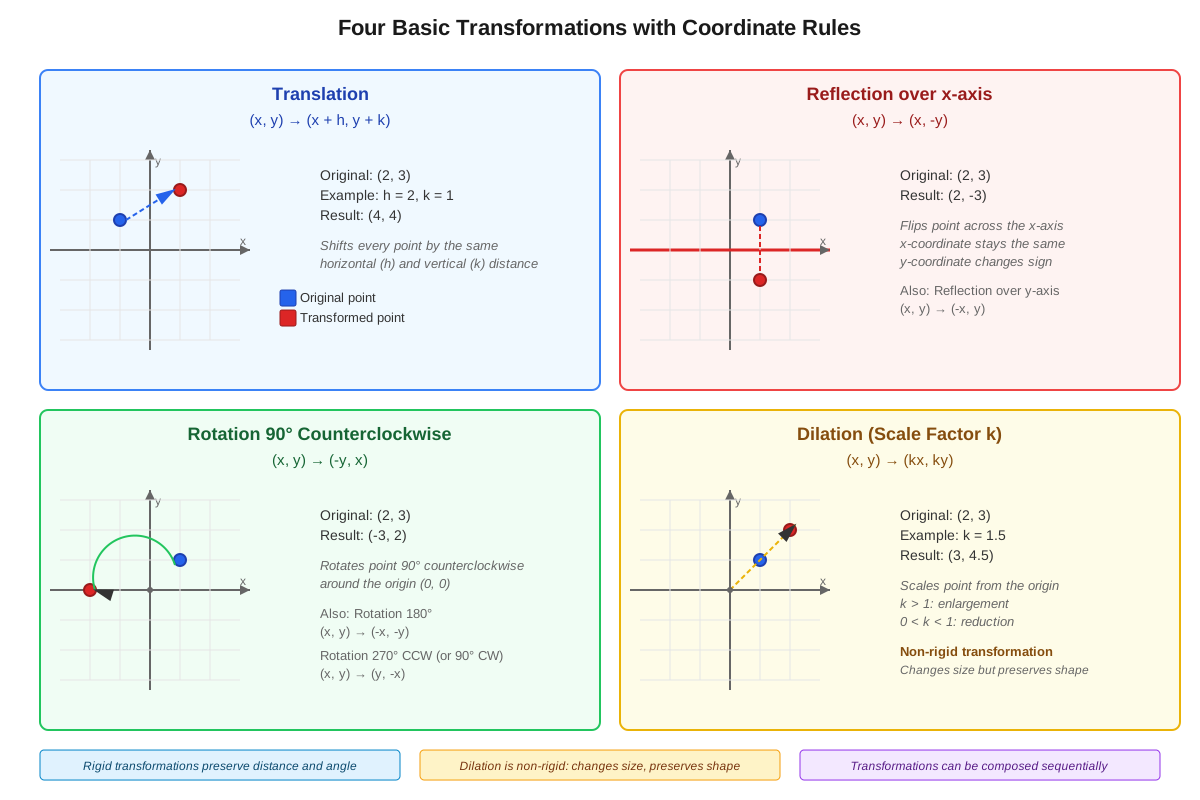
Transformations are functions that map points from one location to another on the coordinate plane. The four fundamental types tested on the ACT are translations, reflections, rotations, and dilations. Understanding the coordinate rules for each transformation type enables rapid problem-solving without extensive graphing.
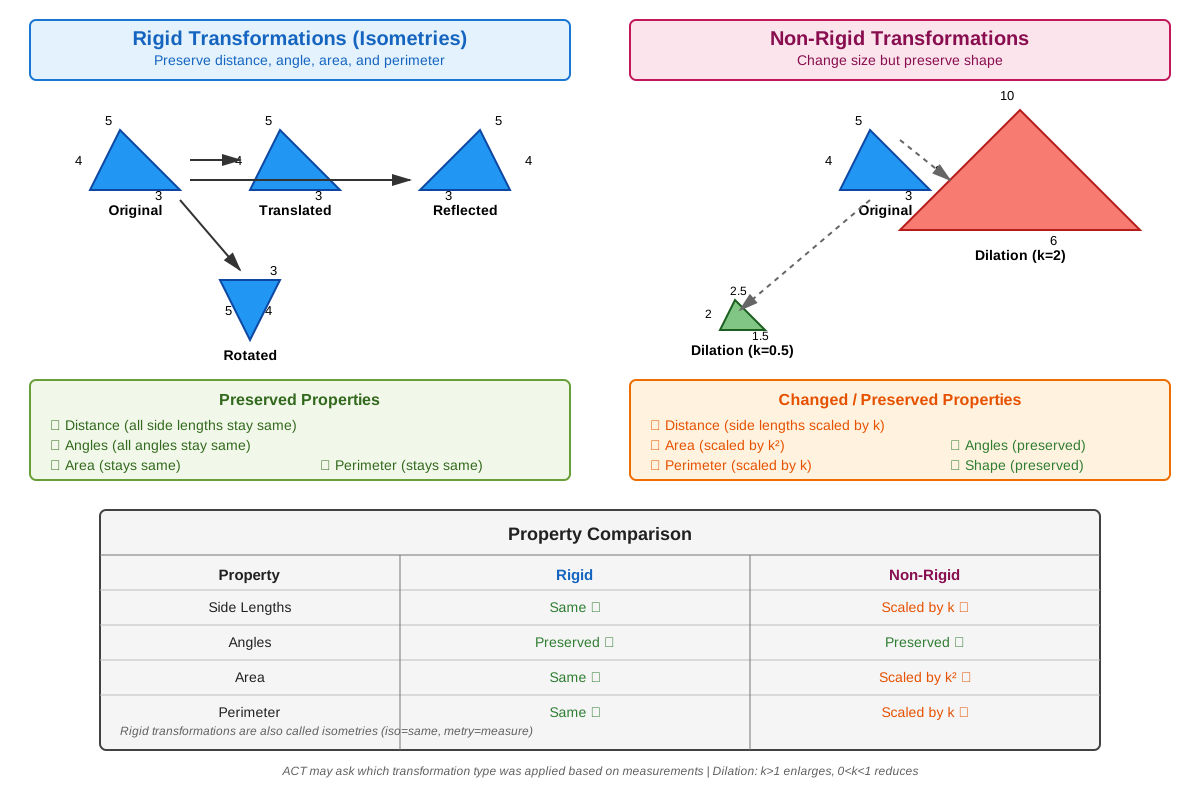
Rigid transformations (also called isometries) preserve distance and angle measures, meaning the transformed figure is congruent to the original. Translations, reflections, and rotations are rigid transformations. Non-rigid transformations change the size of figures while potentially preserving shape; dilations are the primary non-rigid transformation tested on the ACT.
Translations
A translation slides every point of a figure the same distance in the same direction. Translations are described by horizontal and vertical shifts, often written as (x, y) → (x + h, y + k), where h represents the horizontal shift and k represents the vertical shift.
Translation rules:
- Moving right h units: add h to x-coordinate
- Moving left h units: subtract h from x-coordinate
- Moving up k units: add k to y-coordinate
- Moving down k units: subtract k from y-coordinate
For example, translating point (3, -2) by moving 4 units right and 5 units up yields (3 + 4, -2 + 5) = (7, 3). Translations preserve orientation, meaning the figure faces the same direction after transformation.
Reflections
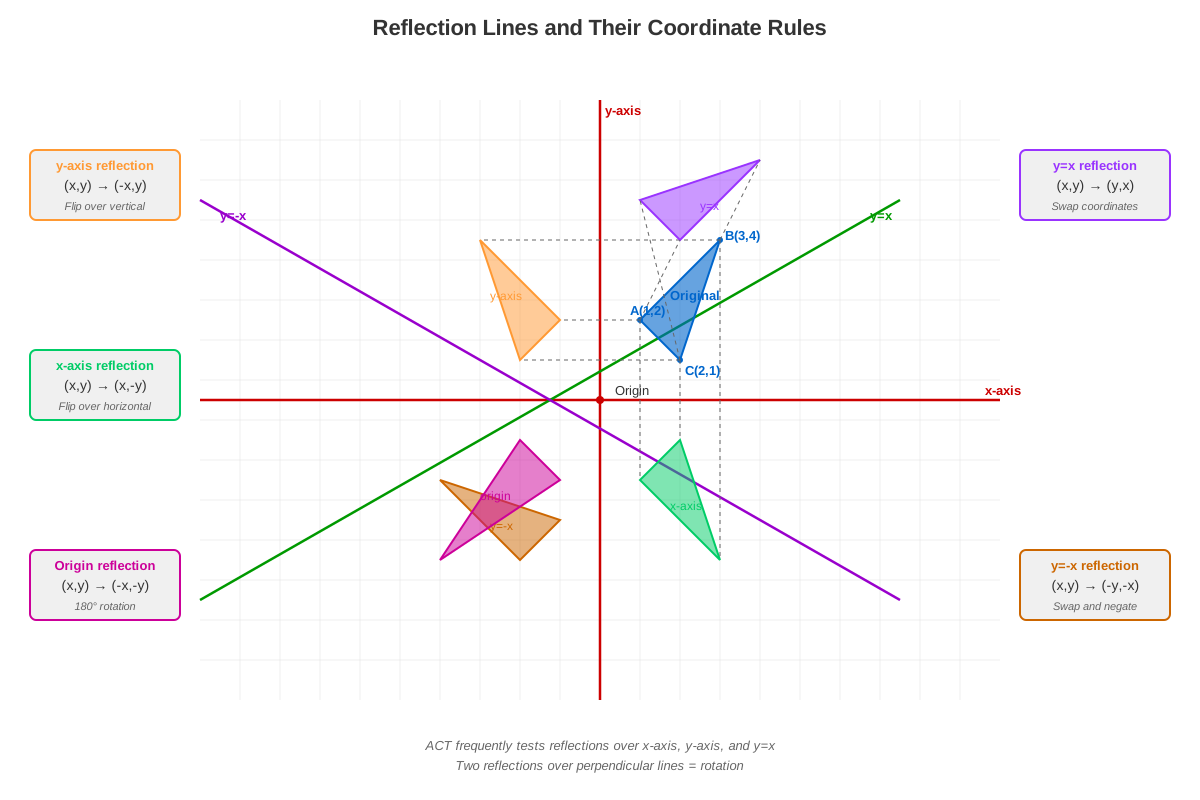
A reflection flips a figure across a line of reflection, creating a mirror image. The ACT primarily tests reflections across the x-axis, y-axis, the line y = x, and the line y = -x.
Reflection rules:
| Line of Reflection | Transformation Rule | Effect |
|---|---|---|
| x-axis | (x, y) → (x, -y) | Flips vertically; changes sign of y |
| y-axis | (x, y) → (-x, y) | Flips horizontally; changes sign of x |
| y = x | (x, y) → (y, x) | Swaps coordinates |
| y = -x | (x, y) → (-y, -x) | Swaps and negates coordinates |
| Origin | (x, y) → (-x, -y) | Rotates 180° (equivalent to reflection through origin) |
Reflecting point (4, -3) across the x-axis produces (4, 3), while reflecting across y = x produces (-3, 4). Reflections reverse orientation, meaning figures appear "flipped" compared to their original position.
Rotations
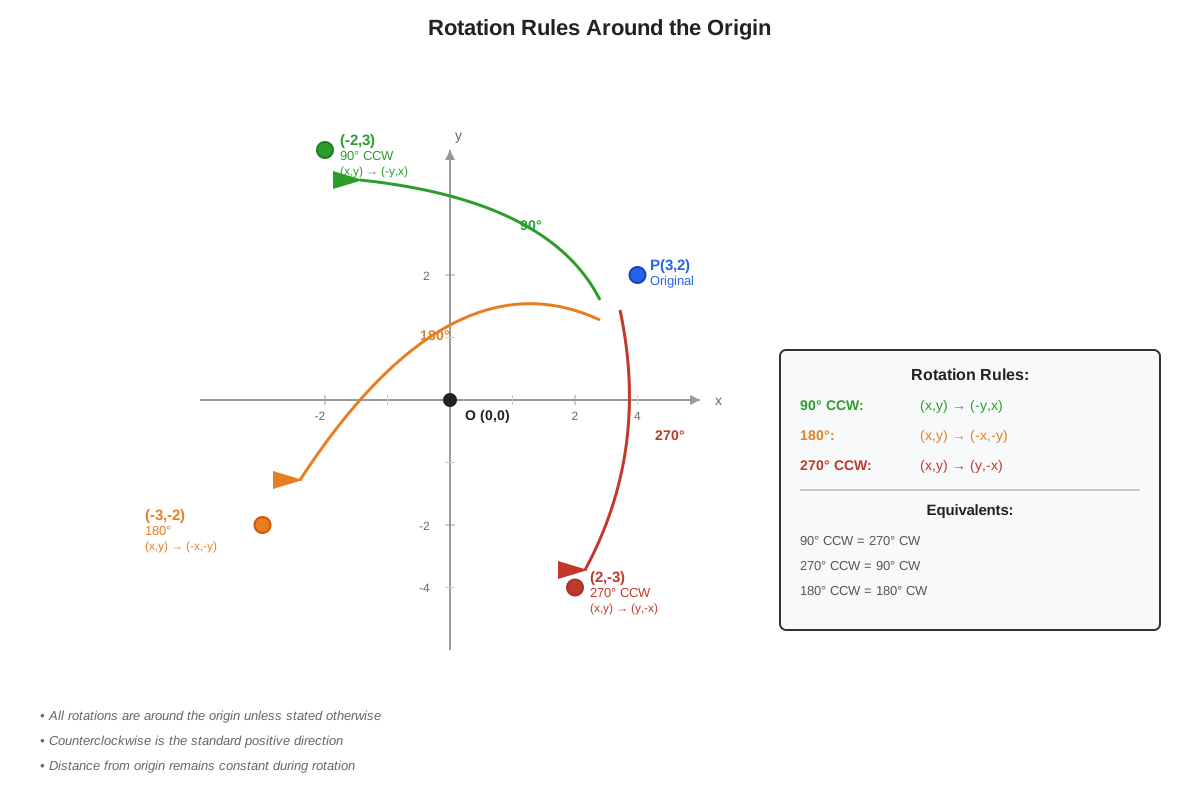
A rotation turns a figure around a fixed point (usually the origin on the ACT) by a specified angle. Counterclockwise rotations are considered positive, while clockwise rotations are negative. The ACT most commonly tests 90°, 180°, and 270° rotations about the origin.
Rotation rules about the origin:
| Rotation Angle | Transformation Rule | Quadrant Movement |
|---|---|---|
| 90° counterclockwise | (x, y) → (-y, x) | I→II→III→IV→I |
| 180° | (x, y) → (-x, -y) | I→III, II→IV |
| 270° counterclockwise (90° clockwise) | (x, y) → (y, -x) | I→IV→III→II→I |
Rotating point (5, 2) by 90° counterclockwise about the origin yields (-2, 5). A 180° rotation of any point (x, y) produces (-x, -y), which is equivalent to reflection through the origin. Rotations preserve orientation for 360° multiples but change it for other angles.
Dilations
A dilation enlarges or reduces a figure by a scale factor k relative to a center point (usually the origin). Dilations are non-rigid transformations that change size but preserve shape (creating similar figures).
Dilation rule from the origin:
(x, y) → (kx, ky)
When k > 1, the dilation is an enlargement (figure grows larger). When 0 < k < 1, the dilation is a reduction (figure shrinks). When k < 0, the dilation includes a reflection through the center point.
For example, dilating point (3, -4) by scale factor 2 produces (6, -8). Dilating by scale factor 1/2 produces (1.5, -2). Important properties of dilations:
- Distances from the center multiply by |k|
- Perimeters multiply by |k|
- Areas multiply by k²
- Angles remain unchanged
- Lines through the center remain unchanged
Composition of Transformations
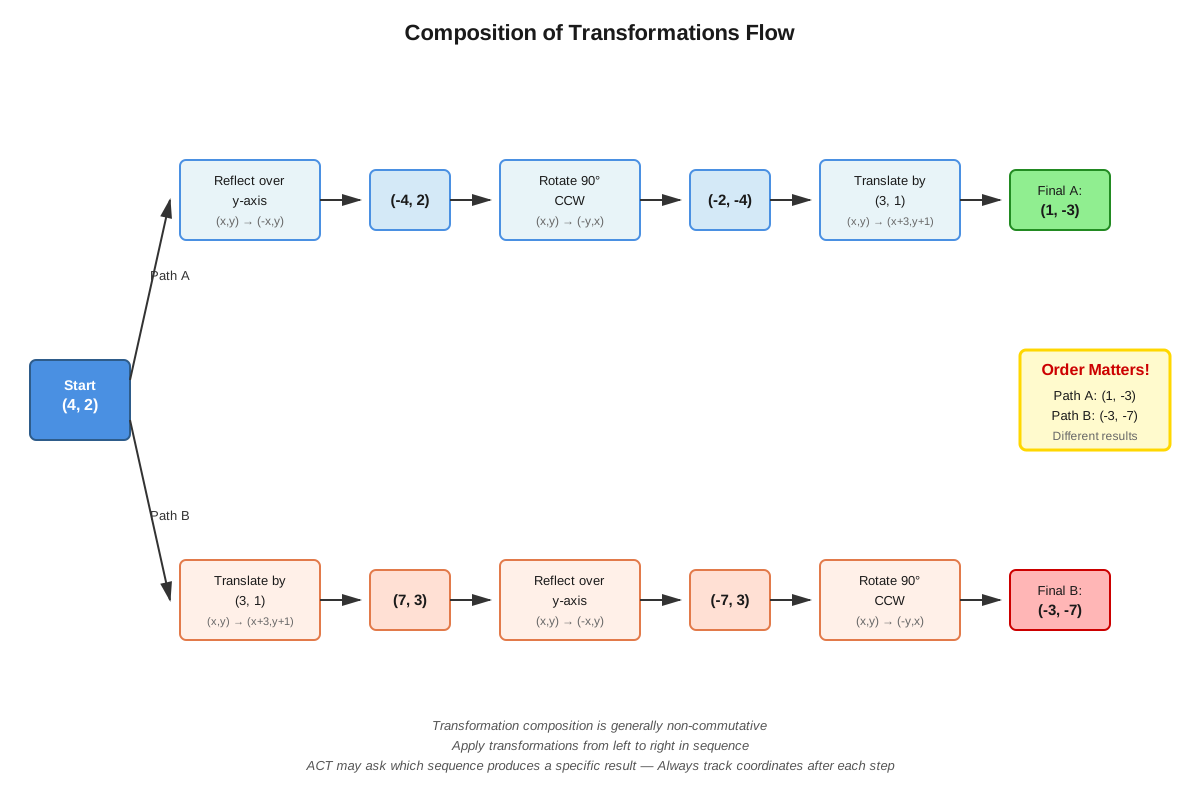
Composition refers to applying multiple transformations sequentially. The order of transformations matters except in specific cases (such as two translations or two reflections across parallel lines). When reading composition notation, apply transformations from right to left, similar to function composition.
For example, if asked to reflect point (2, 3) across the x-axis and then translate 4 units left:
- First reflection: (2, 3) → (2, -3)
- Then translation: (2, -3) → (-2, -3)
The ACT may test whether students understand that different orders produce different results. Reflecting then rotating generally produces a different outcome than rotating then reflecting.
Concept Relationships
The four transformation types form a hierarchy based on their properties. Translations serve as the simplest transformation, involving only addition/subtraction. Reflections introduce the concept of changing signs and swapping coordinates, building on translation understanding. Rotations combine aspects of both reflections and coordinate swapping, representing more complex coordinate changes. Dilations stand apart as the only non-rigid transformation, multiplying rather than adding/subtracting coordinates.
All rigid transformations (translations, reflections, rotations) → preserve congruence → maintain all distances and angles → create identical figures in different positions. This relationship connects to the prerequisite knowledge of congruent figures and the distance formula, which can verify that distances remain unchanged.
Dilations → create similar figures → preserve shape but not size → connect to proportional reasoning and scale factor concepts from geometry. Understanding dilations enables progression to more advanced topics like similarity transformations and coordinate proofs of geometric theorems.
The composition of transformations → builds on individual transformation rules → requires sequential thinking → connects to function composition from algebra. Mastering individual transformations is essential before attempting compositions, which appear in higher-difficulty ACT questions.
Transformation concepts → enable coordinate geometry proofs → support analytic approaches to geometric problems → bridge algebra and geometry. This connection makes transformations central to the ACT's integrated approach to mathematics, where multiple concepts combine in single questions.
Quick check — test yourself on Transformations on coordinate plane so far.
Try Flashcards →High-Yield Facts
⭐ Reflection across the x-axis changes the sign of the y-coordinate only: (x, y) → (x, -y)
⭐ Reflection across the y-axis changes the sign of the x-coordinate only: (x, y) → (-x, y)
⭐ 90° counterclockwise rotation about the origin: (x, y) → (-y, x)
⭐ 180° rotation about the origin (or reflection through origin): (x, y) → (-x, -y)
⭐ Dilation by scale factor k from the origin: (x, y) → (kx, ky)
- Reflection across y = x swaps the coordinates: (x, y) → (y, x)
- Translation by h units horizontally and k units vertically: (x, y) → (x + h, y + k)
- 270° counterclockwise rotation (equivalent to 90° clockwise): (x, y) → (y, -x)
- Rigid transformations preserve distance, angle measures, and area
- Dilations with scale factor k multiply distances by |k| and areas by k²
- Composition order matters: performing transformation A then B generally differs from B then A
- Reflections reverse orientation (clockwise becomes counterclockwise)
- Two reflections across intersecting lines equal a rotation by twice the angle between the lines
- A figure and its image under rigid transformation are always congruent
- The origin (0, 0) remains fixed under rotations and dilations centered at the origin
Common Misconceptions
Misconception: Reflection across the x-axis changes the x-coordinate.
Correction: Reflection across the x-axis only affects the y-coordinate, changing its sign: (x, y) → (x, -y). The x-coordinate remains unchanged because points move vertically to mirror across a horizontal line.
Misconception: All transformations preserve the size and shape of figures.
Correction: Only rigid transformations (translations, reflections, rotations) preserve both size and shape. Dilations preserve shape but change size, creating similar rather than congruent figures.
Misconception: Rotating 90° clockwise is the same as rotating 90° counterclockwise.
Correction: These rotations produce different results. 90° counterclockwise: (x, y) → (-y, x), while 90° clockwise: (x, y) → (y, -x). The signs and positions differ between these transformations.
Misconception: When composing transformations, the order doesn't matter.
Correction: Order is crucial in composition. Reflecting then translating generally produces a different result than translating then reflecting. Only specific combinations (like two translations) are commutative.
Misconception: Dilation by scale factor 2 doubles the area of a figure.
Correction: Dilation by scale factor k multiplies linear dimensions by k but multiplies area by k². A scale factor of 2 actually quadruples the area (2² = 4), not doubles it.
Misconception: Reflection across y = x is the same as reflection across y = -x.
Correction: These produce different results. Reflection across y = x: (x, y) → (y, x), while reflection across y = -x: (x, y) → (-y, -x). The latter includes sign changes that the former does not.
Misconception: A 180° rotation is different from reflecting through the origin.
Correction: These transformations are equivalent. Both map (x, y) → (-x, -y), changing the signs of both coordinates and producing identical results.
Worked Examples
Example 1: Multiple Transformations
Problem: Point A has coordinates (3, -2). Point A is first reflected across the y-axis, then rotated 90° counterclockwise about the origin, and finally translated 4 units up. What are the final coordinates of point A?
Solution:
Step 1: Apply reflection across y-axis
- Rule: (x, y) → (-x, y)
- (3, -2) → (-3, -2)
Step 2: Apply 90° counterclockwise rotation about origin
- Rule: (x, y) → (-y, x)
- (-3, -2) → (2, -3)
- Note: The y-coordinate becomes the new x-coordinate with opposite sign, and the x-coordinate becomes the new y-coordinate
Step 3: Apply translation 4 units up
- Rule: (x, y) → (x, y + 4)
- (2, -3) → (2, 1)
Final Answer: (2, 1)
Connection to Learning Objectives: This problem demonstrates the application of transformation rules to ACT-style questions and shows how to handle composition of multiple transformations by applying each rule sequentially in the correct order.
Example 2: Dilation and Area
Problem: Triangle PQR has vertices P(2, 4), Q(6, 4), and R(4, 8). The triangle undergoes a dilation centered at the origin with scale factor 1/2. What is the ratio of the area of the dilated triangle to the area of the original triangle?
Solution:
Step 1: Apply dilation rule to find new coordinates
- Rule: (x, y) → (kx, ky) where k = 1/2
- P(2, 4) → P'(1, 2)
- Q(6, 4) → Q'(3, 2)
- R(4, 8) → R'(2, 4)
Step 2: Recognize the area relationship for dilations
- When a figure is dilated by scale factor k, the area is multiplied by k²
- Scale factor = 1/2
- Area multiplier = (1/2)² = 1/4
Step 3: Calculate the ratio
- Area of dilated triangle / Area of original triangle = 1/4 or 1:4
Alternative verification (if needed):
- Original triangle: base = 4, height = 4, area = (1/2)(4)(4) = 8
- Dilated triangle: base = 2, height = 2, area = (1/2)(2)(2) = 2
- Ratio = 2/8 = 1/4 ✓
Final Answer: 1/4 or 1:4
Connection to Learning Objectives: This problem illustrates how dilations affect geometric properties beyond just coordinates, specifically demonstrating that areas scale by the square of the scale factor—a high-yield concept for ACT questions involving transformations and measurement.
Exam Strategy
When approaching ACT transformation questions, first identify which transformation type is being tested by looking for trigger words: "reflected" or "flipped" indicates reflection; "rotated" or "turned" indicates rotation; "translated" or "shifted/moved" indicates translation; "dilated," "enlarged," or "reduced" indicates dilation. These keywords immediately tell you which coordinate rule to apply.
Exam Tip: If a question shows a graph with both original and transformed figures, quickly check whether the size changed (dilation) or stayed the same (rigid transformation). This eliminates half the possibilities immediately.
For multiple-choice questions, use process of elimination by checking one coordinate at a time. If a question asks for the image of (5, -3) after reflection across the x-axis, immediately eliminate any answer choice that doesn't have 5 as the x-coordinate. This strategy often eliminates 2-3 answer choices without full calculation.
Time allocation: Simple single-transformation questions should take 30-45 seconds. Multi-step transformation problems may require 60-90 seconds. If a problem requires more than 2 minutes, mark it and return later—these questions often test the same concepts as simpler ones worth equal points.
Watch for questions that describe transformations verbally rather than using mathematical notation. "The figure moves 3 units left and 2 units down" means translation by (-3, -2). "The figure is flipped over the x-axis" means reflection with rule (x, y) → (x, -y). Translating verbal descriptions into coordinate rules is a crucial ACT skill.
Strategic approach for composition problems:
- Write down the starting coordinates clearly
- Apply transformations one at a time, writing intermediate results
- Double-check that you applied transformations in the correct order
- Verify your final answer makes sense (e.g., if reflecting across x-axis, y-coordinate sign should change)
For dilation questions involving area or perimeter, remember the scaling relationships: linear measurements multiply by k, areas multiply by k², and volumes multiply by k³. This knowledge allows you to answer questions about transformed figure properties without calculating actual measurements.
Memory Techniques
TRAP mnemonic for transformation types:
- Translation: slide (add/subtract)
- Reflection: flip (change signs/swap)
- Angle rotation: turn (complex coordinate changes)
- Proportional dilation: scale (multiply)
"X marks the spot" for reflection across x-axis: The X stays, the y changes sign. Similarly, "Y you ask?" for y-axis reflection: The Y stays, the x changes sign.
"Negative Y becomes X" for 90° counterclockwise rotation: (x, y) → (-y, x). Visualize the y-coordinate moving to the x-position but becoming negative.
"Swap and match" for reflection across y = x: The coordinates swap positions and match their signs (both positive or both negative stay that way).
"Double trouble" for 180° rotation: Both coordinates change sign, creating "double" the sign changes.
"K-squared for area" for dilations: When scale factor is k, area multiplies by k². Visualize a square with side length k having area k².
Visualization strategy: For any transformation, imagine the coordinate plane as a piece of paper. Translations slide the paper, reflections fold it along a line, rotations spin it around a pin at the origin, and dilations use a photocopier to enlarge or reduce it.
Summary
Transformations on the coordinate plane represent essential ACT Math content, testing students' ability to manipulate coordinates through translations, reflections, rotations, and dilations. Translations shift figures by adding or subtracting from coordinates, reflections flip figures across lines by changing signs or swapping coordinates, rotations turn figures around the origin using specific coordinate rules, and dilations scale figures by multiplying coordinates by a scale factor. Rigid transformations (translations, reflections, rotations) preserve congruence, while dilations create similar figures. Success on ACT transformation questions requires memorizing coordinate rules for each transformation type, understanding how to compose multiple transformations in sequence, and recognizing how transformations affect geometric properties like distance and area. The most frequently tested concepts include reflections across the x-axis and y-axis, 90° and 180° rotations about the origin, and dilations with their effect on area. Students who master these coordinate rules and can quickly identify transformation types from verbal descriptions or graphs will efficiently handle the 3-5 transformation questions appearing on each ACT Math section.
Key Takeaways
- The four fundamental transformations are translations (slide), reflections (flip), rotations (turn), and dilations (scale)
- Reflection across x-axis: (x, y) → (x, -y); across y-axis: (x, y) → (-x, y); across y = x: (x, y) → (y, x)
- 90° counterclockwise rotation: (x, y) → (-y, x); 180° rotation: (x, y) → (-x, -y)
- Dilation by scale factor k: (x, y) → (kx, ky); areas multiply by k², not k
- Rigid transformations (translations, reflections, rotations) preserve size and create congruent figures; dilations preserve shape but change size
- Order matters in composition of transformations—apply each transformation sequentially and carefully
- Identify transformation type from trigger words in questions: reflected, rotated, translated, dilated
Related Topics
Distance and Midpoint Formulas: After mastering transformations, students can use these formulas to verify that rigid transformations preserve distances between points and to find centers of transformed figures. This combination appears in coordinate geometry proofs.
Symmetry and Functions: Understanding reflections enables analysis of even and odd functions, which are symmetric across the y-axis and origin respectively. This connection bridges coordinate geometry and function analysis.
Matrices and Linear Transformations: Advanced courses represent transformations using matrix multiplication, providing an algebraic framework for the geometric concepts learned here. ACT preparation builds the conceptual foundation for this higher-level mathematics.
Trigonometric Functions and Rotations: Rotations connect to angle measures and trigonometry, particularly when rotating points not at standard 90° increments. This relationship becomes important in precalculus and calculus.
Similarity and Congruence Proofs: Transformations provide the foundation for proving figures are similar (through dilations) or congruent (through rigid transformations), essential skills for geometric reasoning on standardized tests.
Practice CTA
Now that you've mastered the core concepts of transformations on the coordinate plane, it's time to solidify your understanding through practice. Attempt the practice questions to apply these transformation rules to ACT-style problems, testing your ability to work quickly and accurately under exam conditions. Use the flashcards to drill the essential coordinate rules until they become automatic—this memorization will save valuable time on test day. Remember, transformation questions represent high-yield content on the ACT, and consistent practice with these concepts will directly translate to points on your exam. You've built the foundation; now strengthen it through application!
Sign up free to keep reading
Create a free AnvayaPrep account to finish this ACT guide on Transformations on coordinate plane — plus flashcards and practice questions.