Overview
Rotations are a fundamental transformation in coordinate geometry that involve turning a figure around a fixed point, typically the origin, by a specified angle. On the ACT Math test, rotation problems assess a student's ability to visualize spatial transformations, apply coordinate rules, and understand how geometric figures behave under transformation. These questions frequently appear in the coordinate geometry section and often combine rotation concepts with other transformations like reflections and translations.
Understanding ACT rotations is essential because these problems test both computational skills and spatial reasoning—two critical competencies that the ACT values highly. Rotation questions typically appear 1-2 times per test and are considered medium-difficulty problems that separate average scorers from high achievers. Students who master rotations gain a significant advantage because these problems, while appearing complex, follow predictable patterns and rules that can be memorized and applied systematically.
Rotations connect to broader mathematical concepts including trigonometry, the unit circle, angle measurement, and the coordinate plane. They also relate to symmetry, transformational geometry, and function composition. A solid grasp of rotations provides the foundation for understanding more advanced topics in precalculus and calculus, making this topic both immediately practical for the ACT and valuable for future mathematical study.
Learning Objectives
- [ ] Identify when Rotations is being tested in ACT Math questions
- [ ] Explain the core rule or strategy behind Rotations on the coordinate plane
- [ ] Apply Rotations to ACT-style questions accurately and efficiently
- [ ] Determine the coordinates of a point after rotation by 90°, 180°, or 270° around the origin
- [ ] Recognize rotation patterns and their relationship to angle measures
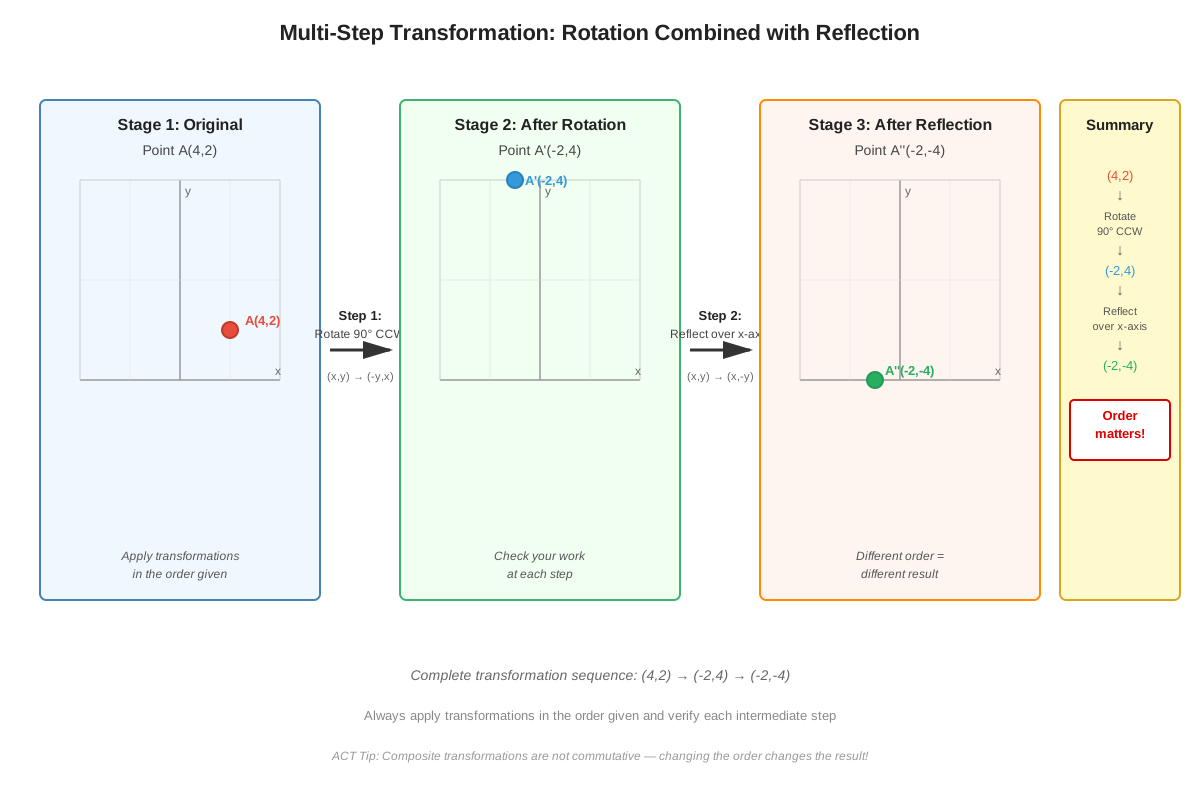
- [ ] Solve multi-step problems involving rotations combined with other transformations
- [ ] Visualize rotational transformations without graphing when time is limited
Prerequisites
- Coordinate plane fundamentals: Understanding x and y coordinates is essential because rotations transform points from one location to another on the plane
- Angle measurement: Knowledge of degrees and the standard position of angles enables proper application of rotation rules
- Basic trigonometry: Familiarity with sine and cosine helps understand why rotation formulas work, though memorizing the rules is sufficient for the ACT
- Quadrant identification: Recognizing which quadrant contains a point helps verify rotation results and catch calculation errors
- Plotting points: The ability to visualize points on a coordinate plane supports understanding of how rotations move figures
Why This Topic Matters
Rotations appear in real-world applications ranging from computer graphics and animation to engineering design and physics. When video game developers create spinning objects, architects design rotating structures, or physicists analyze circular motion, they use the mathematical principles of rotation. Understanding rotations develops spatial reasoning skills that extend far beyond mathematics into fields like architecture, mechanical engineering, and computer science.
On the ACT Math test, rotation problems appear with moderate frequency—typically 1-2 questions per exam. These questions usually fall into the "Preparing for Higher Math" category, specifically within the Geometry subcategory. The ACT tests rotations in several distinct ways: direct application of rotation rules to single points, rotation of entire figures, identification of rotation angles based on before-and-after positions, and combination problems where rotation is one step in a multi-transformation sequence.
Common question formats include: "Point P(3, 4) is rotated 90° counterclockwise about the origin. What are the coordinates of the image?" or "Triangle ABC is rotated 180° about the origin. Which of the following shows the correct coordinates of the vertices?" The ACT also tests rotations indirectly through symmetry questions and problems involving circular motion. Recognition of these question types is the first step toward consistent accuracy.
Core Concepts
Definition of Rotation
A rotation is a transformation that turns a figure around a fixed point called the center of rotation through a specified angle called the angle of rotation. On the ACT, the center of rotation is almost always the origin (0, 0), and angles are measured in degrees. Rotations preserve the size and shape of figures—they are rigid transformations or isometries—meaning the pre-image and image are congruent.
The direction of rotation matters significantly. Unless otherwise specified, rotations are measured counterclockwise from the positive x-axis, following the standard mathematical convention. A positive angle indicates counterclockwise rotation, while a negative angle indicates clockwise rotation. For example, a rotation of -90° is equivalent to a rotation of 270° counterclockwise.
Standard Rotation Rules for the Origin
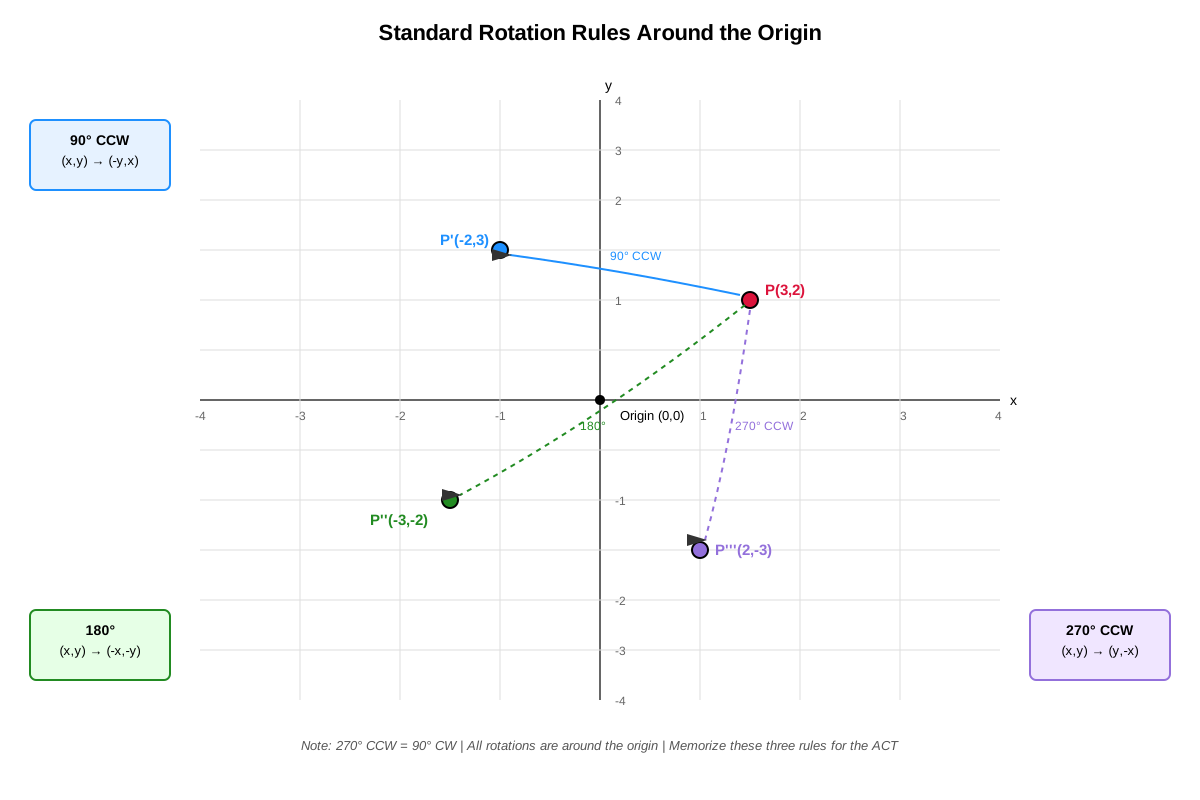
The ACT primarily tests four specific rotations about the origin, each with a memorizable coordinate rule:
| Rotation Angle | Rule | Example: (3, 2) becomes |
|---|---|---|
| 90° counterclockwise | (x, y) → (-y, x) | (-2, 3) |
| 180° (either direction) | (x, y) → (-x, -y) | (-3, -2) |
| 270° counterclockwise | (x, y) → (y, -x) | (2, -3) |
| 360° | (x, y) → (x, y) | (3, 2) |
These rules are the highest-yield content for ACT rotation questions. Students should memorize these transformations because they appear repeatedly and enable rapid problem-solving without extensive calculation.
Understanding the 90° Counterclockwise Rotation
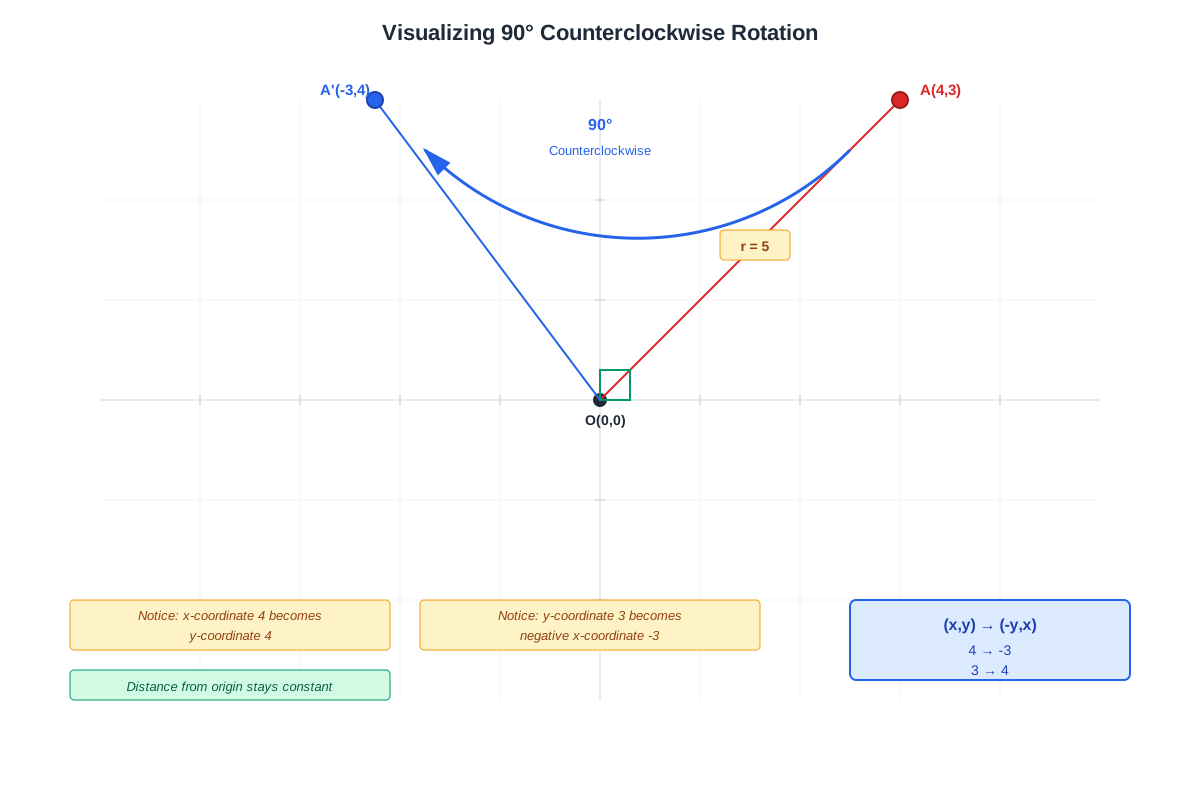
The transformation (x, y) → (-y, x) for a 90° counterclockwise rotation can be understood through visualization. Imagine point (3, 2) on the coordinate plane. When rotated 90° counterclockwise around the origin, the point moves to a position that is the same distance from the origin but in a new direction. The x-coordinate becomes the negative of the original y-coordinate, and the y-coordinate becomes the original x-coordinate.
To verify this rule, consider the point (1, 0) on the positive x-axis. Rotating 90° counterclockwise moves it to (0, 1) on the positive y-axis. Applying the rule: (1, 0) → (-0, 1) = (0, 1). The rule works consistently for all points.
Understanding the 180° Rotation
A 180° rotation is the simplest transformation: both coordinates change sign. The rule (x, y) → (-x, -y) reflects the fact that rotating halfway around a circle places a point directly opposite its starting position. This rotation is the same whether performed clockwise or counterclockwise, making it unique among the standard rotations.
Geometrically, a 180° rotation about the origin is equivalent to reflecting a point across both axes or reflecting it through the origin itself. This connection to reflections helps students verify their answers using multiple approaches.
Understanding the 270° Counterclockwise Rotation
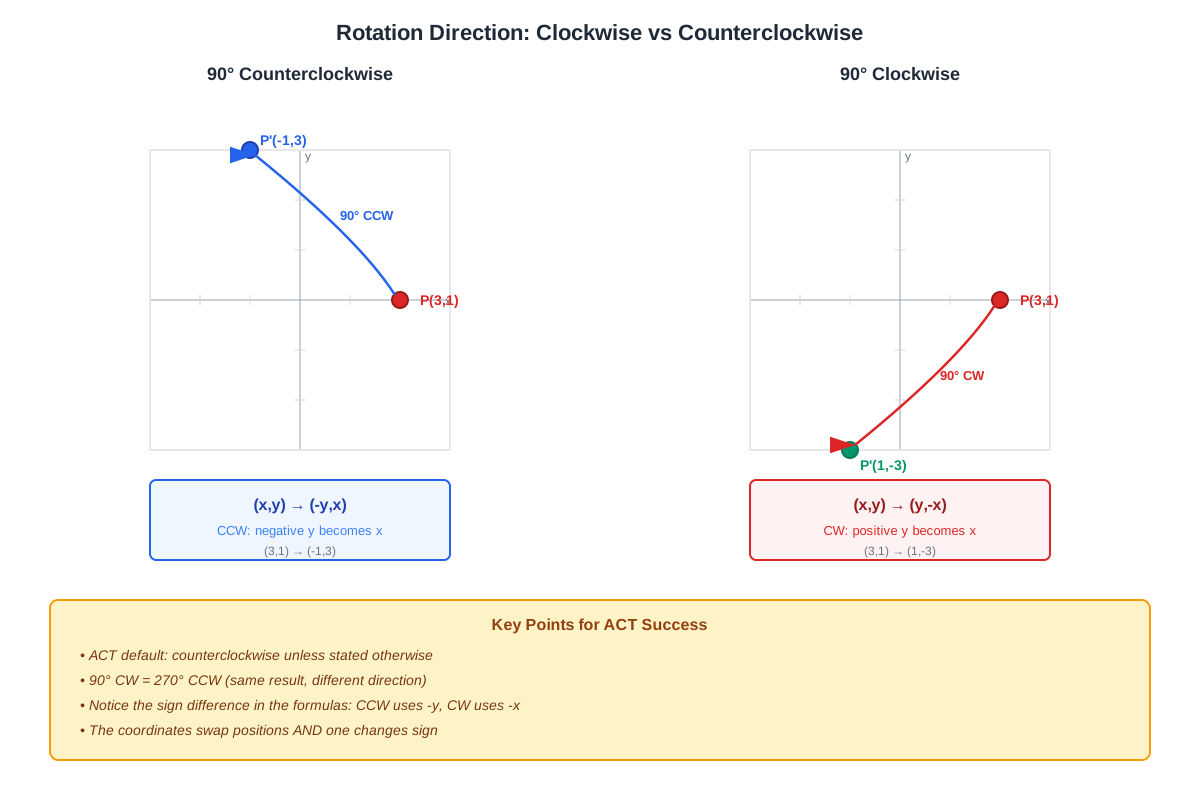
The 270° counterclockwise rotation follows the rule (x, y) → (y, -x). This rotation is equivalent to a 90° clockwise rotation, which the ACT sometimes uses to test whether students understand angle equivalence. A 270° counterclockwise turn and a 90° clockwise turn produce identical results.
Students can remember this rule by noting that it's similar to the 90° rule but with signs adjusted: instead of (-y, x), we have (y, -x). The pattern shows that the coordinates swap positions, with one coordinate changing sign.
Rotating Figures vs. Rotating Points
When the ACT asks about rotating an entire figure (triangle, quadrilateral, etc.), the approach is to rotate each vertex individually using the appropriate rule, then connect the transformed vertices. The figure's shape and size remain unchanged—only its position and orientation change.
For example, if triangle ABC has vertices A(1, 2), B(3, 1), and C(2, 4), and the triangle is rotated 90° counterclockwise about the origin, each vertex transforms independently:
- A(1, 2) → A'(-2, 1)
- B(3, 1) → B'(-1, 3)
- C(2, 4) → C'(-4, 2)
The new triangle A'B'C' is congruent to the original but occupies a different position on the plane.
Clockwise vs. Counterclockwise Rotations
The ACT occasionally specifies clockwise rotations to test conceptual understanding. A 90° clockwise rotation is equivalent to a 270° counterclockwise rotation, and vice versa. The rule for 90° clockwise is (x, y) → (y, -x), which is the same as the 270° counterclockwise rule.
Students should recognize these equivalences:
- 90° clockwise = 270° counterclockwise
- 270° clockwise = 90° counterclockwise
- 180° clockwise = 180° counterclockwise
Composition of Rotations
Sometimes the ACT tests multiple rotations in sequence. When two rotations about the same center are performed consecutively, their angles add. For example, a 90° rotation followed by another 90° rotation equals a 180° rotation. This additive property simplifies multi-step problems: instead of applying two separate transformations, students can add the angles and apply a single rotation.
If a point undergoes a 90° counterclockwise rotation followed by a 180° rotation, the total rotation is 270° counterclockwise, and the single rule (x, y) → (y, -x) can be applied directly.
Concept Relationships
The core concepts of rotations build upon each other in a logical progression. Understanding the definition of rotation provides the foundation for learning specific rotation rules. These rules connect directly to angle measurement and the unit circle from trigonometry, where the sine and cosine functions generate the general rotation formulas.
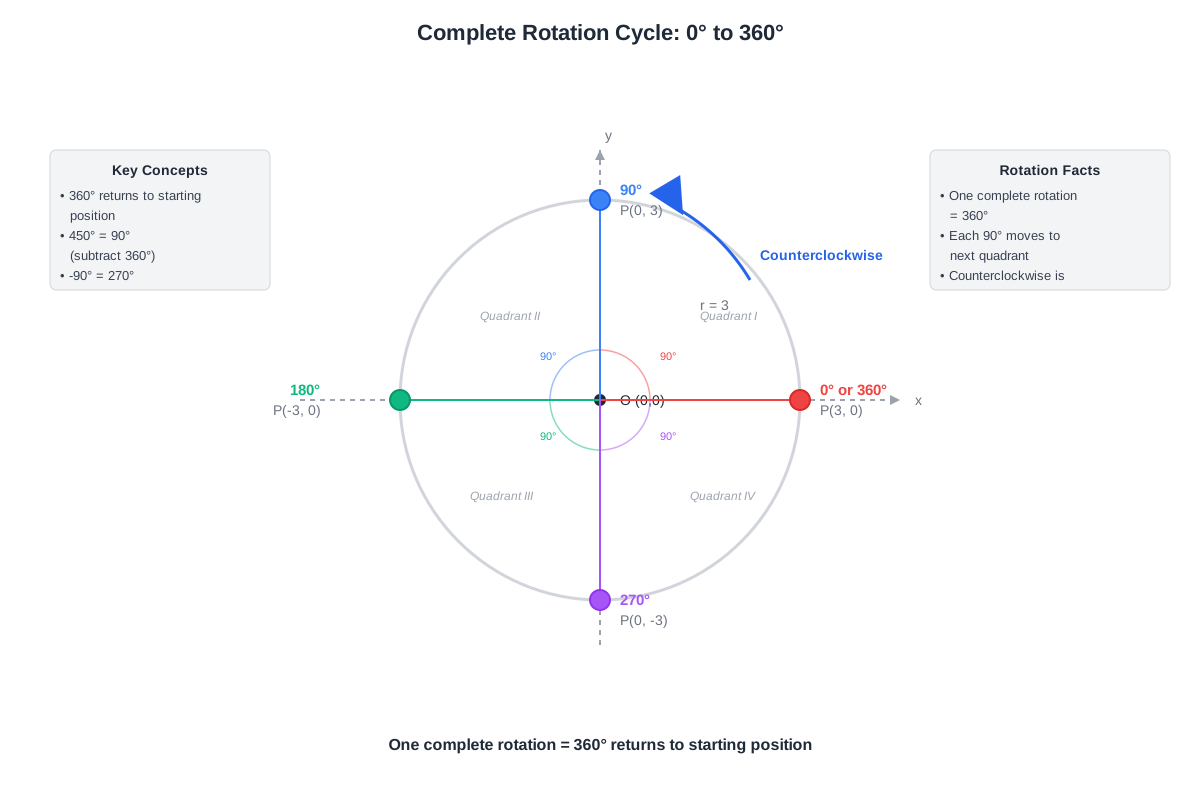
The relationship between clockwise and counterclockwise rotations demonstrates angle equivalence, which connects to the concept of coterminal angles in trigonometry. Understanding that 90° clockwise equals 270° counterclockwise reinforces the cyclical nature of rotations and helps students recognize that 360° returns any point to its original position.
Rotating individual points serves as the building block for rotating entire figures, illustrating how complex transformations reduce to repeated application of simple rules. This concept extends to composition of rotations, where multiple transformations combine through angle addition.
Rotations also connect to prerequisite topics: coordinate plane fundamentals enable plotting and tracking points through transformations, while quadrant identification helps verify that rotated points land in the expected regions. The relationship to reflections becomes apparent when studying 180° rotations, which can be viewed as double reflections.
Concept flow: Basic rotation definition → Memorization of standard rules → Application to single points → Extension to figures → Composition of multiple rotations → Integration with other transformations
Quick check — test yourself on Rotations so far.
Try Flashcards →High-Yield Facts
⭐ The 90° counterclockwise rotation rule is (x, y) → (-y, x)—this is the most frequently tested rotation on the ACT
⭐ The 180° rotation rule is (x, y) → (-x, -y)—both coordinates simply change sign
⭐ The 270° counterclockwise rotation rule is (x, y) → (y, -x)—equivalent to 90° clockwise
⭐ Rotations preserve distance from the center of rotation—the image is always the same distance from the origin as the pre-image
⭐ Unless specified otherwise, rotations are counterclockwise and centered at the origin on the ACT
- A 360° rotation returns any point to its original position: (x, y) → (x, y)
- Rotating a figure rotates each vertex individually; then connect the transformed vertices
- A 90° clockwise rotation uses the rule (x, y) → (y, -x), identical to 270° counterclockwise
- Consecutive rotations about the same center add: 90° + 90° = 180° total rotation
- Rotations are rigid transformations, meaning they preserve size, shape, and angle measures
- The distance formula can verify rotation accuracy: both pre-image and image should be equidistant from the origin
- Rotations change the orientation of figures (clockwise vs. counterclockwise arrangement of vertices)
Common Misconceptions
Misconception: Rotating 90° clockwise and 90° counterclockwise produce the same result.
Correction: These rotations produce different results. A 90° clockwise rotation moves points in the opposite direction from a 90° counterclockwise rotation. The 90° clockwise rule is (x, y) → (y, -x), while 90° counterclockwise is (x, y) → (-y, x).
Misconception: The rotation rules work for any center of rotation.
Correction: The standard rotation rules (x, y) → (-y, x), etc., only apply when rotating about the origin (0, 0). Rotations about other points require different, more complex procedures involving translation that rarely appear on the ACT.
Misconception: In a 180° rotation, the coordinates stay positive if they started positive.
Correction: A 180° rotation changes the sign of both coordinates: (x, y) → (-x, -y). A point in Quadrant I (both coordinates positive) rotates to Quadrant III (both coordinates negative).
Misconception: Rotating a figure changes its size or shape.
Correction: Rotations are rigid transformations that preserve all distances and angles. The rotated figure is congruent to the original—only its position and orientation change, never its size or shape.
Misconception: The order of coordinates doesn't matter when applying rotation rules.
Correction: The order is critical. For 90° counterclockwise, (x, y) → (-y, x) means the new x-coordinate is the negative of the old y-coordinate, and the new y-coordinate is the old x-coordinate. Reversing this order produces incorrect results.
Misconception: A 270° rotation is completely different from a 90° rotation.
Correction: A 270° counterclockwise rotation is equivalent to a 90° clockwise rotation. Understanding this equivalence helps students solve problems more efficiently and provides a way to check answers.
Misconception: You need to graph points to solve rotation problems.
Correction: While graphing can help visualize rotations, it's unnecessary and time-consuming on the ACT. Memorizing and applying the rotation rules directly to coordinates is faster and more accurate.
Worked Examples
Example 1: Single Point Rotation
Problem: Point P has coordinates (5, -3). If P is rotated 90° counterclockwise about the origin, what are the coordinates of the image P'?
Solution:
Step 1: Identify the rotation type and rule.
- The problem specifies 90° counterclockwise about the origin
- The rule for this rotation is (x, y) → (-y, x)
Step 2: Identify the original coordinates.
- x = 5
- y = -3
Step 3: Apply the rotation rule.
- New x-coordinate = -y = -(-3) = 3
- New y-coordinate = x = 5
- Therefore, P'(3, 5)
Step 4: Verify the answer makes sense.
- Original point P(5, -3) is in Quadrant IV (positive x, negative y)
- After 90° counterclockwise rotation, the point should be in Quadrant I (positive x, positive y)
- P'(3, 5) is indeed in Quadrant I ✓
Answer: P'(3, 5)
This example demonstrates the direct application of rotation rules, addressing Learning Objective 3 (Apply Rotations to ACT-style questions accurately).
Example 2: Figure Rotation with Multiple Vertices
Problem: Triangle ABC has vertices A(2, 1), B(4, 1), and C(3, 4). The triangle is rotated 180° about the origin to form triangle A'B'C'. What are the coordinates of vertex C'?
Solution:
Step 1: Identify the rotation and its rule.
- 180° rotation about the origin
- Rule: (x, y) → (-x, -y)
Step 2: Focus on the requested vertex.
- The question asks only for C', not all vertices
- Original coordinates of C are (3, 4)
Step 3: Apply the 180° rotation rule to point C.
- C(3, 4) → C'(-3, -4)
- New x-coordinate = -3
- New y-coordinate = -4
Step 4: Verify using quadrant logic.
- C(3, 4) is in Quadrant I
- A 180° rotation should place the image in Quadrant III (opposite quadrant)
- C'(-3, -4) is in Quadrant III ✓
Step 5: Additional verification using distance.
- Distance from origin to C: √(3² + 4²) = √(9 + 16) = √25 = 5
- Distance from origin to C': √((-3)² + (-4)²) = √(9 + 16) = √25 = 5 ✓
- Distances match, confirming the rotation preserves distance
Answer: C'(-3, -4)
This example shows how to handle figure rotations by focusing on individual vertices and demonstrates verification techniques, addressing Learning Objectives 2 and 3.
Exam Strategy
When approaching rotation questions on the ACT, begin by identifying the trigger words that signal a rotation problem: "rotated," "rotation," "turned about," "revolved around," or "spun." These phrases immediately indicate that transformation rules apply.
Step-by-step approach:
- Identify the center of rotation (almost always the origin on the ACT)
- Determine the angle and direction (90°, 180°, 270°, clockwise vs. counterclockwise)
- Select the appropriate rule from your memorized set
- Apply the rule to the given coordinates
- Verify using quadrant logic or distance preservation
Process of elimination tips:
- Eliminate answer choices in the wrong quadrant. A 90° counterclockwise rotation from Quadrant I should land in Quadrant II, so eliminate any choices in Quadrants I, III, or IV.
- Check if the distance from the origin is preserved. Calculate the distance for the original point and eliminate any answer choices at a different distance.
- For 180° rotations, both coordinates must change sign. Eliminate choices where only one coordinate changed or where neither changed.
- If the problem involves a 360° rotation or multiple of 360°, the point returns to its original position—look for the original coordinates in the answer choices.
Time allocation: Rotation problems should take 30-45 seconds once the rules are memorized. If a problem takes longer, skip it and return later. These problems reward quick pattern recognition rather than lengthy calculation.
Common trap answers: The ACT often includes answer choices that result from applying the wrong rotation rule (e.g., using the 270° rule when 90° was specified) or from sign errors (forgetting to negate a coordinate). Always double-check which coordinate becomes negative.
Memory Techniques
Mnemonic for 90° counterclockwise rotation (x, y) → (-y, x):
"New Y becomes X" (NY → X)
The Negative of the old Y becomes the new X, and the old X becomes the new Y.
Mnemonic for 180° rotation (x, y) → (-x, -y):
"Opposite signs, opposite sides"
Both coordinates flip signs, placing the point on the opposite side of the origin.
Mnemonic for 270° counterclockwise rotation (x, y) → (y, -x):
"Y comes first, X gets negative"
The coordinates swap positions, and the second coordinate (new y) becomes negative.
Visualization strategy: Imagine the coordinate plane as a clock face with the origin at the center. A 90° counterclockwise rotation moves a point from 3 o'clock to 12 o'clock, from 12 to 9, from 9 to 6, and from 6 back to 3. This mental model helps visualize which quadrant the rotated point should occupy.
Acronym for rotation properties: RIPS
- Rigid transformation (preserves size and shape)
- Isometry (preserves distance)
- Preserves angles
- Same distance from center
Finger technique: Use your right hand with fingers pointing right (positive x-axis). Rotate your hand 90° counterclockwise—your fingers now point up (positive y-axis). This physical motion reinforces the direction and helps prevent clockwise/counterclockwise confusion.
Summary
Rotations are transformations that turn figures around a fixed point through a specified angle, preserving size, shape, and distance from the center. On the ACT Math test, rotation problems almost exclusively involve rotations about the origin using four standard angles: 90°, 180°, 270°, and 360°. Success on these problems depends on memorizing three key coordinate rules: 90° counterclockwise transforms (x, y) to (-y, x); 180° transforms (x, y) to (-x, -y); and 270° counterclockwise transforms (x, y) to (y, -x). These rules apply to individual points and extend to entire figures by rotating each vertex separately. Understanding that rotations are rigid transformations—meaning they preserve all distances and angles—provides a powerful verification tool. Students should recognize that clockwise and counterclockwise rotations are related (90° clockwise equals 270° counterclockwise) and that consecutive rotations add their angles. Mastery requires both memorization of the rules and practice applying them quickly and accurately to ACT-style problems.
Key Takeaways
- Memorize the three essential rotation rules: 90° counterclockwise (x, y) → (-y, x); 180° (x, y) → (-x, -y); 270° counterclockwise (x, y) → (y, -x)
- Rotations preserve distance from the center, providing a reliable method to verify answers by checking that the pre-image and image are equidistant from the origin
- Unless specified otherwise, assume counterclockwise rotation about the origin on ACT problems
- Rotate figures by rotating each vertex individually, then connecting the transformed points to form the image
- Use quadrant logic to eliminate wrong answers: know which quadrant should contain the rotated point based on the rotation angle
- Clockwise and counterclockwise rotations are related: 90° clockwise = 270° counterclockwise, and vice versa
- Consecutive rotations add their angles, allowing multiple transformations to be combined into a single rotation
Related Topics
Reflections: After mastering rotations, study reflections across the x-axis, y-axis, and line y = x. Reflections are another type of rigid transformation that frequently appears alongside rotations on the ACT. Understanding both transformations enables solving complex composition problems.
Translations: Translations involve sliding figures without rotating or flipping them. Combined with rotations, translations form the foundation of all rigid transformations and appear in multi-step transformation problems.
Symmetry: Rotational symmetry connects directly to rotations. A figure has rotational symmetry if it looks identical after rotation by less than 360°. This concept appears in geometry problems involving regular polygons.
Trigonometric Functions and the Unit Circle: The general rotation formulas derive from sine and cosine functions. While not necessary for ACT success, understanding this connection deepens mathematical insight and prepares students for precalculus.
Matrices and Linear Transformations: In advanced mathematics, rotations are represented using rotation matrices. This topic appears in college-level linear algebra and provides a powerful framework for understanding all transformations.
Practice CTA
Now that you've mastered the core concepts of rotations, it's time to solidify your understanding through practice. Attempt the practice questions to test your ability to apply rotation rules quickly and accurately under timed conditions. Use the flashcards to drill the three essential rotation formulas until they become automatic—this memorization will save valuable time on test day. Remember, rotations are high-yield ACT content that rewards preparation. Every practice problem you solve builds the pattern recognition and confidence needed to tackle these questions efficiently on the actual exam. You've got this!
Sign up free to keep reading
Create a free AnvayaPrep account to finish this ACT guide on Rotations — plus flashcards and practice questions.