Overview
The vertex of a parabola represents one of the most frequently tested coordinate geometry concepts on the ACT Math section. A parabola is a U-shaped curve that can open upward, downward, left, or right, and its vertex is the point where the parabola changes direction—either the minimum point (for upward-opening parabolas) or the maximum point (for downward-opening parabolas). Understanding how to identify, calculate, and apply the vertex is essential for solving a wide range of ACT problems, from simple graphing questions to complex optimization scenarios.
On the ACT, questions involving the act vertex of a parabola typically appear 2-3 times per test and can be worth significant points. These questions may ask students to find the coordinates of the vertex given an equation, determine the equation of a parabola given its vertex, or use the vertex to solve real-world application problems involving maximum or minimum values. The vertex concept bridges algebraic manipulation with geometric visualization, making it a critical skill that demonstrates mathematical maturity.
Mastery of parabola vertices connects directly to broader mathematical concepts including quadratic functions, transformations of functions, and optimization problems. This topic serves as a foundation for understanding conic sections in higher mathematics and provides practical problem-solving tools for physics, engineering, and economics applications. Students who thoroughly understand vertex concepts gain a significant advantage on the ACT, as these questions often separate high scorers from average performers.
Learning Objectives
- [ ] Identify when Vertex of a parabola is being tested
- [ ] Explain the core rule or strategy behind Vertex of a parabola
- [ ] Apply Vertex of a parabola to ACT-style questions accurately
- [ ] Convert between standard form and vertex form of quadratic equations
- [ ] Determine the axis of symmetry from the vertex coordinates
- [ ] Use the vertex to solve optimization problems involving maximum and minimum values
- [ ] Recognize how transformations affect the vertex position
Prerequisites
- Quadratic equations and expressions: Understanding how to work with expressions in the form ax² + bx + c is essential for manipulating parabola equations
- Coordinate plane basics: Knowledge of plotting points and understanding x and y coordinates enables visualization of vertex location
- Function notation: Familiarity with f(x) notation helps interpret parabola equations and their transformations
- Completing the square: This algebraic technique is the primary method for converting standard form to vertex form
- Basic graphing skills: Ability to sketch curves and understand how equations relate to visual representations
Why This Topic Matters
The vertex of a parabola has extensive real-world applications that extend far beyond standardized testing. Engineers use parabolic curves to design suspension bridges, satellite dishes, and headlight reflectors, where the vertex represents the optimal focal point. In business and economics, the vertex helps determine maximum profit or minimum cost in quadratic models. Physicists rely on parabolic trajectories to predict projectile motion, with the vertex indicating the maximum height of an object in flight.
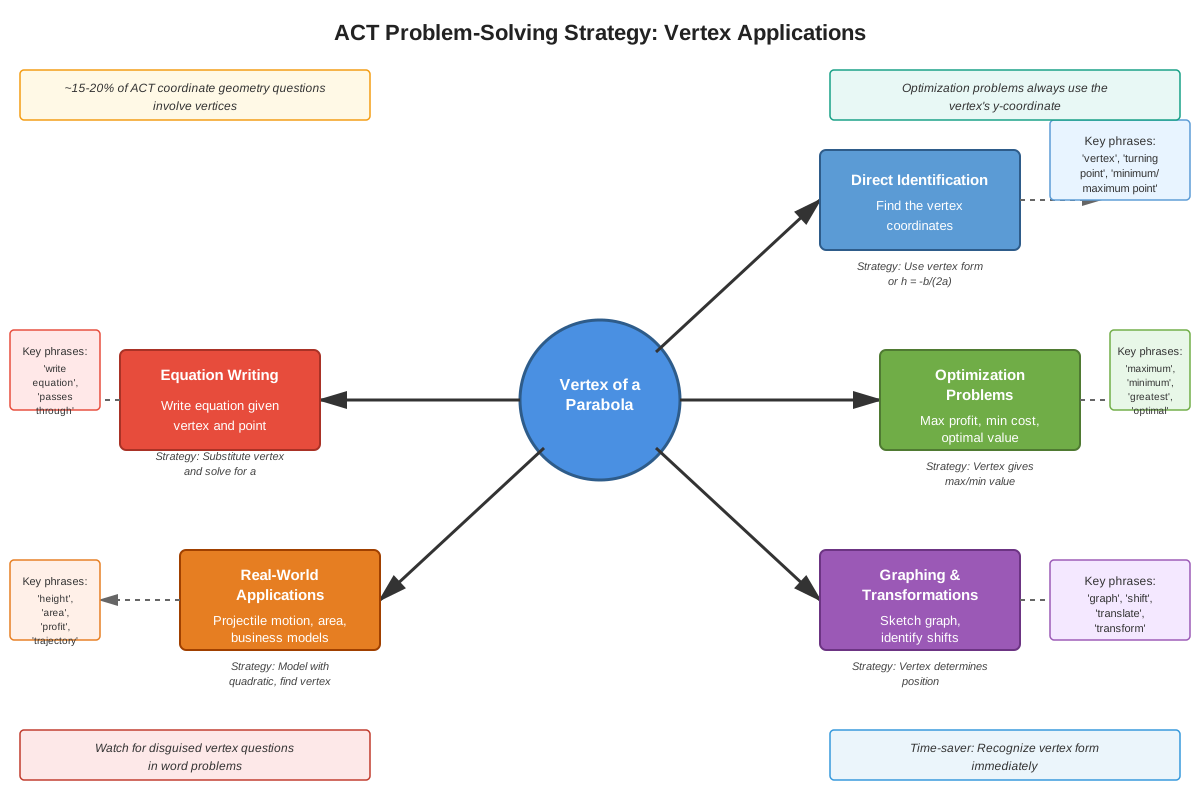
On the ACT Math section, vertex-related questions appear with high frequency—approximately 5-7% of all math questions involve parabolas directly, and many additional questions test related concepts. These questions typically fall into several categories: finding vertex coordinates from equations, writing equations given vertex information, determining maximum or minimum values in word problems, and analyzing transformations of parabolic functions. The ACT particularly favors questions that combine vertex knowledge with practical applications, such as determining the maximum area of a rectangular enclosure or the optimal price point for maximizing revenue.
Common question formats include: "What are the coordinates of the vertex of the parabola y = x² - 6x + 11?", "A ball is thrown upward with height h(t) = -16t² + 48t + 4. What is the maximum height?", and "The graph of y = (x - h)² + k has its vertex at (3, -5). What are the values of h and k?" Understanding vertex concepts enables students to quickly identify the most efficient solution path and avoid time-consuming algebraic manipulation.
Core Concepts
Standard Form vs. Vertex Form
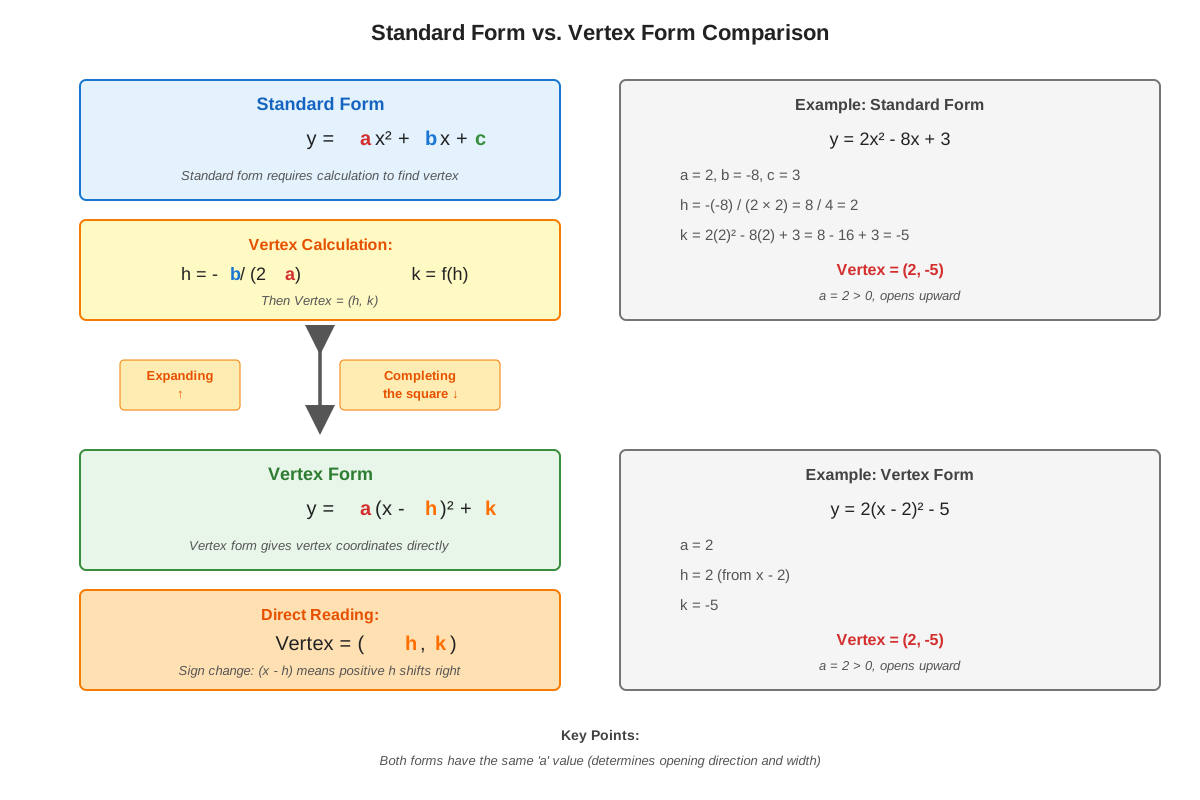
Quadratic functions representing parabolas can be expressed in multiple forms, each offering different advantages. The standard form is written as y = ax² + bx + c, where a, b, and c are constants. This form readily reveals the y-intercept (c) but obscures the vertex location. The vertex form is written as y = a(x - h)² + k, where (h, k) represents the coordinates of the vertex. This form immediately displays the vertex location and makes transformations transparent.
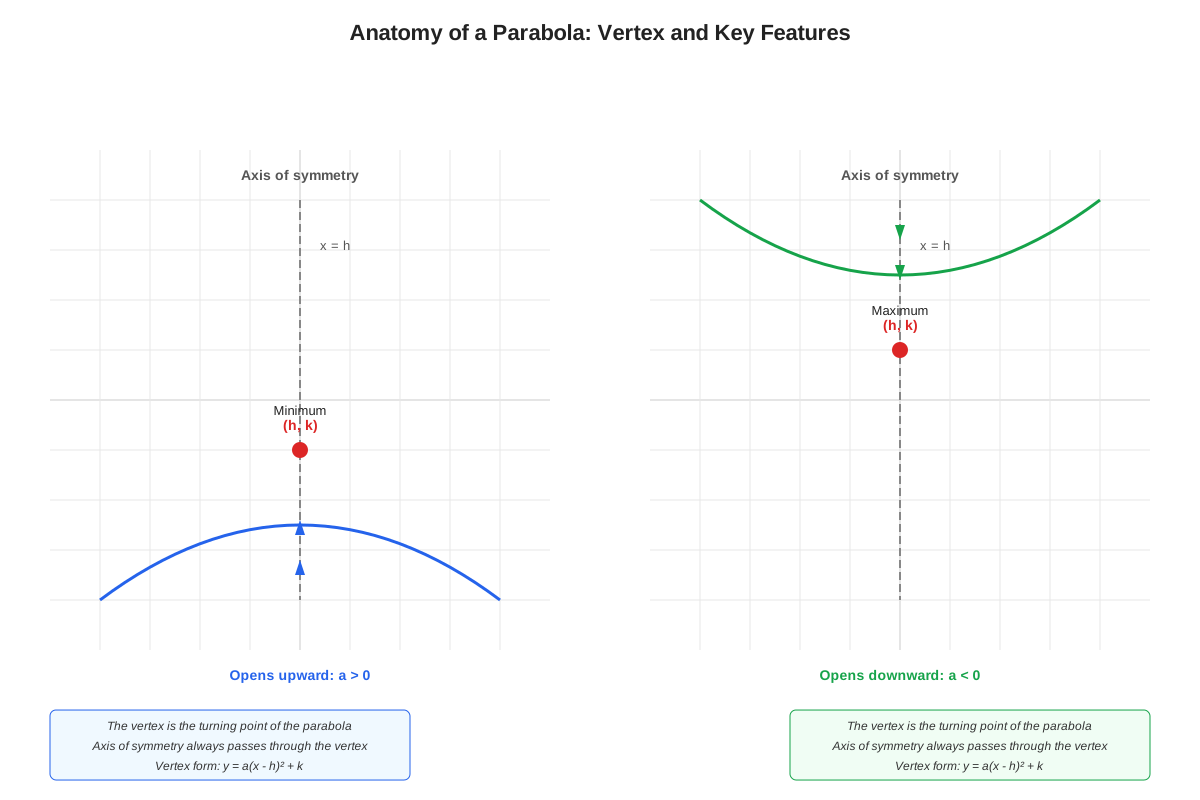
The coefficient 'a' in both forms determines the parabola's orientation and width. When a > 0, the parabola opens upward and the vertex represents a minimum point. When a < 0, the parabola opens downward and the vertex represents a maximum point. The absolute value of 'a' affects the parabola's width: larger |a| values create narrower parabolas, while smaller |a| values create wider parabolas.
Finding the Vertex from Standard Form
When given a parabola in standard form y = ax² + bx + c, the x-coordinate of the vertex can be calculated using the formula:
x = -b/(2a)This formula derives from the axis of symmetry of the parabola, which always passes through the vertex. Once the x-coordinate is determined, substitute this value back into the original equation to find the corresponding y-coordinate. For example, given y = 2x² - 8x + 3:
- Calculate x-coordinate: x = -(-8)/(2·2) = 8/4 = 2
- Calculate y-coordinate: y = 2(2)² - 8(2) + 3 = 8 - 16 + 3 = -5
- Vertex coordinates: (2, -5)
Converting to Vertex Form by Completing the Square
Completing the square transforms standard form into vertex form, explicitly revealing the vertex. The process involves creating a perfect square trinomial from the x² and x terms:
- Factor out the coefficient of x² from the first two terms (if a ≠ 1)
- Take half of the x-coefficient (inside the parentheses), square it, and add/subtract this value
- Rewrite the perfect square trinomial as a binomial squared
- Simplify to isolate the vertex form
Example: Convert y = x² + 6x + 2 to vertex form
- y = (x² + 6x) + 2
- y = (x² + 6x + 9 - 9) + 2
- y = (x² + 6x + 9) - 9 + 2
- y = (x + 3)² - 7
- Vertex: (-3, -7)
Axis of Symmetry
The axis of symmetry is a vertical line that passes through the vertex and divides the parabola into two mirror-image halves. For a parabola with vertex (h, k), the axis of symmetry has equation x = h. This line is crucial for graphing parabolas and understanding their geometric properties. Any point on the parabola has a corresponding point equidistant from the axis of symmetry on the opposite side.
Transformations and the Vertex
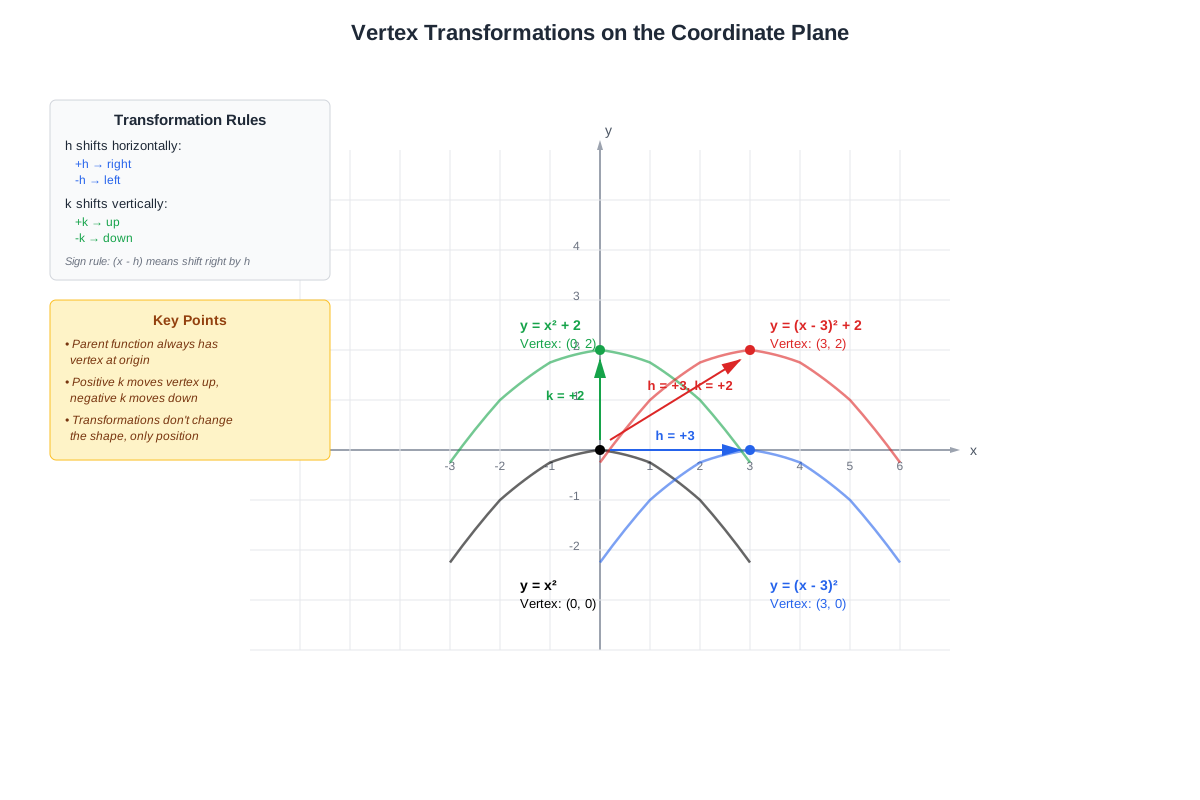
Understanding how transformations affect the vertex enables quick analysis of parabola equations:
| Transformation | Effect on Vertex | Example |
|---|---|---|
| y = (x - h)² | Horizontal shift h units right | (x - 3)² shifts vertex to (3, 0) |
| y = (x + h)² | Horizontal shift h units left | (x + 2)² shifts vertex to (-2, 0) |
| y = x² + k | Vertical shift k units up | x² + 4 shifts vertex to (0, 4) |
| y = x² - k | Vertical shift k units down | x² - 5 shifts vertex to (0, -5) |
| y = -x² | Reflection over x-axis | Vertex remains at (0, 0), opens down |
Application to Optimization Problems
Many ACT word problems involve finding maximum or minimum values, which correspond to the vertex of a parabola. When a quadratic function models a real-world situation, the vertex represents the optimal value. For revenue problems where R(x) = -ax² + bx + c (with a < 0), the vertex gives the price or quantity that maximizes revenue. For projectile motion problems where h(t) = -16t² + v₀t + h₀, the vertex indicates the maximum height and the time at which it occurs.
Concept Relationships
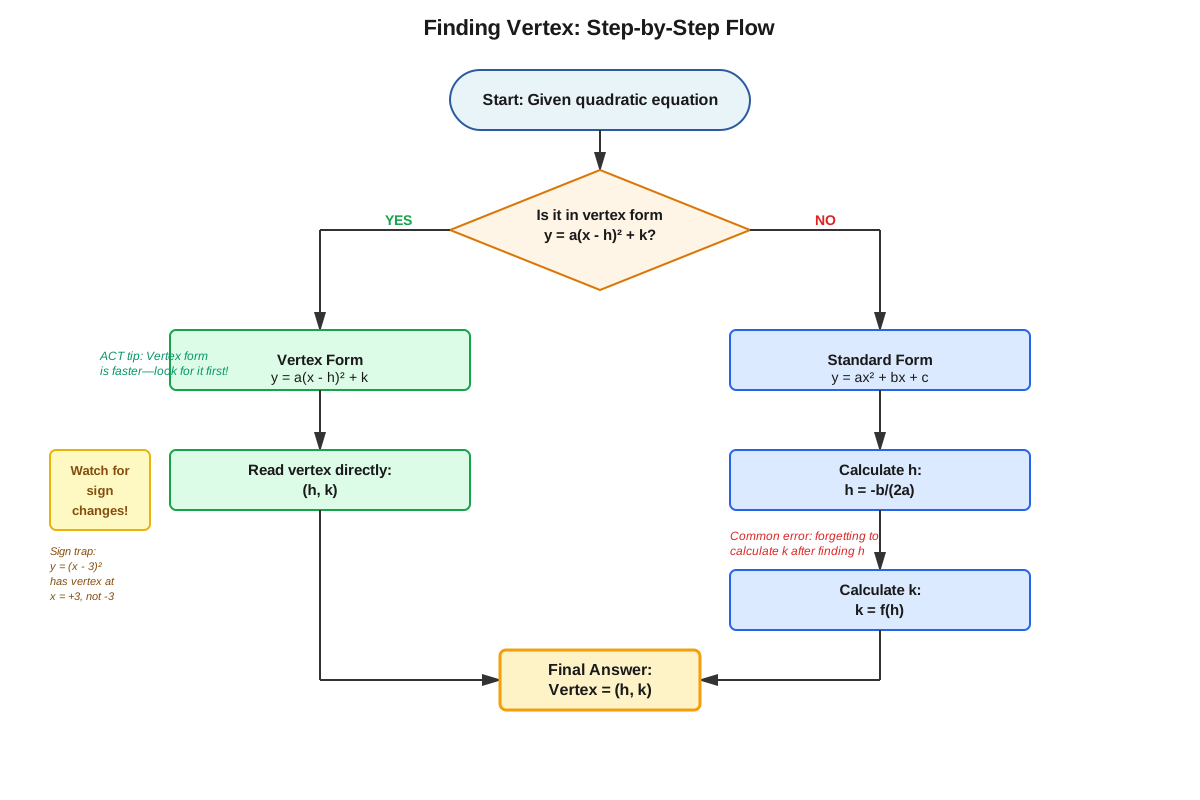
The vertex concept serves as a central hub connecting multiple mathematical ideas. The relationship begins with quadratic functions → which can be expressed in standard form → from which we extract the vertex using the formula x = -b/(2a) → alternatively, we can use completing the square → to convert to vertex form → which directly reveals the vertex coordinates (h, k) → these coordinates define the axis of symmetry x = h → and determine whether the vertex represents a maximum or minimum value based on the sign of coefficient a.
The vertex connects to prerequisite knowledge of the coordinate plane by requiring students to interpret ordered pairs as geometric locations. It builds upon algebraic manipulation skills through completing the square and equation solving. The concept extends forward to more advanced topics including conic sections, where parabolas are one of four fundamental curves, and calculus, where the vertex represents a critical point where the derivative equals zero.
Transformations of functions directly impact vertex location: horizontal shifts change the h-value, vertical shifts change the k-value, and reflections change the orientation while preserving the vertex position. This interconnection between algebraic form and geometric transformation demonstrates the power of multiple representations in mathematics.
Quick check — test yourself on Vertex of a parabola so far.
Try Flashcards →High-Yield Facts
⭐ The vertex form of a parabola is y = a(x - h)² + k, where (h, k) is the vertex
⭐ The x-coordinate of the vertex in standard form y = ax² + bx + c is x = -b/(2a)
⭐ When a > 0, the parabola opens upward and the vertex is a minimum; when a < 0, it opens downward and the vertex is a maximum
⭐ The axis of symmetry passes through the vertex and has equation x = h
⭐ To find the y-coordinate of the vertex, substitute the x-coordinate back into the original equation
- The vertex represents the turning point where the parabola changes direction
- Completing the square converts standard form to vertex form by creating a perfect square trinomial
- In vertex form y = a(x - h)² + k, the value h represents a horizontal shift (opposite sign from what appears in the equation)
- The distance from the vertex to any point on the parabola equals the distance from that point to the focus
- For optimization problems, the vertex gives the maximum or minimum value of the function
- Two parabolas with the same vertex but different 'a' values have different widths but share the same axis of symmetry
- The vertex is the only point on a parabola that lies on the axis of symmetry
Common Misconceptions
Misconception: The vertex of y = (x - 3)² + 2 is at (-3, 2) → Correction: The vertex is at (3, 2). In vertex form y = a(x - h)² + k, the h-value has the opposite sign from what appears in the equation. The expression (x - 3) means the vertex is shifted 3 units to the right, not left.
Misconception: The vertex formula x = -b/(2a) gives both coordinates of the vertex → Correction: This formula only provides the x-coordinate. Students must substitute this x-value back into the original equation to calculate the corresponding y-coordinate.
Misconception: A larger coefficient 'a' makes the parabola wider → Correction: A larger absolute value of 'a' makes the parabola narrower (more compressed vertically), while a smaller |a| makes it wider. For example, y = 3x² is narrower than y = x².
Misconception: The vertex is always at the origin unless the equation is transformed → Correction: Only the basic parabola y = x² has its vertex at the origin. Any parabola in standard form y = ax² + bx + c with b ≠ 0 or c ≠ 0 has a vertex elsewhere.
Misconception: Completing the square changes the parabola's graph → Correction: Completing the square is an algebraic manipulation that rewrites the equation in a different form but represents the exact same parabola. The graph remains identical; only the equation's appearance changes.
Misconception: The axis of symmetry is always the y-axis → Correction: The axis of symmetry is the vertical line x = h, where h is the x-coordinate of the vertex. It only coincides with the y-axis when the vertex has x-coordinate 0.
Worked Examples
Example 1: Finding the Vertex from Standard Form
Problem: Find the vertex of the parabola y = -2x² + 12x - 10.
Solution:
Step 1: Identify the coefficients in standard form y = ax² + bx + c
- a = -2, b = 12, c = -10
Step 2: Calculate the x-coordinate using the vertex formula
- x = -b/(2a) = -12/(2·(-2)) = -12/(-4) = 3
Step 3: Substitute x = 3 into the original equation to find the y-coordinate
- y = -2(3)² + 12(3) - 10
- y = -2(9) + 36 - 10
- y = -18 + 36 - 10
- y = 8
Step 4: State the vertex coordinates
- Vertex: (3, 8)
Step 5: Verify the answer makes sense
- Since a = -2 < 0, the parabola opens downward, so (3, 8) represents a maximum point
- The axis of symmetry is x = 3
Connection to Learning Objectives: This example demonstrates the core strategy for finding vertices from standard form equations, a skill tested frequently on the ACT.
Example 2: Application Problem with Optimization
Problem: A farmer has 200 feet of fencing to enclose a rectangular garden along a river. The river forms one side, so fencing is only needed for three sides. What dimensions maximize the garden's area, and what is the maximum area?
Solution:
Step 1: Set up variables and constraints
- Let x = width of the garden (perpendicular to river)
- The two widths use 2x feet of fencing
- The length (parallel to river) uses 200 - 2x feet of fencing
Step 2: Write the area function
- Area = length × width
- A(x) = x(200 - 2x)
- A(x) = 200x - 2x²
- A(x) = -2x² + 200x
Step 3: Find the vertex to determine maximum area
- This is in standard form with a = -2, b = 200, c = 0
- x-coordinate: x = -200/(2·(-2)) = -200/(-4) = 50
- The width should be 50 feet
Step 4: Calculate the length
- Length = 200 - 2(50) = 200 - 100 = 100 feet
Step 5: Calculate maximum area
- A(50) = -2(50)² + 200(50)
- A(50) = -2(2500) + 10,000
- A(50) = -5,000 + 10,000 = 5,000 square feet
Answer: The garden should be 50 feet wide and 100 feet long, giving a maximum area of 5,000 square feet.
Connection to Learning Objectives: This problem demonstrates how vertex concepts apply to real-world optimization scenarios, a high-yield ACT question type that tests both algebraic manipulation and conceptual understanding.
Exam Strategy
When approaching ACT questions involving the vertex of a parabola, begin by identifying the form of the equation presented. If the equation is already in vertex form y = a(x - h)² + k, the vertex can be read directly as (h, k)—but remember the sign change for h. If the equation is in standard form, immediately calculate x = -b/(2a) and prepare to substitute back for the y-coordinate.
Trigger words and phrases that signal vertex problems include: "maximum value," "minimum value," "highest point," "lowest point," "turning point," "optimal," "vertex," and "axis of symmetry." Word problems involving projectile motion (balls thrown upward, rockets launched), business optimization (maximum profit, minimum cost), or geometric optimization (maximum area, minimum perimeter) almost always require finding the vertex.
For multiple-choice questions, use process of elimination strategically. If a parabola opens upward (a > 0), eliminate any answer choices suggesting the vertex is a maximum. If the equation shows (x - 3)² in vertex form, eliminate choices with negative x-coordinates for the vertex. When given a graph, estimate the vertex coordinates visually and eliminate answers that differ significantly from your estimate.
Time allocation is crucial: straightforward vertex-finding questions should take 30-45 seconds, while application problems may require 60-90 seconds. If a problem requires completing the square and you're running short on time, consider using the vertex formula instead, as it's faster. Always check whether the question asks for just the x-coordinate, just the y-coordinate, or both—reading carefully prevents careless errors.
ACT Tip: When the question asks for a maximum or minimum value (not the location where it occurs), you only need the y-coordinate of the vertex, not the x-coordinate. This can save valuable time.
Memory Techniques
Vertex Formula Mnemonic: "Negative Boy Two Apples" helps remember x = -b/(2a). The negative comes first, then b, then 2a in the denominator.
Vertex Form Sign Mnemonic: "Horizontal is Hard" reminds students that the h-value in y = a(x - h)² + k has the opposite sign from what appears in the equation. If you see (x - 5), h = +5, not -5.
Opening Direction Memory Aid: Visualize the letter 'a' in different orientations. When a is positive, imagine the letter 'a' with its round part forming a cup that opens upward (∪). When a is negative, imagine it flipped to open downward (∩).
Completing the Square Acronym: FATS - Factor out the leading coefficient, Add and subtract the square, Turn into binomial squared, Simplify the constants.
Visualization Strategy: Always sketch a quick graph when solving vertex problems. Mark the vertex, draw the axis of symmetry, and indicate whether the parabola opens up or down. This visual reference catches sign errors and helps verify answers make geometric sense.
Summary
The vertex of a parabola represents the turning point of a quadratic function and is one of the most important concepts in ACT coordinate geometry. Students must master two primary methods for finding the vertex: using the formula x = -b/(2a) for standard form equations, then substituting to find the y-coordinate, or converting to vertex form y = a(x - h)² + k through completing the square. The vertex coordinates (h, k) determine the axis of symmetry (x = h) and represent either a maximum value (when a < 0) or minimum value (when a > 0). ACT questions frequently test vertex concepts through direct calculation problems, graph interpretation, and real-world optimization scenarios involving projectile motion, business applications, or geometric constraints. Success requires recognizing the equation form, applying the appropriate technique efficiently, and understanding the relationship between algebraic expressions and geometric properties. The ability to quickly identify when vertex concepts are being tested and select the most efficient solution method distinguishes high-scoring students from average performers.
Key Takeaways
- The vertex formula x = -b/(2a) finds the x-coordinate from standard form; always substitute back to get the y-coordinate
- Vertex form y = a(x - h)² + k directly reveals the vertex at (h, k), but watch for sign changes in h
- The sign of coefficient 'a' determines whether the vertex is a maximum (a < 0) or minimum (a > 0)
- The axis of symmetry always passes through the vertex with equation x = h
- Completing the square converts standard form to vertex form by creating a perfect square trinomial
- Optimization word problems almost always require finding the vertex to determine maximum or minimum values
- Quick visual sketches help verify answers and catch sign errors in vertex calculations
Related Topics
Quadratic Functions and Their Graphs: Understanding the complete behavior of parabolas, including intercepts, domain, range, and end behavior, builds upon vertex knowledge and provides comprehensive graphing skills.
Systems of Equations with Quadratics: Finding intersection points between parabolas and lines or between two parabolas requires vertex concepts combined with equation-solving techniques.
Transformations of Functions: Studying how translations, reflections, and dilations affect all function types generalizes the vertex transformation concepts to broader mathematical contexts.
Conic Sections: Parabolas are one of four conic sections (along with circles, ellipses, and hyperbolas), and vertex concepts extend to understanding the geometric properties of all conics.
Optimization in Calculus: The vertex-finding techniques learned here provide foundational understanding for calculus methods of finding maxima and minima using derivatives.
Practice CTA
Now that you've mastered the core concepts of parabola vertices, it's time to solidify your understanding through active practice. Work through the practice questions to test your ability to identify vertex problems, apply the appropriate formulas, and solve optimization scenarios under timed conditions. Use the flashcards to reinforce the key formulas, definitions, and strategies until they become automatic. Remember, the ACT rewards both accuracy and speed—consistent practice with these materials will build the confidence and efficiency you need to excel on test day. Every problem you solve strengthens your mathematical intuition and brings you closer to your target score!
Sign up free to keep reading
Create a free AnvayaPrep account to finish this ACT guide on Vertex of a parabola — plus flashcards and practice questions.