Overview
Scientific notation is a standardized mathematical method for expressing very large or very small numbers in a compact, manageable form. This notation uses powers of 10 to represent numbers, making calculations and comparisons more efficient. On the ACT Math test, scientific notation appears regularly across multiple question types, from straightforward conversion problems to complex multi-step calculations involving exponent rules and operations.
Understanding ACT scientific notation is crucial because it bridges several mathematical domains tested on the exam. Questions may require converting between standard and scientific notation, performing arithmetic operations with numbers in scientific notation, or interpreting scientific notation in real-world contexts such as astronomy, chemistry, or economics. The ACT frequently embeds scientific notation within word problems, data interpretation questions, and calculator-permitted sections where students must demonstrate both conceptual understanding and computational accuracy.
Mastery of scientific notation connects directly to broader mathematical concepts including exponent rules, place value, order of magnitude comparisons, and algebraic manipulation. This topic serves as a foundation for understanding logarithms, exponential functions, and dimensional analysis—all of which appear in higher-level ACT Math questions. Students who develop fluency with scientific notation gain a significant advantage in time management and accuracy, as they can quickly estimate answers and eliminate unreasonable choices.
Learning Objectives
- [ ] Identify when scientific notation is being tested in ACT questions
- [ ] Explain the core rule or strategy behind scientific notation
- [ ] Apply scientific notation to ACT-style questions accurately
- [ ] Convert numbers between standard form and scientific notation in both directions
- [ ] Perform arithmetic operations (addition, subtraction, multiplication, division) with numbers in scientific notation
- [ ] Compare and order numbers written in scientific notation
- [ ] Interpret scientific notation in real-world contexts and word problems
Prerequisites
- Exponent rules and properties: Understanding how to multiply, divide, and raise powers to powers is essential for manipulating scientific notation
- Place value system: Recognizing the value of digits in different positions enables accurate conversion between standard and scientific notation
- Basic arithmetic operations: Proficiency with multiplication, division, addition, and subtraction forms the foundation for calculations involving scientific notation
- Order of operations: Correctly sequencing mathematical operations ensures accurate results when working with complex scientific notation expressions
Why This Topic Matters
Scientific notation appears in approximately 2-4 questions per ACT Math test, making it a high-yield topic that can directly impact your score. These questions typically appear in the middle-to-later portions of the test (questions 30-50), where they serve as moderate-difficulty problems that separate average scorers from high achievers. The ACT tests scientific notation through direct conversion questions, multi-step calculation problems, and application questions embedded in real-world scenarios.
In practical applications, scientific notation is indispensable across scientific disciplines. Astronomers use it to express distances between celestial bodies (the distance to the nearest star is approximately 4.0 × 10¹³ kilometers). Chemists employ scientific notation for atomic masses and molecular quantities (Avogadro's number is 6.022 × 10²³). Economists and data scientists use it for large-scale financial figures and population statistics. Understanding scientific notation enables efficient communication of extreme values without writing unwieldy strings of zeros.
On the ACT, scientific notation commonly appears in several formats: pure conversion problems asking students to rewrite numbers; calculation questions requiring operations with scientific notation; comparison questions testing magnitude understanding; and word problems where scientific notation provides context for real-world scenarios. Calculator usage varies—some questions test conceptual understanding without calculation, while others require computational accuracy. Students must be prepared for both scenarios.
Core Concepts
Definition and Structure of Scientific Notation
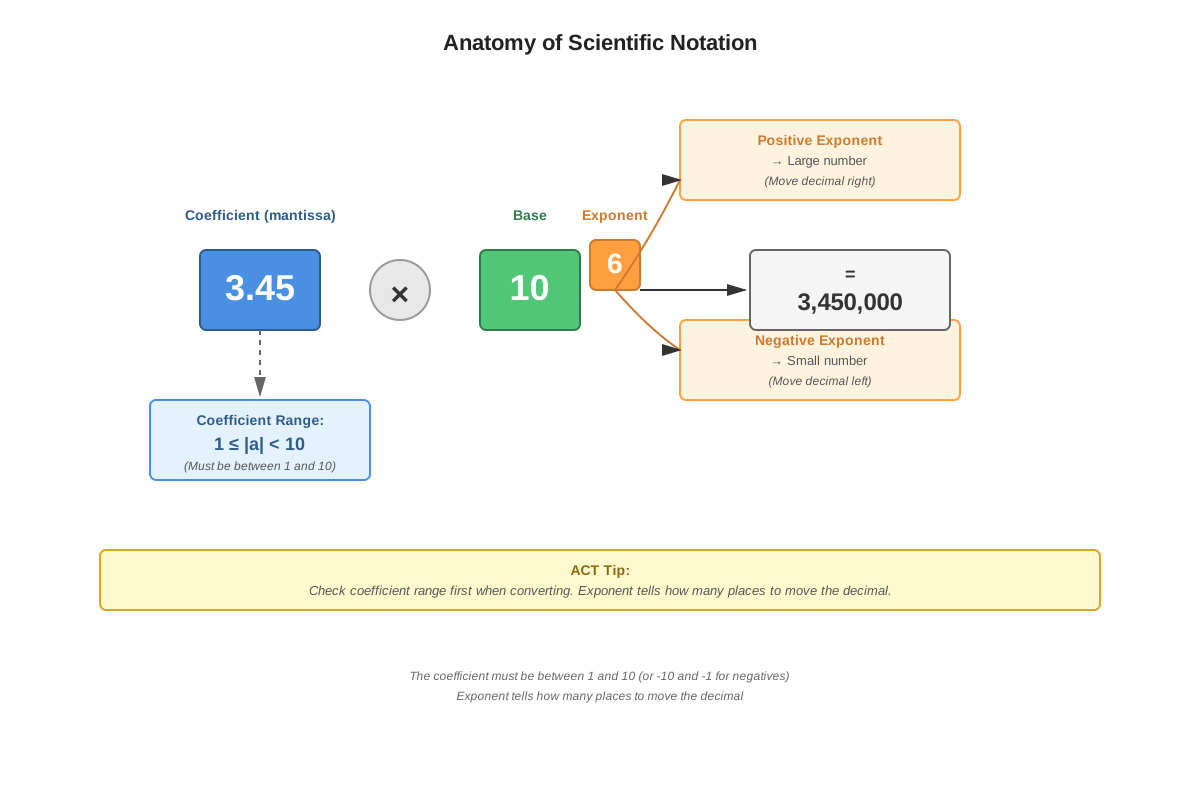
Scientific notation expresses numbers in the form a × 10ⁿ, where a is called the coefficient (or mantissa) and n is an integer exponent. The coefficient must satisfy the condition 1 ≤ |a| < 10, meaning the absolute value of a is at least 1 but less than 10. This standardized form ensures that exactly one non-zero digit appears before the decimal point.
The exponent n indicates how many places the decimal point has moved from its position in standard notation. A positive exponent means the original number is large (greater than or equal to 10), while a negative exponent indicates a small number (between 0 and 1). For example, 3,500 becomes 3.5 × 10³ because the decimal point moves three places to the left, while 0.0035 becomes 3.5 × 10⁻³ because the decimal point moves three places to the right.
Converting from Standard to Scientific Notation
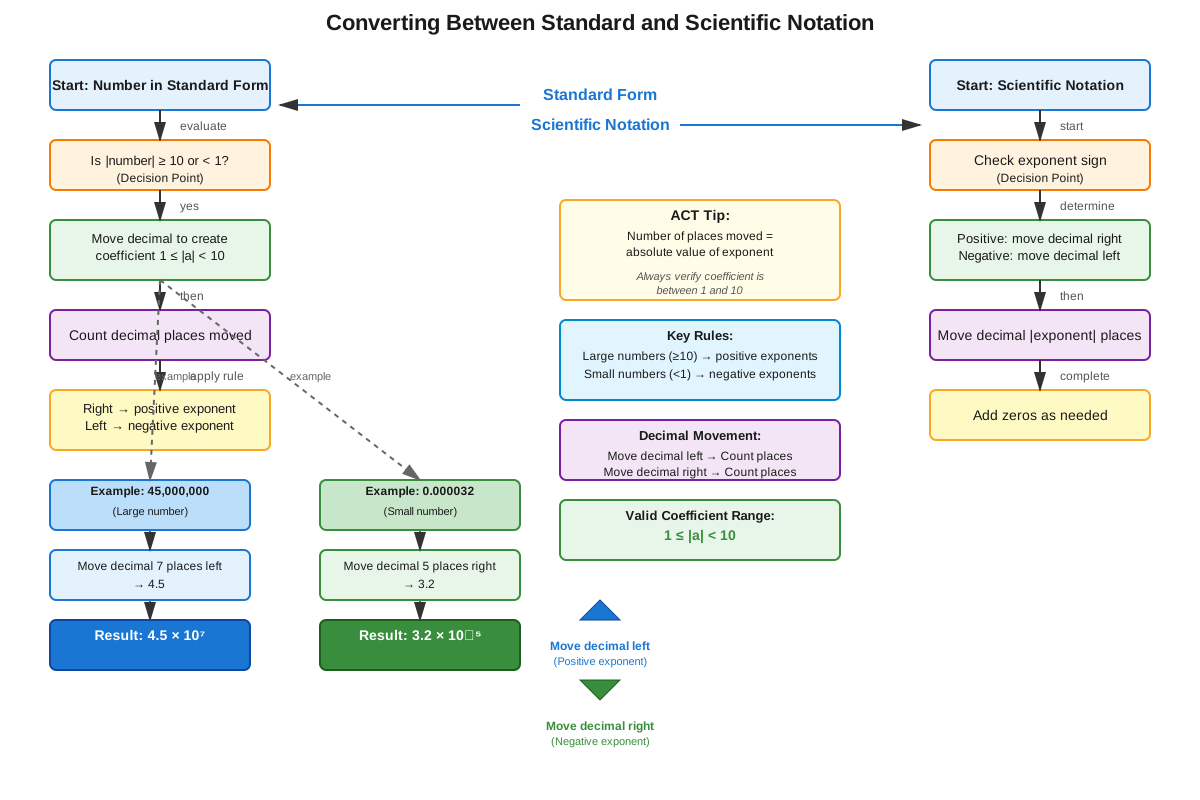
To convert a number from standard form to scientific notation, follow this systematic process:
- Identify the first non-zero digit in the number
- Place a decimal point immediately after this digit
- Count the number of places the decimal point moved from its original position
- Determine the sign of the exponent: positive if the original number is ≥ 10, negative if the original number is between 0 and 1
- Write the result in the form a × 10ⁿ
For large numbers (≥ 10), the decimal point moves left, creating a positive exponent. For example, 45,000,000 converts to 4.5 × 10⁷ because the decimal point moves 7 places left from its implied position after the last zero.
For small numbers (between 0 and 1), the decimal point moves right, creating a negative exponent. For example, 0.000062 converts to 6.2 × 10⁻⁵ because the decimal point moves 5 places right from its original position.
Converting from Scientific to Standard Notation
To convert from scientific notation to standard form, reverse the process:
- Examine the exponent to determine direction and magnitude of decimal movement
- If the exponent is positive, move the decimal point that many places to the right, adding zeros as needed
- If the exponent is negative, move the decimal point that many places to the left, adding zeros as needed
- Write the final number in standard form
For example, 7.3 × 10⁴ becomes 73,000 (decimal moves 4 places right), while 2.9 × 10⁻³ becomes 0.0029 (decimal moves 3 places left).
Multiplication with Scientific Notation
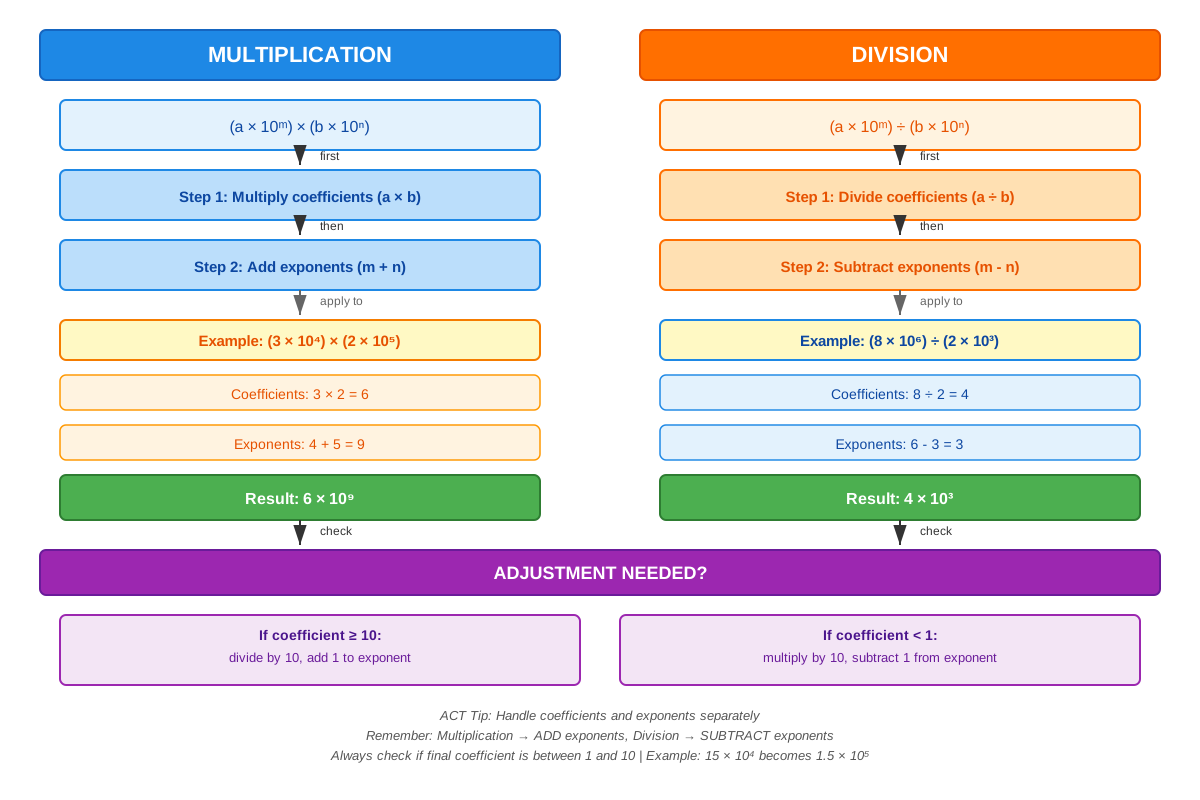
When multiplying numbers in scientific notation, apply the product rule for exponents:
(a × 10ᵐ) × (b × 10ⁿ) = (a × b) × 10⁽ᵐ⁺ⁿ⁾
The process involves three steps:
- Multiply the coefficients: a × b
- Add the exponents: m + n
- Adjust if necessary: If the coefficient product is ≥ 10 or < 1, convert to proper scientific notation
Example: (3.0 × 10⁵) × (2.0 × 10³) = (3.0 × 2.0) × 10⁽⁵⁺³⁾ = 6.0 × 10⁸
If the coefficient product requires adjustment: (4.0 × 10⁶) × (5.0 × 10²) = 20.0 × 10⁸ = 2.0 × 10⁹ (adjusting 20.0 to 2.0 increases the exponent by 1)
Division with Scientific Notation
When dividing numbers in scientific notation, apply the quotient rule for exponents:
(a × 10ᵐ) ÷ (b × 10ⁿ) = (a ÷ b) × 10⁽ᵐ⁻ⁿ⁾
The process involves:
- Divide the coefficients: a ÷ b
- Subtract the exponents: m - n
- Adjust if necessary: Ensure the coefficient is between 1 and 10
Example: (8.0 × 10⁷) ÷ (2.0 × 10³) = (8.0 ÷ 2.0) × 10⁽⁷⁻³⁾ = 4.0 × 10⁴
Addition and Subtraction with Scientific Notation
Adding or subtracting numbers in scientific notation requires matching exponents first:
- Convert both numbers to have the same power of 10
- Add or subtract the coefficients while keeping the common exponent
- Adjust the result to proper scientific notation if needed
Example: (3.5 × 10⁴) + (2.1 × 10³)
First, convert to matching exponents: (3.5 × 10⁴) + (0.21 × 10⁴) = (3.5 + 0.21) × 10⁴ = 3.71 × 10⁴
This operation is more complex than multiplication or division because the exponents must align before combining coefficients.
Comparing Numbers in Scientific Notation
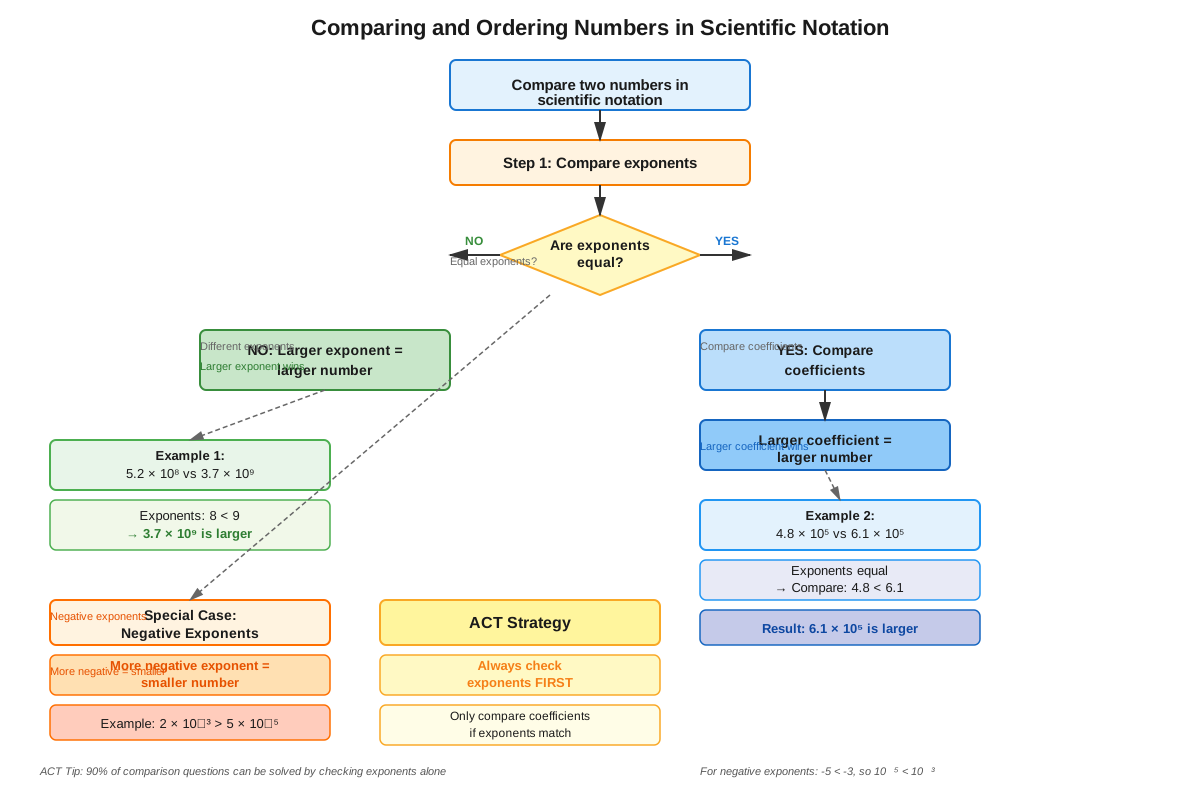
To compare numbers in scientific notation, use this hierarchy:
| Priority | Comparison Method |
|---|---|
| 1st | Compare exponents (larger exponent = larger number for positive coefficients) |
| 2nd | If exponents are equal, compare coefficients |
| 3rd | Consider signs (positive > negative) |
For positive numbers, a larger exponent always indicates a larger number, regardless of coefficients. For example, 2.0 × 10⁸ > 9.9 × 10⁷ because 8 > 7. When exponents match, compare coefficients directly: 7.5 × 10⁴ > 3.2 × 10⁴ because 7.5 > 3.2.
Concept Relationships
Scientific notation fundamentally relies on exponent rules, which govern how powers of 10 behave during arithmetic operations. The multiplication and division procedures directly apply the product and quotient rules for exponents, while addition and subtraction require understanding of place value to align exponents properly.
The relationship flow follows this pattern: Place Value Understanding → Exponent Rules → Scientific Notation Conversions → Operations with Scientific Notation → Real-World Applications
Within scientific notation itself, conversion skills form the foundation for all other operations. Students must master bidirectional conversion (standard ↔ scientific) before attempting calculations. Multiplication and division operations are simpler than addition and subtraction because they don't require matching exponents. Comparison skills synthesize understanding of both exponents and coefficients.
Scientific notation connects forward to logarithms (which essentially ask "what exponent produces this number?"), exponential functions (where the variable appears in the exponent), and order of magnitude estimation (a critical skill for eliminating unreasonable answer choices on the ACT). Understanding scientific notation also supports dimensional analysis in physics and chemistry contexts, where unit conversions often involve powers of 10.
Quick check — test yourself on Scientific notation so far.
Try Flashcards →High-Yield Facts
⭐ Scientific notation has the form a × 10ⁿ where 1 ≤ |a| < 10 and n is an integer
⭐ Positive exponents indicate numbers ≥ 10; negative exponents indicate numbers between 0 and 1
⭐ To multiply in scientific notation: multiply coefficients and add exponents
⭐ To divide in scientific notation: divide coefficients and subtract exponents
⭐ To add or subtract in scientific notation: first match the exponents, then combine coefficients
- Moving the decimal point right (toward larger place values) creates a positive exponent
- Moving the decimal point left (toward smaller place values) creates a negative exponent
- When comparing numbers in scientific notation, the number with the larger exponent is larger (for positive numbers)
- If multiplication or division produces a coefficient outside the range [1, 10), adjust by changing the exponent
- Scientific notation questions on the ACT often combine multiple operations in a single problem
- Calculator errors with scientific notation often result from incorrect exponent entry (use the EE or EXP button, not the ^ symbol)
- Zero cannot be written in proper scientific notation because the coefficient must be at least 1
Common Misconceptions
Misconception: The coefficient in scientific notation can be any number → Correction: The coefficient must satisfy 1 ≤ |a| < 10, meaning exactly one non-zero digit appears before the decimal point. An expression like 45 × 10³ is not in proper scientific notation and should be written as 4.5 × 10⁴.
Misconception: When adding numbers in scientific notation, you add both the coefficients and the exponents → Correction: Addition requires matching exponents first, then adding only the coefficients while keeping the common exponent unchanged. The exponents represent place values and must align before combining.
Misconception: A negative exponent means the entire number is negative → Correction: A negative exponent indicates a small positive number (between 0 and 1), not a negative number. For example, 3 × 10⁻² = 0.03, which is positive. To represent a negative number, place a negative sign before the coefficient: -3 × 10⁻².
Misconception: To enter scientific notation in a calculator, use the ^ (caret) symbol → Correction: Most calculators have a dedicated EE, EXP, or ×10ˣ button for scientific notation. Using ^ creates an incorrect expression. For example, 2.5 × 10⁴ should be entered as "2.5 EE 4" not "2.5 × 10^4".
Misconception: When converting 0.0045 to scientific notation, the exponent is positive because you're moving the decimal point → Correction: The exponent is -3 because the original number is less than 1. The direction of decimal movement determines the sign: moving right (for small numbers) creates negative exponents, while moving left (for large numbers) creates positive exponents. The correct conversion is 4.5 × 10⁻³.
Misconception: Scientific notation is only used for extremely large or small numbers → Correction: While scientific notation is most useful for extreme values, any number can be expressed in scientific notation. For example, 42 = 4.2 × 10¹. The ACT may test conversion of moderately-sized numbers to assess understanding of the notation system itself.
Worked Examples
Example 1: Multi-Step Calculation with Scientific Notation
Problem: Calculate (6.0 × 10⁸) × (4.0 × 10⁻³) ÷ (3.0 × 10²) and express the answer in scientific notation.
Solution:
Step 1: Perform the multiplication first (following order of operations)
- (6.0 × 10⁸) × (4.0 × 10⁻³)
- Multiply coefficients: 6.0 × 4.0 = 24.0
- Add exponents: 8 + (-3) = 5
- Result: 24.0 × 10⁵
Step 2: Adjust to proper scientific notation
- 24.0 × 10⁵ = 2.4 × 10¹ × 10⁵ = 2.4 × 10⁶
Step 3: Divide by (3.0 × 10²)
- (2.4 × 10⁶) ÷ (3.0 × 10²)
- Divide coefficients: 2.4 ÷ 3.0 = 0.8
- Subtract exponents: 6 - 2 = 4
- Result: 0.8 × 10⁴
Step 4: Adjust to proper scientific notation
- 0.8 × 10⁴ = 8.0 × 10⁻¹ × 10⁴ = 8.0 × 10³
Final Answer: 8.0 × 10³
This problem demonstrates the learning objective of applying scientific notation to ACT-style questions by combining multiple operations and requiring proper notation adjustment at each step.
Example 2: Real-World Application with Conversion
Problem: The mass of Earth is approximately 5,970,000,000,000,000,000,000,000 kilograms. The mass of Mars is approximately 6.39 × 10²³ kilograms. How many times more massive is Earth than Mars? Express your answer in scientific notation.
Solution:
Step 1: Convert Earth's mass to scientific notation
- Identify the first non-zero digit: 5
- Place decimal after it: 5.97
- Count places moved: 24 places to the left
- Earth's mass = 5.97 × 10²⁴ kg
Step 2: Set up the division to find the ratio
- (5.97 × 10²⁴) ÷ (6.39 × 10²³)
Step 3: Divide coefficients
- 5.97 ÷ 6.39 ≈ 0.934
Step 4: Subtract exponents
- 24 - 23 = 1
Step 5: Combine results
- 0.934 × 10¹
Step 6: Adjust to proper scientific notation
- 0.934 × 10¹ = 9.34 × 10⁻¹ × 10¹ = 9.34 × 10⁰ = 9.34
Final Answer: Earth is approximately 9.34 times more massive than Mars (or 9.34 × 10⁰ in scientific notation)
This example addresses the learning objective of identifying when scientific notation is being tested (in real-world contexts) and applying conversion skills to solve practical problems.
Exam Strategy
When approaching ACT scientific notation questions, begin by identifying the question type: conversion, calculation, comparison, or application. This classification determines your solution strategy and helps allocate time appropriately.
Trigger words and phrases that signal scientific notation questions include: "express in scientific notation," "written in the form a × 10ⁿ," "order of magnitude," "approximately how many times," and any problem presenting extremely large or small numbers. Word problems involving astronomy, microbiology, chemistry, or economics frequently incorporate scientific notation.
For conversion questions, work systematically: identify the first non-zero digit, count decimal places moved, and determine exponent sign based on whether the original number is large (positive exponent) or small (negative exponent). Double-check that your coefficient falls between 1 and 10.
For calculation questions, apply operation-specific rules: multiply/divide by working with coefficients and exponents separately, but add/subtract only after matching exponents. If the problem involves multiple operations, follow order of operations carefully and adjust to proper scientific notation after each step.
Process of elimination is particularly effective for scientific notation questions. Quickly eliminate answers with incorrect order of magnitude by examining exponents first. If a question asks for the product of 10⁵ and 10³, immediately eliminate any answer without an exponent near 8. For comparison questions, eliminate choices that contradict the exponent hierarchy rule.
Time allocation: Simple conversion questions should take 30-45 seconds. Multi-step calculation problems may require 60-90 seconds. If a problem requires extensive calculation, consider whether estimation or answer choice analysis can provide a faster path to the correct answer.
Calculator usage: Know your calculator's scientific notation function (usually EE or EXP). For verification, enter the problem exactly as written and compare your calculated answer to the choices. However, don't rely solely on calculator output—understand the conceptual process to catch entry errors.
Exam Tip: When time is limited, focus on exponent manipulation first. Many incorrect answer choices have the right coefficient but wrong exponent, or vice versa. Checking the exponent takes seconds and eliminates multiple choices.
Memory Techniques
MADSPM - Mnemonic for operation rules:
- Multiply coefficients, Add exponents
- Divide coefficients, Subtract exponents
- Power: multiply exponents
- Match exponents before adding/subtracting
"Large is Positive, Little is Negative" - Remember that large numbers (≥ 10) have positive exponents, while little numbers (between 0 and 1) have negative exponents.
The Decimal Dance - Visualize the decimal point "dancing" across the number:
- Dancing right (toward smaller places) = negative exponent
- Dancing left (toward larger places) = positive exponent
1-10 Rule - Hold up one finger to remember that the coefficient must have exactly one non-zero digit before the decimal point, and the absolute value must be less than 10.
"Same Power, Same Tower" - For addition and subtraction, remember that numbers must have the same power (exponent) before you can combine them, like stacking blocks in the same tower.
Exponent Sign Visualization: Picture positive exponents as numbers "expanding" to become large (like a balloon inflating), and negative exponents as numbers "shrinking" to become small (like a deflating balloon).
Summary
Scientific notation is a standardized mathematical system for expressing numbers in the form a × 10ⁿ, where the coefficient a satisfies 1 ≤ |a| < 10 and n is an integer exponent. This notation appears regularly on the ACT Math test, requiring students to convert between standard and scientific forms, perform arithmetic operations, and interpret real-world applications. Positive exponents indicate large numbers (≥ 10), while negative exponents represent small numbers (between 0 and 1). Multiplication and division involve working with coefficients and exponents separately, while addition and subtraction require matching exponents first. Mastery of scientific notation demands understanding of exponent rules, systematic conversion procedures, and the ability to adjust results to proper form. Success on ACT scientific notation questions depends on recognizing question types quickly, applying operation-specific strategies accurately, and using process of elimination to verify answers efficiently.
Key Takeaways
- Scientific notation expresses numbers as a × 10ⁿ where 1 ≤ |a| < 10, with positive exponents for large numbers and negative exponents for small numbers
- Conversion requires counting decimal places moved: left movement creates positive exponents, right movement creates negative exponents
- Multiplication and division are straightforward: multiply/divide coefficients, add/subtract exponents
- Addition and subtraction require matching exponents before combining coefficients
- Always adjust results to proper scientific notation with exactly one non-zero digit before the decimal point
- Compare numbers by examining exponents first (larger exponent = larger number for positive values), then coefficients if exponents match
- ACT questions test scientific notation through conversion, calculation, comparison, and real-world application problems
Related Topics
Exponent Rules and Properties: Mastering scientific notation provides direct preparation for more advanced exponent topics, including negative exponents, fractional exponents, and exponential equations. These concepts appear throughout ACT Math questions involving growth, decay, and algebraic manipulation.
Logarithms: Scientific notation serves as conceptual foundation for logarithms, which essentially answer the question "what exponent produces this result?" Understanding powers of 10 in scientific notation makes logarithmic thinking more intuitive.
Order of Magnitude Estimation: Scientific notation skills enable quick estimation of answer reasonableness, a critical test-taking strategy. Students who can rapidly assess whether an answer should be in the thousands, millions, or billions gain significant time advantages.
Dimensional Analysis: Scientific notation frequently appears in unit conversion problems, particularly in science contexts. Combining scientific notation with dimensional analysis allows efficient solution of complex multi-step conversion problems.
Practice CTA
Now that you've mastered the core concepts of scientific notation, it's time to solidify your understanding through active practice. Complete the practice questions to test your ability to convert, calculate, and apply scientific notation in ACT-style problems. Use the flashcards to reinforce key rules and procedures until they become automatic. Remember: scientific notation appears on every ACT Math test, making your investment in this topic directly valuable for score improvement. Approach each practice problem systematically, checking both coefficients and exponents, and you'll build the confidence and accuracy needed for test day success!
Sign up free to keep reading
Create a free AnvayaPrep account to finish this ACT guide on Scientific notation — plus flashcards and practice questions.