Overview
Geometric sequences are one of the most frequently tested topics in the Number and Quantity domain of the ACT Math test. A geometric sequence is a sequence of numbers where each term after the first is found by multiplying the previous term by a fixed, non-zero number called the common ratio. Understanding geometric sequences is essential not only for direct sequence questions but also for problems involving exponential growth and decay, compound interest, and population modeling—all of which appear regularly on the ACT.
The ACT tests geometric sequences in multiple ways: identifying whether a sequence is geometric, finding missing terms, determining the common ratio, calculating specific terms using formulas, and solving real-world application problems. Questions may appear as straightforward computational problems or embedded within word problems involving finance, science, or population studies. Mastery of this topic typically accounts for 2-4 questions per ACT Math section, making it a high-yield area for score improvement.
ACT geometric sequences connect to broader mathematical concepts including exponential functions, logarithms, and series. The skills developed here—pattern recognition, formula application, and algebraic manipulation—transfer directly to other ACT Math domains. Students who master geometric sequences gain confidence in handling exponential relationships, which appear throughout the test in various disguises. This topic serves as a bridge between basic arithmetic sequences and more complex exponential modeling, making it foundational for success on medium to difficult ACT Math questions.
Learning Objectives
- [ ] Identify when Geometric sequences is being tested
- [ ] Explain the core rule or strategy behind Geometric sequences
- [ ] Apply Geometric sequences to ACT-style questions accurately
- [ ] Calculate any term in a geometric sequence using the explicit formula
- [ ] Determine the common ratio from any two consecutive or non-consecutive terms
- [ ] Distinguish between geometric and arithmetic sequences in mixed contexts
- [ ] Solve real-world problems involving exponential growth or decay using geometric sequence principles
Prerequisites
- Basic algebra skills: Ability to solve equations and manipulate algebraic expressions is necessary for working with geometric sequence formulas
- Exponent rules: Understanding how to work with powers and exponents is essential since geometric sequences involve repeated multiplication
- Order of operations: Critical for correctly evaluating geometric sequence formulas that contain multiple operations
- Pattern recognition: The foundation for identifying the common ratio and predicting sequence behavior
- Arithmetic sequences: Familiarity with linear sequences helps students distinguish between additive and multiplicative patterns
Why This Topic Matters
Geometric sequences model countless real-world phenomena that appear both in everyday life and on the ACT. Compound interest calculations, population growth, radioactive decay, viral spread, and investment returns all follow geometric patterns. When a quantity repeatedly multiplies by the same factor—whether growing or shrinking—a geometric sequence describes that behavior. Understanding these sequences enables students to solve practical problems involving money, science, and technology.
On the ACT Math test, geometric sequences appear with notable frequency. Approximately 3-5% of all ACT Math questions directly test sequence knowledge, with geometric sequences comprising roughly half of these. Questions typically appear in the Number and Quantity domain but may also surface in Algebra or Functions contexts. The ACT favors questions that test multiple skills simultaneously, so geometric sequence problems often combine formula application with algebraic manipulation or real-world interpretation.
Common ACT question formats include: identifying the next term in a sequence, finding the nth term given the first term and common ratio, determining the common ratio from given terms, solving word problems involving exponential growth or decay, and distinguishing geometric from arithmetic sequences. The test may present sequences in standard notation, as word problems, or embedded in tables or graphs. Recognizing these various presentations is crucial for exam success.
Core Concepts
Definition and Structure
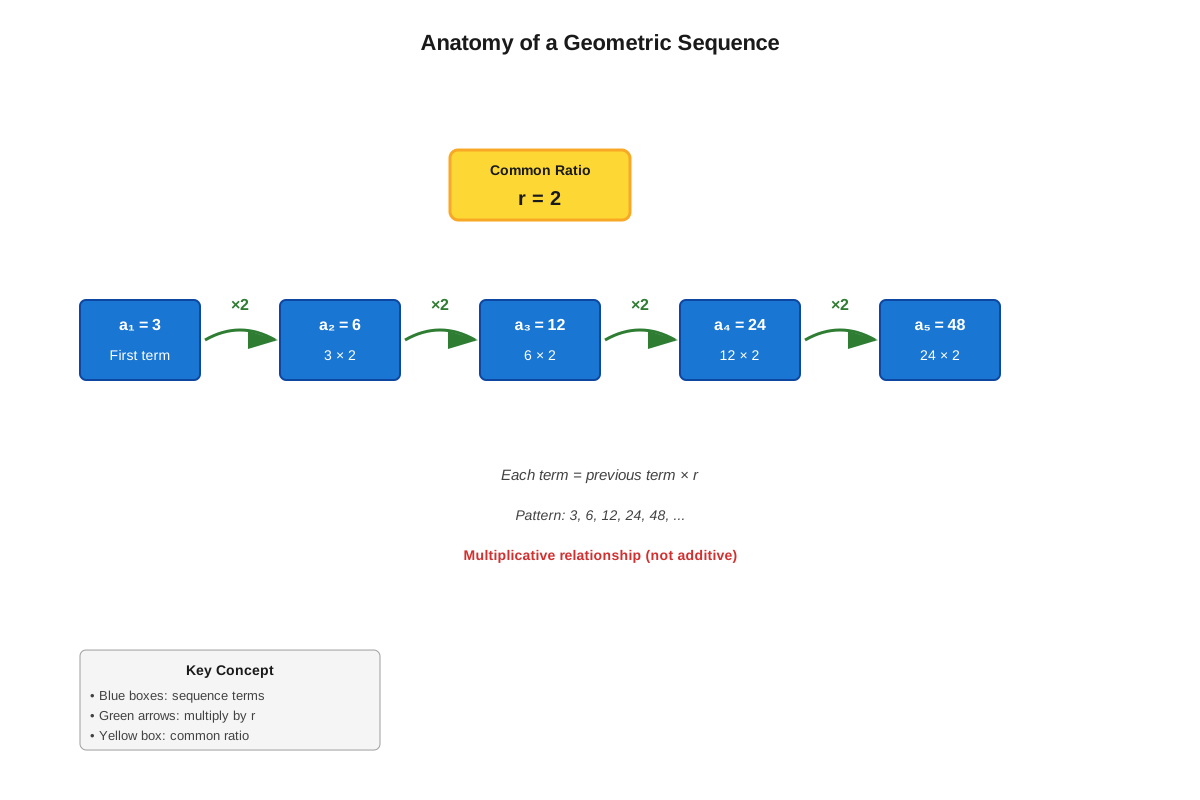
A geometric sequence (also called a geometric progression) is an ordered list of numbers where each term after the first is obtained by multiplying the previous term by a constant value. This constant multiplier is called the common ratio, typically denoted by the variable r. The sequence begins with an initial term or first term, denoted as a₁ or simply a.
For example, the sequence 2, 6, 18, 54, 162... is geometric because each term is obtained by multiplying the previous term by 3. Here, a₁ = 2 and r = 3. The common ratio can be any non-zero real number—positive, negative, whole number, fraction, or decimal.
The Common Ratio
The common ratio (r) is the defining characteristic of a geometric sequence. To find the common ratio, divide any term by the term immediately before it:
r = a₂/a₁ = a₃/a₂ = a₄/a₃ = aₙ/aₙ₋₁The common ratio determines the sequence's behavior:
- When r > 1: The sequence grows exponentially (terms increase in magnitude)
- When 0 < r < 1: The sequence decays exponentially (terms decrease toward zero)
- When r = 1: All terms are identical (constant sequence)
- When -1 < r < 0: Terms alternate signs and decrease in magnitude
- When r < -1: Terms alternate signs and increase in magnitude
- When r = -1: Terms alternate between two values with opposite signs
The Explicit Formula
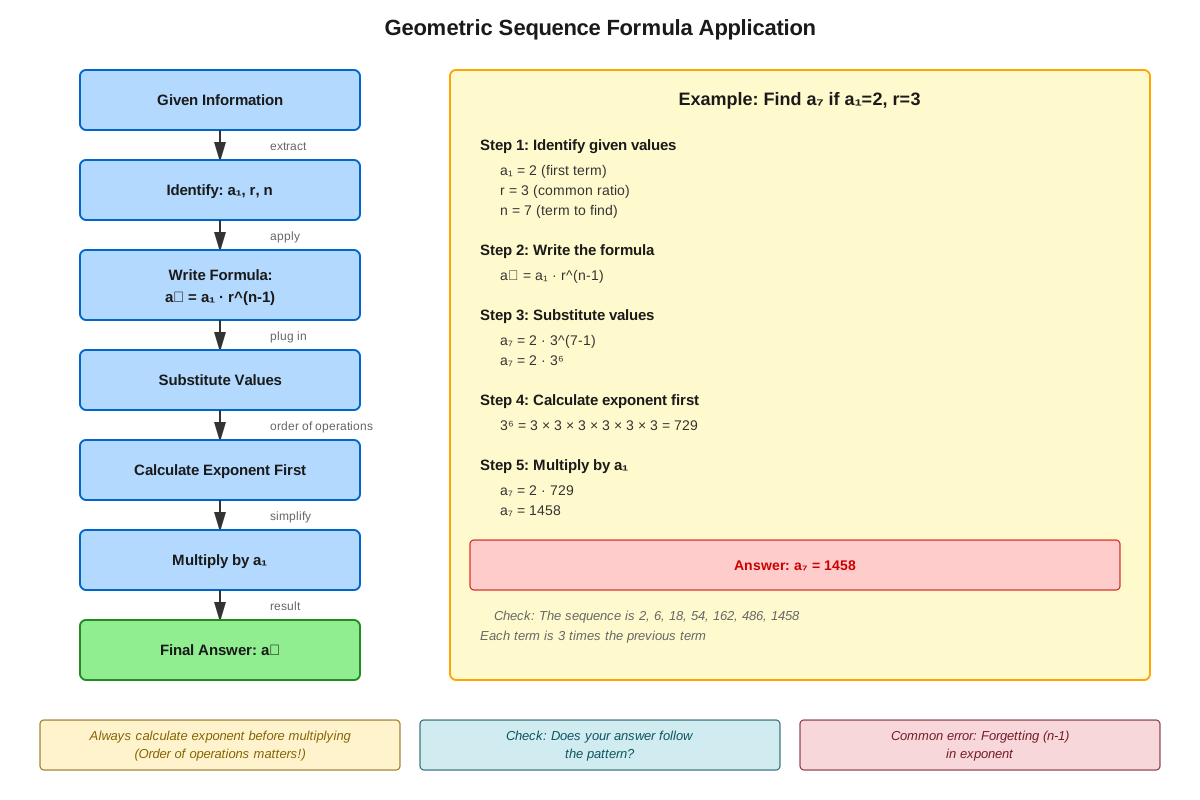
The explicit formula (also called the nth term formula) allows calculation of any term in a geometric sequence without finding all previous terms:
aₙ = a₁ · r^(n-1)Where:
- aₙ = the nth term (the term you're finding)
- a₁ = the first term
- r = the common ratio
- n = the position of the term in the sequence
This formula is derived from the pattern: a₁, a₁·r, a₁·r², a₁·r³, and so on. Notice that the exponent is always one less than the term's position number.
The Recursive Formula
The recursive formula defines each term based on the previous term:
aₙ = aₙ₋₁ · r, where a₁ is givenThis formula is useful when terms are calculated sequentially, but the explicit formula is generally more efficient for ACT questions since it allows direct calculation of any term.
Identifying Geometric Sequences
To determine whether a sequence is geometric, check if the ratio between consecutive terms remains constant:
- Calculate a₂/a₁
- Calculate a₃/a₂
- Calculate a₄/a₃
- If all ratios are equal, the sequence is geometric
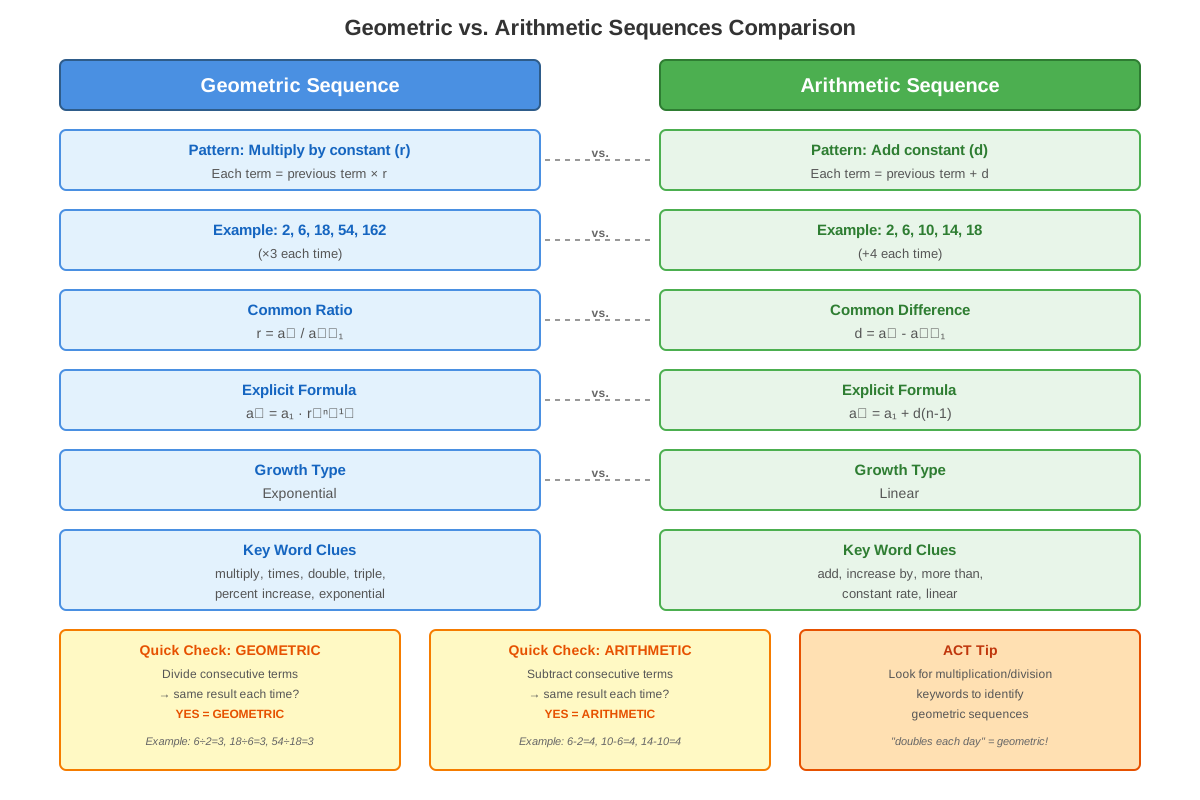
| Sequence Type | Pattern | Example | Test |
|---|---|---|---|
| Geometric | Multiply by constant | 3, 6, 12, 24 | 6/3 = 12/6 = 24/12 = 2 ✓ |
| Arithmetic | Add constant | 3, 6, 9, 12 | 6-3 = 9-6 = 12-9 = 3 ✓ |
| Neither | No constant pattern | 3, 6, 10, 15 | Ratios and differences vary ✗ |
Finding Missing Terms
When terms are missing from a geometric sequence, use the relationship between known terms. If you know aₘ and aₙ, you can find the common ratio:
r^(n-m) = aₙ/aₘThen solve for r by taking the appropriate root. Once you have r, you can find any missing term.
Applications to Real-World Problems
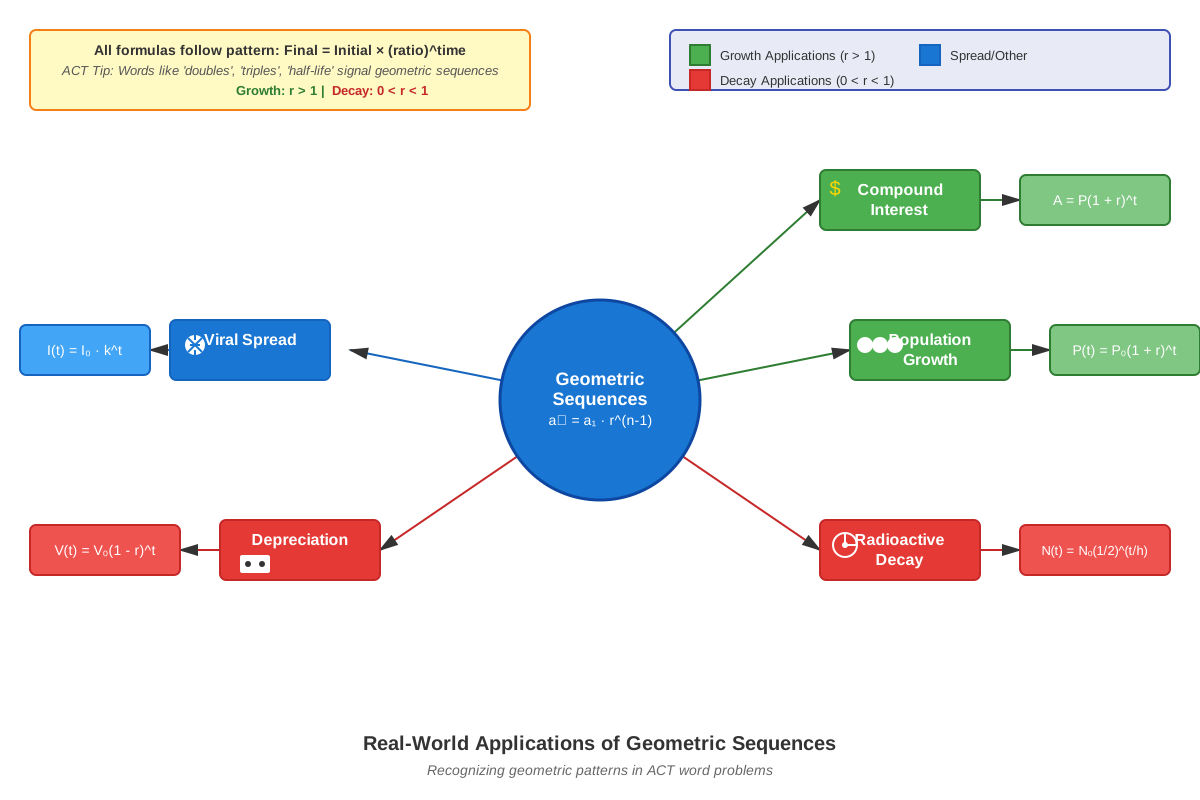
Geometric sequences model exponential growth and decay situations:
- Compound interest: Money grows geometrically when interest is reinvested
- Population growth: Populations multiply by a growth factor each period
- Depreciation: Asset values decrease by a constant percentage
- Radioactive decay: Radioactive material decreases by a constant factor
- Viral spread: Infections can multiply geometrically in early stages
The ACT frequently presents these scenarios, requiring students to recognize the geometric pattern, identify the common ratio, and apply the explicit formula.
Concept Relationships
The concepts within geometric sequences build hierarchically. Understanding the common ratio is foundational—without it, neither the explicit nor recursive formulas can be applied. The common ratio → determines → sequence behavior (growth, decay, or alternation). Once the common ratio is known, it combines with the first term → to enable → explicit formula application, which → produces → any specific term.
The explicit formula connects directly to exponential functions from the Functions domain. A geometric sequence is essentially a discrete exponential function where the domain is restricted to positive integers. The formula aₙ = a₁ · r^(n-1) mirrors the exponential function f(x) = a · b^x, with r corresponding to the base b.
Geometric sequences contrast with arithmetic sequences (a prerequisite topic), where addition replaces multiplication. Both sequence types require pattern recognition, but geometric sequences demand stronger exponent skills. The distinction between these sequence types → leads to → sequence identification problems, a common ACT question format.
Real-world applications → connect → geometric sequences to percent change and exponential modeling. When a quantity changes by a constant percentage, it follows a geometric pattern. This relationship → extends to → compound interest problems and growth/decay scenarios, making geometric sequences relevant across multiple ACT Math domains.
High-Yield Facts
⭐ The common ratio (r) is found by dividing any term by the previous term: r = aₙ/aₙ₋₁
⭐ The explicit formula is aₙ = a₁ · r^(n-1), where the exponent is always one less than the term number
⭐ When r > 1, the sequence grows; when 0 < r < 1, the sequence decays
⭐ A negative common ratio causes terms to alternate between positive and negative
⭐ To find a missing term between two known terms, use the geometric mean: middle term = √(term₁ · term₂)
- The first term (a₁) and common ratio (r) completely determine a geometric sequence
- Geometric sequences can have fractional or decimal common ratios
- If three consecutive terms form a geometric sequence, the middle term squared equals the product of the outer terms: a₂² = a₁ · a₃
- The common ratio can never be zero (this would make all subsequent terms zero)
- Geometric sequences with r = 1 are constant sequences where all terms are identical
- When solving for r from non-consecutive terms, remember to take the appropriate root based on the number of steps between terms
- The sum of a geometric sequence (geometric series) uses a different formula not typically tested on the ACT
Quick check — test yourself on Geometric sequences so far.
Try Flashcards →Common Misconceptions
Misconception: The exponent in the explicit formula equals the term number (n).
Correction: The exponent is always n - 1, not n. For the 5th term, use r⁴, not r⁵. This is because the first term has no multiplication by r (or equivalently, r⁰ = 1).
Misconception: A geometric sequence must always increase.
Correction: Geometric sequences can increase, decrease, or alternate signs depending on the common ratio. When 0 < r < 1, terms decrease. When r < 0, terms alternate signs.
Misconception: The common ratio is found by subtracting consecutive terms.
Correction: Subtraction finds the common difference in arithmetic sequences. For geometric sequences, divide consecutive terms to find the common ratio. Confusing these operations is a frequent error.
Misconception: All sequences with multiplication are geometric.
Correction: A geometric sequence requires multiplication by the same constant ratio for every step. If the multiplier changes, the sequence is not geometric. For example, 2, 4, 12, 48 is not geometric (×2, then ×3, then ×4).
Misconception: When finding r from non-consecutive terms, simply divide the terms.
Correction: If terms are separated by multiple positions, you must account for multiple multiplications. If a₅ = 32 and a₂ = 4, then r³ = 8 (not r = 8), so r = 2. The exponent equals the number of steps between terms.
Misconception: Geometric sequences can only have positive terms.
Correction: Geometric sequences can have negative terms, especially when the common ratio is negative. The sequence -3, 6, -12, 24, -48 is geometric with r = -2.
Misconception: The explicit formula can only be used when you know the first term.
Correction: If you know any term's value and position, you can use it as a reference point. The formula can be adapted: aₙ = aₖ · r^(n-k) where aₖ is any known term.
Worked Examples
Example 1: Finding a Specific Term
Problem: In a geometric sequence, the first term is 5 and the common ratio is 3. What is the 6th term?
Solution:
Step 1: Identify the given information.
- a₁ = 5
- r = 3
- n = 6 (we want the 6th term)
Step 2: Apply the explicit formula.
aₙ = a₁ · r^(n-1)
a₆ = 5 · 3^(6-1)
a₆ = 5 · 3⁵
Step 3: Calculate the exponent.
3⁵ = 3 · 3 · 3 · 3 · 3 = 243Step 4: Complete the multiplication.
a₆ = 5 · 243 = 1,215Answer: The 6th term is 1,215.
Connection to Learning Objectives: This problem demonstrates applying the explicit formula to ACT-style questions accurately. It requires recognizing that the exponent is n - 1, not n, and correctly evaluating powers—both essential skills for geometric sequence questions.
Example 2: Real-World Application with Decay
Problem: A car's value depreciates by 15% each year. If the car is initially worth $24,000, what will its value be after 4 years? (Round to the nearest dollar.)
Solution:
Step 1: Recognize this as a geometric sequence problem.
- The value decreases by 15% each year, meaning it retains 85% of its value
- This is exponential decay with a common ratio
Step 2: Identify the components.
- a₁ = $24,000 (initial value)
- r = 0.85 (retains 85% = 100% - 15%)
- n = 5 (after 4 years means the 5th term: initial value is term 1, after 1 year is term 2, etc.)
Step 3: Apply the explicit formula.
aₙ = a₁ · r^(n-1)
a₅ = 24,000 · (0.85)^(5-1)
a₅ = 24,000 · (0.85)⁴
Step 4: Calculate the power.
(0.85)⁴ = 0.85 · 0.85 · 0.85 · 0.85 ≈ 0.52200625Step 5: Complete the calculation.
a₅ = 24,000 · 0.52200625 ≈ 12,528.15Answer: The car's value after 4 years is approximately $12,528.
Connection to Learning Objectives: This problem requires identifying when geometric sequences are being tested in a real-world context (depreciation), explaining the core strategy (recognizing that constant percentage decrease creates a geometric pattern), and applying the formula accurately. Note the careful attention to term numbering: "after 4 years" means we're at the 5th term position.
Example 3: Finding the Common Ratio from Non-Consecutive Terms
Problem: In a geometric sequence, the 3rd term is 12 and the 6th term is 96. What is the common ratio?
Solution:
Step 1: Set up the relationship between the terms.
- a₃ = 12
- a₆ = 96
- From a₃ to a₆ requires 3 multiplications by r
Step 2: Write the equation.
a₆ = a₃ · r³
96 = 12 · r³
Step 3: Solve for r³.
r³ = 96/12 = 8Step 4: Find r by taking the cube root.
r = ∛8 = 2Step 5: Verify (optional but recommended).
- a₃ = 12
- a₄ = 12 · 2 = 24
- a₅ = 24 · 2 = 48
- a₆ = 48 · 2 = 96 ✓
Answer: The common ratio is 2.
Connection to Learning Objectives: This demonstrates identifying geometric sequence problems in non-standard formats and applying the core strategy of using the relationship between terms. It also shows the importance of understanding that the exponent on r equals the number of steps between terms.
Exam Strategy
When approaching ACT geometric sequence questions, begin by identifying trigger words and phrases: "multiplied by," "grows by a factor of," "common ratio," "exponential," "doubles," "triples," "depreciates by a percentage," or "retains a percentage." These signal geometric rather than arithmetic patterns.
Exam Tip: If a problem mentions percentage increase or decrease that repeats each period, it's almost certainly a geometric sequence. Convert percentages to decimal multipliers immediately.
Follow this systematic approach:
- Identify the sequence type: Verify it's geometric by checking if consecutive terms have a constant ratio
- Extract the given information: Identify a₁, r, n, or whichever values are provided
- Determine what's being asked: Specific term? Common ratio? Term position?
- Choose the appropriate formula: Usually the explicit formula aₙ = a₁ · r^(n-1)
- Solve carefully: Pay special attention to the exponent (n - 1, not n)
- Check reasonableness: Does the answer make sense given the pattern?
For process-of-elimination strategies, use these techniques:
- Magnitude checking: If r > 1 and n is large, the answer should be significantly larger than a₁. Eliminate small answers.
- Sign checking: If r is negative and n is even, the term should have the same sign as a₁. If n is odd, opposite sign.
- Decimal checking: If r is between 0 and 1, later terms should be smaller than earlier terms. Eliminate growing answers.
Time allocation: Straightforward geometric sequence problems should take 30-45 seconds. Word problems requiring setup may take 60-90 seconds. If you're spending more than 2 minutes, mark the question and return to it later.
Watch for these common ACT tricks:
- Confusing term number with exponent (remember n - 1)
- Mixing up arithmetic and geometric sequences
- Providing the second term instead of the first term
- Asking for "after n years" when the initial value is year 0
- Using negative or fractional common ratios to test careful calculation
Memory Techniques
GEAR - Remember the explicit formula components:
- Geometric term (aₙ)
- Equals first term (a₁)
- And ratio (r)
- Raised to (n - 1)
"Multiply to Move" - In geometric sequences, you multiply by the common ratio to move from one term to the next (unlike arithmetic sequences where you add).
"One Less Than" - The exponent is always one less than the term number. Visualize: "To get to term 5, I multiply 4 times, so the exponent is 4."
"Divide to Discover" - To discover the common ratio, divide consecutive terms. This distinguishes it from arithmetic sequences where you subtract.
Percentage Conversion Trick: For percentage decrease problems, remember "keep what remains." If something decreases by 20%, it keeps 80%, so r = 0.80. If it increases by 20%, it becomes 120% of the original, so r = 1.20.
Visual Pattern: Write out the first few terms with their formulas to see the pattern:
- a₁ = a₁ · r⁰
- a₂ = a₁ · r¹
- a₃ = a₁ · r²
- a₄ = a₁ · r³
Notice how the exponent is always one less than the subscript.
Summary
Geometric sequences are ordered lists where each term is obtained by multiplying the previous term by a constant common ratio (r). The explicit formula aₙ = a₁ · r^(n-1) allows direct calculation of any term without finding all previous terms, making it the most efficient tool for ACT questions. The common ratio determines sequence behavior: values greater than 1 produce growth, values between 0 and 1 produce decay, and negative values cause alternating signs. ACT questions test geometric sequences through direct term calculation, common ratio identification, real-world applications involving exponential growth or decay, and distinguishing geometric from arithmetic patterns. Success requires recognizing geometric patterns in various contexts, correctly applying the explicit formula with careful attention to the n - 1 exponent, and accurately performing calculations with powers. Mastery of geometric sequences provides essential skills for exponential functions, compound interest problems, and modeling real-world phenomena—all high-yield topics on the ACT Math test.
Key Takeaways
- The common ratio (r) is found by dividing any term by the previous term and must remain constant throughout the sequence
- The explicit formula aₙ = a₁ · r^(n-1) is the primary tool for ACT questions; remember the exponent is always n - 1
- Geometric sequences model exponential growth (r > 1) and decay (0 < r < 1), making them essential for real-world problems
- Percentage change problems are geometric sequences in disguise; convert percentages to decimal multipliers immediately
- Negative common ratios cause terms to alternate signs; fractional ratios cause terms to decrease
- Always verify whether a sequence is geometric by checking if consecutive ratios are equal before applying geometric formulas
- When terms are non-consecutive, the exponent on r equals the number of steps between the terms
Related Topics
Arithmetic Sequences: The additive counterpart to geometric sequences, where constant differences replace constant ratios. Mastering geometric sequences makes distinguishing between these patterns straightforward.
Exponential Functions: Geometric sequences are discrete exponential functions. Understanding sequences provides intuition for continuous exponential growth and decay models.
Logarithms: Used to solve for unknown exponents in geometric sequence problems, particularly when finding which term reaches a certain value.
Compound Interest: A direct application of geometric sequences where money grows by a constant percentage each period.
Series and Summation: While the ACT rarely tests geometric series directly, understanding geometric sequences is prerequisite knowledge for summing geometric terms.
Practice CTA
Now that you've mastered the core concepts of geometric sequences, it's time to solidify your understanding through practice. Attempt the practice questions to test your ability to identify geometric patterns, apply the explicit formula, and solve real-world problems under timed conditions. Use the flashcards to reinforce the key formulas and concepts until they become automatic. Remember, geometric sequences appear on virtually every ACT Math test—your investment in mastering this topic will directly translate to points on test day. Confidence comes from practice, so challenge yourself with increasingly difficult problems until geometric sequence questions become your favorite type to see on the exam!
Sign up free to keep reading
Create a free AnvayaPrep account to finish this ACT guide on Geometric sequences — plus flashcards and practice questions.