Overview
Arithmetic sequences are one of the most frequently tested topics in the Number and Quantity domain of the ACT Math test. An arithmetic sequence is a list of numbers where each term after the first is obtained by adding a constant value, called the common difference, to the previous term. This seemingly simple pattern forms the foundation for understanding more complex mathematical relationships and appears in approximately 2-4 questions on every ACT exam.
Understanding ACT arithmetic sequences is crucial because these questions often appear in multiple forms: direct calculation problems, word problems involving real-world scenarios, and multi-step problems that combine sequences with other algebraic concepts. Students who master arithmetic sequences gain a significant advantage on test day, as these questions are designed to be solved quickly once the underlying pattern is recognized. The ACT rewards students who can identify the sequence structure, apply the appropriate formula, and calculate answers efficiently under time pressure.
Beyond exam success, arithmetic sequences connect to broader mathematical concepts including linear functions, series, and patterns in data. The skills developed while studying sequences—pattern recognition, formula application, and logical reasoning—transfer directly to algebra, coordinate geometry, and even trigonometry questions on the ACT. Mastering this topic builds mathematical maturity and provides tools that appear throughout the entire Math section.
Learning Objectives
- [ ] Identify when Arithmetic sequences is being tested
- [ ] Explain the core rule or strategy behind Arithmetic sequences
- [ ] Apply Arithmetic sequences to ACT-style questions accurately
- [ ] Calculate any term in an arithmetic sequence using the explicit formula
- [ ] Determine the common difference from any two terms in a sequence
- [ ] Solve for unknown variables when given partial sequence information
- [ ] Apply arithmetic sequence concepts to real-world word problems
Prerequisites
- Basic algebra skills: Ability to solve linear equations and manipulate algebraic expressions is essential for working with sequence formulas
- Order of operations: Required to correctly evaluate sequence formulas that involve multiple arithmetic operations
- Substitution: Understanding how to substitute values into formulas is fundamental to finding specific terms
- Pattern recognition: Basic ability to identify numerical patterns helps in recognizing arithmetic sequences quickly
Why This Topic Matters
Arithmetic sequences appear in countless real-world applications that make them relevant beyond standardized testing. Financial planning uses arithmetic sequences to model regular savings deposits, salary increases with fixed annual raises, and payment schedules. Construction and engineering rely on arithmetic patterns for spacing elements like fence posts, stairs, or structural supports. Even time management involves arithmetic sequences when scheduling events at regular intervals.
On the ACT Math test, arithmetic sequences appear with remarkable consistency. Approximately 3-5% of all Math questions directly test sequence knowledge, translating to 2-3 questions per exam. These questions typically appear in the medium difficulty range (questions 20-40 out of 60), making them accessible to students aiming for scores in the 24-32 range. However, harder sequence questions can appear later in the test, often combining sequences with other concepts like systems of equations or functions.
The ACT presents arithmetic sequences in several distinct formats. Direct calculation questions provide the first few terms and ask for a specific later term. Word problems embed sequences in real-world contexts like ticket pricing, seating arrangements, or growth patterns. Some questions present sequences in table format, requiring students to identify the pattern before calculating. The most challenging questions involve finding the common difference when given non-consecutive terms or determining which term equals a specific value. Recognizing these question types quickly is essential for efficient test-taking.
Core Concepts
Definition and Structure
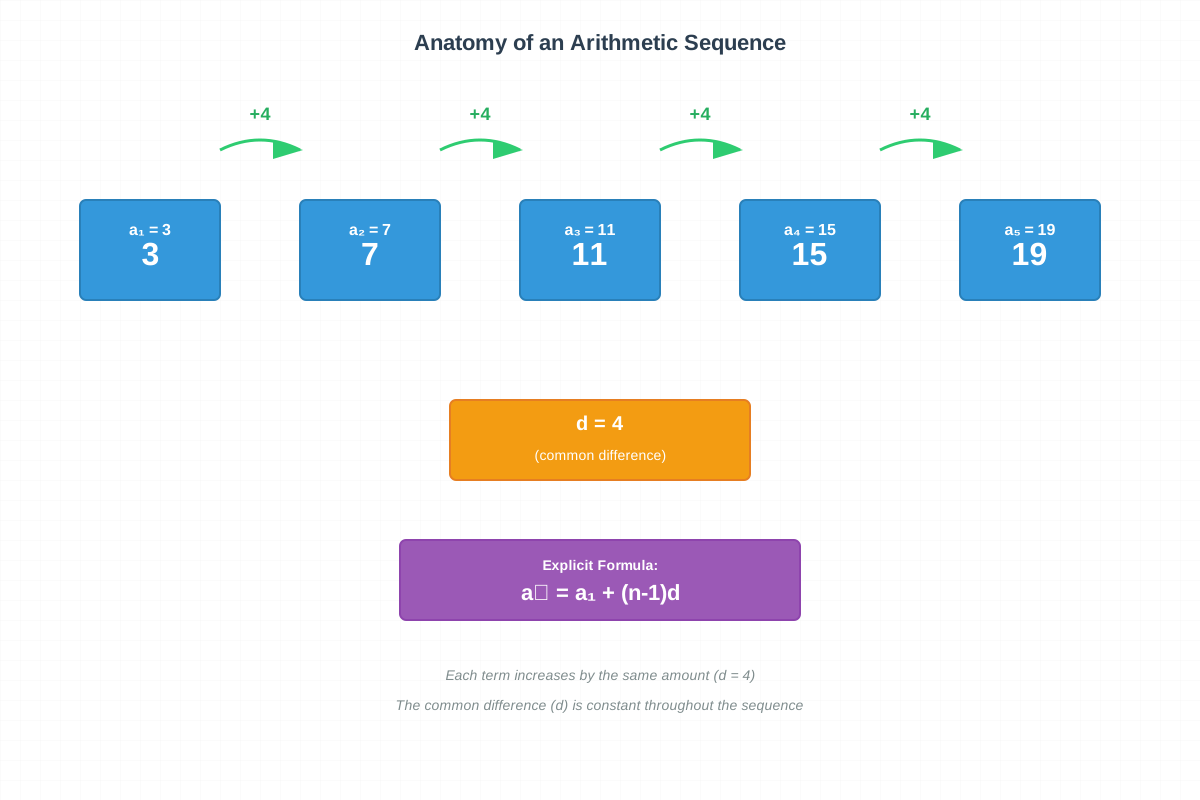
An arithmetic sequence (also called an arithmetic progression) is an ordered list of numbers where the difference between consecutive terms remains constant. This fixed difference is called the common difference, typically denoted by the variable d. The sequence begins with an initial term or first term, denoted as a₁ (read as "a sub one").
For example, the sequence 3, 7, 11, 15, 19, ... is arithmetic because each term is obtained by adding 4 to the previous term. Here, a₁ = 3 and d = 4. The common difference can be positive (increasing sequence), negative (decreasing sequence), or even zero (constant sequence).
Finding the Common Difference
The common difference is calculated by subtracting any term from the term that immediately follows it:
d = aₙ - aₙ₋₁Where aₙ represents any term and aₙ₋₁ represents the term before it. This relationship holds true for any consecutive pair of terms in the sequence.
Example: In the sequence 20, 17, 14, 11, 8, ...
- d = 17 - 20 = -3
- d = 14 - 17 = -3
- d = 11 - 14 = -3
The common difference is -3, indicating a decreasing sequence.
The Explicit Formula
The most important tool for working with arithmetic sequences is the explicit formula (also called the nth term formula), which allows direct calculation of any term without listing all previous terms:
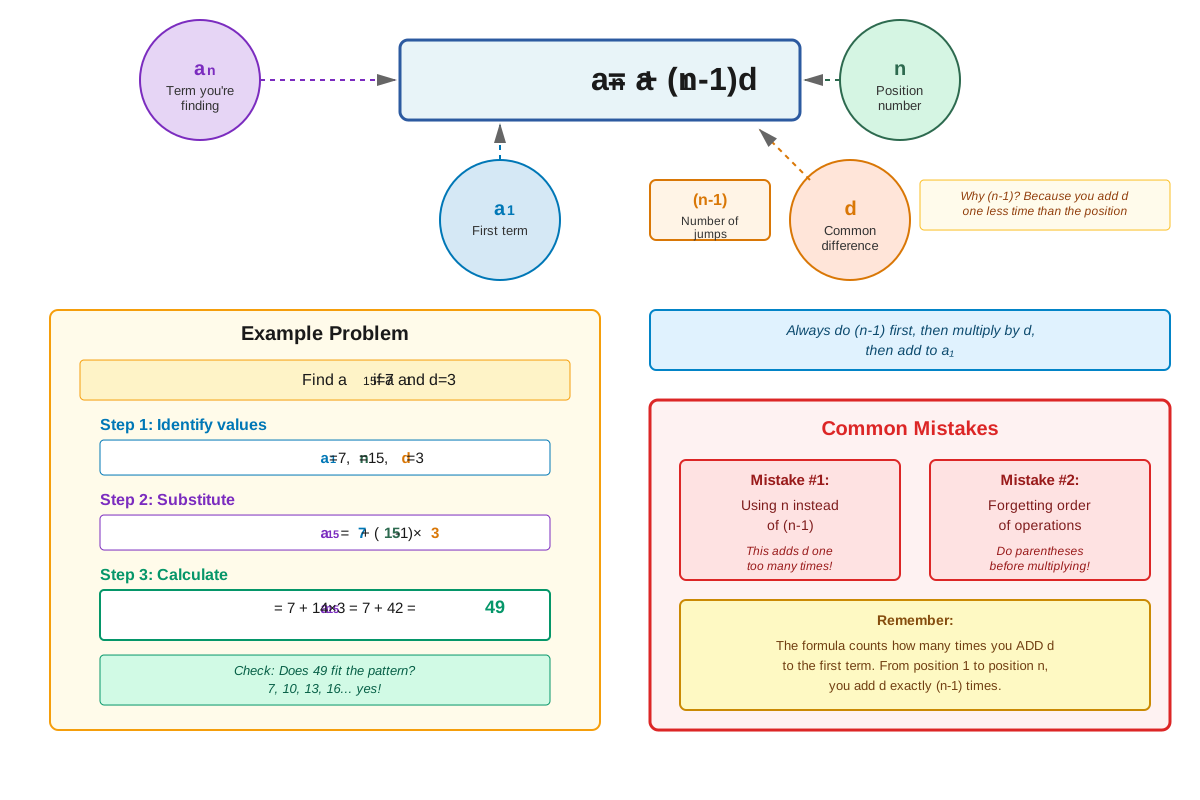
aₙ = a₁ + (n - 1)dWhere:
- aₙ = the nth term (the term you're looking for)
- a₁ = the first term
- n = the position number of the term
- d = the common difference
This formula works because to reach the nth term, you start with the first term and add the common difference (n - 1) times. Note that you add the common difference one fewer time than the term number because you're already starting at the first term.
Example: Find the 50th term of the sequence 5, 9, 13, 17, ...
First, identify the components:
- a₁ = 5
- d = 9 - 5 = 4
- n = 50
Apply the formula:
- a₅₀ = 5 + (50 - 1)(4)
- a₅₀ = 5 + (49)(4)
- a₅₀ = 5 + 196
- a₅₀ = 201
Recursive vs. Explicit Formulas
Arithmetic sequences can be defined in two ways:
| Formula Type | Definition | When to Use |
|---|---|---|
| Recursive | Each term defined using the previous term: aₙ = aₙ₋₁ + d | When finding the next few terms or when the previous term is known |
| Explicit | Each term defined independently: aₙ = a₁ + (n - 1)d | When finding distant terms or when given the term position |
The ACT primarily tests the explicit formula because questions typically ask for terms far into the sequence (like the 40th or 100th term), making the recursive approach impractical.
Working Backwards
Many ACT questions require working backwards from given information to find missing components. The explicit formula contains four variables (aₙ, a₁, n, d), and if any three are known, the fourth can be calculated through algebraic manipulation.
Common scenarios:
- Given a₁, d, and aₙ: Solve for n (which term has this value?)
- Given a₁, n, and aₙ: Solve for d (what's the common difference?)
- Given d, n, and aₙ: Solve for a₁ (what's the first term?)
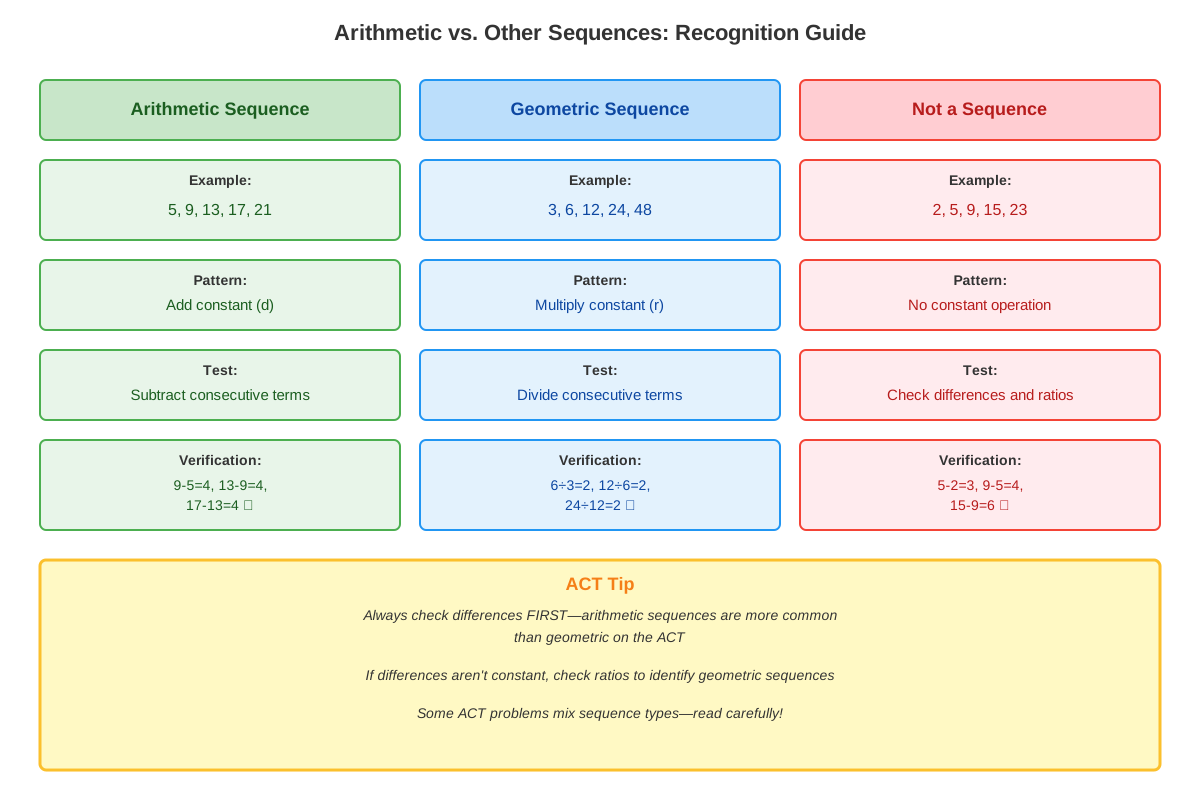
Identifying Arithmetic Sequences
Not every list of numbers forms an arithmetic sequence. To verify a sequence is arithmetic:
- Calculate the difference between the second and first terms
- Calculate the difference between the third and second terms
- If these differences are equal, continue checking
- If all consecutive differences are equal, the sequence is arithmetic
Non-example: The sequence 2, 4, 8, 16, 32, ... is NOT arithmetic because:
- 4 - 2 = 2
- 8 - 4 = 4
- The differences are not constant (this is actually a geometric sequence)
Concept Relationships
The concepts within arithmetic sequences build upon each other in a logical progression. Pattern recognition serves as the foundation → leads to → identifying the common difference → enables → applying the explicit formula → allows for → solving complex problems involving unknown variables or real-world applications.
The common difference connects directly to the slope concept in linear functions. In fact, an arithmetic sequence can be viewed as a discrete linear function where the domain is restricted to positive integers. The explicit formula aₙ = a₁ + (n - 1)d parallels the slope-intercept form y = mx + b, with the common difference d acting like the slope m.
Arithmetic sequences also relate to prerequisite algebra skills. Solving for unknown terms requires equation-solving techniques, while manipulating the explicit formula demands comfort with algebraic substitution and simplification. The pattern recognition skills developed through sequences transfer to identifying linear relationships in coordinate geometry and understanding rate-of-change problems throughout the ACT Math section.
Understanding arithmetic sequences prepares students for more advanced topics including arithmetic series (the sum of sequence terms), geometric sequences (where terms are multiplied by a constant ratio), and function notation. The logical thinking required for sequences—identifying patterns, applying formulas systematically, and checking answers—develops mathematical reasoning applicable to virtually every ACT Math question type.
High-Yield Facts
⭐ The explicit formula for the nth term is: aₙ = a₁ + (n - 1)d
⭐ The common difference d is found by subtracting any term from the next term: d = aₙ - aₙ₋₁
⭐ An arithmetic sequence has a constant difference between consecutive terms
⭐ If the common difference is positive, the sequence increases; if negative, it decreases
⭐ The explicit formula contains four variables; knowing any three allows you to solve for the fourth
- The first term is denoted as a₁ and serves as the starting point for all calculations
- The term position n must be a positive integer (1, 2, 3, ...)
- To find which term equals a specific value, set aₙ equal to that value and solve for n
- Arithmetic sequences can be represented graphically as discrete points forming a linear pattern
- The difference between any two terms equals d multiplied by the number of steps between them: aₘ - aₙ = d(m - n)
- Zero can be a term in an arithmetic sequence, and zero can be the common difference
- Arithmetic sequences extend infinitely in both directions unless otherwise specified
Quick check — test yourself on Arithmetic sequences so far.
Try Flashcards →Common Misconceptions
Misconception: The common difference is always positive.
→ Correction: The common difference can be positive (increasing sequence), negative (decreasing sequence), or zero (constant sequence). Always calculate d by subtracting a term from the following term, and preserve the sign.
Misconception: To find the 10th term, multiply the first term by 10.
→ Correction: Use the explicit formula aₙ = a₁ + (n - 1)d. The term position n determines how many times to add the common difference, not how many times to multiply. Multiplication only applies to geometric sequences.
Misconception: The formula is aₙ = a₁ + nd (forgetting to subtract 1).
→ Correction: The correct formula is aₙ = a₁ + (n - 1)d. You add the common difference (n - 1) times because you're already starting at the first term. For the 5th term, you add d four times, not five times.
Misconception: Any list of numbers is an arithmetic sequence.
→ Correction: A sequence is only arithmetic if the difference between ALL consecutive terms is constant. Always verify by checking multiple consecutive differences before assuming a sequence is arithmetic.
Misconception: The first term is always labeled as a₀.
→ Correction: In arithmetic sequences, the first term is conventionally labeled a₁ (not a₀). The subscript indicates the term's position, and counting begins at 1. Using a₀ would throw off all calculations in the explicit formula.
Misconception: You can only find terms that come after the given terms.
→ Correction: Arithmetic sequences extend infinitely in both directions. You can find "previous" terms by using negative values for the number of steps or by working backwards with the common difference.
Worked Examples
Example 1: Finding a Distant Term
Problem: The first term of an arithmetic sequence is 12, and the common difference is -3. What is the 35th term?
Solution:
Step 1: Identify the given information
- a₁ = 12
- d = -3
- n = 35
- Find: a₃₅
Step 2: Select the appropriate formula
We use the explicit formula because we're finding a distant term: aₙ = a₁ + (n - 1)d
Step 3: Substitute the known values
a₃₅ = 12 + (35 - 1)(-3)
Step 4: Simplify using order of operations
a₃₅ = 12 + (34)(-3)
a₃₅ = 12 + (-102)
a₃₅ = 12 - 102
a₃₅ = -90
Step 5: Verify the answer makes sense
Since the common difference is negative, the sequence is decreasing. Starting at 12 and decreasing by 3 repeatedly should eventually produce negative values, so -90 is reasonable for the 35th term.
Answer: The 35th term is -90.
Connection to Learning Objectives: This example demonstrates applying the explicit formula to ACT-style questions accurately and explains the core strategy of identifying given information and selecting the appropriate formula.
Example 2: Finding the Common Difference from Non-Consecutive Terms
Problem: In an arithmetic sequence, the 7th term is 41 and the 15th term is 73. What is the common difference?
Solution:
Step 1: Recognize what's given
- a₇ = 41
- a₁₅ = 73
- Find: d
Step 2: Set up equations using the explicit formula
For the 7th term: 41 = a₁ + (7 - 1)d → 41 = a₁ + 6d
For the 15th term: 73 = a₁ + (15 - 1)d → 73 = a₁ + 14d
Step 3: Use the system of equations
Rather than solving the system, recognize that between the 7th and 15th terms, there are 8 steps (15 - 7 = 8).
The difference between these terms equals 8d:
73 - 41 = 8d
32 = 8d
d = 4
Step 4: Verify using the alternative method
If we solved the system:
- From equation 1: a₁ = 41 - 6d
- Substitute into equation 2: 73 = (41 - 6d) + 14d
- Simplify: 73 = 41 + 8d
- Solve: 32 = 8d, so d = 4 ✓
Answer: The common difference is 4.
Connection to Learning Objectives: This example shows how to identify when arithmetic sequences are being tested in non-obvious ways and demonstrates the strategy of using the relationship between terms to find missing information efficiently.
Exam Strategy
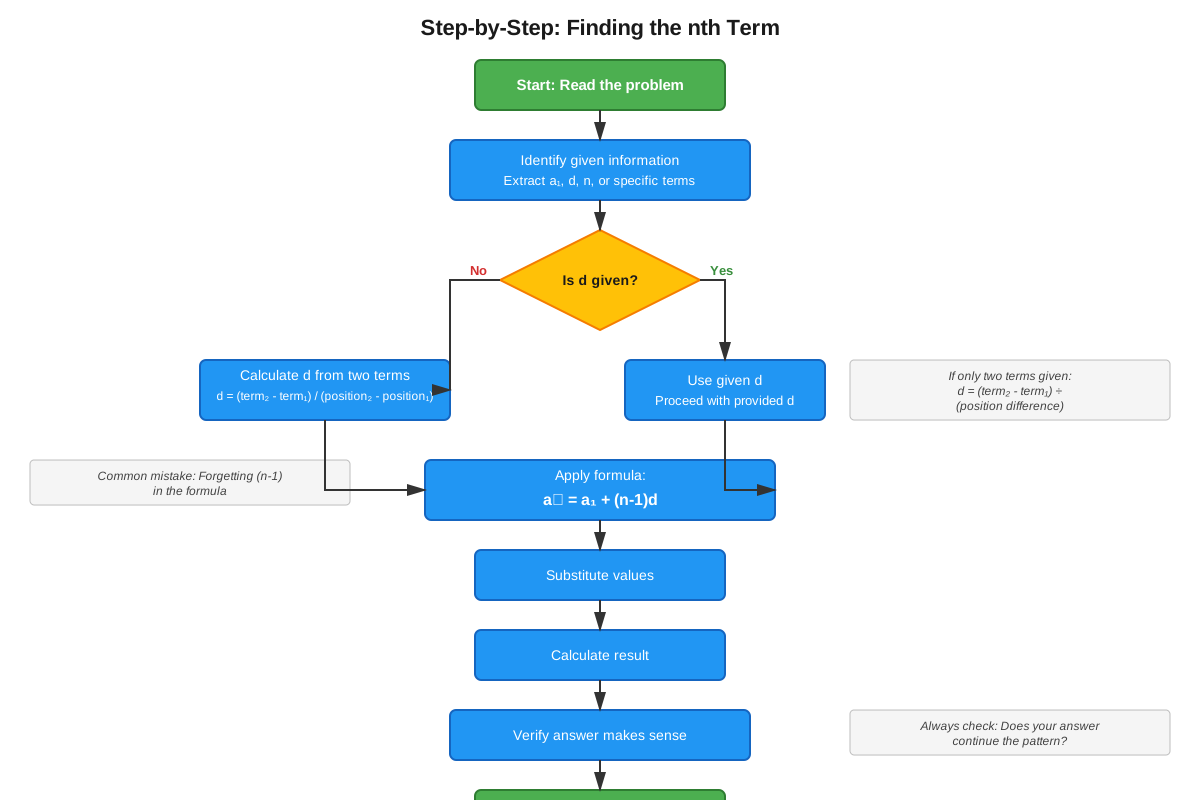
When approaching ACT arithmetic sequence questions, follow this systematic process:
Step 1: Identify the question type
Look for trigger words and phrases that signal arithmetic sequences:
- "arithmetic sequence," "arithmetic progression"
- "constant difference," "common difference"
- "increases/decreases by the same amount"
- "each term is ___ more/less than the previous"
- Lists of numbers with regular patterns
- Tables showing term positions and values
Step 2: Extract and organize information
Create a quick notation system:
- Write down a₁ = [value] if given
- Write down d = [value] if given or calculate it immediately
- Write down n = [value] for the term position you're finding
- Write down aₙ = [value] if a specific term value is given
Step 3: Determine what's being asked
ACT questions typically ask for:
- A specific term value (most common)
- The common difference
- Which term equals a certain value
- The first term
- Whether a sequence is arithmetic
Step 4: Apply the explicit formula strategically
Write out the formula: aₙ = a₁ + (n - 1)d
Substitute known values and solve for the unknown. If solving for n, be prepared to use algebra to isolate the variable.
Time allocation advice: Arithmetic sequence questions should take 45-60 seconds on average. If you're spending more than 90 seconds, you may be overcomplicating the problem. Check that you're using the explicit formula correctly and haven't made a calculation error.
Process of elimination tips:
- Eliminate answers that don't match the sequence's direction (increasing vs. decreasing)
- If finding a large term number, eliminate answers close to the first term
- Check if the answer choice minus the first term is divisible by the common difference
- For "which term" questions, eliminate non-integer answers
Exam Tip: If you're given the first few terms of a sequence, immediately calculate the common difference by subtracting consecutive terms. Write it down before reading the rest of the question—this prevents calculation errors later.
Memory Techniques
Formula Mnemonic: "Add Nearly Done" helps remember the explicit formula structure:
- Aₙ (the term you want)
- N minus one (n - 1)
- D (times the common difference)
- Plus a₁ (the first term)
Visualization Strategy: Picture an arithmetic sequence as climbing stairs. Each step up (or down) is exactly the same height—that's your common difference. The first term is your starting floor, and n tells you how many steps you've taken. The formula calculates your final height.
The "One Less" Rule: Remember that you add the common difference (n - 1) times, not n times. Think: "To get to the 5th term, I take 4 steps from the 1st term." The number of steps is always one less than the term position.
Difference Direction:
- Positive difference = Progressing upward (increasing)
- Negative difference = Nosediving downward (decreasing)
FIND Acronym for problem-solving:
- First term (identify a₁)
- Identify the common difference (d)
- Number the term position (n)
- Deploy the formula (aₙ = a₁ + (n - 1)d)
Summary
Arithmetic sequences form a fundamental pattern in mathematics where each term differs from the previous term by a constant value called the common difference. The explicit formula, aₙ = a₁ + (n - 1)d, provides the essential tool for calculating any term in the sequence without listing all previous terms. Success on ACT arithmetic sequence questions requires three core skills: recognizing when a sequence is arithmetic by verifying constant differences, identifying which components of the formula are given, and applying algebraic techniques to solve for unknown values. The ACT tests this topic through direct calculation problems, word problems with real-world contexts, and multi-step problems requiring manipulation of the explicit formula. Students who master pattern recognition, formula application, and strategic problem-solving can consistently answer these medium-difficulty questions correctly, typically earning 2-3 points per exam. The key to mastery lies in understanding that the formula contains four interconnected variables, and knowing any three allows calculation of the fourth through systematic algebraic reasoning.
Key Takeaways
- The explicit formula aₙ = a₁ + (n - 1)d is the single most important tool for solving arithmetic sequence problems on the ACT
- Always verify a sequence is arithmetic by checking that consecutive differences are constant before applying sequence formulas
- The common difference can be positive, negative, or zero, and its sign determines whether the sequence increases, decreases, or remains constant
- When given non-consecutive terms, use the relationship that the difference between terms equals d times the number of steps between them
- Arithmetic sequence questions appear 2-3 times per ACT exam and should be solved in under 60 seconds with proper formula application
- The term position n must be a positive integer, and the formula uses (n - 1) because you're already starting at the first term
- Working backwards from given information to find missing components (like d or a₁) is a common ACT question type requiring algebraic manipulation
Related Topics
Arithmetic Series: After mastering individual terms in arithmetic sequences, the next progression involves finding the sum of multiple terms. The arithmetic series formula allows calculation of the sum of the first n terms without adding each term individually, appearing occasionally on the ACT.
Geometric Sequences: While arithmetic sequences involve adding a constant difference, geometric sequences involve multiplying by a constant ratio. Understanding the distinction between these two sequence types is crucial, as the ACT sometimes tests whether students can differentiate between them.
Linear Functions: Arithmetic sequences represent discrete linear functions where the domain consists only of positive integers. The connection between the common difference and slope, and between the explicit formula and slope-intercept form, deepens understanding of both topics.
Systems of Equations: Complex arithmetic sequence problems often require setting up and solving systems of equations when multiple unknowns must be determined from given information about various terms.
Practice CTA
Now that you've mastered the core concepts of arithmetic sequences, it's time to solidify your understanding through active practice. Complete the practice questions to test your ability to recognize sequence patterns, apply the explicit formula under timed conditions, and solve multi-step problems that mirror actual ACT questions. Use the flashcards to reinforce the explicit formula, common difference calculation, and key problem-solving strategies until they become automatic. Remember: arithmetic sequences appear on every ACT exam, and these 2-3 questions represent achievable points that can significantly boost your Math score. Consistent practice transforms these medium-difficulty questions into quick confidence-builders on test day!
Sign up free to keep reading
Create a free AnvayaPrep account to finish this ACT guide on Arithmetic sequences — plus flashcards and practice questions.