Overview
The least common multiple (LCM) is a fundamental concept in number theory that appears regularly on the ACT Math test. Understanding LCM is essential for solving problems involving repeating patterns, scheduling scenarios, fraction operations, and divisibility questions. The least common multiple of two or more integers is the smallest positive integer that is divisible by each of those numbers without leaving a remainder.
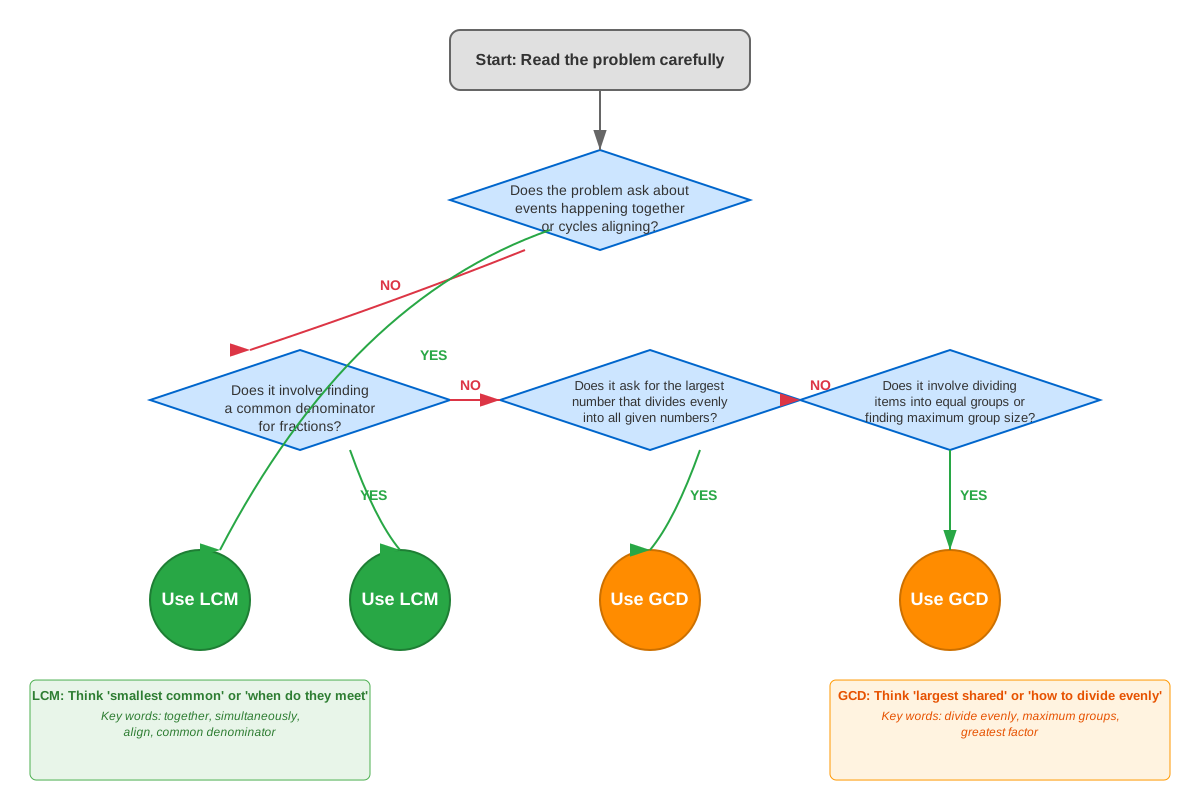
On the ACT, act least common multiple questions often appear disguised within word problems rather than as straightforward computational exercises. Students might encounter scenarios involving synchronized events (such as buses arriving at different intervals), problems requiring common denominators for fraction arithmetic, or questions about when multiple cycles align. These problems test not only computational ability but also the capacity to recognize when LCM is the appropriate tool to apply.
Mastering the least common multiple connects directly to broader mathematical concepts including prime factorization, greatest common divisor (GCD), fraction operations, and modular arithmetic. The relationship between LCM and GCD is particularly important, as these concepts are mathematical inverses in many ways. Strong LCM skills also support success in algebra, where finding common denominators for rational expressions becomes essential. For the ACT specifically, LCM questions typically appear 1-3 times per test and are considered medium difficulty, making them high-yield targets for score improvement.
Learning Objectives
- [ ] Identify when Least common multiple is being tested
- [ ] Explain the core rule or strategy behind Least common multiple
- [ ] Apply Least common multiple to ACT-style questions accurately
- [ ] Calculate the LCM of two or more numbers using multiple methods (prime factorization, listing multiples, and the GCD relationship)
- [ ] Recognize real-world scenarios that require LCM application and translate them into mathematical problems
- [ ] Distinguish between situations requiring LCM versus those requiring GCD
Prerequisites
- Prime factorization: Understanding how to break numbers into their prime factors is essential because the prime factorization method is the most efficient way to find LCM for larger numbers
- Multiples and divisibility rules: Recognizing what it means for one number to be a multiple of another forms the conceptual foundation of LCM
- Greatest common divisor (GCD): The relationship between GCD and LCM provides an alternative calculation method and deepens conceptual understanding
- Basic fraction operations: Many LCM applications involve finding common denominators for adding or subtracting fractions
Why This Topic Matters
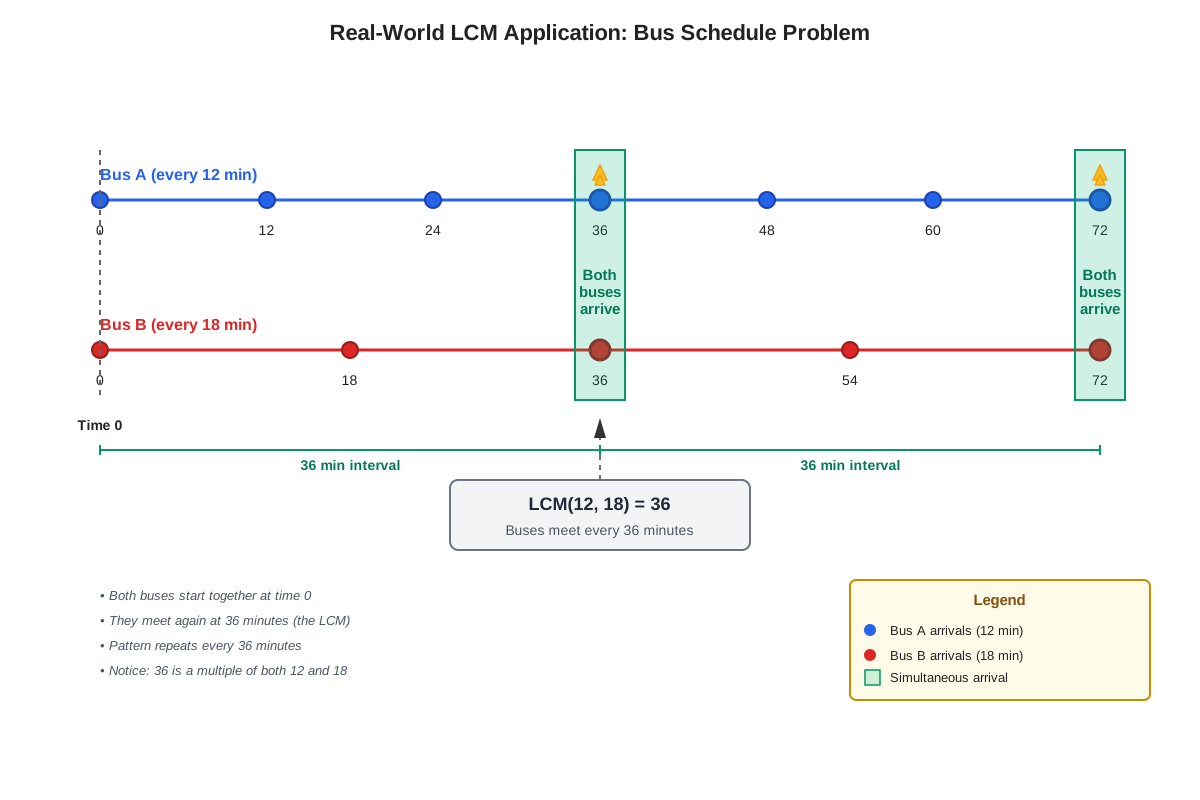
The least common multiple has extensive real-world applications that extend far beyond standardized testing. Scheduling problems represent the most common practical use—determining when events that occur at different intervals will coincide. For example, if one bus arrives every 12 minutes and another every 18 minutes, LCM helps determine when both buses arrive simultaneously. Musicians use LCM when working with different time signatures or rhythmic patterns. Engineers apply LCM in gear ratio calculations, and computer scientists use it in algorithm optimization and memory allocation.
On the ACT Math test, LCM questions appear with notable frequency—typically 1-3 questions per exam, representing approximately 2-5% of the total Math section. These questions most commonly appear in the Number and Quantity domain but can also surface in Pre-Algebra and Elementary Algebra contexts. The ACT tends to favor word problems that require students to recognize when LCM is needed rather than explicitly stating "find the least common multiple." This makes pattern recognition and problem translation skills as important as computational ability.
Common ACT question formats include: scheduling problems where multiple events repeat at different intervals; fraction problems requiring common denominators; questions about when repeating patterns align; and problems involving divisibility by multiple numbers simultaneously. The test writers often combine LCM with other concepts, such as asking students to find the LCM and then perform additional operations with that result. Understanding LCM thoroughly provides a significant strategic advantage because these questions, while medium difficulty, are highly predictable in structure once you recognize the pattern.
Core Concepts
Definition and Fundamental Understanding
The least common multiple of two or more positive integers is the smallest positive integer that is a multiple of all the given numbers. In other words, it's the smallest number that each of the original numbers divides into evenly. For example, the LCM of 4 and 6 is 12 because 12 is the smallest number that both 4 and 6 divide into without remainder (12 ÷ 4 = 3 and 12 ÷ 6 = 2).
It's crucial to understand that the LCM must be at least as large as the largest number in the set. Additionally, if one number is a multiple of another, the LCM is simply the larger number. For instance, LCM(5, 15) = 15 because 15 is already a multiple of 5.
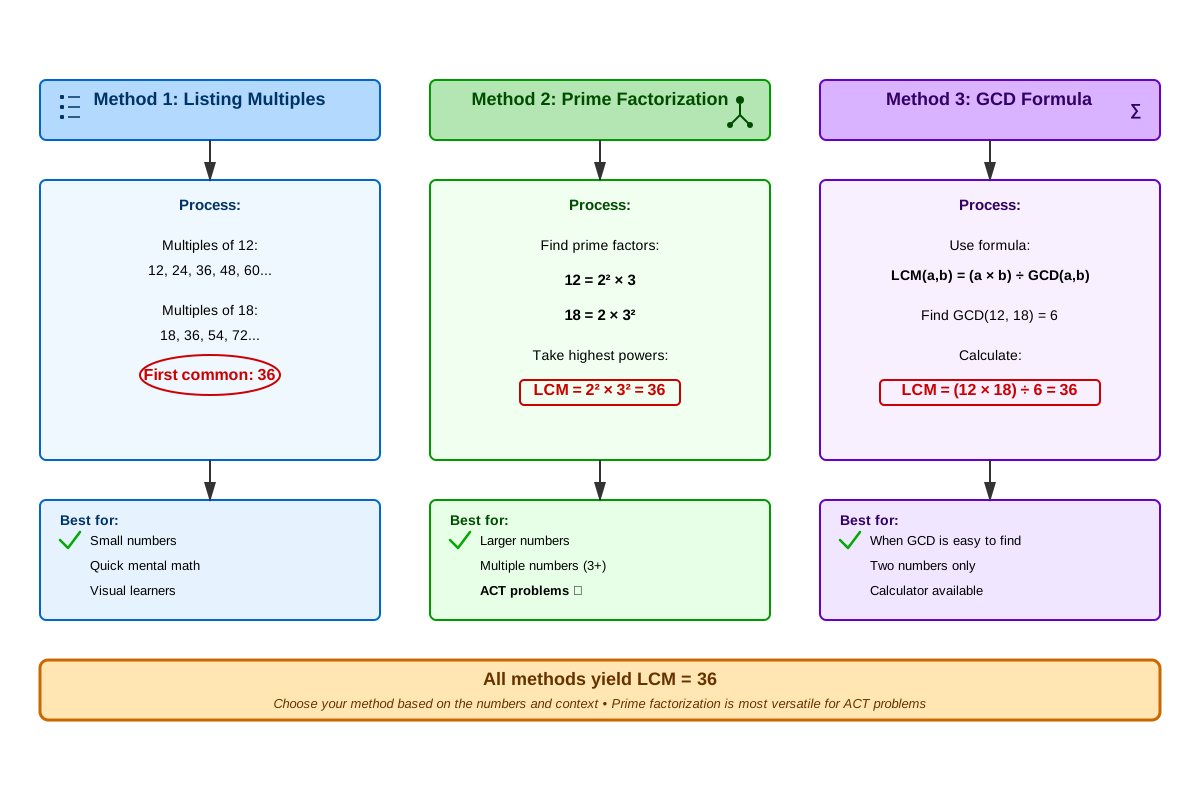
Method 1: Listing Multiples
The most intuitive method for finding LCM involves listing the multiples of each number until a common multiple appears. This method works best for smaller numbers and provides strong conceptual understanding.
Process:
- List several multiples of the first number
- List several multiples of the second number
- Identify the smallest multiple that appears in both lists
Example: Find LCM(6, 8)
- Multiples of 6: 6, 12, 18, 24, 30, 36, 42, 48...
- Multiples of 8: 8, 16, 24, 32, 40, 48...
- The smallest common multiple is 24
While this method is straightforward, it becomes impractical for larger numbers or when finding the LCM of three or more numbers.
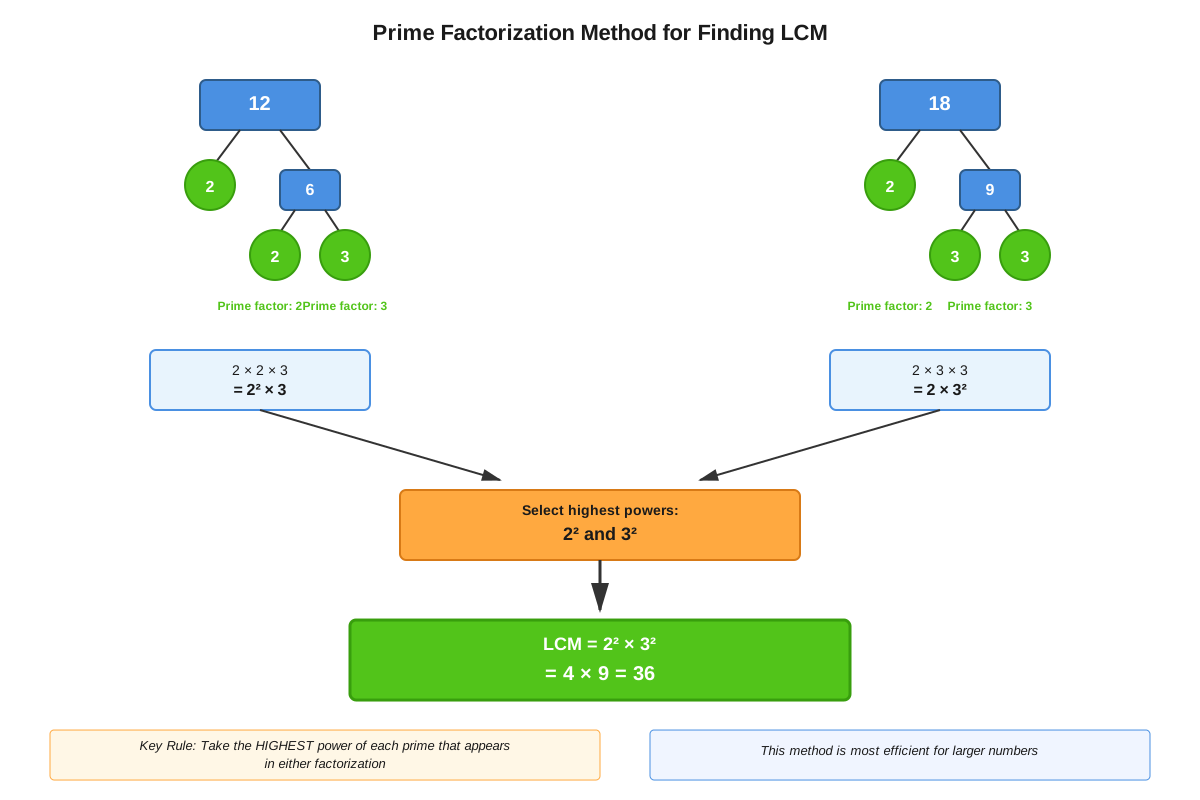
Method 2: Prime Factorization Method
The prime factorization method is the most efficient and reliable approach for ACT questions, especially with larger numbers. This method leverages the fundamental theorem of arithmetic.
Process:
- Find the prime factorization of each number
- For each prime that appears, take the highest power of that prime from any factorization
- Multiply these highest powers together
Example: Find LCM(12, 18, 30)
12 = 2² × 3
18 = 2 × 3²
30 = 2 × 3 × 5
Taking the highest power of each prime:
- Highest power of 2: 2²
- Highest power of 3: 3²
- Highest power of 5: 5¹
LCM = 2² × 3² × 5 = 4 × 9 × 5 = 180This method is particularly powerful because it works efficiently regardless of how many numbers you're working with and scales well to larger values.
Method 3: Using the GCD Relationship
For exactly two numbers, there's an elegant relationship between LCM and GCD (greatest common divisor):
LCM(a, b) × GCD(a, b) = a × bTherefore:
LCM(a, b) = (a × b) / GCD(a, b)Example: Find LCM(24, 36)
First, find GCD(24, 36) = 12
LCM(24, 36) = (24 × 36) / 12 = 864 / 12 = 72This method is particularly useful when the GCD is easy to identify or when you've already calculated it for another part of the problem.
Special Cases and Properties
Several special cases simplify LCM calculations:
| Situation | LCM Result | Example |
|---|---|---|
| Two numbers are coprime (GCD = 1) | Product of the numbers | LCM(7, 11) = 77 |
| One number divides the other | The larger number | LCM(5, 20) = 20 |
| Both numbers are equal | That number | LCM(8, 8) = 8 |
| One number is 1 | The other number | LCM(1, n) = n |
LCM of More Than Two Numbers
When finding the LCM of three or more numbers, you can either:
- Use the prime factorization method (most efficient)
- Find the LCM progressively: LCM(a, b, c) = LCM(LCM(a, b), c)
The progressive method works because LCM is associative, meaning the order of operations doesn't matter.
Concept Relationships
The least common multiple sits at the intersection of several fundamental number theory concepts. Prime factorization serves as the foundation for the most efficient LCM calculation method, demonstrating how breaking numbers into their building blocks reveals their relationships. This connection flows naturally: Prime Factorization → Identifying Common and Unique Factors → Selecting Highest Powers → Computing LCM.
The relationship between LCM and GCD represents a mathematical duality. While GCD finds the largest number that divides into all given numbers, LCM finds the smallest number that all given numbers divide into. This inverse relationship is captured in the formula LCM(a,b) × GCD(a,b) = a × b, showing how these concepts are mathematically complementary. Understanding one deepens understanding of the other.
Fraction operations depend heavily on LCM when finding common denominators. The connection flows: Different Denominators → Need Common Denominator → Apply LCM to Denominators → Perform Addition/Subtraction. This makes LCM essential for algebraic fraction manipulation, which appears frequently in higher-level ACT problems.
Divisibility concepts connect directly to LCM because the LCM is, by definition, divisible by all input numbers. This relationship extends to modular arithmetic and cyclical patterns, where LCM determines when multiple cycles synchronize. In word problems, this manifests as: Individual Cycle Lengths → Apply LCM → Find Synchronization Point.
Quick check — test yourself on Least common multiple so far.
Try Flashcards →High-Yield Facts
⭐ The LCM of two numbers is always greater than or equal to the larger of the two numbers
⭐ If two numbers are coprime (share no common factors except 1), their LCM equals their product
⭐ The prime factorization method for LCM uses the highest power of each prime factor that appears in any of the numbers
⭐ For any two numbers a and b: LCM(a,b) × GCD(a,b) = a × b
⭐ When one number is a multiple of another, the LCM is simply the larger number
- The LCM of any number and 1 is the number itself
- LCM is commutative: LCM(a,b) = LCM(b,a)
- LCM is associative: LCM(a,b,c) = LCM(LCM(a,b),c)
- The LCM of consecutive integers n and n+1 is always n(n+1) because consecutive integers are coprime
- If you multiply both numbers by the same factor k, the LCM is also multiplied by k: LCM(ka, kb) = k × LCM(a,b)
- The LCM of three or more numbers can be found by repeatedly applying the two-number LCM formula
- Every common multiple of two numbers is a multiple of their LCM
Common Misconceptions
Misconception: The LCM is always the product of the two numbers → Correction: The LCM equals the product only when the numbers are coprime (share no common factors). For numbers with common factors, the LCM is less than their product. For example, LCM(6,8) = 24, not 48, because they share the factor 2.
Misconception: LCM and GCD are the same thing → Correction: LCM and GCD are inverse concepts. GCD finds the largest number that divides into all given numbers, while LCM finds the smallest number that all given numbers divide into. For 12 and 18, GCD = 6 (largest common divisor) while LCM = 36 (smallest common multiple).
Misconception: To find LCM of three numbers, multiply all three together → Correction: Simply multiplying three numbers gives a common multiple but rarely the least common multiple. You must use prime factorization or find LCM(LCM(a,b),c). For example, LCM(4,6,8) = 24, not 192.
Misconception: The LCM must include all prime factors from all numbers multiplied together → Correction: The LCM uses the highest power of each prime factor, not all instances. For LCM(12,18) where 12 = 2² × 3 and 18 = 2 × 3², you take 2² and 3² (highest powers), giving 36, not 2² × 3 × 2 × 3² = 108.
Misconception: When listing multiples, the first common number you see is always the LCM → Correction: While this is true if you list multiples systematically starting from each number, if you list randomly or skip numbers, you might miss the LCM. Always verify you haven't skipped smaller multiples.
Misconception: LCM problems always explicitly ask for "the least common multiple" → Correction: On the ACT, LCM is often hidden in word problems about scheduling, repeating events, or when things "happen together again." Recognizing these scenarios is crucial for identifying when to apply LCM.
Worked Examples
Example 1: Classic Scheduling Problem
Problem: A red light blinks every 12 seconds, and a blue light blinks every 18 seconds. If both lights blink together at the same time, how many seconds will pass before they blink together again?
Solution:
This is a classic LCM application because we need to find when two repeating cycles align.
Step 1: Recognize this as an LCM problem. The lights will blink together again at the LCM of their individual periods.
Step 2: Find LCM(12, 18) using prime factorization.
12 = 2² × 3
18 = 2 × 3²
Step 3: Take the highest power of each prime factor:
- Highest power of 2: 2²
- Highest power of 3: 3²
Step 4: Calculate:
LCM = 2² × 3² = 4 × 9 = 36Answer: The lights will blink together again after 36 seconds.
Connection to Learning Objectives: This problem demonstrates identifying when LCM is being tested (scheduling/repeating events) and applying the core strategy (prime factorization method) to an ACT-style question.
Example 2: Multi-Number LCM with Application
Problem: Three runners complete laps around a track in 6 minutes, 8 minutes, and 9 minutes respectively. If they all start together at the starting line, after how many minutes will all three runners be at the starting line together again? How many laps will each runner have completed at that time?
Solution:
Step 1: Identify this as an LCM problem—we need to find when three different cycles align.
Step 2: Find LCM(6, 8, 9) using prime factorization.
6 = 2 × 3
8 = 2³
9 = 3²
Step 3: Take the highest power of each prime:
- Highest power of 2: 2³
- Highest power of 3: 3²
Step 4: Calculate:
LCM = 2³ × 3² = 8 × 9 = 72Step 5: Answer the second part—how many laps each runner completes:
- First runner: 72 ÷ 6 = 12 laps
- Second runner: 72 ÷ 8 = 9 laps
- Third runner: 72 ÷ 9 = 8 laps
Answer: All three runners will be at the starting line together again after 72 minutes. At that time, they will have completed 12, 9, and 8 laps respectively.
Connection to Learning Objectives: This problem requires recognizing LCM in a complex scenario, applying the strategy to three numbers, and extending the solution to answer a follow-up question—all common ACT patterns.
Exam Strategy
When approaching ACT questions involving least common multiple, begin by identifying trigger phrases that signal LCM is needed. Watch for words like "together again," "at the same time," "simultaneously," "coincide," "align," or scenarios describing repeating events with different periods. Questions about "when will both/all" events occur together are almost always LCM problems.
Exam Tip: If a problem describes two or more events happening at regular intervals and asks when they'll happen together, immediately think LCM.
For calculation strategy, use the prime factorization method for most problems, especially those involving numbers larger than 20 or more than two numbers. This method is faster and less error-prone than listing multiples. However, for very small numbers (under 15), listing multiples can be quicker if you're confident in your mental math.
Process-of-elimination strategies specific to LCM:
- Eliminate any answer choice smaller than the largest input number
- Eliminate any answer that isn't divisible by all the given numbers
- If the numbers are coprime, eliminate anything less than their product
- For scheduling problems, eliminate answers that don't make logical sense in context
Time allocation: Budget approximately 1-2 minutes for straightforward LCM calculations and 2-3 minutes for word problems requiring translation and application. If you're stuck on the prime factorization, quickly switch to listing multiples for smaller numbers rather than wasting time.
Common trap answers on the ACT include:
- The product of all numbers (correct only if coprime)
- The GCD instead of LCM (tests whether you know the difference)
- A common multiple that isn't the least common multiple
- The sum of the numbers (completely incorrect but included as a distractor)
Always verify your answer by checking that each original number divides evenly into your LCM result. This quick check catches most calculation errors and takes only seconds.
Memory Techniques
Mnemonic for LCM vs GCD: "LCM goes Large (finds the larger number that's a multiple), GCD goes Grab (grabs the largest common factor, which is smaller)."
Prime Factorization Method: Remember "Highest Powers Multiply" (HPM) - take the Highest Powers of each prime, then Multiply them together.
Visualization Strategy: Picture LCM as a "meeting point" on a number line where all the numbers' multiples converge. Imagine each number taking steps of its own size—the LCM is where they all land on the same spot for the first time.
Acronym for Problem Recognition: STAR problems need LCM:
- Scheduling (events happening at intervals)
- Timing (when things coincide)
- Alignment (patterns lining up)
- Repetition (cycles repeating)
Relationship Formula Memory: Think "LCM and GCD are Product Partners" - their product equals the product of the original numbers: L × G = P × P (LCM × GCD = Product of Pairs).
Summary
The least common multiple is a fundamental number theory concept that finds the smallest positive integer divisible by all given numbers. On the ACT Math test, LCM appears primarily in word problems involving scheduling, repeating patterns, and synchronization of events, making pattern recognition as important as calculation ability. The three main methods for finding LCM—listing multiples, prime factorization, and using the GCD relationship—each have optimal use cases, with prime factorization being most efficient for ACT-level problems. Understanding that LCM represents when multiple cycles align provides the conceptual foundation for translating word problems into mathematical calculations. The relationship between LCM and GCD, where their product equals the product of the original numbers, offers both a computational shortcut and deeper mathematical insight. Success on ACT LCM questions requires recognizing trigger phrases like "together again" or "simultaneously," applying the appropriate calculation method efficiently, and verifying that the answer is divisible by all original numbers.
Key Takeaways
- The least common multiple is the smallest positive integer that all given numbers divide into evenly, and it must be at least as large as the largest input number
- The prime factorization method (taking the highest power of each prime factor) is the most efficient and reliable approach for ACT questions
- LCM and GCD are inverse concepts connected by the formula: LCM(a,b) × GCD(a,b) = a × b
- ACT questions rarely ask directly for "the LCM" but instead embed it in word problems about scheduling, repeating events, or synchronization
- When two numbers are coprime (share no common factors), their LCM equals their product; when one divides the other, their LCM is the larger number
- Always verify your LCM answer by confirming each original number divides into it evenly
- Recognizing STAR scenarios (Scheduling, Timing, Alignment, Repetition) helps identify when LCM is the appropriate tool
Related Topics
Greatest Common Divisor (GCD): Understanding GCD deepens LCM mastery through their inverse relationship and provides alternative solution methods. The formula connecting them is essential for efficient problem-solving.
Prime Factorization: Mastering prime factorization is prerequisite to the most efficient LCM method and connects to broader number theory concepts including divisibility and factor counting.
Fraction Operations: LCM is essential for finding common denominators when adding or subtracting fractions, a skill that extends into algebraic fraction manipulation.
Modular Arithmetic: LCM applications in cyclical patterns and remainders connect to more advanced modular arithmetic concepts that appear in competition mathematics.
Rational Expressions: In algebra, finding common denominators for rational expressions requires LCM, making this topic foundational for equation solving and simplification.
Practice CTA
Now that you've mastered the core concepts, strategies, and common pitfalls of least common multiple problems, it's time to solidify your understanding through active practice. Work through the practice questions to apply these techniques to ACT-style problems, and use the flashcards to reinforce key facts and formulas. Remember, recognizing when to use LCM is just as important as calculating it correctly—practice will make both skills automatic. Each problem you solve builds the pattern recognition and computational speed you need for test day success!
Sign up free to keep reading
Create a free AnvayaPrep account to finish this ACT guide on Least common multiple — plus flashcards and practice questions.