Overview
Number lines are fundamental visual representations of numbers arranged in order along a straight line, serving as one of the most versatile tools in mathematics. On the ACT Math test, number line questions appear with surprising frequency and test a student's ability to understand numerical relationships, inequalities, absolute value, distance, and coordinate systems. While number lines may seem elementary at first glance, the ACT number lines questions often combine multiple mathematical concepts—such as inequalities, absolute value, midpoints, and distance—requiring students to interpret visual information quickly and accurately under time pressure.
Understanding number lines is essential because they form the foundation for coordinate geometry, graphing functions, understanding intervals, and solving inequality problems. The ACT frequently uses number lines to test whether students can translate between algebraic expressions and visual representations, identify solution sets for inequalities, calculate distances between points, and determine the location of specific values. These questions typically appear 2-4 times per ACT Math section and often serve as gateway questions that, when answered correctly, build confidence for tackling more complex problems.
Number lines connect to virtually every area of ACT Math: they underpin coordinate geometry (the x and y axes are perpendicular number lines), support understanding of functions and their domains, provide visual clarity for absolute value problems, and offer an intuitive way to understand operations with integers, fractions, and irrational numbers. Mastering number line concepts ensures students can quickly visualize mathematical relationships, verify algebraic solutions, and eliminate incorrect answer choices through spatial reasoning.
Learning Objectives
- [ ] Identify when Number lines is being tested in ACT questions
- [ ] Explain the core rule or strategy behind Number lines
- [ ] Apply Number lines to ACT-style questions accurately
- [ ] Determine the distance between any two points on a number line using the distance formula
- [ ] Identify and graph solution sets for compound inequalities on number lines
- [ ] Calculate midpoints between two values on a number line
- [ ] Interpret absolute value expressions as distances on number lines
Prerequisites
- Basic arithmetic operations: Understanding addition, subtraction, multiplication, and division is necessary for calculating distances and positions on number lines
- Understanding of positive and negative numbers: Number lines extend in both directions from zero, requiring comfort with signed numbers
- Inequality symbols and notation: Recognizing <, >, ≤, ≥ symbols is essential for graphing solution sets
- Coordinate system basics: Familiarity with ordered pairs helps connect number lines to two-dimensional graphing
- Absolute value concept: Understanding absolute value as distance from zero supports many number line applications
Why This Topic Matters
Number lines represent one of the most practical mathematical tools used in everyday life. They appear in temperature scales, timelines, financial statements showing profit and loss, elevation maps, and any situation requiring ordered numerical data. Scientists use number lines to represent measurements, economists use them to show economic indicators over time, and engineers rely on them for precision measurements and tolerances. The ability to visualize numerical relationships spatially enhances problem-solving across disciplines.
On the ACT Math test, number line questions appear in approximately 5-8% of all math questions, translating to 3-5 questions per test. These questions typically fall into several categories: graphing inequality solutions (most common), calculating distances between points, identifying coordinates of specific points, determining midpoints, and interpreting absolute value as distance. The ACT particularly favors questions that combine number lines with inequalities, asking students to identify which graph correctly represents a given inequality or which inequality matches a given graph.
Number line questions often appear early in the ACT Math section, serving as confidence-building problems for well-prepared students. However, the test makers also create challenging variations by combining number lines with absolute value inequalities, compound inequalities with "and/or" logic, or asking students to work backward from a graph to determine the original inequality. These questions reward students who can quickly translate between algebraic and visual representations, making number line mastery a high-yield study investment.
Core Concepts
Structure and Components of Number Lines
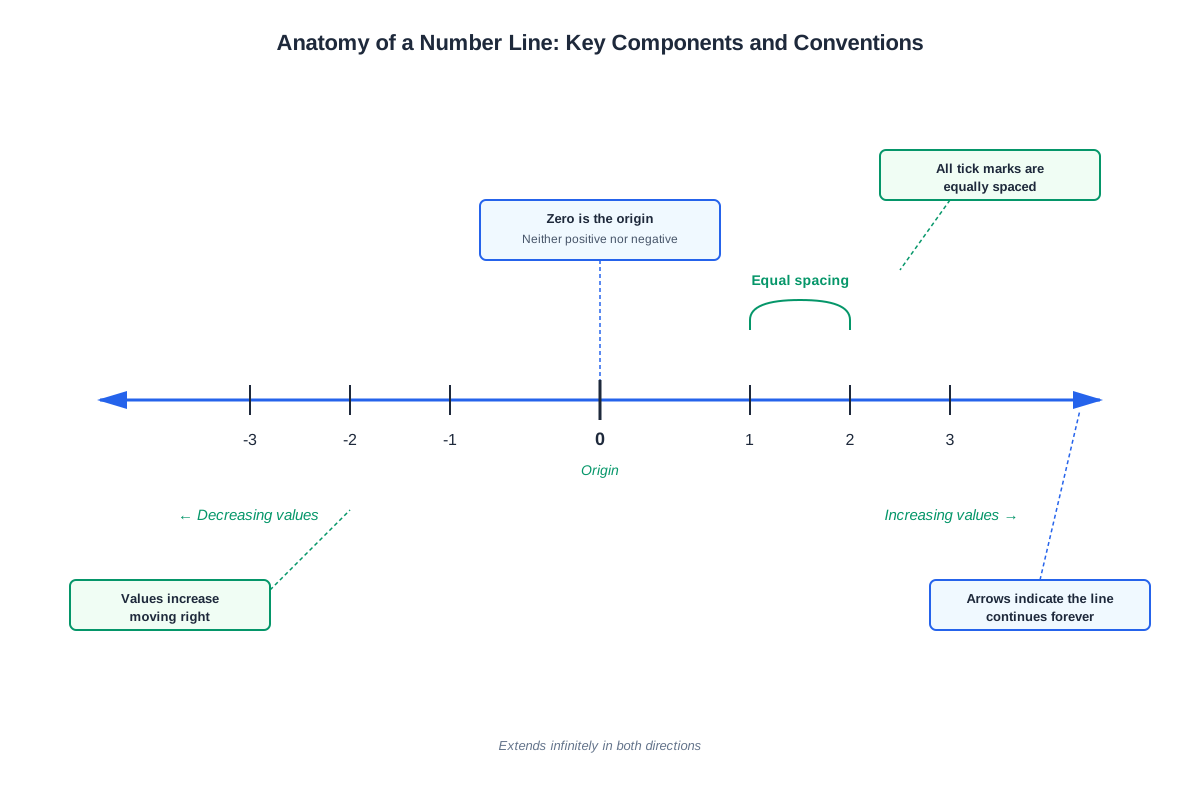
A number line is a straight horizontal (or sometimes vertical) line with numbers placed at equal intervals, extending infinitely in both directions. The fundamental components include the origin (typically zero), positioned at the center, with positive numbers extending to the right and negative numbers to the left. Each point on the line corresponds to exactly one real number, and each real number corresponds to exactly one point—this one-to-one correspondence is crucial for understanding number lines as complete representations of the real number system.
The scale of a number line determines the distance between consecutive integers or marked values. On ACT questions, the scale may not always be 1; students must examine the given markings carefully to determine whether each interval represents 1, 2, 5, 0.5, or another value. Misreading the scale is one of the most common errors on number line questions.
Distance on Number Lines
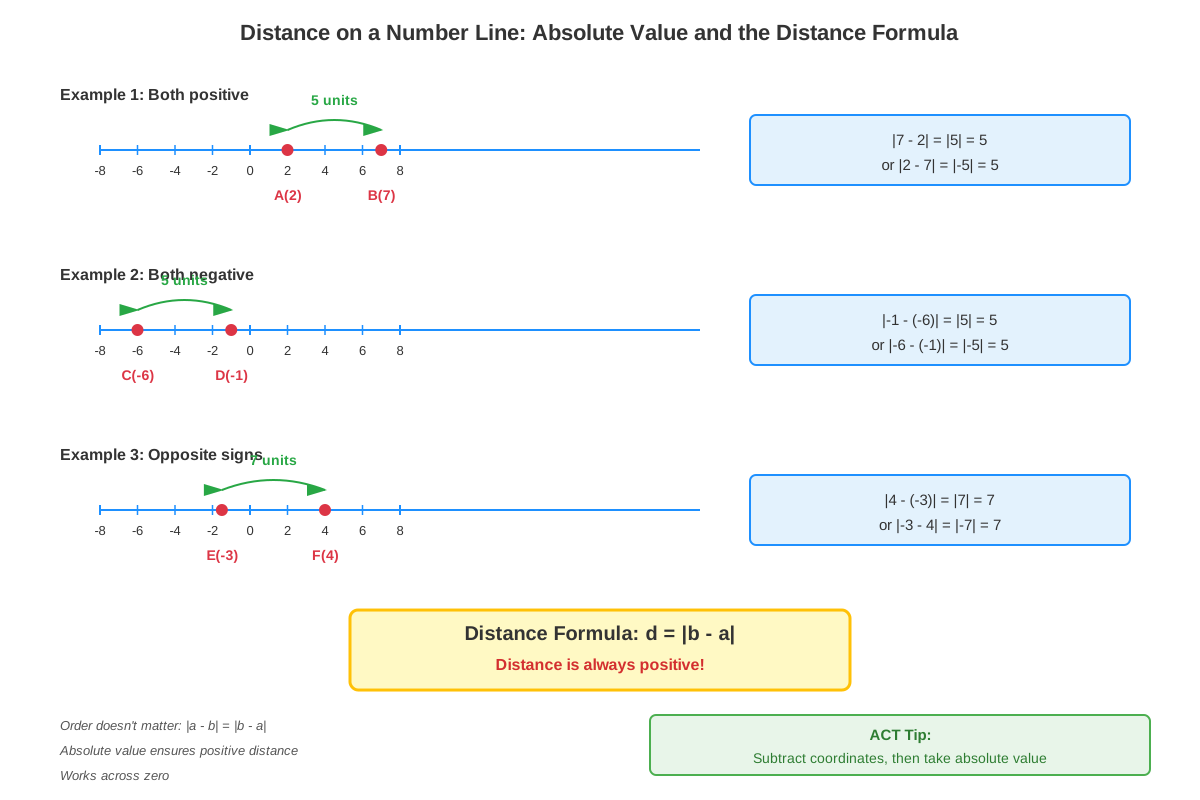
The distance between any two points on a number line equals the absolute value of their difference. For points A and B with coordinates a and b respectively, the distance formula is:
Distance = |b - a| = |a - b|This formula works regardless of which number is larger or whether the numbers are positive, negative, or mixed. For example, the distance between -3 and 5 is |5 - (-3)| = |8| = 8, which can be verified by counting units on the number line. The absolute value ensures the distance is always positive, as distance cannot be negative.
Understanding distance as absolute value connects directly to more complex ACT problems involving absolute value equations and inequalities. When solving |x - 3| < 5, students can interpret this as "all numbers whose distance from 3 is less than 5," leading to the solution -2 < x < 8.
Graphing Points and Intervals
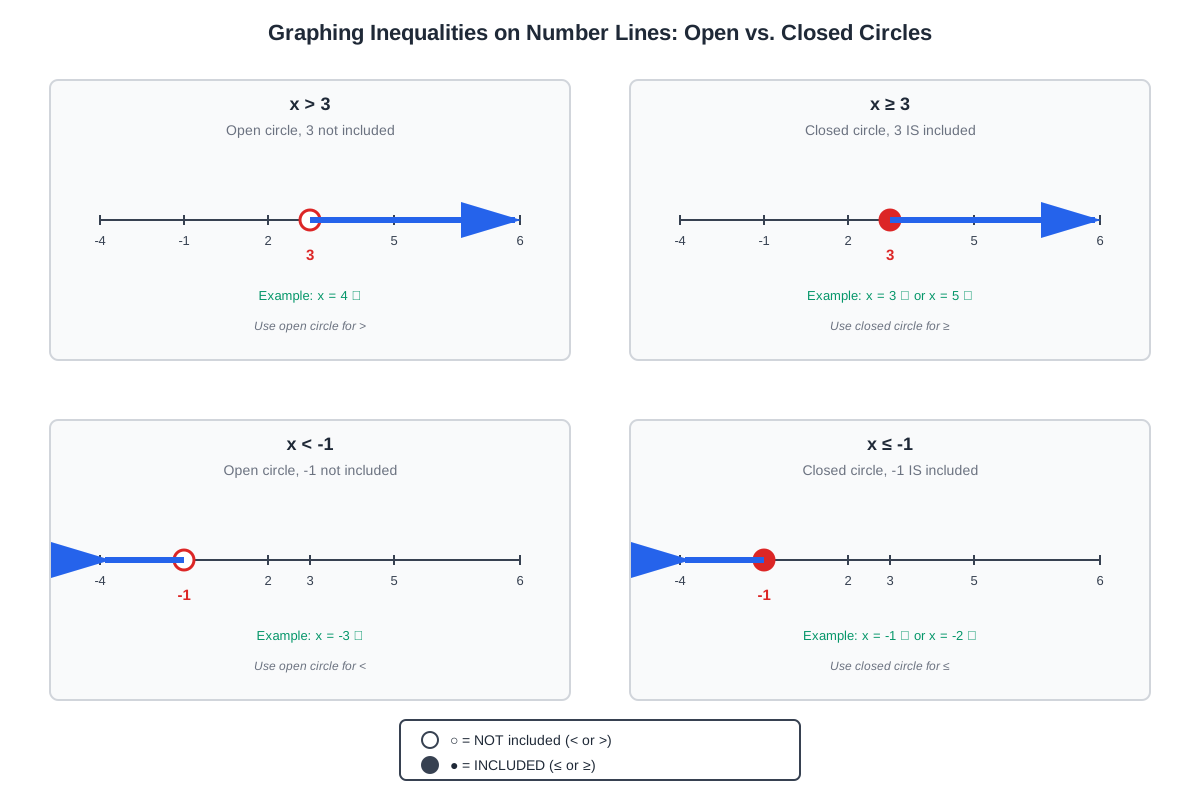
Individual points on number lines are represented by closed dots (●) when the value is included in the solution set, and open dots (○) when the value is excluded. This distinction is critical for correctly graphing inequalities:
| Inequality Symbol | Dot Type | Meaning |
|---|---|---|
| < or > | Open dot (○) | Value not included |
| ≤ or ≥ | Closed dot (●) | Value included |
Intervals represent ranges of values and are shown by shading or drawing a thick line segment between boundary points. For example, the inequality x ≥ -2 is graphed with a closed dot at -2 and shading extending to the right (toward positive infinity). The inequality -3 < x < 4 is graphed with open dots at -3 and 4, with shading between them.
Compound Inequalities
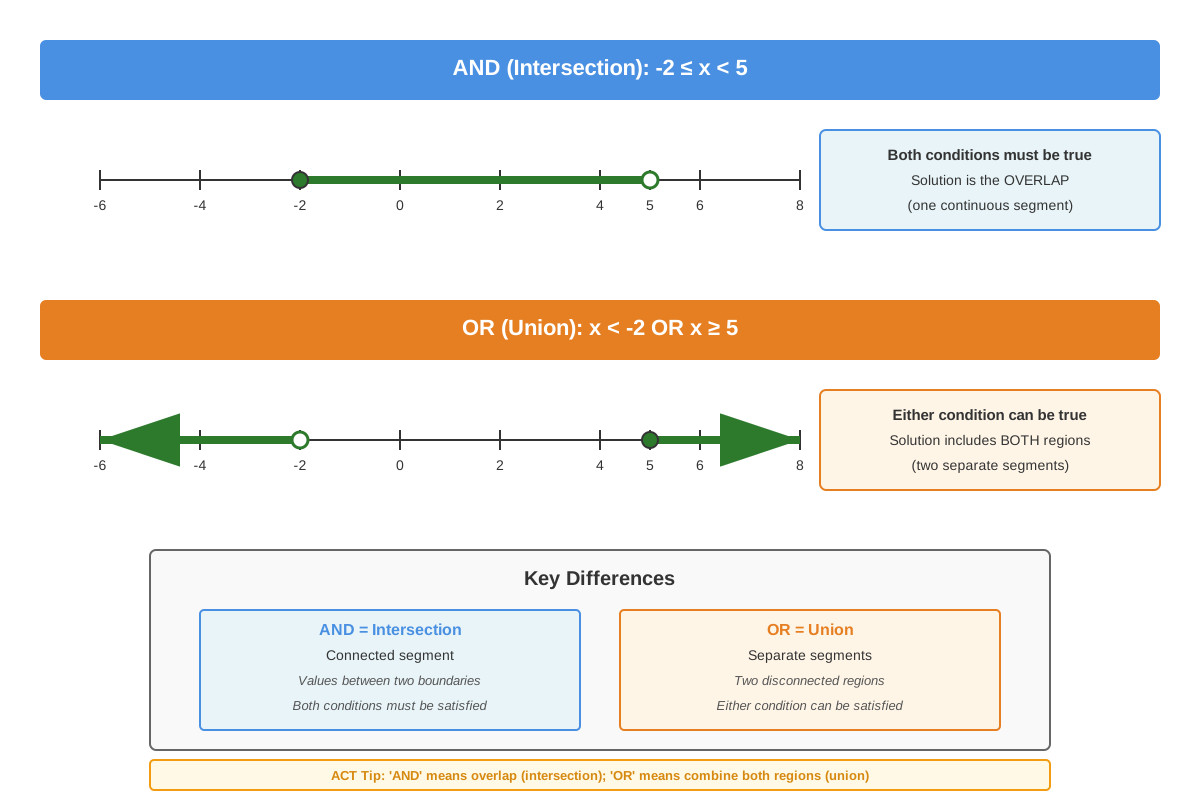
Compound inequalities involve two separate conditions connected by "and" or "or." Understanding how to graph these on number lines is essential for ACT success:
"And" compound inequalities require both conditions to be true simultaneously. The solution set is the intersection (overlap) of the two individual solution sets. For example, x > 1 AND x < 5 is written as 1 < x < 5 and graphed with open dots at 1 and 5, with shading between them.
"Or" compound inequalities require at least one condition to be true. The solution set is the union of the two individual solution sets. For example, x < -2 OR x > 3 is graphed with an open dot at -2 with shading extending left, and an open dot at 3 with shading extending right, with no shading between -2 and 3.
Midpoint on Number Lines
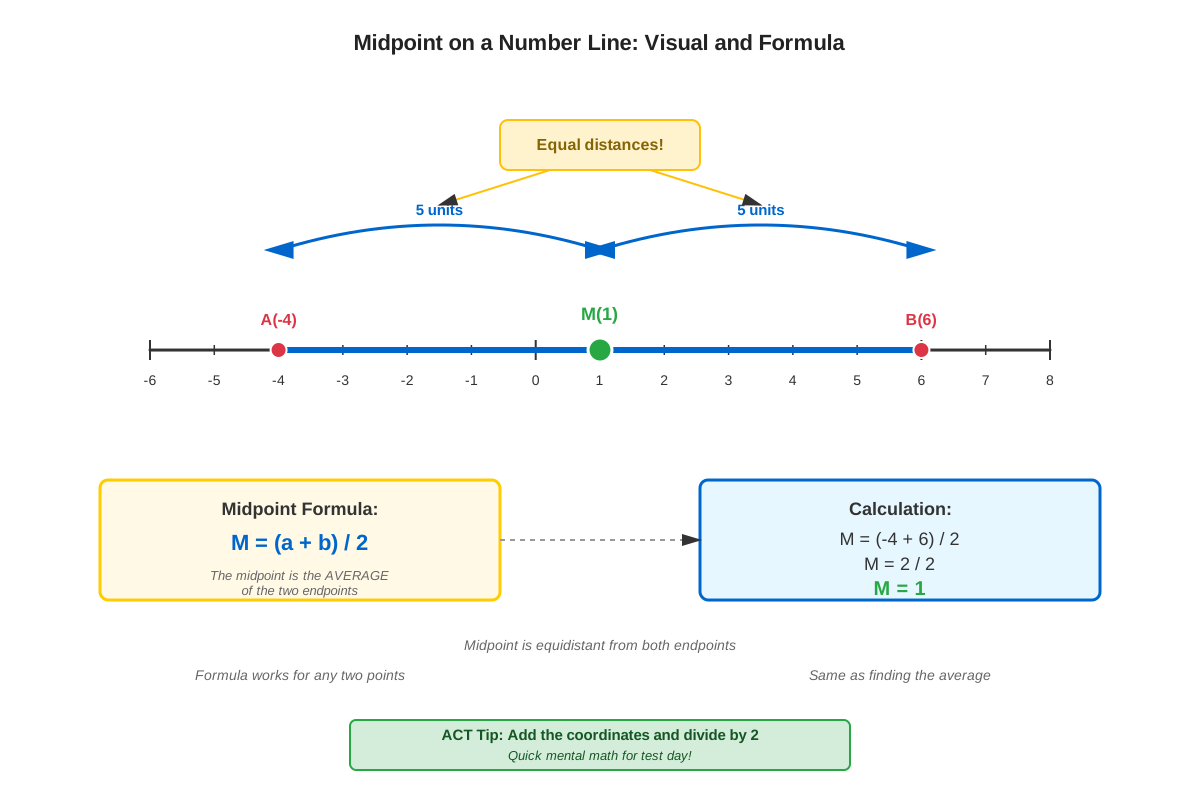
The midpoint between two points on a number line is the average of their coordinates. For points with coordinates a and b:
Midpoint = (a + b) / 2This formula finds the point exactly halfway between the two given points. For example, the midpoint between -4 and 10 is (-4 + 10) / 2 = 6 / 2 = 3. The midpoint concept extends to coordinate geometry, where midpoints are calculated separately for x and y coordinates.
Absolute Value and Number Lines
Absolute value represents the distance from zero on a number line. The expression |x| asks "how far is x from zero?" This geometric interpretation helps solve absolute value equations and inequalities:
- |x| = 5 means "x is 5 units from zero," giving solutions x = 5 or x = -5
- |x| < 5 means "x is less than 5 units from zero," giving -5 < x < 5
- |x| > 5 means "x is more than 5 units from zero," giving x < -5 or x > 5
More complex absolute value expressions like |x - 3| represent distance from a point other than zero. The expression |x - 3| < 5 means "the distance from x to 3 is less than 5," which translates to -2 < x < 8.
Concept Relationships
The concepts within number lines form an interconnected system where each element builds upon and reinforces others. The fundamental structure of number lines (ordered points with a scale) → enables the calculation of distance between points → which connects directly to absolute value as distance from zero → which extends to absolute value inequalities → which require understanding of compound inequalities and their graphical representations.
Distance calculations on number lines serve as the foundation for the distance formula in coordinate geometry, where the Pythagorean theorem extends the one-dimensional distance concept to two dimensions. Similarly, the midpoint formula on number lines generalizes to the midpoint formula for coordinate pairs, making number line mastery essential for success in coordinate geometry questions.
The relationship between algebraic inequalities and their graphical representations on number lines creates a bidirectional translation skill: students must be able to graph a given inequality AND write the inequality that matches a given graph. This translation ability connects to function graphing, where understanding how to read and interpret graphs becomes increasingly important.
Absolute value concepts bridge number lines to more advanced topics including piecewise functions, distance problems in word questions, and optimization problems. The geometric interpretation of absolute value as distance provides intuitive understanding that purely algebraic approaches often lack, making number lines an essential visualization tool throughout mathematics.
High-Yield Facts
⭐ The distance between two points a and b on a number line is always |b - a| or |a - b|, which gives the same result
⭐ Open dots (○) are used for < and >, while closed dots (●) are used for ≤ and ≥
⭐ Compound inequalities with "and" show overlapping regions; those with "or" show separate regions
⭐ The midpoint between a and b is calculated as (a + b) / 2
⭐ Absolute value |x - c| represents the distance from x to c on the number line
- The number line extends infinitely in both directions, representing all real numbers
- Positive numbers are always to the right of zero; negative numbers are always to the left
- When graphing x > a, the shading extends to the right (toward positive infinity)
- When graphing x < a, the shading extends to the left (toward negative infinity)
- The inequality a < x < b is equivalent to "x > a AND x < b"
- The solution to |x| < a (where a > 0) is always -a < x < a
- The solution to |x| > a (where a > 0) is always x < -a OR x > a
- Every point on a number line corresponds to exactly one real number
- The scale of a number line must be determined by examining the marked intervals
- Distance on a number line is always positive or zero, never negative
Quick check — test yourself on Number lines so far.
Try Flashcards →Common Misconceptions
Misconception: The distance from -5 to 3 is calculated as 3 - (-5) = 8, so the order matters in the distance formula.
Correction: While 3 - (-5) = 8 is correct, the distance formula uses absolute value specifically so order doesn't matter: |3 - (-5)| = |-5 - 3| = 8. The absolute value ensures distance is always positive regardless of which number is subtracted from which.
Misconception: An open dot means the inequality is "less than" and a closed dot means "greater than."
Correction: The dot type indicates whether the boundary value is included (closed) or excluded (open), not the direction of the inequality. The inequality x ≥ 5 uses a closed dot at 5 with shading to the right, while x ≤ 5 uses a closed dot at 5 with shading to the left.
Misconception: The compound inequality x < -2 OR x > 3 should be written as -2 > x > 3.
Correction: The notation -2 > x > 3 is mathematically meaningless because it would require x to be simultaneously less than -2 AND greater than 3, which is impossible. "Or" compound inequalities must be written as two separate inequalities: x < -2 or x > 3.
Misconception: The midpoint between -8 and 4 is 6 because the distance is 12 and half of 12 is 6.
Correction: The midpoint formula is (a + b) / 2, not half the distance. The midpoint between -8 and 4 is (-8 + 4) / 2 = -4 / 2 = -2. The distance is 12, but the midpoint is located at -2, which is 6 units from each endpoint.
Misconception: When solving |x - 3| < 5, the solution is x < 8 because 3 + 5 = 8.
Correction: Absolute value inequalities of the form |x - c| < a translate to -a < x - c < a. For |x - 3| < 5, this gives -5 < x - 3 < 5, which simplifies to -2 < x < 8. The solution is an interval, not a single inequality.
Misconception: All number lines must have zero at the center and show both positive and negative numbers.
Correction: Number lines can show any portion of the real number line. ACT questions may show number lines from 0 to 10, from -5 to -1, or any other interval. Students must read the given scale carefully rather than assuming zero is present or centered.
Misconception: The inequality x ≠ 3 is graphed with an open dot at 3 and no shading.
Correction: The inequality x ≠ 3 includes all real numbers except 3, so it should be graphed with an open dot at 3 and shading extending in both directions (left and right). It's equivalent to x < 3 OR x > 3.
Worked Examples
Example 1: Compound Inequality Graphing
Problem: Which of the following graphs represents the solution to the compound inequality -2 ≤ x < 4?
Solution:
Step 1: Identify the type of compound inequality. This is an "and" compound inequality because it can be read as "x is greater than or equal to -2 AND x is less than 4."
Step 2: Determine the boundary points and dot types.
- At x = -2: The inequality uses ≤, so use a closed dot (●)
- At x = 4: The inequality uses <, so use an open dot (○)
Step 3: Determine the shading direction. Since this is an "and" compound inequality written in the form a ≤ x < b, the shading goes between the two boundary points (from -2 to 4).
Step 4: Construct the graph. Place a closed dot at -2, an open dot at 4, and shade the region between them.
Answer: The correct graph shows a closed dot at -2, an open dot at 4, with shading connecting them.
Connection to Learning Objectives: This example demonstrates identifying when number lines are being tested (compound inequality graphing), explaining the core strategy (determining dot types and shading direction based on inequality symbols), and applying the concept accurately.
Example 2: Distance and Absolute Value
Problem: On a number line, point A is located at -7 and point B is located at 5. Point C is located at the midpoint of segment AB. What is the distance from point C to point B?
Solution:
Step 1: Find the midpoint C using the midpoint formula.
Midpoint = (a + b) / 2 = (-7 + 5) / 2 = -2 / 2 = -1Point C is located at -1.
Step 2: Calculate the distance from C to B using the distance formula.
Distance = |b - c| = |5 - (-1)| = |5 + 1| = |6| = 6Step 3: Verify the answer makes sense. The total distance from A to B is |5 - (-7)| = 12. Since C is the midpoint, it should be 6 units from each endpoint. ✓
Answer: The distance from point C to point B is 6 units.
Alternative approach: Since C is the midpoint, it's equidistant from both A and B. The total distance AB is 12, so the distance from C to either endpoint is 12 / 2 = 6.
Connection to Learning Objectives: This example applies the midpoint formula and distance formula, demonstrating how these concepts work together in multi-step problems typical of the ACT.
Example 3: Absolute Value Inequality
Problem: Which of the following represents the solution set for |x + 2| ≤ 5?
Solution:
Step 1: Recognize this as an absolute value inequality of the form |expression| ≤ a, which translates to -a ≤ expression ≤ a.
Step 2: Apply the translation rule.
|x + 2| ≤ 5 → -5 ≤ x + 2 ≤ 5Step 3: Solve for x by subtracting 2 from all parts.
-5 - 2 ≤ x + 2 - 2 ≤ 5 - 2
-7 ≤ x ≤ 3
Step 4: Graph the solution. Use closed dots at both -7 and 3 (because of ≤), with shading between them.
Step 5: Verify using the distance interpretation. The inequality |x + 2| ≤ 5 means "the distance from x to -2 is at most 5." Starting at -2 and moving 5 units in each direction gives -7 and 3. ✓
Answer: The solution is -7 ≤ x ≤ 3, graphed with closed dots at -7 and 3 with shading between them.
Connection to Learning Objectives: This example demonstrates the core strategy of translating absolute value inequalities using the distance interpretation and applying it to create an accurate graph.
Exam Strategy
Trigger Words: Watch for phrases like "on a number line," "graph the solution," "which inequality is represented," "distance between," "midpoint," and "absolute value." These signal number line questions.
When approaching ACT number line questions, follow this systematic process:
Step 1: Identify what's being asked. Determine whether you need to create a graph from an inequality, write an inequality from a graph, calculate a distance or midpoint, or interpret an absolute value expression.
Step 2: Check the scale carefully. Don't assume each interval represents 1 unit. Count the marked intervals and determine the scale before attempting any calculations or graphing.
Step 3: For graphing inequalities, first identify boundary points, then determine dot types (open for < or >, closed for ≤ or ≥), then determine shading direction (right for >, left for <, between for "and" compounds, separate regions for "or" compounds).
Step 4: For reading graphs, start by identifying the dot types and shading direction, then translate to inequality notation. Remember that shading to the right means "greater than" and shading to the left means "less than."
Process of elimination tips:
- Eliminate any answer choice with the wrong dot type (open vs. closed)
- Eliminate choices with shading in the wrong direction
- For compound inequalities, eliminate choices that show "and" when "or" is needed, or vice versa
- For distance problems, eliminate negative answers immediately (distance is always non-negative)
Time allocation: Number line questions should take 30-45 seconds each. If a question involves multiple steps (like finding a midpoint then calculating a distance), allocate up to 60 seconds. These questions reward quick visual processing, so practice until recognition becomes automatic.
Common traps: The ACT often includes answer choices that represent common errors, such as using the wrong dot type, shading in the wrong direction, or confusing "and" with "or" in compound inequalities. Always double-check your work against the original question.
Memory Techniques
CODS - Remember dot types with "Closed Or Dot Selector":
- Closed dots for ≤ and ≥ (the symbols have a line underneath, like a closed door)
- Open dots for < and > (the symbols are open, like an open mouth)
RIGHT-LEFT - For shading direction:
- RIGHT for greater than (>) - think "right" and "greater" both suggest moving forward/upward
- LEFT for less than (<) - think "left behind" means less
Distance = Absolute Difference - Remember "DAD":
- Distance equals
- Absolute value of
- Difference
Midpoint = Average - The midpoint is simply the average of the two endpoints. Think "Midpoint = Mean"
Absolute Value Inequality Translation:
- |x| < a means x is between -a and a (think: < looks like it's squeezing together)
- |x| > a means x is outside -a and a (think: > looks like it's spreading apart)
AND vs. OR visualization:
- AND = Adjacent shading (connected region)
- OR = Opposite shading (separate regions)
Summary
Number lines serve as fundamental visual tools for representing numerical relationships, inequalities, distances, and absolute values on the ACT Math test. Mastery requires understanding the structure of number lines (origin, scale, positive/negative directions), the distance formula (absolute value of the difference), the midpoint formula (average of endpoints), and the graphing conventions for inequalities (open vs. closed dots, shading direction). Compound inequalities with "and" produce overlapping regions while "or" compounds produce separate regions. Absolute value expressions represent distances on number lines, with |x - c| measuring distance from x to c. The ACT tests these concepts through direct graphing questions, interpretation of given graphs, distance and midpoint calculations, and absolute value inequalities. Success requires quick translation between algebraic and visual representations, careful attention to scale and dot types, and systematic application of graphing rules. Students who master number lines gain powerful visualization tools that support success across multiple ACT Math topics.
Key Takeaways
- Distance between points a and b equals |b - a|; always use absolute value to ensure positive distance
- Closed dots (●) indicate included values (≤ or ≥); open dots (○) indicate excluded values (< or >)
- Compound "and" inequalities show connected shading between boundaries; "or" inequalities show separate shaded regions
- The midpoint between a and b is calculated as (a + b) / 2
- Absolute value |x - c| represents the distance from x to c on the number line
- Always check the scale of a number line before making calculations or interpretations
- Shading extends right for "greater than" and left for "less than" inequalities
Related Topics
Coordinate Geometry: Number lines form the foundation of the coordinate plane, where perpendicular number lines (x and y axes) create a two-dimensional system. Mastering one-dimensional number lines makes coordinate graphing intuitive.
Absolute Value Equations and Inequalities: Advanced absolute value problems build directly on the distance interpretation developed through number line work, extending to more complex algebraic manipulations.
Inequalities and Systems: Understanding how to graph and interpret inequalities on number lines prepares students for systems of inequalities and linear programming problems.
Functions and Domain/Range: Number lines provide the visual framework for understanding function domains (input values) and ranges (output values), making function analysis more concrete.
Distance and Midpoint in Coordinate Geometry: The one-dimensional formulas for distance and midpoint extend naturally to two dimensions, making number line mastery essential for coordinate geometry success.
Practice CTA
Now that you've mastered the core concepts of number lines, it's time to solidify your understanding through practice! Work through the practice questions to test your ability to graph inequalities, calculate distances and midpoints, and interpret absolute value expressions. Use the flashcards to reinforce key formulas and graphing conventions until they become automatic. Remember, number line questions appear frequently on the ACT and offer quick points when you've practiced the systematic approaches outlined in this guide. Your investment in mastering this foundational topic will pay dividends across multiple areas of ACT Math!
Sign up free to keep reading
Create a free AnvayaPrep account to finish this ACT guide on Number lines — plus flashcards and practice questions.