Overview
Absolute value equations represent a critical algebraic concept that appears consistently on the ACT Math section. These equations involve expressions within absolute value bars, which measure the distance of a number from zero on the number line, always yielding a non-negative result. Understanding how to solve these equations requires recognizing that absolute value creates two possible scenarios: the expression inside can be positive or negative while still producing the same absolute value. This dual nature is what makes absolute value equations both challenging and high-yield for standardized testing.
The ACT frequently tests absolute value equations because they assess multiple mathematical skills simultaneously: algebraic manipulation, logical reasoning about positive and negative values, and the ability to check solutions for validity. Students who master this topic gain a significant advantage, as these questions typically appear 2-3 times per test and can be solved quickly once the underlying principles are understood. The questions range from straightforward one-variable equations to more complex scenarios involving inequalities or compound expressions.
ACT absolute value equations connect to broader mathematical concepts including linear equations, inequalities, graphing on coordinate planes, and distance formulas. The absolute value function serves as a bridge between basic algebra and more advanced topics like piecewise functions and transformations. Mastering absolute value equations strengthens problem-solving skills that apply across multiple question types, making this topic essential for achieving competitive scores in the Math section.
Learning Objectives
- [ ] Identify when absolute value equations are being tested in ACT questions
- [ ] Explain the core rule or strategy behind solving absolute value equations
- [ ] Apply absolute value equation solving techniques to ACT-style questions accurately
- [ ] Determine when an absolute value equation has no solution, one solution, or two solutions
- [ ] Verify solutions by substituting back into the original equation
- [ ] Recognize and avoid common algebraic errors when isolating absolute value expressions
- [ ] Solve absolute value equations that require preliminary algebraic simplification
Prerequisites
- Basic algebraic manipulation: Essential for isolating variables and simplifying expressions before and after removing absolute value bars
- Understanding of positive and negative numbers: Required to comprehend why absolute value creates two cases and how signs affect solutions
- Linear equation solving: The foundation for solving the two equations that result from splitting an absolute value equation
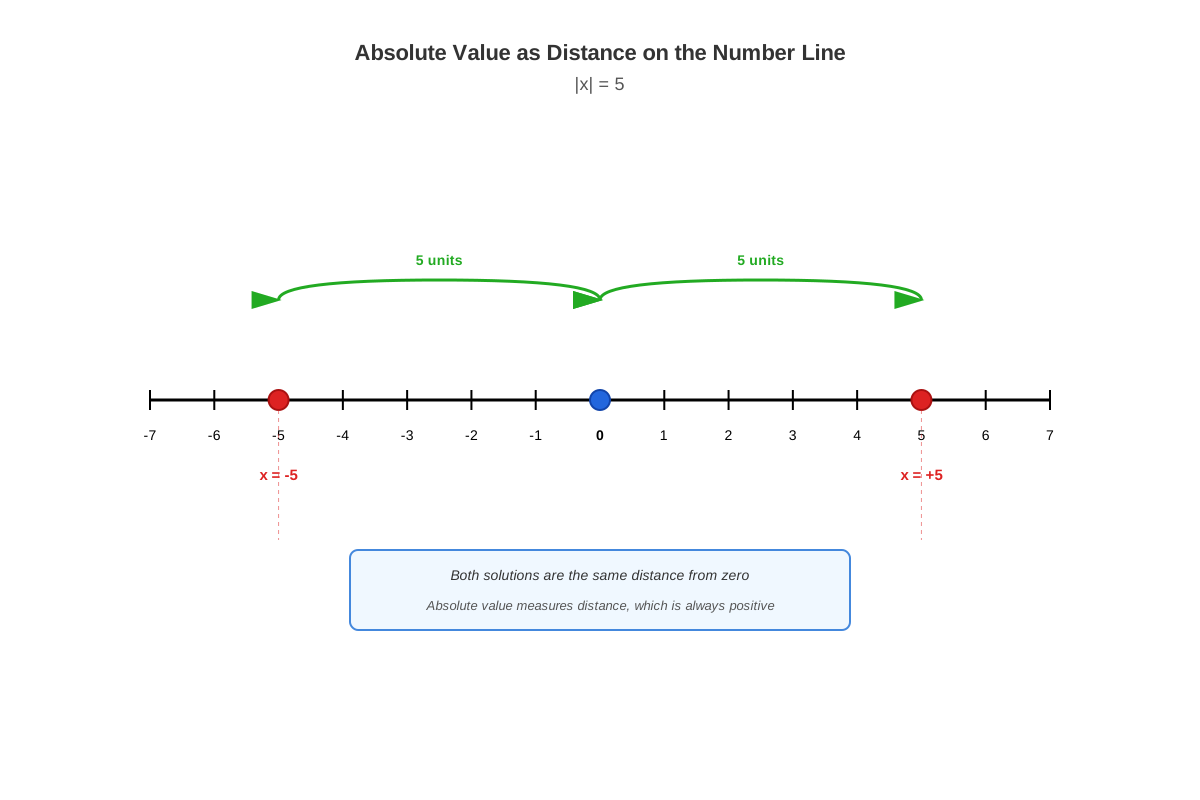
- Number line concepts: Helps visualize absolute value as distance from zero, making the dual-case nature intuitive
- Order of operations: Necessary for correctly simplifying expressions within absolute value bars and handling multi-step equations
Why This Topic Matters
Absolute value equations appear in real-world contexts whenever distance, magnitude, or deviation from a target value matters. Engineers use absolute value to calculate tolerances in manufacturing (a part must be within ±0.05 inches of specification), scientists measure experimental error as absolute deviation from expected values, and financial analysts assess volatility by examining absolute differences from mean values. GPS systems calculate distances using absolute value principles, and quality control processes rely on absolute value to determine whether products meet standards regardless of whether measurements are above or below target.
On the ACT Math section, absolute value equations typically appear 2-3 times per test, representing approximately 3-5% of all math questions. These questions most commonly appear in the Preparing for Higher Math category under the Algebra subcategory. The ACT tests absolute value in several formats: basic equations requiring two-case solutions, equations embedded within word problems about distance or error, equations requiring preliminary simplification, and occasionally as part of coordinate geometry questions involving distance formulas. Questions may also combine absolute value with other concepts like systems of equations or function notation.
The ACT favors absolute value questions because they efficiently test multiple competencies: algebraic fluency, logical reasoning, attention to detail when checking solutions, and the ability to recognize when extraneous solutions must be rejected. Students who can quickly identify the absolute value equation structure and systematically apply the two-case method gain valuable time for more complex problems. Additionally, absolute value questions often serve as "medium difficulty" problems that separate students scoring in the mid-20s from those achieving 30+.
Core Concepts
Definition of Absolute Value
The absolute value of a number represents its distance from zero on the number line, always expressed as a non-negative value. Symbolically, |x| equals x when x ≥ 0, and equals -x when x < 0. This piecewise definition is fundamental: absolute value strips away the sign, leaving only magnitude. For example, |5| = 5 and |-5| = 5 because both numbers are five units from zero. This distance interpretation is crucial for understanding why absolute value equations generate multiple solutions.
The Two-Case Method
When solving absolute value equations of the form |A| = B where B is positive, the equation splits into two cases:
- A = B (the expression inside equals the positive value)
- A = -B (the expression inside equals the negative of that value)
This splitting occurs because both B and -B have the same absolute value. Consider |x - 3| = 7: the expression (x - 3) could equal 7 or -7, since both have absolute value 7. This generates two linear equations to solve separately: x - 3 = 7 and x - 3 = -7, yielding x = 10 and x = -4.
Standard Solution Process
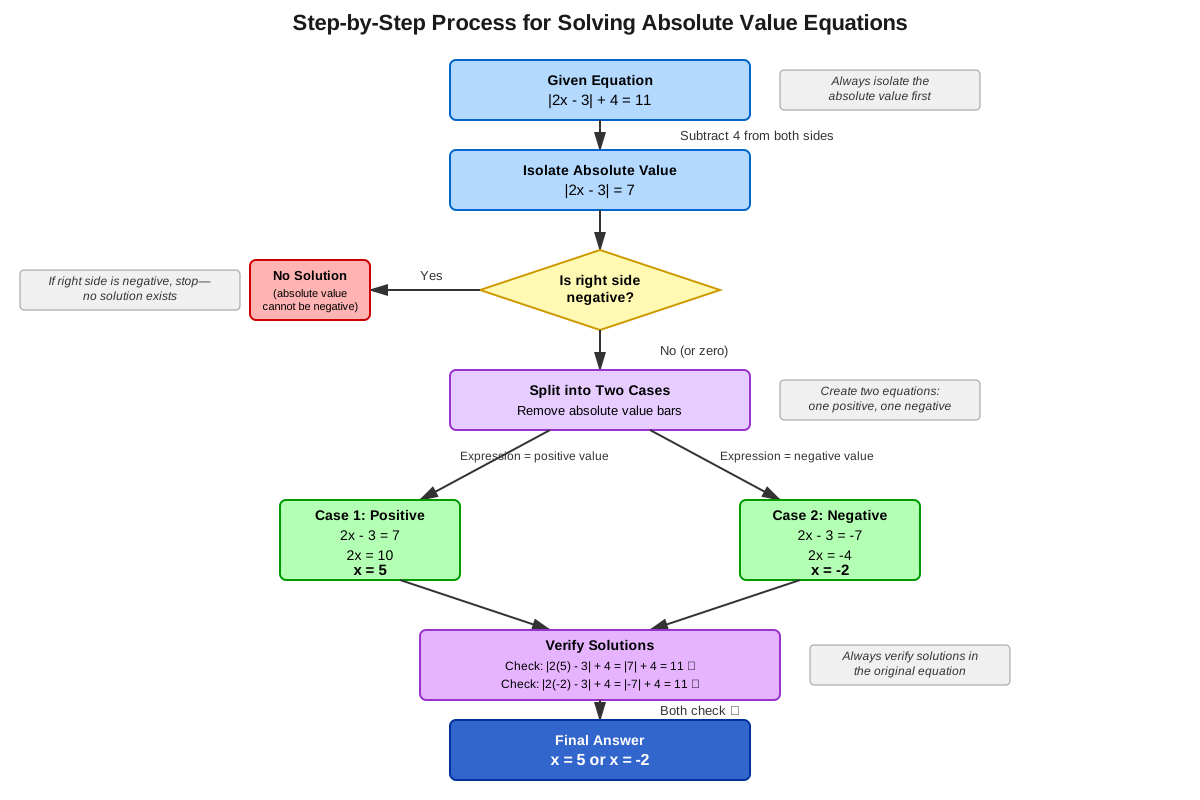
The systematic approach to solving absolute value equations follows these steps:
- Isolate the absolute value expression: Move all terms not inside absolute value bars to one side of the equation
- Check the right side: Verify whether the isolated absolute value equals a positive number, zero, or negative number
- Apply the appropriate case logic: Split into two equations if the right side is positive or zero
- Solve both resulting equations: Use standard algebraic techniques for each linear equation
- Verify solutions: Substitute each solution back into the original equation to confirm validity
Special Cases and Solution Counts
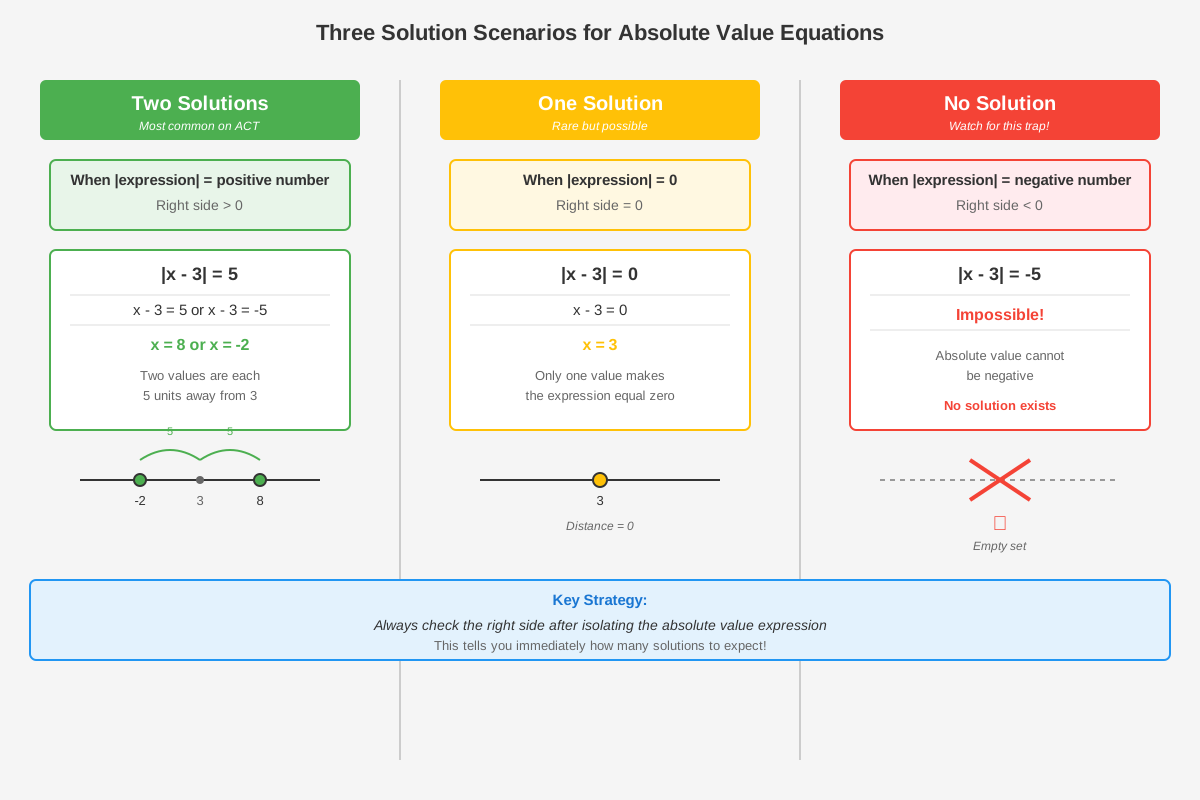
Not all absolute value equations have two solutions. Understanding these special cases is critical for ACT success:
| Equation Form | Number of Solutions | Reasoning | ||||
|---|---|---|---|---|---|---|
| \ | A\ | = positive number | Usually 2 | Both positive and negative values of A produce the same absolute value | ||
| \ | A\ | = 0 | Exactly 1 | Only when A = 0 does the absolute value equal zero | ||
| \ | A\ | = negative number | 0 (no solution) | Absolute value cannot be negative | ||
| \ | A\ | = \ | B\ | Usually 2 | Either A = B or A = -B |
For example, |2x + 5| = -3 has no solution because absolute value is always non-negative. The equation |x - 4| = 0 has exactly one solution: x = 4.
Equations Requiring Preliminary Simplification
Many ACT questions present absolute value equations that require algebraic manipulation before applying the two-case method. Consider 3|x + 2| - 5 = 10:
- Add 5 to both sides: 3|x + 2| = 15
- Divide both sides by 3: |x + 2| = 5
- Now apply two-case method: x + 2 = 5 or x + 2 = -5
- Solve: x = 3 or x = -7
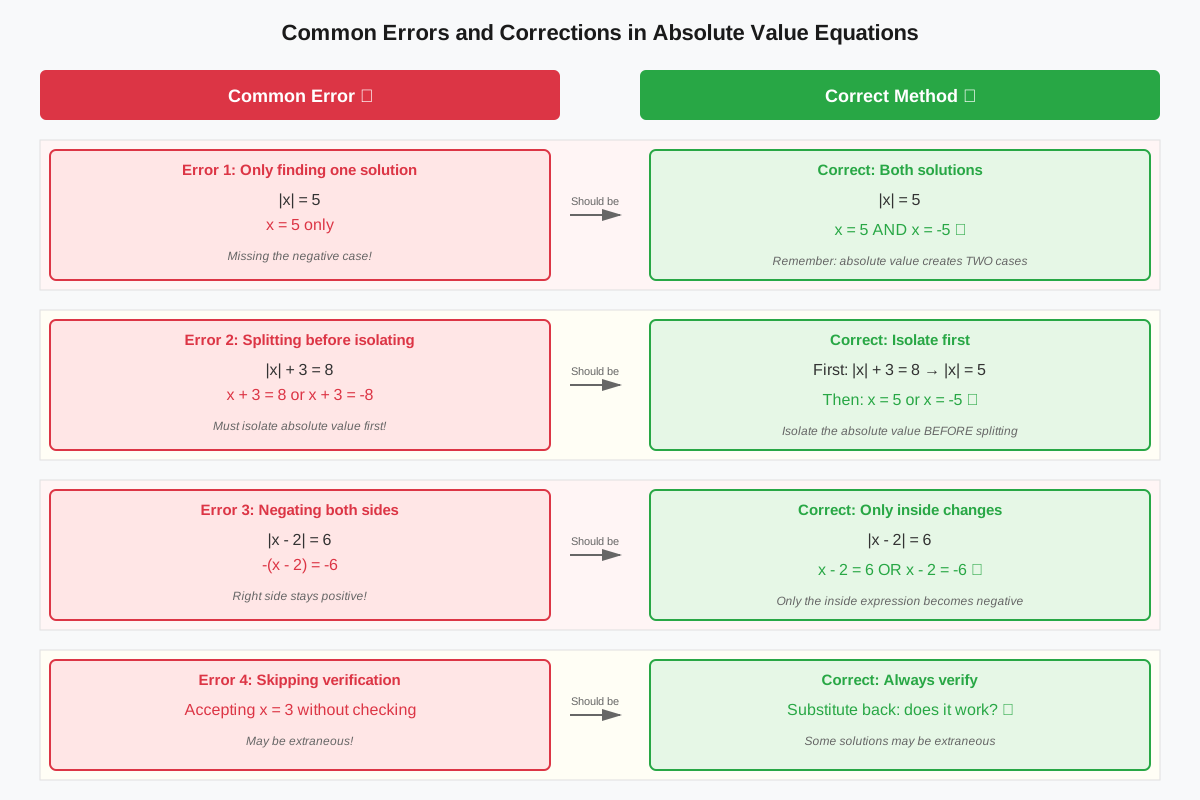
Failing to isolate the absolute value expression first is a common error that leads to incorrect solutions.
Absolute Value Equations with Variables on Both Sides
When absolute value appears on both sides, such as |2x - 1| = |x + 3|, the equation means the expressions have equal distance from zero. This creates two cases:
- Case 1: The expressions are equal: 2x - 1 = x + 3
- Case 2: The expressions are opposites: 2x - 1 = -(x + 3)
Solving Case 1: 2x - 1 = x + 3 → x = 4
Solving Case 2: 2x - 1 = -x - 3 → 3x = -2 → x = -2/3
Both solutions should be verified in the original equation.
Extraneous Solutions
An extraneous solution is a value that emerges from the algebraic process but doesn't satisfy the original equation. These occur less frequently with basic absolute value equations but can appear when equations involve more complex expressions or when combined with other operations. Always verify solutions by substituting back into the original equation. If a proposed solution makes the equation false, discard it.
Absolute Value in Context Problems
The ACT often embeds absolute value equations within word problems. Key phrases that signal absolute value include:
- "distance from"
- "deviation from"
- "within [number] units of"
- "error of at most"
- "differs from by"
For example: "A temperature differs from 72°F by at most 5 degrees" translates to |T - 72| ≤ 5 (though this is an inequality, the absolute value interpretation is identical).
Concept Relationships
The core concepts within absolute value equations build upon each other in a logical progression. The definition of absolute value as distance from zero → establishes why the two-case method is necessary → which provides the framework for the standard solution process → that must account for special cases based on what the absolute value equals → and sometimes requires preliminary simplification before the two-case method can be applied → ultimately leading to solutions that must be checked for extraneous solutions.
Absolute value equations connect directly to prerequisite topics: linear equations provide the solving techniques used after splitting cases, number line concepts offer geometric intuition for why two solutions exist, and algebraic manipulation skills enable the isolation of absolute value expressions. Looking forward, mastering absolute value equations prepares students for absolute value inequalities (which use similar two-case logic but with inequality symbols), piecewise functions (which formalize the definition of absolute value), distance formulas in coordinate geometry (which use absolute value implicitly), and complex number magnitude in advanced mathematics.
The relationship map flows as: Basic Algebra → Linear Equations → Absolute Value Definition → Two-Case Method → Absolute Value Equations → Absolute Value Inequalities → Piecewise Functions → Advanced Applications.
Quick check — test yourself on Absolute value equations so far.
Try Flashcards →High-Yield Facts
⭐ The absolute value of any real number is always non-negative: |x| ≥ 0 for all x, meaning equations like |x| = -5 have no solution
⭐ An equation |A| = B where B > 0 splits into exactly two cases: A = B and A = -B
⭐ Always isolate the absolute value expression before applying the two-case method: Failing to do this is the most common error on ACT questions
⭐ The equation |A| = 0 has exactly one solution: A must equal zero
⭐ Both solutions from the two-case method should be verified by substituting back into the original equation
- When absolute value appears on both sides (|A| = |B|), create cases: A = B or A = -B
- Absolute value represents distance on a number line, which is why |x - a| = d means x is d units from a
- The ACT rarely includes extraneous solutions in basic absolute value equations, but verification is still best practice
- Equations requiring preliminary simplification appear more frequently than straightforward two-case problems
- Absolute value can never equal a negative number, making such equations immediately solvable as "no solution"
- The expression inside absolute value bars can be any algebraic expression, not just a simple variable
- When solving |A| = |B|, both A and B could be positive, both negative, or have opposite signs
Common Misconceptions
Misconception: The equation |x| = 5 has only one solution, x = 5 → Correction: Absolute value equations typically have two solutions because both 5 and -5 have absolute value 5, so x = 5 or x = -5
Misconception: To solve |x + 3| = 7, simply remove the absolute value bars and solve x + 3 = 7 → Correction: Must create two cases: x + 3 = 7 AND x + 3 = -7, yielding x = 4 and x = -10
Misconception: The equation |2x - 4| = -6 has solutions if you solve 2x - 4 = -6 → Correction: Absolute value cannot equal a negative number, so this equation has no solution regardless of algebraic manipulation
Misconception: When solving 2|x - 1| = 10, split into cases immediately: 2(x - 1) = 10 or 2(x - 1) = -10 → Correction: First isolate the absolute value by dividing both sides by 2 to get |x - 1| = 5, then split into cases: x - 1 = 5 or x - 1 = -5
Misconception: If an absolute value equation yields two solutions, both must be correct → Correction: While basic absolute value equations rarely produce extraneous solutions, always verify by substituting back into the original equation
Misconception: The equation |x| + 3 = 8 means x + 3 = 8 or x + 3 = -8 → Correction: First isolate the absolute value: |x| = 5, then split into cases: x = 5 or x = -5
Misconception: Absolute value only applies to single variables like |x|, not expressions → Correction: Absolute value can contain any algebraic expression, such as |3x - 7|, |x² + 2x - 1|, or |(x + 1)/(x - 2)|
Worked Examples
Example 1: Standard Two-Case Absolute Value Equation
Problem: Solve |3x - 7| = 11
Solution:
Step 1: Verify the absolute value is isolated. ✓ (The absolute value expression is already alone on the left side)
Step 2: Check the right side. The absolute value equals 11, which is positive, so we'll have two cases.
Step 3: Set up both cases:
- Case 1: 3x - 7 = 11 (the expression inside equals the positive value)
- Case 2: 3x - 7 = -11 (the expression inside equals the negative value)
Step 4: Solve Case 1:
3x - 7 = 11
3x = 18
x = 6
Step 5: Solve Case 2:
3x - 7 = -11
3x = -4
x = -4/3
Step 6: Verify both solutions:
- For x = 6: |3(6) - 7| = |18 - 7| = |11| = 11 ✓
- For x = -4/3: |3(-4/3) - 7| = |-4 - 7| = |-11| = 11 ✓
Answer: x = 6 or x = -4/3
This example demonstrates the standard two-case method and connects to Learning Objective 2 (explaining the core strategy) and Learning Objective 3 (applying to ACT-style questions).
Example 2: Equation Requiring Preliminary Simplification
Problem: Solve 5|2x + 3| - 8 = 17
Solution:
Step 1: Isolate the absolute value expression.
5|2x + 3| - 8 = 17
5|2x + 3| = 25 (add 8 to both sides)
|2x + 3| = 5 (divide both sides by 5)
Step 2: Now that the absolute value is isolated and equals a positive number, set up two cases:
- Case 1: 2x + 3 = 5
- Case 2: 2x + 3 = -5
Step 3: Solve Case 1:
2x + 3 = 5
2x = 2
x = 1
Step 4: Solve Case 2:
2x + 3 = -5
2x = -8
x = -4
Step 5: Verify both solutions in the ORIGINAL equation:
- For x = 1: 5|2(1) + 3| - 8 = 5|5| - 8 = 25 - 8 = 17 ✓
- For x = -4: 5|2(-4) + 3| - 8 = 5|-5| - 8 = 25 - 8 = 17 ✓
Answer: x = 1 or x = -4
This example illustrates why preliminary simplification is crucial (addressing Learning Objective 6) and shows the complete verification process (Learning Objective 5). Students who skip the isolation step and immediately split into cases will arrive at incorrect equations and wrong answers.
Exam Strategy
When approaching absolute value equations on the ACT, begin by quickly scanning for the absolute value bars—these are the visual trigger that signals this question type. The most efficient strategy follows a mental checklist: (1) Is the absolute value isolated? If not, isolate it first. (2) What does it equal? If negative, mark "no solution" and move on. If zero, solve for one solution. If positive, prepare for two cases. (3) Set up both cases systematically, being careful with signs. (4) Solve both equations. (5) If time permits, verify at least one solution.
Trigger words and phrases that indicate absolute value equations include: "distance from," "differs by," "deviation," "within [number] units," "magnitude," and explicit absolute value notation |expression|. Word problems using these phrases often translate directly into absolute value equations. For example, "a number's distance from 8 is 3" becomes |x - 8| = 3.
Process-of-elimination tips: When answer choices are given, you can often eliminate options quickly. If the equation has the form |expression| = negative number, eliminate all numerical answers and select "no solution." If you solve and get two solutions, eliminate any answer choice listing only one value. For multiple-choice questions asking "which value is a solution," substitute each answer choice into the original equation—the absolute value structure makes verification faster than solving from scratch.
Time allocation: Basic absolute value equations should take 30-45 seconds once you've mastered the two-case method. Equations requiring preliminary simplification may take 60-90 seconds. If you find yourself spending more than 90 seconds, mark the question and return to it later. The ACT rewards efficient problem-solving, and absolute value questions are designed to be solved quickly with the right approach.
ACT Tip: If you're unsure whether you've isolated the absolute value correctly, ask yourself: "Is there anything multiplying or adding to the absolute value bars?" If yes, you haven't finished isolating.
Memory Techniques
The "Split and Flip" Mnemonic: When you see |A| = B, remember to SPLIT into two cases and FLIP the sign on one: A = B and A = -B (flip the sign of B).
The "I-C-S-V" Process: Isolate the absolute value, Create two cases, Solve both equations, Verify solutions. This acronym keeps you from skipping critical steps.
The "Distance Visualization": Picture the number line whenever you see absolute value. If |x - 5| = 3, visualize standing at 5 on the number line and moving 3 units in either direction—you land at 8 or 2. This mental image reinforces why two solutions exist.
The "Negative Check" Rhyme: "Absolute value can't be negative, so if it equals less than zero, there's no perspective"—a quick reminder that |anything| = negative has no solution.
The "Bars Before Cases" Rule: Never split into cases until the absolute value bars stand alone on one side. Think of the bars as a container that must be isolated before opening.
Summary
Absolute value equations are high-yield ACT Math topics that test algebraic fluency and logical reasoning simultaneously. The fundamental principle is that absolute value measures distance from zero, always yielding non-negative results, which creates two possible scenarios when solving equations. The systematic approach—isolate the absolute value expression, verify the right side is non-negative, split into two cases (positive and negative), solve both resulting linear equations, and verify solutions—provides a reliable framework for all absolute value equation problems. Special cases require recognition: equations where absolute value equals zero have one solution, equations where it equals a negative number have no solution, and equations requiring preliminary simplification must be handled before applying the two-case method. Success on ACT absolute value questions depends on avoiding common errors like failing to isolate the absolute value first, forgetting the negative case, or assuming equations with negative right sides have solutions. Mastering this topic provides a foundation for more advanced concepts including absolute value inequalities and piecewise functions while contributing directly to competitive Math section scores.
Key Takeaways
- Absolute value always produces non-negative results, so |A| = negative number means no solution exists
- The two-case method is essential: |A| = B (where B > 0) splits into A = B and A = -B
- Always isolate the absolute value expression first before creating cases—this is the most common source of errors
- Verification prevents careless mistakes: substitute solutions back into the original equation to confirm validity
- Special cases matter: |A| = 0 has one solution, |A| = positive has two solutions, |A| = negative has zero solutions
- ACT questions often require preliminary simplification before the two-case method can be applied
- Distance interpretation provides intuition: |x - a| = d means x is d units away from a on the number line
Related Topics
Absolute Value Inequalities: Building directly on absolute value equations, inequalities like |x - 3| < 5 or |2x + 1| ≥ 7 require similar two-case logic but produce solution intervals rather than discrete values. Mastering equations makes inequalities significantly more accessible.
Piecewise Functions: The formal definition of absolute value as a piecewise function (f(x) = x when x ≥ 0, f(x) = -x when x < 0) connects absolute value to more advanced function concepts tested on the ACT.
Distance Formula and Coordinate Geometry: The distance formula √[(x₂-x₁)² + (y₂-y₁)²] implicitly uses absolute value principles, as squaring and taking square roots ensure non-negative distances.
Systems of Equations: Absolute value equations can appear within systems, requiring students to combine solving techniques from both topics.
Quadratic Equations: Some complex absolute value problems involve quadratic expressions inside the bars, requiring factoring or the quadratic formula after applying the two-case method.
Practice CTA
Now that you've mastered the core concepts, strategies, and common pitfalls of absolute value equations, it's time to solidify your understanding through practice. Work through the practice questions systematically, applying the I-C-S-V process (Isolate, Create cases, Solve, Verify) to each problem. Use the flashcards to drill the special cases and key facts until they become automatic. Remember: absolute value equations are among the most predictable question types on the ACT—consistent practice transforms them from challenging problems into quick points. Your investment in mastering this topic will pay dividends not only in direct absolute value questions but also in related topics throughout the Math section. You've got this!
Sign up free to keep reading
Create a free AnvayaPrep account to finish this ACT guide on Absolute value equations — plus flashcards and practice questions.