Overview
Estimation is a critical mathematical skill that appears frequently throughout the ACT Math test, often determining whether students can efficiently navigate time-constrained problems. Rather than performing lengthy calculations, estimation allows test-takers to quickly approximate answers by rounding numbers, simplifying expressions, and using mental math strategies. This approach not only saves precious time but also serves as a powerful verification tool to catch calculation errors and eliminate obviously incorrect answer choices.
On the ACT, ACT estimation questions rarely ask students to estimate explicitly. Instead, the test rewards students who recognize when exact calculations are unnecessary or impractical. These situations include problems with messy decimals, complex fractions, or answer choices that are widely spaced apart. Mastering estimation transforms difficult-looking problems into manageable ones and provides a strategic advantage when time pressure mounts during the final minutes of the test.
Estimation connects deeply to number sense, mental math, and strategic test-taking. It builds upon fundamental arithmetic operations while supporting more advanced topics like algebra, geometry, and data analysis. Students who develop strong estimation skills gain confidence in their mathematical intuition and can approach unfamiliar problems with flexible problem-solving strategies rather than rigid algorithmic thinking.
Learning Objectives
- [ ] Identify when Estimation is being tested
- [ ] Explain the core rule or strategy behind Estimation
- [ ] Apply Estimation to ACT-style questions accurately
- [ ] Determine appropriate rounding strategies based on answer choice spacing
- [ ] Use benchmark values and reference points to estimate complex calculations
- [ ] Verify exact calculations through estimation to catch computational errors
- [ ] Recognize when estimation provides sufficient accuracy versus when exact calculation is required
Prerequisites
- Basic arithmetic operations (addition, subtraction, multiplication, division): Estimation relies on quickly performing simplified versions of these operations mentally
- Understanding of place value and decimal notation: Rounding strategies require recognizing the significance of digits in different positions
- Fraction and percentage concepts: Many estimation problems involve approximating fractional or percentage relationships
- Order of operations: Estimating multi-step calculations requires knowing which operations to simplify first
- Number sense and magnitude comparison: Effective estimation depends on intuitive understanding of relative sizes of numbers
Why This Topic Matters
Estimation serves as both a mathematical skill and a strategic test-taking tool. In real-world contexts, professionals across fields—from engineers calculating material requirements to financial analysts projecting budgets—use estimation daily to make quick decisions without perfect information. Scientists estimate orders of magnitude, architects approximate dimensions, and healthcare providers calculate dosages using mental approximations before verifying exact values.
On the ACT Math test, estimation-related skills appear in approximately 8-12 questions per exam, representing roughly 13-20% of the total Math section. These questions span multiple content areas including pre-algebra, elementary algebra, intermediate algebra, coordinate geometry, and plane geometry. The ACT frequently embeds estimation opportunities within problems that appear to require exact calculation, rewarding students who recognize shortcuts.
Common manifestations include: problems with answer choices spaced far apart (suggesting estimation suffices), questions involving irrational numbers like π or √2, percentage increase/decrease problems with complex decimals, geometric measurement problems where exact formulas yield messy calculations, and data interpretation questions requiring quick magnitude comparisons. The test also includes "reasonableness" questions where students must identify which answer choice makes logical sense given the problem context—a skill fundamentally rooted in estimation.
Core Concepts
Rounding Strategies
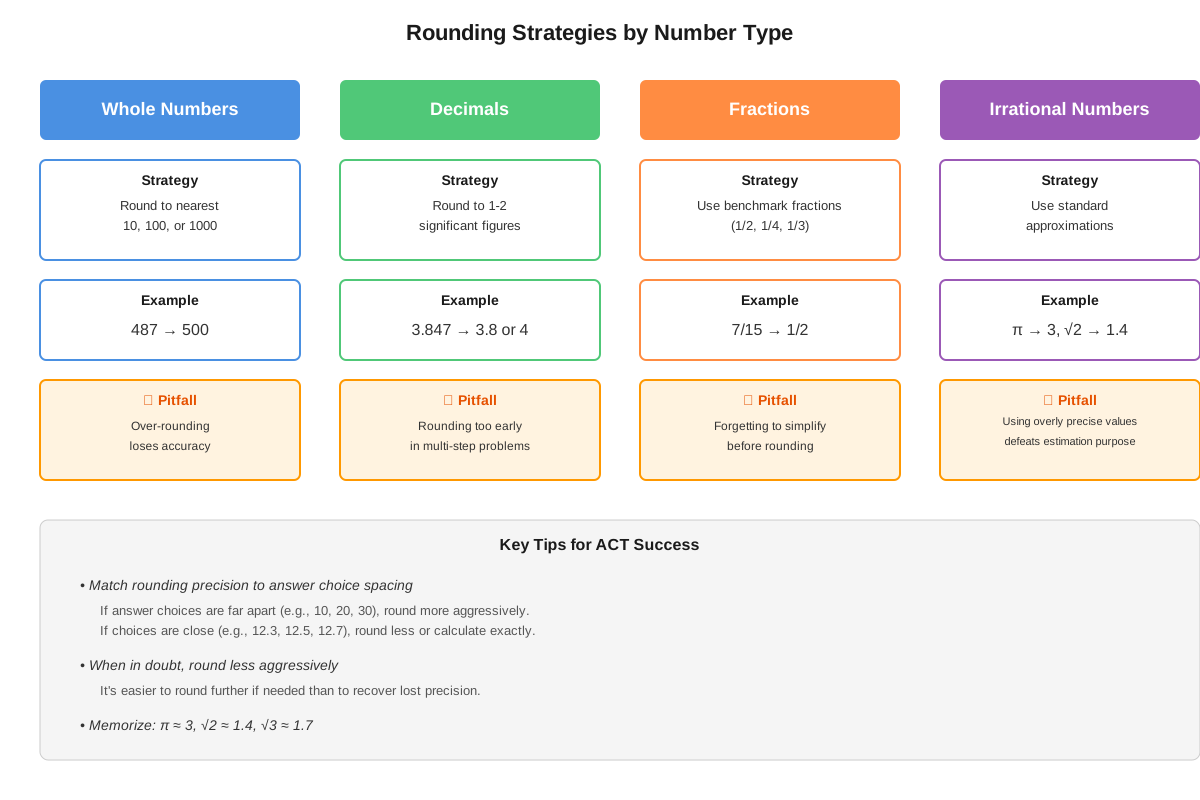
Rounding forms the foundation of estimation, involving the replacement of exact numbers with nearby values that are easier to manipulate mentally. The standard rounding rule states: if the digit to the right of the rounding position is 5 or greater, round up; if it's 4 or less, round down. However, strategic rounding on the ACT requires flexibility beyond this basic rule.
Compatible numbers are values that work well together in mental calculations. For example, when estimating 48 × 23, rounding to 50 × 20 = 1,000 provides a quick approximation. The key is choosing rounded values that maintain reasonable accuracy while maximizing computational simplicity. When multiplying, rounding one factor up and another down often compensates for errors and yields better estimates than rounding all factors in the same direction.
Front-end estimation focuses on the leftmost (most significant) digits while temporarily ignoring smaller place values. For instance, estimating 6,847 + 3,291 by considering only 6,000 + 3,000 = 9,000 provides a quick ballpark figure. This technique works particularly well when answer choices differ by thousands or when only order of magnitude matters.
Benchmark Values and Reference Points
Benchmark values are familiar numbers that serve as reference points for comparison. Common benchmarks include powers of 10 (10, 100, 1,000), simple fractions (1/2, 1/4, 1/3), and frequently used percentages (25%, 50%, 75%). Recognizing that 0.48 is approximately 1/2 or that 73% is roughly 3/4 enables rapid mental calculations.
For square roots, memorizing perfect squares (1, 4, 9, 16, 25, 36, 49, 64, 81, 100, 121, 144) allows estimation of non-perfect square roots. For example, √50 falls between √49 = 7 and √64 = 8, and since 50 is closer to 49, √50 ≈ 7.1. Similarly, knowing that π ≈ 3.14 ≈ 3 for rough estimates and √2 ≈ 1.4 provides quick approximations for geometry problems.
Answer Choice Analysis
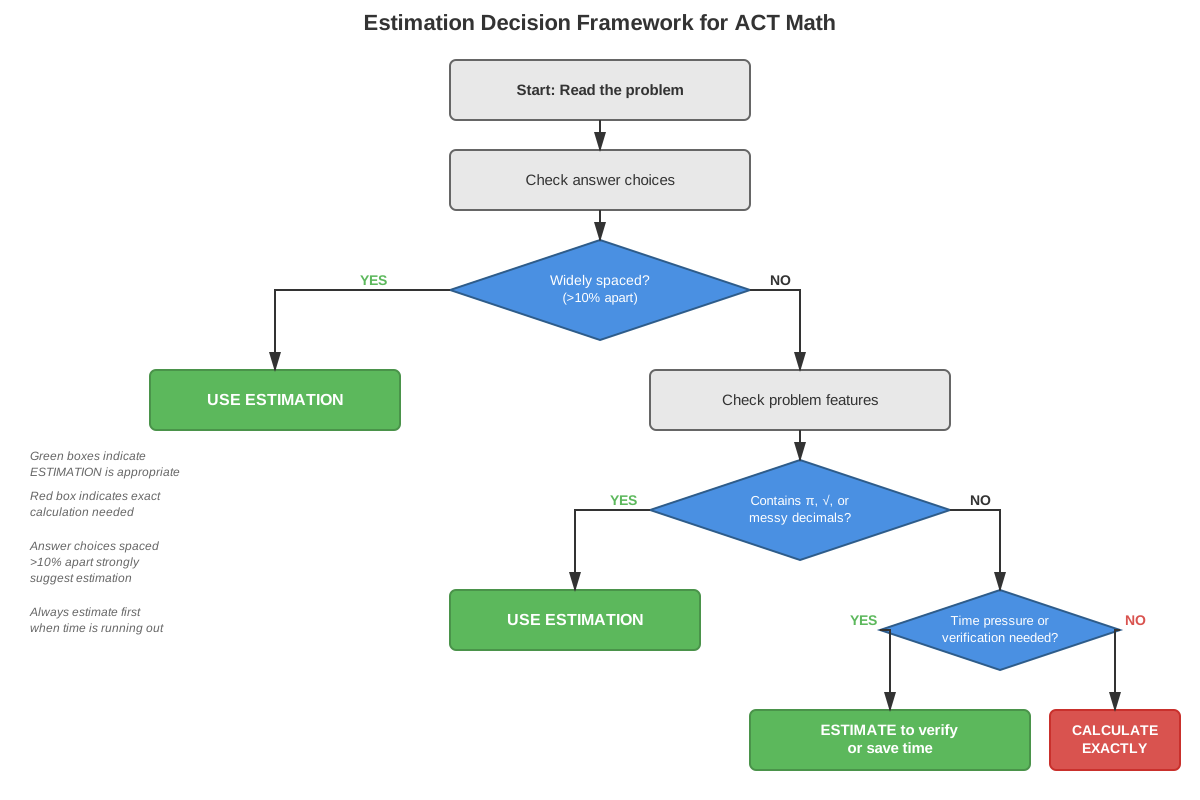
The spacing of answer choices provides crucial information about required precision. When choices are widely separated (e.g., 20, 45, 70, 95, 120), rough estimation suffices. When choices cluster closely (e.g., 47.2, 48.1, 48.9, 49.3, 50.0), exact calculation becomes necessary. This pattern recognition should occur immediately upon reading answer choices.
Elimination through estimation leverages the multiple-choice format. If estimating 17.8 × 3.2 by calculating 18 × 3 = 54, any answer choice below 50 or above 60 can be eliminated immediately. Often, estimation narrows options to two choices, at which point either refined estimation or quick exact calculation resolves the question.
Magnitude and Order of Operations
Understanding order of magnitude means recognizing whether an answer should be in the tens, hundreds, thousands, or other range. When multiplying 0.0043 × 2,100, recognizing that approximately 0.004 × 2,000 = 8 immediately indicates the answer is near 8-10, not 80-100 or 0.8-1.0. This prevents decimal point errors, one of the most common mistakes on the ACT.
When estimating multi-step calculations, apply strategic simplification by identifying which operations most significantly impact the result. In the expression (487 + 523) ÷ 19, estimating the numerator as 1,000 and the denominator as 20 yields 1,000 ÷ 20 = 50. The division operation dominates the calculation's magnitude, so precise estimation of the addition matters less than choosing a convenient divisor.
Percentage Estimation
Percentage problems frequently benefit from estimation. To find 18% of 247, recognize that 20% (one-fifth) of 250 equals 50, providing a quick approximation. For percentage increase/decrease, the formula (change/original) × 100% often involves messy division that estimation simplifies. If a quantity increases from 387 to 461, estimating (75/400) × 100% ≈ (75/400) × 100% = 18.75% ≈ 19% avoids tedious decimal division.
The 10% benchmark proves particularly useful: 10% of any number simply moves the decimal point one place left. From this, 5% is half of 10%, 20% is double 10%, and 15% is 10% plus 5%. These relationships enable rapid mental calculation of tips, discounts, and other percentage-based problems.
Geometric Estimation
In geometry problems, estimation helps verify formula applications and catch unit errors. When calculating the area of a circle with radius 7, the exact answer is 49π ≈ 153.94. Estimating π ≈ 3 gives 49 × 3 = 147, confirming the answer should be in the 140-160 range. If calculation yields 1,539 or 15.4, estimation immediately flags the error.
For coordinate geometry, estimating distances and slopes from graphs often suffices. If two points appear roughly 3 units apart horizontally and 4 units apart vertically, the distance is approximately 5 (recognizing the 3-4-5 Pythagorean triple) without calculating √(3² + 4²).
Concept Relationships
Estimation skills build directly upon fundamental arithmetic operations, as effective estimation requires fluency with mental addition, subtraction, multiplication, and division. The relationship flows: basic arithmetic → mental math fluency → strategic rounding → estimation mastery.
Within estimation itself, concepts interconnect hierarchically. Rounding strategies form the foundation, enabling benchmark value recognition, which in turn supports answer choice analysis. These three elements combine to enable magnitude checking and error detection. The relationship can be mapped as:
Rounding Strategies → Compatible Numbers → Benchmark Values → Answer Choice Analysis → Elimination Strategy → Time Efficiency
Estimation connects forward to virtually every ACT Math topic. In algebra, estimating solutions helps verify algebraic manipulations. In geometry, estimation validates formula applications and unit conversions. In trigonometry, knowing that sin(30°) = 0.5 and sin(45°) ≈ 0.7 enables quick approximations. In statistics, estimation helps interpret graphs and data tables without precise calculation.
The bidirectional relationship between estimation and exact calculation is crucial: estimation informs when exact calculation is necessary, while exact calculation validates estimation accuracy. Strong estimators develop intuition about when their approximations are "close enough" versus when precision matters.
Quick check — test yourself on Estimation so far.
Try Flashcards →High-Yield Facts
⭐ When answer choices are spaced more than 10% apart, estimation typically suffices for selecting the correct answer
⭐ Rounding one factor up and another down in multiplication problems compensates for errors and improves estimation accuracy
⭐ The spacing of answer choices immediately indicates whether the problem requires estimation or exact calculation
⭐ Memorizing perfect squares from 1² to 12² enables rapid estimation of square roots
⭐ Using π ≈ 3 for rough estimates and π ≈ 3.14 for refined estimates covers most ACT geometry problems
- Front-end estimation (using only the leftmost digits) works best when answer choices differ by orders of magnitude
- Compatible numbers like 25, 50, 75, and 100 simplify mental calculations more than standard rounding
- Estimating 10% of a value (by moving the decimal point) provides a foundation for calculating other percentages
- When estimating fractions, converting to familiar benchmarks (1/2, 1/4, 1/3) enables faster mental math
- Order of magnitude checking catches decimal point errors, the most common calculation mistake on the ACT
- Estimation serves as a verification tool: if your exact answer differs significantly from your estimate, recalculate
- In multi-step problems, estimate after each major operation to catch errors early rather than at the end
- The ACT rewards estimation skills by including problems where exact calculation is possible but time-consuming
Common Misconceptions
Misconception: Estimation always means rounding to the nearest ten or hundred → Correction: Strategic estimation involves choosing whatever rounded values make mental calculation easiest, which might mean rounding to compatible numbers like 25 or 75 rather than following standard rounding rules
Misconception: Estimation is only useful when the problem explicitly asks for an approximate answer → Correction: The ACT rarely asks explicitly for estimates; instead, estimation is a strategic tool students should apply whenever answer choices are widely spaced or exact calculation is cumbersome
Misconception: Always round before performing operations in multi-step problems → Correction: Sometimes performing one exact operation before estimating subsequent steps yields better accuracy; strategic estimation requires judgment about when to round
Misconception: If estimation gives an answer between two choices, you must calculate exactly → Correction: When estimation places the answer between two choices, consider which direction your rounding biased the estimate, then select accordingly; refined estimation often suffices without exact calculation
Misconception: Estimation is less accurate than exact calculation, so exact calculation is always preferable → Correction: Under time pressure, rushed exact calculations often contain errors, while careful estimation provides reliable approximations; estimation also serves as error-checking for exact calculations
Misconception: You should estimate by rounding all numbers in the same direction (all up or all down) → Correction: Rounding some numbers up and others down often produces more accurate estimates by balancing errors
Misconception: Estimation only applies to arithmetic problems, not algebra or geometry → Correction: Estimation applies across all ACT Math topics, including estimating solutions to equations, geometric measurements, and data analysis interpretations
Worked Examples
Example 1: Multiplication with Widely Spaced Answer Choices
Problem: A rectangular garden measures 47.8 feet by 23.2 feet. Which of the following is closest to the area of the garden in square feet?
A) 850
B) 1,100
C) 1,350
D) 1,600
E) 1,850
Solution:
Step 1: Recognize that answer choices are spaced approximately 250-300 apart, indicating estimation will suffice.
Step 2: Round the dimensions to compatible numbers. Round 47.8 to 50 and 23.2 to 25 (choosing numbers that are easy to multiply mentally).
Step 3: Calculate the estimated area: 50 × 25 = 1,250 square feet.
Step 4: Analyze the rounding bias. We rounded 47.8 up by about 2.2 and 23.2 up by about 1.8, so our estimate is slightly high.
Step 5: The closest answer choice to 1,250 is 1,100 (choice B). Since we rounded both dimensions up, our estimate should be higher than the actual value, confirming that 1,100 is correct rather than 1,350.
Connection to Learning Objectives: This example demonstrates identifying when estimation is being tested (widely spaced answer choices), applying the core strategy (rounding to compatible numbers), and using estimation accurately to select the correct answer.
Example 2: Percentage Estimation with Complex Decimals
Problem: A store's revenue increased from $18,734 to $22,891 over one year. Which of the following is closest to the percent increase?
A) 18%
B) 22%
C) 26%
D) 30%
E) 34%
Solution:
Step 1: Recall the percent change formula: (change/original) × 100%.
Step 2: Estimate the change: $22,891 - $18,734 ≈ $23,000 - $19,000 = $4,000.
Step 3: Estimate the original value: $18,734 ≈ $19,000.
Step 4: Calculate the estimated percentage: (4,000/19,000) × 100%.
Step 5: Simplify the fraction: 4,000/19,000 ≈ 4/19. Recognize that 4/20 = 1/5 = 20%, and since 19 is slightly less than 20, 4/19 is slightly more than 20%.
Step 6: The answer should be just above 20%, making 22% (choice B) the best answer.
Step 7: Verify by considering that 4/19 ≈ 0.21, which equals 21%, confirming choice B.
Connection to Learning Objectives: This example shows applying estimation to complex calculations, using benchmark values (recognizing 1/5 = 20%), and explaining the strategy of simplifying fractions for mental calculation.
Exam Strategy
When approaching ACT Math questions, develop a systematic estimation protocol. First, immediately scan answer choices before beginning any calculation. If choices are widely spaced (differing by 20% or more), flag the problem as an estimation opportunity. If choices cluster closely, prepare for exact calculation but still estimate first to establish a target range.
Trigger words and phrases that signal estimation opportunities include: "approximately," "closest to," "about," "roughly," and "estimate." However, the absence of these words doesn't preclude estimation—many ACT problems benefit from estimation even when not explicitly requested. Watch for problems involving π, square roots of non-perfect squares, complex decimals, or large numbers, as these often reward estimation.
For process of elimination, estimate quickly to eliminate obviously incorrect answers before calculating exactly. If a problem asks for 23% of 487, immediately eliminate any answer choice above 500 (since 23% must be less than 25%, which is one-quarter). This strategy often reduces five choices to two or three, improving guessing odds if time runs short.
Time allocation should favor estimation when under pressure. If you have 30 seconds remaining and two problems left, estimation provides your best chance of answering both rather than calculating one exactly and leaving one blank. Practice estimation during timed drills to build confidence in your approximations.
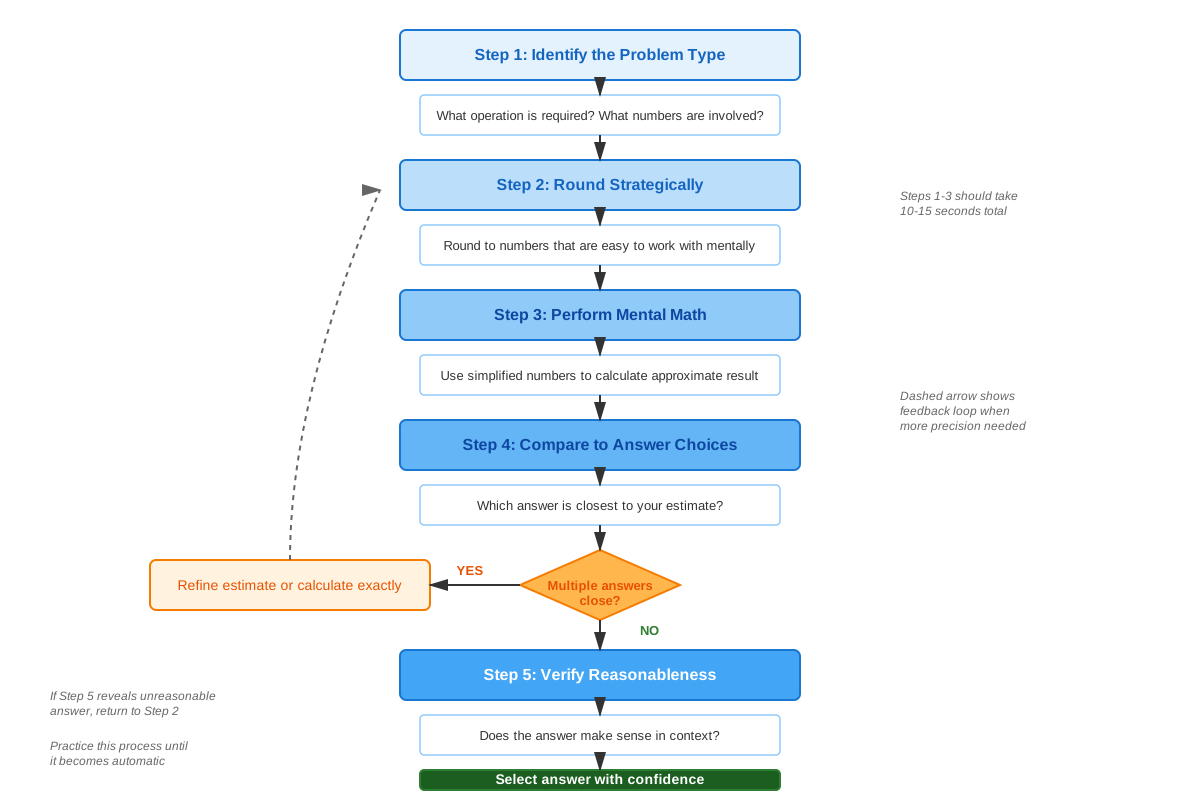
Develop a two-pass approach: estimate first to establish the answer's magnitude and eliminate unreasonable choices, then calculate exactly only if necessary. This prevents wasted time on full calculations when estimation suffices and catches errors when your exact answer falls outside your estimated range.
Memory Techniques
SPACE mnemonic for estimation strategy:
- Scan answer choices first
- Pick compatible numbers for rounding
- Approximate using mental math
- Check magnitude and reasonableness
- Eliminate incorrect choices
Perfect Squares Visualization: Picture a 12×12 grid to remember squares from 1² to 12². Visualize the grid expanding: 1×1=1, 2×2=4, 3×3=9, continuing to 12×12=144. This spatial memory aids square root estimation.
Benchmark Fraction Equivalents: Remember "Half-Quarter-Third" (1/2 = 0.5, 1/4 = 0.25, 1/3 ≈ 0.33) as the foundation. From these, derive 2/3 ≈ 0.67, 3/4 = 0.75, and other common fractions.
The 10% Rule: Visualize moving the decimal point one place left to find 10%. From this anchor, build other percentages: 5% is half of 10%, 20% is double, 15% is 10% + 5%. This creates a mental percentage calculator.
Pi Approximation Levels: Remember "3 for rough, 3.14 for refined, 3.1416 for exact." Most ACT problems need only the first two levels. Associate π ≈ 3 with quick elimination and π ≈ 3.14 with final answer selection.
Summary
Estimation represents both a mathematical skill and a strategic test-taking approach essential for ACT Math success. By recognizing when estimation is appropriate—primarily through analyzing answer choice spacing—students can save significant time while maintaining accuracy. The core strategies involve rounding to compatible numbers, using benchmark values as reference points, and understanding order of magnitude. Effective estimation requires flexibility beyond standard rounding rules, often involving strategic choices about which numbers to round and in which direction. The skill applies across all ACT Math content areas, from basic arithmetic through geometry and data analysis. Students who master estimation gain a powerful verification tool for exact calculations, catching errors before selecting answers. The ACT rewards estimation skills by including problems where exact calculation is possible but inefficient, making estimation proficiency a key differentiator between good and excellent scores.
Key Takeaways
- Answer choice spacing immediately indicates whether estimation suffices or exact calculation is required; widely spaced choices signal estimation opportunities
- Strategic rounding to compatible numbers (25, 50, 75) often produces better estimates than standard rounding rules
- Estimation serves dual purposes: as a time-saving calculation method and as an error-checking verification tool
- Memorizing benchmark values (perfect squares, common fractions, π ≈ 3.14) enables rapid mental approximations across problem types
- The ACT rarely asks explicitly for estimates but frequently rewards students who recognize when estimation is more efficient than exact calculation
- Rounding one factor up and another down in multiplication problems balances errors and improves accuracy
- Estimation applies across all ACT Math topics, not just arithmetic, making it one of the highest-yield skills to develop
Related Topics
Mental Math Strategies: Building upon estimation, advanced mental math techniques include the distributive property for multiplication, compensation methods for addition/subtraction, and algebraic thinking for solving equations mentally. Mastering estimation provides the foundation for these more sophisticated approaches.
Number Sense and Reasonableness: This broader topic encompasses estimation while extending to proportional reasoning, unit analysis, and logical answer validation. Strong estimation skills directly enhance overall number sense.
Scientific Notation and Orders of Magnitude: Estimation connects to expressing very large or small numbers efficiently and comparing quantities that differ by powers of ten, skills tested in ACT Science and Math.
Measurement and Unit Conversion: Estimation proves invaluable when converting between units (inches to feet, pounds to kilograms), as exact conversions often involve complex decimals while estimated conversions suffice for answer selection.
Data Analysis and Statistics: Interpreting graphs, calculating means, and analyzing trends all benefit from estimation skills, particularly when extracting approximate values from visual representations.
Practice CTA
Now that you've mastered the concepts and strategies of estimation, it's time to apply these skills to ACT-style practice questions. The practice problems will challenge you to recognize estimation opportunities, select appropriate rounding strategies, and efficiently navigate time-constrained scenarios. Remember that estimation is a skill that improves dramatically with practice—each problem you solve builds your intuition about when approximation suffices and when precision matters. Approach the practice questions strategically, always scanning answer choices first and estimating before calculating exactly. The flashcards will reinforce key benchmark values and common estimation patterns, helping you develop the automatic recognition that separates efficient test-takers from those who struggle with time management. Your investment in mastering estimation will pay dividends across every section of the ACT Math test!
Sign up free to keep reading
Create a free AnvayaPrep account to finish this ACT guide on Estimation — plus flashcards and practice questions.