Overview
Unit conversions represent one of the most practical and frequently tested mathematical skills on the ACT Math section. This topic requires students to transform measurements from one unit to another—whether converting inches to feet, hours to minutes, or miles per hour to feet per second. While the concept may seem straightforward, the ACT consistently challenges students with multi-step conversions, unfamiliar units, and time-pressured scenarios that demand both accuracy and efficiency.
Mastering ACT unit conversions is essential because these questions appear across multiple content areas within the Math section. Students encounter unit conversion problems in geometry (converting between area and volume units), algebra (rate problems involving different time or distance units), and word problems that require translating real-world scenarios into mathematical expressions. The ACT typically includes 2-4 direct unit conversion questions per test, but conversion skills are embedded in many additional problems, making this a high-yield topic that can significantly impact overall scores.
Unit conversions connect to broader mathematical reasoning by reinforcing proportional relationships, dimensional analysis, and the fundamental principle that multiplying by strategically chosen forms of "1" (conversion factors) preserves equality while changing representation. This topic builds upon basic fraction operations and ratio understanding while serving as a foundation for more complex rate problems, scientific notation applications, and real-world problem-solving scenarios that students will encounter throughout the ACT Math section.
Learning Objectives
- [ ] Identify when Unit conversions is being tested in ACT Math questions
- [ ] Explain the core rule or strategy behind Unit conversions, including dimensional analysis
- [ ] Apply Unit conversions to ACT-style questions accurately and efficiently
- [ ] Convert between multiple units in a single problem using chain multiplication
- [ ] Recognize and avoid common unit conversion errors under time pressure
- [ ] Set up conversion factors correctly to ensure units cancel appropriately
- [ ] Solve complex rate problems requiring multiple simultaneous unit conversions
Prerequisites
- Basic fraction multiplication and division: Essential for setting up and calculating conversion factors as fractions
- Understanding of ratios and proportions: Unit conversions are fundamentally ratio-based transformations
- Familiarity with common measurement systems: Knowledge of metric and customary units provides context for conversion problems
- Order of operations: Necessary for correctly evaluating multi-step conversion calculations
- Basic algebraic manipulation: Required for setting up equations when conversions are embedded in larger problems
Why This Topic Matters
Unit conversions appear in countless real-world contexts, from cooking (converting recipe measurements) to travel (calculating fuel efficiency), construction (determining material quantities), and scientific research (standardizing measurements). Healthcare professionals convert medication dosages, engineers convert between measurement systems for international projects, and financial analysts convert currencies and time periods. This practical applicability makes unit conversions one of the most immediately useful mathematical skills students will develop.
On the ACT Math section, unit conversion questions appear with remarkable consistency. Approximately 3-5% of all Math questions directly test conversion skills, translating to 2-4 questions per 60-question test. However, conversion skills are embedded in an additional 10-15% of questions involving rates, proportions, geometry, and word problems. These questions typically appear in the first 40 questions of the Math section, though complex multi-step conversions may appear later among more challenging problems.
The ACT presents unit conversions in several characteristic formats: direct conversion problems ("Convert 3.5 hours to seconds"), rate problems requiring conversion ("A car travels 60 miles per hour; what is its speed in feet per second?"), geometry problems with mixed units ("Find the area in square feet of a rectangle measuring 4 yards by 6 yards"), and word problems where conversion is one step in a multi-part solution. The test frequently uses unfamiliar or less common units to assess true understanding rather than memorized formulas.
Core Concepts
The Fundamental Principle of Unit Conversion
Unit conversions rely on the mathematical principle that multiplying any quantity by 1 does not change its value. A conversion factor is a ratio equal to 1 that expresses the relationship between two different units. For example, since 12 inches equals 1 foot, the ratios 12 inches/1 foot and 1 foot/12 inches both equal 1. By multiplying a measurement by the appropriate conversion factor, students change the units while preserving the actual quantity.
The key to successful conversion is selecting the conversion factor orientation that causes unwanted units to cancel. If converting 36 inches to feet, multiply by (1 foot/12 inches) so that "inches" cancels:
36 inches × (1 foot / 12 inches) = 3 feetThe inches unit appears in both numerator and denominator, allowing cancellation, leaving only feet.
Dimensional Analysis Method
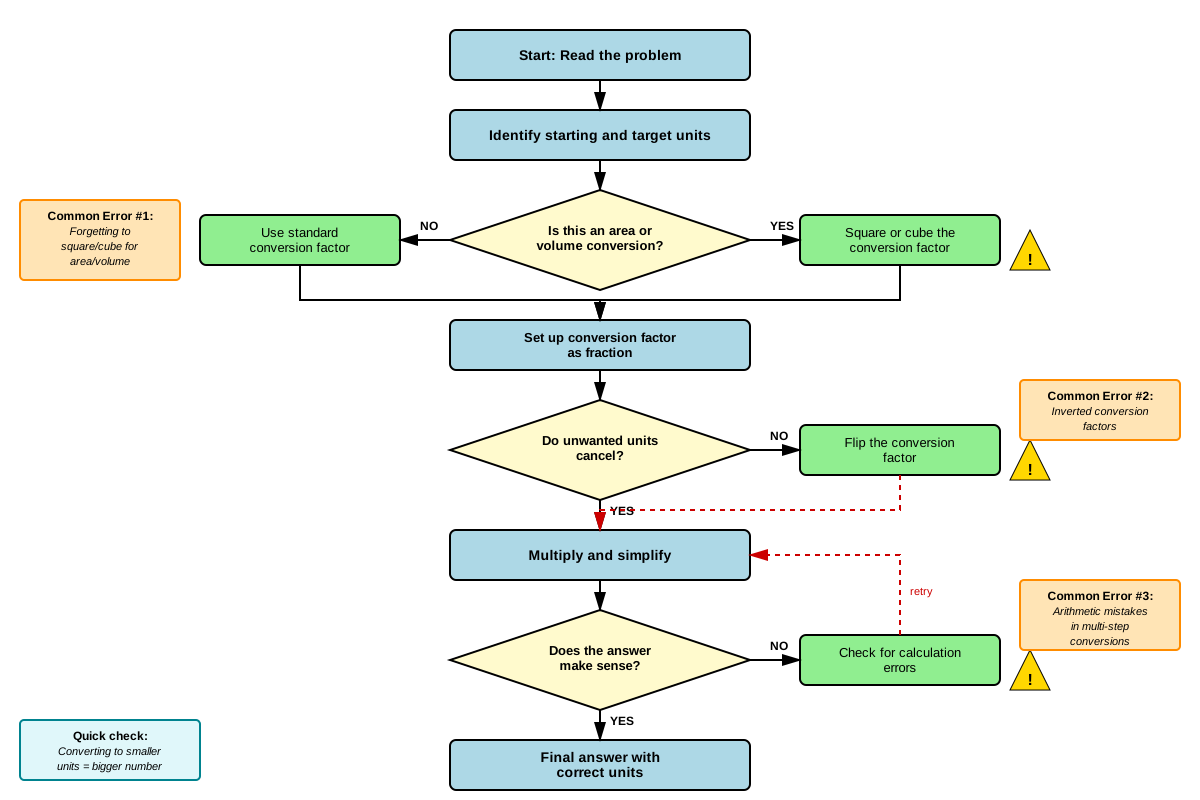
Dimensional analysis (also called the factor-label method) is the systematic approach to unit conversion that ensures accuracy through unit cancellation. This method treats units as algebraic quantities that can be multiplied and divided. The process involves:
- Write the starting measurement with its units
- Multiply by conversion factors arranged so unwanted units cancel
- Continue multiplying by additional conversion factors until reaching the desired unit
- Perform the numerical calculation
- Verify that only the desired units remain
For example, converting 5 miles to inches requires two conversion factors:
5 miles × (5,280 feet / 1 mile) × (12 inches / 1 foot) = 316,800 inchesNotice how "miles" cancels with the first factor, "feet" cancels with the second factor, leaving only "inches."
Common Conversion Relationships
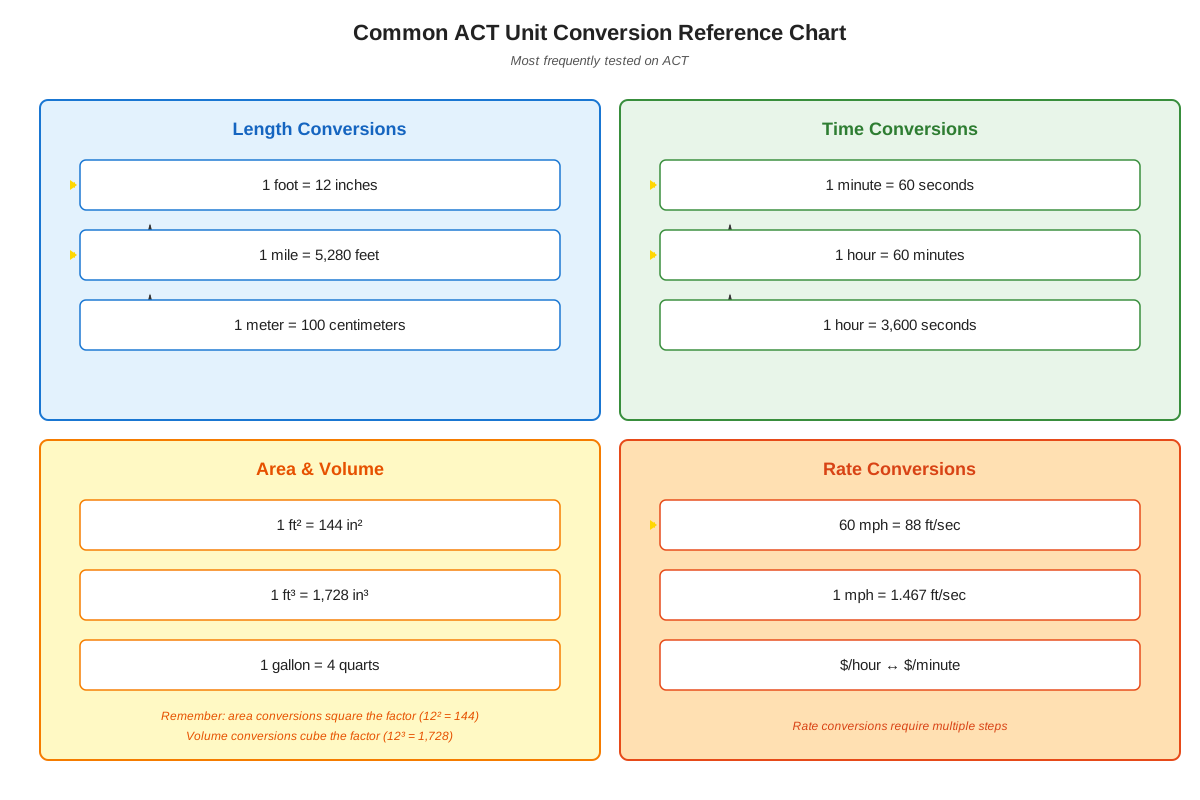
The ACT expects students to know or quickly derive standard conversion relationships. While some conversions may be provided in the question, familiarity with common conversions saves valuable time:
| Category | Conversion | Relationship |
|---|---|---|
| Length (Customary) | Inches to feet | 12 inches = 1 foot |
| Length (Customary) | Feet to yards | 3 feet = 1 yard |
| Length (Customary) | Feet to miles | 5,280 feet = 1 mile |
| Length (Metric) | Centimeters to meters | 100 centimeters = 1 meter |
| Length (Metric) | Meters to kilometers | 1,000 meters = 1 kilometer |
| Time | Seconds to minutes | 60 seconds = 1 minute |
| Time | Minutes to hours | 60 minutes = 1 hour |
| Time | Hours to days | 24 hours = 1 day |
| Area | Square feet to square yards | 9 square feet = 1 square yard |
| Volume | Cubic feet to cubic yards | 27 cubic feet = 1 cubic yard |
Converting Squared and Cubed Units
A critical concept that frequently challenges students involves converting area and volume units. When converting squared units (area), the conversion factor must be squared. When converting cubed units (volume), the conversion factor must be cubed.
To convert square feet to square yards, recognize that 1 yard = 3 feet, so:
1 square yard = 1 yard × 1 yard = 3 feet × 3 feet = 9 square feetTherefore, to convert 45 square feet to square yards:
45 square feet × (1 square yard / 9 square feet) = 5 square yardsSimilarly, for cubic units: 1 cubic yard = 3 feet × 3 feet × 3 feet = 27 cubic feet.
Rate Conversions
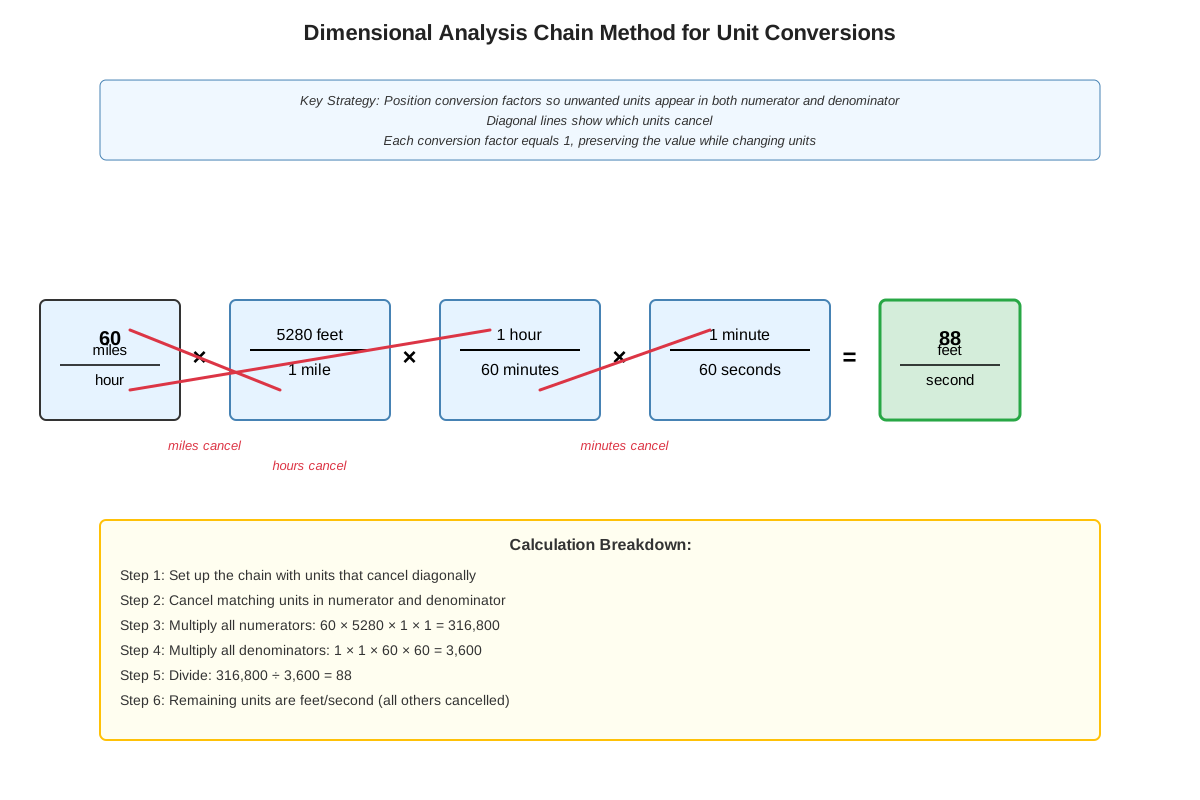
Rate conversions involve changing both the numerator and denominator units simultaneously. Speed, flow rates, and other compound units require careful attention to both components. Converting 60 miles per hour to feet per second requires converting miles to feet AND hours to seconds:
60 miles/hour × (5,280 feet / 1 mile) × (1 hour / 60 minutes) × (1 minute / 60 seconds) = 88 feet/secondThe strategy is to convert the numerator unit first, then convert the denominator unit, ensuring all unwanted units cancel.
Multi-Step Conversions
Complex ACT problems often require converting through intermediate units. Converting miles per hour to inches per second might require the chain: miles → feet → inches (numerator) and hours → minutes → seconds (denominator). The dimensional analysis method handles these systematically by multiplying successive conversion factors.
Concept Relationships
Unit conversions fundamentally depend on proportional reasoning and equivalent ratios. Each conversion factor represents a proportion (12 inches : 1 foot), and the conversion process applies this proportion to scale measurements. This connects directly to the prerequisite understanding of ratios and fractions.
The relationship flow within unit conversions follows this pattern:
Basic Conversion Factor → Dimensional Analysis Setup → Unit Cancellation → Numerical Calculation → Verified Answer
For squared and cubed units, the relationship extends:
Linear Conversion Factor → Squaring/Cubing the Factor → Area/Volume Conversion → Application to Problem
Unit conversions connect to rate problems (speed, density, flow rates) because rates are inherently compound units requiring conversion of both components. They connect to geometry through area and volume calculations with mixed units. They relate to scientific notation when converting very large or small measurements. Finally, they support algebraic problem-solving by enabling students to work with consistent units throughout equations.
The prerequisite knowledge of fraction operations enables the multiplication and division of conversion factors. Ratio understanding provides the conceptual foundation for why conversion factors equal 1. Measurement system familiarity supplies the specific conversion relationships needed for problems.
High-Yield Facts
⭐ A conversion factor is a ratio equal to 1 that relates two different units
⭐ To convert units, multiply by conversion factors arranged so unwanted units cancel
⭐ When converting squared units (area), square the linear conversion factor
⭐ When converting cubed units (volume), cube the linear conversion factor
⭐ Rate conversions require converting both numerator and denominator units
- There are 5,280 feet in one mile, a frequently tested conversion on the ACT
- There are 60 seconds in a minute and 60 minutes in an hour (3,600 seconds per hour)
- One square yard equals 9 square feet (3² = 9)
- One cubic yard equals 27 cubic feet (3³ = 27)
- The metric system uses powers of 10: 100 cm = 1 m, 1,000 m = 1 km
- Dimensional analysis ensures accuracy by treating units as algebraic quantities
- Multiple conversion factors can be multiplied in a single chain calculation
- Always verify that final units match what the question asks for
- Converting from smaller to larger units results in a smaller number
- Converting from larger to smaller units results in a larger number
Quick check — test yourself on Unit conversions so far.
Try Flashcards →Common Misconceptions
Misconception: When converting area units, simply use the linear conversion factor without squaring it.
Correction: Area conversions require squaring the linear factor. Since 1 yard = 3 feet, then 1 square yard = 9 square feet (3²), not 3 square feet. Always square the conversion factor for area and cube it for volume.
Misconception: Conversion factors can be oriented either way without affecting the answer.
Correction: The orientation of the conversion factor is critical for proper unit cancellation. To convert inches to feet, use (1 foot / 12 inches), not (12 inches / 1 foot). The unwanted unit must appear in the position that allows cancellation.
Misconception: Rate conversions only require converting one unit (either numerator or denominator).
Correction: Rates are compound units requiring conversion of both components. Converting miles per hour to feet per second requires converting miles to feet AND hours to seconds. Neglecting either conversion produces an incorrect answer.
Misconception: All metric conversions use the same factor (like 100 or 1,000).
Correction: Different metric prefixes represent different powers of 10. Centi- means 1/100, kilo- means 1,000, and milli- means 1/1,000. Students must know the specific prefix meanings rather than assuming all metric conversions are identical.
Misconception: The numerical answer should always be larger after conversion.
Correction: The direction of numerical change depends on the relative size of units. Converting from smaller to larger units (inches to feet) decreases the number, while converting from larger to smaller units (feet to inches) increases the number. The actual quantity remains constant.
Misconception: Conversion factors provided in the problem can be ignored if you know a different conversion.
Correction: When the ACT provides specific conversion information (especially for unfamiliar units), use exactly what is given. The problem may use non-standard definitions or test your ability to work with provided information rather than memorized facts.
Worked Examples
Example 1: Multi-Step Linear Conversion
Problem: A hiking trail is 2.5 miles long. What is the length of the trail in inches?
Solution:
Step 1: Identify the starting unit (miles) and target unit (inches).
Step 2: Determine the conversion path. Since there's no direct miles-to-inches conversion, use intermediate units: miles → feet → inches.
Step 3: Set up the dimensional analysis chain with conversion factors oriented for cancellation:
2.5 miles × (5,280 feet / 1 mile) × (12 inches / 1 foot)Step 4: Verify unit cancellation. "Miles" cancels between the first and second terms. "Feet" cancels between the second and third terms. Only "inches" remains.
Step 5: Calculate numerically:
2.5 × 5,280 × 12 = 2.5 × 63,360 = 158,400 inchesAnswer: The trail is 158,400 inches long.
Connection to Learning Objectives: This example demonstrates identifying when conversion is needed (different units in question and answer), applying the core dimensional analysis strategy, and accurately executing a multi-step conversion.
Example 2: Rate Conversion with Compound Units
Problem: A river flows at a rate of 3 miles per hour. What is the flow rate in feet per second?
Solution:
Step 1: Identify that this is a rate conversion requiring changes to both numerator (miles to feet) and denominator (hours to seconds).
Step 2: Set up the conversion chain, converting numerator first:
3 miles/hour × (5,280 feet / 1 mile)This gives: 15,840 feet/hour
Step 3: Now convert the denominator from hours to seconds using two conversion factors:
15,840 feet/hour × (1 hour / 60 minutes) × (1 minute / 60 seconds)Step 4: Verify all units cancel properly:
- "Miles" cancels, leaving "feet" in numerator
- "Hour" cancels with first denominator conversion
- "Minutes" cancels with second denominator conversion
- Only "feet/second" remains
Step 5: Calculate:
(3 × 5,280) / (60 × 60) = 15,840 / 3,600 = 4.4 feet/secondAnswer: The river flows at 4.4 feet per second.
Connection to Learning Objectives: This example shows how to identify rate conversion problems, apply dimensional analysis to compound units, and handle multiple simultaneous conversions accurately.
Example 3: Area Conversion
Problem: A rectangular garden measures 6 yards by 4 yards. What is the area of the garden in square feet?
Solution:
Step 1: Calculate the area in the given units:
Area = 6 yards × 4 yards = 24 square yardsStep 2: Recognize this is an area conversion requiring the squared conversion factor.
Step 3: Determine the linear conversion: 1 yard = 3 feet
Step 4: Square the linear conversion for area: 1 square yard = 9 square feet (3² = 9)
Step 5: Apply the conversion:
24 square yards × (9 square feet / 1 square yard) = 216 square feetAnswer: The garden has an area of 216 square feet.
Alternative Method: Convert the dimensions first, then calculate area:
6 yards × (3 feet / 1 yard) = 18 feet
4 yards × (3 feet / 1 yard) = 12 feet
Area = 18 feet × 12 feet = 216 square feet
Both methods yield the same answer, demonstrating the flexibility of conversion strategies.
Connection to Learning Objectives: This example illustrates the critical concept of squaring conversion factors for area, a frequently tested ACT concept that students often miss.
Exam Strategy
When approaching ACT unit conversions questions, begin by carefully reading what units are given and what units the answer requires. Circle or underline these units to maintain focus. The ACT often includes answer choices with common conversion errors, so identifying the target unit prevents selecting a trap answer.
Trigger words and phrases that signal unit conversion problems include: "convert," "express in terms of," "what is the speed in [different unit]," "how many [unit A] are in [unit B]," and any problem presenting measurements in one unit while asking for an answer in another. Rate problems using words like "per" (miles per hour, dollars per pound) often require conversion.
For process of elimination, immediately eliminate answer choices with incorrect units. If converting miles to feet, eliminate any answer in miles, yards, or inches. Next, use estimation to eliminate unreasonable magnitudes. When converting from larger to smaller units, the number should increase; when converting from smaller to larger units, the number should decrease. An answer that changes in the wrong direction is incorrect.
Time allocation for unit conversion questions should be approximately 30-45 seconds for straightforward single-step conversions and 60-90 seconds for multi-step or rate conversions. If a conversion requires more than three conversion factors, double-check the setup before calculating to avoid wasting time on an incorrect approach. The dimensional analysis method, while systematic, is efficient once practiced.
Set up the conversion chain completely before performing calculations. Writing out the full dimensional analysis expression allows verification that units cancel correctly before committing to arithmetic. This prevents the common error of multiplying when division is needed (or vice versa). For complex conversions, work left to right, canceling units as you go.
When the ACT provides conversion information in the problem, use exactly what is given rather than relying on memory. The test may use non-standard conversions or test your ability to apply provided information. If a problem states "1 fathom = 6 feet," use this relationship even if you know a different definition.
Memory Techniques
"5-12-3" Mnemonic for customary length conversions:
- 5 (thousand, 280): 5,280 feet in a mile
- 12: 12 inches in a foot
- 3: 3 feet in a yard
"Squared Squares, Cubed Cubes" for area and volume:
- When you see square units (area), remember to square the conversion factor
- When you see cube units (volume), remember to cube the conversion factor
- Visualization: A square yard is a 3×3 grid of square feet (9 total)
"60-60-24" Time Chain:
- 60 seconds per minute
- 60 minutes per hour
- 24 hours per day
- Multiply these for longer conversions (3,600 seconds per hour)
"Small to Big, Divide" Principle:
- Converting from small units to big units means divide (or multiply by a fraction less than 1)
- Converting from big units to small units means multiply (by a number greater than 1)
- Example: 36 inches to feet (small to big) = 36 ÷ 12 = 3 feet
"Cancel Culture" Visualization:
- Imagine units as words you're crossing out
- The conversion factor must have the unwanted unit in the opposite position (numerator vs. denominator)
- Visualize drawing diagonal lines through matching units
Metric Prefix Ladder:
- Visualize a ladder: kilo (top) → base unit (middle) → centi/milli (bottom)
- Moving down the ladder = multiply by 10, 100, or 1,000
- Moving up the ladder = divide by 10, 100, or 1,000
Summary
Unit conversions are essential ACT Math skills that test students' ability to transform measurements between different units while preserving the actual quantity. The fundamental strategy involves multiplying by conversion factors—ratios equal to 1 that relate two units—arranged so unwanted units cancel through dimensional analysis. Success requires knowing common conversion relationships (particularly 5,280 feet per mile, 12 inches per foot, 3 feet per yard, and time conversions), understanding that area conversions require squaring the linear factor and volume conversions require cubing it, and recognizing that rate conversions demand converting both numerator and denominator units. The ACT tests these concepts through direct conversion problems, rate problems, geometry questions with mixed units, and multi-step word problems. Mastery comes from systematic application of dimensional analysis, careful attention to unit cancellation, and verification that final answers have the correct units and reasonable magnitudes. Students who develop fluency with unit conversions gain both direct points on conversion questions and improved accuracy on the many other problems where conversion is an embedded step.
Key Takeaways
- Unit conversions use multiplication by ratios equal to 1 (conversion factors) to change units without changing quantity
- Dimensional analysis ensures accuracy by treating units algebraically and verifying cancellation
- Area conversions require squaring the linear conversion factor; volume conversions require cubing it
- Rate conversions demand converting both the numerator and denominator units separately
- Common ACT conversions include 5,280 feet/mile, 12 inches/foot, 3 feet/yard, and 60 seconds/minute
- Orient conversion factors so the unwanted unit cancels (appears in both numerator and denominator)
- Multi-step conversions chain multiple conversion factors in a single calculation, canceling units sequentially
Related Topics
Ratio and Proportion Problems: Unit conversions are a specific application of proportional reasoning. Mastering conversions strengthens the ability to solve scaling problems, similar figures, and mixture problems that appear frequently on the ACT.
Rate, Time, and Distance Problems: These problems often require converting between different units of speed (mph to fps), time (hours to minutes), or distance (miles to feet). Strong conversion skills are essential for efficiently solving these high-yield ACT questions.
Dimensional Analysis in Science: While primarily tested in ACT Math, dimensional analysis is fundamental to ACT Science passages involving experimental data, unit consistency, and quantitative reasoning across scientific contexts.
Geometry with Mixed Units: Many ACT geometry problems present dimensions in different units (a rectangle with length in yards and width in feet), requiring conversion before calculating area, perimeter, or volume.
Scientific Notation and Unit Conversions: Advanced problems may combine very large or small numbers in scientific notation with unit conversions, requiring fluency in both skills simultaneously.
Practice CTA
Now that you've mastered the core concepts, strategies, and common pitfalls of unit conversions, it's time to solidify your understanding through practice. Attempt the practice questions designed specifically for this topic, focusing on applying dimensional analysis systematically and verifying unit cancellation. Use the flashcards to reinforce conversion relationships and build the automaticity that saves valuable time on test day. Remember: unit conversion mastery isn't just about memorizing factors—it's about developing the systematic thinking that makes you confident and accurate under pressure. Every practice problem you solve strengthens the neural pathways that will serve you on test day. You've got this!
Sign up free to keep reading
Create a free AnvayaPrep account to finish this ACT guide on Unit conversions — plus flashcards and practice questions.