Overview
Angle basics form the foundation of geometry questions on the ACT Math test, appearing in approximately 15-20% of all geometry problems. Understanding angles is not merely about memorizing definitions—it requires recognizing angle relationships, applying fundamental properties, and solving multi-step problems efficiently under time pressure. The ACT consistently tests angle concepts through questions involving intersecting lines, parallel lines cut by transversals, triangles, polygons, and coordinate geometry.
Mastery of ACT angle basics provides the essential framework for tackling more complex geometry problems. Students who struggle with angle fundamentals often find themselves unable to solve questions involving triangles, circles, or coordinate geometry, as these topics build directly upon angle properties. The ACT rewards students who can quickly identify angle relationships and apply the appropriate rules without hesitation.
This topic connects to virtually every other plane geometry concept tested on the ACT. Angle relationships appear in triangle problems (where angle sum properties are essential), polygon questions (requiring knowledge of interior and exterior angles), circle geometry (involving inscribed and central angles), and even coordinate geometry (where slope relationships create specific angle measures). A solid grasp of angle basics enables students to approach these more complex problems with confidence and accuracy.
Learning Objectives
- [ ] Identify when Angle basics is being tested
- [ ] Explain the core rule or strategy behind Angle basics
- [ ] Apply Angle basics to ACT-style questions accurately
- [ ] Calculate unknown angle measures using complementary and supplementary angle relationships
- [ ] Recognize and apply vertical angle properties in multi-step problems
- [ ] Determine angle measures formed by parallel lines and transversals
- [ ] Solve problems involving angle bisectors and angle addition
Prerequisites
- Basic arithmetic operations: Essential for calculating angle measures through addition, subtraction, and algebraic manipulation
- Algebraic equation solving: Required when angle measures are expressed as variables or algebraic expressions
- Understanding of geometric notation: Necessary to interpret angle symbols, degree measures, and geometric diagrams correctly
- Number sense with degrees: Familiarity with the 360-degree system and common angle measures (30°, 45°, 60°, 90°, 180°)
Why This Topic Matters
Angle relationships appear in everyday situations from architecture and construction to navigation and design. Engineers use angle principles to ensure structural stability, graphic designers apply angle concepts to create visual balance, and surveyors rely on angle measurements to map terrain accurately. Understanding angles develops spatial reasoning skills that extend far beyond mathematics into fields like physics, computer graphics, and robotics.
On the ACT Math test, angle problems appear with remarkable consistency. Approximately 4-6 questions per test directly assess angle knowledge, while another 6-8 questions require angle concepts as part of multi-step solutions. The ACT presents angle questions in several formats: straightforward calculation problems, diagram-based questions requiring multiple angle relationships, word problems describing geometric situations, and coordinate geometry questions where angle properties determine solutions.
Common ACT question types include: finding missing angles in diagrams with intersecting lines, determining angle measures when parallel lines are cut by transversals, calculating angles in polygons, solving for variables when angle measures are expressed algebraically, and applying angle relationships in real-world contexts. The test frequently combines angle basics with other geometry concepts, making this topic a gateway skill for success across the entire geometry section.
Core Concepts
Angle Measurement and Classification
An angle is formed by two rays sharing a common endpoint called the vertex. Angles are measured in degrees, with a complete rotation around a point equaling 360°. The ACT uses standard angle notation where ∠ABC represents an angle with vertex at point B, formed by rays BA and BC.
Angles are classified by their measures:
- Acute angles: measures between 0° and 90°
- Right angles: exactly 90°, indicated by a small square symbol in diagrams
- Obtuse angles: measures between 90° and 180°
- Straight angles: exactly 180°, forming a straight line
- Reflex angles: measures between 180° and 360° (rarely tested on the ACT)
Complementary and Supplementary Angles
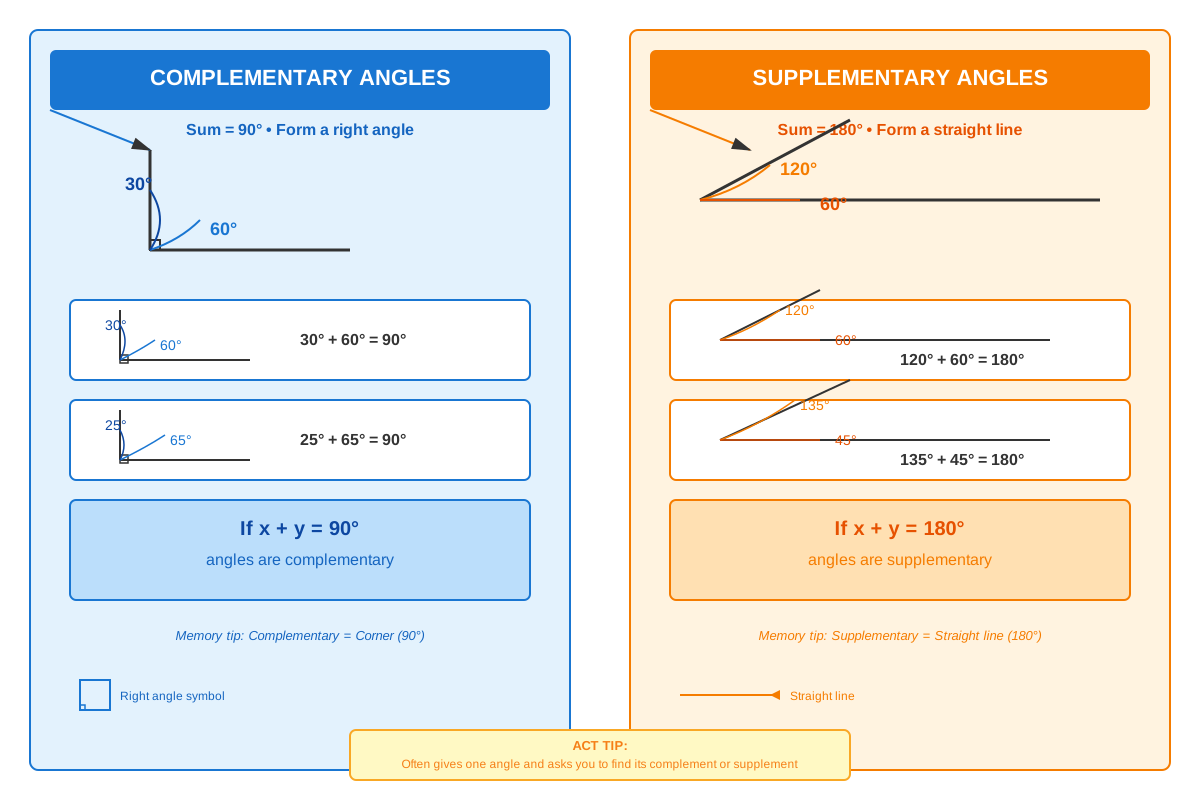
Complementary angles are two angles whose measures sum to 90°. When the ACT describes angles as "complementary," students must recognize that if one angle measures x°, the other measures (90 - x)°. These angles need not be adjacent or share a common vertex—the relationship depends solely on their sum.
Supplementary angles are two angles whose measures sum to 180°. This relationship appears frequently in ACT problems involving straight lines, where angles on one side of a line must be supplementary. If one angle measures x°, its supplement measures (180 - x)°.
| Angle Relationship | Sum | Example | Complement/Supplement Formula |
|---|---|---|---|
| Complementary | 90° | 30° and 60° | If angle = x°, complement = (90 - x)° |
| Supplementary | 180° | 110° and 70° | If angle = x°, supplement = (180 - x)° |
Vertical Angles
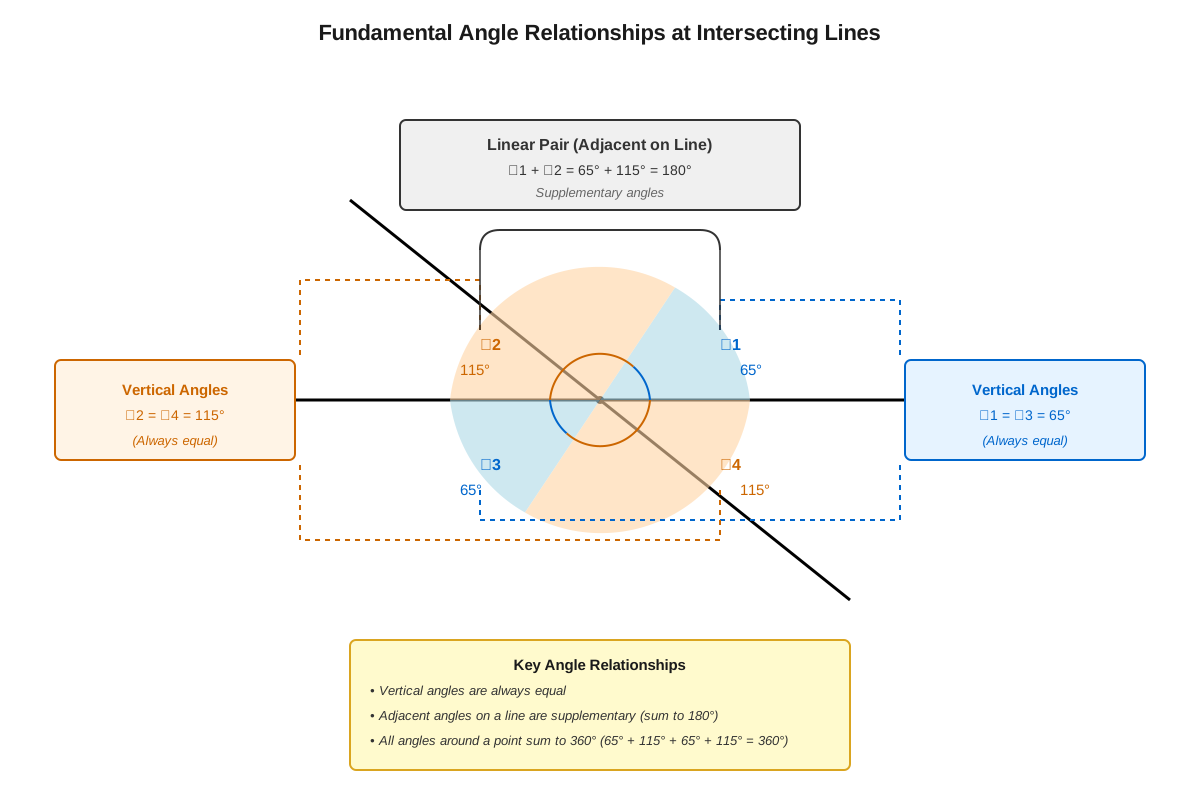
When two lines intersect, they form four angles at the point of intersection. Vertical angles are the pairs of non-adjacent angles formed by intersecting lines. The critical property: vertical angles are always congruent (equal in measure). This theorem appears in approximately 30% of ACT angle problems.
If two lines intersect forming angles of measures a°, b°, a°, and b° (in order around the intersection point), the angles measuring a° are vertical to each other, as are the angles measuring b°. Additionally, any two adjacent angles at the intersection are supplementary, summing to 180°.
Linear Pairs
A linear pair consists of two adjacent angles whose non-common sides form a straight line. Linear pairs are always supplementary, meaning they sum to 180°. The ACT frequently tests whether students recognize that adjacent angles on a straight line must have this relationship, even when the diagram doesn't explicitly show a straight line.
Angle Addition Postulate
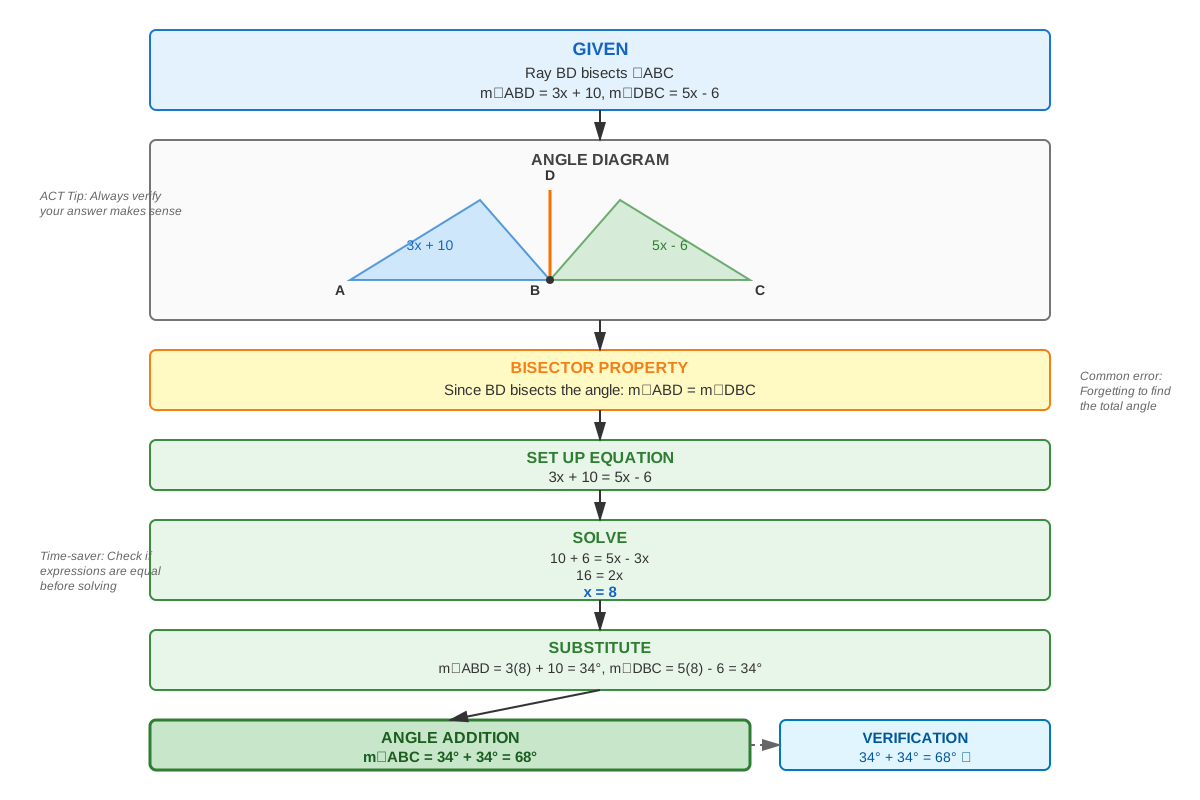
The Angle Addition Postulate states that if point D lies in the interior of ∠ABC, then m∠ABD + m∠DBC = m∠ABC. This principle allows students to break complex angles into simpler components or combine smaller angles to find larger angle measures. The ACT uses this concept when diagrams show rays dividing angles into multiple parts.
Angles Formed by Parallel Lines and Transversals
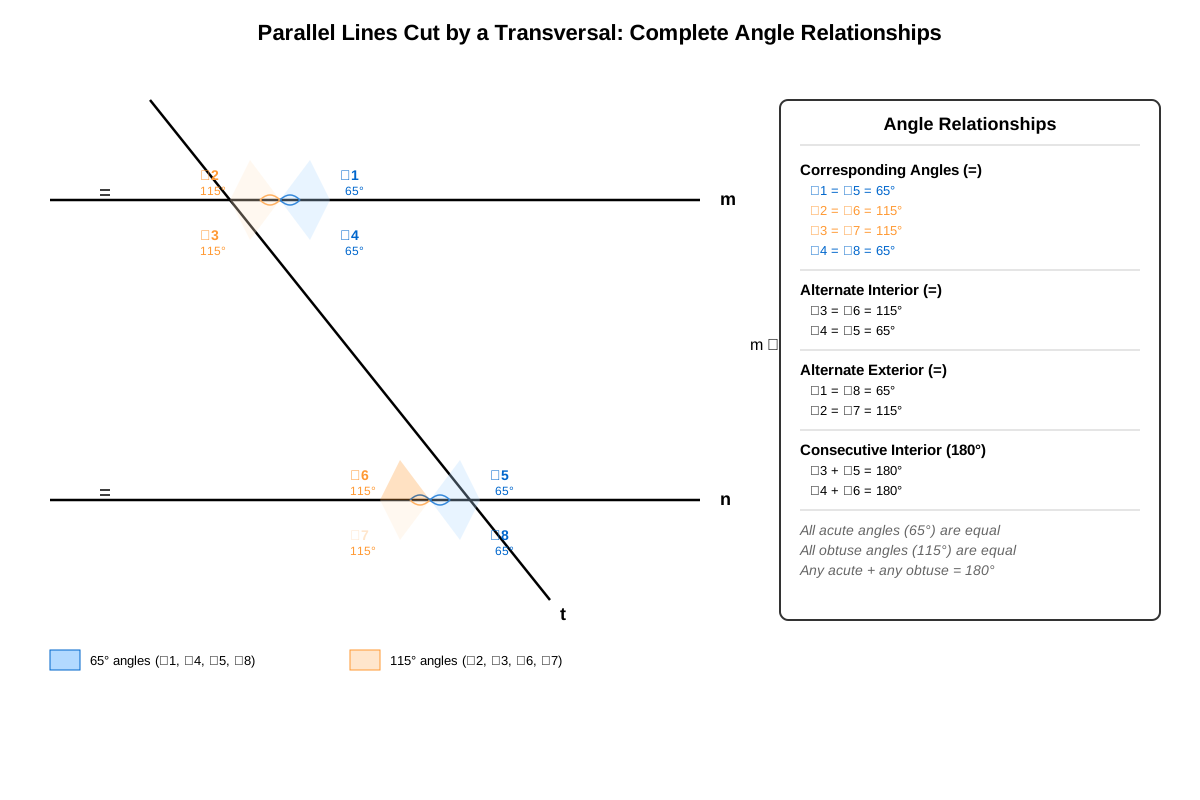
When a transversal (a line intersecting two or more lines) cuts through parallel lines, eight angles are formed, creating several important relationships:
Corresponding angles occupy the same relative position at each intersection point and are congruent. For example, if a transversal crosses two parallel lines, the upper-right angle at the first intersection equals the upper-right angle at the second intersection.
Alternate interior angles lie between the parallel lines on opposite sides of the transversal and are congruent. These angles form a "Z" pattern in diagrams.
Alternate exterior angles lie outside the parallel lines on opposite sides of the transversal and are congruent.
Consecutive interior angles (also called co-interior or same-side interior angles) lie between the parallel lines on the same side of the transversal and are supplementary, summing to 180°.
Angle Bisectors
An angle bisector is a ray that divides an angle into two congruent angles. If ray BD bisects ∠ABC, then m∠ABD = m∠DBC, and each of these angles measures half of m∠ABC. The ACT tests this concept both in pure geometry problems and in coordinate geometry where students must find equations of angle bisectors.
Concept Relationships
Angle basics concepts form an interconnected web of relationships. Angle measurement serves as the foundation → enabling understanding of angle classification → which leads to recognizing complementary and supplementary relationships. These fundamental relationships then extend to vertical angles and linear pairs, which are specific applications of the supplementary angle principle.
The concept of intersecting lines creating vertical angles → connects directly to parallel lines cut by transversals, where multiple intersection points create corresponding, alternate interior, and alternate exterior angle relationships. All of these relationships rely on the foundational principle that angles around a point sum to 360° and angles on a straight line sum to 180°.
Angle addition serves as a bridge concept, connecting simple angle measurement to more complex problems involving angle bisectors and composite angle calculations. This relationship extends into triangle geometry (where three angles sum to 180°) and polygon geometry (where interior angle sums follow predictable patterns).
The prerequisite knowledge of algebraic equation solving becomes essential when angle measures are expressed as variables, creating equations based on complementary, supplementary, or vertical angle relationships. This algebraic application of angle basics appears in approximately 40% of ACT angle problems.
High-Yield Facts
⭐ Vertical angles formed by intersecting lines are always congruent—this is one of the most frequently tested angle relationships on the ACT.
⭐ Complementary angles sum to 90°; if one angle measures x°, its complement measures (90 - x)°.
⭐ Supplementary angles sum to 180°; if one angle measures x°, its supplement measures (180 - x)°.
⭐ When a transversal crosses parallel lines, corresponding angles are congruent—look for angles in the same relative position at each intersection.
⭐ Alternate interior angles formed by parallel lines and a transversal are congruent—these create a "Z" pattern in diagrams.
- Adjacent angles that form a straight line (linear pairs) are always supplementary, summing to 180°.
- Consecutive interior angles (same-side interior angles) formed by parallel lines and a transversal are supplementary, summing to 180°.
- An angle bisector divides an angle into two congruent angles, each measuring half the original angle.
- All angles around a single point sum to 360°.
- Alternate exterior angles formed by parallel lines and a transversal are congruent.
- Right angles measure exactly 90° and are often indicated by a small square symbol in diagrams.
- Acute angles measure less than 90°, while obtuse angles measure between 90° and 180°.
- The Angle Addition Postulate allows breaking complex angles into simpler components: if D is in the interior of ∠ABC, then m∠ABD + m∠DBC = m∠ABC.
Quick check — test yourself on Angle basics so far.
Try Flashcards →Common Misconceptions
Misconception: Complementary angles must be adjacent or share a common vertex.
Correction: Complementary angles only need to sum to 90°; they can be completely separate angles in different parts of a diagram or even in different diagrams entirely. The relationship depends solely on the sum of their measures.
Misconception: All angles formed by intersecting lines are equal.
Correction: Only vertical angles (non-adjacent angle pairs) are congruent. Adjacent angles at an intersection are supplementary, not equal, unless all four angles are right angles.
Misconception: Corresponding angles are always congruent regardless of whether lines are parallel.
Correction: Corresponding angles are congruent only when the lines cut by the transversal are parallel. If the lines are not parallel, corresponding angles will have different measures.
Misconception: When solving for an unknown angle algebraically, the variable represents the answer.
Correction: The variable often represents an expression that must be evaluated. For example, if an angle is labeled (2x + 10)° and you solve to find x = 15, the angle measure is 2(15) + 10 = 40°, not 15°.
Misconception: Alternate interior angles are the angles inside the parallel lines on the same side of the transversal.
Correction: Alternate interior angles are on opposite sides of the transversal (creating a "Z" pattern). Angles on the same side of the transversal are consecutive interior angles, which are supplementary, not congruent.
Misconception: An angle bisector creates two 45° angles.
Correction: An angle bisector creates two congruent angles that each measure half the original angle. Only when bisecting a 90° angle do you get two 45° angles.
Misconception: Supplementary angles must form a straight line.
Correction: While adjacent angles forming a straight line are supplementary, any two angles that sum to 180° are supplementary, regardless of their position or whether they're adjacent.
Worked Examples
Example 1: Multi-Step Problem with Intersecting Lines
Problem: Two lines intersect, forming four angles. One angle measures (3x - 15)°, and its vertical angle measures (2x + 20)°. Find the measures of all four angles.
Solution:
Step 1: Recognize that vertical angles are congruent, so we can set up an equation:
3x - 15 = 2x + 20Step 2: Solve for x:
3x - 2x = 20 + 15
x = 35
Step 3: Calculate the measure of the first angle:
3x - 15 = 3(35) - 15 = 105 - 15 = 90°Step 4: Verify using the vertical angle expression:
2x + 20 = 2(35) + 20 = 70 + 20 = 90°Step 5: Find the other two angles using the supplementary relationship (linear pairs):
180° - 90° = 90°Answer: All four angles measure 90°. This is a special case where the intersecting lines are perpendicular.
Connection to Learning Objectives: This problem demonstrates identifying when angle basics is tested (vertical angles and linear pairs), explaining the core rules (vertical angles are congruent, linear pairs are supplementary), and applying these concepts to solve an ACT-style algebraic problem.
Example 2: Parallel Lines and Transversal
Problem: Two parallel lines are cut by a transversal. One of the alternate interior angles measures (4x + 12)°, and one of the consecutive interior angles on the same side of the transversal measures (6x + 18)°. Find the value of x and the measures of both angles.
Solution:
Step 1: Recognize that consecutive interior angles are supplementary:
(4x + 12) + (6x + 18) = 180Step 2: Combine like terms:
10x + 30 = 180Step 3: Solve for x:
10x = 150
x = 15
Step 4: Calculate the first angle:
4x + 12 = 4(15) + 12 = 60 + 12 = 72°Step 5: Calculate the second angle:
6x + 18 = 6(15) + 18 = 90 + 18 = 108°Step 6: Verify the angles are supplementary:
72° + 108° = 180° ✓Answer: x = 15, and the angles measure 72° and 108°.
Connection to Learning Objectives: This problem requires identifying parallel line angle relationships, applying the rule that consecutive interior angles are supplementary, and accurately solving an ACT-style algebraic problem involving multiple angle concepts.
Exam Strategy
Trigger Words: Watch for phrases like "vertical angles," "complementary," "supplementary," "parallel lines," "transversal," "corresponding angles," "alternate interior," and "bisector." These signal specific angle relationships with predictable properties.
When approaching ACT angle problems, follow this systematic process:
- Mark up the diagram: Label all known angle measures directly on the figure. If angles are given as algebraic expressions, write these on the diagram as well.
- Identify the angle relationships: Look for vertical angles (mark them with the same symbol), linear pairs (angles on a straight line), or parallel line indicators (arrows showing parallel lines).
- Set up equations strategically: If multiple unknowns exist, look for the relationship that creates the simplest equation first. Often, vertical angles provide the most direct path to finding x.
- Remember to answer what's asked: If the problem asks for an angle measure but you solved for x, you must substitute x back into the expression. This is one of the most common errors on ACT angle problems.
- Use the answer choices: On multiple-choice questions, you can work backwards by testing answer choices, especially when algebraic solutions seem complex.
Time allocation: Simple angle problems (finding one missing angle using a single relationship) should take 30-45 seconds. Multi-step problems involving parallel lines or multiple angle relationships warrant 60-90 seconds. If a problem requires more than 90 seconds, mark it and return after completing easier questions.
Process of elimination tips:
- Eliminate any answer choice that would create an angle greater than 180° in a standard diagram (unless the problem explicitly involves reflex angles)
- If the problem involves complementary angles, eliminate choices greater than 90°
- For parallel line problems, corresponding angles must be equal—eliminate choices that violate this principle
- Check whether answer choices would create impossible situations (like a triangle with angles summing to more or less than 180°)
Memory Techniques
CVALL for angle pairs formed by intersecting lines:
- Congruent: Vertical angles
- Vertical angles are equal
- Adjacent angles (linear pairs)
- Linear pairs sum to 180°
- Line angles total 180°
"C-A-C" Pattern for parallel lines and transversals:
- Corresponding angles are Congruent
- Alternate interior angles are congruent
- Consecutive interior angles are supplementary (sum to 180°)
"90-180-360" Rule:
- Complementary = 90
- Supplementary = 180
- Full rotation = 360
Visualization Strategy: Picture a "Z" for alternate interior angles and an "F" for corresponding angles when parallel lines are cut by a transversal. These letter shapes help identify which angles are congruent.
The "Half Rule": When you see the word "bisector," immediately think "divide by 2" or "multiply by 2" depending on whether you're finding the parts or the whole.
Summary
Angle basics constitute essential knowledge for ACT Math success, appearing directly in 15-20% of geometry questions and indirectly in many others. Mastery requires understanding fundamental angle relationships: complementary angles sum to 90°, supplementary angles sum to 180°, vertical angles are congruent, and linear pairs are supplementary. When parallel lines are cut by a transversal, corresponding angles and alternate interior angles are congruent, while consecutive interior angles are supplementary. The Angle Addition Postulate allows breaking complex angles into manageable parts, and angle bisectors create two congruent angles. Success on ACT angle problems demands quick recognition of these relationships, accurate setup of algebraic equations when variables are involved, and careful attention to what the question asks—often requiring substitution of solved variables back into expressions to find actual angle measures.
Key Takeaways
- Vertical angles formed by intersecting lines are always congruent—this is the most frequently tested single angle relationship on the ACT
- Complementary angles sum to 90°; supplementary angles sum to 180°; these definitions are non-negotiable and appear in numerous problem types
- When parallel lines are cut by a transversal, corresponding angles are congruent, alternate interior angles are congruent, and consecutive interior angles are supplementary
- Linear pairs (adjacent angles on a straight line) always sum to 180°, providing a reliable method for finding unknown angles
- Always verify that you're answering what the question asks—if you solve for x, you may still need to substitute to find the actual angle measure
- Mark up diagrams with all known information and use consistent notation to track angle relationships
- Angle basics connect to virtually every other geometry topic on the ACT, making this foundational knowledge essential for overall math success
Related Topics
Triangle Angle Properties: Building on angle basics, triangle problems require knowing that interior angles sum to 180° and applying exterior angle theorems. Mastering angle basics makes triangle problems significantly more manageable.
Polygon Angle Relationships: Understanding how to calculate interior and exterior angle sums in polygons extends directly from the angle basics covered here, particularly the concepts of supplementary angles and angle addition.
Circle Angle Theorems: Inscribed angles, central angles, and angles formed by chords and tangents all rely on fundamental angle relationships, making angle basics prerequisite knowledge for circle geometry.
Coordinate Geometry and Slope: The relationship between perpendicular lines (slopes that are negative reciprocals) connects to the concept of right angles, while parallel lines in coordinate geometry relate to the parallel line angle theorems.
Trigonometry: All trigonometric functions are defined in terms of angles, making solid understanding of angle measurement and relationships essential for success in ACT trigonometry questions.
Practice CTA
Now that you've mastered the core concepts of angle basics, it's time to solidify your understanding through practice. Attempt the practice questions to test your ability to recognize angle relationships quickly and apply the strategies you've learned. Use the flashcards to reinforce the key definitions and theorems until they become automatic. Remember: the ACT rewards speed and accuracy, both of which come from deliberate practice. Every problem you solve builds the pattern recognition that will help you identify angle relationships instantly on test day. You've got this!
Sign up free to keep reading
Create a free AnvayaPrep account to finish this ACT guide on Angle basics — plus flashcards and practice questions.