Overview
Slope is one of the most fundamental and frequently tested concepts in the ACT Math section, appearing in approximately 3-5 questions per test. Understanding slope is essential not only for success on coordinate geometry questions but also as a foundational skill that connects to linear equations, graphing, functions, and real-world rate problems. The ACT slope questions test whether students can calculate slope from various representations, interpret its meaning in context, and apply it to solve multi-step problems.
Slope represents the rate of change between two variables and describes how steep a line is on the coordinate plane. On the ACT, slope questions appear in multiple forms: calculating slope from two points, identifying slope from a graph, determining slope from an equation, or applying slope concepts to word problems involving rates, speeds, or other changing quantities. Mastery of slope is non-negotiable for achieving a competitive Math score, as it serves as the gateway to understanding linear relationships that permeate the entire algebra domain.
The concept of slope bridges arithmetic reasoning with algebraic thinking and geometric visualization. It connects directly to linear equations (both slope-intercept and point-slope forms), parallel and perpendicular lines, systems of equations, and even calculus concepts that advanced students may encounter. A solid understanding of slope enables students to quickly navigate through coordinate geometry questions, which constitute roughly 15-20% of the ACT Math section, making this a high-yield topic worthy of thorough mastery.
Learning Objectives
- [ ] Identify when Slope is being tested in ACT questions
- [ ] Explain the core rule or strategy behind Slope calculations
- [ ] Apply Slope to ACT-style questions accurately
- [ ] Calculate slope from two coordinate points using the slope formula
- [ ] Determine slope from linear equations in various forms (slope-intercept, standard, point-slope)
- [ ] Interpret the meaning of positive, negative, zero, and undefined slopes in context
- [ ] Recognize relationships between slopes of parallel and perpendicular lines
Prerequisites
- Coordinate plane basics: Understanding x and y coordinates is essential because slope measures the relationship between changes in these two dimensions
- Signed number operations: Calculating slope requires subtracting coordinates and dividing signed numbers, making fluency with positive and negative numbers critical
- Fraction simplification: Slope is often expressed as a fraction that should be reduced to lowest terms for accuracy
- Basic algebraic manipulation: Rearranging equations to identify slope requires comfort with isolating variables and working with coefficients
- Graphing fundamentals: Visualizing lines on a coordinate plane helps develop intuition about what different slope values represent
Why This Topic Matters
Slope is not merely an abstract mathematical concept—it represents rate of change, which appears constantly in real-world applications. When economists discuss inflation rates, when engineers calculate road grades, when scientists measure reaction rates, or when business analysts track profit growth, they're all working with slope. Understanding slope enables interpretation of any situation where one quantity changes relative to another: miles per hour (speed), dollars per item (unit price), or degrees per hour (temperature change).
On the ACT Math section, slope appears in approximately 8-12% of questions, making it one of the most frequently tested individual concepts. These questions typically appear in positions 20-50 of the 60-question test, spanning the medium to difficult range. The ACT tests slope through direct calculation problems, graph interpretation questions, equation manipulation tasks, and word problems requiring students to recognize slope as a rate. Questions may ask students to find the slope between two points, identify which line has the greatest slope from a graph, determine the equation of a line with a given slope, or solve real-world problems where slope represents a meaningful rate.
Common ACT question formats include: providing two coordinate points and asking for the slope; showing a graph and asking which line has a specific slope property; giving a linear equation in standard form and asking for the slope; presenting a word problem about rates and requiring slope calculation; or asking about parallel/perpendicular line relationships. The versatility of slope questions means students must be prepared to recognize and apply the concept across multiple representations and contexts.
Core Concepts
Definition of Slope
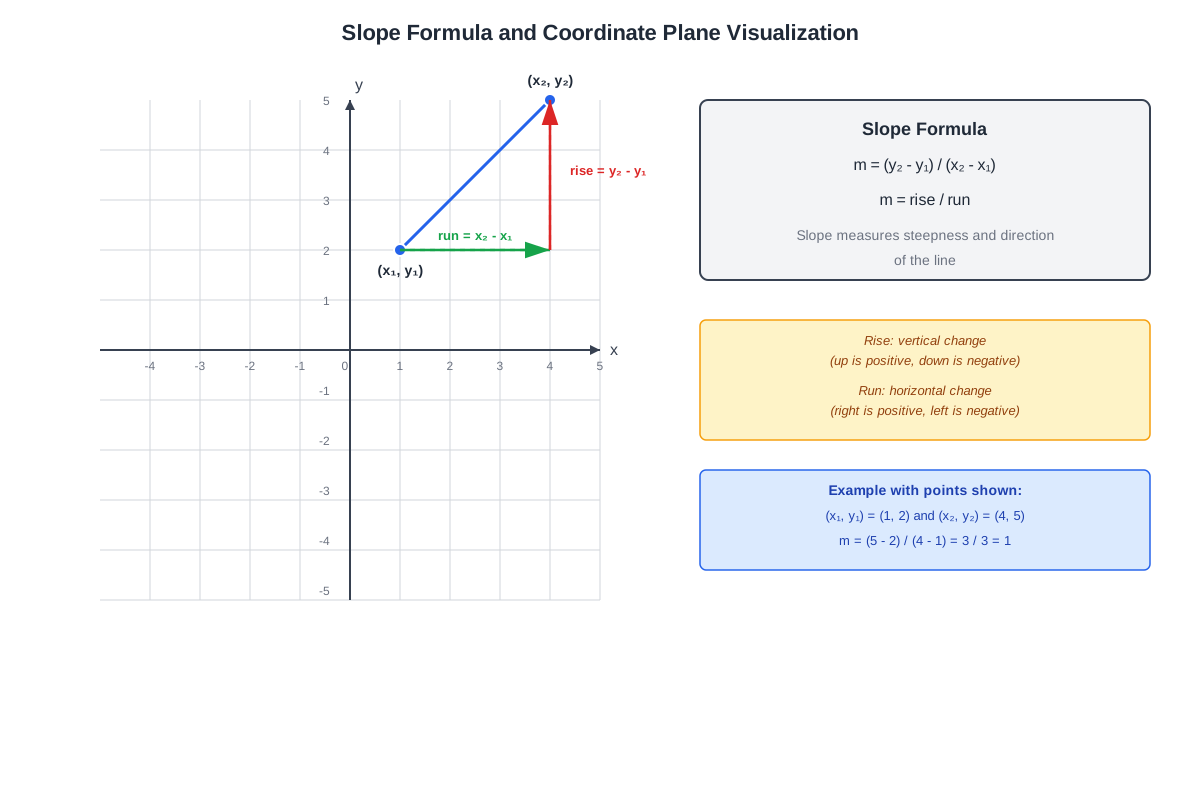
Slope is the measure of the steepness and direction of a line, calculated as the ratio of vertical change (rise) to horizontal change (run) between any two points on the line. Mathematically, slope represents the rate at which the y-coordinate changes with respect to the x-coordinate. The slope of a line remains constant regardless of which two points on the line are selected for calculation, making it an intrinsic property of the line itself.
The standard notation for slope is the letter m, though the ACT may occasionally use other variables. Understanding slope requires recognizing it as both a geometric property (how tilted a line appears) and an algebraic property (the coefficient of x in certain equation forms).
The Slope Formula
The fundamental formula for calculating slope between two points (x₁, y₁) and (x₂, y₂) is:
m = (y₂ - y₁) / (x₂ - x₁)This formula is often remembered as "rise over run" or "change in y over change in x." The numerator represents the vertical change (how much the line goes up or down), while the denominator represents the horizontal change (how much the line goes left or right).
Critical implementation details:
- Subtract y-coordinates in the numerator (y₂ - y₁)
- Subtract x-coordinates in the denominator (x₂ - x₁)
- Use the same order for both subtractions (if you use point 2 minus point 1 in the numerator, use point 2 minus point 1 in the denominator)
- Simplify the resulting fraction to lowest terms
- The order of the two points doesn't matter as long as consistency is maintained
Types of Slope
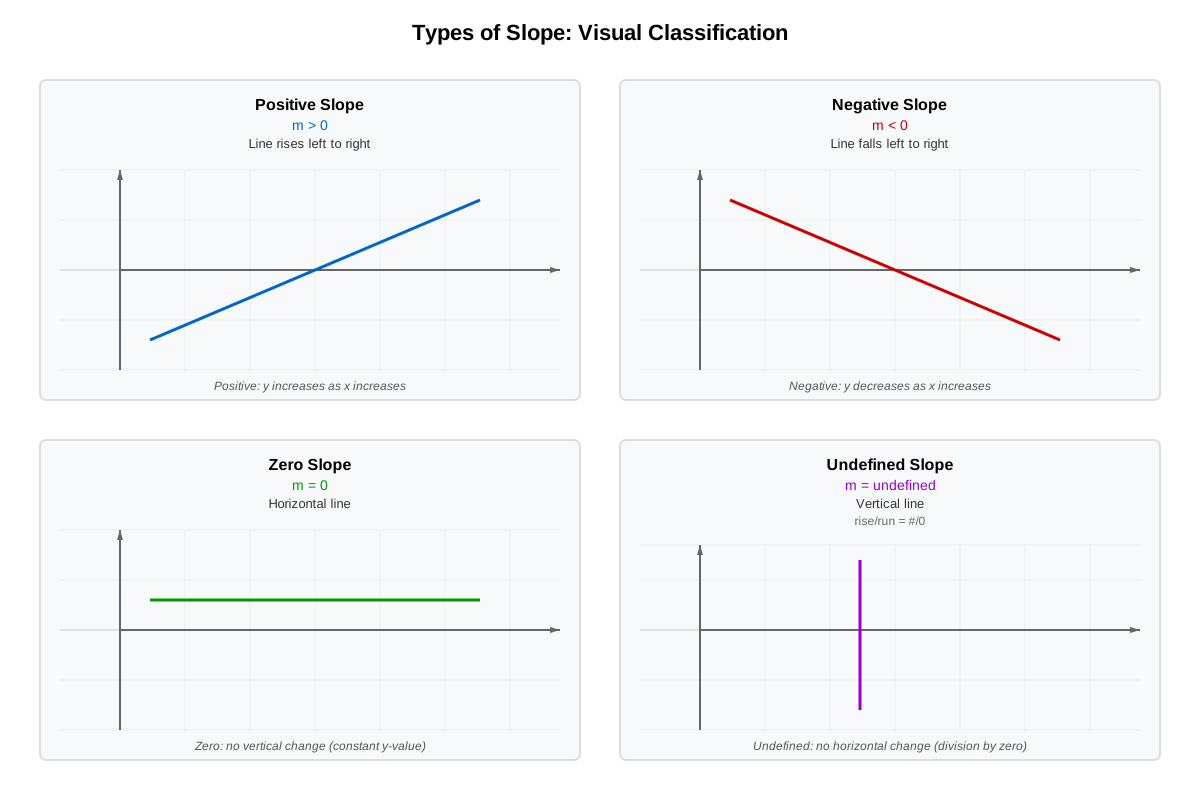
Slope values fall into four distinct categories, each with geometric and algebraic significance:
| Slope Type | Value | Line Appearance | Example |
|---|---|---|---|
| Positive | m > 0 | Rises from left to right | m = 2, m = 1/3 |
| Negative | m < 0 | Falls from left to right | m = -3, m = -1/2 |
| Zero | m = 0 | Horizontal line | y = 5 |
| Undefined | Division by zero | Vertical line | x = 3 |
Positive slope indicates that as x increases, y also increases. The line climbs upward when moving from left to right. Steeper positive slopes have larger numerical values (a slope of 5 is steeper than a slope of 2).
Negative slope indicates that as x increases, y decreases. The line descends when moving from left to right. Steeper negative slopes have larger absolute values (a slope of -4 is steeper than a slope of -1).
Zero slope occurs when there is no vertical change between points—the line is perfectly horizontal. All points on a horizontal line have the same y-coordinate, making the numerator of the slope formula equal to zero. The equation of a horizontal line is y = k, where k is a constant.
Undefined slope occurs when there is no horizontal change between points—the line is perfectly vertical. All points on a vertical line have the same x-coordinate, making the denominator of the slope formula equal to zero. Since division by zero is undefined, we say the slope is undefined (not zero). The equation of a vertical line is x = k, where k is a constant.
Slope from Equations
Linear equations can be written in multiple forms, and each form reveals the slope differently:
Slope-Intercept Form: y = mx + b
- The slope is the coefficient of x (the value of m)
- This is the most direct form for identifying slope
- Example: In y = 3x - 7, the slope is 3
Standard Form: Ax + By = C
- The slope must be calculated as m = -A/B
- Rearrange to slope-intercept form by solving for y
- Example: In 2x + 3y = 6, the slope is -2/3
Point-Slope Form: y - y₁ = m(x - x₁)
- The slope is the coefficient m in the equation
- Example: In y - 4 = 2(x + 1), the slope is 2
Parallel and Perpendicular Lines
The slopes of parallel and perpendicular lines have special relationships that the ACT tests frequently:
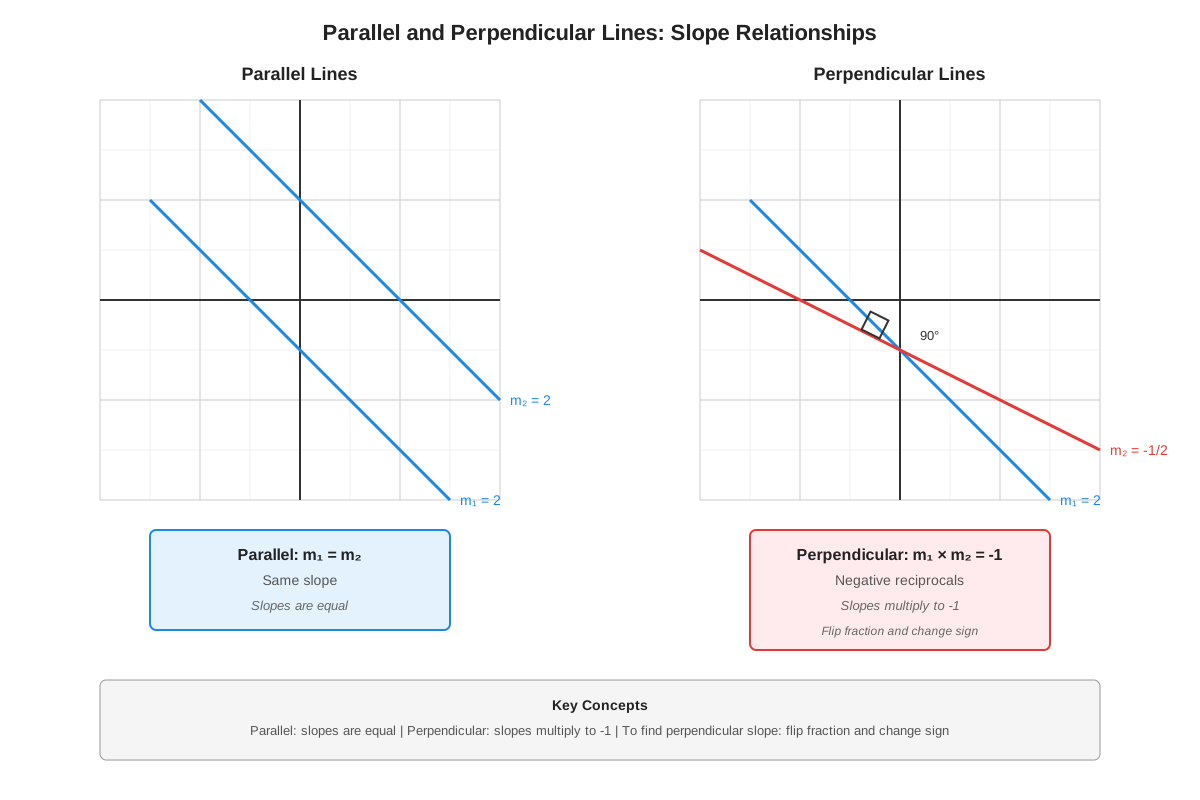
Parallel lines have identical slopes. If two non-vertical lines are parallel, their slopes are equal: m₁ = m₂. This makes intuitive sense—lines that never intersect must be tilted at exactly the same angle. All horizontal lines (slope = 0) are parallel to each other, and all vertical lines (undefined slope) are parallel to each other.
Perpendicular lines have slopes that are negative reciprocals of each other. If two non-vertical lines are perpendicular, their slopes satisfy: m₁ × m₂ = -1, or equivalently, m₂ = -1/m₁. For example, if one line has slope 2/3, a perpendicular line has slope -3/2. A horizontal line (slope = 0) is perpendicular to a vertical line (undefined slope).
Slope as Rate of Change
In application problems, slope represents the rate at which one quantity changes relative to another. The units of slope are the units of the y-variable divided by the units of the x-variable. For example:
- If y represents distance in miles and x represents time in hours, slope represents speed in miles per hour
- If y represents cost in dollars and x represents quantity in items, slope represents unit price in dollars per item
- If y represents temperature in degrees and x represents time in minutes, slope represents rate of temperature change in degrees per minute
Recognizing slope as a rate enables students to translate word problems into mathematical representations and interpret mathematical results in context.
Concept Relationships
The concept of slope serves as a central hub connecting multiple algebraic and geometric ideas. Slope calculation using the formula (y₂ - y₁)/(x₂ - x₁) → leads to → understanding linear equations, because slope is the defining characteristic that determines how a line behaves. This understanding → enables → writing equations of lines in various forms (slope-intercept, point-slope, standard form).
Slope interpretation → connects to → rate of change concepts, which → extends to → real-world problem solving involving speeds, prices, and other rates. The ability to recognize slope in context → facilitates → translating word problems into mathematical models.
Parallel line relationships (equal slopes) and perpendicular line relationships (negative reciprocal slopes) → build upon → basic slope calculation and → connect to → systems of equations and geometric proofs. These relationships → are essential for → coordinate geometry problems involving quadrilaterals, triangles, and other shapes on the coordinate plane.
Graphical interpretation of slope → reinforces → visual-spatial reasoning and → connects to → function behavior analysis. Understanding how slope values correspond to line steepness → prepares students for → more advanced function concepts including increasing/decreasing intervals and rates of change in calculus.
The prerequisite knowledge of coordinate planes → provides the foundation for → plotting points → which enables → calculating slope between points. Similarly, signed number operations → are essential for → correctly computing the numerator and denominator of the slope formula → which determines → accurate slope values.
Quick check — test yourself on Slope so far.
Try Flashcards →High-Yield Facts
⭐ The slope formula is m = (y₂ - y₁)/(x₂ - x₁), representing rise over run
⭐ Parallel lines have equal slopes: m₁ = m₂
⭐ Perpendicular lines have slopes that are negative reciprocals: m₁ × m₂ = -1
⭐ In the equation y = mx + b, the slope is m (the coefficient of x)
⭐ Horizontal lines have slope = 0; vertical lines have undefined slope
- A positive slope indicates a line rising from left to right; a negative slope indicates a line falling from left to right
- The steeper the line, the larger the absolute value of the slope
- To find slope from standard form Ax + By = C, use m = -A/B
- Slope represents rate of change in application problems, with units of y-units per x-unit
- The slope of a line is constant—it's the same between any two points on that line
- When calculating slope, the order of points doesn't matter as long as you're consistent in the numerator and denominator
- A slope of 1 means the line rises one unit vertically for every one unit horizontally (45-degree angle)
- Slope can be expressed as a fraction, decimal, or integer—all forms are valid
Common Misconceptions
Misconception: The slope formula is (x₂ - x₁)/(y₂ - y₁) → Correction: The slope formula is (y₂ - y₁)/(x₂ - x₁). The change in y goes in the numerator (rise), and the change in x goes in the denominator (run). Reversing these produces the reciprocal of the correct slope.
Misconception: A steeper line always has a larger slope value → Correction: A steeper line has a larger absolute value of slope, but a line with slope -5 is steeper than a line with slope 2, even though -5 < 2. Steepness is determined by |m|, not by m itself.
Misconception: Horizontal lines have undefined slope and vertical lines have zero slope → Correction: This is exactly backwards. Horizontal lines have zero slope (no rise, so numerator is 0), while vertical lines have undefined slope (no run, so denominator is 0, and division by zero is undefined).
Misconception: Perpendicular lines have slopes that are opposite signs of each other → Correction: Perpendicular lines have slopes that are negative reciprocals, not just opposite signs. If one line has slope 3, a perpendicular line has slope -1/3 (not -3). The relationship is m₂ = -1/m₁.
Misconception: When using the slope formula, you must always subtract the first point from the second point → Correction: You can subtract in either order (point 2 minus point 1, or point 1 minus point 2), as long as you use the same order in both the numerator and denominator. The slope will be the same either way.
Misconception: Slope is always a whole number → Correction: Slope can be any real number—whole numbers, fractions, decimals, positive, negative, or zero. Many ACT problems intentionally use fractional slopes to test computational accuracy.
Misconception: In the equation 2x + 3y = 6, the slope is 2 → Correction: In standard form Ax + By = C, the slope is -A/B, not A. For 2x + 3y = 6, the slope is -2/3. To verify, solve for y: 3y = -2x + 6, so y = (-2/3)x + 2, confirming slope = -2/3.
Worked Examples
Example 1: Calculating Slope from Two Points
Problem: Find the slope of the line passing through the points (-3, 7) and (5, -1).
Solution:
Step 1: Identify the coordinates of both points.
- Point 1: (x₁, y₁) = (-3, 7)
- Point 2: (x₂, y₂) = (5, -1)
Step 2: Apply the slope formula m = (y₂ - y₁)/(x₂ - x₁).
Step 3: Substitute the values:
m = (-1 - 7) / (5 - (-3))Step 4: Simplify the numerator:
- -1 - 7 = -8
Step 5: Simplify the denominator:
- 5 - (-3) = 5 + 3 = 8
Step 6: Calculate the slope:
m = -8/8 = -1Answer: The slope is -1.
Connection to learning objectives: This problem demonstrates the core strategy of applying the slope formula to two coordinate points, a fundamental skill tested directly on the ACT. The negative slope indicates the line falls from left to right, which students should visualize to verify their answer makes sense.
Example 2: Multi-Step Application Problem
Problem: A water tank contains 500 gallons of water. Water is being drained at a constant rate, and after 4 hours, the tank contains 380 gallons. What is the slope of the line representing the relationship between time (in hours) and the amount of water (in gallons), and what does this slope represent?
Solution:
Step 1: Identify what the problem is asking. We need to find the slope and interpret its meaning in context.
Step 2: Recognize that this is a slope problem. The phrase "constant rate" indicates a linear relationship, and we're given two data points.
Step 3: Define the variables:
- Let x = time in hours
- Let y = amount of water in gallons
Step 4: Identify the two points:
- Initial condition: (0, 500) — at time 0, there are 500 gallons
- After 4 hours: (4, 380) — at time 4, there are 380 gallons
Step 5: Apply the slope formula:
m = (380 - 500) / (4 - 0)Step 6: Calculate:
m = -120 / 4 = -30Step 7: Interpret the slope in context:
- The slope is -30 gallons per hour
- The negative sign indicates the amount of water is decreasing
- The magnitude (30) tells us the rate: 30 gallons are drained each hour
Answer: The slope is -30, which represents that the water is being drained at a rate of 30 gallons per hour.
Connection to learning objectives: This problem requires identifying that slope is being tested (recognizing "constant rate" as a trigger), applying the slope formula accurately, and interpreting the result in context—all key ACT skills. The problem also demonstrates how slope represents rate of change in real-world applications.
Exam Strategy
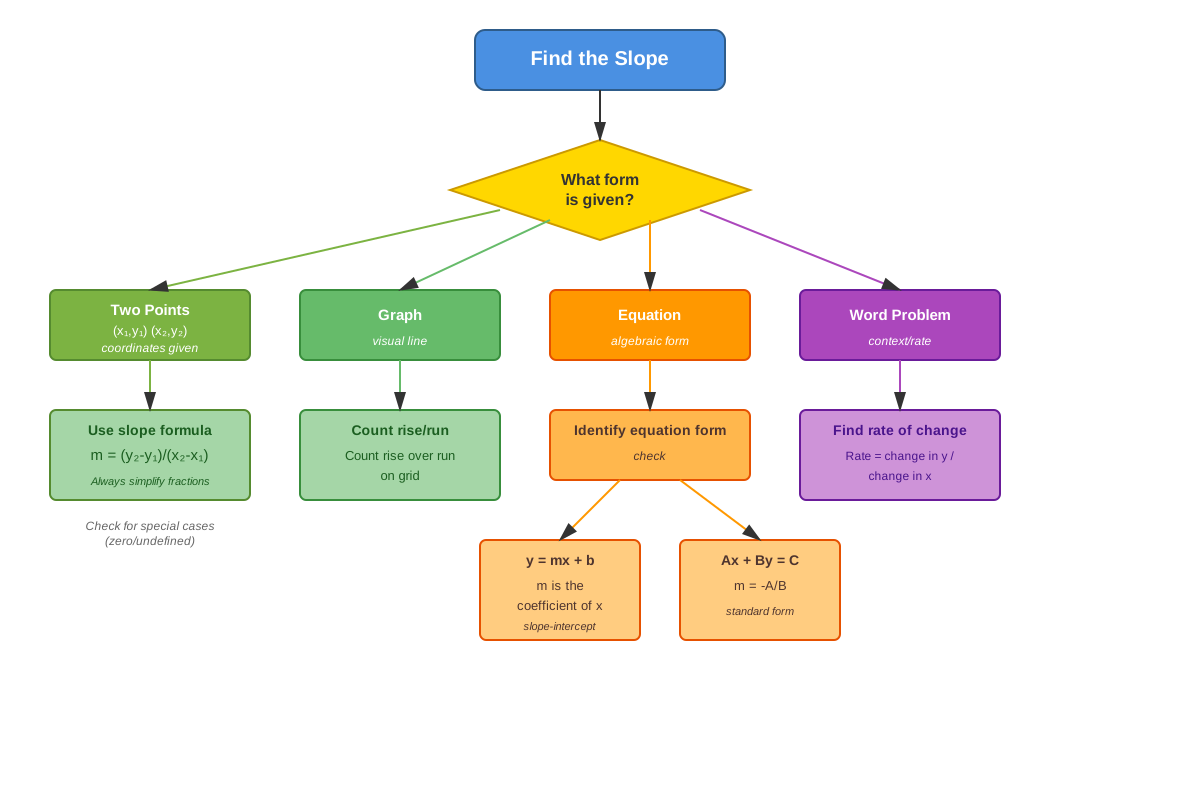
When approaching ACT slope questions, begin by identifying what form the information is presented in: two coordinate points, a graph, an equation, or a word problem. This determines which strategy to employ.
Trigger words and phrases that indicate slope is being tested include:
- "Rate of change"
- "Steepness"
- "Constant rate"
- "Per" (as in miles per hour, dollars per item)
- "Slope of the line"
- "Parallel to" or "perpendicular to"
- "How much does y change when x increases by..."
For two-point problems: Write down the slope formula immediately, label your points clearly as (x₁, y₁) and (x₂, y₂), and be meticulous about signs when subtracting. Double-check that you've subtracted in the same order in both numerator and denominator.
For graph problems: If the line passes through grid intersections, count the rise and run directly rather than trying to read decimal coordinates. Always verify the direction (positive or negative) by checking whether the line rises or falls from left to right.
For equation problems: Identify the form of the equation first. If it's in y = mx + b form, the slope is immediately visible. If it's in standard form (Ax + By = C), either use m = -A/B or quickly solve for y. Don't waste time converting to standard form if the question only asks for slope.
Process of elimination tips:
- Eliminate answer choices with the wrong sign first (if the line clearly rises, eliminate negative slopes)
- If you can determine whether the slope should be greater than or less than 1, eliminate accordingly
- For parallel/perpendicular questions, eliminate any answer that doesn't match the required relationship
- If the problem involves a horizontal or vertical line, immediately eliminate choices that don't show 0 or undefined
Time allocation: Most slope questions should take 30-45 seconds. If you find yourself spending more than a minute, you may be overcomplicating the problem. Look for a more direct approach or move on and return later.
Common ACT tricks to watch for:
- Giving points in (y, x) order instead of (x, y) order
- Providing the negative reciprocal as a distractor in perpendicular line questions
- Including the reciprocal (but not negative) as a distractor
- Using standard form equations where students might incorrectly identify A as the slope
- Word problems where the independent and dependent variables might be confused
Memory Techniques
For the slope formula: Remember "You Rise before you Run" — Y comes first (in the numerator), and both Rise and Run start with R, helping you remember the order: (y₂ - y₁)/(x₂ - x₁).
For parallel vs. perpendicular:
- Parallel = Perfectly the Pame (same slope)
- Perpendicular = Product is Negative One (m₁ × m₂ = -1)
For slope types: Use the acronym PNZU:
- Positive: line goes up (northeast direction)
- Negative: line goes down (southeast direction)
- Zero: horizontal (like the horizon)
- Undefined: vertical (stands up)
For slope-intercept form: "Y = Mountain X + Base camp" — The slope (m) tells you how steep the mountain is, and b tells you where base camp (the y-intercept) is located.
Visual memory technique: Picture a skier going down a slope. A steeper ski slope (larger absolute value) is harder to ski. If the skier goes downhill from left to right, it's negative; uphill from left to right is positive.
For standard form slope: "Negative Attitude Before Coffee" — In Ax + By = C, the slope is -A/B (negative A over B).
Summary
Slope is the measure of a line's steepness and direction, calculated as the ratio of vertical change to horizontal change between any two points. The fundamental formula m = (y₂ - y₁)/(x₂ - x₁) enables calculation from coordinates, while different equation forms reveal slope through their structure. Positive slopes indicate lines rising from left to right, negative slopes indicate falling lines, horizontal lines have zero slope, and vertical lines have undefined slope. Parallel lines share identical slopes, while perpendicular lines have slopes that are negative reciprocals (their product equals -1). On the ACT, slope appears in direct calculation problems, equation manipulation questions, graph interpretation tasks, and real-world rate problems. Mastery requires recognizing slope in multiple representations, applying the formula accurately with attention to signs, and interpreting slope as rate of change in context. Success on ACT slope questions depends on identifying trigger words, selecting the appropriate strategy based on how information is presented, and avoiding common errors like reversing the formula or confusing parallel and perpendicular relationships.
Key Takeaways
- The slope formula m = (y₂ - y₁)/(x₂ - x₁) calculates rise over run and must maintain consistent subtraction order in numerator and denominator
- Slope type determines line direction: positive slopes rise left to right, negative slopes fall left to right, zero slopes are horizontal, and undefined slopes are vertical
- In y = mx + b form, slope is the coefficient m; in Ax + By = C form, slope equals -A/B
- Parallel lines have equal slopes (m₁ = m₂), while perpendicular lines have negative reciprocal slopes (m₁ × m₂ = -1)
- Slope represents rate of change in application problems, with units derived from y-units per x-unit
- ACT questions test slope through multiple representations: coordinate points, graphs, equations, and word problems—recognize which approach each format requires
- Common errors include reversing the slope formula, confusing horizontal and vertical line slopes, and misidentifying slope from standard form equations
Related Topics
Linear Equations: Mastering slope enables writing equations of lines in slope-intercept, point-slope, and standard forms. Understanding how slope functions as the coefficient in these equations is essential for solving systems of equations and graphing linear relationships.
Systems of Linear Equations: The relationship between slopes determines whether systems have one solution (intersecting lines with different slopes), no solution (parallel lines with equal slopes), or infinitely many solutions (identical lines).
Functions and Function Notation: Slope extends to the concept of average rate of change for functions, preparing students for understanding how functions increase, decrease, or remain constant over intervals.
Coordinate Geometry: Slope is fundamental to proving properties of geometric figures on the coordinate plane, including showing that sides are parallel or perpendicular, and calculating distances and areas.
Inequalities and Linear Programming: Understanding slope helps graph linear inequalities and identify feasible regions in optimization problems, where boundary lines are defined by their slopes and intercepts.
Practice CTA
Now that you've mastered the core concepts of slope, it's time to solidify your understanding through active practice. Work through the practice questions to test your ability to calculate slope from various representations, identify slope in different contexts, and apply these skills to ACT-style problems. Use the flashcards to reinforce key formulas, relationships, and strategies until they become automatic. Remember: slope appears on virtually every ACT Math section, making your investment in this topic one of the highest-yield uses of your study time. Approach each practice problem methodically, check your work carefully, and learn from any mistakes. You've got this!
Sign up free to keep reading
Create a free AnvayaPrep account to finish this ACT guide on Slope — plus flashcards and practice questions.