Overview
The area of polygons is a fundamental topic in plane geometry that appears consistently on the ACT Math test. Understanding how to calculate the area of various polygonal shapes—from basic triangles and rectangles to more complex quadrilaterals and composite figures—is essential for success on 3-5 questions per exam. This topic tests not only formula memorization but also spatial reasoning, the ability to decompose complex shapes into simpler components, and strategic problem-solving under time pressure.
Mastering ACT area of polygons questions requires fluency with multiple formulas, recognition of when to apply each one, and the ability to manipulate given information to find missing dimensions. The ACT frequently embeds area problems within coordinate geometry, word problems involving real-world scenarios, or multi-step questions that require finding intermediate values before calculating area. Students who develop systematic approaches to these problems gain significant advantages in both accuracy and speed.
This topic connects deeply to other plane geometry concepts including perimeter, similar figures, coordinate geometry, and the Pythagorean theorem. Area calculations often serve as stepping stones to more complex problems involving volume, ratios, or optimization. Additionally, understanding area relationships helps students recognize patterns in geometric transformations and develop stronger spatial visualization skills that benefit performance across the entire Math section.
Learning Objectives
- [ ] Identify when Area of polygons is being tested
- [ ] Explain the core rule or strategy behind Area of polygons
- [ ] Apply Area of polygons to ACT-style questions accurately
- [ ] Decompose irregular polygons into standard shapes for area calculation
- [ ] Recognize and apply area formulas for triangles, rectangles, parallelograms, trapezoids, and regular polygons
- [ ] Solve multi-step problems that require finding missing dimensions before calculating area
- [ ] Calculate areas of composite figures by adding or subtracting component areas
Prerequisites
- Basic algebraic manipulation: Solving for variables in formulas and equations is necessary when working backward from area to find dimensions
- Understanding of geometric shapes: Recognition of triangles, quadrilaterals, and their properties enables proper formula selection
- Pythagorean theorem: Finding missing side lengths in right triangles often precedes area calculations
- Coordinate plane basics: Many ACT area problems present polygons on coordinate grids requiring distance calculations
- Unit conversion: Problems may require converting between square inches, square feet, and other area units
Why This Topic Matters
Area calculations extend far beyond the classroom into architecture, construction, landscaping, interior design, agriculture, and countless other fields. Professionals regularly calculate floor space, paint coverage, land parcels, and material requirements—all applications of polygon area formulas. Understanding these concepts builds quantitative literacy essential for informed decision-making in everyday life.
On the ACT Math test, area of polygons appears in approximately 8-12% of questions, making it one of the highest-yield geometry topics. These questions typically appear as standalone geometry problems (3-4 questions), within coordinate geometry contexts (1-2 questions), or embedded in word problems requiring spatial reasoning. The ACT favors questions that test multiple concepts simultaneously, so area problems frequently combine with ratios, similar figures, or algebraic reasoning.
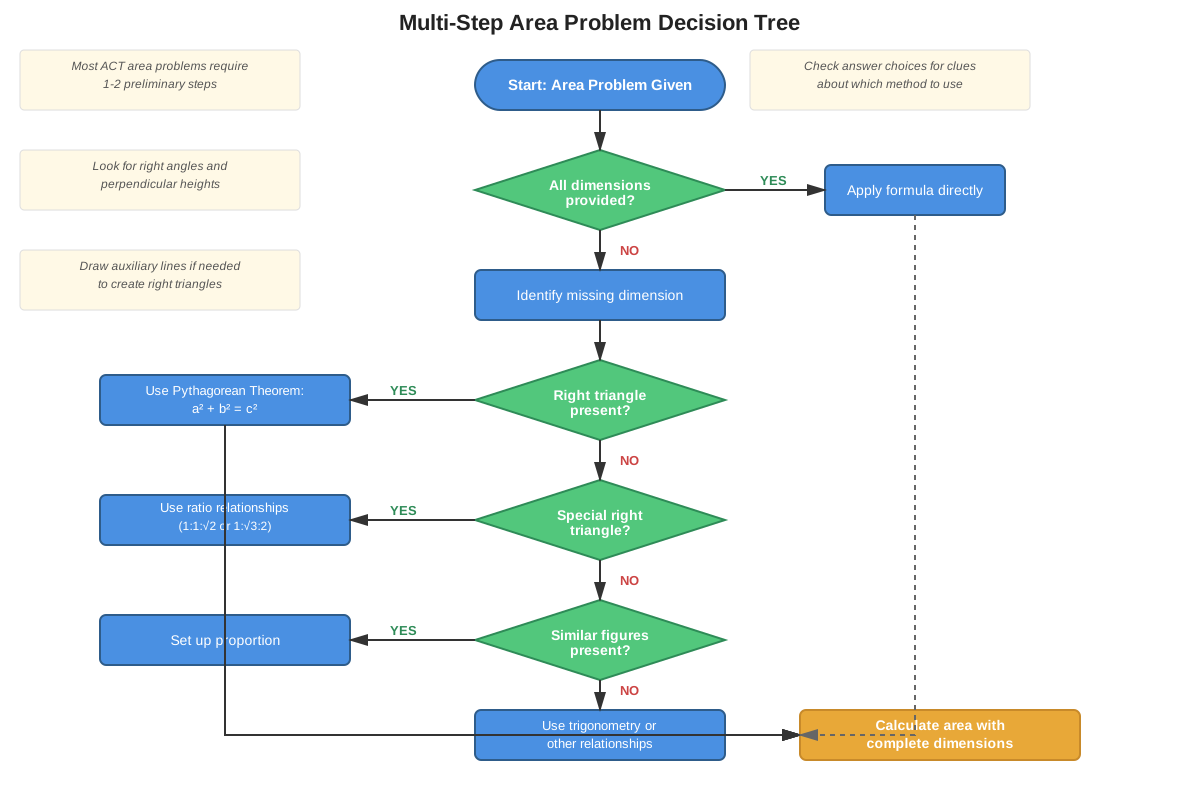
Common question formats include: finding the area when all dimensions are given directly; determining area after calculating a missing dimension using the Pythagorean theorem or other relationships; calculating the area of shaded regions by subtraction; finding areas of figures on coordinate planes; and solving word problems where area is the key to answering questions about cost, coverage, or comparison. The test particularly favors composite figures that require decomposition strategies and problems involving special right triangles (30-60-90 and 45-45-90).
Core Concepts
Fundamental Area Formula Structure
All polygon area formulas share a common conceptual foundation: they measure the two-dimensional space enclosed within the polygon's boundaries, expressed in square units. Understanding that area represents "coverage" helps students remember that the answer must always be in squared units (square inches, square centimeters, square feet, etc.). The ACT frequently includes answer choices with incorrect units to catch students who forget this fundamental principle.
Rectangle and Square Areas
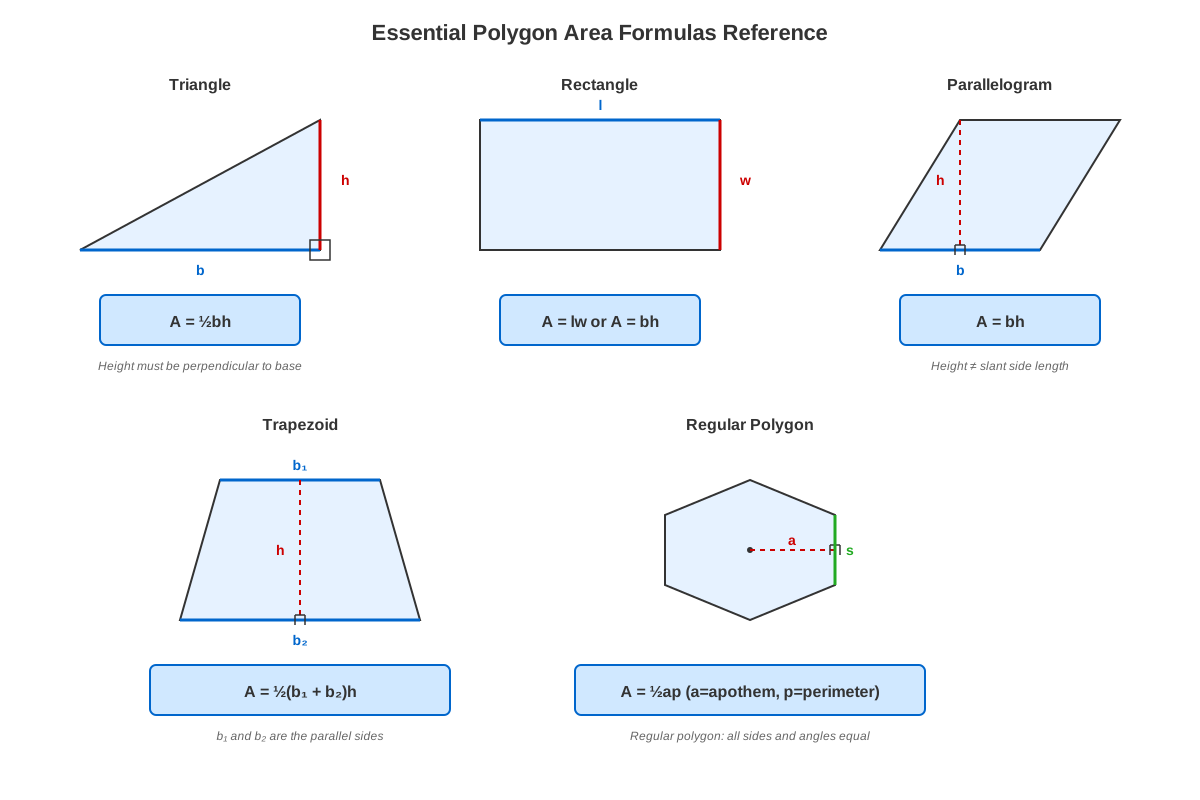
The rectangle area formula serves as the foundation for understanding all other polygon areas:
Area = length × widthFor squares, where all sides are equal:
Area = side²These formulas are intuitive because they count how many unit squares fit within the shape. The ACT tests these concepts directly in simple problems but more commonly embeds them within composite figures or word problems. Students must recognize that any quadrilateral can potentially be divided into rectangles for area calculation purposes.
Triangle Area Formulas
The standard triangle area formula is the most frequently tested polygon formula on the ACT:
Area = (1/2) × base × heightCritical understanding: the height must be perpendicular to the base. The ACT exploits confusion about this requirement by providing slant heights or other non-perpendicular measurements as distractors. Students must identify or calculate the perpendicular distance from the base to the opposite vertex.
For right triangles, the two legs serve as base and height:
Area = (1/2) × leg₁ × leg₂Special cases include equilateral triangles with side length s:
Area = (s²√3)/4This formula appears less frequently but is valuable for time-saving on problems involving equilateral triangles.
Parallelogram Area
A parallelogram has area calculated by:
Area = base × heightLike triangles, the height must be the perpendicular distance between parallel sides, not the length of the slanted side. Students often confuse the slant side length with height—a common ACT trap. Recognizing that a parallelogram can be "rearranged" into a rectangle with the same base and height helps reinforce this formula conceptually.
Trapezoid Area
A trapezoid (quadrilateral with exactly one pair of parallel sides) has area:
Area = (1/2) × (base₁ + base₂) × heightThis formula averages the two parallel bases and multiplies by the perpendicular height. The ACT frequently tests trapezoids because students are less familiar with this formula. Remembering that the formula finds the area of an "average rectangle" helps with retention. The two parallel sides are the bases, and the height is the perpendicular distance between them.
Regular Polygon Areas
For regular polygons (all sides and angles equal), the general formula is:
Area = (1/2) × perimeter × apothemThe apothem is the perpendicular distance from the center to any side. While this formula appears infrequently on the ACT, recognizing it can save time on problems involving hexagons or octagons. More commonly, the ACT expects students to divide regular polygons into triangles radiating from the center.
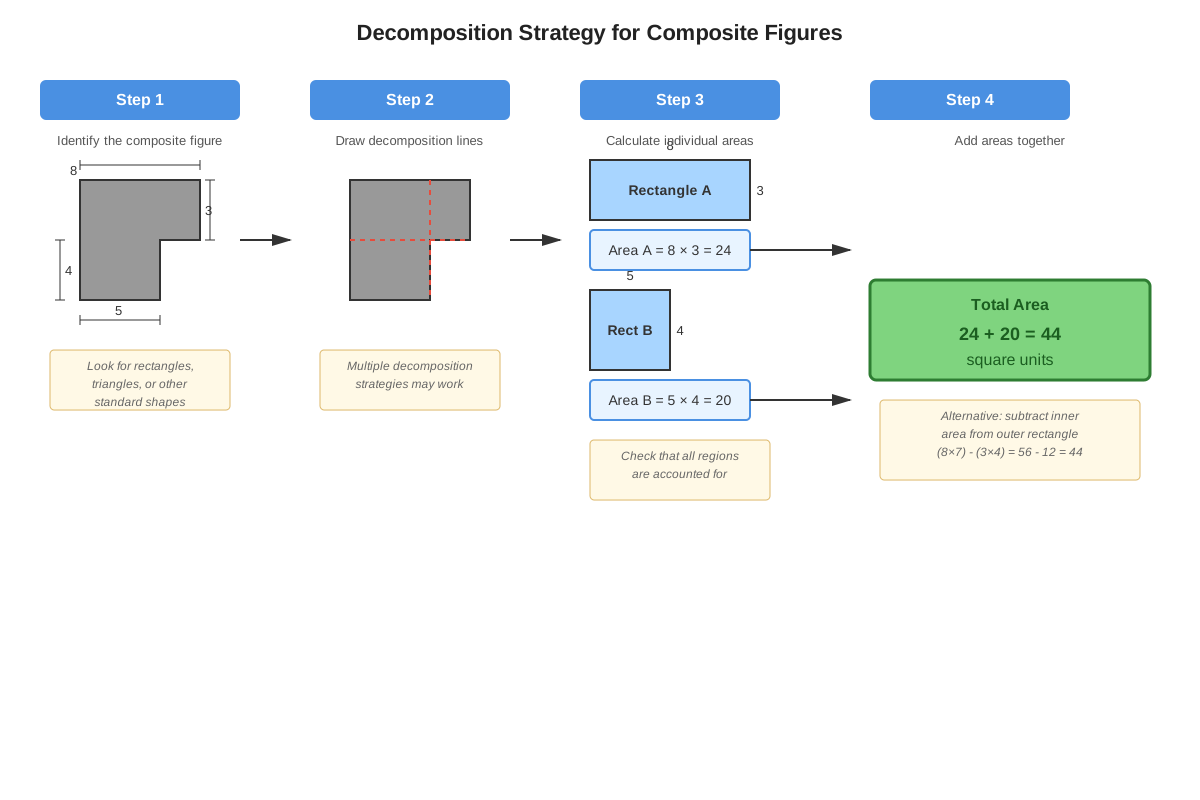
Composite Figures and Decomposition
Composite figures combine multiple basic shapes. The ACT heavily favors these problems because they test both formula knowledge and spatial reasoning. The key strategy involves:
- Identifying component shapes (rectangles, triangles, semicircles, etc.)
- Determining necessary dimensions for each component
- Calculating individual areas
- Adding or subtracting as appropriate
For shaded region problems, calculate the area of the larger figure and subtract the area of the unshaded portion. These problems test careful attention to what the question asks for and systematic organization of calculations.
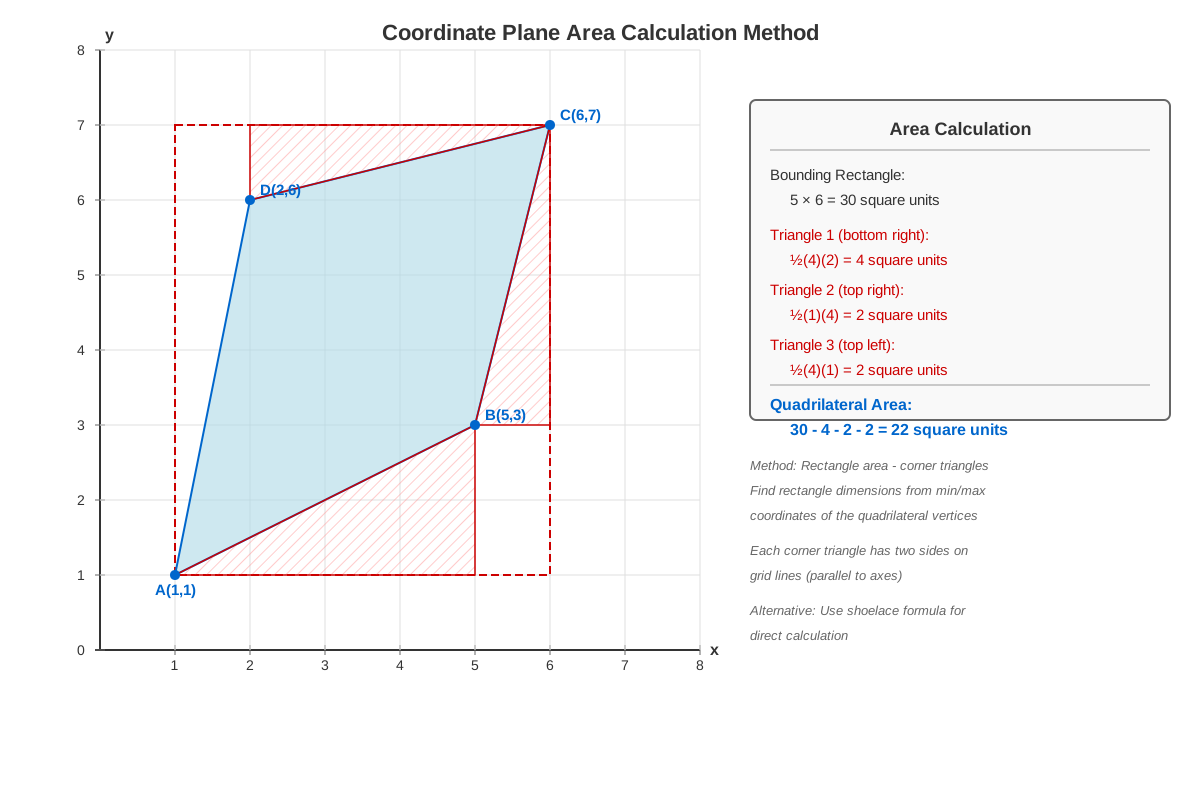
Coordinate Plane Areas
When polygons appear on the coordinate plane, students can:
- Use the distance formula to find side lengths
- Apply standard area formulas after finding dimensions
- Use the "shoelace formula" for irregular polygons (less common on ACT)
- Count unit squares for simple figures
- Draw perpendicular lines to create rectangles and triangles
The ACT particularly favors right triangles and rectangles on coordinate grids because they test both coordinate geometry and area calculation simultaneously.
Concept Relationships
The area formulas for different polygons are interconnected through geometric principles. The rectangle area formula (length × width) serves as the foundation → the parallelogram formula (base × height) represents a rectangle that has been "sheared" → the triangle formula [(1/2) × base × height] represents half of a parallelogram → the trapezoid formula [(1/2) × (b₁ + b₂) × h] averages two different-sized rectangles.
Understanding these relationships helps with formula retention and provides backup strategies when a specific formula is forgotten. For example, any parallelogram can be divided into two congruent triangles, so if you forget the parallelogram formula, you can calculate the triangle area and double it.
Area of polygons connects to prerequisite topics through multiple pathways: the Pythagorean theorem enables finding heights or side lengths needed for area calculations; coordinate geometry provides the framework for finding dimensions of figures on grids; algebraic manipulation allows solving for unknown dimensions when area is given; and similar figures create proportional relationships where area ratios equal the square of the side length ratio.
This topic also enables progression to more advanced concepts: surface area extends polygon areas into three dimensions; volume calculations often require finding base areas; trigonometry provides alternative methods for finding areas when angles are known; and optimization problems frequently involve maximizing or minimizing areas subject to constraints.
High-Yield Facts
⭐ The triangle area formula (1/2 × base × height) is the most frequently tested polygon area formula on the ACT
⭐ Height in area formulas always means perpendicular distance, never slant height or side length
⭐ Area is always expressed in square units; forgetting to square the unit is a common error
⭐ For composite figures, draw lines to decompose the shape into recognizable components before calculating
⭐ Shaded region problems require subtraction: Area(larger figure) - Area(unshaded portion)
- The area of a square can be found using either side² or (1/2) × diagonal² when only the diagonal is given
- Trapezoid problems always provide or allow calculation of both parallel bases and the perpendicular height
- Right triangles on coordinate planes can have their legs measured directly as horizontal and vertical distances
- When a polygon is inscribed in or circumscribed about a circle, look for opportunities to use special right triangles
- Doubling all dimensions of a polygon quadruples its area (area scales with the square of the linear scale factor)
- Equilateral triangles, squares, and regular hexagons are the most commonly tested regular polygons
- Area problems involving "cost per square foot" or similar rates require multiplying the area by the unit rate
- Parallelograms and rectangles with the same base and height have equal areas
- The ACT rarely requires the general regular polygon formula; decomposition into triangles is usually sufficient
Quick check — test yourself on Area of polygons so far.
Try Flashcards →Common Misconceptions
Misconception: The slant side of a parallelogram or triangle can be used as the height in area formulas → Correction: Height must always be the perpendicular distance from the base to the opposite side or vertex. The slant side is only the height if the figure contains a right angle at the base.
Misconception: The area of a trapezoid is base × height, just like a parallelogram → Correction: Trapezoid area requires averaging the two parallel bases: (1/2) × (base₁ + base₂) × height. Using only one base will give an incorrect answer.
Misconception: When dimensions are doubled, area is also doubled → Correction: Area scales with the square of the linear scale factor. Doubling all dimensions multiplies the area by 4 (2²), tripling dimensions multiplies area by 9 (3²), and so on.
Misconception: Any two sides of a triangle can serve as base and height → Correction: Only perpendicular sides can be used directly as base and height. For non-right triangles, you must identify or calculate the perpendicular height corresponding to your chosen base.
Misconception: The area of a composite figure equals the sum of all visible side lengths → Correction: This confuses perimeter with area. Area requires identifying component shapes, calculating each area separately using appropriate formulas, then adding or subtracting as needed.
Misconception: Coordinate plane areas require complex formulas → Correction: Most ACT coordinate plane area problems involve right triangles or rectangles with sides parallel to the axes. Simply find the base and height by counting units or subtracting coordinates, then apply standard formulas.
Misconception: All quadrilaterals use the same area formula → Correction: Different quadrilaterals require different formulas: rectangles use length × width, parallelograms use base × height, trapezoids use (1/2) × (b₁ + b₂) × h, and irregular quadrilaterals may require decomposition.
Worked Examples
Example 1: Composite Figure with Subtraction
Problem: A rectangular garden measures 20 feet by 15 feet. A circular fountain with radius 3 feet is placed in the center. What is the area of the garden not covered by the fountain, to the nearest square foot?
Solution:
Step 1: Identify the approach. This is a shaded region problem requiring subtraction of the fountain area from the total garden area.
Step 2: Calculate the rectangular garden area.
Area(rectangle) = length × width = 20 × 15 = 300 square feetStep 3: Calculate the circular fountain area.
Area(circle) = πr² = π(3)² = 9π ≈ 28.27 square feetStep 4: Subtract to find the uncovered area.
Area(uncovered) = 300 - 28.27 ≈ 272 square feetAnswer: 272 square feet
Connection to learning objectives: This problem tests the ability to identify when area of polygons is being tested (combined with circles), apply the core strategy of decomposition and subtraction for composite figures, and accurately calculate areas in an ACT-style multi-step problem.
Example 2: Trapezoid with Missing Height
Problem: A trapezoid has parallel bases of length 8 cm and 14 cm. The non-parallel sides each measure 5 cm, and the trapezoid is isosceles. What is the area of the trapezoid?
Solution:
Step 1: Recognize that we need the perpendicular height, which is not directly given.
Step 2: Draw the trapezoid and drop perpendiculars from the ends of the shorter base to the longer base. This creates two congruent right triangles on the sides and a rectangle in the middle.
Step 3: Find the base of each right triangle. The rectangle in the middle has width 8 cm (the shorter base). The remaining length on the longer base is 14 - 8 = 6 cm, split equally between the two triangles: 6 ÷ 2 = 3 cm per triangle.
Step 4: Use the Pythagorean theorem to find the height. Each right triangle has hypotenuse 5 cm and base 3 cm.
h² + 3² = 5²
h² + 9 = 25
h² = 16
h = 4 cm
Step 5: Apply the trapezoid area formula.
Area = (1/2) × (base₁ + base₂) × height
Area = (1/2) × (8 + 14) × 4
Area = (1/2) × 22 × 4
Area = 44 square cmAnswer: 44 square cm
Connection to learning objectives: This problem demonstrates identifying when area of polygons is tested, explaining the core strategy of finding missing dimensions before applying formulas, and applying knowledge accurately through multi-step reasoning that combines the Pythagorean theorem with trapezoid area calculation.
Exam Strategy
When approaching ACT area of polygons questions, begin by identifying what type of figure is presented and what information is given versus what is needed. Draw or annotate the figure if one isn't provided or if the given diagram lacks labels. This visual organization prevents errors and helps identify solution pathways.
Trigger words and phrases that signal area problems include: "square feet," "square inches," or any squared unit; "region," "space," or "coverage"; "shaded area"; "how much larger is the area"; "cost per square foot"; and "what is the area of." Questions asking for "dimensions" or "perimeter" are different problems, though they may be intermediate steps.
For composite figures, immediately identify component shapes and mark them on your diagram. Look for rectangles, triangles, semicircles, and trapezoids. Determine whether you need to add areas (separate regions) or subtract (shaded regions, regions with cutouts). Write down the area formula for each component before calculating to ensure you're using the correct approach.
Process of elimination is particularly effective for area problems. Eliminate answer choices with incorrect units (not squared). Eliminate choices that are impossibly large or small compared to the given dimensions—for example, if a rectangle is 5 by 7, the area must be 35, so any answer greater than 35 or less than 0 can be eliminated. For composite figures, estimate whether the area should be closer to the larger component or a sum of components.
Time allocation: Simple, direct area problems (given all dimensions, apply one formula) should take 30-45 seconds. Multi-step problems requiring finding a missing dimension first should take 60-90 seconds. Complex composite figures may require up to 2 minutes. If a problem is taking longer, mark it and return after completing easier questions.
Common strategic moves: When height isn't given, look for right triangles where you can apply the Pythagorean theorem. When a figure is on a coordinate plane, calculate distances by subtracting coordinates. When dealing with irregular polygons, draw lines to create rectangles and triangles. When the problem involves "how much more area," calculate both areas and subtract rather than trying to find a shortcut.
Exam Tip: Always check that your final answer makes intuitive sense. If a room is 10 feet by 12 feet, an area of 22 square feet is clearly wrong (that's the perimeter). An area of 120 square feet is correct. This quick reasonableness check catches calculation errors.
Memory Techniques
Mnemonic for triangle area: "Base times Height Halved" (BHH) reminds you that triangle area is (1/2) × base × height.
Mnemonic for trapezoid area: "Average the Bases, Multiply by Height, Halve it" (ABMHH) captures the formula (1/2) × (b₁ + b₂) × h.
Visualization strategy for parallelograms: Picture "cutting off" a triangle from one end and "moving it" to the other end to create a rectangle. This mental image reinforces that parallelogram area equals base × height, just like a rectangle, and clarifies why the slant side isn't used.
Acronym for composite figure strategy: DICE - Draw/Diagram the figure, Identify component shapes, Calculate each area, Evaluate (add or subtract as needed).
Memory aid for area scaling: "Linear Scale Squared" (LSS) - when linear dimensions change by a factor, area changes by that factor squared. Double the sides → 2² = 4 times the area.
Rhyme for perpendicular height: "Height must be straight, not on a slant; perpendicular is what you want." This reinforces the most common error in area calculations.
Summary
The area of polygons is a high-yield ACT Math topic requiring mastery of multiple formulas and strategic problem-solving approaches. Success depends on knowing when to apply each formula—rectangle (length × width), triangle [(1/2) × base × height], parallelogram (base × height), and trapezoid [(1/2) × (b₁ + b₂) × h]—and understanding that height always means perpendicular distance. The ACT frequently tests composite figures requiring decomposition into simpler shapes, shaded region problems requiring subtraction, and multi-step problems where missing dimensions must be calculated before finding area. Students must recognize that area scales with the square of linear dimensions, always express answers in square units, and systematically organize calculations for complex figures. Connecting area concepts to coordinate geometry, the Pythagorean theorem, and algebraic manipulation enables solving the full range of ACT problems. Developing automatic recognition of problem types and efficient solution pathways transforms area questions from time-consuming challenges into reliable point opportunities.
Key Takeaways
- Master the five core area formulas: rectangle, square, triangle, parallelogram, and trapezoid—these cover 95% of ACT area problems
- Height in any area formula must be perpendicular to the base; slant heights and side lengths are common trap answers
- Composite figures require systematic decomposition: identify components, calculate individual areas, then add or subtract appropriately
- Area always uses square units; forgetting to square units or incorrectly squaring dimensions are frequent errors
- Multi-step problems often require finding missing dimensions using the Pythagorean theorem or coordinate geometry before calculating area
- Shaded region problems follow the pattern: Area(total) - Area(unshaded) = Area(shaded)
- When dimensions scale by factor k, area scales by k²—doubling sides quadruples area
Related Topics
Perimeter of Polygons: Understanding the relationship between perimeter (linear measurement around a figure) and area (space enclosed) helps avoid confusion and enables solving problems that provide one measure to find the other.
Similar Figures: Mastering area of polygons enables understanding how area ratios relate to side length ratios in similar figures—a key concept for proportion problems.
Surface Area and Volume: Polygon area formulas extend directly into three-dimensional geometry, where faces of prisms and pyramids require area calculations.
Coordinate Geometry: Many ACT problems combine coordinate plane concepts with area calculations, requiring integration of distance formulas and polygon area formulas.
Trigonometry: Advanced area calculations using formulas like (1/2)ab sin(C) for triangles build on foundational polygon area understanding.
Practice CTA
Now that you've mastered the core concepts, formulas, and strategies for area of polygons, it's time to solidify your understanding through practice. Work through the practice questions to apply these concepts to ACT-style problems, and use the flashcards to reinforce formula memorization and quick recall. Remember, consistent practice with immediate feedback is the most effective way to transform understanding into test-day performance. Each problem you solve builds the pattern recognition and confidence needed to tackle any area question the ACT presents. You've got this!
Sign up free to keep reading
Create a free AnvayaPrep account to finish this ACT guide on Area of polygons — plus flashcards and practice questions.