Overview
Polygons are fundamental geometric figures that appear frequently throughout the ACT Math test, making them essential for achieving a competitive score. A polygon is a closed, two-dimensional figure formed by three or more straight line segments that connect end-to-end without crossing. Understanding polygons goes far beyond simple shape recognition—it requires mastery of interior and exterior angles, perimeter calculations, area formulas, and the relationships between different polygon types. The ACT consistently tests polygon concepts both directly through standalone geometry questions and indirectly through word problems involving real-world applications.
The importance of ACT polygons cannot be overstated. Approximately 4-6 questions on each ACT Math section directly involve polygon properties, and many additional questions incorporate polygon concepts within coordinate geometry, trigonometry, or complex problem-solving scenarios. Students who master polygon fundamentals gain a significant advantage because these concepts serve as building blocks for more advanced geometric reasoning. The ACT particularly favors questions about triangles, quadrilaterals (especially rectangles, squares, and parallelograms), and regular polygons like pentagons and hexagons.
Polygon knowledge connects intimately with other critical ACT Math domains. Understanding polygons strengthens performance in coordinate geometry (plotting polygon vertices), trigonometry (using angles within polygons), and even algebra (setting up equations based on polygon properties). The relationships between side lengths, angle measures, perimeter, and area create a web of interconnected concepts that the ACT exploits to test mathematical reasoning. Mastering polygons provides the foundation for tackling composite figures, three-dimensional geometry, and optimization problems that frequently appear in the higher-difficulty questions that separate good scores from excellent ones.
Learning Objectives
- [ ] Identify when Polygons is being tested in ACT questions
- [ ] Explain the core rule or strategy behind Polygons
- [ ] Apply Polygons to ACT-style questions accurately
- [ ] Calculate interior and exterior angle sums for any polygon
- [ ] Determine the number of diagonals in a polygon using the appropriate formula
- [ ] Distinguish between regular and irregular polygons and apply properties accordingly
- [ ] Solve multi-step problems involving polygon perimeter and area calculations
Prerequisites
- Basic angle relationships: Understanding complementary, supplementary, and vertical angles is essential because polygon problems frequently require angle calculations and the application of angle addition principles
- Triangle properties: Knowledge of triangle angle sums, types of triangles, and basic triangle theorems provides the foundation for understanding more complex polygons, which can always be divided into triangles
- Algebraic equation solving: The ability to set up and solve linear equations is necessary because many polygon problems require translating geometric relationships into algebraic expressions
- Area and perimeter fundamentals: Familiarity with basic formulas for rectangles and squares enables extension to more complex polygon area calculations
Why This Topic Matters
Polygons represent one of the most practical applications of geometry in everyday life. Architects use polygon properties to design buildings with specific structural characteristics. Urban planners apply polygon concepts when designing city blocks, parks, and traffic patterns. Artists and designers rely on polygon relationships to create aesthetically pleasing compositions. Engineers calculate polygon angles and dimensions when designing everything from bridges to computer chips. Even in digital technology, polygons form the basis of computer graphics, with every image on a screen composed of countless tiny polygons rendered at high speed.
On the ACT Math test, polygon questions appear with remarkable consistency. Statistical analysis of released ACT exams reveals that 6-10% of all Math questions directly test polygon concepts, translating to approximately 3-6 questions per test. These questions span the difficulty spectrum, from straightforward angle calculations worth quick points to complex multi-step problems that challenge even high-scoring students. The ACT particularly favors questions that combine polygon properties with other mathematical concepts, such as finding the area of a polygon plotted on a coordinate plane or determining angle measures in a polygon inscribed in a circle.
Common question formats include: calculating the sum of interior angles in a polygon with a given number of sides; finding a missing angle measure when other angles are provided; determining the number of sides in a regular polygon given one interior or exterior angle; calculating perimeter when side lengths follow a pattern; and finding areas of irregular polygons by decomposing them into familiar shapes. The ACT also tests polygon concepts through word problems involving fencing, tiling, or construction scenarios where students must translate real-world situations into geometric calculations.
Core Concepts
Definition and Classification of Polygons
A polygon is a closed plane figure formed by three or more line segments (called sides) that intersect only at their endpoints (called vertices). The term derives from Greek roots: "poly" meaning many and "gon" meaning angle. For a figure to qualify as a polygon, it must satisfy three conditions: all sides must be straight line segments, the figure must be closed (the path returns to the starting point), and sides can only intersect at vertices (no crossing sides).
Polygons are classified by the number of sides they contain:
| Number of Sides | Polygon Name | Number of Sides | Polygon Name |
|---|---|---|---|
| 3 | Triangle | 7 | Heptagon |
| 4 | Quadrilateral | 8 | Octagon |
| 5 | Pentagon | 9 | Nonagon |
| 6 | Hexagon | 10 | Decagon |
| n | n-gon |
Polygons are further categorized as convex or concave. A convex polygon has all interior angles less than 180°, and any line segment connecting two points inside the polygon remains entirely inside the figure. A concave polygon has at least one interior angle greater than 180°, creating an indentation. The ACT primarily tests convex polygons, though recognizing the distinction helps avoid errors.
Regular vs. Irregular Polygons
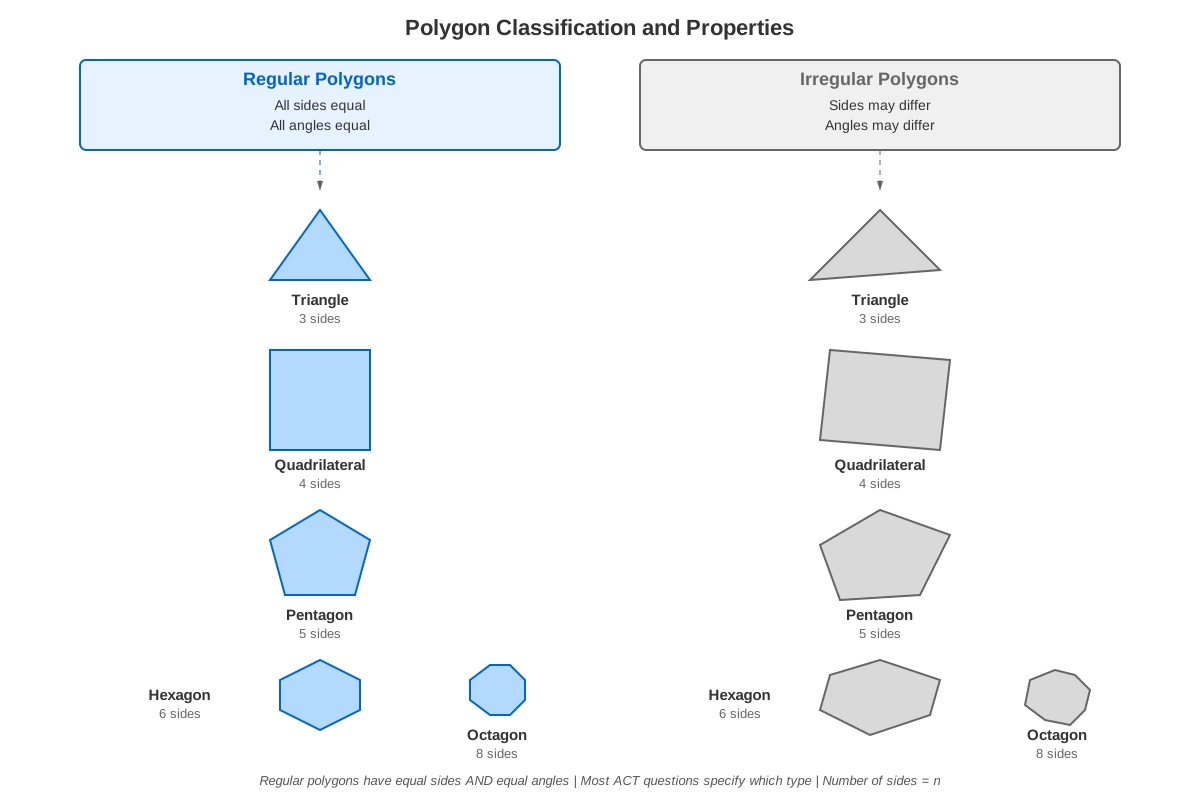
A regular polygon is both equilateral (all sides equal length) and equiangular (all angles equal measure). Examples include equilateral triangles, squares, and regular pentagons. Regular polygons possess special properties that simplify calculations and frequently appear in ACT questions. An irregular polygon lacks uniformity in either side lengths or angle measures or both. Most real-world polygons are irregular, making them common in applied ACT problems.
The distinction matters because regular polygons allow the use of simplified formulas. For a regular n-sided polygon, each interior angle measures exactly (n-2)×180°/n degrees, and each exterior angle measures 360°/n degrees. These formulas provide quick solutions to ACT questions that would otherwise require more complex reasoning.
Interior Angles of Polygons
The sum of interior angles in any polygon depends solely on the number of sides. The formula is:
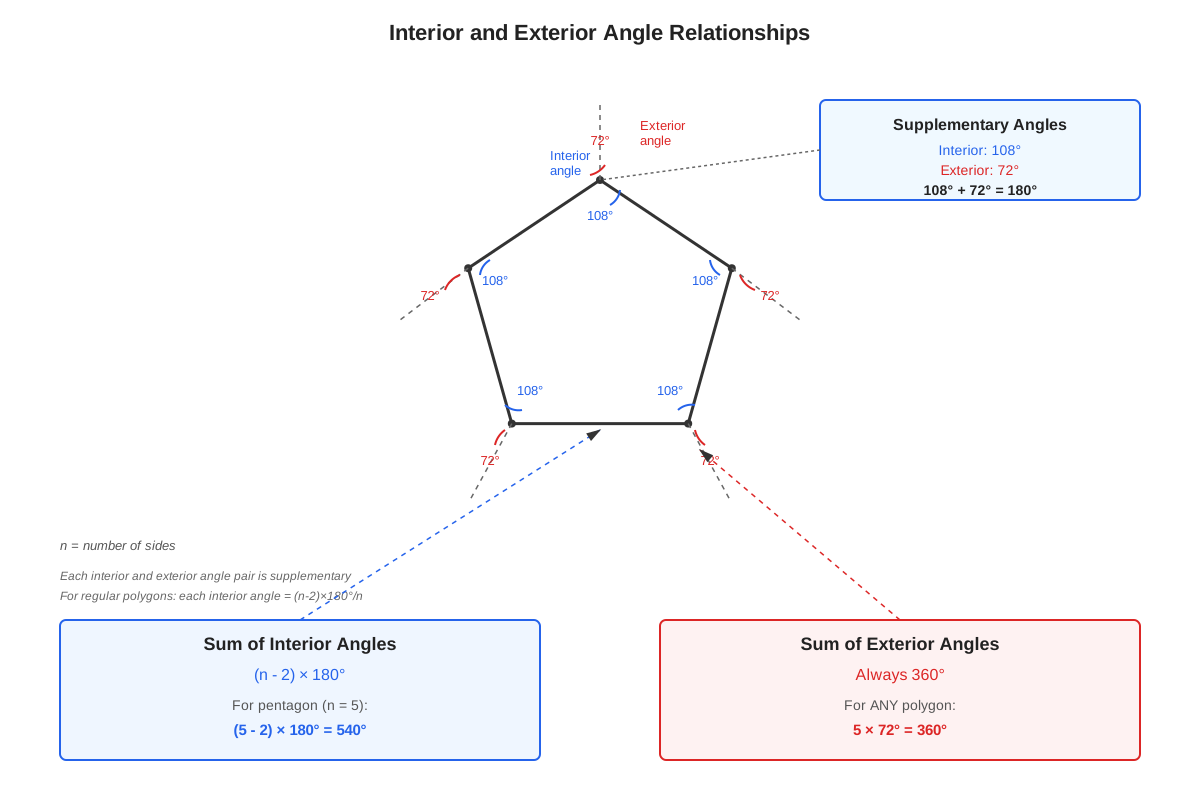
Sum of Interior Angles = (n - 2) × 180°where n represents the number of sides. This formula derives from the fact that any polygon can be divided into (n-2) triangles by drawing diagonals from a single vertex, and since each triangle contains 180°, the total is (n-2)×180°.
For example, a hexagon (6 sides) has interior angles summing to (6-2)×180° = 4×180° = 720°. This formula works for all polygons, regular or irregular, convex or concave. The ACT frequently tests this concept by providing the number of sides and asking for the angle sum, or by providing the angle sum and asking for the number of sides.
For regular polygons, each individual interior angle can be found by dividing the sum by the number of angles:
Each Interior Angle (regular polygon) = [(n - 2) × 180°] / nThis simplifies to: 180° - (360°/n), which connects interior and exterior angles elegantly.
Exterior Angles of Polygons
An exterior angle of a polygon is formed by extending one side of the polygon beyond a vertex. At each vertex, the interior and exterior angles are supplementary (sum to 180°). The remarkable property of exterior angles is that their sum is constant regardless of the number of sides:
Sum of Exterior Angles = 360°This holds true for any convex polygon, whether regular or irregular. The proof involves walking around the polygon's perimeter—you make one complete rotation (360°) regardless of how many turns you take. This property provides a powerful problem-solving tool on the ACT.
For regular polygons, each exterior angle measures:
Each Exterior Angle (regular polygon) = 360° / nThe ACT often tests whether students recognize that knowing one exterior angle of a regular polygon immediately reveals the number of sides (n = 360°/exterior angle).
Diagonals in Polygons
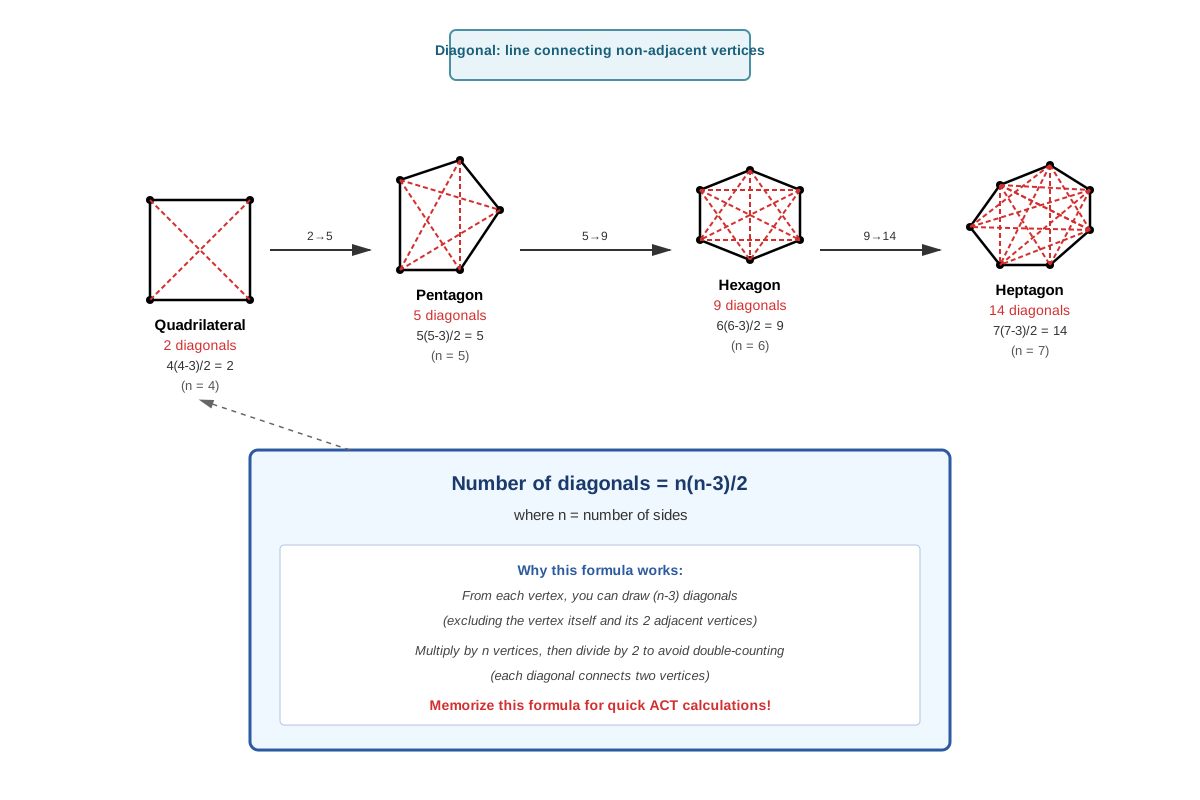
A diagonal is a line segment connecting two non-adjacent vertices of a polygon. The number of diagonals increases rapidly as the number of sides increases. The formula for the total number of diagonals in an n-sided polygon is:
Number of Diagonals = n(n - 3) / 2This formula derives from combinatorial reasoning: from each of n vertices, you can draw (n-3) diagonals (to all vertices except itself and its two adjacent vertices), giving n(n-3) directed diagonals, then dividing by 2 to avoid counting each diagonal twice.
For example, a pentagon has 5(5-3)/2 = 5(2)/2 = 5 diagonals. A hexagon has 6(6-3)/2 = 6(3)/2 = 9 diagonals. While the ACT rarely asks directly about diagonal counts, understanding this concept helps visualize polygon decomposition strategies for area calculations.
Perimeter of Polygons
The perimeter of a polygon is the sum of all side lengths. For irregular polygons, this requires adding each individual side length. For regular polygons with side length s and n sides:
Perimeter (regular polygon) = n × sACT questions often provide partial information about side lengths and require algebraic reasoning to find the perimeter. Common scenarios include: polygons where sides follow a pattern (consecutive integers, arithmetic sequences), polygons where the perimeter is given and one side length must be found, and composite figures where the perimeter excludes internal segments.
Area of Polygons
Area calculations for polygons vary by type. The ACT expects students to know standard formulas and to decompose irregular polygons into familiar shapes:
Triangles: Area = (1/2) × base × height
Rectangles: Area = length × width
Squares: Area = side²
Parallelograms: Area = base × height
Trapezoids: Area = (1/2) × (base₁ + base₂) × height
Regular Polygons: Area = (1/2) × perimeter × apothem (where apothem is the perpendicular distance from center to a side)
For irregular polygons, the strategy involves dividing the figure into triangles, rectangles, or other shapes with known area formulas, calculating each area separately, then summing the results. The ACT frequently tests this decomposition skill through complex figures drawn on coordinate grids.
Concept Relationships
The concepts within polygon geometry form an interconnected system where understanding one element strengthens comprehension of others. The relationship begins with the fundamental definition of polygons, which leads directly to classification by number of sides. This classification determines the interior angle sum through the formula (n-2)×180°, which in turn connects to individual angle measures in regular polygons.
The relationship map flows as follows:
Number of sides (n) → determines → Interior angle sum [(n-2)×180°] → divides into → Individual interior angles (for regular polygons) → supplements → Exterior angles → sum to constant → 360° total
Simultaneously, number of sides → determines → Number of diagonals [n(n-3)/2] → enables → Polygon decomposition strategies → facilitates → Area calculations
The distinction between regular and irregular polygons branches throughout these relationships. Regular polygons allow simplified calculations at every step, while irregular polygons require more individualized approaches but follow the same underlying principles.
Connections to prerequisite knowledge include: triangle properties (every polygon decomposes into triangles), angle relationships (supplementary angles connect interior and exterior angles), and algebraic reasoning (translating geometric relationships into solvable equations). These polygon concepts then enable progression to more advanced topics like coordinate geometry (plotting polygon vertices and using distance formulas), trigonometry (applying sine and cosine to find polygon dimensions), and three-dimensional geometry (understanding polyhedra as three-dimensional analogs of polygons).
Quick check — test yourself on Polygons so far.
Try Flashcards →High-Yield Facts
⭐ The sum of interior angles in any polygon equals (n-2)×180°, where n is the number of sides
⭐ The sum of exterior angles in any convex polygon always equals 360°, regardless of the number of sides
⭐ Each exterior angle of a regular n-sided polygon measures 360°/n
⭐ Each interior angle of a regular n-sided polygon measures [(n-2)×180°]/n
⭐ A polygon must have at least 3 sides; there is no upper limit to the number of sides
- The number of diagonals in an n-sided polygon is n(n-3)/2
- Interior and exterior angles at the same vertex are supplementary (sum to 180°)
- A regular polygon is both equilateral (equal sides) and equiangular (equal angles)
- The perimeter of a regular polygon equals n×s, where s is the side length
- Any polygon can be divided into (n-2) triangles by drawing all diagonals from one vertex
- A quadrilateral's interior angles always sum to 360° [(4-2)×180° = 360°]
- A pentagon's interior angles always sum to 540° [(5-2)×180° = 540°]
- A hexagon's interior angles always sum to 720° [(6-2)×180° = 720°]
- In a regular hexagon, each interior angle measures 120° and each exterior angle measures 60°
- The apothem of a regular polygon is the perpendicular distance from the center to any side
Common Misconceptions
Misconception: All polygons with equal side lengths are regular polygons.
Correction: A regular polygon must have both equal side lengths AND equal angle measures. A rhombus has four equal sides but is not a regular polygon because its angles are not all equal (only a square, which is a special rhombus, is regular).
Misconception: The exterior angle sum formula only works for regular polygons.
Correction: The sum of exterior angles equals 360° for ALL convex polygons, whether regular or irregular. This is one of the most powerful and universal properties in polygon geometry.
Misconception: To find the sum of interior angles, multiply the number of sides by 180°.
Correction: The correct formula is (n-2)×180°, not n×180°. Students often forget to subtract 2 from the number of sides. A triangle (3 sides) has angles summing to 180°, not 540°, confirming the (3-2)×180° = 180° formula.
Misconception: A polygon's perimeter can be found by multiplying any side length by the number of sides.
Correction: This only works for regular polygons where all sides are equal. For irregular polygons, each side length must be added individually. The ACT specifically tests this by providing irregular polygons with varying side lengths.
Misconception: Concave polygons follow different angle sum rules than convex polygons.
Correction: The interior angle sum formula (n-2)×180° applies to both convex and concave polygons. However, in concave polygons, at least one interior angle exceeds 180° (a reflex angle), which can complicate calculations. The ACT rarely tests concave polygons but may include them as distractors.
Misconception: The diagonal formula n(n-3)/2 gives the number of diagonals from one vertex.
Correction: This formula gives the TOTAL number of diagonals in the entire polygon. From any single vertex, you can draw exactly (n-3) diagonals—to all vertices except itself and its two adjacent neighbors.
Misconception: If you know one angle in a polygon, you can find all the others.
Correction: This is only true for regular polygons. In irregular polygons, knowing one angle provides limited information unless additional constraints are given. The ACT tests this by providing one angle and asking what additional information is needed.
Worked Examples
Example 1: Finding Missing Angles in an Irregular Polygon
Problem: A hexagon has five interior angles measuring 110°, 125°, 130°, 115°, and 140°. What is the measure of the sixth angle?
Solution:
Step 1: Identify what we know. We have a hexagon (n = 6) and five of its six interior angles.
Step 2: Calculate the sum of interior angles for a hexagon using the formula (n-2)×180°:
- Sum = (6-2)×180° = 4×180° = 720°
Step 3: Add the five known angles:
- 110° + 125° + 130° + 115° + 140° = 620°
Step 4: Subtract from the total to find the missing angle:
- Sixth angle = 720° - 620° = 100°
Answer: The sixth angle measures 100°.
Connection to learning objectives: This problem demonstrates identifying when polygon concepts are tested (recognizing the need for the interior angle sum formula) and applying the core strategy (using the formula to find a missing value). This question type appears frequently on the ACT because it tests both formula knowledge and arithmetic accuracy.
Example 2: Determining the Number of Sides from Angle Information
Problem: Each exterior angle of a regular polygon measures 40°. How many sides does the polygon have?
Solution:
Step 1: Recognize that this is a regular polygon, so all exterior angles are equal.
Step 2: Recall that the sum of all exterior angles in any polygon equals 360°.
Step 3: If each exterior angle is 40° and they sum to 360°, set up the equation:
- Number of angles × 40° = 360°
- Number of angles = 360° ÷ 40° = 9
Step 4: Since the number of angles equals the number of sides in a polygon, the polygon has 9 sides.
Alternative approach: Use the formula for each exterior angle of a regular polygon:
- Each exterior angle = 360°/n
- 40° = 360°/n
- 40n = 360
- n = 9
Answer: The polygon has 9 sides (it is a regular nonagon).
Connection to learning objectives: This problem requires recognizing the polygon concept being tested (relationship between exterior angles and number of sides), explaining the core strategy (using the 360° sum or the formula), and applying it accurately to find the answer. The ACT frequently asks this question type because it tests whether students understand the inverse relationship between angle size and number of sides in regular polygons.
Example 3: Multi-Step Problem with Perimeter and Area
Problem: A regular pentagon has a perimeter of 40 inches. If the apothem (perpendicular distance from center to side) is 5.5 inches, what is the area of the pentagon?
Solution:
Step 1: Find the side length. Since the pentagon is regular with 5 equal sides:
- Perimeter = 5 × side length
- 40 = 5 × side length
- side length = 8 inches
Step 2: Use the area formula for regular polygons:
- Area = (1/2) × perimeter × apothem
- Area = (1/2) × 40 × 5.5
- Area = 20 × 5.5
- Area = 110 square inches
Answer: The area is 110 square inches.
Connection to learning objectives: This multi-step problem requires identifying multiple polygon concepts (perimeter of regular polygons and area calculation), applying the appropriate formulas in sequence, and maintaining accuracy through multiple calculations. This complexity level is typical of medium-to-hard ACT polygon questions.
Exam Strategy
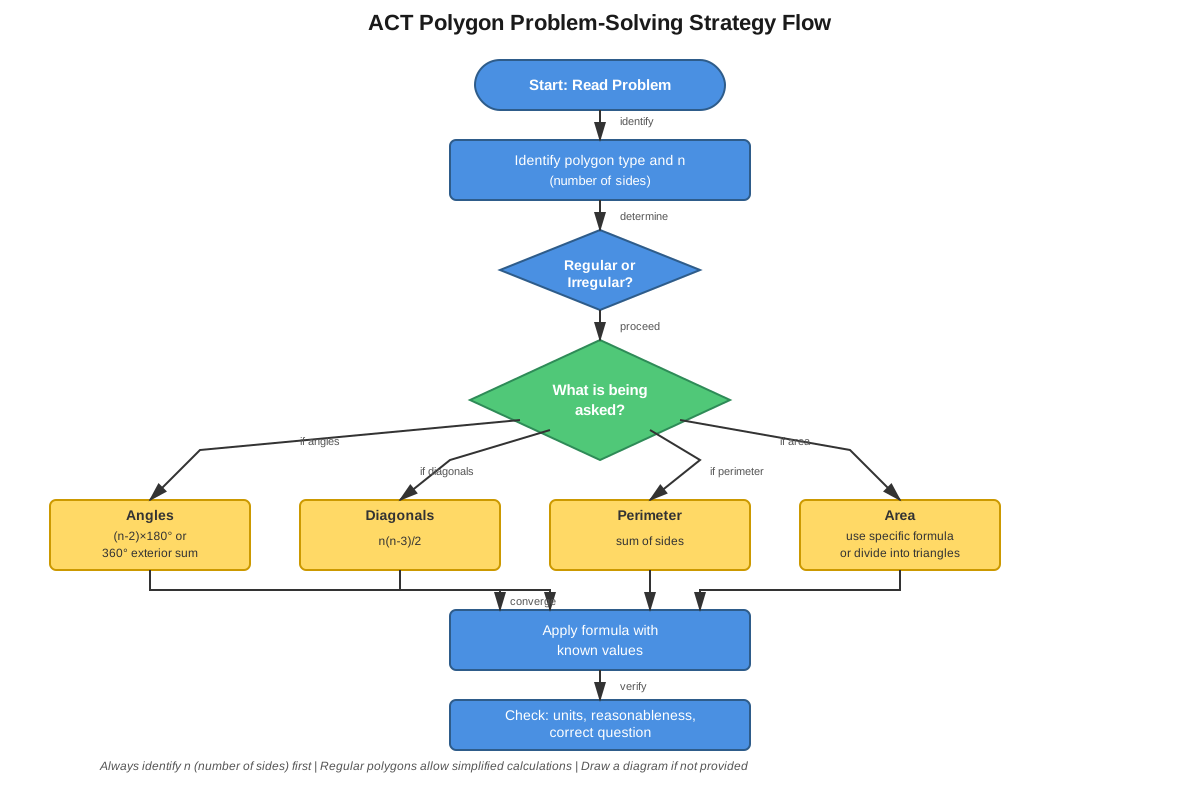
When approaching ACT polygon questions, begin by identifying the polygon type and what information is provided versus what is being asked. Draw a diagram if one isn't provided—visual representation prevents errors and reveals relationships that might not be obvious from text alone. Label all known values directly on your diagram, including side lengths, angle measures, and any special markings indicating equal sides or angles.
Trigger words and phrases that signal polygon questions include: "interior angles," "exterior angles," "regular polygon," "sum of angles," "number of sides," "perimeter," "diagonal," "convex," and specific polygon names (pentagon, hexagon, octagon, etc.). When you see "regular polygon," immediately recognize that all sides and all angles are equal, which dramatically simplifies calculations. When you see "sum of angles" without specification, assume interior angles unless the context clearly indicates otherwise.
Process-of-elimination strategies for polygon questions:
- Eliminate answers that violate basic constraints (e.g., if asked for an interior angle of a convex polygon, eliminate any answer ≥180°)
- Check whether the answer makes sense for the polygon type (e.g., a triangle's angles must sum to 180°, so eliminate any answer suggesting otherwise)
- For regular polygon questions, verify that the answer is consistent with both the interior and exterior angle relationships
- When multiple formulas could apply, use the simpler one first to eliminate obviously wrong answers
Time allocation: Simple polygon questions (applying one formula) should take 30-45 seconds. Medium complexity questions (two-step problems) warrant 60-90 seconds. Complex problems involving multiple concepts or requiring decomposition may justify up to 2 minutes, but if you're not making progress after 90 seconds, mark the question and return to it later.
Common question patterns to recognize:
- Given angle sum, find number of sides: Use (n-2)×180° = given sum, solve for n
- Given number of sides, find angle sum: Apply (n-2)×180° directly
- Given one exterior angle of regular polygon, find number of sides: Use n = 360°/exterior angle
- Given perimeter and one side of regular polygon, find number of sides: Use n = perimeter/side length
- Missing angle problems: Find total angle sum, subtract known angles
Always verify that your answer makes logical sense. If you calculate that a polygon has 2.5 sides or that an interior angle is 200° in a convex polygon, you've made an error and should recalculate.
Memory Techniques
For the interior angle sum formula: Remember "Need Two Less Triangles" → (n-2)×180°. The number of triangles you can create from one vertex is always two less than the number of sides.
For exterior angles: Visualize walking around a polygon—you make exactly one complete turn (360°) no matter how many sides it has. This physical visualization makes the 360° sum memorable and intuitive.
For regular polygon angles: Use the phrase "Exterior Equals 360 Evenly" → Each exterior angle = 360°/n. The three E's help recall that exterior angles divide 360° evenly.
For polygon names: Create a story using the prefixes: "Tri-cycles have 3 wheels, Quad-bikes have 4 wheels, the Pentagon building has 5 sides, Hexagons have 6 sides like a bee's honeycomb, Octapuses have 8 tentacles." Connecting polygon names to familiar objects with the same number of parts strengthens recall.
For the diagonal formula: Remember "Neighbors Not Counted, Halved" → n(n-3)/2. From each vertex, you can't draw to itself or its two neighbors (n-3), multiply by n vertices, then halve to avoid double-counting.
For distinguishing regular vs. irregular: "Regular means Really Equal—both sides AND angles." The alliteration helps remember that both conditions must be met.
Summary
Polygons form a cornerstone of ACT Math geometry, appearing in approximately 6-10% of test questions through both direct assessment and integration with other mathematical concepts. Mastery requires understanding that polygons are closed figures with three or more straight sides, classified by their number of sides and distinguished as regular (equal sides and angles) or irregular. The two most critical formulas are the interior angle sum (n-2)×180° and the exterior angle sum (always 360°), which together enable solving the vast majority of ACT polygon questions. Regular polygons follow simplified rules where each interior angle equals [(n-2)×180°]/n and each exterior angle equals 360°/n. Additional essential skills include calculating perimeter (sum of all sides, or n×s for regular polygons), determining the number of diagonals [n(n-3)/2], and finding areas through standard formulas or decomposition strategies. Success on ACT polygon questions requires recognizing which formula applies to each situation, drawing accurate diagrams, and maintaining arithmetic precision through multi-step calculations.
Key Takeaways
- The sum of interior angles in any n-sided polygon is (n-2)×180°, while exterior angles always sum to 360° regardless of the number of sides
- Regular polygons have all sides equal AND all angles equal, enabling simplified calculations using formulas based on n (number of sides)
- Each exterior angle of a regular polygon measures 360°/n, providing a quick method to determine the number of sides
- Interior and exterior angles at any vertex are supplementary, summing to 180°
- Polygon problems on the ACT frequently require multi-step reasoning, combining angle calculations with perimeter, area, or algebraic relationships
- Drawing and labeling diagrams is essential for visualizing relationships and avoiding errors
- The ACT most commonly tests triangles, quadrilaterals, pentagons, hexagons, and octagons—memorize angle sums for these polygons for rapid recall
Related Topics
Coordinate Geometry and Polygons: Extends polygon concepts to the coordinate plane, where vertices are given as ordered pairs and students must calculate distances, slopes, and areas using coordinate formulas. Mastering basic polygon properties enables efficient problem-solving when polygons are represented algebraically.
Trigonometry in Polygons: Applies sine, cosine, and tangent functions to find unknown sides and angles in polygons, particularly regular polygons inscribed in or circumscribed about circles. Understanding polygon angle relationships provides the foundation for these more advanced calculations.
Three-Dimensional Geometry: Builds on polygon knowledge to understand polyhedra (three-dimensional figures with polygonal faces), including prisms, pyramids, and Platonic solids. Each face of a polyhedron is a polygon, making polygon mastery prerequisite to spatial reasoning.
Circle and Polygon Relationships: Explores polygons inscribed in circles (all vertices on the circle) and circumscribed about circles (all sides tangent to the circle), introducing concepts like central angles and arc lengths. These problems combine polygon angle properties with circle theorems.
Practice CTA
Now that you've mastered the core concepts of polygons, it's time to solidify your understanding through active practice. Attempt the practice questions designed specifically to mirror ACT-style polygon problems, progressing from straightforward applications to complex multi-step scenarios. Use the flashcards to drill essential formulas and properties until they become automatic—speed and accuracy on test day depend on instant recall of these fundamentals. Remember, polygon questions represent high-yield opportunities for points on the ACT Math section. Every minute invested in practice translates directly to confidence and performance when you encounter these questions under timed conditions. You've built the foundation—now strengthen it through deliberate practice!
Sign up free to keep reading
Create a free AnvayaPrep account to finish this ACT guide on Polygons — plus flashcards and practice questions.