Overview
The area of quadrilaterals represents one of the most frequently tested concepts in the ACT Math section, appearing in approximately 3-5 questions per exam. Quadrilaterals—four-sided polygons—come in various forms including squares, rectangles, parallelograms, trapezoids, rhombuses, and kites. Each type has specific formulas and properties that determine how to calculate the space enclosed within its boundaries. Mastering these formulas and recognizing when to apply them is essential for achieving a competitive score on the ACT.
Understanding ACT area of quadrilaterals problems requires more than memorizing formulas; students must develop the ability to identify which quadrilateral type is presented, extract relevant measurements from diagrams or word problems, and apply the appropriate calculation method. These questions often integrate multiple mathematical concepts, requiring students to work with coordinate geometry, algebraic expressions, or composite figures. The ACT frequently embeds quadrilateral area problems within real-world contexts such as construction, landscaping, or floor planning scenarios.
This topic connects directly to broader plane geometry concepts including perimeter, similarity, transformations, and three-dimensional geometry. Strong proficiency with quadrilateral areas provides the foundation for calculating surface areas of prisms and pyramids, understanding scale factors in similar figures, and solving optimization problems. Additionally, these skills transfer to coordinate geometry problems where students must find areas using vertices plotted on the coordinate plane.
Learning Objectives
- [ ] Identify when Area of quadrilaterals is being tested
- [ ] Explain the core rule or strategy behind Area of quadrilaterals
- [ ] Apply Area of quadrilaterals to ACT-style questions accurately
- [ ] Distinguish between different types of quadrilaterals and select the appropriate area formula
- [ ] Solve multi-step problems involving composite figures containing quadrilaterals
- [ ] Calculate areas of quadrilaterals given coordinates of vertices on the coordinate plane
- [ ] Manipulate area formulas algebraically to solve for unknown dimensions
Prerequisites
- Basic multiplication and division: Required to compute products of dimensions and divide by two for triangular components
- Understanding of perpendicular lines: Essential for identifying heights in parallelograms and trapezoids
- Properties of special triangles: Helps in decomposing quadrilaterals and finding missing measurements
- Algebraic manipulation: Necessary for solving equations when area is given but dimensions are unknown
- Coordinate plane basics: Needed for problems presenting quadrilaterals as plotted points
Why This Topic Matters
In real-world applications, calculating the area of quadrilaterals is fundamental to construction, architecture, interior design, agriculture, and urban planning. Professionals use these calculations to determine material quantities for flooring, estimate paint coverage for walls, calculate land parcels for property assessment, and design efficient layouts for buildings and spaces. Understanding these concepts enables practical problem-solving in everyday situations from planning a garden to estimating renovation costs.
On the ACT Math section, quadrilateral area problems appear with high frequency, typically comprising 5-8% of all math questions. These problems appear in various formats: straightforward calculation questions, word problems requiring setup and interpretation, coordinate geometry applications, and complex multi-step problems involving composite figures. The ACT particularly favors problems that combine area calculations with other concepts such as perimeter, ratios, or algebraic expressions.
Common question formats include: finding the area given dimensions, determining a missing dimension when area is provided, calculating areas of shaded regions, comparing areas of different quadrilaterals, and solving real-world application problems. The exam often presents diagrams that require students to identify the quadrilateral type and extract relevant measurements, sometimes requiring additional calculations to find the height or base length before applying the area formula.
Core Concepts
Rectangle Area
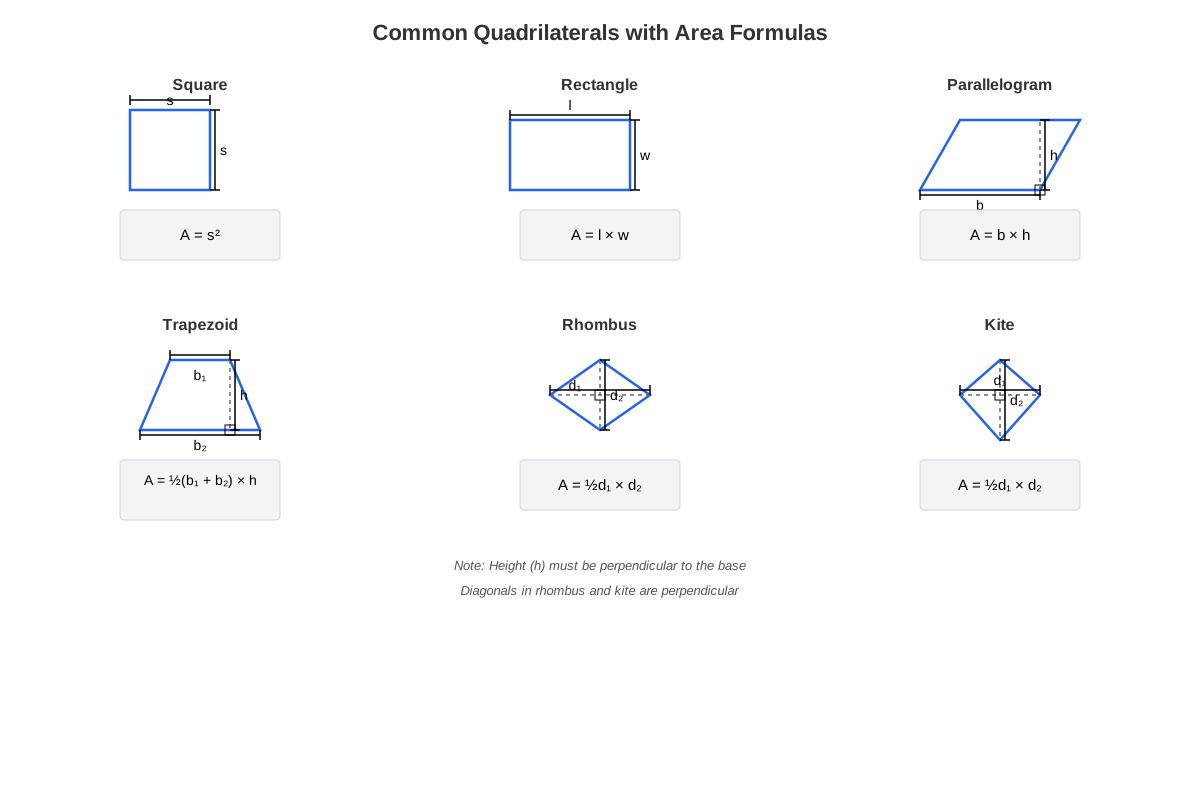
A rectangle is a quadrilateral with four right angles and opposite sides that are equal in length. The area of a rectangle is calculated by multiplying its length by its width:
Area = length × width = l × wThis is the most fundamental quadrilateral area formula and serves as the basis for understanding other formulas. When working with rectangles on the ACT, ensure you correctly identify which dimension is the length and which is the width—though mathematically it doesn't matter which is which, consistency in your work prevents errors. Rectangle problems may present dimensions in different units, requiring conversion before calculation.
Square Area
A square is a special rectangle where all four sides are equal in length and all angles are 90 degrees. The area of a square uses the formula:
Area = side² = s²Since all sides are equal, you only need one side measurement. ACT problems may provide the side length directly, give the perimeter (requiring division by 4), or present the diagonal (requiring the relationship diagonal = s√2). When the diagonal is given, use the formula:
Area = (diagonal²)/2Parallelogram Area
A parallelogram is a quadrilateral with opposite sides parallel and equal in length. Unlike rectangles, parallelograms can have non-right angles. The area of a parallelogram requires identifying the base and the perpendicular height:
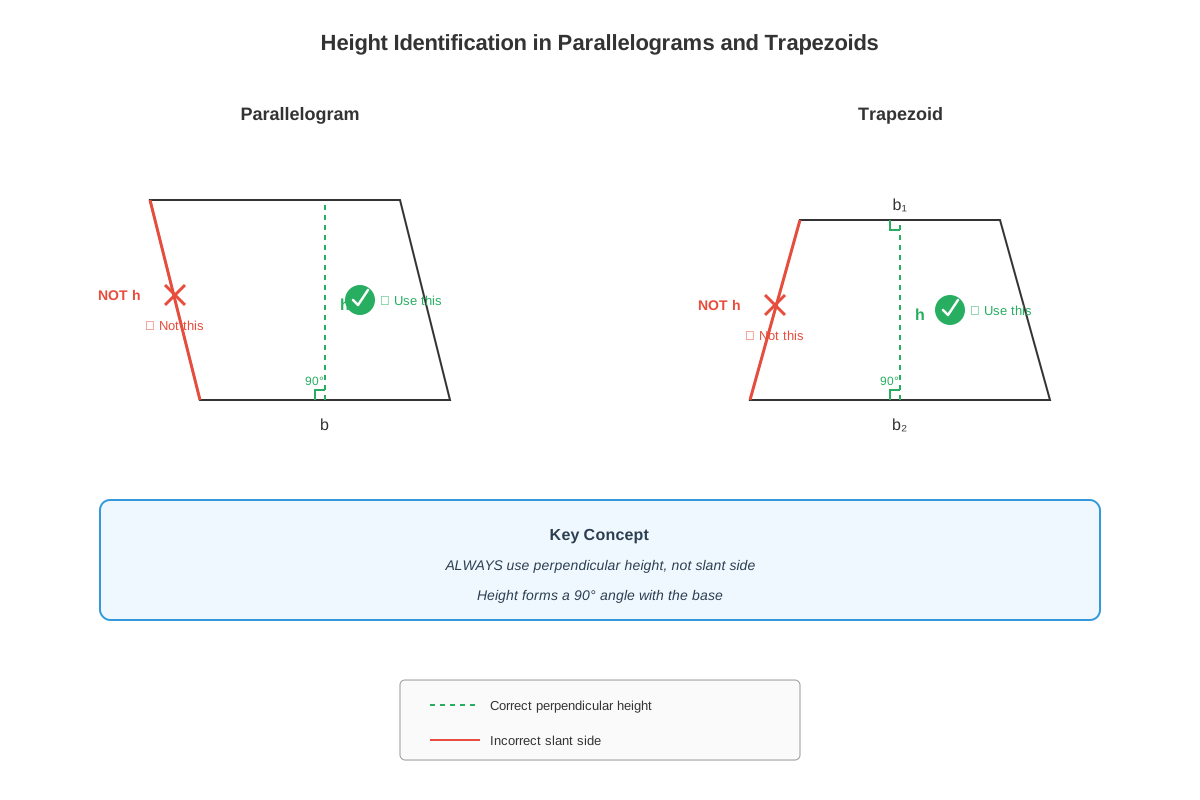
Area = base × height = b × hThe critical distinction here is that the height must be perpendicular to the base—it is not the length of the slanted side. The ACT frequently tests whether students confuse the slanted side length with the height. The height forms a right angle with the base, often shown as a dashed line in diagrams. If given the side length and an angle, you may need to use trigonometry to find the height: h = side × sin(angle).
Trapezoid Area
A trapezoid (or trapezium) is a quadrilateral with exactly one pair of parallel sides called bases. The area of a trapezoid uses the formula:
Area = (1/2) × (base₁ + base₂) × height = (1/2)(b₁ + b₂)hThis formula represents the average of the two parallel bases multiplied by the perpendicular distance between them. Think of it as finding the area of a rectangle whose width is the average of the two bases. The height must be perpendicular to both bases. ACT problems may require you to use the Pythagorean theorem or special right triangles to find the height when given the legs of the trapezoid.
Rhombus Area
A rhombus is a parallelogram with all four sides equal in length. While you can use the parallelogram formula (base × height), the ACT more commonly tests the diagonal formula:
Area = (1/2) × diagonal₁ × diagonal₂ = (1/2)d₁d₂The diagonals of a rhombus are perpendicular bisectors of each other, creating four right triangles. This formula essentially calculates the area as half the product of the diagonals. When both diagonals are given, this method is more efficient than finding the height.
Kite Area
A kite is a quadrilateral with two pairs of adjacent sides that are equal in length. The diagonals are perpendicular, with one diagonal bisecting the other. The area of a kite uses the same formula as a rhombus:
Area = (1/2) × diagonal₁ × diagonal₂Though less commonly tested than other quadrilaterals, kites appear occasionally on the ACT, particularly in problems involving coordinate geometry or composite figures.
General Quadrilateral Strategies
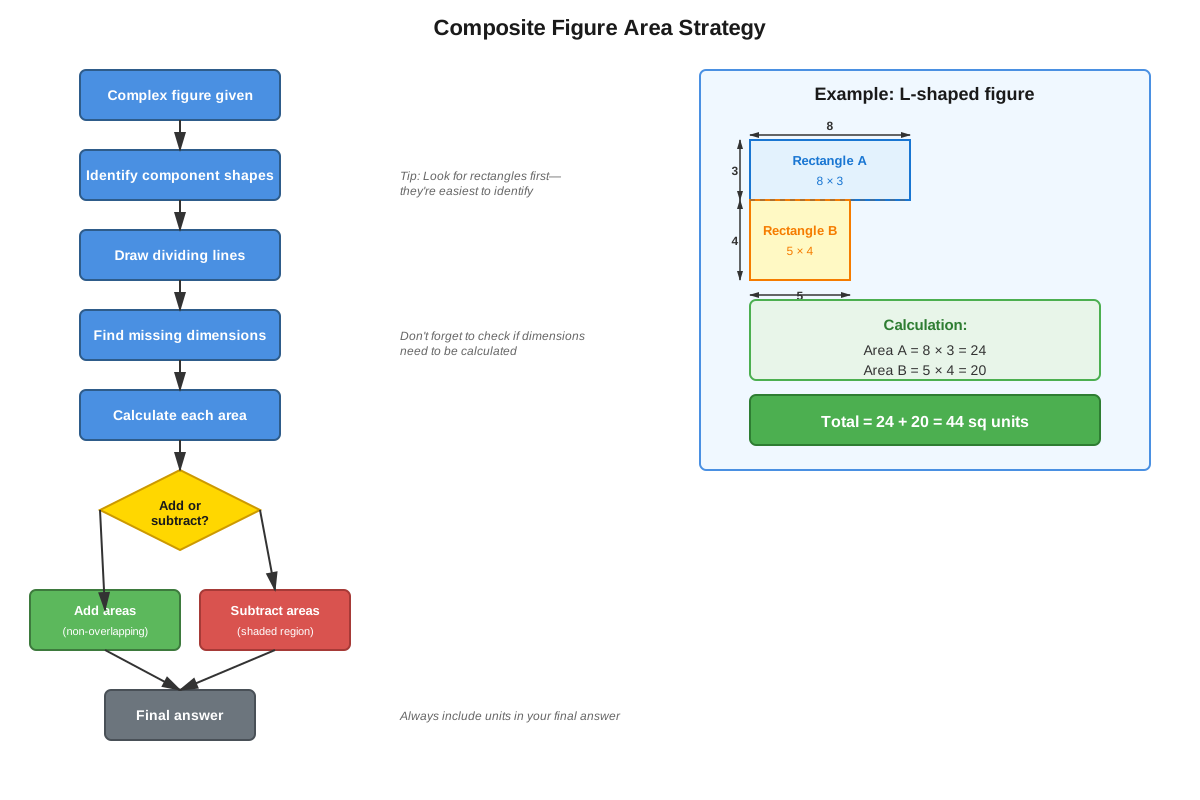
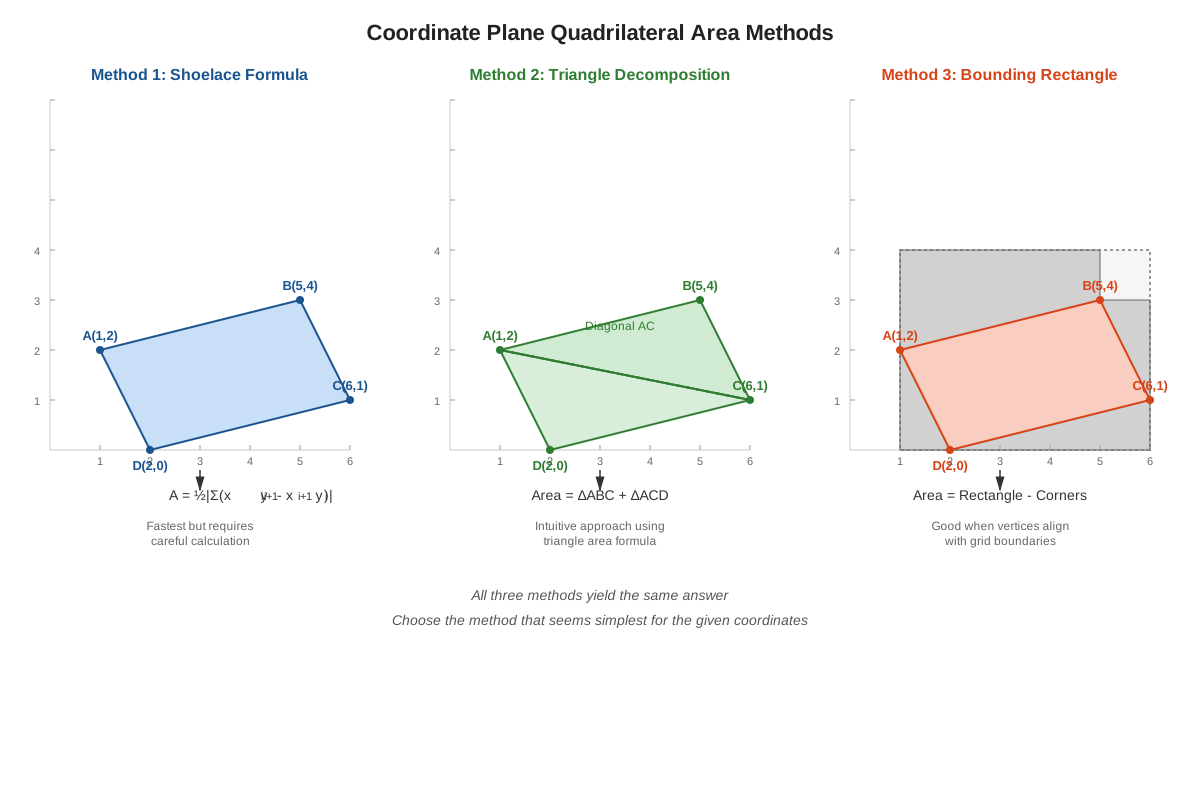
For irregular quadrilaterals without special properties, the ACT typically provides enough information to decompose the figure into triangles or other recognizable shapes. Use these strategies:
- Triangulation: Divide the quadrilateral into two triangles by drawing a diagonal
- Coordinate method: Use the Shoelace formula when vertices are given as coordinates
- Subtraction method: Calculate a larger rectangle's area and subtract unwanted regions
Comparison Table
| Quadrilateral Type | Formula | Key Requirement | Common ACT Trap |
|---|---|---|---|
| Rectangle | l × w | Two dimensions | Confusing perimeter with area |
| Square | s² | One side length | Forgetting to square the side |
| Parallelogram | b × h | Perpendicular height | Using slant side instead of height |
| Trapezoid | (1/2)(b₁ + b₂)h | Both bases and height | Forgetting the 1/2 factor |
| Rhombus | (1/2)d₁d₂ | Both diagonals | Using sides instead of diagonals |
| Kite | (1/2)d₁d₂ | Both diagonals | Assuming it's a rhombus |
Concept Relationships
The area formulas for quadrilaterals form a hierarchical relationship based on special properties. The rectangle formula (l × w) serves as the foundation, with the square formula (s²) representing a special case where length equals width. The parallelogram formula (b × h) generalizes the rectangle concept by allowing non-perpendicular sides, though the height measurement maintains perpendicularity.
The trapezoid formula connects to both rectangles and triangles: it can be derived by decomposing a trapezoid into a rectangle and two triangles, or by viewing it as the average of two rectangles with different widths. The rhombus and kite formulas using diagonals represent an alternative approach to area calculation, connecting to the concept that perpendicular line segments can define regions.
Relationship Map:
Rectangle (l × w) → Square (s²) [special case where l = w]
Rectangle (l × w) → Parallelogram (b × h) [allows non-right angles]
Parallelogram (b × h) → Rhombus [can use b × h OR (1/2)d₁d₂]
Rectangle concepts → Trapezoid [(1/2)(b₁ + b₂)h] [averaging bases]
Rhombus diagonal formula → Kite [(1/2)d₁d₂] [same perpendicular diagonal principle]
These formulas connect to prerequisite knowledge of multiplication, perpendicular lines, and the Pythagorean theorem. They extend forward to surface area calculations for three-dimensional figures (prisms, pyramids) and to integration concepts in calculus. Understanding these relationships helps students select the most efficient formula and recognize when multiple approaches are possible.
High-Yield Facts
⭐ The area of a rectangle equals length times width (A = lw), the most fundamental quadrilateral formula
⭐ For parallelograms, the height must be perpendicular to the base—never use the slanted side length
⭐ The trapezoid formula requires averaging the two parallel bases: A = (1/2)(b₁ + b₂)h
⭐ A square's area can be found using either s² or (diagonal²)/2
⭐ Rhombus and kite areas use the diagonal formula: A = (1/2)d₁d₂
- All quadrilateral area formulas produce results in square units (units²)
- The diagonals of a rhombus are perpendicular bisectors of each other
- A trapezoid has exactly one pair of parallel sides; if both pairs are parallel, it's a parallelogram
- When dimensions are given in different units, convert to the same unit before calculating
- The area of a quadrilateral on the coordinate plane can be found using the Shoelace formula
- Composite figures require adding or subtracting areas of component shapes
- If a quadrilateral's area is given and you need to find a dimension, set up an equation and solve algebraically
- The height of a trapezoid or parallelogram is always measured perpendicular to the base
- Doubling all dimensions of a quadrilateral quadruples its area (scale factor squared)
- A parallelogram and rectangle with the same base and height have equal areas
Quick check — test yourself on Area of quadrilaterals so far.
Try Flashcards →Common Misconceptions
Misconception: The area of a parallelogram equals base times side length.
Correction: The area equals base times perpendicular height, not the slanted side. The height forms a 90-degree angle with the base and is typically shorter than the side length unless the parallelogram is a rectangle.
Misconception: For trapezoids, you can multiply one base by the height without averaging.
Correction: The trapezoid formula requires averaging both parallel bases first: A = (1/2)(b₁ + b₂)h. Forgetting to add both bases or omitting the 1/2 factor leads to incorrect answers.
Misconception: A rhombus area is calculated as side times side (s²).
Correction: While s² works for squares, rhombus area typically uses the diagonal formula: A = (1/2)d₁d₂. You can use base times height if the perpendicular height is given, but the diagonal method is more common on the ACT.
Misconception: All four-sided figures with equal sides are squares.
Correction: Squares require both equal sides AND four right angles. A rhombus has equal sides but non-right angles. Always check angle measurements before assuming a figure is a square.
Misconception: Perimeter and area formulas are interchangeable or related in a simple way.
Correction: Perimeter measures the distance around a figure (linear units), while area measures the space inside (square units). They are fundamentally different measurements; knowing one doesn't directly give you the other without additional information.
Misconception: When a quadrilateral's dimensions double, its area doubles.
Correction: When all dimensions are multiplied by a scale factor k, the area is multiplied by k². Doubling dimensions (k = 2) quadruples the area (2² = 4), not doubles it.
Misconception: The diagonals of any quadrilateral can be used with the formula A = (1/2)d₁d₂.
Correction: This formula only works when the diagonals are perpendicular (rhombus, kite, square). For other quadrilaterals, this formula produces incorrect results.
Worked Examples
Example 1: Multi-Step Trapezoid Problem
Problem: A trapezoid has parallel bases of length 8 cm and 14 cm. The non-parallel sides each measure 5 cm and meet the longer base at 60-degree angles. Find the area of the trapezoid.
Solution:
Step 1: Identify what we know and what we need.
- Base₁ = 8 cm
- Base₂ = 14 cm
- Side length = 5 cm
- Angle = 60°
- Need: height (perpendicular distance between bases)
Step 2: Visualize the trapezoid. The difference in base lengths is 14 - 8 = 6 cm. This difference is split equally on both sides (3 cm each) when we drop perpendiculars from the shorter base to the longer base.
Step 3: Use trigonometry to find the height. The perpendicular from the shorter base to the longer base creates a right triangle where:
- Hypotenuse = 5 cm (the side of the trapezoid)
- Angle = 60°
- Height = opposite side
Using sine: sin(60°) = height/5
Height = 5 × sin(60°) = 5 × (√3/2) = 5√3/2 ≈ 4.33 cm
Step 4: Apply the trapezoid area formula:
Area = (1/2)(b₁ + b₂)h
Area = (1/2)(8 + 14)(5√3/2)
Area = (1/2)(22)(5√3/2)
Area = 55√3/2 ≈ 47.63 cm²
Connection to Learning Objectives: This problem requires identifying the trapezoid type, recognizing that additional calculation (finding height) is needed before applying the area formula, and accurately executing multi-step problem-solving—all key ACT skills.
Example 2: Coordinate Geometry Quadrilateral
Problem: A quadrilateral has vertices at A(1, 2), B(5, 2), C(6, 5), and D(2, 5). Find its area.
Solution:
Step 1: Plot or visualize the points. Notice that points A and B share the same y-coordinate (2), and points C and D share the same y-coordinate (5). This suggests the quadrilateral might be a trapezoid with horizontal parallel sides.
Step 2: Calculate the lengths of the parallel sides.
- Bottom base (AB): distance = 5 - 1 = 4 units
- Top base (DC): distance = 6 - 2 = 4 units
Step 3: Since both bases equal 4 units and they're parallel, this is actually a parallelogram (both pairs of opposite sides are parallel and equal).
Step 4: Calculate the height (perpendicular distance between the parallel sides).
- Height = 5 - 2 = 3 units (difference in y-coordinates)
Step 5: Calculate the area using the parallelogram formula:
Area = base × height = 4 × 3 = 12 square unitsAlternative approach using the Shoelace formula:
Area = (1/2)|x₁(y₂ - y₄) + x₂(y₃ - y₁) + x₃(y₄ - y₂) + x₄(y₁ - y₃)|
Area = (1/2)|1(2 - 5) + 5(5 - 2) + 6(5 - 2) + 2(2 - 5)|
Area = (1/2)|1(-3) + 5(3) + 6(3) + 2(-3)|
Area = (1/2)|-3 + 15 + 18 - 6|
Area = (1/2)|24| = 12 square units
Connection to Learning Objectives: This demonstrates identifying quadrilateral types from coordinates, selecting appropriate formulas, and verifying answers using alternative methods—essential skills for ACT coordinate geometry problems.
Exam Strategy
When approaching area of quadrilaterals questions on the ACT, begin by carefully examining any provided diagram or creating a quick sketch if only coordinates or descriptions are given. Identify the specific type of quadrilateral—this determines which formula to use. Look for visual cues: right angle symbols indicate rectangles or squares, parallel markings indicate parallelograms or trapezoids, and equal side markings suggest rhombuses or squares.
Trigger words and phrases to watch for include:
- "Parallel sides" or "parallel bases" → suggests trapezoid or parallelogram
- "Perpendicular diagonals" → indicates rhombus, kite, or square
- "All sides equal" → rhombus or square
- "Right angles" → rectangle or square
- "Height" or "altitude" → signals need for perpendicular measurement
- "Shaded region" → requires subtraction or addition of multiple areas
For process of elimination, eliminate answer choices that:
- Have incorrect units (linear units instead of square units)
- Are impossibly large or small compared to given dimensions
- Result from using perimeter formulas instead of area formulas
- Come from forgetting the 1/2 factor in trapezoid, rhombus, or kite formulas
- Use the slanted side instead of perpendicular height in parallelograms
Time allocation: Straightforward area problems should take 30-45 seconds. Multi-step problems requiring additional calculations (finding missing dimensions, working with composite figures) may require 60-90 seconds. If a problem requires more than 2 minutes, mark it and return later—the ACT rewards efficient time management.
Exam Tip: When the problem provides more information than seems necessary, you likely need to calculate an intermediate value (like height) before finding the area. Don't assume all given measurements plug directly into the formula.
Always double-check that your answer makes intuitive sense. If a rectangle is 5 by 7 units, the area should be 35 square units—not 12 (the perimeter) or 70 (double the area). Developing this number sense prevents careless errors under time pressure.
Memory Techniques
Mnemonic for Trapezoid Formula: "Half the Sum of Bases times Height" = HSBH
- Think: "Has Both Bases? Halve!"
- Remember to add both bases, then multiply by height, then divide by 2
Visualization for Parallelogram Height: Picture a parallelogram as a "pushed over" rectangle. The height is the perpendicular "drop" from top to bottom, not the slanted side. Imagine rain falling straight down—that's the height direction.
Diagonal Formula Acronym: "Diagonals Divided by Two" = DDT
- For rhombus and kite: multiply the diagonals, then divide by 2
- Think: "Diagonals Determine Together"
Square Formulas: "Square the Side" or "Diagonal Divided by 2"
- Two methods: s² or d²/2
- Remember: "Squares have two square formulas"
Quadrilateral Hierarchy: Use the acronym "Really Smart People Take Rhythm Klasses"
- Rectangle → Square → Parallelogram → Trapezoid → Rhombus → Kite
- This helps remember the family relationships and which formulas generalize
Units Check: "Area Always Adds Another dimension"
- Linear measurements (cm) become square measurements (cm²) for area
- If your answer doesn't have square units, you've made an error
Summary
The area of quadrilaterals is a high-yield ACT Math topic requiring mastery of multiple formulas and the ability to identify which quadrilateral type is presented. Rectangles use length times width (lw), squares use side squared (s²), parallelograms require base times perpendicular height (bh), and trapezoids need half the sum of bases times height [(1/2)(b₁ + b₂)h]. Rhombuses and kites use half the product of diagonals [(1/2)d₁d₂]. The critical skill is recognizing that height measurements must be perpendicular to the base—never confuse slanted sides with perpendicular heights. ACT problems frequently require multi-step solutions: finding missing dimensions using the Pythagorean theorem, trigonometry, or coordinate geometry before applying area formulas. Success requires not just memorizing formulas but understanding when and how to apply them, recognizing composite figures that need multiple calculations, and avoiding common traps like using perimeter formulas or forgetting fractional factors. Developing quick identification skills and systematic problem-solving approaches enables efficient, accurate performance on test day.
Key Takeaways
- Master all six primary quadrilateral area formulas: rectangle (lw), square (s²), parallelogram (bh), trapezoid [(1/2)(b₁ + b₂)h], rhombus/kite [(1/2)d₁d₂]
- Always identify the quadrilateral type first—this determines which formula to apply and prevents using incorrect approaches
- Height must be perpendicular to the base in parallelograms and trapezoids; the slanted side length is not the height
- Trapezoid and diagonal formulas include a factor of 1/2—forgetting this factor is the most common error on these problems
- Multi-step problems require finding missing dimensions before calculating area; use Pythagorean theorem, trigonometry, or coordinate geometry as needed
- Area is always expressed in square units; if your answer lacks square units, you've made a calculation error
- Practice decomposing composite figures into recognizable quadrilaterals and triangles, then add or subtract areas appropriately
Related Topics
Perimeter of Quadrilaterals: Understanding the relationship between perimeter (sum of all sides) and area helps avoid confusion between these distinct measurements. Mastering area formulas provides context for perimeter problems.
Triangle Area: Since many quadrilaterals can be decomposed into triangles, and the trapezoid formula relates to triangle concepts, strong triangle area skills enhance quadrilateral problem-solving.
Coordinate Geometry: Many ACT problems present quadrilaterals as plotted points, requiring distance formula and Shoelace formula applications. Area mastery enables tackling these integrated problems.
Similar Figures and Scale Factor: Understanding how area changes with scale factor (k² relationship) builds on basic area calculation skills and appears frequently in ACT problems.
Three-Dimensional Geometry: Surface area calculations for prisms and pyramids require finding areas of quadrilateral faces, making this topic foundational for solid geometry.
Optimization Problems: Real-world applications often involve maximizing or minimizing area given constraints, connecting quadrilateral area to algebraic problem-solving.
Practice CTA
Now that you've mastered the core concepts of quadrilateral areas, it's time to solidify your understanding through active practice. Attempt the practice questions to test your ability to identify quadrilateral types, select appropriate formulas, and execute multi-step solutions under timed conditions. Use the flashcards to reinforce formula memorization and develop instant recall—essential for ACT success. Remember, understanding the concepts is just the first step; achieving automaticity through repeated practice is what transforms knowledge into test-day performance. Each practice problem you solve builds confidence and speed, bringing you closer to your target score. Start practicing now!
Sign up free to keep reading
Create a free AnvayaPrep account to finish this ACT guide on Area of quadrilaterals — plus flashcards and practice questions.