Overview
Quadrilaterals are four-sided polygons that appear frequently on the ACT Math test, representing one of the most tested topics within Plane Geometry. Understanding quadrilaterals is essential because these shapes form the foundation for numerous geometric problems, including those involving area, perimeter, angle relationships, and coordinate geometry. The ACT regularly tests students' ability to recognize different types of quadrilaterals, apply their unique properties, and solve multi-step problems that combine geometric reasoning with algebraic manipulation.
Mastery of ACT quadrilaterals requires more than memorizing formulas—students must develop the ability to identify which type of quadrilateral is being tested, recognize the specific properties that apply, and efficiently apply the appropriate strategy. Questions may present quadrilaterals directly or embed them within coordinate plane problems, word problems involving real-world scenarios, or complex figures where students must identify quadrilaterals as components of larger shapes. The ACT particularly favors questions that test parallelograms, rectangles, squares, trapezoids, and rhombuses, often requiring students to work with diagonal properties, angle relationships, or area calculations under time pressure.
The study of quadrilaterals connects directly to fundamental concepts in algebra, coordinate geometry, and trigonometry. Understanding quadrilaterals strengthens spatial reasoning skills and provides essential tools for tackling more advanced geometric proofs and three-dimensional geometry problems. Since quadrilateral questions often combine multiple mathematical concepts—such as using the Pythagorean theorem to find diagonal lengths or applying coordinate geometry formulas to verify properties—this topic serves as an integration point for various mathematical skills tested on the ACT.
Learning Objectives
- [ ] Identify when Quadrilaterals is being tested
- [ ] Explain the core rule or strategy behind Quadrilaterals
- [ ] Apply Quadrilaterals to ACT-style questions accurately
- [ ] Distinguish between different types of quadrilaterals based on their defining properties
- [ ] Calculate areas and perimeters of all major quadrilateral types using appropriate formulas
- [ ] Determine unknown angles, side lengths, and diagonal measurements using quadrilateral properties
- [ ] Solve coordinate geometry problems involving quadrilaterals by applying distance and slope formulas
Prerequisites
- Basic polygon properties: Understanding that polygons are closed figures with straight sides is necessary to recognize quadrilaterals as a specific category of four-sided polygons
- Angle relationships: Knowledge of supplementary angles, complementary angles, and the sum of interior angles in polygons enables solving for unknown angles in quadrilaterals
- Triangle properties: Since diagonals divide quadrilaterals into triangles, understanding triangle angle sums and the Pythagorean theorem is essential for many quadrilateral problems
- Coordinate plane fundamentals: Familiarity with plotting points, calculating distances, and finding slopes is required for coordinate geometry problems involving quadrilaterals
- Basic area and perimeter concepts: Understanding how to calculate perimeter (sum of side lengths) and the general concept of area as space enclosed by a figure provides the foundation for quadrilateral-specific formulas
Why This Topic Matters
Quadrilaterals appear in everyday life more frequently than any other geometric shape. From rectangular screens and books to trapezoidal architectural elements and rhombus-shaped road signs, these four-sided figures are fundamental to design, construction, engineering, and art. Understanding quadrilateral properties enables practical problem-solving in fields ranging from carpentry and landscaping to computer graphics and urban planning. The ability to calculate areas and perimeters of quadrilaterals is essential for real-world tasks like determining flooring materials needed for a room, calculating the amount of fencing required for a property, or designing efficient layouts for spaces.
On the ACT Math test, quadrilateral questions appear with high frequency, typically comprising 3-5 questions per exam. These questions span difficulty levels from straightforward area calculations to complex multi-step problems requiring integration of multiple geometric concepts. The ACT tests quadrilaterals through various question formats: direct calculation problems asking for area or perimeter, angle-finding problems requiring knowledge of special properties, coordinate geometry problems where students must prove a figure is a specific type of quadrilateral, and word problems embedding quadrilaterals in real-world contexts. Questions may also present composite figures where quadrilaterals must be identified as components of larger shapes.
The ACT particularly favors testing parallelograms and their special cases (rectangles, rhombuses, and squares), followed by trapezoids. Questions often require students to recognize that a figure is a specific type of quadrilateral based on given information, then apply the appropriate properties. Common question types include: finding the area of a trapezoid given its bases and height, determining diagonal lengths in rectangles using the Pythagorean theorem, calculating unknown angles using properties of parallelograms, and verifying that four points form a specific quadrilateral type using coordinate geometry. The ability to quickly identify which quadrilateral type is being tested and recall its specific properties is crucial for efficient problem-solving under timed conditions.
Core Concepts
Definition and Classification of Quadrilaterals
A quadrilateral is any polygon with exactly four sides, four vertices, and four interior angles. The sum of all interior angles in any quadrilateral always equals 360 degrees, regardless of the quadrilateral's shape. This fundamental property derives from the fact that any quadrilateral can be divided into two triangles by drawing a diagonal, and since each triangle contains 180 degrees, the total is 2 × 180 = 360 degrees.
Quadrilaterals are classified into several categories based on their properties:
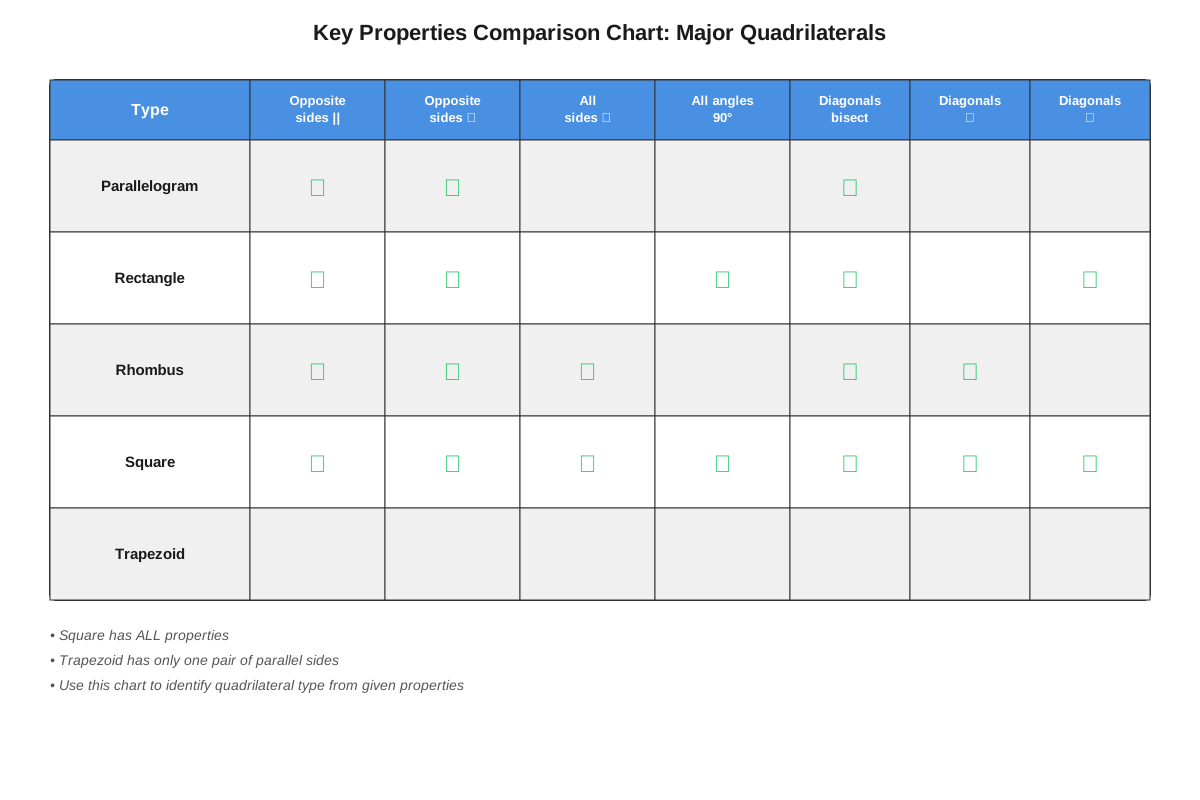
| Quadrilateral Type | Defining Properties | Special Characteristics |
|---|---|---|
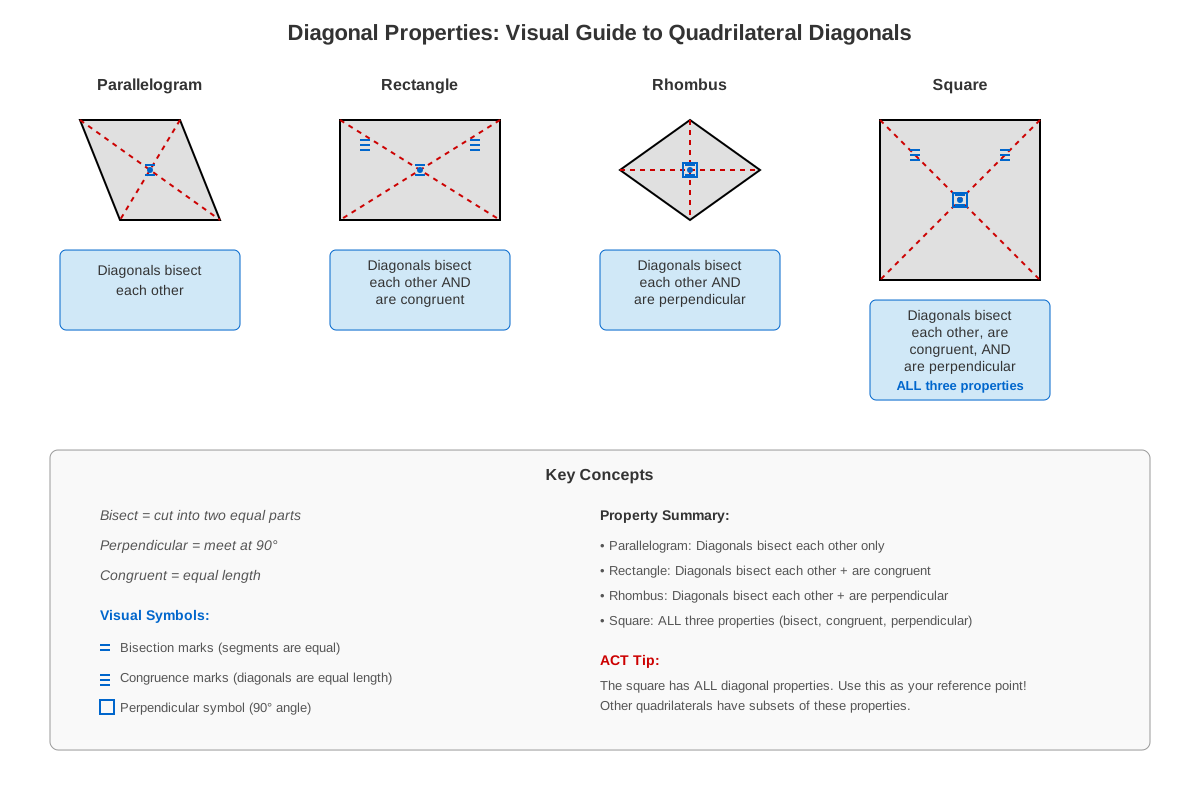
| Parallelogram | Opposite sides parallel and equal; opposite angles equal | Diagonals bisect each other |
| Rectangle | Parallelogram with four right angles | Diagonals are equal in length |
| Square | Rectangle with all sides equal | Diagonals are equal, perpendicular, and bisect angles |
| Rhombus | Parallelogram with all sides equal | Diagonals are perpendicular and bisect angles |
| Trapezoid | Exactly one pair of parallel sides | Parallel sides called bases |
| Isosceles Trapezoid | Trapezoid with equal non-parallel sides | Base angles are equal; diagonals are equal |
| Kite | Two pairs of consecutive equal sides | Diagonals are perpendicular; one diagonal bisects the other |
Parallelograms and Their Properties
A parallelogram is a quadrilateral where both pairs of opposite sides are parallel. This single defining characteristic leads to numerous other properties that the ACT frequently tests. In a parallelogram:
- Opposite sides are congruent (equal in length)
- Opposite angles are congruent
- Consecutive angles are supplementary (sum to 180°)
- Diagonals bisect each other (cut each other in half at their intersection point)
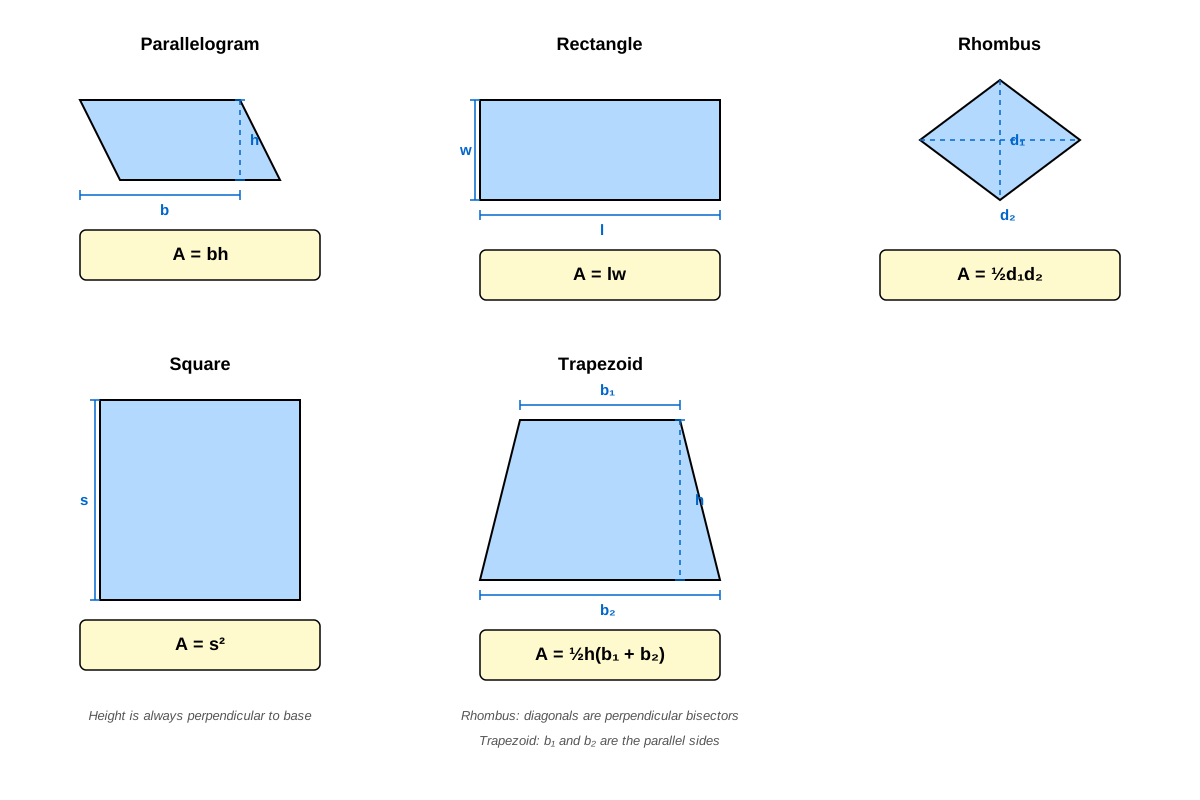
The area formula for a parallelogram is A = base × height, where the height is the perpendicular distance between parallel sides, not the length of a slanted side. This distinction is crucial—students must identify the perpendicular height, which may require using trigonometry or the Pythagorean theorem if only side lengths and angles are given.
The perimeter of a parallelogram is simply P = 2(a + b), where a and b represent the lengths of two adjacent sides.
Rectangles: Special Parallelograms
A rectangle is a parallelogram with four right angles. Because rectangles are parallelograms, they inherit all parallelogram properties, but the right angles create additional special characteristics. In a rectangle:
- All four angles measure exactly 90°
- Diagonals are equal in length
- Diagonals bisect each other (but are not necessarily perpendicular)
- Adjacent sides are perpendicular
The area formula simplifies to A = length × width (or A = lw), which is the most commonly used area formula on the ACT. The perimeter is P = 2(l + w) or P = 2l + 2w.
Diagonal length in a rectangle can be found using the Pythagorean theorem: d = √(l² + w²), since the diagonal forms the hypotenuse of a right triangle with the length and width as legs.
Squares: The Most Regular Quadrilateral
A square is simultaneously a rectangle (four right angles) and a rhombus (four equal sides), making it the most regular quadrilateral. All properties of both rectangles and rhombuses apply to squares. Additionally:
- All four sides are equal in length
- All four angles are 90°
- Diagonals are equal, perpendicular, and bisect each other at 45° angles
- Diagonals bisect the corner angles, creating 45° angles
For a square with side length s, the area is A = s² and the perimeter is P = 4s. The diagonal length is d = s√2, derived from applying the Pythagorean theorem to the right triangle formed by two sides and a diagonal.
Rhombuses: Equal-Sided Parallelograms
A rhombus is a parallelogram with four equal sides. While all sides are equal (like a square), the angles are not necessarily 90°. Key properties include:
- All four sides are congruent
- Opposite angles are equal
- Diagonals are perpendicular to each other
- Diagonals bisect the vertex angles
- Diagonals bisect each other
The area of a rhombus can be calculated using the parallelogram formula A = base × height, but more commonly on the ACT using the diagonal formula: A = (d₁ × d₂)/2, where d₁ and d₂ are the lengths of the two diagonals. This formula works because the perpendicular diagonals divide the rhombus into four right triangles.
Trapezoids: One Pair of Parallel Sides
A trapezoid (also called a trapezium in some countries) is a quadrilateral with exactly one pair of parallel sides. The parallel sides are called bases (often labeled b₁ and b₂), while the non-parallel sides are called legs. The perpendicular distance between the bases is the height (h).
The area formula for a trapezoid is A = [(b₁ + b₂)/2] × h or equivalently A = (b₁ + b₂)h/2. This formula represents the average of the two base lengths multiplied by the height. Students can remember this as "average of the bases times the height."
An isosceles trapezoid is a special trapezoid where the two legs are equal in length. In an isosceles trapezoid:
- Base angles (angles along the same base) are equal
- Diagonals are equal in length
- The trapezoid has a line of symmetry through the midpoints of the bases
Kites: Consecutive Equal Sides
A kite is a quadrilateral with two pairs of consecutive sides that are equal in length. Unlike parallelograms, opposite sides are not equal. Properties of kites include:
- Two pairs of consecutive equal sides
- One pair of opposite angles (where unequal sides meet) are equal
- Diagonals are perpendicular
- One diagonal (the "main diagonal") bisects the other
- The main diagonal bisects the vertex angles at its endpoints
The area of a kite uses the same formula as a rhombus: A = (d₁ × d₂)/2, where the diagonals are perpendicular.
Coordinate Geometry and Quadrilaterals
The ACT frequently tests quadrilaterals in the coordinate plane, requiring students to verify properties using coordinate geometry formulas. To prove a quadrilateral is a specific type:
To prove a parallelogram: Show that both pairs of opposite sides are parallel (equal slopes) OR show that both pairs of opposite sides are equal in length (using distance formula) OR show that diagonals bisect each other (midpoints are the same).
To prove a rectangle: Prove it's a parallelogram AND show that adjacent sides are perpendicular (slopes are negative reciprocals) OR show that all four angles are right angles.
To prove a square: Prove it's a rectangle AND show that all four sides are equal in length.
To prove a rhombus: Prove it's a parallelogram AND show that all four sides are equal OR show that diagonals are perpendicular.
To prove a trapezoid: Show that exactly one pair of opposite sides is parallel (equal slopes) and the other pair is not parallel.
Concept Relationships
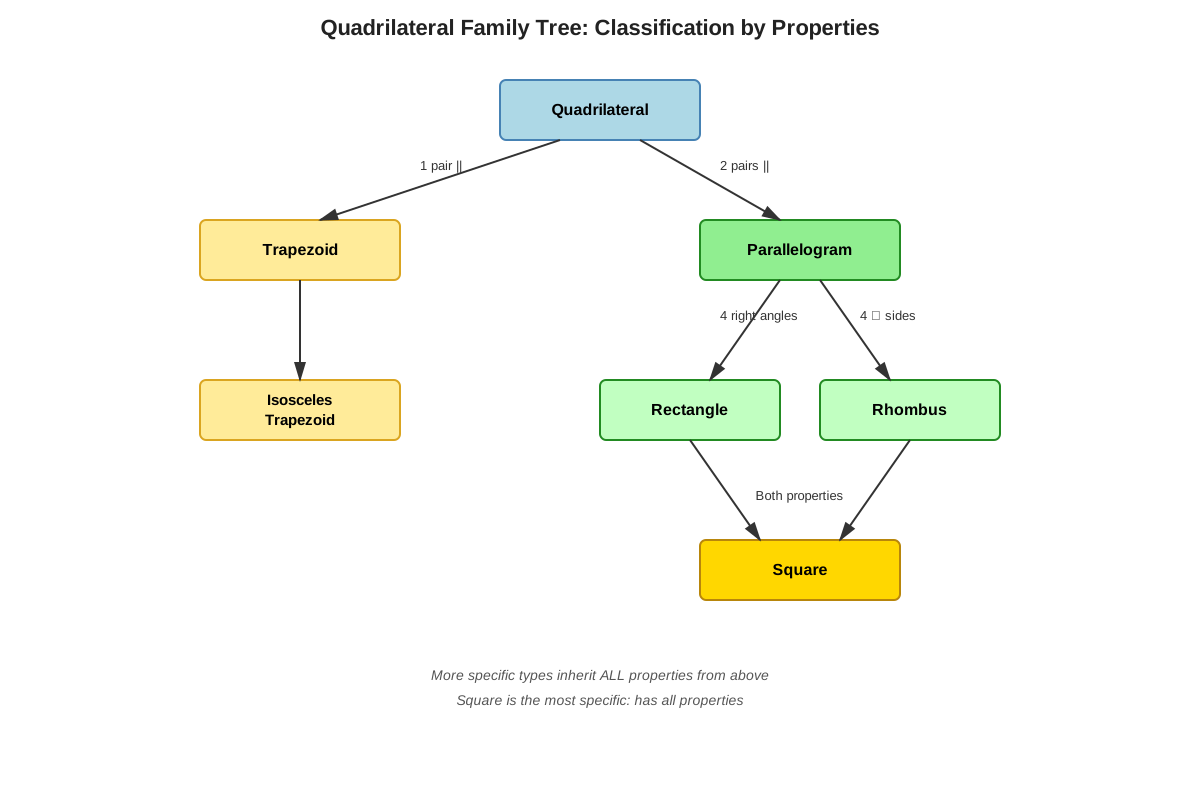
The hierarchy of quadrilaterals forms a logical structure where more specific types inherit properties from more general types. At the broadest level, all quadrilaterals share the fundamental property that their interior angles sum to 360°. From this general category, quadrilaterals branch into those with special properties.
Parallelograms represent the first major specialization, requiring both pairs of opposite sides to be parallel. This single requirement generates multiple consequences: opposite sides become equal, opposite angles become equal, and diagonals bisect each other. From parallelograms, three important special cases emerge:
Parallelograms → Rectangles (adding the requirement of right angles) → Rectangles → Squares (adding the requirement of equal sides)
Parallelograms → Rhombuses (adding the requirement of equal sides) → Rhombuses → Squares (adding the requirement of right angles)
This creates a diamond-shaped relationship where squares sit at the intersection, being both rectangles and rhombuses simultaneously. Every square is a rectangle, every rectangle is a parallelogram, and every parallelogram is a quadrilateral, but the reverse is not true.
Trapezoids branch separately from the general quadrilateral category, requiring only one pair of parallel sides. Isosceles trapezoids specialize further by adding the requirement of equal legs. Importantly, trapezoids are NOT parallelograms because they have only one pair of parallel sides, not two.
Kites represent another independent branch, defined by consecutive equal sides rather than parallel sides. Rhombuses are special cases of kites where both pairs of opposite sides happen to be parallel.
Understanding these relationships helps on the ACT because a problem might give information about a "parallelogram" and ask about properties—students must recognize that if additional information reveals all sides are equal, they're actually working with a rhombus and can apply additional properties like perpendicular diagonals.
The connection to prerequisite topics is essential: triangle properties enable understanding of how diagonals divide quadrilaterals; angle relationships explain why consecutive angles in parallelograms are supplementary; coordinate geometry provides tools to verify quadrilateral properties algebraically; and the Pythagorean theorem enables calculation of diagonal lengths and heights.
Quick check — test yourself on Quadrilaterals so far.
Try Flashcards →High-Yield Facts
⭐ The sum of interior angles in ANY quadrilateral always equals 360 degrees
⭐ In a parallelogram, opposite sides are equal and parallel, opposite angles are equal, and consecutive angles are supplementary
⭐ The area of a trapezoid is A = [(b₁ + b₂)/2] × h, representing the average of the bases times the height
⭐ In a rectangle, diagonals are equal in length and can be found using d = √(l² + w²)
⭐ A square's diagonal length is s√2, where s is the side length
- In any parallelogram, the diagonals bisect each other at their intersection point
- A rhombus has perpendicular diagonals that bisect the vertex angles
- The area of a rhombus or kite is (d₁ × d₂)/2, where d₁ and d₂ are diagonal lengths
- In an isosceles trapezoid, base angles are equal and diagonals are equal in length
- To prove a quadrilateral is a parallelogram using coordinates, show that opposite sides have equal slopes OR equal lengths, OR that diagonals have the same midpoint
- Every square is a rectangle, rhombus, parallelogram, and quadrilateral, but not every quadrilateral is a square
- The height of a parallelogram or trapezoid must be perpendicular to the base, not the slanted side length
- In a rectangle, adjacent sides are perpendicular (slopes are negative reciprocals in coordinate geometry)
- A kite has exactly one pair of equal opposite angles (where the unequal sides meet)
- The perimeter of any quadrilateral is simply the sum of all four side lengths
Common Misconceptions
Misconception: All quadrilaterals with four equal sides are squares.
Correction: A rhombus has four equal sides but does not have right angles. A quadrilateral must have both four equal sides AND four right angles to be a square. Rhombuses are "tilted squares" where the angles are not 90°.
Misconception: The height of a parallelogram is the same as the length of its slanted side.
Correction: The height is the perpendicular distance between parallel sides, not the length of the slanted side. The height forms a right angle with the base. Using the slanted side length instead of the perpendicular height is one of the most common errors in area calculations.
Misconception: All trapezoids have equal legs.
Correction: Only isosceles trapezoids have equal legs. A general trapezoid requires only one pair of parallel sides; the legs can be any length. The ACT often presents non-isosceles trapezoids where students cannot assume the legs are equal.
Misconception: If a quadrilateral has equal diagonals, it must be a rectangle.
Correction: While rectangles have equal diagonals, isosceles trapezoids also have equal diagonals but are not rectangles. Equal diagonals alone are insufficient to prove a quadrilateral is a rectangle; you must also verify that it's a parallelogram with right angles.
Misconception: The diagonals of a rectangle are perpendicular.
Correction: Rectangle diagonals are equal in length and bisect each other, but they are NOT perpendicular unless the rectangle is also a square. Only squares (and rhombuses) have perpendicular diagonals among the parallelogram family.
Misconception: A trapezoid is a type of parallelogram.
Correction: Trapezoids and parallelograms are distinct categories. A trapezoid has exactly ONE pair of parallel sides, while a parallelogram has TWO pairs of parallel sides. These definitions are mutually exclusive—a quadrilateral cannot be both a trapezoid and a parallelogram.
Misconception: To find the area of a rhombus, you must use base times height.
Correction: While base × height works for rhombuses (since they're parallelograms), the ACT more commonly provides diagonal lengths. The formula A = (d₁ × d₂)/2 is often more efficient and is the preferred method when diagonal lengths are given or can be easily calculated.
Worked Examples
Example 1: Multi-Step Parallelogram Problem
Problem: In parallelogram ABCD, angle A measures 65°. Side AB has length 12 cm, and side BC has length 8 cm. Find (a) the measure of angle C, (b) the measure of angle B, and (c) the perimeter of the parallelogram.
Solution:
(a) Finding angle C:
In a parallelogram, opposite angles are equal. Since angle A and angle C are opposite angles:
- Angle C = Angle A = 65°
(b) Finding angle B:
In a parallelogram, consecutive angles are supplementary (they sum to 180°). Angles A and B are consecutive:
- Angle A + Angle B = 180°
- 65° + Angle B = 180°
- Angle B = 180° - 65° = 115°
We can verify this is correct because angle B and angle D should also be opposite angles and therefore equal. Since consecutive angles are supplementary: Angle B + Angle C = 115° + 65° = 180° ✓
(c) Finding the perimeter:
In a parallelogram, opposite sides are equal. Therefore:
- AB = CD = 12 cm
- BC = AD = 8 cm
- Perimeter = AB + BC + CD + AD = 12 + 8 + 12 + 8 = 40 cm
Connection to Learning Objectives: This problem requires identifying that a parallelogram is being tested (Learning Objective 1), applying the core rules about opposite and consecutive angles (Learning Objective 2), and accurately solving a multi-part ACT-style question (Learning Objective 3).
Example 2: Coordinate Geometry Quadrilateral Verification
Problem: Four points are given: A(1, 2), B(5, 4), C(7, 8), and D(3, 6). Prove that quadrilateral ABCD is a parallelogram and determine whether it is a rectangle.
Solution:
Step 1: Prove it's a parallelogram by showing opposite sides are parallel
To show sides are parallel, we need to prove they have equal slopes.
Slope of AB = (4 - 2)/(5 - 1) = 2/4 = 1/2
Slope of CD = (8 - 6)/(7 - 3) = 2/4 = 1/2
Since slope of AB = slope of CD, sides AB and CD are parallel. ✓
Slope of BC = (8 - 4)/(7 - 5) = 4/2 = 2
Slope of AD = (6 - 2)/(3 - 1) = 4/2 = 2
Since slope of BC = slope of AD, sides BC and AD are parallel. ✓
Because both pairs of opposite sides are parallel, ABCD is a parallelogram.
Step 2: Determine if it's a rectangle by checking if adjacent sides are perpendicular
For adjacent sides to be perpendicular, their slopes must be negative reciprocals.
Slope of AB = 1/2
Slope of BC = 2
Check if these are negative reciprocals: The negative reciprocal of 1/2 is -2, not 2.
Since adjacent sides are NOT perpendicular, ABCD is not a rectangle.
Conclusion: ABCD is a parallelogram but not a rectangle.
Connection to Learning Objectives: This problem demonstrates how to identify quadrilateral problems in coordinate geometry (Learning Objective 1), apply the strategy of using slopes to verify properties (Learning Objective 2), and distinguish between different quadrilateral types (additional Learning Objective 4).
Exam Strategy
When approaching ACT quadrilaterals questions, begin by identifying which type of quadrilateral is being tested. Look for trigger words and given information:
Trigger words to watch for:
- "Parallelogram" → opposite sides equal and parallel, opposite angles equal, consecutive angles supplementary
- "Rectangle" → all properties of parallelogram PLUS four right angles and equal diagonals
- "Square" → all properties of rectangle PLUS all sides equal
- "Rhombus" → all properties of parallelogram PLUS all sides equal and perpendicular diagonals
- "Trapezoid" → exactly one pair of parallel sides; use the average-of-bases formula for area
- "Isosceles trapezoid" → equal legs, equal base angles, equal diagonals
- "Quadrilateral" (without specification) → only assume the 360° angle sum unless more information is given
Strategic approach sequence:
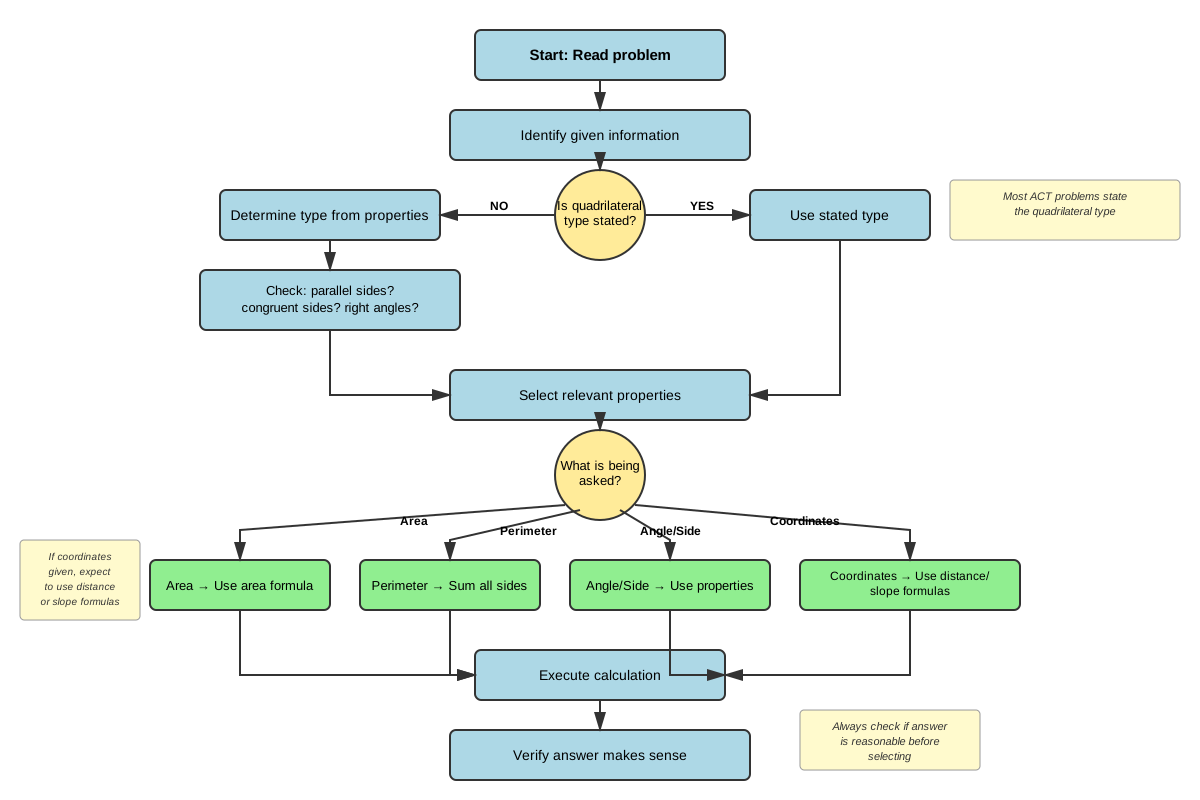
- Identify the quadrilateral type from the problem statement or given properties
- List the relevant properties of that quadrilateral type mentally
- Determine what's being asked: area, perimeter, angle measure, side length, or proof
- Select the appropriate formula or property based on what's given and what's needed
- Check if you need intermediate steps (like finding height using Pythagorean theorem before calculating area)
Process-of-elimination tips:
- If a problem gives you four side lengths that are all equal but doesn't mention right angles, eliminate answer choices that assume it's a square—it could be a rhombus
- When calculating area, eliminate answers that use slanted side lengths instead of perpendicular height
- For angle problems, eliminate answers that don't respect the 360° total or the supplementary relationship of consecutive angles in parallelograms
- In coordinate geometry, eliminate answer choices that claim a figure is a rectangle without verifying perpendicular sides
Time allocation advice:
Straightforward area or perimeter calculations should take 30-45 seconds. Multi-step problems involving finding unknown measurements before calculating area should take 60-90 seconds. Coordinate geometry proofs requiring multiple slope or distance calculations may take up to 2 minutes. If a problem requires more than 2 minutes, mark it and return later—the ACT rewards efficient time management.
Quick decision tree: Given information about sides → Check if all equal (rhombus/square) or opposite pairs equal (parallelogram/rectangle). Given information about angles → Check if all 90° (rectangle/square) or opposite pairs equal (parallelogram/rhombus). Given coordinates → Calculate slopes first (fastest way to identify type). Given one pair of parallel sides → Trapezoid, use average-of-bases formula.
Memory Techniques
PORS - Properties of Parallelograms:
- Parallel opposite sides
- Opposite sides equal
- Reflexive opposite angles (equal)
- Supplementary consecutive angles
"A Square is RARE" - Remember the four properties that make squares special:
- Right angles (all four)
- All sides equal
- Regular diagonals (equal and perpendicular)
- Everything bisected (diagonals bisect each other and angles)
Trapezoid Area: "Average the Bases, Then Multiply"
Visualize taking the two parallel sides, finding their average (adding and dividing by 2), then multiplying by the height. This creates a mental image of "averaging" the trapezoid into a rectangle.
Diagonal Perpendicularity: "RhoKi"
Rhombus and Kite both have perpendicular diagonals. This unusual word helps remember these two quadrilateral types share this property.
Rectangle vs. Rhombus: "Rectangles are Right, Rhombuses are Rigid"
Rectangles have right angles (90°). Rhombuses have rigid sides (all equal length). This distinguishes the two special parallelograms.
Coordinate Geometry Slopes: "Parallel = Same, Perpendicular = Negative Flip"
For parallel sides, slopes are the same number. For perpendicular sides, slopes are negative reciprocals (flip the fraction and change the sign).
Visualization Strategy for Area Formulas:
Picture a parallelogram being "pushed" into a rectangle—the area stays the same (base × height). Picture a trapezoid with a line through the middle parallel to the bases—this middle line is the average of the bases, and the area is this average times the height. Picture a rhombus's diagonals creating four right triangles—the area is half the product of the diagonals.
Summary
Quadrilaterals are four-sided polygons that appear frequently on the ACT Math test, requiring students to master multiple types and their unique properties. All quadrilaterals share the fundamental property that interior angles sum to 360°, but specific types have additional defining characteristics. Parallelograms feature opposite sides that are parallel and equal, with opposite angles equal and consecutive angles supplementary. Rectangles are parallelograms with four right angles and equal diagonals. Squares combine all properties of rectangles and rhombuses, featuring four equal sides, four right angles, and perpendicular diagonals. Rhombuses have four equal sides and perpendicular diagonals that bisect vertex angles. Trapezoids have exactly one pair of parallel sides, with area calculated using the average of the bases times the height. Success on ACT quadrilateral questions requires quickly identifying which type is being tested, recalling the appropriate properties and formulas, and efficiently applying them to calculate areas, perimeters, angles, or side lengths. Coordinate geometry problems add complexity by requiring verification of properties using slopes and distances, making it essential to understand both the geometric properties and their algebraic representations.
Key Takeaways
- All quadrilaterals have interior angles that sum to exactly 360 degrees, regardless of shape or type
- Parallelograms have opposite sides parallel and equal, opposite angles equal, consecutive angles supplementary, and diagonals that bisect each other
- The area of a trapezoid is the average of the two bases multiplied by the perpendicular height: A = [(b₁ + b₂)/2] × h
- Rectangles have equal diagonals, squares have perpendicular diagonals, and rhombuses have perpendicular diagonals that bisect vertex angles
- In coordinate geometry, prove parallelograms by showing opposite sides have equal slopes, and prove rectangles by additionally showing adjacent sides have slopes that are negative reciprocals
- Height in area formulas always refers to perpendicular distance, never slanted side length
- Every square is a rectangle and a rhombus, but not every rectangle or rhombus is a square—understanding the hierarchy prevents classification errors
Related Topics
Triangles and Triangle Properties: Mastering quadrilaterals naturally leads to deeper understanding of triangles, since diagonals divide quadrilaterals into triangles. Advanced problems may require using triangle congruence theorems or special right triangles within quadrilaterals.
Polygons with More Than Four Sides: The angle sum formula for quadrilaterals (360°) extends to a general formula for n-sided polygons: (n-2) × 180°. Understanding quadrilaterals provides the foundation for working with pentagons, hexagons, and other polygons.
Circle and Quadrilateral Relationships: Some ACT problems involve quadrilaterals inscribed in circles or circles inscribed in quadrilaterals, requiring integration of circle properties with quadrilateral properties.
Three-Dimensional Geometry: Rectangular prisms, cubes, and other 3D shapes have quadrilateral faces. Mastering 2D quadrilaterals is essential before tackling surface area and volume problems involving these solids.
Coordinate Geometry and Transformations: Understanding how quadrilaterals behave under translations, rotations, and reflections in the coordinate plane builds on the coordinate geometry skills developed through quadrilateral problems.
Practice CTA
Now that you've mastered the core concepts, properties, and strategies for ACT quadrilateral problems, it's time to solidify your understanding through active practice. Attempt the practice questions to apply these concepts to realistic ACT-style problems, and use the flashcards to reinforce the key properties and formulas until they become automatic. Remember: recognizing quadrilateral types quickly and recalling their properties instantly will save you valuable time on test day. Every practice problem you solve builds the pattern recognition and problem-solving speed that separates good scores from great scores. You've got this!
Sign up free to keep reading
Create a free AnvayaPrep account to finish this ACT guide on Quadrilaterals — plus flashcards and practice questions.