Overview
The circle radius is one of the most fundamental and frequently tested concepts in ACT Math, appearing in approximately 10-15% of all Plane Geometry questions. Understanding the radius—the distance from the center of a circle to any point on its circumference—serves as the gateway to solving a wide variety of circle-related problems on the exam. Questions involving ACT circle radius typically require students to find missing measurements, calculate areas and circumferences, work with inscribed or circumscribed figures, or apply the distance formula in coordinate geometry contexts.
Mastery of circle radius concepts extends far beyond simple identification. Students must recognize how the radius relates to diameter (twice the radius), how it determines both area (πr²) and circumference (2πr), and how it functions within the coordinate plane when circles are defined by equations. The ACT frequently embeds radius problems within multi-step questions that combine algebraic manipulation, geometric reasoning, and sometimes trigonometric relationships. A solid understanding of radius properties enables efficient problem-solving and prevents common calculation errors that cost valuable points.
The circle radius connects to broader mathematical concepts including the Pythagorean theorem (when finding radius using coordinates), similar triangles (when working with tangent lines), and even three-dimensional geometry (when circles appear as cross-sections of cylinders or spheres). This topic serves as foundational knowledge for more advanced geometric concepts and appears across multiple question types, from straightforward computational problems to complex word problems requiring spatial reasoning.
Learning Objectives
- [ ] Identify when Circle radius is being tested in ACT questions
- [ ] Explain the core rule or strategy behind Circle radius calculations
- [ ] Apply Circle radius to ACT-style questions accurately
- [ ] Calculate radius when given diameter, circumference, or area
- [ ] Determine radius using the distance formula in coordinate geometry
- [ ] Solve multi-step problems involving radius and other geometric figures
- [ ] Recognize and apply radius properties in inscribed and circumscribed figures
Prerequisites
- Basic circle vocabulary (center, circumference, diameter): Essential for understanding how radius relates to other circle measurements and for interpreting question language correctly
- Area and perimeter formulas: Necessary because radius appears in the fundamental formulas for circle area (πr²) and circumference (2πr)
- Coordinate plane basics: Required for problems where circles are positioned on a coordinate grid and radius must be calculated using point coordinates
- Distance formula: Critical for finding radius when given the center and a point on the circle: d = √[(x₂-x₁)² + (y₂-y₁)²]
- Algebraic manipulation: Needed to isolate radius when solving equations involving circle formulas
Why This Topic Matters
Circle radius problems appear with remarkable consistency on every ACT Math test, making this a high-yield topic that directly impacts scores. In real-world applications, radius calculations are essential in engineering (designing circular components), architecture (planning curved structures), navigation (calculating distances from a central point), and technology (determining signal coverage areas). Understanding radius enables professionals to work with wheels, gears, pipes, planetary orbits, and countless other circular objects.
On the ACT, circle radius questions typically appear 2-4 times per test, distributed across different difficulty levels and question formats. Students encounter radius in pure geometry problems (finding measurements), coordinate geometry questions (working with circle equations), word problems (real-world scenarios involving circular objects), and complex multi-step problems that combine circles with other shapes. The ACT particularly favors questions where students must work backwards from area or circumference to find radius, apply the Pythagorean theorem to find radius in right triangles, or use coordinate geometry to determine radius from an equation.
Common question formats include: finding radius when given circumference or area, calculating the radius of a circle inscribed in or circumscribed about a polygon, determining radius from a standard form circle equation (x-h)² + (y-k)² = r², finding the radius of a circle passing through specific points, and solving problems involving concentric circles with different radii. The versatility of radius questions means students must be prepared to recognize this concept across multiple contexts and question types.
Core Concepts
Definition and Basic Properties
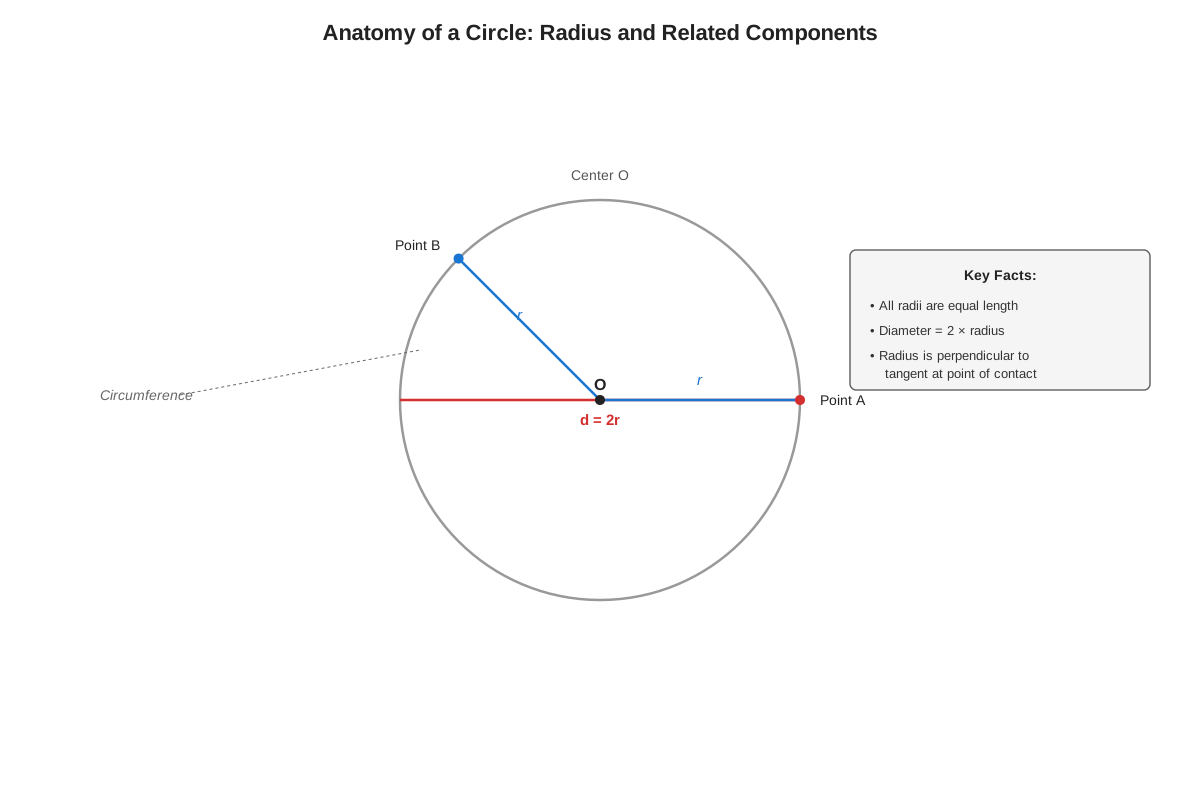
The circle radius is defined as the distance from the center of a circle to any point on the circle itself. This distance remains constant for all points on the circumference, which is the defining characteristic of a circle. Every circle has infinitely many radii (plural of radius), but all radii of the same circle have identical length. The radius is typically denoted by the variable r in formulas and equations.
The radius relates directly to the diameter through the simple relationship: diameter = 2 × radius, or d = 2r. Conversely, r = d/2. This relationship appears frequently on the ACT, particularly in questions that provide diameter but require radius for calculations, or vice versa. Students must automatically recognize when to convert between these measurements.
Radius in Circle Formulas
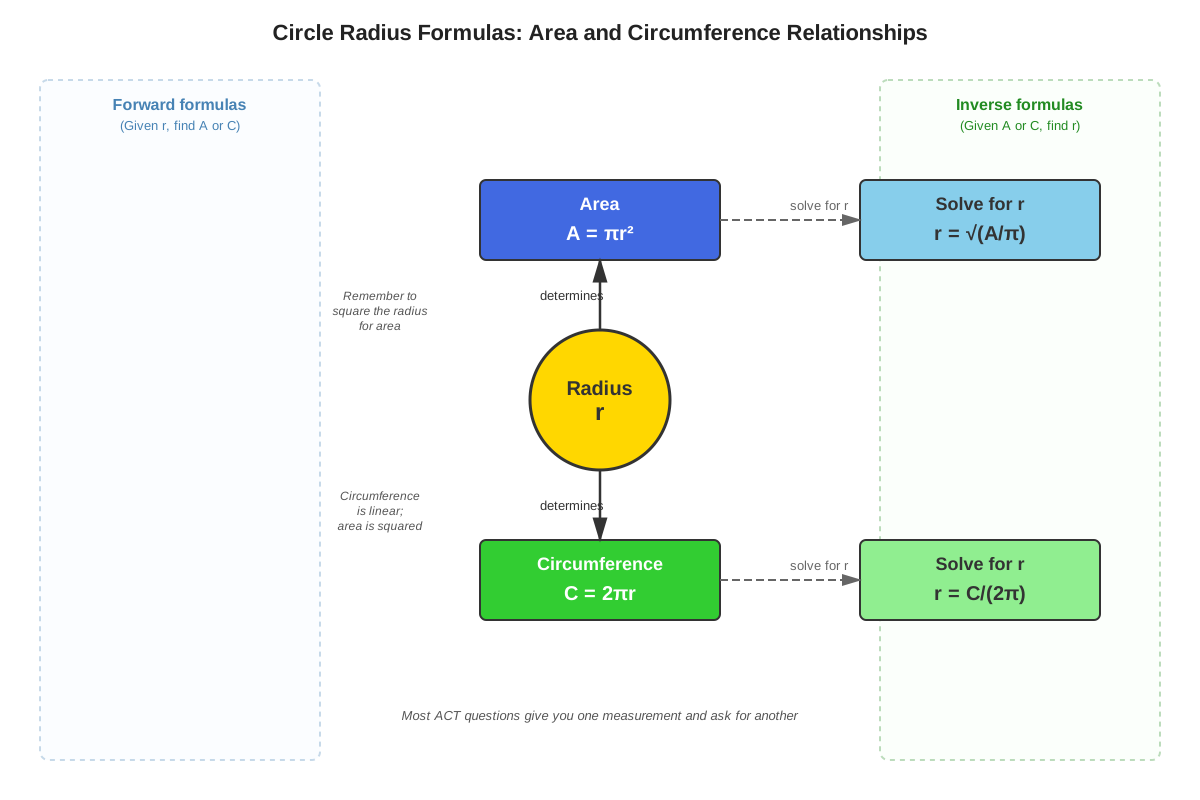
The radius serves as the key variable in the two most important circle formulas:
Circumference Formula: C = 2πr (or C = πd)
- The circumference is the distance around the circle
- Doubling the radius doubles the circumference (linear relationship)
- ACT questions often provide circumference and ask for radius: r = C/(2π)
Area Formula: A = πr²
- The area is the space enclosed within the circle
- Doubling the radius quadruples the area (quadratic relationship)
- ACT questions frequently provide area and ask for radius: r = √(A/π)
| Given Information | Formula to Find Radius | Example |
|---|---|---|
| Diameter = 10 | r = d/2 | r = 10/2 = 5 |
| Circumference = 12π | r = C/(2π) | r = 12π/(2π) = 6 |
| Area = 49π | r = √(A/π) | r = √(49π/π) = 7 |
Radius in Coordinate Geometry
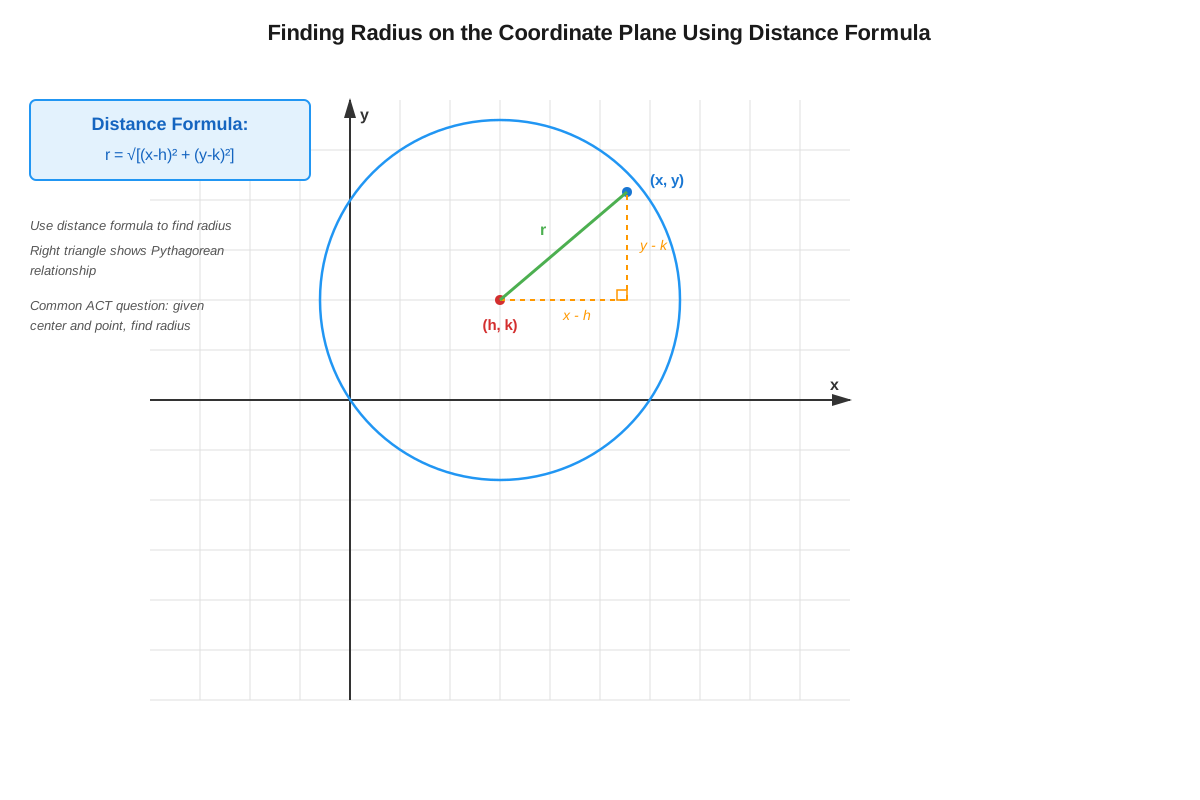
When circles appear on the coordinate plane, the radius can be calculated using the distance formula. For a circle with center (h, k) and a point (x, y) on the circumference, the radius is:
r = √[(x - h)² + (y - k)²]The standard form equation of a circle directly incorporates the radius:
(x - h)² + (y - k)² = r²Where (h, k) is the center and r is the radius. Notice that r² appears in the equation, so finding the actual radius requires taking the square root of the right side. For example, if the equation is (x - 3)² + (y + 2)² = 25, then r² = 25, so r = 5.
Radius in Inscribed and Circumscribed Figures
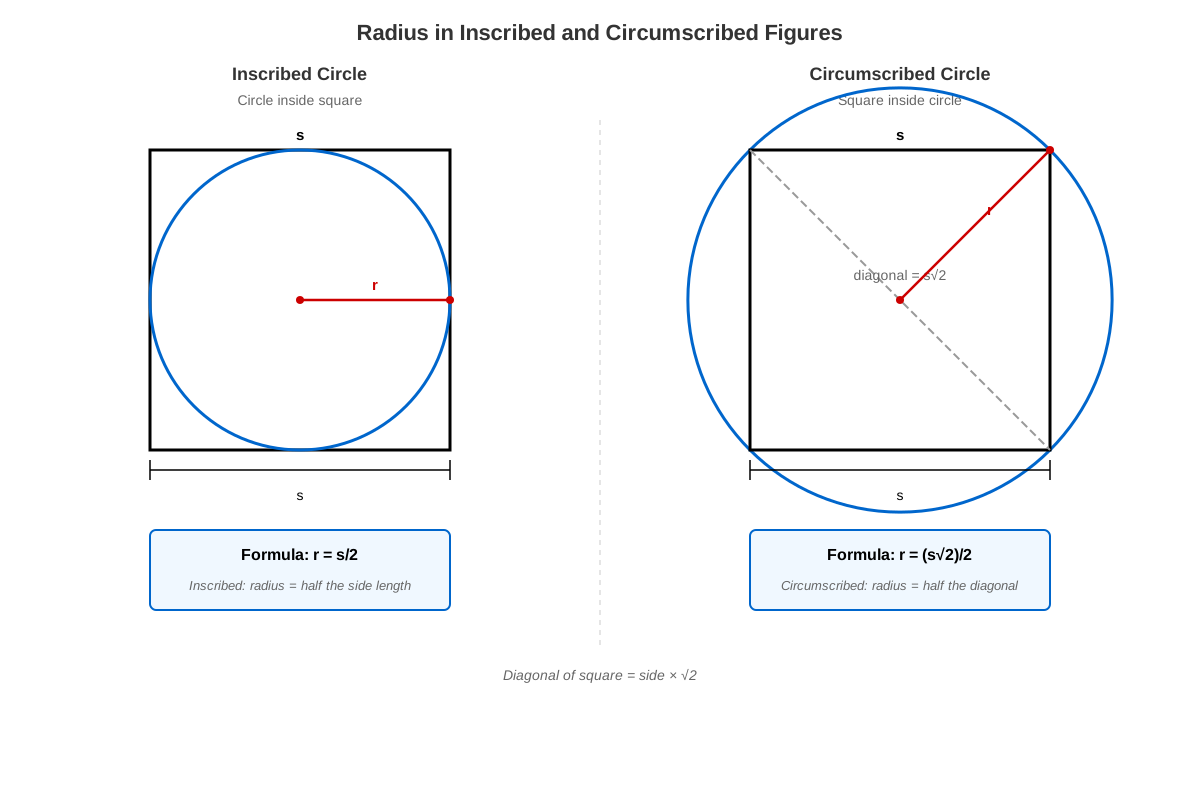
Inscribed circles (circles drawn inside polygons, touching all sides) have a radius called the inradius. For a circle inscribed in a square with side length s, the radius equals s/2 because the diameter equals the side length.
Circumscribed circles (circles drawn around polygons, passing through all vertices) have a radius called the circumradius. For a circle circumscribed about a square with side length s, the radius can be found using the Pythagorean theorem: the diagonal of the square equals the diameter, so r = (s√2)/2.
Radius and Arc Length
The radius is essential for calculating arc length, the distance along a portion of the circle's circumference. The formula is:
Arc Length = (θ/360°) × 2πrWhere θ is the central angle in degrees. The radius directly determines how long an arc will be for a given angle.
Radius and Sector Area
A sector is a "slice" of a circle, like a piece of pie. The area of a sector depends on the radius:
Sector Area = (θ/360°) × πr²The radius appears squared in this formula, meaning doubling the radius quadruples the sector area.
Concept Relationships
The circle radius serves as the central hub connecting multiple geometric concepts. The radius directly determines both circumference and area through their respective formulas, creating a one-way dependency where knowing the radius allows immediate calculation of these measurements. Conversely, knowing circumference or area enables calculation of radius through algebraic manipulation.
The relationship between radius and diameter is bidirectional and proportional: diameter = 2r and r = d/2. This simple doubling/halving relationship appears in virtually every circle problem and must become automatic.
In coordinate geometry, the radius connects to the distance formula, which itself derives from the Pythagorean theorem. When finding the radius of a circle given its center and a point on the circumference, students apply: Pythagorean theorem → distance formula → radius calculation. This chain represents a fundamental connection between algebra and geometry.
For inscribed and circumscribed figures, the radius relates to polygon properties through geometric relationships. For example: square side length → diagonal (via Pythagorean theorem) → circumradius (diagonal = diameter). These multi-step relationships require understanding how radius interacts with other shapes.
Concept Flow Map:
Center point + Point on circle → Distance formula → Radius → Area (πr²) and Circumference (2πr) → Arc length and Sector area → Complete circle measurements
High-Yield Facts
⭐ The radius is exactly half the diameter: r = d/2, and this conversion appears in approximately 30% of circle questions
⭐ Area formula: A = πr², which means radius = √(A/π) when working backwards from area
⭐ Circumference formula: C = 2πr, which means radius = C/(2π) when working backwards from circumference
⭐ Standard circle equation: (x - h)² + (y - k)² = r², where r² is the value on the right side
⭐ Distance formula gives radius: When you know the center (h, k) and any point (x, y) on the circle, r = √[(x-h)² + (y-k)²]
- Doubling the radius doubles the circumference but quadruples the area
- All radii of the same circle have equal length by definition
- The radius of a circle inscribed in a square equals half the square's side length
- The radius of a circle circumscribed about a square equals (side × √2)/2
- In a semicircle, the radius connects the center to any point on the curved edge
- Arc length formula requires radius: Arc = (θ/360°) × 2πr
- Sector area formula requires radius squared: Sector Area = (θ/360°) × πr²
- The radius is perpendicular to a tangent line at the point of tangency
- Concentric circles share the same center but have different radii
- The radius of a circle with center at origin (0, 0) passing through point (a, b) is √(a² + b²)
Quick check — test yourself on Circle radius so far.
Try Flashcards →Common Misconceptions
Misconception: The radius and diameter are the same measurement.
Correction: The diameter is always exactly twice the radius. Students must remember to divide diameter by 2 to get radius, or multiply radius by 2 to get diameter. Confusing these measurements leads to answers that are off by a factor of 2 or 4 (when calculating area).
Misconception: When the circle equation shows r² = 36, the radius is 36.
Correction: The radius is 6, not 36. The standard form equation contains r², so you must take the square root of the right side to find the actual radius. This is one of the most common errors in coordinate geometry circle problems.
Misconception: Doubling the radius doubles the area.
Correction: Doubling the radius quadruples the area because area depends on r². If r = 3 gives area = 9π, then r = 6 gives area = 36π (four times larger, not two times). This quadratic relationship is frequently tested.
Misconception: The radius can be negative.
Correction: Radius represents a distance and must always be positive. When solving for radius algebraically, always take the positive square root. If you get r² = 25, then r = 5 (not ±5) because negative distance is meaningless.
Misconception: In the equation (x - 3)² + (y + 4)² = 16, the center is (3, 4).
Correction: The center is (3, -4). The standard form is (x - h)² + (y - k)² = r², so the signs are opposite of what appears in the equation. The y-coordinate is -4 because (y + 4) = (y - (-4)). This sign error affects radius calculations when using the distance formula.
Misconception: The radius of a circle inscribed in a rectangle equals half the rectangle's length.
Correction: The radius of an inscribed circle equals half the shorter dimension (width) of the rectangle, not the length. The circle must fit within the rectangle's width, so the diameter equals the width, making radius = width/2.
Worked Examples
Example 1: Finding Radius from Area
Problem: A circular garden has an area of 144π square feet. What is the radius of the garden in feet?
Solution:
Step 1: Identify the given information and what we need to find.
- Given: Area = 144π square feet
- Find: radius (r)
Step 2: Recall the area formula for a circle.
- A = πr²
Step 3: Substitute the known value and solve for r.
- 144π = πr²
Step 4: Divide both sides by π to isolate r².
- 144 = r²
Step 5: Take the square root of both sides (positive root only).
- r = √144 = 12
Answer: The radius is 12 feet.
Key Insight: This problem tests the learning objective of calculating radius when given area. Notice that π appears on both sides and cancels out, simplifying the calculation. Always remember to take the square root at the end—a common error is to report r² as the radius.
Example 2: Finding Radius Using Coordinate Geometry
Problem: A circle has its center at point C(2, -3) and passes through point P(6, 0). What is the radius of the circle?
Solution:
Step 1: Recognize that the radius is the distance from the center to any point on the circle.
- Center: C(2, -3)
- Point on circle: P(6, 0)
Step 2: Apply the distance formula.
r = √[(x₂ - x₁)² + (y₂ - y₁)²]Step 3: Substitute the coordinates (let C be point 1 and P be point 2).
r = √[(6 - 2)² + (0 - (-3))²]Step 4: Simplify inside the parentheses.
r = √[(4)² + (3)²]Step 5: Calculate the squares.
r = √[16 + 9]Step 6: Add and find the final square root.
r = √25 = 5Answer: The radius is 5 units.
Key Insight: This problem combines coordinate geometry with circle radius concepts, testing the learning objective of applying radius calculations in different contexts. The distance formula is essential for these problems. Watch for sign errors when subtracting negative coordinates—here, 0 - (-3) = 0 + 3 = 3.
Exam Strategy
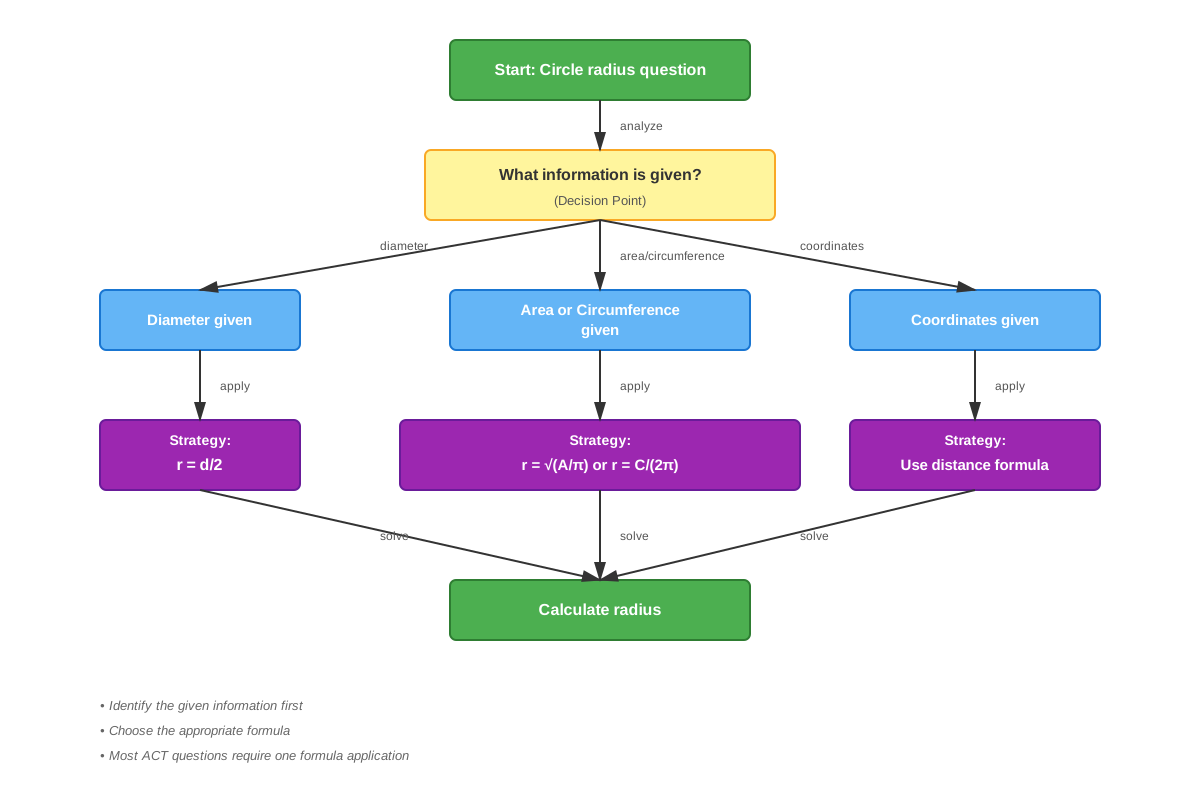
When approaching ACT circle radius questions, begin by identifying what information is provided and what the question asks for. Circle problems often require working backwards: if given area or circumference, you must solve for radius before proceeding to other calculations. Write down the relevant formula immediately to organize your thinking.
Trigger words and phrases that indicate radius problems include:
- "distance from the center to the edge"
- "halfway across the circle" (this actually means radius, not diameter)
- "the circle has area..." or "the circle has circumference..." (you'll need to find radius)
- "center at point (h, k) and passes through point (x, y)" (use distance formula)
- "inscribed in" or "circumscribed about" (radius relates to the polygon's dimensions)
- Any equation in the form (x - h)² + (y - k)² = [number]
Process of elimination tips:
- Eliminate answers that confuse radius with diameter (often twice or half the correct answer)
- Eliminate negative values—radius cannot be negative
- Check if the answer makes geometric sense (e.g., radius should be smaller than the side of a square it's inscribed in)
- For coordinate geometry, eliminate answers that don't satisfy the distance formula
- When given area, eliminate answers where πr² doesn't equal the given area
Time allocation: Simple radius problems (given diameter, find radius) should take 15-30 seconds. Multi-step problems involving formulas should take 45-90 seconds. Complex coordinate geometry problems may require up to 2 minutes. If a radius problem is taking longer than 2 minutes, mark it and return later—you may be missing a simpler approach.
Exam Tip: Always check whether the problem gives you diameter or radius. The ACT intentionally provides diameter when the formula requires radius (or vice versa) to test whether students automatically convert between the two.
Memory Techniques
Mnemonic for Circle Formulas: "Circles Are Round"
- C = 2πr (Circumference uses 2 and r to the first power)
- A = πr² (Area uses r squared)
- Remember: Area has the exponent (r²), circumference doesn't
Visualization Strategy: Picture the radius as a spoke in a bicycle wheel, extending from the hub (center) to the rim (circumference). All spokes have the same length, just as all radii are equal. This mental image helps remember that radius connects center to edge.
Acronym for Standard Form: "HKRS" = "Horizontal, Kertical, R Squared"
- (x - H)² + (y - K)² = R²
- The center is (H, K) and the radius is the square root of R²
Diameter-Radius Relationship: Think "Diameter is Double" (both start with D)
- Diameter = 2 × radius
- This alliteration helps prevent confusion
Area vs. Circumference: "Area Always has the exponent" (both start with A)
- Area = πr² (has the exponent)
- Circumference = 2πr (no exponent)
Summary
The circle radius is the fundamental measurement from which all other circle properties derive, making it an essential concept for ACT Math success. Students must master three core skills: calculating radius from other measurements (diameter, area, circumference), finding radius using coordinate geometry and the distance formula, and applying radius in multi-step problems involving inscribed or circumscribed figures. The radius appears in both primary circle formulas—circumference (C = 2πr) and area (A = πr²)—and understanding the relationship between radius and these measurements enables efficient problem-solving. In coordinate geometry, the standard form equation (x - h)² + (y - k)² = r² directly incorporates radius, requiring students to recognize that r² appears in the equation and the actual radius requires taking a square root. Common pitfalls include confusing radius with diameter, forgetting to take the square root when r² is given, and misunderstanding how radius scales with area (quadratically) versus circumference (linearly). Success on ACT radius questions requires automatic recognition of when to convert between measurements, fluency with algebraic manipulation to isolate radius, and careful attention to whether problems provide radius or require calculating it as an intermediate step.
Key Takeaways
- The radius is half the diameter (r = d/2), and this conversion appears in approximately one-third of all circle questions
- Area = πr² and Circumference = 2πr are the two essential formulas; work backwards to find radius when given area or circumference
- In the standard circle equation (x - h)² + (y - k)² = r², the radius is the square root of the right side, not the right side itself
- Use the distance formula to find radius when given a center point and a point on the circle: r = √[(x₂-x₁)² + (y₂-y₁)²]
- Doubling the radius doubles the circumference but quadruples the area due to the squared relationship
- Always verify whether a problem provides radius or diameter—the ACT frequently tests whether students automatically convert between them
- Radius must always be positive; when solving algebraically, take only the positive square root
Related Topics
Circle Diameter and Circumference: Building directly on radius concepts, this topic explores how to calculate the distance around a circle and work with diameter as an alternative measurement. Mastering radius enables immediate progression to these related measurements.
Circle Area and Sectors: Understanding radius is prerequisite to calculating both total circle area and partial areas (sectors). The r² relationship in the area formula becomes critical for more complex problems.
Coordinate Geometry of Circles: This advanced topic uses radius concepts within the coordinate plane, including graphing circles, finding equations, and working with circles that intersect other geometric figures.
Inscribed and Circumscribed Figures: These problems combine circle radius with polygon properties, requiring students to find relationships between a circle's radius and the dimensions of shapes drawn inside or around it.
Three-Dimensional Geometry: Radius concepts extend to spheres (volume = 4/3πr³), cylinders (volume = πr²h), and cones, making circle radius foundational for spatial reasoning problems.
Practice CTA
Now that you've mastered the core concepts of circle radius, it's time to solidify your understanding through active practice. Work through the practice questions to test your ability to identify radius problems, apply the correct formulas, and solve multi-step problems efficiently. Use the flashcards to reinforce key formulas and relationships until they become automatic. Remember: the difference between knowing these concepts and scoring points on test day is practice. Every problem you solve builds the pattern recognition and calculation speed you need for ACT success. You've got this!
Sign up free to keep reading
Create a free AnvayaPrep account to finish this ACT guide on Circle radius — plus flashcards and practice questions.