Overview
The circle diameter is one of the most fundamental and frequently tested concepts in ACT Plane Geometry. Understanding the diameter—the longest chord that passes through the center of a circle—is essential for solving a wide range of geometry problems on the exam. The diameter serves as a bridge connecting multiple circle properties: it equals twice the radius, divides the circle into two equal semicircles, and creates right angles when inscribed in semicircles. Mastery of diameter relationships enables students to quickly solve problems involving circumference, area, inscribed angles, and coordinate geometry.
On the ACT Math section, ACT circle diameter questions appear with remarkable consistency, typically showing up 2-3 times per exam. These questions range from straightforward calculations requiring students to find diameter from radius or circumference, to more complex multi-step problems involving inscribed polygons, tangent lines, or circles in the coordinate plane. The diameter concept frequently appears disguised within word problems about wheels, circular tracks, pizza slices, or architectural features, requiring students to recognize the underlying geometric principle.
The diameter's relationship to other mathematical concepts makes it a high-yield topic for exam preparation. It connects directly to radius calculations, circumference formulas (C = πd), area computations, and the Pythagorean theorem when dealing with chords and right triangles. Understanding diameter properties also unlocks solutions to problems involving sectors, arcs, and inscribed shapes. Students who master diameter concepts gain a significant advantage in tackling approximately 15-20% of all ACT Plane Geometry questions, making this 20-minute study investment one of the highest-return uses of preparation time.
Learning Objectives
- [ ] Identify when Circle diameter is being tested in ACT questions
- [ ] Explain the core rule or strategy behind Circle diameter calculations
- [ ] Apply Circle diameter to ACT-style questions accurately
- [ ] Calculate diameter from given radius, circumference, or area measurements
- [ ] Recognize diameter properties in inscribed angle and semicircle theorems
- [ ] Solve coordinate geometry problems involving circle diameters
- [ ] Apply diameter relationships to multi-step word problems within 60 seconds
Prerequisites
- Basic circle vocabulary (radius, center, chord): The diameter is defined in relation to these fundamental terms, and students must distinguish between radius and diameter instantly
- Algebraic manipulation skills: Solving for diameter often requires isolating variables in equations like C = πd or d = 2r
- Understanding of π (pi): The constant π appears in all circumference and area formulas involving diameter
- Pythagorean theorem: Many diameter problems involve right triangles formed by radii, chords, or tangent lines
- Coordinate plane basics: ACT questions frequently place circles on coordinate grids, requiring distance formula applications
Why This Topic Matters
In real-world applications, diameter calculations are ubiquitous in engineering, architecture, manufacturing, and everyday problem-solving. Engineers use diameter measurements to specify pipe sizes, gear dimensions, and wheel specifications. Architects calculate circular floor plans and dome structures using diameter relationships. Even everyday tasks like determining whether furniture fits through doorways or calculating pizza sizes involve diameter reasoning. The practical utility of this concept extends far beyond the classroom.
On the ACT Math section, circle diameter questions appear with exceptional frequency and predictability. Statistical analysis of released ACT exams reveals that diameter-related questions constitute approximately 3-5% of the entire 60-question Math section. These questions typically appear in positions 25-45, falling within the medium difficulty range, though they can appear as early as question 15 or as late as question 55. The ACT tests diameter knowledge through multiple question formats: direct calculation problems (40%), word problems requiring diameter identification (35%), coordinate geometry applications (15%), and inscribed figure problems (10%).
Common exam presentations include: circular track problems asking for distance traveled in one revolution; wheel rotation problems connecting diameter to linear distance; coordinate plane circles where students must find diameter from endpoint coordinates; inscribed angle problems where diameter creates right angles; and area/circumference problems requiring diameter as an intermediate step. Recognizing these patterns allows students to quickly categorize questions and apply the appropriate solution strategy.
Core Concepts
Definition and Basic Properties
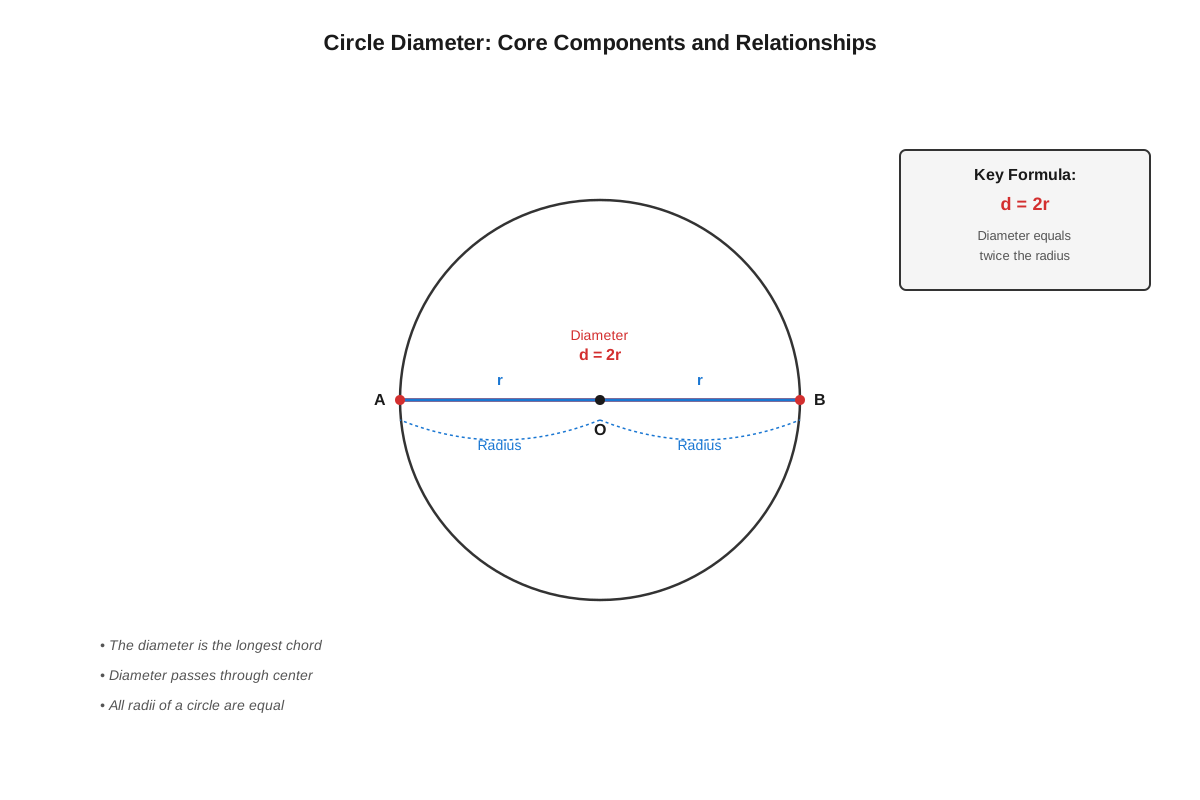
The circle diameter is defined as any line segment that passes through the center of a circle and has both endpoints on the circle's circumference. This makes the diameter the longest possible chord in any circle. Every circle has infinitely many diameters, but all diameters of the same circle have identical length. The diameter is exactly twice the length of the radius, expressed mathematically as:
d = 2rwhere d represents diameter and r represents radius. This fundamental relationship is the most frequently tested diameter property on the ACT. Students must be able to convert between radius and diameter instantly, as many problems provide one measurement while requiring the other for the solution.
The diameter divides a circle into two congruent semicircles, each containing exactly half the circle's area and half its circumference. This property becomes crucial when solving problems involving semicircular regions, arcs, or sectors. The diameter also serves as an axis of symmetry—any line perpendicular to a diameter and passing through the circle's center creates mirror-image halves.
Diameter in Circumference Calculations
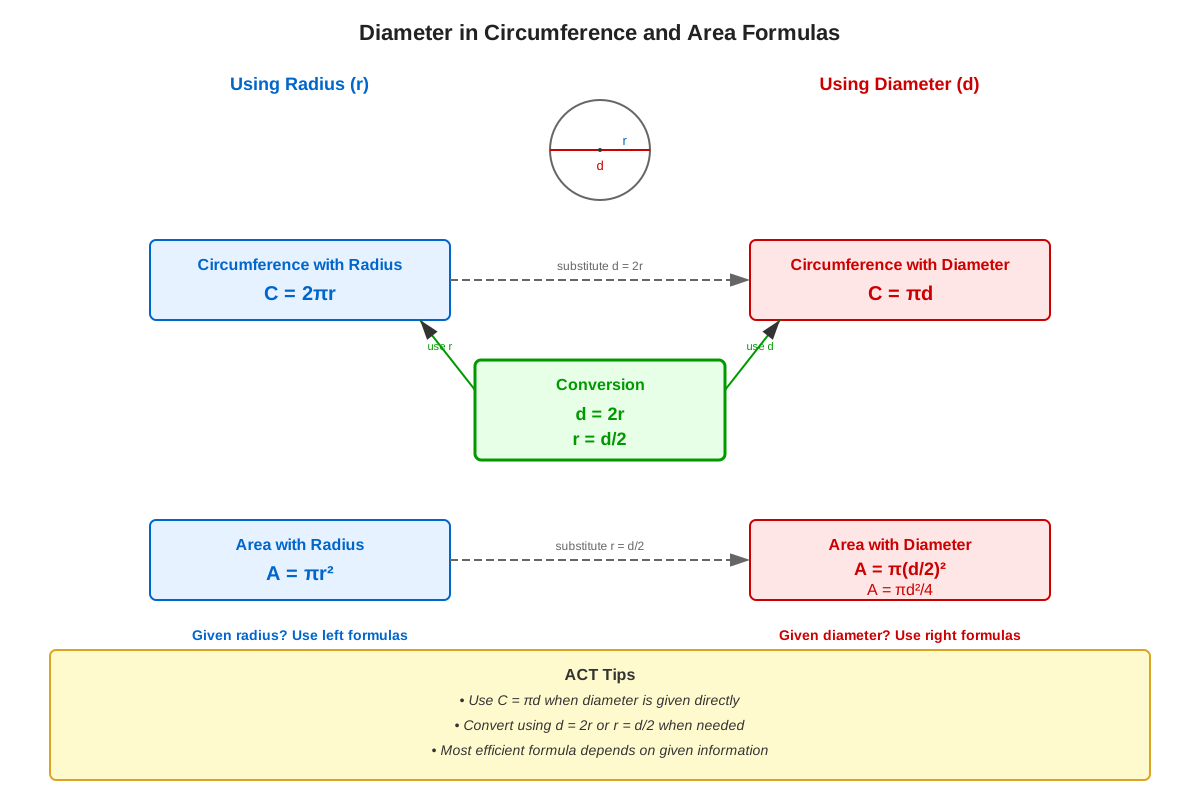
The circumference (perimeter) of a circle can be calculated using the diameter through the formula:
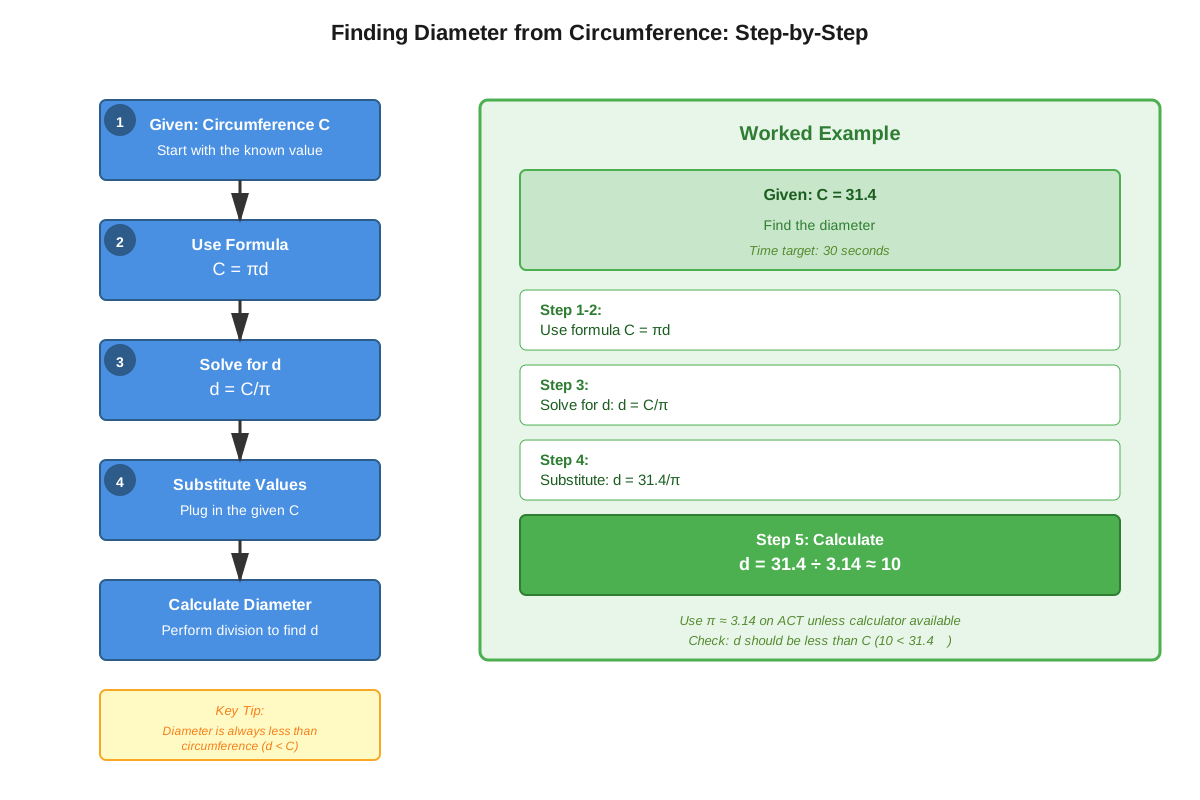
C = πdThis formula is often more direct than the radius-based formula (C = 2πr) when diameter is given. On the ACT, students must recognize when to use this formula and be comfortable manipulating it algebraically. For example, if circumference is given and diameter must be found:
d = C/πMany ACT questions present circumference information and require diameter as an intermediate step toward finding area or solving a word problem. The ability to quickly isolate diameter from the circumference formula saves valuable exam time.
Diameter in Area Calculations
While the standard circle area formula uses radius (A = πr²), diameter can be substituted using the relationship r = d/2:
A = π(d/2)² = πd²/4This diameter-based area formula appears less frequently in textbooks but proves useful when only diameter is provided. ACT questions occasionally require students to derive this relationship or recognize it in answer choices. Understanding both formulas provides flexibility in problem-solving approaches.
Diameter and the Inscribed Angle Theorem
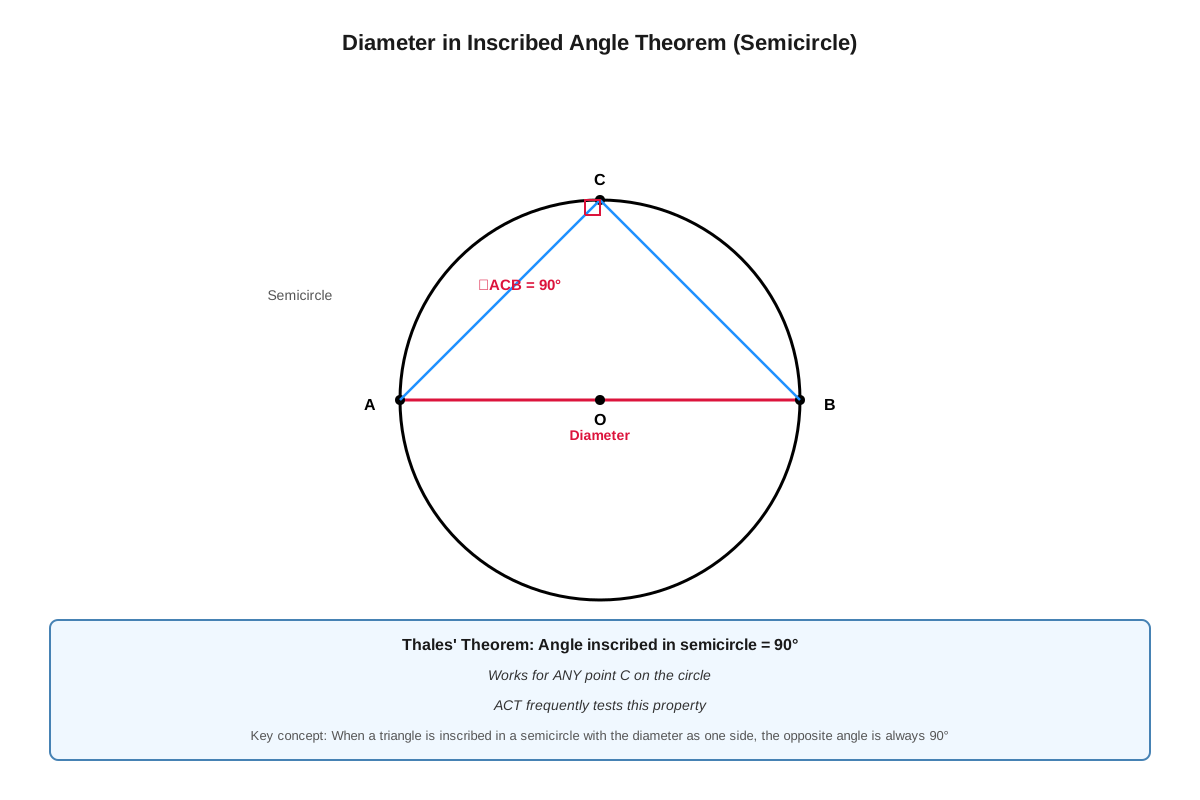
One of the most powerful diameter properties tested on the ACT is the inscribed angle theorem for diameters: any angle inscribed in a semicircle (with the diameter as one side) is a right angle (90°). This theorem, sometimes called Thales' theorem, creates right triangles within circles and enables Pythagorean theorem applications.
When a diameter connects two points on a circle, and a third point anywhere else on the circle connects to both diameter endpoints, the angle at that third point measures exactly 90°. This property allows students to identify right triangles in complex diagrams and solve for unknown lengths using the Pythagorean theorem.
Diameter in Coordinate Geometry
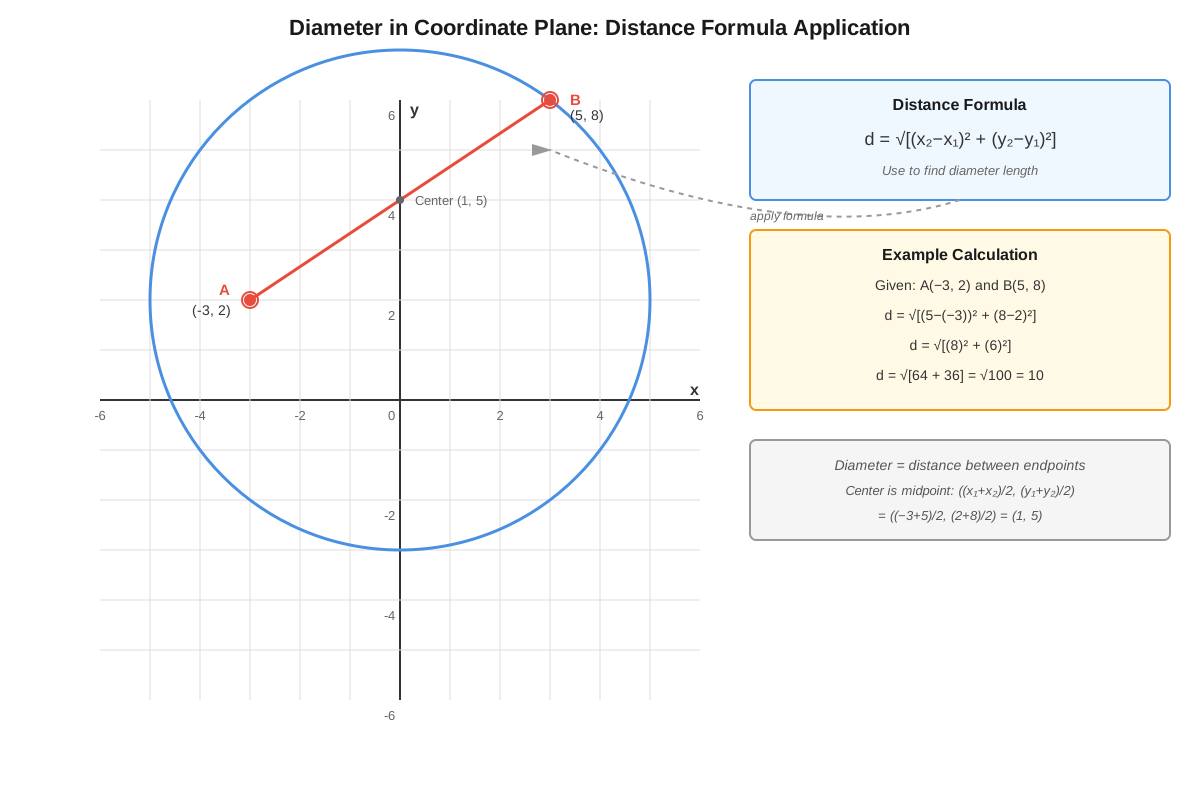
On the coordinate plane, the diameter of a circle can be found using the distance formula when two endpoints are given. If points (x₁, y₁) and (x₂, y₂) are endpoints of a diameter:
d = √[(x₂ - x₁)² + (y₂ - y₁)²]The center of the circle lies at the midpoint of any diameter, calculated as:
Center = ((x₁ + x₂)/2, (y₁ + y₂)/2)ACT coordinate geometry questions frequently provide diameter endpoints and ask for the circle's center, radius, or equation. Recognizing that diameter endpoints determine the center through midpoint calculation is a high-yield strategy.
Diameter and Perpendicular Chords
A diameter that is perpendicular to a chord bisects that chord. This property creates right triangles within circles and enables length calculations. When solving problems involving chords and diameters, students should look for perpendicular relationships that create right angles and allow Pythagorean theorem application.
Concept Relationships
The diameter serves as the central hub connecting multiple circle concepts. The foundational relationship radius → diameter (d = 2r) forms the basis for all other diameter calculations. This relationship flows into diameter → circumference (C = πd), which enables distance and perimeter calculations. Similarly, diameter → area (A = πd²/4) provides an alternative path to area computation.
The diameter concept connects to angle geometry through diameter → inscribed right angles, where any angle inscribed in a semicircle measures 90°. This relationship bridges circle geometry and triangle geometry, particularly right triangle properties and the Pythagorean theorem. The connection follows: diameter creates semicircle → inscribed angle in semicircle → right angle → Pythagorean theorem application.
In coordinate geometry, the relationship map shows: diameter endpoints → distance formula → diameter length → radius → circle equation. Additionally, diameter endpoints → midpoint formula → circle center → circle equation. These connections demonstrate how diameter knowledge unlocks multiple solution pathways.
The diameter also relates to chord properties: diameter → longest chord and diameter perpendicular to chord → chord bisection → right triangle formation. Understanding these relationships allows students to recognize when diameter properties apply even when the word "diameter" doesn't appear in the problem.
High-Yield Facts
⭐ The diameter equals exactly twice the radius: d = 2r (most frequently tested relationship)
⭐ Circumference equals π times diameter: C = πd (appears in 60% of diameter questions)
⭐ Any angle inscribed in a semicircle is a right angle: This creates right triangles for Pythagorean theorem application
⭐ The diameter is the longest chord in a circle: No other line segment connecting two points on the circle can be longer
⭐ All diameters of the same circle have equal length: This property enables multiple solution approaches
- The diameter passes through the center of the circle (defining characteristic)
- A diameter divides a circle into two congruent semicircles
- The midpoint of any diameter is the circle's center
- A diameter perpendicular to a chord bisects that chord
- The area formula using diameter is A = πd²/4
- In coordinate geometry, diameter length equals the distance between its endpoints
- The radius equals diameter divided by 2: r = d/2
- Two diameters intersect at the circle's center at their midpoints
- The diameter is twice the distance from center to circumference
- Diameter can be found from area: d = 2√(A/π)
Quick check — test yourself on Circle diameter so far.
Try Flashcards →Common Misconceptions
Misconception: The diameter and radius are the same measurement. → Correction: The diameter is always exactly twice the radius. Students must carefully read whether a problem provides radius or diameter and convert appropriately using d = 2r or r = d/2.
Misconception: Circumference equals π times radius. → Correction: Circumference equals π times diameter (C = πd) or 2π times radius (C = 2πr). Confusing these formulas leads to answers that are off by a factor of 2.
Misconception: Any chord that passes through the circle is a diameter. → Correction: Only chords that pass through the center of the circle are diameters. A chord that misses the center is shorter than the diameter.
Misconception: The area formula is A = πd². → Correction: The area formula using diameter is A = πd²/4, not A = πd². The standard formula A = πr² requires radius, and since r = d/2, substituting gives A = π(d/2)² = πd²/4.
Misconception: All inscribed angles in a circle are right angles. → Correction: Only angles inscribed in a semicircle (where the diameter forms one side) are guaranteed to be right angles. Other inscribed angles measure half their intercepted arc.
Misconception: The diameter is the distance from the center to the edge. → Correction: That distance is the radius. The diameter is the distance across the entire circle, passing through the center, which equals twice the radius.
Misconception: In coordinate geometry, the diameter equals the sum of the x-coordinates and y-coordinates of the endpoints. → Correction: The diameter equals the distance between endpoints, calculated using the distance formula: d = √[(x₂ - x₁)² + (y₂ - y₁)²].
Worked Examples
Example 1: Multi-Step Circumference to Area Problem
Problem: A circular running track has a circumference of 400π meters. What is the area enclosed by the track in square meters?
Solution:
Step 1: Identify what's given and what's needed. Given: circumference C = 400π meters. Need: area A.
Step 2: Recognize that we need diameter or radius to find area. Use the circumference formula to find diameter first.
C = πd
400π = πd
Step 3: Solve for diameter by dividing both sides by π.
d = 400π/π = 400 metersStep 4: Find radius from diameter.
r = d/2 = 400/2 = 200 metersStep 5: Calculate area using the radius formula.
A = πr² = π(200)² = π(40,000) = 40,000π square metersAnswer: 40,000π square meters
Connection to Learning Objectives: This problem demonstrates identifying diameter testing (circumference given), applying the core strategy (C = πd to find diameter), and accurately solving an ACT-style multi-step problem. The key insight is recognizing that diameter serves as the bridge between circumference and area calculations.
Example 2: Coordinate Geometry with Diameter Endpoints
Problem: In the coordinate plane, a circle has diameter endpoints at A(-3, 4) and B(5, -2). What is the radius of the circle?
Solution:
Step 1: Recognize that diameter endpoints are given, and we need radius. The strategy is to find diameter length first, then divide by 2.
Step 2: Apply the distance formula to find diameter length.
d = √[(x₂ - x₁)² + (y₂ - y₁)²]
d = √[(5 - (-3))² + (-2 - 4)²]
d = √[(5 + 3)² + (-6)²]
d = √[8² + 36]
d = √[64 + 36]
d = √100
d = 10
Step 3: Calculate radius from diameter.
r = d/2 = 10/2 = 5Answer: The radius is 5 units.
Alternative approach: Students could also find the center using the midpoint formula [(-3+5)/2, (4-2)/2] = (1, 1), then calculate the distance from the center to either endpoint. This demonstrates the flexibility that diameter knowledge provides.
Connection to Learning Objectives: This problem shows how to identify diameter testing in coordinate geometry contexts and apply the core diameter-radius relationship after using the distance formula. It demonstrates the connection between diameter concepts and prerequisite coordinate geometry skills.
Exam Strategy
When approaching ACT circle diameter questions, begin by identifying what measurement is provided (radius, diameter, circumference, or area) and what the question asks for. Create a mental flowchart: if radius is given and diameter is needed, multiply by 2; if diameter is given and radius is needed, divide by 2. This instant conversion saves time and prevents errors.
Trigger words and phrases that signal diameter testing include: "distance across the circle," "longest chord," "passes through the center," "endpoints of a diameter," "semicircle," and direct mentions of "diameter." Word problems about wheels, circular tracks, or rotating objects almost always involve diameter when asking about "one complete revolution" or "distance traveled."
For process of elimination, remember that diameter must be exactly twice the radius—if answer choices don't reflect this relationship, eliminate them immediately. When circumference is given, diameter must equal C/π; answers that don't match this calculation can be eliminated. In coordinate geometry problems, the diameter must be longer than the distance between the center and either endpoint (which is the radius).
Time allocation for diameter questions should average 45-60 seconds for straightforward calculations and 90-120 seconds for multi-step problems involving coordinate geometry or inscribed angles. If a problem requires more than two minutes, mark it and return later—diameter questions should not be time traps.
When diagrams are provided, immediately mark the diameter, label it with "d," and mark the radius with "r = d/2." This visual organization prevents confusion between radius and diameter. If no diagram is provided but the problem involves circles, sketch a quick circle and label known measurements.
For word problems, translate circular motion into diameter relationships: "one complete revolution" means the circumference (πd), "halfway around" means half the circumference (πd/2), and "radius of rotation" typically means you need to find or use the diameter.
Memory Techniques
Mnemonic for diameter-radius relationship: "Diameter is Double" – the two D's remind you that diameter equals 2 times radius.
Mnemonic for circumference formula: "Cherry Pie Delicious" represents C = π × d (Circumference = Pi × Diameter).
Visualization strategy: Picture a pizza being cut in half straight through the center. That cut line is the diameter. Each half is a semicircle. The distance from the center to the crust is the radius—notice it's half the diameter cut.
Acronym for diameter properties: CLAP
- Centers: diameter passes through the center
- Longest: diameter is the longest chord
- Angle: inscribed angle in semicircle is 90°
- Pair: diameter equals 2 radii paired together
Memory hook for inscribed right angles: "Diameter makes a Degree of ninety" – when you see a diameter, look for right angles (90°) at inscribed points.
Coordinate geometry reminder: "Endpoints Make Centers" (EMC) – diameter Endpoints, use Midpoint formula to find Center.
Summary
The circle diameter is a foundational concept that connects multiple areas of ACT Plane Geometry through its relationship to radius, circumference, area, and inscribed angles. Mastery requires instant recall that diameter equals twice the radius (d = 2r) and that circumference equals π times diameter (C = πd). The diameter serves as the longest chord in any circle, passes through the center, and creates right angles when forming inscribed triangles in semicircles. On the ACT, diameter questions appear 2-3 times per exam in various formats: direct calculations, word problems involving circular motion, coordinate geometry applications, and inscribed figure problems. Success requires recognizing diameter testing triggers, converting between radius and diameter automatically, and applying the appropriate formula based on given information. Students must distinguish between radius-based and diameter-based formulas, particularly for circumference and area calculations, and understand how diameter properties enable multi-step problem solving through connections to the Pythagorean theorem and coordinate geometry.
Key Takeaways
- The diameter always equals exactly twice the radius: d = 2r (memorize this relationship for instant application)
- Circumference is calculated directly from diameter using C = πd, making diameter the most efficient measurement for perimeter problems
- Any angle inscribed in a semicircle (with diameter as one side) measures exactly 90°, creating right triangles for Pythagorean theorem use
- The diameter is the longest possible chord in a circle and must pass through the center point
- In coordinate geometry, diameter length is found using the distance formula between endpoints, and the circle's center is the midpoint of the diameter
- Converting between radius and diameter is the most common operation in ACT circle problems—practice this conversion until it becomes automatic
- Diameter questions appear 2-3 times per ACT exam across multiple question types, making this a high-yield topic for focused preparation
Related Topics
Circle Radius and Chords: Understanding radius properties and chord relationships builds directly on diameter knowledge, as the diameter is both twice the radius and a special type of chord. Mastering diameter concepts makes radius and chord problems significantly easier.
Circumference and Arc Length: Diameter mastery enables quick circumference calculations, which form the foundation for understanding arc length (portions of circumference) and sector problems.
Circle Area and Sector Area: Since area formulas can use either radius or diameter, strong diameter skills provide alternative solution pathways and enable faster sector area calculations.
Inscribed and Central Angles: The diameter's property of creating right angles in inscribed triangles connects to broader angle theorems, including relationships between inscribed angles, central angles, and intercepted arcs.
Coordinate Geometry of Circles: Diameter concepts in the coordinate plane lead to writing circle equations, finding tangent lines, and solving systems involving circles and other geometric figures.
Three-Dimensional Geometry: Diameter understanding extends to spheres, cylinders, and cones, where circular cross-sections require diameter and radius calculations for volume and surface area problems.
Practice CTA
Now that you've mastered the core concepts of circle diameter, it's time to cement your understanding through active practice. Complete the practice questions to test your ability to identify diameter testing, apply formulas accurately, and solve multi-step problems under timed conditions. Use the flashcards to drill the essential formulas and properties until they become automatic. Remember, the difference between knowing diameter concepts and scoring points on test day is practice—students who complete focused practice problems improve their geometry scores by an average of 2-3 points. You've invested 20 minutes in learning; invest another 15 minutes in practice to maximize your ACT Math score!
Sign up free to keep reading
Create a free AnvayaPrep account to finish this ACT guide on Circle diameter — plus flashcards and practice questions.