Overview
Parallelograms represent one of the most frequently tested quadrilateral shapes on the ACT parallelograms section of the Math test. These four-sided figures possess unique properties that distinguish them from other quadrilaterals, making them essential for solving a wide range of geometry problems. Understanding parallelograms requires recognizing their defining characteristics: opposite sides that are both parallel and congruent, opposite angles that are equal, and consecutive angles that are supplementary. The ACT regularly tests these properties through direct questions about side lengths, angle measures, area calculations, and coordinate geometry applications.
Mastery of parallelograms is crucial because these shapes serve as the foundation for understanding other special quadrilaterals, including rectangles, rhombuses, and squares—all of which are specific types of parallelograms with additional constraints. On the ACT Math test, parallelogram questions typically appear 2-3 times per exam, often integrated with coordinate geometry, triangle properties, or algebraic reasoning. Students who can quickly identify parallelogram properties and apply them efficiently gain a significant advantage in both accuracy and time management.
The study of parallelograms connects directly to broader plane geometry concepts, including triangle congruence (since diagonals divide parallelograms into congruent triangles), coordinate geometry (when vertices are given as coordinate points), and algebraic problem-solving (when variables represent unknown side lengths or angle measures). This topic also reinforces understanding of parallel lines cut by transversals, as the parallel sides of parallelograms create numerous angle relationships that the ACT frequently exploits in multi-step problems.
Learning Objectives
- [ ] Identify when Parallelograms is being tested
- [ ] Explain the core rule or strategy behind Parallelograms
- [ ] Apply Parallelograms to ACT-style questions accurately
- [ ] Calculate the area and perimeter of parallelograms using appropriate formulas
- [ ] Determine unknown side lengths and angle measures using parallelogram properties
- [ ] Recognize special parallelograms (rectangles, rhombuses, squares) and their unique properties
- [ ] Solve coordinate geometry problems involving parallelograms by applying distance and midpoint formulas
Prerequisites
- Properties of parallel lines and transversals: Understanding alternate interior angles, corresponding angles, and same-side interior angles is essential for recognizing angle relationships within parallelograms
- Triangle congruence theorems: Parallelogram diagonals create triangles, and proving congruence helps establish parallelogram properties
- Basic algebraic equation solving: Many parallelogram problems require setting up and solving equations to find unknown values
- Coordinate plane fundamentals: Problems often place parallelograms on coordinate grids, requiring distance formula and midpoint formula applications
- Area formulas for basic shapes: Understanding how base and height relate to area in rectangles provides the foundation for parallelogram area calculations
Why This Topic Matters
Parallelograms appear throughout real-world applications in architecture, engineering, and design. Structural supports in bridges often form parallelogram patterns to distribute weight efficiently. Scissor lifts and adjustable desk lamps use parallelogram linkages to maintain stability while changing height or position. Artists and graphic designers regularly work with parallelogram transformations when creating perspective drawings or applying shear transformations to digital images.
On the ACT Math test, parallelogram questions appear with high frequency—typically 2-3 questions per exam, accounting for approximately 3-5% of the 60 math questions. These questions span multiple difficulty levels, from straightforward property identification to complex multi-step problems combining coordinate geometry, algebra, and spatial reasoning. The ACT tests parallelograms through various question formats: finding missing angle measures, calculating areas when given non-standard information, determining coordinates of vertices, proving that a quadrilateral is a parallelogram, and solving for variables in algebraic expressions representing side lengths or angles.
Common question types include: (1) direct property application questions asking for opposite angles or sides, (2) area calculation problems requiring identification of base and height, (3) coordinate geometry problems where students must verify parallelogram properties using slopes or midpoints, (4) algebraic problems where expressions represent sides or angles and students must solve for variables, and (5) special parallelogram identification questions requiring recognition of rectangles, rhombuses, or squares based on given properties.
Core Concepts
Definition and Basic Properties
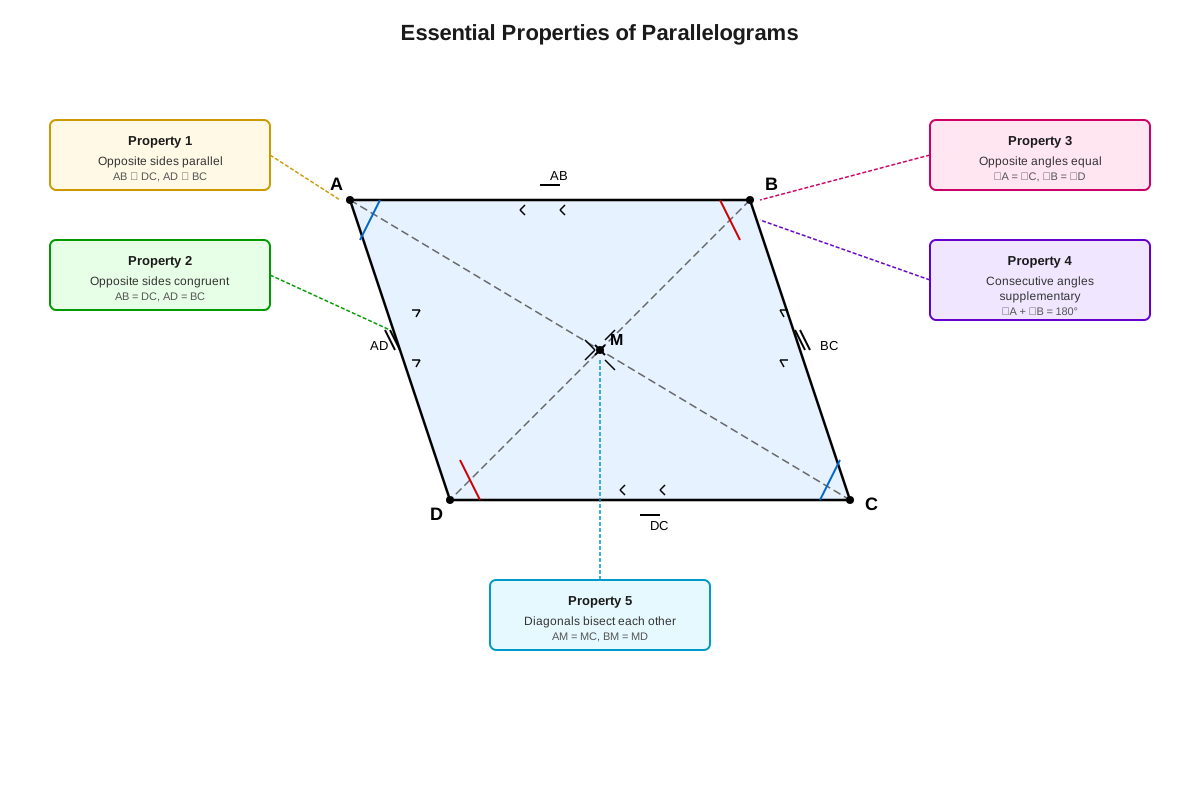
A parallelogram is a quadrilateral with two pairs of opposite sides that are parallel. This defining characteristic leads to several important derived properties that the ACT tests extensively. The parallel nature of opposite sides creates congruent alternate interior angles when diagonals or transversals intersect these sides, establishing the fundamental angle relationships within the figure.
The essential properties of all parallelograms include:
- Opposite sides are congruent (equal in length)
- Opposite angles are congruent (equal in measure)
- Consecutive angles are supplementary (sum to 180°)
- Diagonals bisect each other (intersect at their midpoints)
These four properties form the core of most ACT parallelogram questions. Understanding that any one of these properties can be used to prove a quadrilateral is a parallelogram is crucial for coordinate geometry applications.
Side and Angle Relationships
In any parallelogram ABCD, if we label the sides as AB, BC, CD, and DA, the parallel relationships establish that AB || CD and BC || DA. This parallelism creates the congruence relationships: AB ≅ CD and BC ≅ DA. When solving for unknown side lengths, students can set up equations using these congruence relationships.
The angle relationships follow from the parallel sides cut by transversals. If angles are labeled ∠A, ∠B, ∠C, and ∠D going around the parallelogram, then:
- ∠A ≅ ∠C (opposite angles)
- ∠B ≅ ∠D (opposite angles)
- ∠A + ∠B = 180° (consecutive angles)
- ∠B + ∠C = 180° (consecutive angles)
- ∠C + ∠D = 180° (consecutive angles)
- ∠D + ∠A = 180° (consecutive angles)
The sum of all interior angles in any parallelogram equals 360°, consistent with all quadrilaterals.
Area Calculation
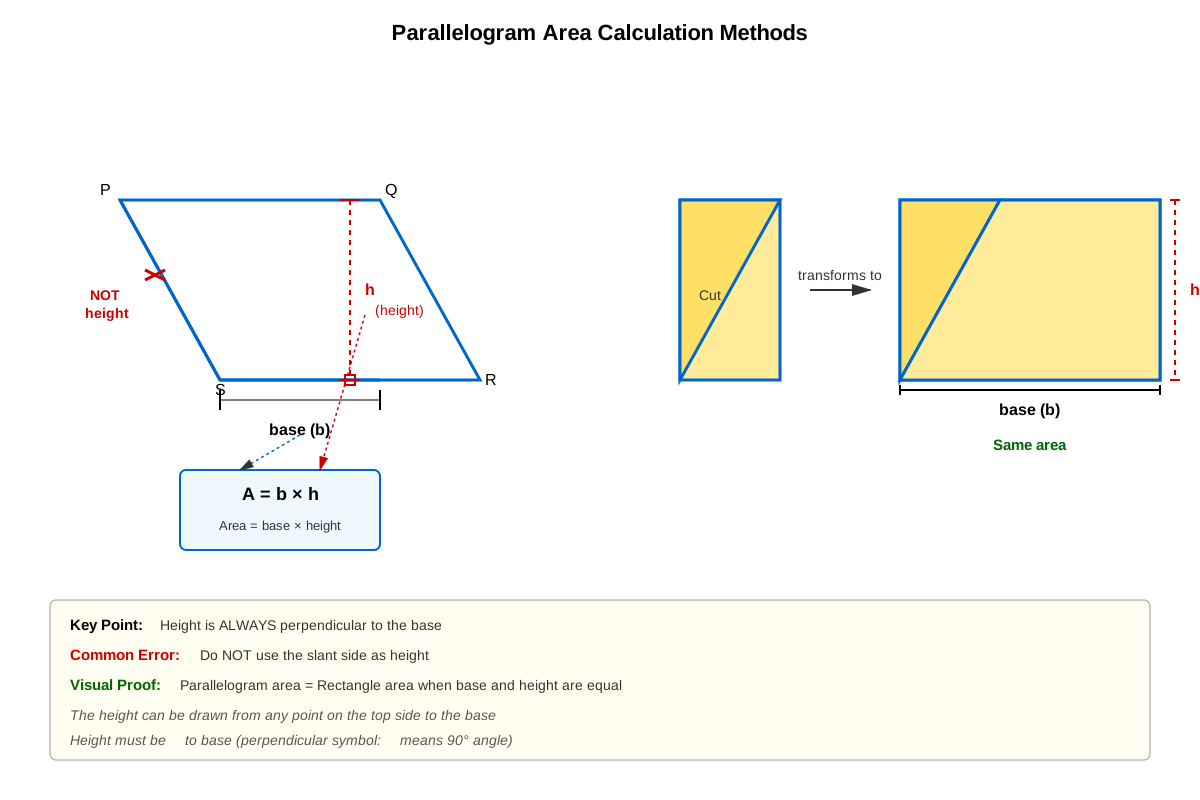
The area of a parallelogram equals the base multiplied by the height: A = bh. The critical understanding here is that the height must be perpendicular to the base. Many students incorrectly use the slant side length instead of the perpendicular height, leading to incorrect answers.
The base can be any side of the parallelogram, but once a base is chosen, the height must be the perpendicular distance from that base to the opposite side. On the ACT, height information may be given directly, embedded in a diagram with right angle markers, or require calculation using trigonometry or the Pythagorean theorem.
An alternative area formula uses two adjacent sides and the included angle: A = ab sin(θ), where a and b are adjacent side lengths and θ is the angle between them. This formula appears less frequently on the ACT but proves useful when angle measures are given instead of perpendicular height.
Diagonal Properties
The diagonals of a parallelogram bisect each other, meaning they intersect at their midpoints. If diagonals AC and BD intersect at point E, then AE = EC and BE = ED. This property is particularly important in coordinate geometry problems where students must find the coordinates of vertices or prove that a quadrilateral is a parallelogram.
Unlike rectangles or rhombuses, the diagonals of a general parallelogram are neither congruent nor perpendicular. However, the diagonals do divide the parallelogram into two pairs of congruent triangles. Diagonal AC divides the parallelogram into triangles ABC and CDA, which are congruent. Similarly, diagonal BD creates congruent triangles ABD and CDB.
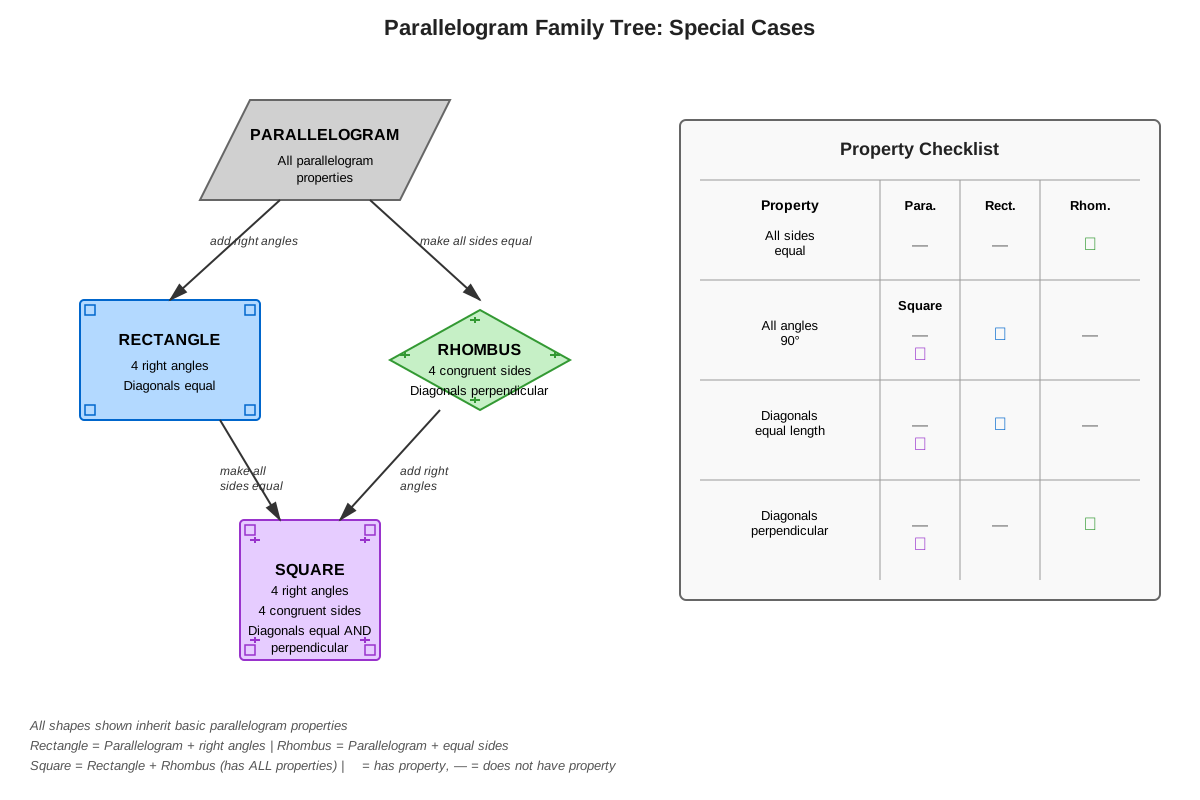
Special Parallelograms
Three special types of parallelograms appear frequently on the ACT:
| Type | Additional Properties | Diagonal Properties |
|---|---|---|
| Rectangle | All angles are 90°; opposite sides congruent | Diagonals are congruent; bisect each other |
| Rhombus | All four sides are congruent | Diagonals are perpendicular; bisect each other; bisect the angles |
| Square | All angles are 90°; all sides congruent | Diagonals are congruent, perpendicular, bisect each other, and bisect angles |
Recognizing these special cases allows for additional problem-solving strategies. For example, if a problem states that a parallelogram has perpendicular diagonals, it must be a rhombus, immediately establishing that all sides are congruent.
Coordinate Geometry Applications
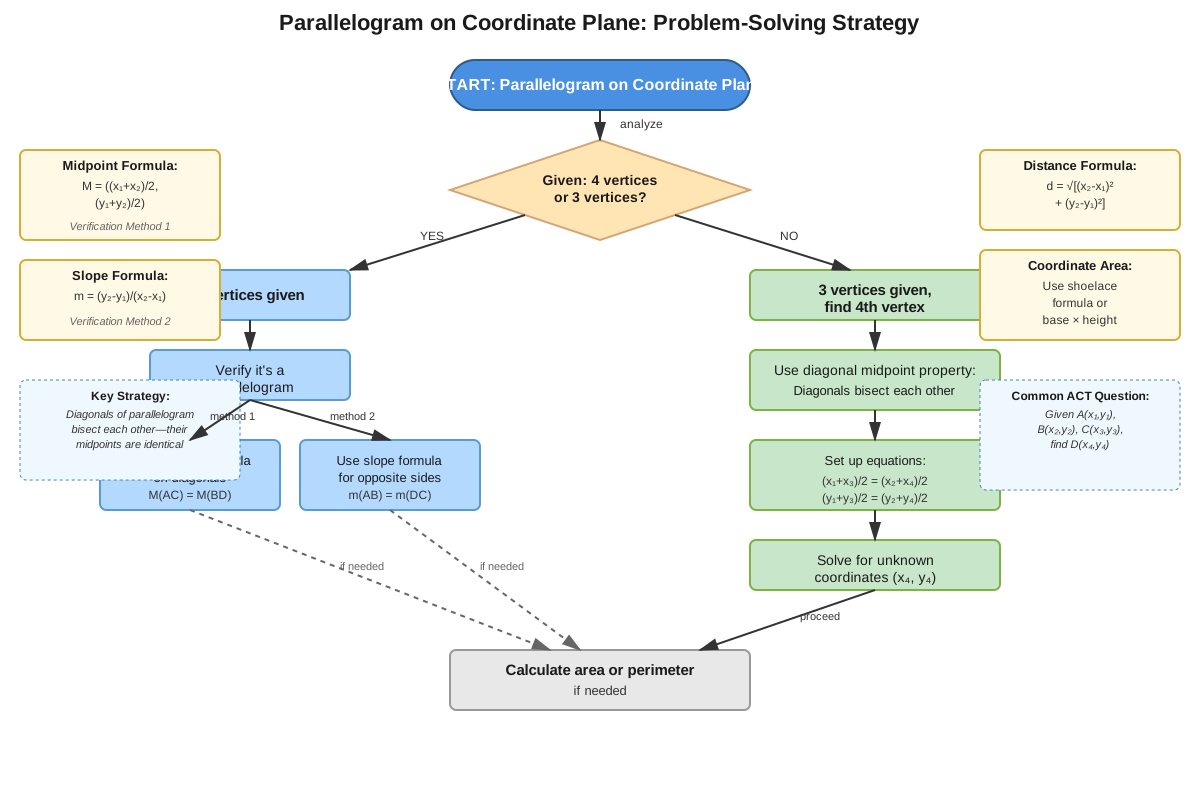
When parallelogram vertices are given as coordinate points, several strategies prove useful:
- Slope verification: Opposite sides must have equal slopes to be parallel
- Distance formula: Opposite sides must have equal lengths
- Midpoint formula: Diagonals must share the same midpoint
For a quadrilateral with vertices A(x₁, y₁), B(x₂, y₂), C(x₃, y₃), and D(x₄, y₄) to be a parallelogram, the midpoint of diagonal AC must equal the midpoint of diagonal BD. This provides the most efficient verification method on the ACT.
Perimeter Calculation
The perimeter of a parallelogram equals the sum of all four side lengths. Since opposite sides are congruent, if adjacent sides have lengths a and b, then P = 2a + 2b = 2(a + b). This formula simplifies perimeter calculations and appears in problems where students must solve for unknown side lengths given the perimeter and one side length.
Concept Relationships
The properties of parallelograms form an interconnected web of relationships. The defining property (opposite sides parallel) → leads to → congruent opposite sides and congruent opposite angles through alternate interior angle relationships. These angle congruences → combine with → the quadrilateral angle sum property (360°) → to establish → that consecutive angles are supplementary.
The diagonal bisection property → connects to → coordinate geometry through the midpoint formula, while also → relating to → triangle congruence theorems. When diagonals bisect each other, they create congruent triangles through the Side-Angle-Side (SAS) congruence theorem, which → reinforces → the opposite side and angle congruence properties.
Special parallelograms → build upon → general parallelogram properties by adding constraints. Rectangles → add → right angles to parallelogram properties, while rhombuses → add → congruent sides. Squares → combine → both rectangle and rhombus properties, making them the most constrained parallelograms.
Area calculations → depend on → understanding perpendicular height versus slant side length, which → connects to → right triangle trigonometry and the Pythagorean theorem. Coordinate geometry problems → integrate → distance formulas, slope calculations, and midpoint formulas with parallelogram properties, creating multi-step problems that test multiple skills simultaneously.
Quick check — test yourself on Parallelograms so far.
Try Flashcards →High-Yield Facts
⭐ Opposite sides of a parallelogram are both parallel and congruent
⭐ Opposite angles in a parallelogram are congruent
⭐ Consecutive angles in a parallelogram are supplementary (sum to 180°)
⭐ The diagonals of a parallelogram bisect each other
⭐ The area of a parallelogram equals base times perpendicular height: A = bh
- The sum of all interior angles in any parallelogram equals 360°
- If one angle of a parallelogram is a right angle, all angles are right angles (making it a rectangle)
- The diagonals of a parallelogram divide it into two pairs of congruent triangles
- A quadrilateral is a parallelogram if and only if its diagonals bisect each other
- In coordinate geometry, opposite sides of a parallelogram have equal slopes
- The perimeter of a parallelogram with adjacent sides a and b equals 2(a + b)
- A rhombus is a parallelogram with four congruent sides and perpendicular diagonals
- A rectangle is a parallelogram with four right angles and congruent diagonals
- A square is both a rectangle and a rhombus, possessing all properties of both
- The height of a parallelogram must be measured perpendicular to the base, not along a slant side
Common Misconceptions
Misconception: The height of a parallelogram is the length of the slant side.
Correction: The height must be the perpendicular distance from the base to the opposite side. The slant side is typically longer than the height unless the parallelogram is a rectangle. Always look for right angle markers or calculate the perpendicular distance.
Misconception: All parallelograms have congruent diagonals.
Correction: Only rectangles (and squares, which are special rectangles) have congruent diagonals. General parallelograms and rhombuses have diagonals of different lengths. The diagonals of all parallelograms bisect each other, but this doesn't mean they're congruent.
Misconception: If a quadrilateral has one pair of parallel sides, it's a parallelogram.
Correction: A parallelogram requires two pairs of parallel sides. A quadrilateral with only one pair of parallel sides is a trapezoid, not a parallelogram. Both pairs of opposite sides must be parallel.
Misconception: Adjacent angles in a parallelogram are congruent.
Correction: Adjacent (consecutive) angles are supplementary, meaning they sum to 180°, not congruent. Opposite angles are the ones that are congruent. This distinction is crucial for solving angle measure problems.
Misconception: The diagonals of a parallelogram are perpendicular.
Correction: Only rhombuses (and squares, which are special rhombuses) have perpendicular diagonals. General parallelograms and rectangles have diagonals that intersect at non-right angles. If a problem states the diagonals are perpendicular, you can conclude the figure is a rhombus.
Misconception: All sides of a parallelogram are equal.
Correction: Only rhombuses and squares have four congruent sides. General parallelograms and rectangles have two pairs of congruent opposite sides, but adjacent sides typically have different lengths. Don't assume all sides are equal unless explicitly stated or proven.
Worked Examples
Example 1: Finding Unknown Angles
Problem: In parallelogram PQRS, angle P measures 65°. Find the measures of angles Q, R, and S.
Solution:
Step 1: Identify what we know. We have a parallelogram with ∠P = 65°.
Step 2: Apply the opposite angles property. Since opposite angles in a parallelogram are congruent:
- ∠R = ∠P = 65°
Step 3: Apply the consecutive angles property. Consecutive angles are supplementary, so:
- ∠P + ∠Q = 180°
- 65° + ∠Q = 180°
- ∠Q = 180° - 65° = 115°
Step 4: Use the opposite angles property again:
- ∠S = ∠Q = 115°
Step 5: Verify by checking that all angles sum to 360°:
- 65° + 115° + 65° + 115° = 360° ✓
Answer: ∠Q = 115°, ∠R = 65°, ∠S = 115°
This problem directly tests Learning Objective 2 (explaining core rules) and Objective 5 (determining unknown angle measures using parallelogram properties).
Example 2: Coordinate Geometry Application
Problem: Points A(2, 3), B(7, 5), and C(9, 10) are three vertices of parallelogram ABCD. Find the coordinates of vertex D.
Solution:
Step 1: Understand that in a parallelogram, diagonals bisect each other. This means the midpoint of diagonal AC equals the midpoint of diagonal BD.
Step 2: Find the midpoint of diagonal AC using the midpoint formula: M = ((x₁ + x₂)/2, (y₁ + y₂)/2)
- Midpoint of AC = ((2 + 9)/2, (3 + 10)/2) = (11/2, 13/2) = (5.5, 6.5)
Step 3: Let D have coordinates (x, y). The midpoint of BD must also be (5.5, 6.5).
- Midpoint of BD = ((7 + x)/2, (5 + y)/2)
Step 4: Set up equations:
- (7 + x)/2 = 5.5
- (5 + y)/2 = 6.5
Step 5: Solve for x:
- 7 + x = 11
- x = 4
Step 6: Solve for y:
- 5 + y = 13
- y = 8
Step 7: Verify by checking that opposite sides are parallel (equal slopes):
- Slope of AB = (5 - 3)/(7 - 2) = 2/5
- Slope of DC = (8 - 10)/(4 - 9) = -2/-5 = 2/5 ✓
- Slope of BC = (10 - 5)/(9 - 7) = 5/2
- Slope of AD = (8 - 3)/(4 - 2) = 5/2 ✓
Answer: D(4, 8)
This problem demonstrates Learning Objective 3 (applying parallelograms to ACT-style questions) and Objective 7 (solving coordinate geometry problems).
Exam Strategy
When approaching parallelogram questions on the ACT, begin by identifying trigger words and visual cues. Look for explicit mentions of "parallelogram," diagrams showing parallel side markers (arrows), or descriptions stating "opposite sides are parallel." Questions may also describe special parallelograms using terms like "rectangle," "rhombus," or "square."
Key trigger phrases include:
- "In parallelogram ABCD..."
- "Opposite sides are parallel and congruent..."
- "The diagonals bisect each other..."
- "Find the measure of angle..."
- "Calculate the area of the parallelogram..."
- "Prove that quadrilateral WXYZ is a parallelogram..."
Strategic approach sequence:
- Identify the type: Determine if you're working with a general parallelogram or a special type (rectangle, rhombus, square). Special types have additional properties you can exploit.
- Mark known information: On your test booklet, label all given side lengths, angle measures, and coordinate points directly on the diagram.
- Apply properties systematically: Use opposite side congruence for length problems, consecutive angle supplementarity for angle problems, and diagonal bisection for coordinate problems.
- Choose the right formula: For area problems, identify the base and perpendicular height carefully. Don't confuse slant side length with height.
- Verify when possible: If time permits, check your answer using an alternative property or method.
Process of elimination tips:
- Eliminate answer choices that violate the 360° angle sum
- Reject area calculations that use slant side instead of height
- Eliminate coordinates that don't result in bisecting diagonals
- Rule out angle measures that would make consecutive angles sum to something other than 180°
Time allocation: Straightforward property application questions should take 30-45 seconds. Multi-step coordinate geometry or algebraic problems may require 60-90 seconds. If a problem requires more than 2 minutes, mark it and return later.
Exam Tip: When a diagram isn't provided, quickly sketch the parallelogram and label all given information. Visual representation prevents errors and reveals relationships more clearly.
Memory Techniques
POCS - Remember the four main parallelogram properties:
- Parallel opposite sides
- Opposite sides and angles congruent
- Consecutive angles supplementary
- Split diagonals (bisect each other)
"Opposite Twins, Consecutive Supplements" - This phrase captures the two key angle relationships: opposite angles are identical (twins), while consecutive angles add to 180° (supplements).
Height vs. Slant visualization: Picture a parallelogram as a "leaning rectangle." The height is like dropping a perpendicular line from the top to the base—it's always shorter than the slanted side unless the figure is actually a rectangle.
Special parallelogram hierarchy: Visualize a pyramid:
- Top: Square (most restrictive - all properties)
- Middle: Rectangle and Rhombus (each adds one special property)
- Bottom: Parallelogram (basic properties only)
Diagonal memory device: "Diagonals Meet in the Middle" - This reminds you that diagonals bisect each other (meet at their midpoints).
Area formula connection: Think "base × height" just like rectangles, but remember the height must "drop down" perpendicular to the base, not slant along the side.
Summary
Parallelograms are quadrilaterals with two pairs of parallel opposite sides, creating a cascade of important properties that the ACT tests extensively. The four fundamental properties—opposite sides congruent, opposite angles congruent, consecutive angles supplementary, and diagonals bisecting each other—form the foundation for solving virtually all parallelogram problems. Area calculations require careful identification of the perpendicular height rather than slant side length, using the formula A = bh. Special parallelograms (rectangles, rhombuses, and squares) possess all general parallelogram properties plus additional constraints that provide extra problem-solving tools. Coordinate geometry applications leverage the diagonal bisection property through midpoint calculations, while algebraic problems use congruence relationships to set up equations. Success on ACT parallelogram questions requires quick property recognition, systematic application of relationships, and careful attention to whether consecutive or opposite elements are being compared. Mastering these concepts enables efficient solution of the 2-3 parallelogram questions that typically appear on each ACT Math test.
Key Takeaways
- Opposite sides and opposite angles of parallelograms are always congruent; consecutive angles always sum to 180°
- The diagonals of any parallelogram bisect each other, making midpoint calculations crucial for coordinate geometry problems
- Area equals base times perpendicular height (A = bh), never base times slant side length
- Rectangles add right angles, rhombuses add congruent sides and perpendicular diagonals, and squares combine both
- In coordinate geometry, verify parallelograms by confirming opposite sides have equal slopes or diagonals share a midpoint
- Perimeter equals twice the sum of two adjacent sides: P = 2(a + b)
- All parallelogram interior angles sum to 360°, consistent with all quadrilaterals
Related Topics
Trapezoids: Understanding parallelograms provides contrast with trapezoids, which have only one pair of parallel sides. Mastering parallelogram properties helps identify when a quadrilateral is not a parallelogram.
Triangle Congruence and Similarity: Parallelogram diagonals create triangles, and proving these triangles congruent reinforces parallelogram properties while building proof-writing skills.
Coordinate Geometry: Advanced coordinate geometry problems often involve parallelograms, requiring integration of distance formulas, slope calculations, and midpoint formulas with geometric properties.
Vectors: In advanced mathematics, parallelograms represent vector addition geometrically, with adjacent sides representing vectors and the diagonal representing their sum.
Transformations: Understanding parallelograms enables study of geometric transformations, particularly shear transformations that convert rectangles to general parallelograms.
Practice CTA
Now that you've mastered the essential properties and strategies for parallelograms, it's time to solidify your understanding through active practice. Work through the practice questions to apply these concepts to ACT-style problems, testing your ability to identify properties, calculate areas, and solve coordinate geometry challenges. Use the flashcards to reinforce the key properties and formulas until they become automatic. Remember, parallelogram questions appear frequently on the ACT, and confident mastery of this topic will boost both your accuracy and speed on test day. You've built a strong foundation—now practice applying it!
Sign up free to keep reading
Create a free AnvayaPrep account to finish this ACT guide on Parallelograms — plus flashcards and practice questions.