Overview
Trapezoids represent a critical category of quadrilaterals that appear regularly on the ACT Math section, particularly within Plane Geometry questions. A trapezoid is defined as a quadrilateral with exactly one pair of parallel sides, called bases, while the non-parallel sides are called legs. Understanding trapezoids requires mastery of their unique properties, area formulas, and relationships to other geometric figures. The ACT frequently tests trapezoid concepts through area calculations, coordinate geometry applications, and multi-step problems that combine trapezoid properties with other geometric principles.
The importance of trapezoids on the ACT extends beyond simple identification and formula application. Test-makers often embed trapezoid problems within complex scenarios involving coordinate planes, similar figures, or composite shapes. Students must recognize when a problem involves a trapezoid—sometimes the shape isn't explicitly named—and apply the appropriate formulas and properties efficiently. Trapezoid questions typically appear 1-2 times per ACT Math section, making them high-yield content that deserves focused attention.
Trapezoids connect to broader mathematical concepts including parallel lines, area formulas, coordinate geometry, and properties of quadrilaterals. They serve as a bridge between simpler shapes like rectangles and parallelograms and more complex polygon problems. Mastering trapezoids strengthens overall geometric reasoning and provides essential tools for solving multi-step problems that integrate multiple geometric concepts—a hallmark of medium-to-difficult ACT Math questions.
Learning Objectives
- [ ] Identify when Trapezoids is being tested
- [ ] Explain the core rule or strategy behind Trapezoids
- [ ] Apply Trapezoids to ACT-style questions accurately
- [ ] Calculate the area of trapezoids using the standard formula with both given and derived measurements
- [ ] Determine missing dimensions of trapezoids using properties of parallel lines and coordinate geometry
- [ ] Distinguish between general trapezoids and isosceles trapezoids and apply their specific properties
- [ ] Solve multi-step problems involving trapezoids in coordinate planes and composite figures
Prerequisites
- Parallel lines and transversals: Essential for understanding the relationship between trapezoid bases and recognizing when sides are parallel
- Area formulas for basic shapes: Provides foundation for understanding how trapezoid area formula relates to rectangles and triangles
- Coordinate geometry basics: Necessary for finding distances, slopes, and identifying parallel sides in coordinate plane problems
- Properties of quadrilaterals: Helps distinguish trapezoids from other four-sided figures and understand their unique characteristics
- Algebraic manipulation: Required for solving equations when finding unknown dimensions or working with variable expressions
Why This Topic Matters
Trapezoids appear in numerous real-world applications, from architectural design and engineering to land surveying and construction. Trapezoidal shapes are common in bridge supports, building facades, and road design where parallel edges at different lengths are structurally advantageous. Understanding trapezoid calculations enables professionals to determine material quantities, structural loads, and spatial relationships in practical scenarios.
On the ACT Math section, trapezoid questions typically appear 1-2 times per test, representing approximately 2-3% of the Plane Geometry content. These questions most commonly test area calculations (60% of trapezoid problems), coordinate geometry applications (25%), and properties-based reasoning (15%). The ACT favors problems where students must first identify that a shape is a trapezoid before applying formulas, or where trapezoid calculations are embedded within larger multi-step problems.
Common ACT question formats include: providing a diagram with labeled dimensions and asking for area; presenting coordinates of vertices and requiring students to calculate area using the coordinate plane; describing a trapezoid verbally and asking students to determine missing measurements; and incorporating trapezoids into composite figure problems where students must decompose or combine shapes. The test also frequently presents isosceles trapezoids in coordinate geometry contexts, testing whether students recognize the special properties of this trapezoid subtype.
Core Concepts
Definition and Basic Properties
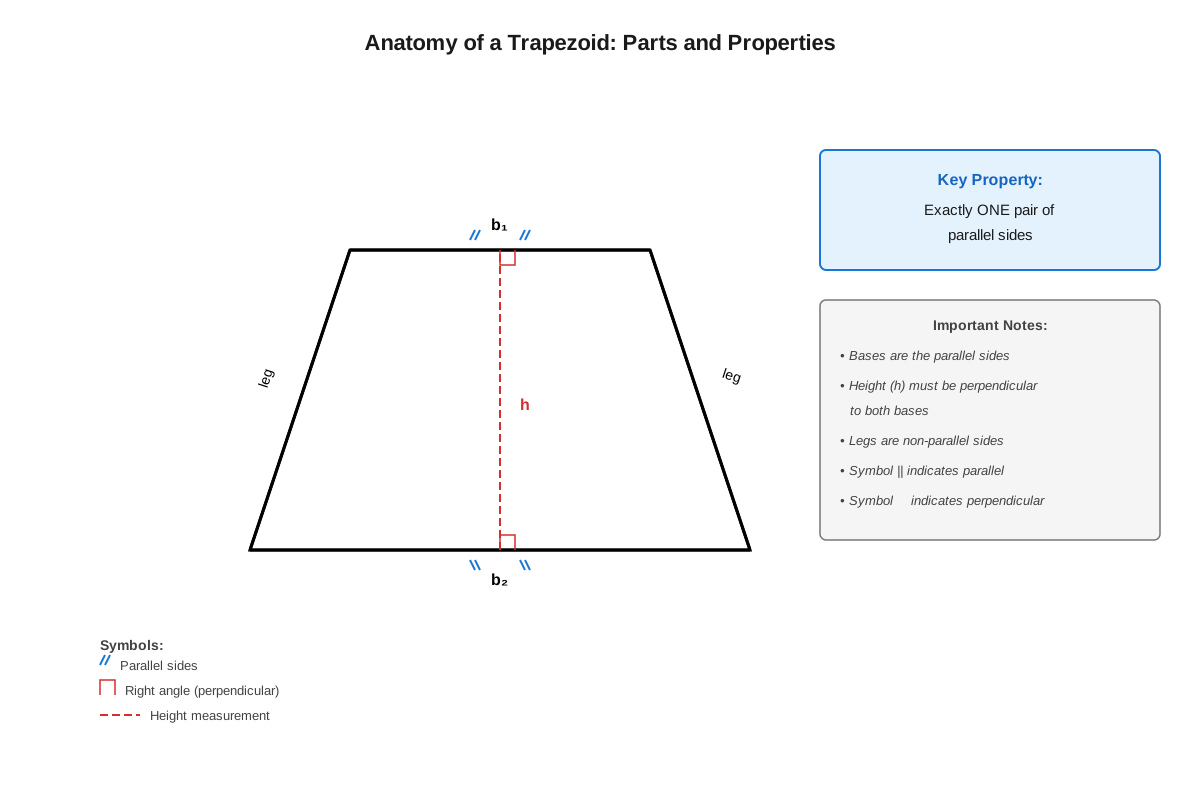
A trapezoid is a quadrilateral with exactly one pair of parallel sides. The parallel sides are called bases (typically labeled b₁ and b₂), while the non-parallel sides are called legs. The perpendicular distance between the two bases is the height (h) or altitude of the trapezoid. This definition distinguishes trapezoids from parallelograms, which have two pairs of parallel sides.
Key properties of all trapezoids include:
- The bases are parallel to each other
- The legs are not parallel
- The sum of all interior angles equals 360° (like all quadrilaterals)
- Consecutive angles between a base and a leg are supplementary (sum to 180°) when extended
Trapezoid Area Formula
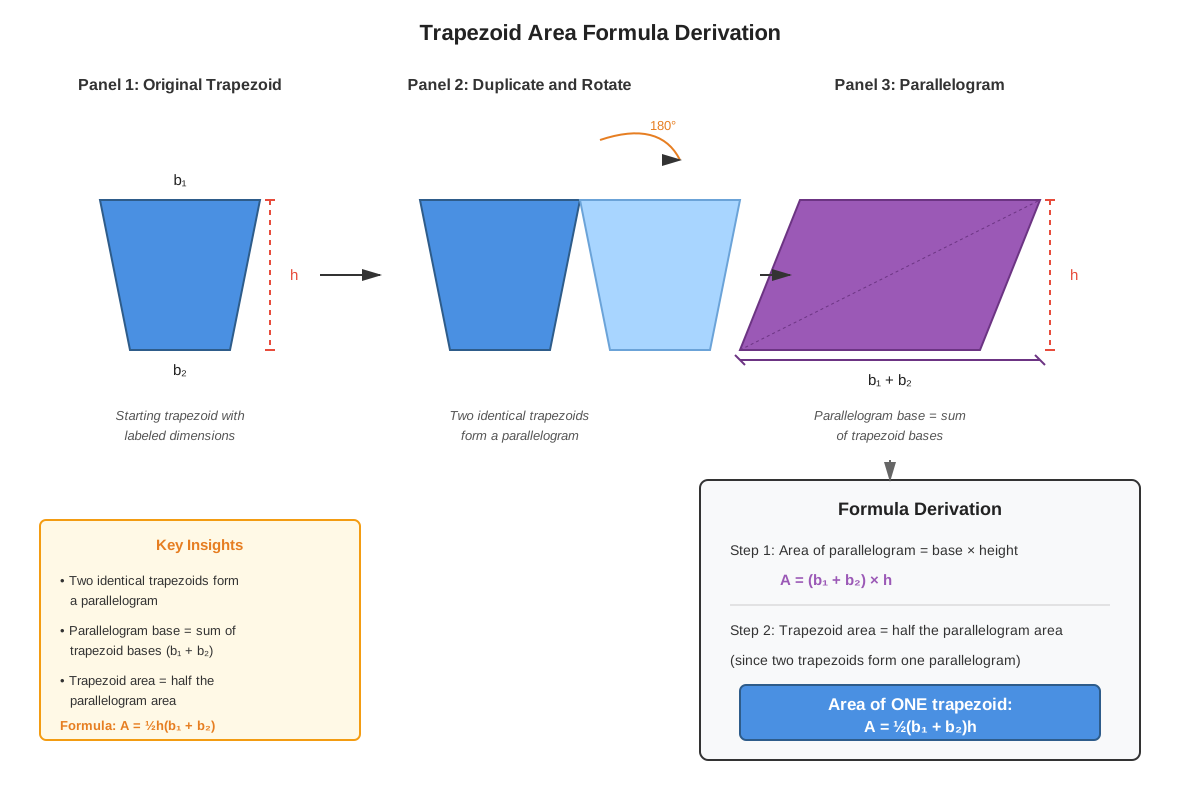
The fundamental formula for calculating the area of any trapezoid is:
Area = ½ × (b₁ + b₂) × hWhere:
- b₁ = length of the first base
- b₂ = length of the second base
- h = perpendicular height between the bases
This formula can be understood as the average of the two base lengths multiplied by the height, or equivalently, half the sum of the bases times the height. The formula works because a trapezoid can be visualized as the average of two rectangles—one with width b₁ and one with width b₂—both with height h.
Critical insight: The height must be perpendicular to both bases. If given a slant height (the length of a leg), students must use additional information to find the perpendicular height, often through the Pythagorean theorem or trigonometry.
Isosceles Trapezoids
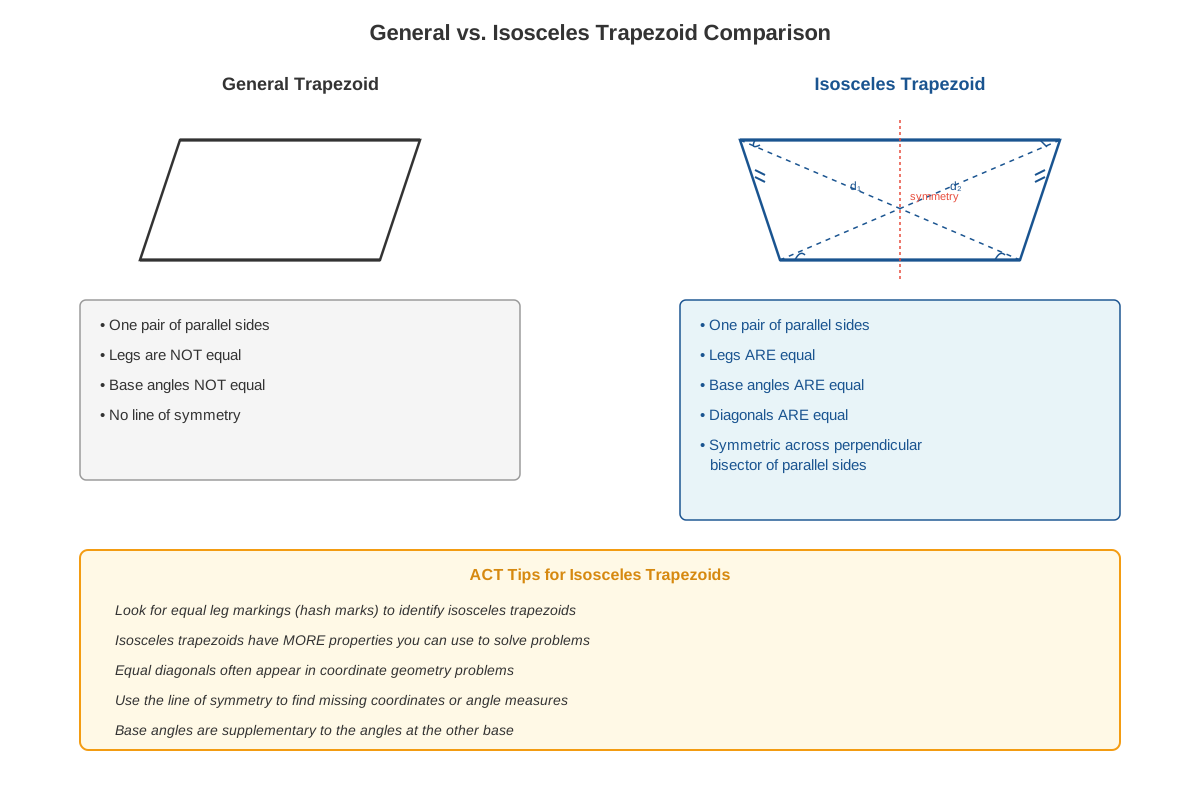
An isosceles trapezoid is a special type of trapezoid where the two legs are congruent (equal in length). This additional constraint creates several important properties:
- The base angles are congruent (angles along the same base are equal)
- The diagonals are congruent
- The trapezoid has a line of symmetry perpendicular to both bases, passing through their midpoints
- When placed on a coordinate plane with bases parallel to the x-axis, the trapezoid is symmetric about a vertical line
Isosceles trapezoids frequently appear in ACT coordinate geometry problems because their symmetry creates predictable coordinate patterns. For example, if the vertices are at (a, c), (b, c), (d, e), and (f, e), and the shape is an isosceles trapezoid, then the x-coordinates satisfy specific relationships based on the symmetry.
Median (Midsegment) of a Trapezoid
The median or midsegment of a trapezoid is the line segment connecting the midpoints of the two legs. This segment has two crucial properties:
- It is parallel to both bases
- Its length equals the average of the two base lengths: m = (b₁ + b₂)/2
While less commonly tested than area, the median property can appear in problems involving similar figures or when determining unknown dimensions. The median divides the trapezoid into two smaller trapezoids of equal height.
Trapezoids in Coordinate Geometry
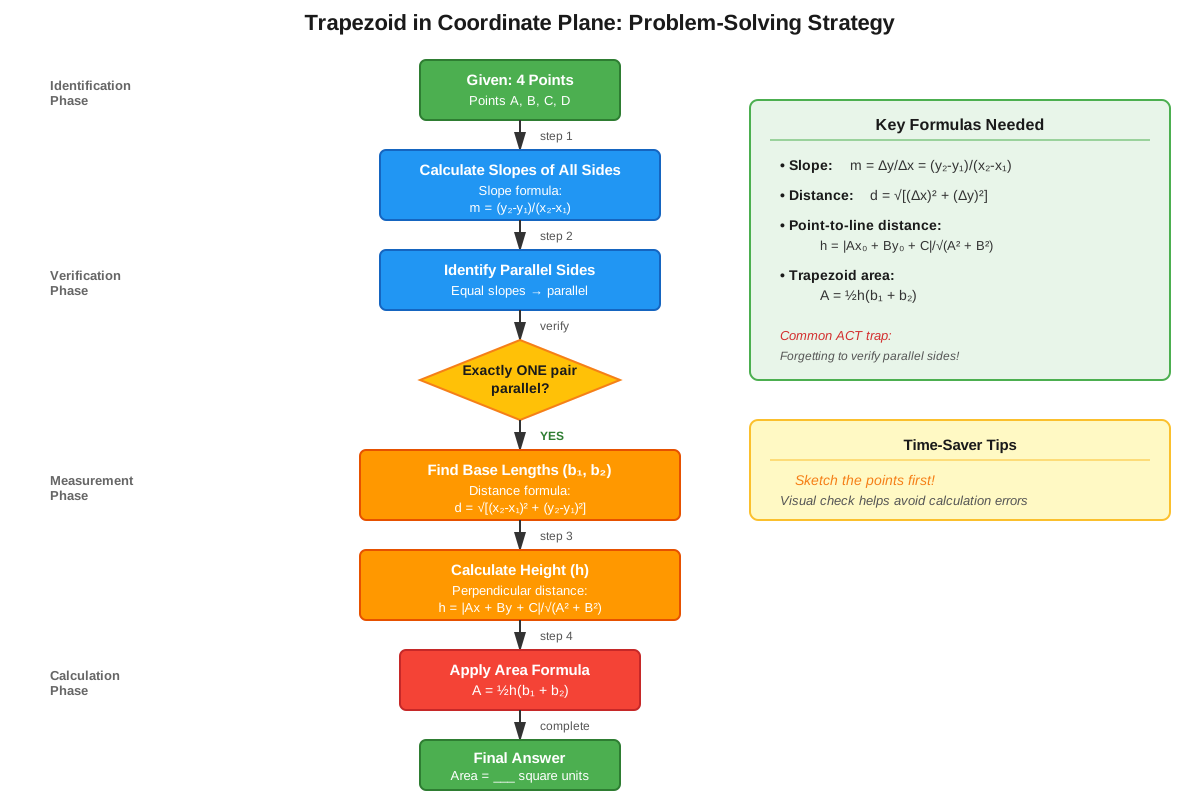
When trapezoid vertices are given as coordinate points, students must:
- Verify parallel sides by calculating slopes (parallel lines have equal slopes)
- Calculate base lengths using the distance formula
- Determine height by finding the perpendicular distance between the parallel sides
For trapezoids with bases parallel to the x-axis or y-axis, the height calculation simplifies to the absolute difference in the constant coordinates. For example, if bases lie on y = 3 and y = 7, the height is |7 - 3| = 4.
Decomposition Strategy
Complex trapezoid problems often benefit from decomposition—breaking the trapezoid into simpler shapes. A trapezoid can be divided into:
- A rectangle and one or two triangles
- Two triangles by drawing a diagonal
- A parallelogram and a triangle
This strategy is particularly useful when the standard area formula cannot be directly applied or when working with composite figures.
Concept Relationships
The core concepts of trapezoids form an interconnected system where understanding one element enhances comprehension of others. The definition (one pair of parallel sides) → directly determines → which formula applies (the trapezoid area formula rather than parallelogram or triangle formulas). The area formula → connects to → median properties because both involve averaging the base lengths, revealing the underlying mathematical relationship.
Isosceles trapezoids → represent a special case → building upon general trapezoid properties while adding symmetry constraints. This specialization → enables → more efficient problem-solving in coordinate geometry contexts where symmetry provides additional equations and relationships.
The coordinate geometry applications → integrate → prerequisite knowledge of parallel lines (through slope calculations) and distance formulas (for finding base lengths and heights). The decomposition strategy → connects trapezoids → to triangles and rectangles, demonstrating how complex shapes relate to simpler foundational figures.
Understanding these relationships allows students to approach unfamiliar problems by recognizing patterns: coordinate problems often involve isosceles trapezoids; area problems may require finding height through decomposition; and multi-step problems frequently combine trapezoid properties with parallel line theorems or similar figure ratios.
High-Yield Facts
⭐ The trapezoid area formula is A = ½(b₁ + b₂)h, where b₁ and b₂ are the parallel bases and h is the perpendicular height
⭐ A trapezoid has exactly one pair of parallel sides; if it has two pairs, it's a parallelogram, not a trapezoid
⭐ The height of a trapezoid must be perpendicular to both bases; leg length is not the same as height
⭐ In coordinate geometry, two sides are parallel if and only if they have equal slopes
⭐ An isosceles trapezoid has congruent legs, congruent base angles, and congruent diagonals
- The median (midsegment) of a trapezoid is parallel to the bases and has length equal to the average of the base lengths
- Consecutive angles between a base and a leg in a trapezoid are supplementary (sum to 180°)
- The sum of all interior angles in any trapezoid equals 360°
- When a trapezoid has bases parallel to the x-axis, the height equals the absolute difference of the y-coordinates
- A trapezoid can be decomposed into a rectangle and triangles for alternative area calculation methods
- The diagonals of a general trapezoid are not necessarily congruent (only in isosceles trapezoids)
- If given coordinates, always verify which sides are parallel before assuming a shape is a trapezoid
- The area formula can be rewritten as A = (median) × h, where median = (b₁ + b₂)/2
Quick check — test yourself on Trapezoids so far.
Try Flashcards →Common Misconceptions
Misconception: All quadrilaterals with two parallel sides are trapezoids → Correction: Trapezoids have exactly one pair of parallel sides. Parallelograms, rectangles, rhombuses, and squares have two pairs of parallel sides and are not classified as trapezoids in the exclusive definition used by the ACT.
Misconception: The leg length can be used as the height in the area formula → Correction: The height must be the perpendicular distance between the bases. The leg length is typically longer than the height (except in right trapezoids where one leg is perpendicular to the bases). Using leg length instead of height will produce an incorrect, inflated area.
Misconception: The longer side is always the base → Correction: The bases are defined as the parallel sides, regardless of their length. Sometimes the shorter parallel side is referred to as the "upper base" and the longer as the "lower base," but both are bases. The non-parallel sides are legs, regardless of their length.
Misconception: Isosceles trapezoids must have equal bases → Correction: Isosceles trapezoids have equal legs (the non-parallel sides), not equal bases. If the bases were equal, combined with equal legs, the figure would be a parallelogram. The defining feature of an isosceles trapezoid is congruent legs.
Misconception: You can always use the distance formula to find the height → Correction: The distance formula gives the straight-line distance between two points, which might be along a leg or diagonal rather than the perpendicular height. To find height, you need the perpendicular distance between the parallel bases, which may require additional calculations using the Pythagorean theorem or coordinate geometry techniques.
Misconception: Trapezoids always have right angles → Correction: Only right trapezoids have right angles (specifically, two adjacent right angles). General trapezoids can have any angle measures as long as consecutive angles along a leg are supplementary and the sum of all angles equals 360°.
Misconception: The area formula requires the bases to be horizontal → Correction: The formula A = ½(b₁ + b₂)h works regardless of the trapezoid's orientation. The bases are simply the parallel sides, and the height is the perpendicular distance between them, whether the trapezoid is oriented horizontally, vertically, or at any angle.
Worked Examples
Example 1: Standard Area Calculation with Given Dimensions
Problem: A trapezoid has parallel bases measuring 8 cm and 14 cm. The perpendicular distance between the bases is 5 cm. What is the area of the trapezoid?
Solution:
Step 1: Identify the given information
- Base 1 (b₁) = 8 cm
- Base 2 (b₂) = 14 cm
- Height (h) = 5 cm
Step 2: Recognize this is a direct application of the trapezoid area formula
Step 3: Apply the formula A = ½(b₁ + b₂)h
A = ½(8 + 14)(5)
A = ½(22)(5)
A = (11)(5)
A = 55 cm²Answer: 55 cm²
Connection to Learning Objectives: This example demonstrates the core strategy of identifying when the trapezoid formula applies and executing the calculation accurately—addressing the objectives of explaining the core rule and applying it to ACT-style questions.
Example 2: Coordinate Geometry Application
Problem: A trapezoid has vertices at points A(2, 3), B(8, 3), C(7, 7), and D(3, 7). Find the area of trapezoid ABCD.
Solution:
Step 1: Identify which sides are parallel by examining coordinates
- Points A and B both have y-coordinate 3, so AB is horizontal
- Points C and D both have y-coordinate 7, so CD is horizontal
- Since AB and CD are both horizontal, they are parallel—these are the bases
Step 2: Calculate the length of each base using the distance formula (simplified for horizontal lines)
- Base AB: |8 - 2| = 6 units
- Base CD: |7 - 3| = 4 units
Step 3: Calculate the height (perpendicular distance between the parallel bases)
- Since both bases are horizontal, height = |7 - 3| = 4 units
Step 4: Apply the trapezoid area formula
A = ½(b₁ + b₂)h
A = ½(6 + 4)(4)
A = ½(10)(4)
A = 20 square unitsAnswer: 20 square units
Connection to Learning Objectives: This example addresses identifying when trapezoids are being tested (recognizing the shape from coordinates), determining missing dimensions using coordinate geometry, and applying the formula accurately in a coordinate plane context.
Example 3: Multi-Step Problem with Unknown Dimension
Problem: An isosceles trapezoid has bases of length 10 inches and 18 inches. Each leg has length 5 inches. What is the area of the trapezoid?
Solution:
Step 1: Recognize that we need to find the height, which is not directly given
Step 2: Use the properties of isosceles trapezoids to set up a right triangle
- The difference in base lengths is 18 - 10 = 8 inches
- Due to symmetry, this difference is split equally on both sides: 8/2 = 4 inches
- Drawing a perpendicular from the end of the shorter base to the longer base creates a right triangle with:
- Hypotenuse = leg length = 5 inches
- Base = 4 inches
- Height = unknown (this is the trapezoid's height)
Step 3: Apply the Pythagorean theorem to find the height
h² + 4² = 5²
h² + 16 = 25
h² = 9
h = 3 inches
Step 4: Calculate the area using the trapezoid formula
A = ½(10 + 18)(3)
A = ½(28)(3)
A = 42 square inchesAnswer: 42 square inches
Connection to Learning Objectives: This example demonstrates identifying trapezoid problems in complex scenarios, applying properties of isosceles trapezoids, using multi-step reasoning to find missing dimensions, and accurately calculating area—addressing all major learning objectives.
Exam Strategy
When approaching ACT trapezoids questions, begin by carefully reading the problem to identify whether a trapezoid is explicitly mentioned or must be inferred from given information. Look for trigger phrases such as "quadrilateral with one pair of parallel sides," "bases of length," or coordinate problems where exactly two sides have equal slopes. Sometimes the ACT presents a diagram without naming the shape, requiring students to recognize the trapezoid from visual cues.
Time allocation: Standard trapezoid problems should take 45-60 seconds, while complex coordinate geometry or multi-step problems may require 90-120 seconds. If a problem requires finding the height through the Pythagorean theorem or decomposition, budget the full two minutes.
Process-of-elimination strategies:
- Eliminate answer choices that exceed the area of a rectangle with dimensions equal to the larger base and the height (this represents the maximum possible area)
- Eliminate choices smaller than the area of a triangle with base equal to the larger base and the same height (this represents approximately the minimum area)
- For coordinate geometry problems, eliminate answers that don't match the scale of the coordinate system
- If the problem involves an isosceles trapezoid, use symmetry to eliminate answers that don't reflect this property
Step-by-step approach:
- Identify the shape as a trapezoid and determine which sides are the bases (parallel sides)
- Extract or calculate the lengths of both bases
- Determine the height—this may be given directly, require coordinate geometry, or need the Pythagorean theorem
- Apply the formula A = ½(b₁ + b₂)h carefully, checking each calculation
- Verify the answer makes geometric sense given the dimensions
Common traps to avoid:
- Using leg length instead of perpendicular height
- Forgetting the ½ in the area formula
- Adding bases without multiplying by height
- Confusing which sides are parallel in coordinate problems
- Assuming a quadrilateral is a trapezoid without verifying exactly one pair of parallel sides
Exam Tip: If you're given a trapezoid problem with coordinates, immediately check slopes to confirm which sides are parallel. This prevents wasting time on incorrect approaches.
Memory Techniques
Trapezoid Area Mnemonic: "Half the Bases Times Height" → HBTH → Think "Have Both, Times Height" to remember A = ½(b₁ + b₂)h
Parallel Identification: "Same Slope = Sides are Siblings" → In coordinate geometry, parallel sides have identical slopes, like siblings sharing traits
Isosceles Trapezoid Properties: "Legs Like Length" → The defining feature is equal leg length, which leads to equal base angles and equal diagonals
Height vs. Leg Visualization: Picture a ladder leaning against a wall—the ladder length (leg) is always longer than the perpendicular distance from the wall (height). This prevents confusing the two measurements.
Base Identification Acronym: "Parallel = Primary = Pair of bases" → The parallel sides are the primary defining feature and form the pair of bases
Formula Structure Memory: Think of the trapezoid formula as "averaging the bases, then multiplying by height"—this conceptual understanding helps reconstruct the formula if forgotten: average = (b₁ + b₂)/2, then multiply by h, which gives ½(b₁ + b₂)h
Summary
Trapezoids are quadrilaterals with exactly one pair of parallel sides (bases), distinguished from parallelograms and other quadrilaterals by this defining characteristic. The fundamental skill for ACT success is applying the area formula A = ½(b₁ + b₂)h, where students must correctly identify the parallel bases and determine the perpendicular height between them. Isosceles trapezoids, with their congruent legs and symmetry properties, frequently appear in coordinate geometry contexts. Success requires recognizing when problems involve trapezoids (even when not explicitly stated), distinguishing between height and leg length, and applying coordinate geometry skills to find necessary measurements. Multi-step problems often require using the Pythagorean theorem to find height or decomposing trapezoids into simpler shapes. The ACT tests trapezoid concepts through direct area calculations, coordinate plane applications, and integration with other geometric principles, making this a high-yield topic that rewards systematic problem-solving approaches and careful attention to which dimensions are provided versus which must be calculated.
Key Takeaways
- A trapezoid has exactly one pair of parallel sides (the bases); the perpendicular distance between them is the height
- The area formula A = ½(b₁ + b₂)h requires the perpendicular height, not the leg length
- In coordinate geometry, verify parallel sides by confirming equal slopes before applying trapezoid formulas
- Isosceles trapezoids have congruent legs, congruent base angles, and congruent diagonals, with symmetry that simplifies coordinate problems
- Multi-step problems often require finding height using the Pythagorean theorem, decomposition strategies, or coordinate geometry techniques
- Always identify which sides are the parallel bases before attempting calculations
- The median of a trapezoid equals the average of the base lengths and is parallel to both bases
Related Topics
Parallelograms: Building on trapezoid knowledge, parallelograms have two pairs of parallel sides and different area formulas, representing the next level of quadrilateral complexity.
Triangle Area and Properties: Since trapezoids can be decomposed into triangles, mastering triangle area formulas and properties enhances trapezoid problem-solving abilities.
Coordinate Geometry Advanced Applications: Deeper study of distance, midpoint, and slope formulas enables solving complex trapezoid problems involving transformations and composite figures.
Similar Figures and Scale Factors: Trapezoids frequently appear in similarity problems where understanding proportional relationships between corresponding sides is essential.
Composite Figures: Many ACT problems combine trapezoids with other shapes, requiring students to calculate areas of complex figures by adding or subtracting component shapes.
Practice CTA
Now that you've mastered the core concepts, properties, and strategies for trapezoid problems, it's time to solidify your understanding through active practice. Attempt the practice questions to apply these concepts in ACT-style scenarios, and use the flashcards to reinforce the formulas and properties until they become automatic. Remember, trapezoid questions represent high-yield content on the ACT—investing 20 minutes in focused practice now can directly translate to points on test day. Challenge yourself with both straightforward area calculations and complex coordinate geometry problems to build the versatility the ACT demands. You've got this!
Sign up free to keep reading
Create a free AnvayaPrep account to finish this ACT guide on Trapezoids — plus flashcards and practice questions.