Overview
Points, lines, and planes form the foundational vocabulary and conceptual framework for all geometry tested on the ACT Math section. These fundamental building blocks appear not only in dedicated geometry questions but also underpin coordinate geometry, transformations, and spatial reasoning problems. Understanding the precise definitions, properties, and relationships among points, lines, and planes enables students to decode complex geometric scenarios, identify hidden relationships, and apply appropriate problem-solving strategies across approximately 14 geometry questions on each ACT exam.
The ACT frequently tests students' ability to recognize geometric relationships, calculate distances and angles, and apply postulates about how these basic elements interact. Questions may ask about collinear points, parallel and perpendicular lines, angle relationships formed by intersecting lines, or the number of lines determined by a set of points. While these concepts may seem elementary, the ACT presents them in sophisticated contexts that require precise reasoning and the ability to connect multiple geometric principles simultaneously.
Mastery of points lines and planes creates the foundation for success in plane geometry, coordinate geometry, and even trigonometry questions on the ACT. These concepts connect directly to angle measurement, triangle properties, circle theorems, and coordinate plane problems. Students who develop fluency with this foundational material can approach more complex geometric scenarios with confidence, recognizing familiar patterns and relationships even when embedded in challenging multi-step problems.
Learning Objectives
- [ ] Identify when Points lines and planes is being tested
- [ ] Explain the core rule or strategy behind Points lines and planes
- [ ] Apply Points lines and planes to ACT-style questions accurately
- [ ] Determine the number of lines or planes that can be formed by a given set of points
- [ ] Calculate distances between points using the distance formula and geometric reasoning
- [ ] Recognize and apply properties of parallel, perpendicular, and intersecting lines
- [ ] Analyze angle relationships formed by transversals and intersecting lines
Prerequisites
- Basic arithmetic operations: Essential for calculating distances, angle measures, and applying formulas
- Algebraic manipulation: Required for solving equations involving coordinates and geometric relationships
- Coordinate plane familiarity: Necessary for plotting points and understanding position in two-dimensional space
- Angle measurement concepts: Foundational for understanding relationships between lines and planes
- Basic set theory: Helpful for understanding collections of points and their properties
Why This Topic Matters
Understanding act points lines and planes provides the essential vocabulary and conceptual framework that geometry questions depend upon. In real-world applications, these concepts underlie architectural design, computer graphics, navigation systems, engineering blueprints, and spatial planning. Engineers use point-line-plane relationships to design structures, programmers use them to create 3D graphics, and surveyors apply them to map terrain.
On the ACT Math section, approximately 23% of questions (14 out of 60) come from plane geometry, and nearly all of these questions require understanding of points, lines, and planes either directly or as foundational knowledge. These concepts appear in multiple question formats: some questions explicitly test definitions and postulates, while others embed these principles within coordinate geometry, triangle problems, or circle questions. The ACT particularly favors questions about:
- Determining the number of geometric objects (lines, planes) that can be formed from a set of points
- Calculating distances between points in the coordinate plane
- Identifying angle relationships when lines intersect or when a transversal crosses parallel lines
- Recognizing collinear and coplanar relationships
- Applying properties of perpendicular and parallel lines
Students who master this foundational material gain significant advantages in time management and accuracy, as they can quickly recognize geometric relationships and apply appropriate strategies without hesitation.
Core Concepts
Fundamental Definitions
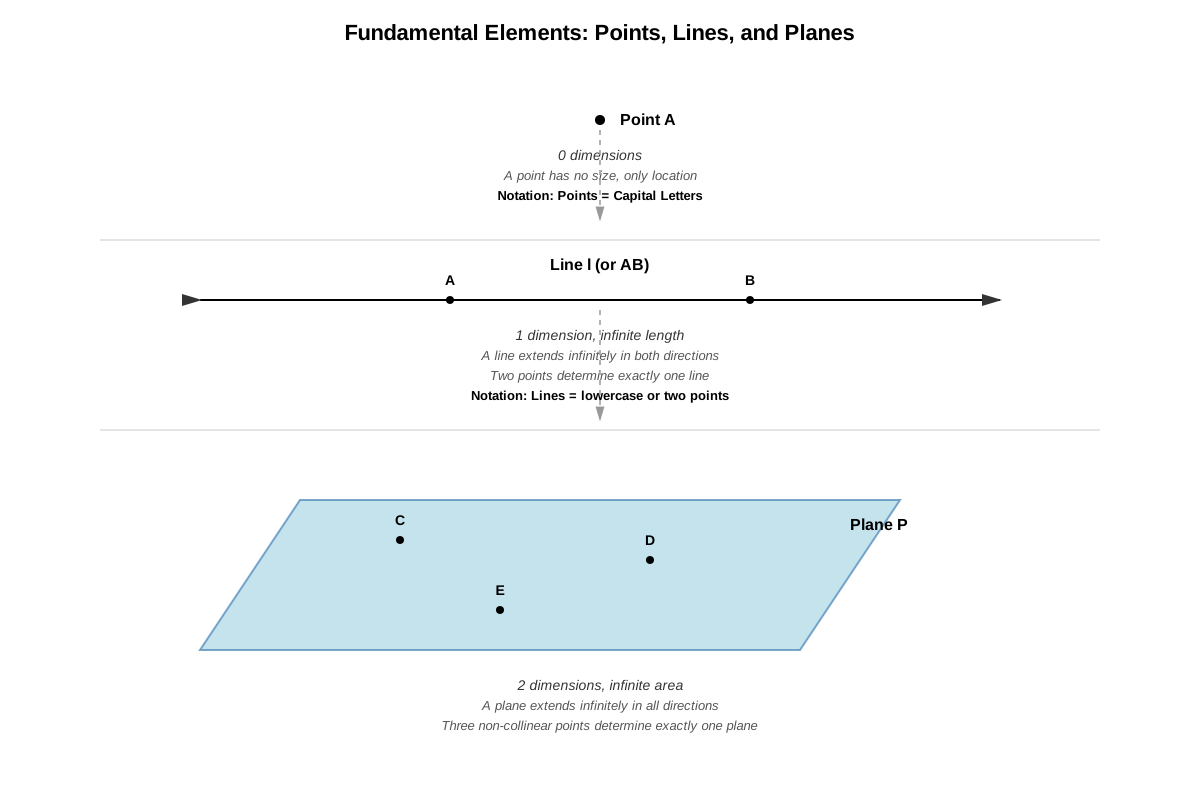
A point represents a specific location in space with no dimension—no length, width, or height. Points are typically labeled with capital letters (A, B, C) and serve as the most basic building block of geometry. On the ACT, points are often given as coordinate pairs (x, y) in the coordinate plane, allowing for precise calculations of distance and position.
A line is a straight, one-dimensional figure that extends infinitely in both directions. Lines contain infinitely many points and have no thickness. A line can be named by any two points on it (line AB or line BA) or by a single lowercase letter (line m). The ACT frequently tests understanding that exactly one line passes through any two distinct points, and that a line segment is the portion of a line between two endpoints.
A plane is a flat, two-dimensional surface that extends infinitely in all directions. A plane contains infinitely many points and lines. Three non-collinear points determine exactly one plane. Planes are typically named by a single capital letter or by three points within the plane. While three-dimensional plane concepts appear less frequently on the ACT than line concepts, understanding planes helps with spatial reasoning questions.
Collinearity and Coplanarity
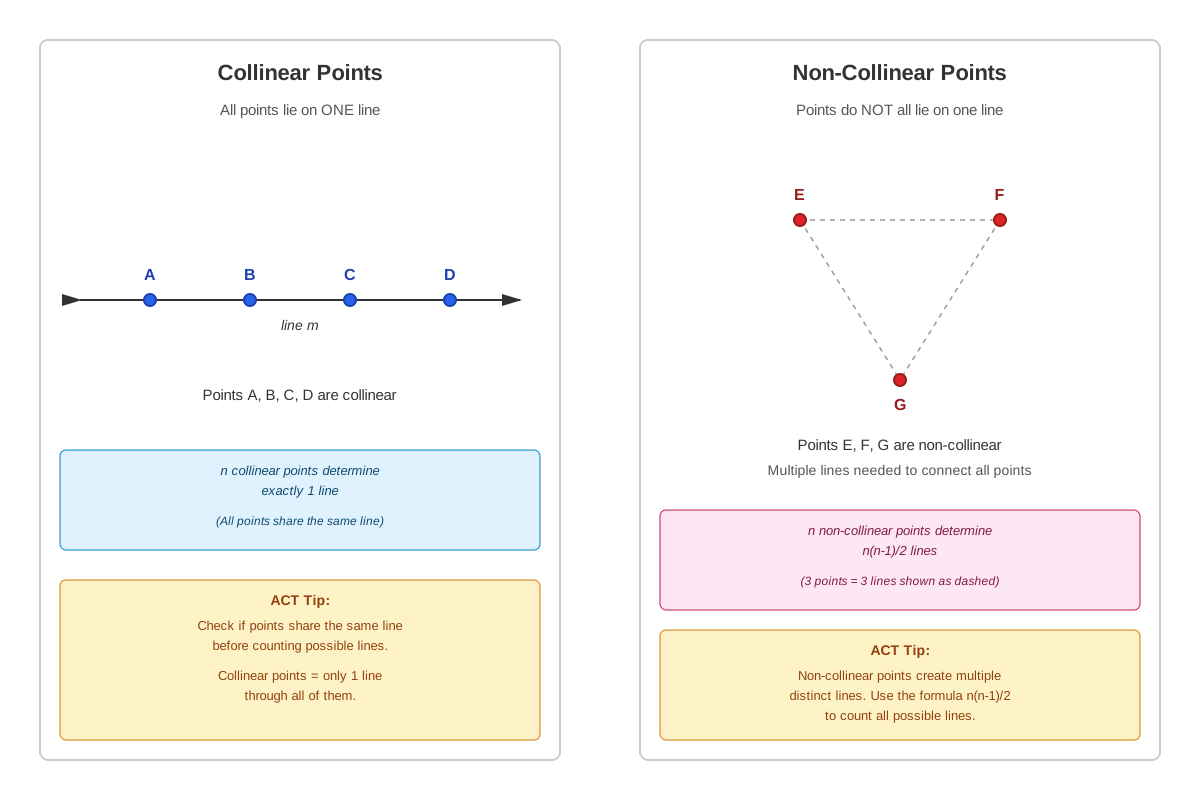
Collinear points are points that lie on the same line. Any two points are always collinear (since exactly one line passes through them), but three or more points may or may not be collinear. The ACT tests this concept by asking students to determine whether given points share a common line or by asking how many lines can be drawn through a set of points.
Coplanar points are points that lie in the same plane. Any three points are always coplanar (since three non-collinear points determine exactly one plane), but four or more points may or may not be coplanar. Understanding coplanarity helps with three-dimensional geometry questions, though these appear less frequently on the ACT.
Distance Between Points
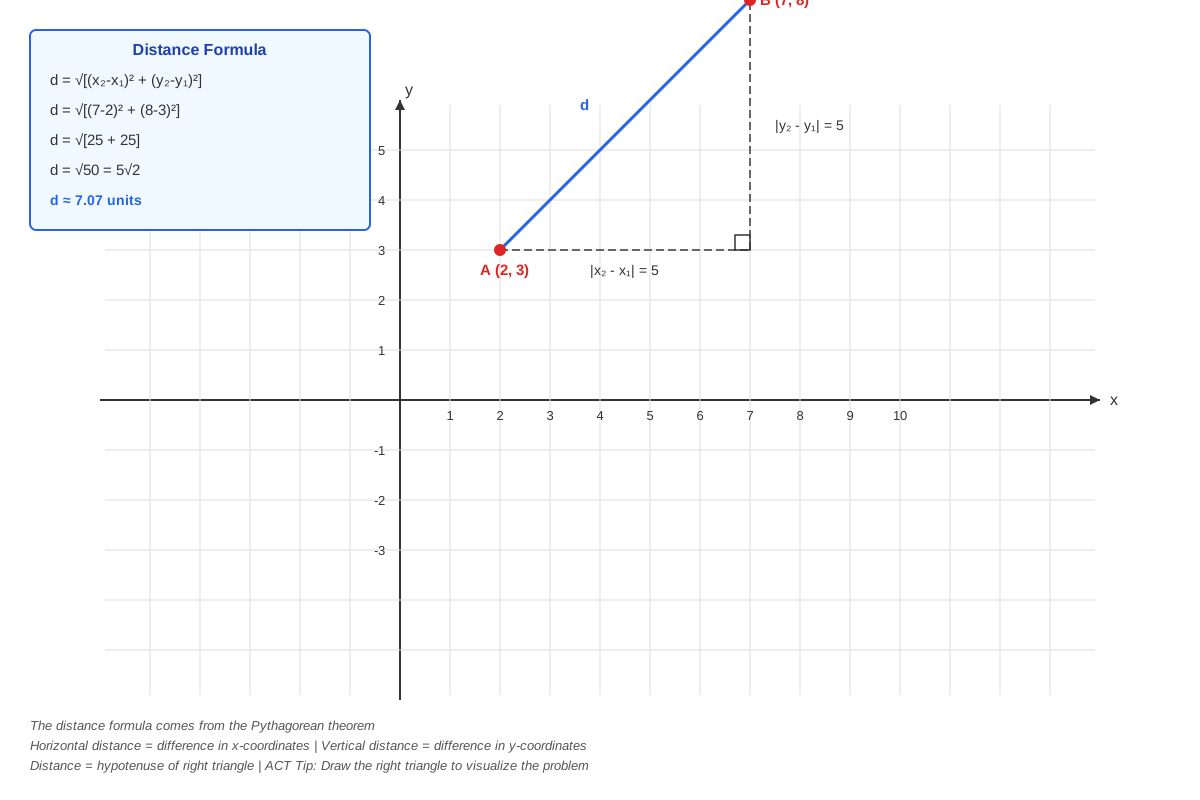
The distance formula calculates the distance between two points in the coordinate plane:
d = √[(x₂ - x₁)² + (y₂ - y₁)²]This formula derives from the Pythagorean theorem and represents the length of the straight line segment connecting the two points. The ACT frequently requires distance calculations, sometimes explicitly and sometimes as part of larger problems involving circles, triangles, or other figures.
For points on a number line or points sharing the same x-coordinate or y-coordinate, distance can be calculated more simply by finding the absolute value of the difference: |x₂ - x₁| or |y₂ - y₁|.
Line Relationships
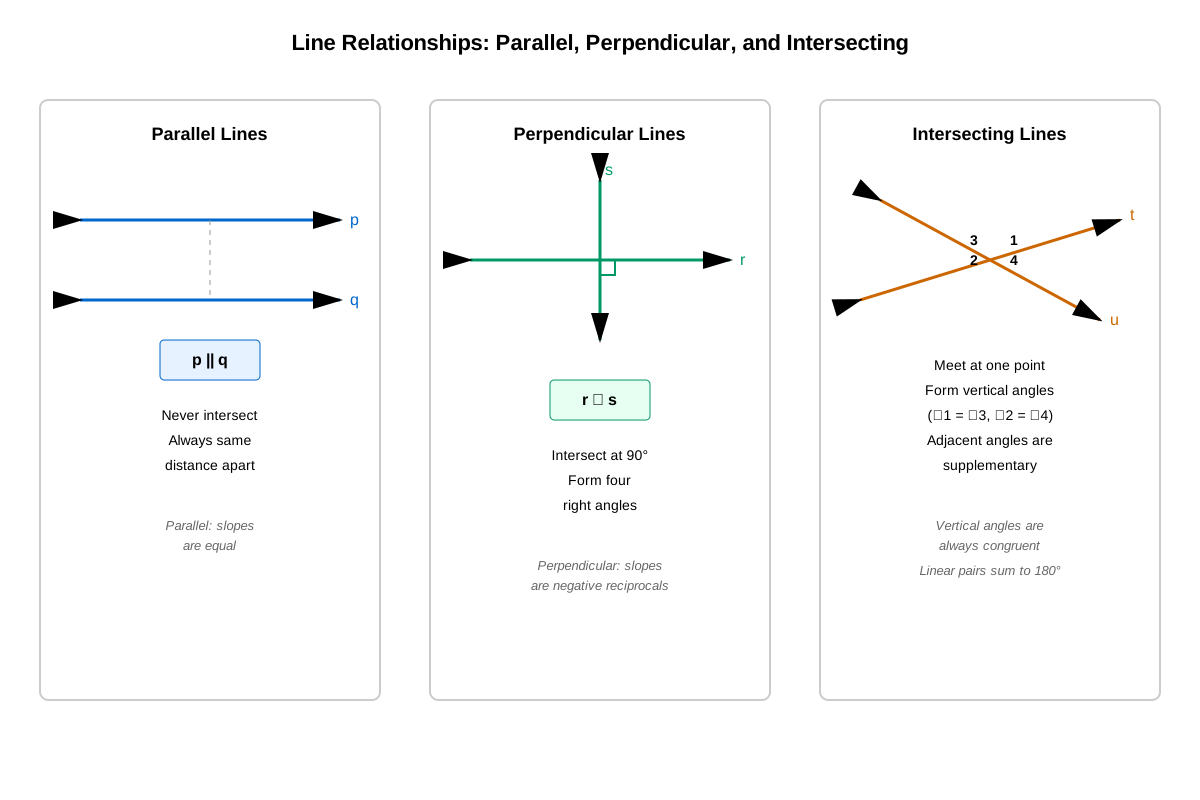
Parallel lines are coplanar lines that never intersect, maintaining the same distance apart at all points. Parallel lines have the same slope in the coordinate plane. The symbol ∥ denotes parallel lines (line m ∥ line n). The ACT tests parallel line properties extensively, particularly angle relationships formed when a transversal crosses parallel lines.
Perpendicular lines intersect at a 90-degree angle (right angle). In the coordinate plane, perpendicular lines have slopes that are negative reciprocals of each other (if one line has slope m, the perpendicular line has slope -1/m, assuming neither line is vertical). The symbol ⊥ denotes perpendicular lines (line m ⊥ line n).
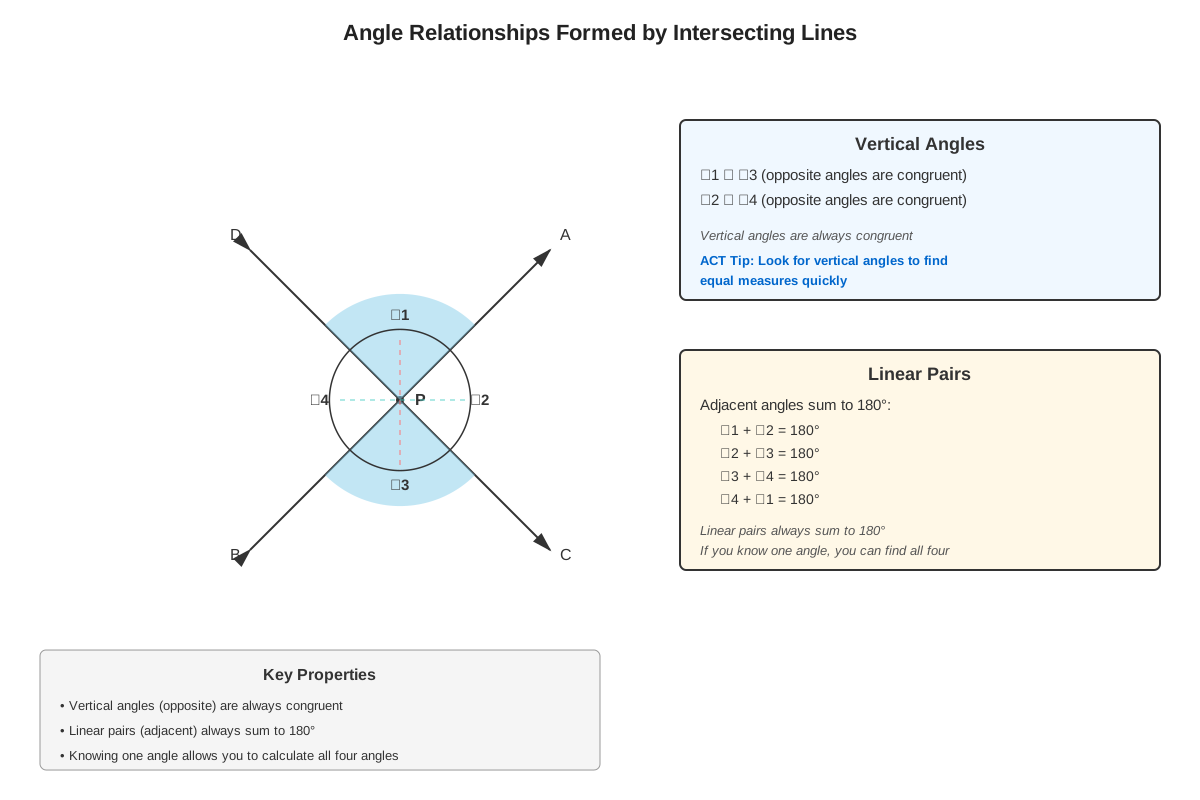
Intersecting lines are lines that cross at exactly one point. When two lines intersect, they form four angles. Vertical angles (opposite angles) are congruent, and adjacent angles are supplementary (sum to 180°).
Angle Relationships
When two lines intersect, they create several important angle relationships:
- Vertical angles: Opposite angles formed by intersecting lines; always congruent
- Linear pairs: Adjacent angles that form a straight line; always supplementary (sum to 180°)
- Adjacent angles: Angles that share a common vertex and side
When a transversal (a line that intersects two or more lines) crosses parallel lines, eight angles are formed with special relationships:
| Angle Relationship | Description | Property |
|---|---|---|
| Corresponding angles | Same position at each intersection | Congruent |
| Alternate interior angles | Inside the parallel lines, opposite sides of transversal | Congruent |
| Alternate exterior angles | Outside the parallel lines, opposite sides of transversal | Congruent |
| Consecutive interior angles | Inside the parallel lines, same side of transversal | Supplementary |
Counting Lines and Planes
The ACT frequently asks how many lines or planes can be determined by a set of points. Key formulas and principles include:
- Through any two distinct points, exactly one line can be drawn
- Through three non-collinear points, exactly one plane can be determined
- The number of lines determined by n non-collinear points is: n(n-1)/2
- For 3 points: 3(2)/2 = 3 lines
- For 4 points: 4(3)/2 = 6 lines
- For 5 points: 5(4)/2 = 10 lines
Midpoint and Segment Division
The midpoint of a line segment is the point that divides the segment into two equal parts. The midpoint formula for a segment with endpoints (x₁, y₁) and (x₂, y₂) is:
M = ((x₁ + x₂)/2, (y₁ + y₂)/2)This formula simply averages the x-coordinates and y-coordinates of the endpoints. The ACT uses midpoint calculations in various contexts, including finding centers of circles, determining locations of vertices, and solving coordinate geometry problems.
Concept Relationships
The fundamental concepts of points lines and planes form a hierarchical structure where each element builds upon the previous. Points serve as the foundation → multiple points determine lines → multiple non-collinear points determine planes. This progression from zero-dimensional (point) to one-dimensional (line) to two-dimensional (plane) creates the framework for all geometric reasoning.
Distance calculations connect directly to the coordinate plane representation of points, bridging the gap between pure geometric concepts and algebraic methods. The distance formula → enables calculation of segment lengths → which supports determination of triangle properties, circle radii, and polygon dimensions.
Line relationships (parallel, perpendicular, intersecting) → create angle relationships → which connect to triangle angle theorems and polygon properties. Understanding how lines interact provides the foundation for analyzing more complex figures composed of multiple line segments.
The counting principles for lines and planes → demonstrate combinatorial thinking → which appears in probability and counting problems elsewhere on the ACT. These concepts also connect to the prerequisite knowledge of basic arithmetic and algebra, as solving geometric problems often requires setting up and solving equations.
High-Yield Facts
⭐ Exactly one line passes through any two distinct points—this fundamental postulate underlies many ACT geometry questions
⭐ The distance formula d = √[(x₂ - x₁)² + (y₂ - y₁)²] calculates the distance between any two points in the coordinate plane
⭐ When a transversal crosses parallel lines, corresponding angles are congruent and alternate interior angles are congruent
⭐ Vertical angles formed by intersecting lines are always congruent
⭐ Perpendicular lines in the coordinate plane have slopes that are negative reciprocals (m₁ × m₂ = -1)
- Three non-collinear points determine exactly one plane
- The number of lines determined by n non-collinear points is n(n-1)/2
- The midpoint formula averages the coordinates: M = ((x₁ + x₂)/2, (y₁ + y₂)/2)
- Adjacent angles formed by intersecting lines are supplementary (sum to 180°)
- Parallel lines have the same slope and never intersect
- Consecutive interior angles formed by a transversal crossing parallel lines are supplementary
- Collinear points all lie on the same line; any two points are always collinear
- A line segment has two endpoints; a ray has one endpoint and extends infinitely in one direction
Quick check — test yourself on Points lines and planes so far.
Try Flashcards →Common Misconceptions
Misconception: A line has endpoints and a finite length → Correction: A line extends infinitely in both directions with no endpoints. A line segment has two endpoints and finite length. The ACT carefully distinguishes between these terms, and confusing them leads to incorrect answers about geometric properties.
Misconception: Three points always determine three distinct lines → Correction: Three points determine three distinct lines only if the points are non-collinear. If the three points are collinear (lie on the same line), they determine only one line. Always check whether points are collinear before counting lines.
Misconception: The distance formula only works for points in the first quadrant → Correction: The distance formula works for any two points in the coordinate plane, regardless of which quadrant they occupy. The formula uses differences (x₂ - x₁) and (y₂ - y₁), which automatically account for negative coordinates.
Misconception: Parallel lines must be horizontal or vertical → Correction: Parallel lines can have any slope; they simply must have the same slope. Lines with slopes of 2 are parallel to each other, as are lines with slopes of -3/4, regardless of their orientation.
Misconception: When two lines intersect, all four angles formed are equal → Correction: When two lines intersect, only vertical angles (opposite angles) are equal. Adjacent angles are supplementary but not necessarily equal unless the lines are perpendicular (forming four 90° angles).
Misconception: The midpoint formula gives the distance between two points → Correction: The midpoint formula gives the coordinates of the point halfway between two endpoints, not the distance. Use the distance formula to find the length between points.
Misconception: Any three points determine a plane → Correction: Three non-collinear points determine exactly one plane. If three points are collinear, infinitely many planes contain all three points (imagine a line with infinitely many planes passing through it).
Worked Examples
Example 1: Counting Lines and Analyzing Collinearity
Problem: Points A, B, C, and D are positioned such that A, B, and C are collinear, but D is not on line ABC. How many distinct lines are determined by these four points?
Solution:
Step 1: Identify what we know. Points A, B, and C all lie on the same line. Point D does not lie on this line.
Step 2: Count lines involving only the collinear points. Since A, B, and C are collinear, they determine only 1 line (line ABC), not 3 lines.
Step 3: Count lines involving point D. Point D can form a line with each of the other three points:
- Line DA (or AD)
- Line DB (or BD)
- Line DC (or CD)
This gives us 3 additional lines.
Step 4: Total the distinct lines. We have:
- 1 line through A, B, and C
- 3 lines connecting D to each of the collinear points
- Total: 4 distinct lines
Step 5: Verify using the formula. If all four points were non-collinear, we would have n(n-1)/2 = 4(3)/2 = 6 lines. However, since three points are collinear, we "lose" 2 lines (the 3 lines that would have been formed by A, B, and C become just 1 line). So 6 - 2 = 4 lines, confirming our answer.
Connection to learning objectives: This problem requires identifying when collinearity affects counting (Objective 1), applying the core strategy of systematically counting geometric objects (Objective 2), and accurately solving an ACT-style question (Objective 3).
Example 2: Distance and Midpoint Application
Problem: Point P has coordinates (2, 5) and point Q has coordinates (8, -3). Find the distance between P and Q, and determine the coordinates of the midpoint M of segment PQ.
Solution:
Step 1: Apply the distance formula with (x₁, y₁) = (2, 5) and (x₂, y₂) = (8, -3).
d = √[(x₂ - x₁)² + (y₂ - y₁)²]
d = √[(8 - 2)² + (-3 - 5)²]
d = √[(6)² + (-8)²]
d = √[36 + 64]
d = √100
d = 10
The distance between P and Q is 10 units.
Step 2: Apply the midpoint formula to find M.
M = ((x₁ + x₂)/2, (y₁ + y₂)/2)
M = ((2 + 8)/2, (5 + (-3))/2)
M = (10/2, 2/2)
M = (5, 1)
The midpoint M has coordinates (5, 1).
Step 3: Verify the answer makes sense. The midpoint should be "between" the original points. Point P is at (2, 5) and Q is at (8, -3). The midpoint x-coordinate of 5 is indeed between 2 and 8, and the y-coordinate of 1 is between -3 and 5. ✓
Connection to learning objectives: This problem demonstrates applying the distance formula and midpoint formula (Objective 3), using core strategies for coordinate geometry (Objective 2), and calculating distances between points (Objective 5).
Exam Strategy
When approaching act points lines and planes questions, begin by carefully reading what the question asks for—the ACT often tests whether students can distinguish between lines and line segments, or between distance and midpoint. Circle or underline key terms like "collinear," "perpendicular," "parallel," or "distance" to focus your approach.
Trigger words and phrases that indicate this topic is being tested include:
- "How many lines can be drawn through..."
- "What is the distance between..."
- "Points A, B, and C are collinear..."
- "Find the midpoint of..."
- "Lines m and n are parallel..."
- "Perpendicular to..."
- "Vertical angles"
- "Corresponding angles"
For process-of-elimination strategies, remember that:
- If a question asks about the number of lines through points, eliminate any answer that would be possible only if all points were non-collinear (unless the problem states this)
- For distance problems, eliminate negative answers (distance is always positive)
- For angle problems involving parallel lines and transversals, eliminate any answer that violates the congruent or supplementary relationships
- If asked about perpendicular lines in the coordinate plane, eliminate any answer choice whose slope doesn't satisfy the negative reciprocal relationship
Time allocation: Most basic points, lines, and planes questions should take 30-45 seconds once you've mastered the concepts. If a question involves multiple steps (finding distance, then using that distance in another calculation), allocate up to 90 seconds. Don't spend more than 2 minutes on any single question—if you're stuck, mark it and return later.
Strategic approach sequence:
- Identify what geometric objects are involved (points, lines, planes)
- Determine what relationship or property is being tested
- Recall the relevant formula or theorem
- Execute the calculation or reasoning carefully
- Check that your answer makes geometric sense
Memory Techniques
For remembering the distance formula, use the mnemonic "Differences Squared, Square-rooted": Take the differences of coordinates, square them, add them, then take the square root. Visualize the right triangle formed by the horizontal and vertical distances—the distance formula is just the Pythagorean theorem in disguise.
For midpoint formula, remember "Average the Coordinates": The midpoint is simply the average of the x-coordinates and the average of the y-coordinates. Think of it as finding the "middle" by averaging.
For counting lines through n points, remember the formula n(n-1)/2 with the phrase "Each point connects to every other, but don't count twice": Each of n points connects to (n-1) others, giving n(n-1) connections, but we've counted each line twice (once from each endpoint), so divide by 2.
For parallel line angle relationships, use "CAI" (pronounced "kai"):
- Corresponding angles are Congruent
- Alternate interior angles are congruent
- Interior angles on the same side are supplementary (add to I80°)
For perpendicular slopes, remember "Flip and Negate": To find the perpendicular slope, flip the fraction (reciprocal) and change the sign (negate). If the slope is 2/3, the perpendicular slope is -3/2.
For vertical angles, visualize a "V" shape: Vertical angles are Very equal (congruent).
Summary
Points, lines, and planes constitute the foundational vocabulary and conceptual framework for all geometry tested on the ACT Math section. A point represents a location with no dimension, a line extends infinitely in both directions through points, and a plane is a flat surface extending infinitely in all directions. Understanding relationships among these elements—including collinearity, distance calculations, parallel and perpendicular line properties, and angle relationships formed by intersecting lines—enables students to decode complex geometric scenarios efficiently. The distance formula √[(x₂ - x₁)² + (y₂ - y₁)²] and midpoint formula ((x₁ + x₂)/2, (y₁ + y₂)/2) provide algebraic tools for coordinate geometry problems. When parallel lines are cut by a transversal, corresponding angles and alternate interior angles are congruent, while consecutive interior angles are supplementary. Mastering these core concepts, along with counting principles for lines determined by points, provides the foundation for success on approximately 23% of ACT Math questions and supports understanding of more advanced geometric topics.
Key Takeaways
- Points, lines, and planes are the fundamental building blocks of all geometry; precise understanding of their definitions and properties is essential for ACT success
- The distance formula d = √[(x₂ - x₁)² + (y₂ - y₁)²] and midpoint formula M = ((x₁ + x₂)/2, (y₁ + y₂)/2) are high-yield formulas that appear frequently
- Exactly one line passes through any two distinct points; n non-collinear points determine n(n-1)/2 distinct lines
- When parallel lines are cut by a transversal, corresponding angles and alternate interior angles are congruent, while consecutive interior angles are supplementary
- Perpendicular lines form 90° angles and have slopes that are negative reciprocals in the coordinate plane
- Vertical angles formed by intersecting lines are always congruent; adjacent angles are supplementary
- Collinearity affects counting problems—always check whether points lie on the same line before determining how many lines they form
Related Topics
Angle Measurement and Classification: Building on the angle relationships introduced with intersecting and parallel lines, this topic explores acute, obtuse, right, and straight angles, as well as complementary and supplementary angle pairs. Mastering points, lines, and planes provides the foundation for understanding how angles are formed and measured.
Triangle Properties and Theorems: Triangles are formed by three non-collinear points connected by line segments. Understanding line relationships (especially perpendicular and parallel) enables analysis of triangle altitudes, medians, and special triangle types.
Coordinate Geometry: The coordinate plane represents points as ordered pairs, allowing algebraic methods to solve geometric problems. Distance and midpoint formulas learned here extend to finding equations of lines, circles, and other figures.
Transformations: Translations, rotations, reflections, and dilations all involve moving points according to specific rules. Understanding how points and lines behave under transformations requires solid foundational knowledge of their basic properties.
Practice CTA
Now that you've mastered the foundational concepts of points, lines, and planes, it's time to solidify your understanding through active practice. Attempt the practice questions to test your ability to identify when these concepts are being tested, apply the appropriate formulas and strategies, and solve problems efficiently under timed conditions. Use the flashcards to reinforce key definitions, formulas, and relationships until they become automatic. Remember: geometry success on the ACT comes from recognizing patterns quickly and executing strategies confidently. Every practice problem you complete builds the pattern recognition and procedural fluency that will help you achieve your target score. You've got this!
Sign up free to keep reading
Create a free AnvayaPrep account to finish this ACT guide on Points lines and planes — plus flashcards and practice questions.