Overview
Measurement is a foundational skill tested throughout the ACT Science section, appearing in approximately 30-40% of all passages. While students often overlook measurement as "too basic," the ACT consistently tests the ability to extract, interpret, and manipulate quantitative data from tables, graphs, and experimental descriptions. Success on the ACT Science test depends heavily on quickly and accurately reading measurements from visual representations, understanding units and scales, and recognizing when data supports or contradicts a hypothesis.
The ACT measurement questions assess whether students can navigate the relationship between variables, identify trends in data sets, and make predictions based on experimental results. These skills extend beyond simple number reading—they require understanding precision, significant figures, scientific notation, and the relationship between different measurement scales. Students who master measurement techniques can answer questions more efficiently, leaving additional time for complex reasoning passages.
Measurement connects to virtually every other topic in ACT Science because all experimental data relies on quantitative observations. Whether analyzing conflicting viewpoints about climate change, interpreting genetics experiments, or evaluating physics demonstrations, students must extract measurements accurately and understand what those numbers represent in context. This topic serves as the gateway skill that enables success across all three passage types: Data Representation, Research Summaries, and Conflicting Viewpoints.
Learning Objectives
- [ ] Identify when Measurement is being tested in ACT Science passages
- [ ] Explain the core rule or strategy behind Measurement questions
- [ ] Apply Measurement skills to ACT-style questions accurately
- [ ] Extract precise values from complex graphs, tables, and figures within 10 seconds
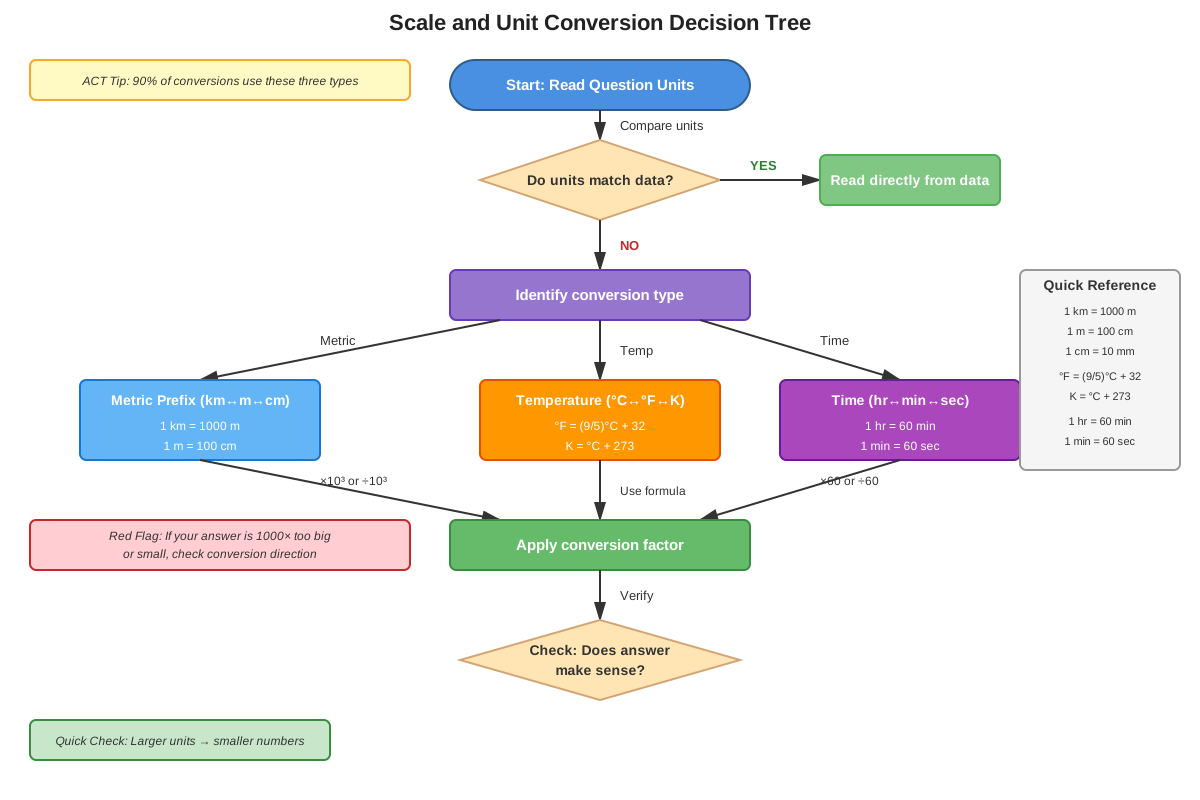
- [ ] Convert between different units and scales commonly used in ACT passages
- [ ] Recognize when measurement precision affects answer choices
- [ ] Interpolate and extrapolate data points from visual representations
Prerequisites
- Basic arithmetic operations: Essential for calculating differences, averages, and ratios between measured values
- Understanding of coordinate systems: Required to locate points on graphs and interpret x-y relationships
- Familiarity with common scientific units: Enables quick recognition of what is being measured (meters, grams, seconds, degrees)
- Reading comprehension at grade level: Necessary to understand what variables are being measured and why
- Basic fraction and decimal operations: Critical for interpreting scales and intermediate values
Why This Topic Matters
Measurement skills translate directly to real-world scientific literacy. Every scientific discovery, from vaccine development to climate modeling, depends on accurate measurement and data interpretation. Medical professionals read patient vital signs from monitors, engineers analyze stress-test data from materials, and environmental scientists track pollution levels over time—all requiring the same measurement skills tested on the ACT.
On the ACT Science test, measurement appears in every single test administration across all passage types. Approximately 8-12 questions per test directly assess measurement skills, while another 10-15 questions require measurement as a preliminary step before applying additional reasoning. Data Representation passages (which constitute 30-40% of the Science section) focus almost exclusively on measurement interpretation. Research Summary passages typically include 2-3 tables or figures requiring measurement extraction, and even Conflicting Viewpoints passages often present data that students must measure and compare.
The ACT presents measurement challenges in several characteristic ways: tables with multiple columns requiring careful row-column matching, line graphs with multiple data series, bar graphs comparing experimental conditions, scatter plots showing correlations, and diagrams with labeled measurements. Questions may ask students to identify specific values, compare measurements across conditions, recognize trends, or predict values beyond the given data range. The test deliberately includes distractors based on common measurement errors—reading the wrong row, confusing x and y axes, or misinterpreting scale intervals.
Core Concepts
Reading Tables Accurately
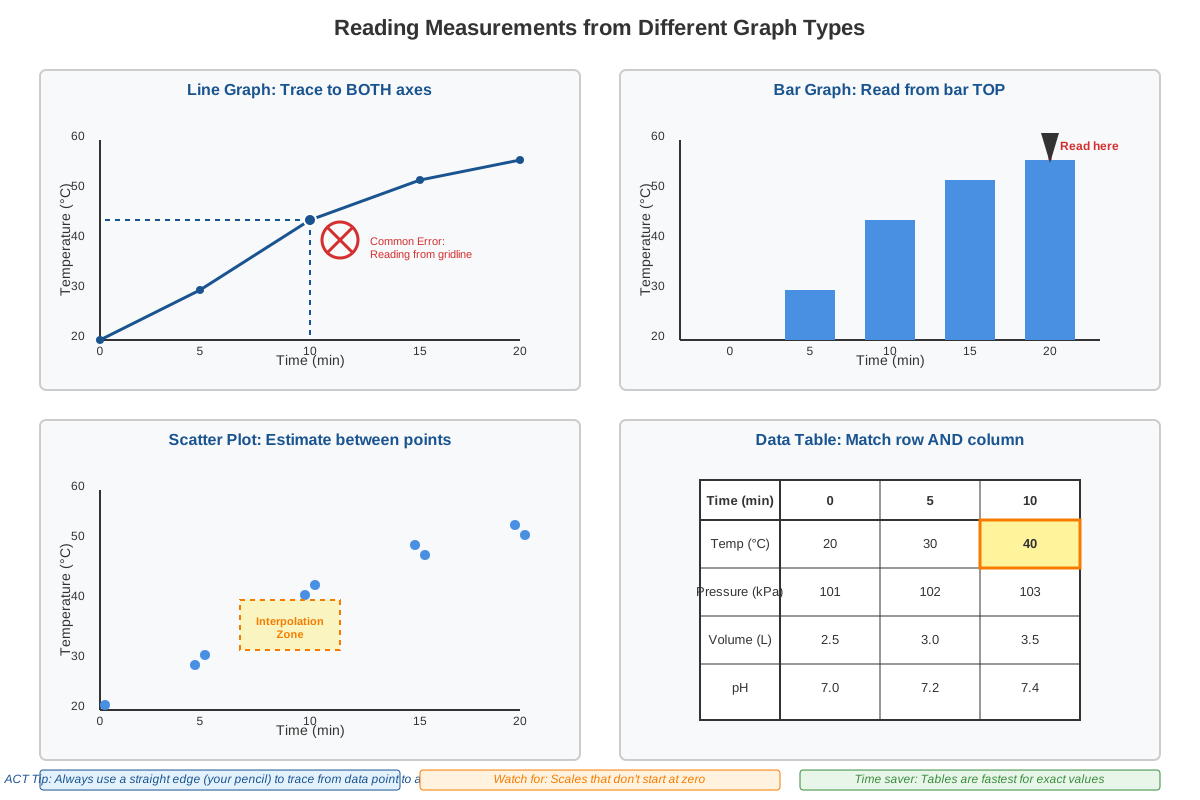
Tables represent the most straightforward measurement presentation format on the ACT, yet they generate numerous errors due to careless reading. Each table contains rows and columns with headers that define what is being measured. The critical skill involves matching the correct row with the correct column to extract the precise value requested.
ACT tables typically include 3-6 columns and 4-10 rows, with the leftmost column showing the independent variable (what the experimenter changed) and subsequent columns showing dependent variables (what was measured as a result). Students must read headers carefully, as the ACT often includes similar-sounding variables with different units. For example, a table might show both "Temperature (°C)" and "Temperature Change (°C)" as separate columns.
When extracting values from tables, follow this systematic approach:
- Identify the question's target variable in the column headers
- Locate the specified condition or trial in the row labels
- Trace horizontally from the row and vertically from the column to find the intersection
- Verify the units match what the question asks for
- Double-check by reading the value aloud mentally
Interpreting Line Graphs
Line graphs show how one variable changes in relation to another, making them ideal for displaying continuous data and trends. The ACT measurement questions based on line graphs test whether students can locate specific points, compare values between different lines, and identify overall patterns.
The x-axis (horizontal) typically represents the independent variable, while the y-axis (vertical) shows the dependent variable. Multiple lines on the same graph represent different experimental conditions, trials, or subjects. Each line may be distinguished by color, pattern (solid, dashed, dotted), or symbols at data points.
To read a value from a line graph:
- Locate the x-value on the horizontal axis
- Move vertically upward until reaching the line
- Move horizontally to the y-axis
- Read the y-value, estimating between gridlines if necessary
- For multiple lines, verify which line the question references
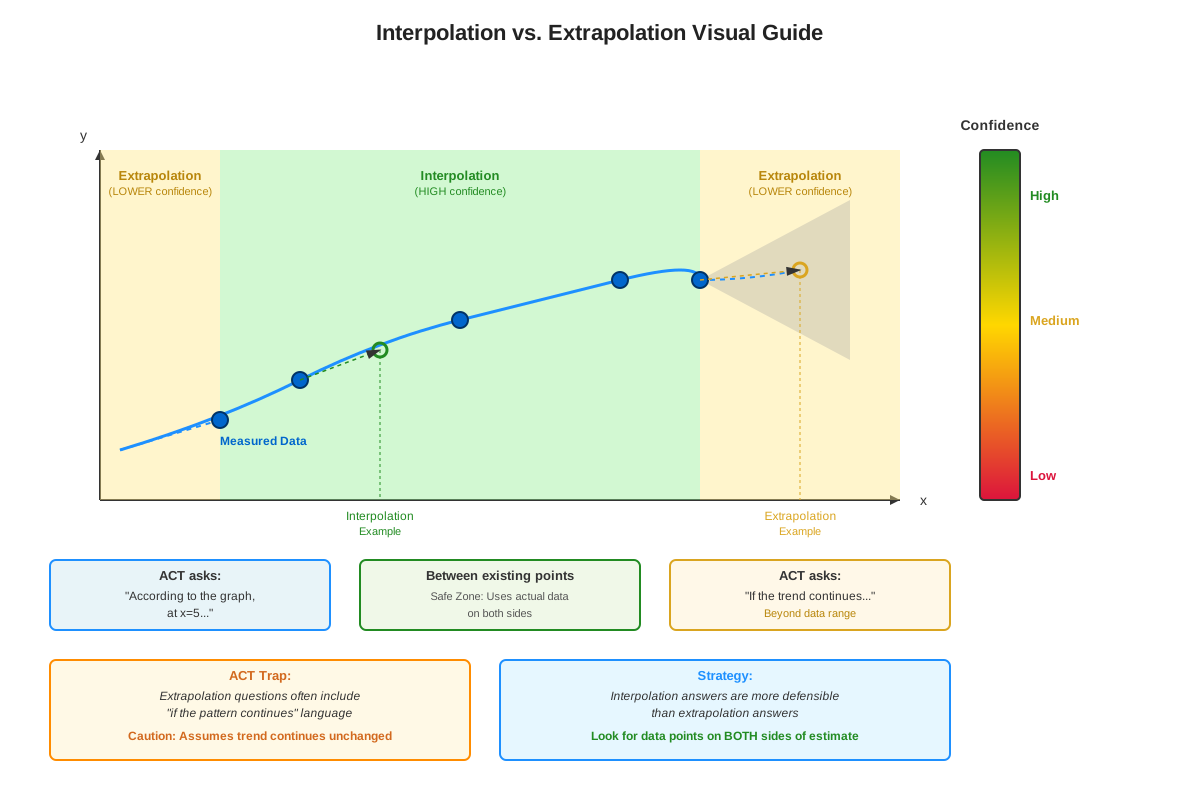
The ACT frequently tests interpolation (estimating values between plotted points) and extrapolation (predicting values beyond the plotted range). For interpolation, estimate where a point would fall along the line between two known points. For extrapolation, extend the line's trend beyond the last data point, though this requires assuming the pattern continues.
Understanding Bar Graphs
Bar graphs compare discrete categories or experimental conditions using rectangular bars whose heights or lengths represent measured values. Unlike line graphs that show continuous change, bar graphs display separate, distinct measurements that cannot be connected by a line.
The ACT uses bar graphs to compare experimental groups, different trials, or various substances under the same conditions. Questions typically ask students to identify which bar is tallest/shortest, calculate differences between bars, or determine ratios. The key challenge involves reading the scale accurately, especially when bars fall between marked gridlines.
Common bar graph variations include:
- Grouped bars: Multiple bars side-by-side for each category, comparing different variables
- Stacked bars: Bars divided into segments showing component parts of a total
- Horizontal bars: Bars extending left-to-right instead of bottom-to-top
Navigating Scatter Plots
Scatter plots display individual data points without connecting them, revealing correlations and patterns in data. Each point represents a single observation or measurement with both an x-value and y-value. The ACT uses scatter plots to test whether students can identify trends (positive correlation, negative correlation, or no correlation) and locate specific data points.
When analyzing scatter plots, look for:
- Positive correlation: Points trend upward from left to right (as x increases, y increases)
- Negative correlation: Points trend downward from left to right (as x increases, y decreases)
- No correlation: Points show no clear pattern
- Outliers: Points that fall far from the general pattern
Questions may ask students to count points meeting certain criteria, identify the point with the maximum or minimum value, or predict where a new point would fall based on the existing pattern.
Units and Scale Interpretation
Understanding units is crucial for accurate measurement on the ACT. The test includes metric units (meters, grams, liters, Celsius), imperial units (feet, pounds, gallons, Fahrenheit), and specialized scientific units (moles, joules, pascals, watts). Questions may require converting between related units or recognizing when units change between different parts of a passage.
Scale interpretation involves understanding the intervals between marked values on axes. If a graph's y-axis shows marks at 0, 10, 20, and 30, each gridline represents 10 units. However, the ACT often uses non-standard intervals (0, 5, 15, 30, 50) to test careful reading. Students must calculate the interval size by subtracting consecutive marked values and dividing by the number of spaces between them.
Scientific notation appears frequently in ACT tables and graphs, especially for very large or very small numbers. A value like 3.5 × 10⁴ equals 35,000, while 2.1 × 10⁻³ equals 0.0021. Questions may require comparing values in scientific notation or converting between standard and scientific notation.
Precision and Significant Figures
Measurement precision refers to how exactly a value is specified. A measurement of 25.4 cm is more precise than 25 cm, and 25.43 cm is more precise still. The ACT tests whether students recognize appropriate precision levels when selecting answers.
Answer choices often differ in precision, with one choice showing more decimal places than others. The correct answer typically matches the precision level of the data in the passage. If a table shows temperatures to the nearest whole degree (23°C, 24°C, 25°C), an answer of 24.7°C would be inappropriately precise.
Significant figures indicate which digits in a number are meaningful based on measurement precision. The ACT rarely asks students to calculate significant figures explicitly but does expect answers to reflect reasonable precision based on the given data.
Concept Relationships
The measurement concepts form an interconnected system where mastery of basic skills enables more complex applications. Reading tables accurately serves as the foundation, as tables present data in its most direct form. This skill connects to understanding units and scale interpretation because tables always include units in column headers, and students must recognize what those units represent.
Interpreting line graphs builds upon table reading by adding a visual dimension—students must translate between numerical tables (often provided alongside graphs) and graphical representations. Line graphs directly connect to interpolation and extrapolation skills, as these graphs show continuous relationships where intermediate values can be estimated.
Bar graphs and scatter plots represent parallel branches from the core table-reading skill, each adding different analytical dimensions. Bar graphs emphasize comparison between discrete categories, while scatter plots reveal correlations and patterns. Both require the same fundamental scale-reading skills but apply them to different visual formats.
Precision and significant figures overlay all other measurement concepts as a quality-control mechanism. Regardless of whether data comes from tables, line graphs, bar graphs, or scatter plots, students must consider precision when selecting answers.
The relationship map flows as follows:
Basic arithmetic and coordinate systems → Reading tables accurately → Understanding units and scales → branches to → Line graphs (leading to interpolation/extrapolation), Bar graphs (leading to categorical comparison), and Scatter plots (leading to correlation analysis) → all filtered through → Precision and significant figures → enabling ACT question application
High-Yield Facts
⭐ The ACT Science section includes measurement-based questions in 100% of test administrations, typically 8-12 direct questions plus 10-15 requiring measurement as a preliminary step
⭐ When reading graphs, always check both axes for units and scale before attempting to extract values—misreading scale intervals is the most common measurement error
⭐ If a question asks for a value that falls between marked gridlines, estimate to the nearest reasonable increment based on the scale (usually to the nearest tenth of an interval)
⭐ Tables on the ACT are organized with independent variables in the leftmost column and dependent variables in subsequent columns—reading the wrong column is a common trap
⭐ Answer choices often differ by one order of magnitude (10×) to catch students who misread scientific notation or decimal placement
- Line graphs with multiple data series always include a legend or key—verify which line corresponds to the question's specified condition before reading values
- When comparing two measurements, calculate the difference by subtracting the smaller from the larger to avoid negative numbers unless the question specifically asks about decrease
- Scatter plots showing no clear pattern indicate no correlation between variables, which is itself a valid scientific finding the ACT may test
- Bar graphs with grouped bars require reading both the bar position (which group) and bar color/pattern (which variable within that group)
- If a graph's axis doesn't start at zero, the visual differences between bars or points may appear exaggerated—always read actual values rather than judging by visual size alone
- Temperature scales require special attention: Celsius and Fahrenheit use different zero points and degree sizes, so 20°C ≠ 20°F
- When extrapolating beyond plotted data, assume the trend continues linearly unless the passage provides information suggesting otherwise
- Percentage measurements always require knowing the reference value (percentage of what?)—the ACT often tests whether students can identify the correct denominator
- Measurements with more decimal places are not necessarily more accurate—precision depends on the measuring instrument's capabilities described in the passage
- Time measurements may appear in various units (seconds, minutes, hours, days)—verify the unit before comparing values or calculating rates
Quick check — test yourself on Measurement so far.
Try Flashcards →Common Misconceptions
Misconception: All graphs start at zero on both axes, so visual bar height directly represents the measured value.
Correction: ACT graphs frequently use truncated axes that don't start at zero, making visual comparisons misleading. Always read the actual numerical values from the axis scale rather than judging by visual appearance. A bar that looks twice as tall as another might represent only a 10% difference if the y-axis starts at 90 instead of 0.
Misconception: When a question asks for a value between two data points, students should always choose the mathematical average of those points.
Correction: Interpolation requires following the line or curve between points, not simply averaging. If a line graph shows a steep increase between x=2 (y=10) and x=4 (y=30), the value at x=3 follows the line's trajectory, which might be y=18 if the increase is linear, but could be y=15 or y=25 if the line curves. Always trace the actual line rather than calculating the midpoint.
Misconception: More decimal places in an answer choice make it more accurate and therefore more likely to be correct.
Correction: Answer precision should match data precision. If a table shows values to the nearest whole number, an answer with three decimal places is inappropriately precise and likely incorrect. The ACT uses overly precise answer choices as distractors to catch students who don't consider significant figures.
Misconception: Scientific notation values like 3.5 × 10⁴ and 3.5 × 10⁻⁴ are similar in magnitude because they both contain 3.5.
Correction: The exponent determines the magnitude entirely. 3.5 × 10⁴ = 35,000 while 3.5 × 10⁻⁴ = 0.00035—a difference of eight orders of magnitude (100 million times). The ACT deliberately includes answer choices that differ only in the exponent to test careful reading.
Misconception: When multiple lines appear on a graph, the question refers to whichever line is most prominent or drawn in the boldest color.
Correction: Always verify which line the question specifies by checking the legend and matching the description (e.g., "Trial 2," "Student A," "Temperature = 25°C"). The ACT intentionally asks about less prominent lines to test whether students read carefully rather than making assumptions.
Misconception: Extrapolating beyond the data range is always invalid and should never be done.
Correction: The ACT frequently asks students to predict values beyond the plotted range by extending observed trends. This is valid when the question asks "According to the data, what would likely happen if..." or "Based on the trend shown..." The key is recognizing that extrapolation assumes the pattern continues, which may or may not be true in reality but is acceptable for answering the question based on the given data.
Misconception: Units don't matter as long as the numerical value is correct.
Correction: Units are integral to measurements and frequently distinguish correct from incorrect answers. A question asking for speed in m/s cannot be correctly answered with km/h, even if the numerical relationship is correct. The ACT includes answer choices with correct numbers but wrong units as common distractors.
Worked Examples
Example 1: Multi-Variable Table Analysis
Passage Context: Students conducted an experiment measuring plant growth under different light and water conditions. The table below shows plant height (cm) after 4 weeks.
| Water Amount (mL/day) | Light: Low | Light: Medium | Light: High |
|---|---|---|---|
| 10 | 8.2 | 12.5 | 15.8 |
| 20 | 12.4 | 18.3 | 22.1 |
| 30 | 14.1 | 21.7 | 26.4 |
| 40 | 13.8 | 20.9 | 25.2 |
Question: According to the table, what was the height of plants that received 30 mL/day of water and medium light?
Step 1 - Identify target variables: The question asks for height (the measured value in the table cells) under specific conditions: 30 mL/day water and medium light.
Step 2 - Locate the row: Find "30" in the "Water Amount (mL/day)" column (leftmost column). This is the third data row.
Step 3 - Locate the column: Find "Light: Medium" in the column headers. This is the middle column of the three light conditions.
Step 4 - Find the intersection: Trace horizontally from the 30 mL/day row and vertically from the Medium light column. The intersection shows 21.7.
Step 5 - Verify units: The question asks for height, and the table header indicates measurements are in cm. The answer is 21.7 cm.
Step 6 - Check for common errors: Verify you didn't accidentally read the "Light: High" column (26.4) or the 20 mL/day row (18.3), which are adjacent values that could be selected by mistake.
Answer: 21.7 cm
Connection to Learning Objectives: This example demonstrates identifying when measurement is being tested (extracting a specific value from a table) and applying measurement skills accurately by following a systematic row-column matching process.
Example 2: Line Graph Interpolation and Comparison
Passage Context: Scientists measured the temperature of two chemical reactions over time. Figure 1 shows temperature (°C) versus time (minutes) for Reaction A (solid line) and Reaction B (dashed line).
[Description of graph: X-axis shows time from 0 to 10 minutes with marks every 2 minutes. Y-axis shows temperature from 20°C to 80°C with marks every 10°C. Reaction A (solid line) starts at 25°C at time 0, rises to 50°C at 4 minutes, and reaches 70°C at 8 minutes. Reaction B (dashed line) starts at 30°C at time 0, rises to 60°C at 4 minutes, and reaches 75°C at 8 minutes.]
Question: At 6 minutes, approximately how much higher was the temperature of Reaction B compared to Reaction A?
Step 1 - Identify what to measure: Need to find temperatures of both reactions at 6 minutes, then calculate the difference.
Step 2 - Locate x-value: Find 6 minutes on the x-axis. This falls between the marked values of 4 and 8 minutes, exactly halfway between them.
Step 3 - Read Reaction A value: From x=6, move vertically upward to the solid line. The line at this point falls between 50°C (at x=4) and 70°C (at x=8). Since 6 is halfway between 4 and 8, and the line appears relatively straight, estimate halfway between 50 and 70, which is 60°C.
Step 4 - Read Reaction B value: From x=6, move vertically upward to the dashed line. The line at this point falls between 60°C (at x=4) and 75°C (at x=8). Halfway between these values is 67.5°C, approximately 67-68°C.
Step 5 - Calculate the difference: Reaction B temperature (67.5°C) minus Reaction A temperature (60°C) = 7.5°C difference.
Step 6 - Consider precision: Since we estimated values between gridlines, the answer should reflect appropriate precision. "Approximately 7-8°C" or "7.5°C" would be reasonable answers depending on the choices provided.
Step 7 - Verify the comparison direction: The question asks how much higher Reaction B was, confirming we should subtract A from B (not B from A), giving a positive difference.
Answer: Approximately 7.5°C (or 7-8°C depending on answer choices)
Connection to Learning Objectives: This example demonstrates the core strategy of interpolating values between plotted points, reading multiple data series from the same graph, and applying measurement to calculate differences—all essential ACT measurement skills.
Exam Strategy
Approaching Measurement Questions Systematically
When encountering an ACT Science question requiring measurement, follow this decision tree:
- Identify the data source: Is the information in a table, line graph, bar graph, scatter plot, or diagram?
- Locate the specific variable: What exactly is being measured? Check units and labels carefully.
- Find the specified condition: What trial, time point, temperature, or other condition does the question reference?
- Extract the value: Use the appropriate technique for the data format (row-column matching for tables, axis reading for graphs).
- Verify units: Do the units in your answer match what the question asks for?
- Check precision: Does your answer's precision match the data's precision?
Trigger Words and Phrases
Recognize these phrases that signal ACT measurement questions:
- "According to Table/Figure X..." (direct measurement extraction)
- "What was the value of..." (specific value identification)
- "At what [condition] did..." (finding conditions that produced a specific measurement)
- "How much greater/less..." (comparing two measurements)
- "Approximately..." (indicates estimation/interpolation is acceptable)
- "Based on the data..." (requires reading and interpreting measurements)
- "The [variable] was closest to..." (requires finding nearest value)
Process of Elimination Strategies
For measurement questions, eliminate answers that:
- Use wrong units: If the table shows cm but an answer choice uses mm, it's likely a distractor (unless conversion is explicitly requested)
- Show inappropriate precision: Three decimal places when data shows whole numbers only
- Fall outside the data range: Unless the question specifically asks for extrapolation
- Represent values from wrong rows/columns: Check adjacent cells in tables—these often appear as distractors
- Differ by powers of 10: If you calculated 3.5 but see 35 and 0.35 as choices, you likely misplaced a decimal or misread scientific notation
Time Allocation
Measurement questions should be among the fastest to answer—typically 20-30 seconds each for straightforward extraction, up to 45 seconds for questions requiring interpolation or multiple steps. If a measurement question takes longer than one minute, you're likely overthinking it or looking in the wrong place.
Time-saving techniques:
- Use your finger or pencil to trace from axis to line to axis, preventing eye-tracking errors
- For tables, physically cover irrelevant rows/columns with your hand to focus attention
- When comparing multiple values, jot down the numbers briefly rather than trying to hold them in working memory
- Skip questions requiring complex calculations and return to them after completing faster questions
Exam Tip: The ACT Science section is designed so that measurement questions provide "easy points" that balance more difficult reasoning questions. Accuracy on measurement questions is essential for achieving top scores—these are points you cannot afford to lose to careless errors.
Memory Techniques
The "TRACE" Method for Graph Reading
Target the variable (what am I looking for?)
Read the axes (units and scale)
Align with the specified condition (x-value or category)
Cross to the line or bar (move perpendicular to axis)
Extract the value (read from the opposite axis)
The "MATCH" System for Tables
Mark the question's target variable
Analyze the column headers to find it
Trace down to find the row condition
Cross-reference row and column
Highlight (mentally or physically) the intersection value
Unit Conversion Visualization
Create mental images for common conversions:
- Kilo = thousand: Picture 1,000 individual items bundled together
- Milli = thousandth: Imagine dividing something into 1,000 tiny pieces
- Centi = hundredth: Visualize a dollar (100 cents) or a meter stick (100 cm)
Scale Interval Acronym: "FIND"
Find two consecutive marked values
Identify the number of spaces between them
Note the difference between the values
Divide the difference by the number of spaces
Precision Matching Reminder: "MATCH THE BATCH"
Your answer's precision should match the batch (set) of data provided. If data shows whole numbers, answer with whole numbers. If data shows one decimal place, answer with one decimal place.
Summary
Measurement forms the foundation of ACT Science success, appearing in every test administration across all passage types. Mastering measurement requires systematic approaches to extracting values from tables, line graphs, bar graphs, and scatter plots while maintaining awareness of units, scales, and precision. The core strategy involves identifying what is being measured, locating the specified conditions, carefully reading the value using appropriate techniques for each data format, and verifying that units and precision match the question requirements. Students must develop the ability to interpolate between data points, extrapolate beyond the given range when appropriate, and avoid common pitfalls such as misreading scales, confusing row-column intersections, or selecting answers with inappropriate precision. Success on measurement questions provides the foundation for more complex scientific reasoning tasks and represents high-yield points that separate top scorers from average performers. By applying systematic approaches like the TRACE method for graphs and MATCH system for tables, students can answer measurement questions quickly and accurately, typically within 20-45 seconds per question.
Key Takeaways
- Measurement questions appear in 100% of ACT Science tests and represent approximately 30-40% of all questions, making them the highest-yield skill to master
- Always verify both axes on graphs for units and scale before extracting values—misreading scale intervals causes more errors than any other measurement mistake
- Use systematic approaches (TRACE for graphs, MATCH for tables) to prevent careless errors and increase speed
- Answer precision must match data precision—overly precise answers are usually incorrect distractors
- Interpolation (estimating between points) and extrapolation (predicting beyond the range) are valid and frequently tested skills on the ACT
- Units are integral to measurements—verify that your answer's units match what the question requests
- Measurement questions should take 20-45 seconds each; if you're spending more than one minute, reassess your approach or move on and return later
Related Topics
Data Analysis and Interpretation: Builds directly on measurement skills by adding statistical concepts like averages, ranges, and standard deviations to describe measured data sets. Mastering measurement enables progression to analyzing what measurements mean collectively.
Experimental Design: Understanding measurement is prerequisite to evaluating whether experiments measure appropriate variables with sufficient precision. Students who can accurately extract measurements can then assess whether those measurements answer the research question.
Graphical Trends and Patterns: Extends measurement skills from reading individual values to recognizing overall relationships between variables—positive correlations, negative correlations, linear versus nonlinear relationships, and rate of change.
Scientific Notation and Orders of Magnitude: Deepens the unit and scale interpretation aspects of measurement by focusing specifically on very large and very small numbers common in scientific contexts.
Error Analysis and Uncertainty: Advanced application of precision concepts, examining how measurement limitations affect conclusions and why repeated measurements with averaging improve reliability.
Practice CTA
Now that you've mastered the core concepts and strategies for ACT measurement questions, it's time to apply these skills! Complete the practice questions to reinforce your systematic approaches and build the speed necessary for test day. Focus on using the TRACE and MATCH methods, and pay special attention to units and precision in your answers. The flashcards will help you internalize trigger words and common question patterns. Remember: measurement questions are your opportunity to secure quick, high-confidence points on the ACT Science section—make them count! With consistent practice, you'll develop the automatic habits that separate top scorers from the rest.
Sign up free to keep reading
Create a free AnvayaPrep account to finish this ACT guide on Measurement — plus flashcards and practice questions.