Overview
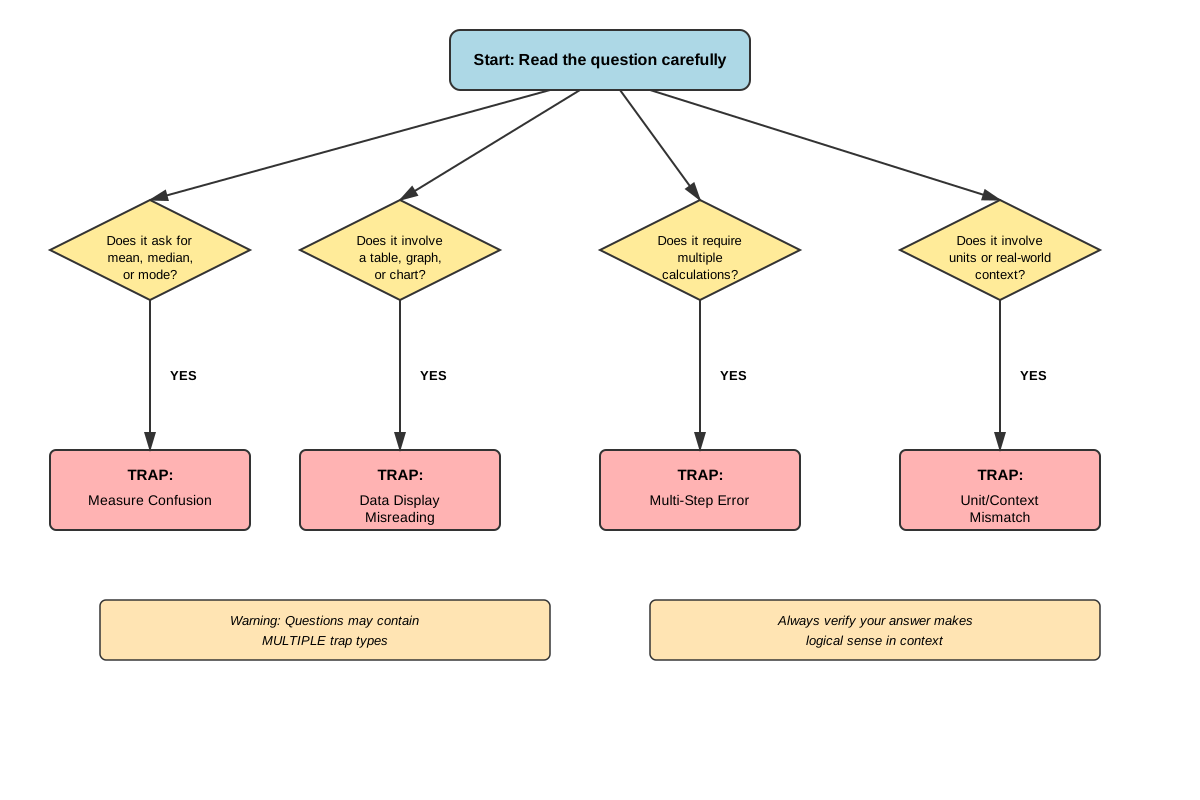
The ACT Math section contains numerous questions involving statistics and data analysis, and test-makers deliberately design these questions to include common traps that catch unprepared students. ACT statistics traps refer to the predictable patterns of misleading answer choices, confusing question wording, and calculation pitfalls that appear repeatedly on the exam. These traps exploit common student errors such as confusing mean with median, misinterpreting data displays, or rushing through multi-step calculations without verifying units or context.
Understanding ACT statistics traps is essential because statistics questions appear in approximately 15-20% of the Math section, making them one of the highest-yield topics to master. Unlike pure computational errors, these traps are specifically designed to test whether students truly understand statistical concepts or are simply applying formulas mechanically. Students who fall for these traps often select answer choices that "look right" but result from predictable mistakes in reasoning or calculation.
This topic connects directly to broader mathematical reasoning skills including data interpretation, logical analysis, and careful reading comprehension. Mastering statistics traps not only improves performance on explicit statistics questions but also strengthens the critical thinking skills needed throughout the entire Math section. The ability to identify and avoid these traps demonstrates mathematical maturity and the kind of careful, systematic problem-solving that the ACT rewards with top scores.
Learning Objectives
- [ ] Identify when ACT statistics traps is being tested
- [ ] Explain the core rule or strategy behind ACT statistics traps
- [ ] Apply ACT statistics traps to ACT-style questions accurately
- [ ] Distinguish between mean, median, and mode in trap scenarios where answer choices include all three
- [ ] Recognize when data displays (tables, graphs, charts) contain misleading visual elements or require multi-step interpretation
- [ ] Verify that calculated answers make logical sense within the context of the problem
- [ ] Identify when questions test understanding of statistical concepts versus simple calculation
Prerequisites
- Basic arithmetic operations: Essential for calculating measures of central tendency and performing data analysis without calculator errors
- Understanding of mean, median, and mode definitions: Required to recognize when questions deliberately confuse these concepts
- Ability to read tables and graphs: Necessary foundation for interpreting the data displays that contain most statistics traps
- Fraction and decimal conversions: Needed to avoid unit confusion traps and percentage calculation errors
- Basic algebraic manipulation: Required for solving equations that arise in statistics word problems
Why This Topic Matters
Statistics traps appear in real-world contexts constantly—from misleading advertising claims to misinterpreted medical studies to financial data presentations designed to obscure rather than clarify. The critical thinking skills developed by learning to identify these traps extend far beyond test-taking into everyday decision-making and professional contexts where data literacy is increasingly essential.
On the ACT specifically, statistics questions appear in 8-12 questions per test, representing approximately 13-20% of the Math section. These questions typically fall into the "Integrating Essential Skills" and "Modeling" categories, with difficulty levels ranging from straightforward calculation to complex multi-step reasoning. The ACT deliberately includes trap answers that result from the most common student errors, meaning that understanding these traps can directly prevent 2-4 wrong answers per test—a significant score improvement.
Statistics traps most commonly appear in questions involving: data tables requiring careful reading of row and column labels; word problems where the question asks for one measure but trap answers provide others; graph interpretation where visual scaling creates misleading impressions; and probability scenarios where conditional relationships confuse students. The ACT also frequently embeds statistics traps in real-world contexts (sports statistics, survey results, scientific data) where students must extract relevant information while ignoring distractors.
Core Concepts
Mean vs. Median Confusion Traps
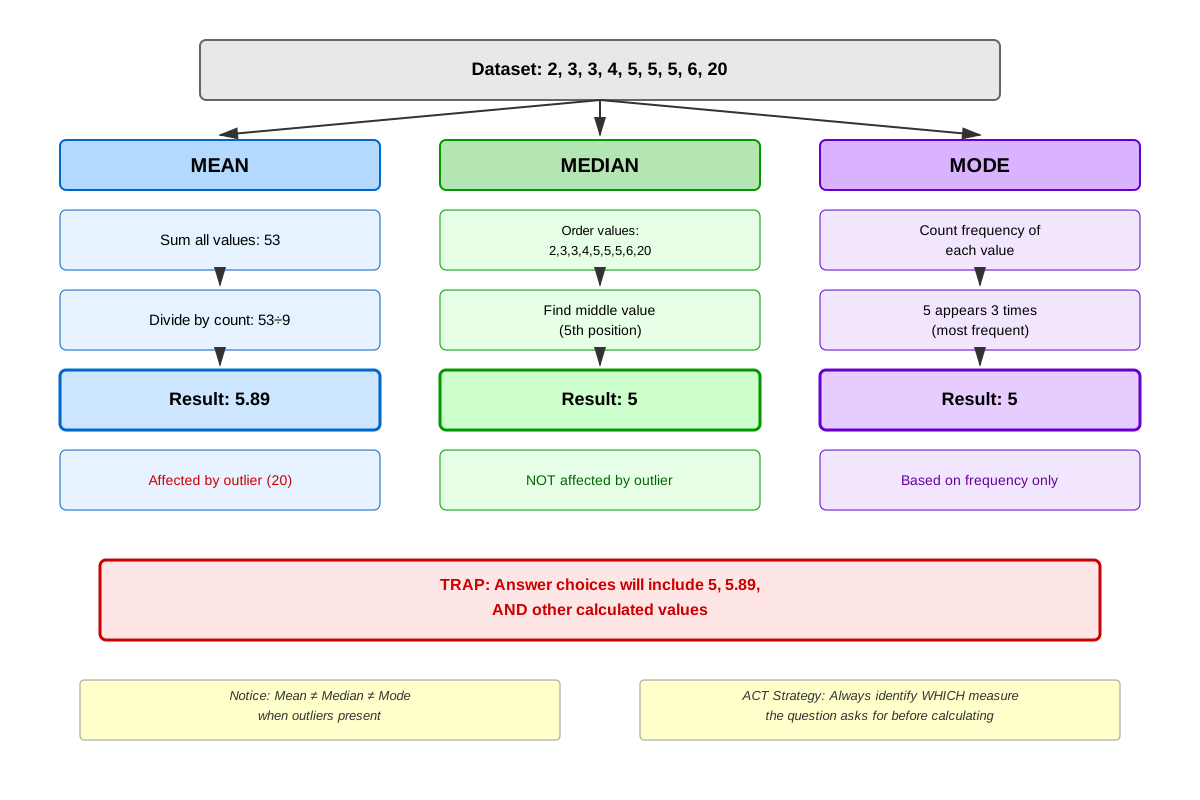
The most fundamental statistics trap on the ACT involves questions that test whether students understand the difference between mean (average) and median (middle value). Test-makers exploit this by including both values as answer choices, knowing that rushed students will calculate one when the question asks for the other. The mean is calculated by summing all values and dividing by the count, while the median requires ordering values and finding the middle position.
This trap becomes especially dangerous when dealing with skewed data sets where mean and median differ significantly. For example, in a data set like {2, 3, 4, 5, 100}, the mean is 22.8 but the median is 4. Questions often ask for the median while providing the mean as a trap answer, or vice versa. Always identify which measure the question specifically requests before beginning calculations.
Mode and Range Distractor Traps
Questions frequently include mode (most frequent value) and range (difference between maximum and minimum) as distractor answers even when these measures aren't requested. Students who recognize familiar-looking numbers in the answer choices may select these without verifying they answer the actual question. The ACT exploits pattern recognition by making these distractors appear in positions (like choice C) where correct answers often appear.
Data Display Misreading Traps
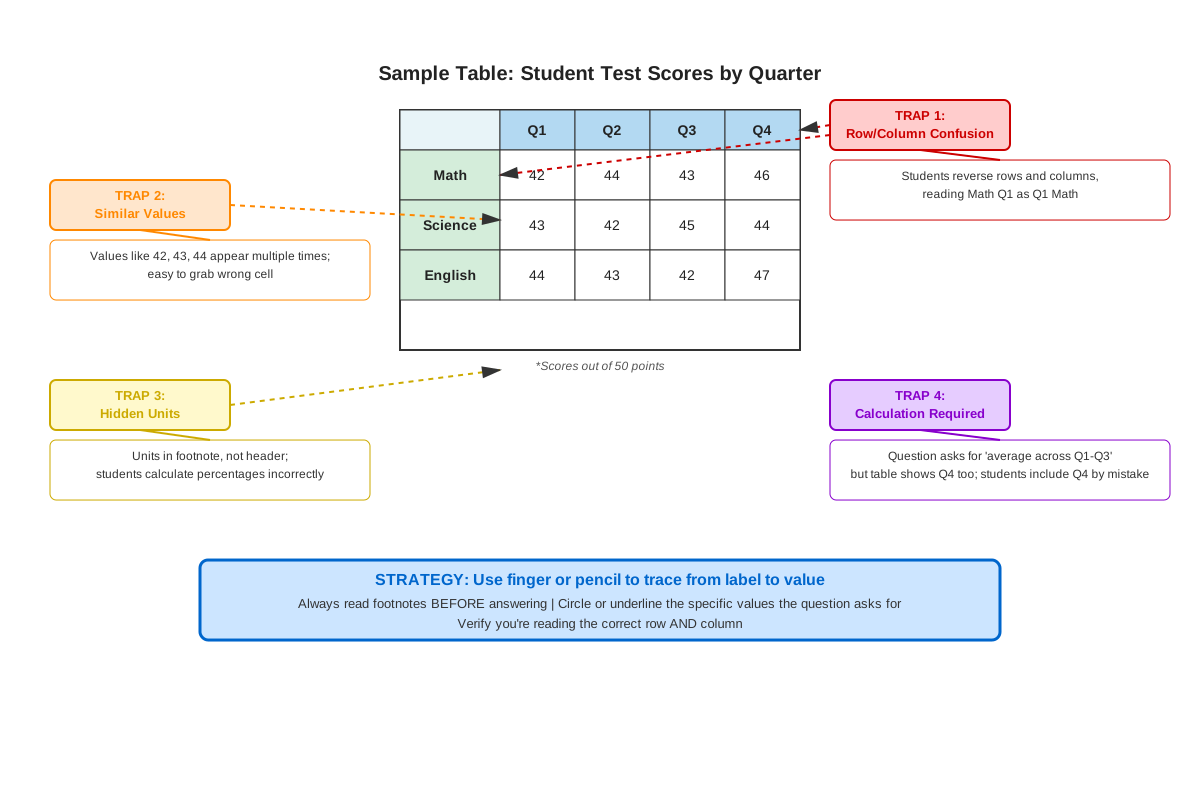
Data tables and graphs on the ACT contain deliberate traps in their structure and labeling. Common traps include:
- Row/column confusion: Switching which dimension represents which variable
- Unit mismatches: Mixing percentages with raw counts, or different scales
- Axis scaling: Non-zero baselines or irregular intervals that distort visual impressions
- Legend misinterpretation: Confusing which line, bar, or symbol represents which category
- Multi-step requirements: Needing to combine information from multiple rows, columns, or graphs
Always read all labels carefully, verify units match throughout the calculation, and check that the answer makes sense relative to the visual display.
Percentage and Proportion Traps
The ACT frequently tests whether students confuse percentages, proportions, and raw counts. A classic trap presents data as percentages but asks for actual counts (or vice versa), with wrong answers providing the unconverted values. For example, if 40% of 250 students prefer pizza, the answer is 100 students, but 40 appears as a trap answer.
Related traps include:
- Percentage of percentage errors: Calculating 20% increase then 20% decrease doesn't return to the original value
- Part-whole confusion: Using the wrong base when calculating percentages
- Percentage point vs. percent change: Confusing absolute differences with relative changes
Outlier and Data Manipulation Traps
Questions about how adding, removing, or changing data points affects statistics contain predictable traps. Key principles:
| Change | Effect on Mean | Effect on Median | Effect on Mode |
|---|---|---|---|
| Add value above mean | Increases | May increase, stay same, or increase | May change or stay same |
| Add value below mean | Decreases | May decrease, stay same, or decrease | May change or stay same |
| Remove outlier | Moves toward median | Usually minimal change | Usually no change |
| Add duplicate of existing value | Slight change | May change | May create or strengthen mode |
The ACT exploits students' intuitive but incorrect assumptions about these relationships. For instance, adding a value equal to the current mean doesn't change the mean, but many students expect it to increase.
Probability Conditional Traps
Probability questions often contain traps involving conditional probability and independent events. The classic trap presents a scenario where students must calculate P(A and B) but confuse whether events are independent (multiply probabilities) or dependent (adjust second probability based on first outcome).
For example, drawing two cards without replacement requires adjusting the second probability (dependent events), while rolling two dice doesn't (independent events). Trap answers include results from treating dependent events as independent or vice versa.
Sample vs. Population Traps
The ACT tests understanding of sample statistics versus population parameters. Questions may describe a sample (like surveying 100 students) but include trap answers that incorrectly generalize to the entire population without acknowledging limitations. Conversely, questions may provide population data but include answers that incorrectly apply sampling concepts like margin of error.
Weighted Average Traps
Weighted averages appear frequently, with traps exploiting the common error of calculating a simple average when different categories have different frequencies or weights. For example, if Class A (20 students) averages 85 and Class B (30 students) averages 90, the combined average is NOT 87.5 (the simple average of 85 and 90) but rather 88 (the weighted average accounting for class sizes).
The formula requires: (n₁ × x₁ + n₂ × x₂) / (n₁ + n₂), where n represents frequencies and x represents values. Trap answers always include the incorrect simple average.
Concept Relationships
The various statistics traps interconnect through the common theme of testing conceptual understanding versus mechanical calculation. Mean vs. median confusion forms the foundation, as this distinction appears across multiple trap types. This concept connects to outlier traps because outliers affect mean much more than median, and to data manipulation traps because understanding how changes affect different measures requires knowing what each measure represents.
Data display traps serve as the delivery mechanism for many other traps—the same question testing mean vs. median becomes more difficult when data must first be extracted from a complex table. This creates a relationship chain: Data Display → Extraction → Calculation → Verification. Each step contains potential traps.
Percentage traps connect to weighted average traps because both involve proportional reasoning and part-whole relationships. These connect further to probability traps through the shared mathematical structure of ratios and proportions. Understanding one trap type strengthens recognition of related traps.
The relationship map flows: Basic Definitions (mean, median, mode) → Calculation Traps (confusing measures, unit errors) → Interpretation Traps (data displays, context) → Advanced Traps (weighted averages, conditional probability) → Verification (checking reasonableness). Mastering earlier concepts is essential for recognizing later, more sophisticated traps.
Quick check — test yourself on ACT statistics traps so far.
Try Flashcards →High-Yield Facts
⭐ The ACT always includes both mean and median as answer choices when testing either concept—identify which the question asks for before calculating
⭐ When data displays show percentages, trap answers include the percentage value itself when the question asks for actual count
⭐ Outliers affect mean significantly but have minimal effect on median—questions testing this relationship appear on nearly every ACT
⭐ Weighted averages cannot be calculated by simply averaging the averages—must account for different group sizes
⭐ The mode is the most frequently occurring value, not the highest value—this confusion appears in 30% of mode questions
- Range equals maximum minus minimum, not maximum minus mean or any other combination
- Adding a value equal to the current mean does not change the mean
- Percentage increase followed by the same percentage decrease does not return to the original value
- When calculating probability of multiple events, independent events multiply while dependent events require adjusted probabilities
- The median of an even-numbered data set is the average of the two middle values, not either middle value alone
- Data tables may use different units in different columns—always verify unit consistency before calculating
- Visual scaling on graphs can make small differences appear large or large differences appear small
- Sample statistics cannot be directly applied to entire populations without acknowledging limitations
- The sum of all values equals mean multiplied by count—useful for reverse-calculating missing information
- Removing the highest and lowest values affects range but may not significantly affect mean or median
Common Misconceptions
Misconception: The mean is always the best measure of central tendency to use.
Correction: The median is more appropriate for skewed distributions or data with outliers, as it's not affected by extreme values. The ACT tests whether students recognize when each measure is most useful.
Misconception: If a graph shows one bar twice as tall as another, the value is twice as large.
Correction: Always check the axis scale—if the y-axis doesn't start at zero or uses irregular intervals, visual proportions don't match numerical proportions. The ACT deliberately uses misleading scales to trap students who rely on visual estimation.
Misconception: Calculating 20% of a value and then calculating 20% of that result is the same as calculating 40% of the original value.
Correction: Successive percentage calculations multiply, not add. 20% of 20% equals 4%, not 40%. This trap appears frequently in multi-step percentage problems.
Misconception: The mode is the largest number in the data set.
Correction: The mode is the most frequently occurring value, regardless of its magnitude. A data set like {1, 1, 1, 100} has a mode of 1, not 100. This confusion appears in approximately one-third of mode questions.
Misconception: When combining two groups with different averages, the overall average is the simple average of the two group averages.
Correction: The overall average must be weighted by group sizes. If groups have different sizes, the larger group's average has more influence on the combined average. This weighted average trap appears on virtually every ACT.
Misconception: Adding more data points always changes the mean.
Correction: Adding a value equal to the current mean leaves the mean unchanged. Adding values both above and below the mean may also leave it unchanged if they balance out. The ACT tests understanding of how specific changes affect statistics.
Misconception: Probability of independent events should be added.
Correction: Probability of multiple independent events occurring together requires multiplication, not addition. Addition applies when calculating probability of either event occurring (using the addition rule with appropriate adjustments for overlap).
Worked Examples
Example 1: Mean vs. Median with Outlier
Problem: The test scores for seven students are: 72, 75, 78, 80, 82, 85, 98. What is the median score?
Solution:
Step 1: Identify what the question asks for—specifically the median, not mean.
Step 2: Recognize the trap—the answer choices likely include:
- The mean (approximately 81.4)
- The median (80)
- The mode (none exists, but might include a distractor)
- The range (26)
Step 3: Calculate the median by finding the middle value in the ordered list. Since there are 7 values (odd number), the median is the 4th value when ordered from least to greatest.
Step 4: The data is already ordered: 72, 75, 78, 80, 82, 85, 98
Step 5: The median is 80.
Step 6: Verify this makes sense—80 is indeed in the middle of the distribution, with three values below and three above.
Connection to Learning Objectives: This example demonstrates identifying when statistics traps are being tested (mean vs. median confusion), explaining the core strategy (always identify which measure is requested before calculating), and applying the concept accurately (finding the middle value rather than calculating the average).
Example 2: Weighted Average Trap
Problem: In a school, 40 students in Class A have an average test score of 85, and 60 students in Class B have an average test score of 90. What is the average test score for all 100 students combined?
Solution:
Step 1: Recognize the trap—the simple average of 85 and 90 is 87.5, which will appear as a trap answer.
Step 2: Identify that this requires a weighted average because the classes have different sizes.
Step 3: Calculate the total points for each class:
- Class A: 40 students × 85 points = 3,400 total points
- Class B: 60 students × 90 points = 5,400 total points
Step 4: Calculate the combined average:
- Total points: 3,400 + 5,400 = 8,800
- Total students: 40 + 60 = 100
- Average: 8,800 ÷ 100 = 88
Step 5: Verify reasonableness—88 is closer to 90 than to 85, which makes sense because Class B (with the 90 average) has more students and therefore more influence on the combined average.
Step 6: Recognize that 87.5 (the trap answer) would only be correct if both classes had equal numbers of students.
Connection to Learning Objectives: This example shows how to identify weighted average traps, explains why simple averaging fails when groups have different sizes, and demonstrates the correct calculation method that accounts for different weights.
Exam Strategy
When approaching ACT statistics questions, implement a systematic four-step process: Read → Identify → Calculate → Verify. First, read the entire question carefully, noting exactly what measure or value is requested. Circle or underline key words like "median," "average," "most frequently," or "range." This prevents the most common trap of calculating the wrong measure.
Second, identify potential traps before looking at answer choices. Ask: "Would this question be easier if I confused mean and median?" or "Are there different units I might mix up?" Anticipating traps makes them easier to avoid. Look for trigger phrases:
- "What is the average..." → Check if median appears as a trap answer
- "What is the median..." → Check if mean appears as a trap answer
- "According to the table..." → Verify row/column labels and units
- "What percent..." → Check if raw count appears as a trap answer
- "How many..." → Check if percentage appears as a trap answer
- "Combined average..." → Recognize weighted average requirement
Third, calculate carefully, showing work even on "easy" problems. Write down intermediate steps to prevent arithmetic errors and make verification easier. Use the calculator for complex arithmetic but verify that you're calculating the right thing.
Fourth, verify that your answer makes logical sense. If calculating a median, ensure your answer actually appears in the data set (for odd-numbered sets) or falls between two data values (for even-numbered sets). If calculating an average, confirm it falls within the range of the data. If calculating a percentage, verify it's between 0 and 100 (or above 100 only if the context allows for increases beyond the original).
Time allocation: Spend 30-45 seconds reading and identifying the question type, 45-60 seconds calculating, and 15-30 seconds verifying. Don't rush statistics questions—the 30 seconds spent verifying often prevents wrong answers worth more time than they cost.
Process of elimination: Eliminate answers that fail basic reasonableness tests. If calculating a median from a data set ranging from 20 to 80, eliminate any answer outside this range. If calculating a weighted average of 85 and 90, eliminate any answer below 85 or above 90. Often, 2-3 answer choices can be eliminated through logic before calculation.
Memory Techniques
MEDIAN mnemonic: Middle Element Determined In Arranged Numbers—remember that median requires ordering data and finding the middle position.
TRAP acronym for verification: Type (did I calculate what was asked?), Range (is my answer within reasonable bounds?), Arithmetic (did I calculate correctly?), Placement (does my answer make sense in context?).
Weighted Average visualization: Picture a seesaw with different numbers of people on each side—the balance point isn't in the middle if one side has more people. The side with more people (larger sample size) pulls the average toward their value.
Mean vs. Median memory aid: Mean is "mean" to outliers—it gets pulled by extreme values. Median is "medium"—it stays in the middle regardless of extremes.
Percentage trap reminder: "Percent OF means multiply, percent IS means divide." When calculating "30% of 200," multiply. When finding "60 is what percent of 200," divide.
Mode memory: Mode sounds like "most"—it's the value that appears most frequently.
Data display checklist (visualize checking boxes): □ Read all labels, □ Check units, □ Verify scale, □ Identify what's requested, □ Calculate, □ Verify reasonableness.
Summary
ACT statistics traps represent predictable patterns of misleading answer choices and question designs that exploit common student errors in statistical reasoning. The most frequent traps involve confusing mean with median, misreading data displays, incorrectly handling percentages and proportions, and failing to use weighted averages when combining groups of different sizes. Success requires a systematic approach: carefully identifying what the question asks for before calculating, recognizing common trap patterns, performing calculations accurately, and verifying that answers make logical sense within the problem context. These traps appear in 8-12 questions per ACT Math section, making them high-yield topics where focused preparation directly improves scores. Mastery requires understanding not just how to calculate statistical measures, but why certain wrong answers appear tempting and how to avoid the reasoning errors that lead to them. The key to avoiding statistics traps is slowing down enough to read carefully, think critically about what's being asked, and verify that calculated answers align with both the question and common sense.
Key Takeaways
- Always identify whether a question asks for mean, median, mode, or another measure before calculating—trap answers include all of these regardless of what's requested
- Data displays require careful reading of all labels, units, and scales before extracting information for calculations
- Weighted averages account for different group sizes and cannot be calculated by simply averaging the averages
- Outliers significantly affect mean but minimally affect median—the ACT frequently tests understanding of this relationship
- Percentage questions often include trap answers that confuse percentages with raw counts or use the wrong base for calculations
- Verification is essential—check that answers fall within reasonable ranges and make sense in the problem context
- Statistics traps are predictable and learnable—recognizing common patterns prevents wrong answers and saves time
Related Topics
Probability and Counting Principles: Builds on statistics foundations to explore more complex scenarios involving combinations, permutations, and conditional probability. Mastering statistics traps provides the careful reasoning skills needed for probability questions.
Data Analysis and Interpretation: Extends statistics concepts to more complex data displays including scatterplots, box plots, and multi-variable tables. Understanding basic statistics traps is essential before tackling these advanced representations.
Linear Regression and Correlation: Applies statistical thinking to relationships between variables, requiring solid understanding of means, medians, and data interpretation to avoid similar traps in more complex contexts.
Scientific Data Analysis: Uses statistics in real-world scientific contexts, building on the verification and reasonableness-checking skills developed through avoiding statistics traps.
Practice CTA
Now that you understand the common statistics traps on the ACT and strategies to avoid them, it's time to put this knowledge into practice. Work through the practice questions to encounter these traps in realistic ACT-style problems, and use the flashcards to reinforce quick recognition of trap patterns. Remember that statistics questions represent a significant portion of the Math section—mastering these traps can directly improve your score by 2-4 points. Each practice problem you complete strengthens your ability to recognize and avoid these predictable patterns, building the confidence and accuracy needed for test day success.
Sign up free to keep reading
Create a free AnvayaPrep account to finish this ACT guide on ACT statistics traps — plus flashcards and practice questions.