Overview
Correlation is a fundamental statistical concept that measures the strength and direction of the relationship between two variables. On the ACT Math test, correlation questions assess a student's ability to interpret scatter plots, understand the meaning of positive and negative associations, and recognize the difference between correlation and causation. This topic typically appears in 1-3 questions per test, making it a high-yield area for focused study.
Understanding correlation is essential for ACT success because it bridges multiple mathematical domains. Questions may involve analyzing data presented in graphs, interpreting real-world scenarios, or evaluating statistical claims. The ACT frequently tests whether students can distinguish between strong and weak correlations, identify outliers that affect correlation strength, and avoid the common trap of assuming that correlation implies causation. Mastery of this topic requires both conceptual understanding and the ability to quickly analyze visual data representations.
ACT correlation questions connect to broader mathematical concepts including linear functions, data analysis, and probability. Students who understand correlation can more effectively tackle questions involving trend lines, predictions based on data, and statistical reasoning. This topic also reinforces critical thinking skills that extend beyond mathematics, as the ability to evaluate relationships between variables is fundamental to scientific reasoning and data literacy in the modern world.
Learning Objectives
- [ ] Identify when Correlation is being tested in ACT questions
- [ ] Explain the core rule or strategy behind Correlation concepts
- [ ] Apply Correlation principles to ACT-style questions accurately
- [ ] Distinguish between positive, negative, and no correlation from scatter plots
- [ ] Evaluate the strength of correlation (strong, moderate, weak) from visual data
- [ ] Recognize and explain why correlation does not imply causation
- [ ] Identify outliers and their impact on correlation strength
Prerequisites
- Basic graphing skills: Understanding coordinate planes is essential for interpreting scatter plots where correlation is visualized
- Linear functions: Familiarity with slope and trend lines helps recognize the direction and strength of correlations
- Data interpretation: Basic ability to read graphs and tables is necessary for analyzing relationships between variables
- Variable relationships: Understanding independent and dependent variables provides context for correlation analysis
Why This Topic Matters
Correlation appears frequently on the ACT Math test, typically in 1-3 questions per exam, making it a high-yield topic that can directly impact scores. These questions often appear in the Statistics and Probability content area, which comprises approximately 8-12% of the entire Math section. Understanding correlation is particularly valuable because these questions are often medium difficulty, meaning they're accessible to students aiming for scores across the entire range from 20 to 36.
In real-world applications, correlation analysis is fundamental to fields ranging from medicine (studying relationships between lifestyle factors and health outcomes) to economics (analyzing connections between market variables) to social sciences (examining relationships between demographic factors and behaviors). The ability to interpret correlations correctly prevents misunderstanding of data and helps make informed decisions based on statistical evidence.
On the ACT, correlation questions commonly appear in several formats: scatter plot interpretation questions that ask students to describe the relationship between variables, questions requiring identification of correlation strength, scenarios testing understanding of the correlation-causation distinction, and problems involving outliers or unusual data points. Questions may present real-world contexts such as studying hours versus test scores, temperature versus ice cream sales, or advertising spending versus revenue. The ACT particularly favors questions that combine visual interpretation with conceptual understanding, requiring students to both read graphs accurately and apply statistical reasoning.
Core Concepts
Definition of Correlation
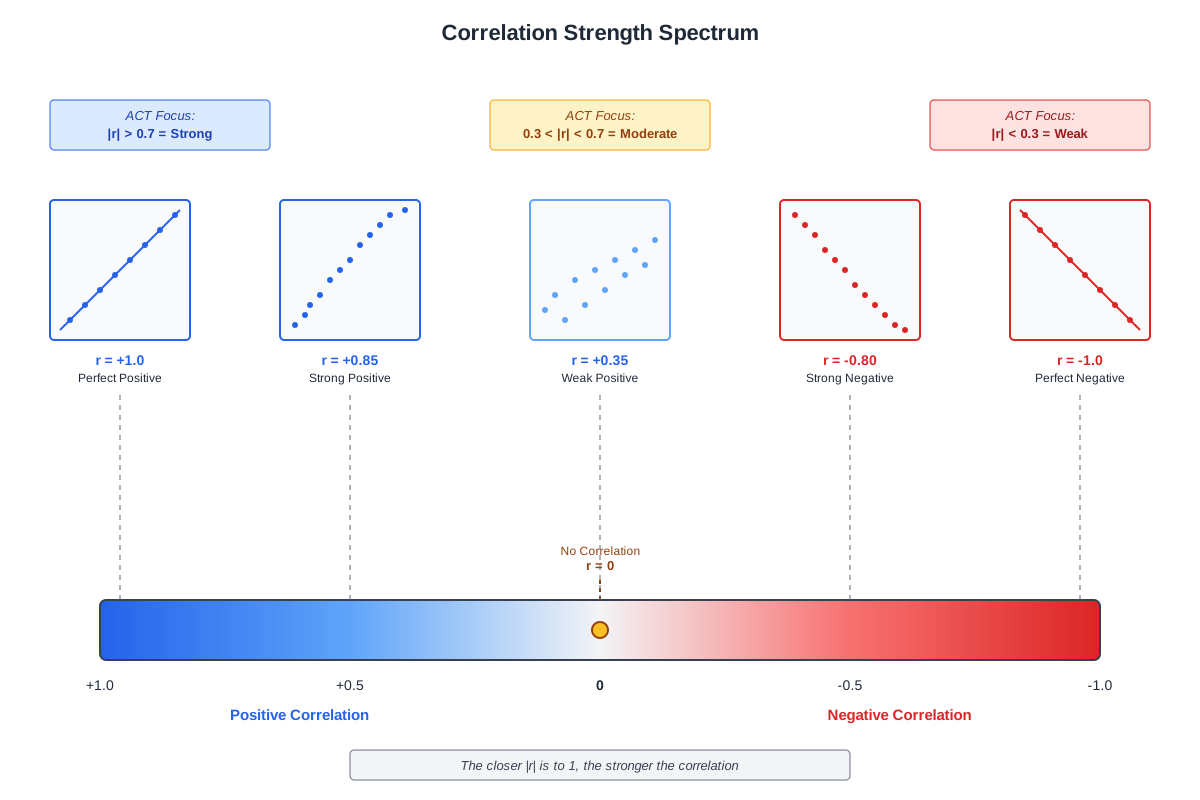
Correlation refers to a statistical relationship between two variables that indicates how they change together. When two variables are correlated, knowing the value of one variable provides information about the likely value of the other. The correlation coefficient, typically denoted as r, ranges from -1 to +1, though the ACT rarely requires calculation of this value. Instead, the exam focuses on qualitative understanding of correlation strength and direction from visual representations.
Correlation describes association, not causation. Two variables can move together without one causing the other. This distinction is crucial for ACT questions and represents one of the most commonly tested concepts in this topic area.
Types of Correlation by Direction
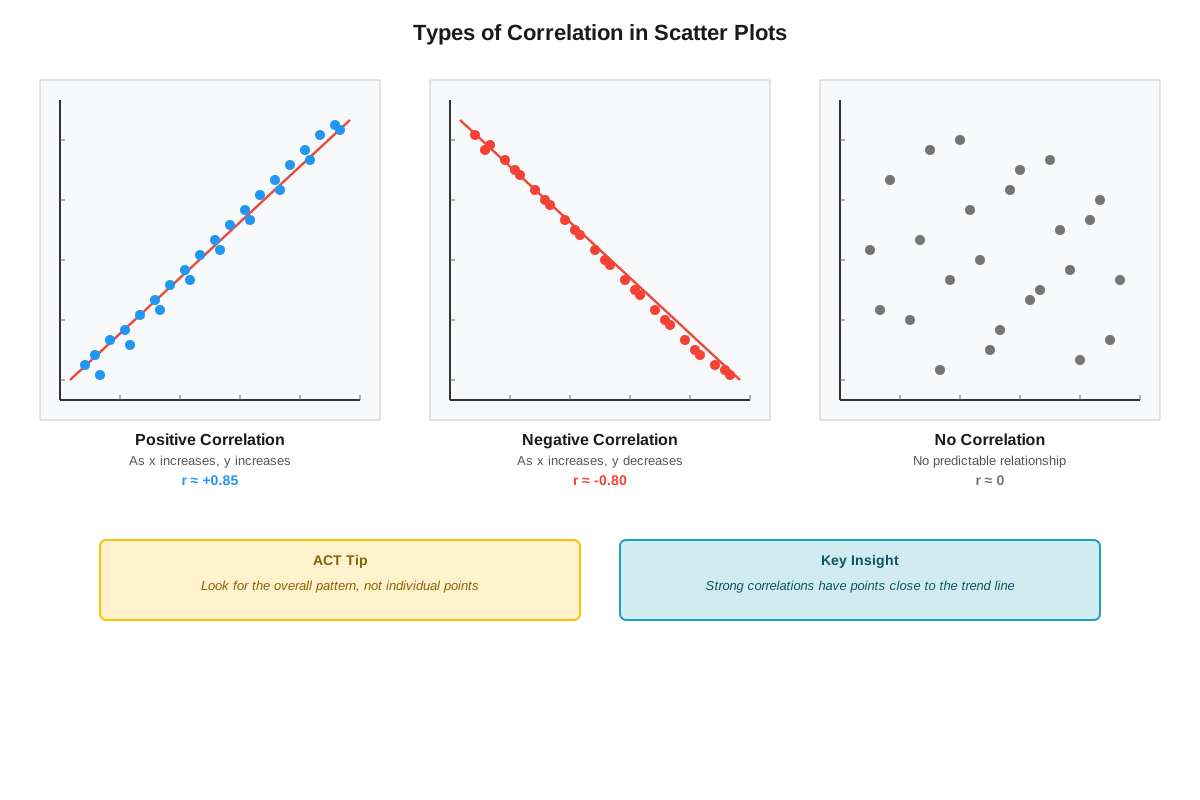
Positive correlation occurs when both variables tend to increase together or decrease together. As one variable increases, the other also tends to increase. On a scatter plot, positive correlation appears as points trending upward from left to right. Examples include the relationship between study time and test scores, or between height and weight in children.
Negative correlation (also called inverse correlation) occurs when one variable tends to increase as the other decreases. On a scatter plot, negative correlation appears as points trending downward from left to right. Examples include the relationship between speed and travel time for a fixed distance, or between outdoor temperature and heating costs.
No correlation (or zero correlation) exists when there is no consistent relationship between the variables. Changes in one variable do not predict changes in the other. On a scatter plot, no correlation appears as a random scatter of points with no discernible pattern. Examples include the relationship between shoe size and test scores, or between birth month and height.
Correlation Strength
The strength of a correlation describes how closely the data points follow a pattern:
| Strength | Description | Visual Appearance |
|---|---|---|
| Strong | Data points cluster tightly around a trend line | Points form a narrow band; pattern is obvious |
| Moderate | Data points show a clear pattern but with more scatter | Points follow general trend with noticeable variation |
| Weak | Data points show a slight pattern but with substantial scatter | Pattern is barely discernible; much variation exists |
| None | No discernible pattern exists | Points appear randomly distributed |
On the ACT, students must evaluate correlation strength visually from scatter plots. Strong correlations have correlation coefficients near -1 or +1, while weak correlations have coefficients near 0, though the exam typically asks for qualitative rather than quantitative assessments.
Scatter Plots and Visual Interpretation
A scatter plot (or scatterplot) is a graph that displays the relationship between two quantitative variables. Each point represents one observation, with its position determined by the values of both variables. The horizontal axis (x-axis) typically represents the independent variable, while the vertical axis (y-axis) represents the dependent variable.
When interpreting scatter plots on the ACT:
- Identify the overall pattern or trend in the data
- Determine the direction (positive, negative, or none)
- Assess the strength based on how tightly points cluster
- Look for outliers that don't fit the general pattern
- Consider what the relationship means in context
Outliers and Their Impact
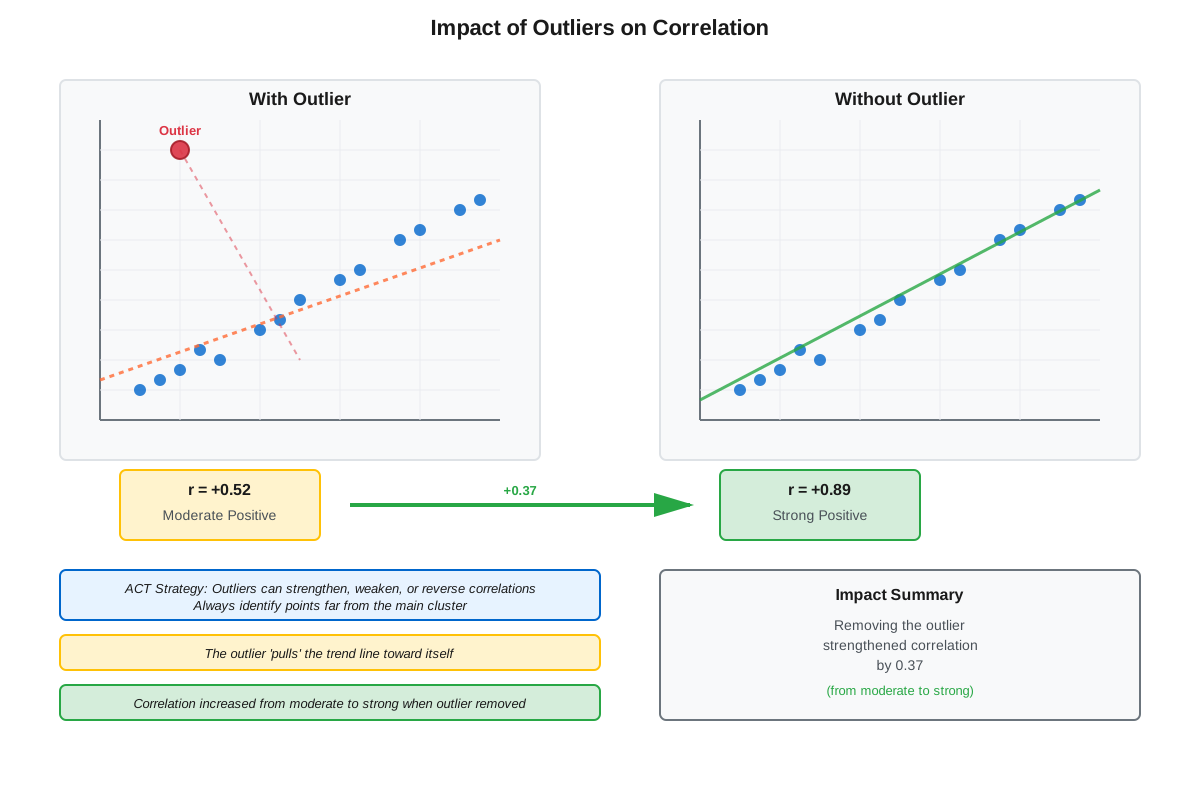
An outlier is a data point that falls far from the general pattern of the other points. Outliers can significantly affect correlation, especially in small datasets. A single outlier can:
- Weaken an otherwise strong correlation by increasing scatter
- Create the appearance of correlation where little exists
- Change the direction of a weak correlation
- Mask the true relationship between variables
The ACT may present questions asking how removing an outlier would affect the correlation, or asking students to identify which point is an outlier based on the overall pattern.
Correlation vs. Causation
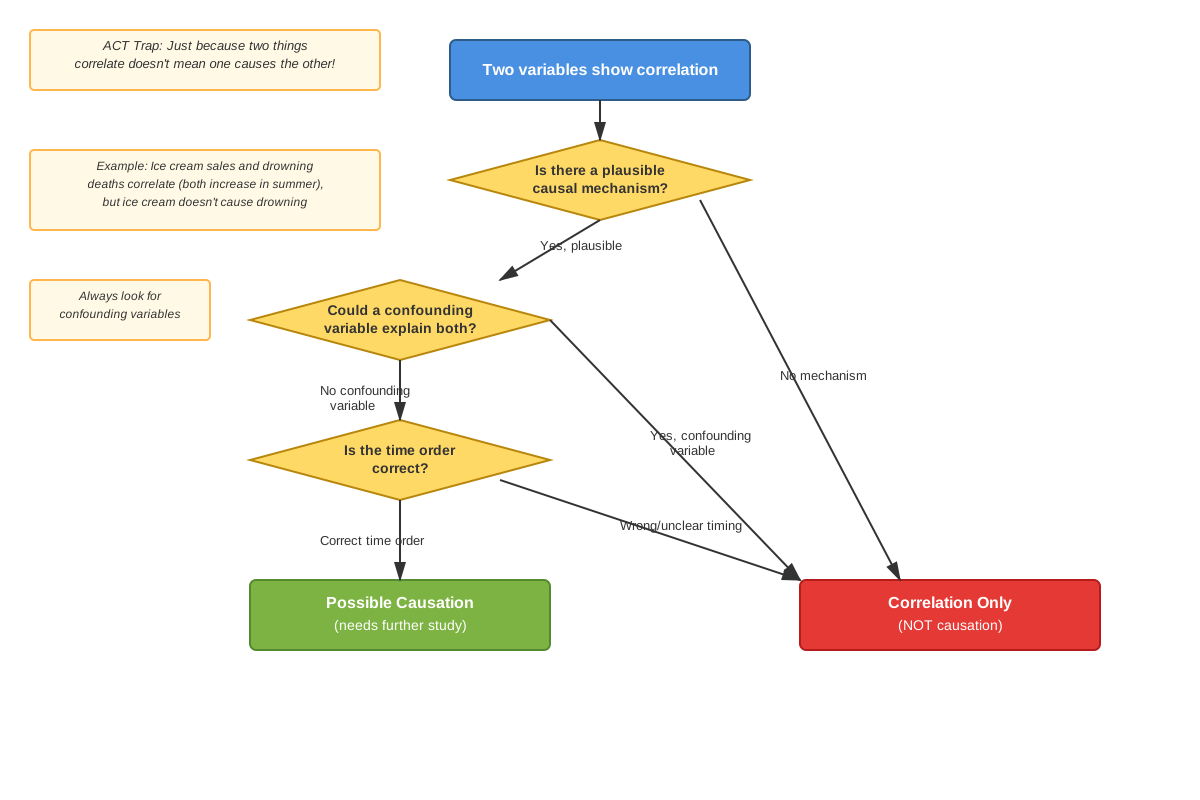
This distinction represents one of the most important concepts tested on the ACT. Correlation does not imply causation means that just because two variables are related does not mean one causes the other. Three possible explanations exist for correlation:
- Direct causation: Variable A causes Variable B
- Reverse causation: Variable B causes Variable A
- Confounding variable: A third variable C causes both A and B
For example, ice cream sales and drowning deaths are positively correlated, but ice cream doesn't cause drowning. Instead, warm weather (a confounding variable) causes both increased ice cream consumption and more swimming, which leads to more drowning incidents.
The ACT frequently tests this concept by presenting a correlation and asking whether causation can be concluded, or by asking students to identify alternative explanations for observed correlations.
Linear vs. Non-Linear Relationships
While most ACT correlation questions involve linear relationships (where the pattern follows a straight line), students should recognize that correlation can also describe non-linear patterns. However, the term "correlation" in its technical sense specifically refers to linear relationships. The ACT may present curved patterns and ask whether a linear correlation exists (the answer would be no or weak, even if a strong non-linear relationship exists).
Concept Relationships
The concepts within correlation form a logical hierarchy: the fundamental definition of correlation → leads to → understanding direction (positive, negative, none) → which combines with → strength assessment (strong, moderate, weak) → all visualized through → scatter plots → complicated by → outliers → and requiring distinction from → causation.
Correlation connects to prerequisite topics in several ways. Understanding linear functions provides the foundation for recognizing positive and negative correlations, as these mirror positive and negative slopes. Graphing skills enable interpretation of scatter plots, the primary visual representation of correlation. Data analysis abilities allow students to extract meaning from statistical displays and make valid inferences.
This topic also relates to other ACT Math concepts. Trend lines (lines of best fit) represent the linear correlation in a scatter plot. Prediction questions may ask students to use correlation to estimate values. Probability and statistics questions often incorporate correlation when analyzing relationships in data sets. Understanding correlation also supports scientific reasoning questions that may appear in the ACT Science section, where interpreting relationships between variables is essential.
The progression flows: Basic data interpretation → Scatter plot reading → Correlation identification → Strength and direction assessment → Outlier analysis → Causation reasoning. Each level builds on the previous, creating a comprehensive understanding of how variables relate.
Quick check — test yourself on Correlation so far.
Try Flashcards →High-Yield Facts
⭐ Correlation measures the strength and direction of the relationship between two variables, ranging from -1 to +1
⭐ Positive correlation means both variables increase together; negative correlation means one increases as the other decreases
⭐ Correlation does NOT imply causation—two variables can be related without one causing the other
⭐ Strong correlations show data points clustering tightly around a trend line; weak correlations show scattered points
⭐ Outliers are data points that fall far from the general pattern and can significantly affect correlation strength
- Scatter plots are the primary visual tool for displaying correlation between two variables
- No correlation (zero correlation) appears as a random scatter with no discernible pattern
- The correlation coefficient r = +1 indicates perfect positive correlation; r = -1 indicates perfect negative correlation
- Confounding variables are third factors that may cause both observed variables, creating a correlation without direct causation
- Linear correlation specifically describes relationships that follow a straight-line pattern
- Removing an outlier typically strengthens the correlation of the remaining data points
- The ACT tests correlation through visual interpretation more than numerical calculation
Common Misconceptions
Misconception: If two variables are correlated, one must cause the other.
Correction: Correlation only indicates that variables are related; causation requires additional evidence. A third variable might cause both, or the correlation might be coincidental. Always consider alternative explanations before concluding causation.
Misconception: A strong correlation means the relationship is important or meaningful.
Correction: Correlation strength describes how closely data follows a pattern, not the practical significance of the relationship. A strong correlation between trivial variables may be meaningless, while a weak correlation between important variables might still be significant.
Misconception: Correlation coefficients near zero always mean no relationship exists.
Correction: A correlation coefficient near zero indicates no linear relationship, but a strong non-linear relationship (curved pattern) might exist. Always examine the scatter plot visually, not just the numerical coefficient.
Misconception: All outliers should be removed from data analysis.
Correction: Outliers may represent important information, measurement errors, or natural variation. They should be investigated and understood, not automatically deleted. The ACT may ask how correlation changes if an outlier were removed, but this doesn't mean removal is always appropriate.
Misconception: Negative correlation means there is no relationship or a weak relationship.
Correction: Negative correlation indicates a strong inverse relationship where one variable increases as the other decreases. "Negative" refers to direction, not strength. A correlation of -0.9 is just as strong as +0.9.
Misconception: Correlation only applies to linear relationships.
Correction: While the standard correlation coefficient (Pearson's r) measures linear relationships, the concept of variables being related applies to any pattern. However, on the ACT, "correlation" typically refers to linear relationships unless otherwise specified.
Worked Examples
Example 1: Scatter Plot Interpretation
Question: The scatter plot below shows the relationship between hours spent studying and test scores for 15 students. Which statement best describes the relationship?
Test Score (y-axis, 0-100)
    |
100 |              ●
 90 |          ●  ● ●
 80 |       ●  ●
 70 |    ●  ●
 60 | ●  ●
 50 |●
    |________________
     0  1  2  3  4  5
     Hours Studied (x-axis)
A) Strong negative correlation
B) Weak positive correlation
C) Strong positive correlation
D) No correlation
E) Weak negative correlation
Solution:
Step 1: Identify the direction of the pattern. As hours studied increases (moving right on x-axis), test scores increase (moving up on y-axis). This indicates a positive correlation, eliminating options A, D, and E.
Step 2: Assess the strength. The data points cluster relatively tightly around an imaginary upward-sloping line. While there is some scatter, the pattern is clear and consistent. The points don't deviate dramatically from the trend.
Step 3: Evaluate the options. Between "weak positive" and "strong positive," the tight clustering and clear pattern indicate a strong relationship. A weak correlation would show much more scatter with points spread widely around the trend.
Answer: C) Strong positive correlation
Connection to Learning Objectives: This example demonstrates identifying when correlation is tested (scatter plot with two variables), explaining the strategy (examine direction first, then strength), and applying the concept accurately to reach the correct answer.
Example 2: Correlation vs. Causation
Question: A researcher finds a strong positive correlation between the number of firefighters at a fire scene and the amount of damage caused by the fire. Which conclusion is most appropriate?
F) Firefighters cause fire damage
G) Fire damage causes more firefighters to respond
H) A confounding variable likely explains the correlation
J) There is no real relationship between these variables
K) The correlation proves firefighters are ineffective
Solution:
Step 1: Recognize this as a correlation vs. causation question. The question states a correlation exists (strong positive), so we can eliminate option J.
Step 2: Evaluate the causation claims. Option F suggests firefighters cause damage, which contradicts common sense and the purpose of firefighters. Option K makes a value judgment not supported by correlation alone. Option G suggests reverse causation—that damage causes firefighter response—which is partially true but incomplete.
Step 3: Consider confounding variables. The size or severity of the fire is a confounding variable that causes both more firefighters to be dispatched AND more damage to occur. Larger fires naturally require more firefighters and cause more damage. This explains the correlation without implying that firefighters cause damage.
Step 4: Select the most appropriate conclusion. Option H correctly identifies that a third variable (fire severity) explains the observed correlation without implying inappropriate causation.
Answer: H) A confounding variable likely explains the correlation
Connection to Learning Objectives: This example tests the critical distinction between correlation and causation, a core concept that appears frequently on the ACT. It requires applying statistical reasoning to real-world scenarios and avoiding the common trap of inferring causation from correlation.
Exam Strategy
When approaching ACT correlation questions, follow this systematic process:
Step 1: Identify the question type. Look for trigger words and phrases such as "relationship between," "correlation," "scatter plot," "as X increases," "associated with," or "related to." Questions showing graphs with scattered points are almost certainly testing correlation.
Step 2: For scatter plot questions, assess direction first. Quickly determine if the pattern trends upward (positive), downward (negative), or shows no pattern (no correlation). This immediately eliminates 2-3 answer choices in most multiple-choice questions.
Step 3: Evaluate strength second. Look at how tightly the points cluster. If you can imagine a narrow band containing most points, the correlation is strong. If points are widely scattered, the correlation is weak.
Step 4: Watch for causation traps. If a question asks what can be "concluded" or "proven" from a correlation, be extremely cautious. The correct answer almost never involves direct causation. Look for words like "suggests," "associated with," or "may indicate" rather than "causes" or "proves."
Step 5: Consider outliers. If the question mentions removing a point or asks about unusual data, identify which point doesn't fit the pattern. Removing outliers typically strengthens correlation.
Exam Tip: On the ACT, if you see the word "correlation" in a question, immediately think "NOT causation" unless additional experimental evidence is provided. This single strategy prevents the most common error on these questions.
Time allocation: Correlation questions typically require 30-45 seconds. Spend 10-15 seconds analyzing the graph or scenario, 10-15 seconds eliminating wrong answers, and 10-15 seconds confirming your choice. Don't overthink—your first impression of a scatter plot's pattern is usually correct.
Process of elimination tips:
- Eliminate any answer claiming causation without experimental evidence
- Eliminate answers that contradict the visual direction of the scatter plot
- Eliminate extreme answers (perfect correlation, no relationship at all) unless the data clearly shows these
- When unsure between "moderate" and "strong," choose "moderate"—the ACT rarely presents perfect correlations
Common wrong answer patterns:
- Answers that reverse positive and negative
- Answers that confuse strength with direction
- Answers that claim causation from correlation
- Answers that ignore obvious outliers
Memory Techniques
PNNS Mnemonic for Direction: Positive goes North-east, Negative goes North-west, No correlation is Scattered
- Positive correlation: points trend toward upper-right (northeast)
- Negative correlation: points trend toward upper-left (northwest)
- No correlation: points scattered everywhere (south, or all directions)
"CORRELATION ≠ CAUSATION" Mantra: Repeat this phrase when studying. On test day, when you see correlation mentioned, immediately think this phrase to avoid the causation trap.
Strength Visualization: Imagine squeezing the scatter plot points between your hands:
- Strong: Points fit in a narrow tube (like a paper towel roll)
- Moderate: Points fit in a wider tube (like a tennis ball can)
- Weak: Points need a very wide container (like a bucket)
Outlier Memory Aid: Think "OUT-lier" = OUT of the pattern. If a point is OUT, it's an outlier.
The Three C's of Correlation Explanation:
- Correlation exists (describe the relationship)
- Confounding variables possible (third factors)
- Causation not proven (avoid this conclusion)
Use this framework when answering written-response questions or evaluating answer choices about what correlation means.
Summary
Correlation is a statistical measure of the relationship between two variables, indicating both the direction and strength of their association. On the ACT Math test, correlation appears primarily through scatter plot interpretation questions that require students to identify positive, negative, or no correlation, assess whether relationships are strong, moderate, or weak, and distinguish between correlation and causation. The most critical concept is that correlation describes association without implying that one variable causes the other—confounding variables or reverse causation may explain observed relationships. Students must be able to quickly analyze visual data, identify outliers that affect correlation strength, and avoid common traps such as inferring causation from correlation alone. Mastery requires both conceptual understanding of what correlation means and practical skills in interpreting scatter plots efficiently. Success on ACT correlation questions comes from systematic analysis: identify direction first, assess strength second, and always question causation claims.
Key Takeaways
- Correlation measures relationship strength and direction between two variables, visualized through scatter plots
- Positive correlation means variables increase together; negative correlation means one increases as the other decreases
- Correlation strength (strong, moderate, weak) depends on how tightly data points cluster around a trend line
- Correlation does NOT prove causation—always consider confounding variables and alternative explanations
- Outliers are points that don't fit the general pattern and can significantly impact correlation strength
- The ACT tests correlation through visual interpretation and conceptual reasoning rather than numerical calculations
- Watch for trigger words like "relationship," "associated with," and "as X increases" to identify correlation questions
Related Topics
Linear Functions and Slope: Understanding how slope relates to correlation direction deepens comprehension of positive and negative relationships. Mastering correlation provides foundation for understanding lines of best fit and trend analysis.
Statistical Measures (Mean, Median, Standard Deviation): These descriptive statistics complement correlation by providing additional ways to analyze data sets. Together, they form a comprehensive toolkit for data interpretation on the ACT.
Probability and Data Analysis: Correlation is one component of the broader Statistics and Probability content area. Mastering correlation enables progression to more complex statistical reasoning questions.
Functions and Modeling: Understanding how variables relate through correlation supports learning about mathematical modeling, where relationships between quantities are expressed through equations.
Scientific Method and Experimental Design: While primarily tested in ACT Science, understanding correlation vs. causation is fundamental to evaluating experimental results and distinguishing between observational and experimental studies.
Practice CTA
Now that you've mastered the core concepts of correlation, it's time to reinforce your learning through active practice. Attempt the practice questions to apply these strategies to ACT-style problems, and use the flashcards to memorize high-yield facts and common question patterns. Remember, correlation questions are highly testable and appear on nearly every ACT—investing 10-15 minutes in focused practice can directly translate to points on test day. You've built the foundation; now strengthen it through application!
Sign up free to keep reading
Create a free AnvayaPrep account to finish this ACT guide on Correlation — plus flashcards and practice questions.